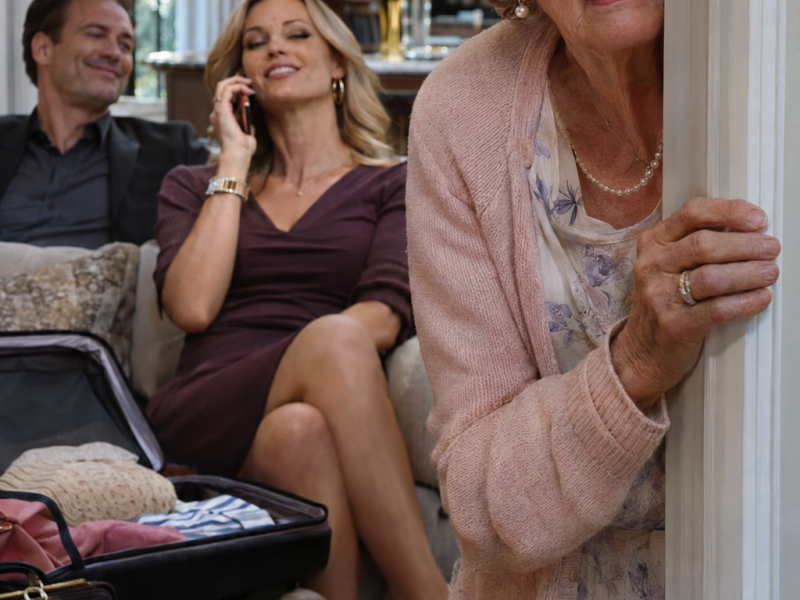
After she pays for my trip, I’ll throw her in a nursing home!_ I overheard this when my daughter…
After she pays for my trip, I’ll throw her in a nursing home!_ I overheard this when my daughter…
The words I heard that afternoon changed my life forever. I was standing in my kitchen, holding a cordless telephone in one hand and a dish towel in the other, when my daughter-in-law’s voice suddenly came through the receiver. At first, I thought she was still talking to me. Then I realized she had forgotten to hang up.
What I heard next made my entire body go cold.
“After she pays for our trip, I’ll throw her in a nursing home. Honestly, I can’t wait to get rid of her.”
I stopped breathing for a moment.
The voice belonged to Sandra, my daughter-in-law of fifteen years. The same woman who had hugged me two days earlier, kissed my cheek, and called me the most wonderful mother-in-law in the world. The same woman whose European vacation I had just agreed to pay for because she and my son, Michael, supposedly needed some time together to save their marriage.
I stood completely motionless, staring at the telephone as though it had suddenly become something dangerous.
Then Sandra laughed.
It wasn’t a nervous laugh or the kind of laugh people use when they’re embarrassed. It was cold, careless, and full of satisfaction.
“I swear, Karen, this old woman is so gullible. She just handed over eight thousand dollars without even asking questions. Can you believe it? Eight thousand! And she thinks we’re actually grateful.”
My fingers tightened around the telephone.
Eight thousand dollars.
That was how much I had paid for their two-week European vacation. Paris, Rome, Barcelona, and a romantic wine tour through Tuscany. Sandra had told me that she and Michael had been going through a difficult period and needed a chance to reconnect. She said they hadn’t taken a proper vacation in years because of work, family responsibilities, and financial pressures.
I had believed her.
In fact, I had been delighted when I saw how excited she was about the trip. She had hugged me so tightly that I could barely breathe, telling me how lucky Michael was to have a mother like me.
Apparently, she had been laughing about my generosity behind my back all along.
“Michael thinks we should wait until after the trip before bringing up the nursing home thing,” Sandra continued. “But honestly, I’m getting tired of pretending to care about her little stories and complaints. Every time we visit, she wants to show me pictures of her garden or tell me something about the past. It’s exhausting.”
I slowly lowered the dish towel onto the counter.
My legs were beginning to tremble.
“The best part,” Sandra said, “is that she actually believes we enjoy spending time with her. She calls every day, asking whether we’re coming over for dinner or whether the children can visit. I mean, does she really think we want to spend our weekends taking care of an old woman?”
I wanted to hang up.
I knew I should have hung up.
But something inside me refused to move. I needed to hear the rest. Perhaps some part of my mind was still hoping that I had misunderstood her, that there was some explanation that would make these words less terrible.
Then she said something that destroyed that last remaining hope.
“I’ve already found three facilities that look pretty good. They accept Medicaid, too, so we won’t have to worry about the costs once everything is arranged.”
Medicaid.
I slowly sank into the nearest kitchen chair.
I wasn’t a woman without resources. I owned my home outright. I had savings, investments, and a life insurance policy. Harold, my late husband, and I had spent forty years working and planning for retirement. We had never been wealthy in the extravagant sense, but we had been careful.
Why was Sandra discussing Medicaid facilities?
And why was she talking as though my future had already been decided?
“She’s been having those senior moments lately,” Sandra continued. “Forgetting where she puts her keys, repeating the same stories, asking the same questions. It’ll be easy to convince people she needs professional care. Michael is already on board. He’s tired of her calling every day, too.”
My eyes filled with tears.
I remembered the last time I had misplaced my keys. They had been sitting inside my refrigerator because I had been carrying groceries and answering a phone call at the same time. I had laughed about it afterward.
I remembered repeating a story about Harold because I missed him and wanted to talk about him with someone who had known him.
And I remembered calling Michael because he was my only child.
My husband had died five years earlier, and after his death, the house had become painfully quiet. I had learned to fill that silence with telephone conversations, visits from family, and invitations to dinner.
Apparently, my loneliness had become evidence against me.
“I figure we give it a month after we get back,” Sandra said. “Let her feel useful one more time. Maybe tell her Michael needs some kind of surgery or that we’re having a financial emergency. Get her to sign over power of attorney for her own good. Then we’ll have everything we need.”
I felt something tighten painfully in my chest.
“The house alone is worth three hundred thousand,” she continued. “And Michael thinks there’s probably close to half a million in savings and investments. That’s not bad for putting up with an old lady’s neediness for a few more weeks.”
Half a million dollars.
They had calculated my entire life into a number.
Forty years of work. Forty years of saving. Forty years of sacrifices, missed vacations, repaired appliances, carefully planned grocery budgets, and postponed luxuries.
To them, it was simply an inheritance they were impatient to collect.
“Once she’s somewhere safe, we can finally stop worrying about her,” Sandra said. “And honestly, she’ll probably thank us. She’s so desperate for approval that she’ll convince herself we’re doing it because we love her.”
Then came another laugh.
I finally found the strength to press the button and disconnect the call.
For several minutes, I remained seated in the kitchen without moving.
The afternoon sunlight fell across the wooden table. Outside, a neighbor was watering her flowers. Somewhere down the street, a lawn mower started.
Everything looked exactly as it had before.
But my life had changed.
I looked toward the family photographs hanging on the wall. There was Michael at eight years old, missing his two front teeth, smiling proudly beside a birthday cake. There was another photograph of him and Sandra on their wedding day. I remembered how happy I had been when he married her. I had genuinely wanted to welcome her into our family.
Had she ever loved me?
Had any of those hugs meant anything?
I thought about the diamond earrings Harold had given me for our thirtieth anniversary. Sandra had admired them one afternoon and mentioned that they would look beautiful with her dress for a wedding renewal ceremony. I had taken them off immediately and given them to her.
There had never been a renewal ceremony.
She had simply kept the earrings.
Then there was my grandmother’s china set. Sandra had admired it repeatedly, saying she had never owned anything so beautiful. I had eventually insisted she take it because I wanted her to enjoy it.
The china now sat inside a cabinet in her dining room, untouched.
I began remembering other things, too.
The occasional requests for money. The emergency bills that always seemed to appear shortly before payday. The car repairs, the credit card payments, the children’s school expenses, and the unexpected household problems.
I had always helped.
When Michael needed money, I transferred it without hesitation. When Sandra said they were struggling, I opened my checkbook. When the grandchildren needed something, I made sure they had it.
I had told myself that this was what family meant.
Now I understood that my generosity had become an expectation.
I stood up and walked toward the bedroom. In the back of an old wooden jewelry box, behind a string of pearls that had belonged to my grandmother, I found a business card.
Margaret Hayes.
Estate attorney.
She had handled Harold’s will five years earlier and had told me to contact her if I ever needed assistance with legal or financial matters.
I picked up the telephone.
When Margaret answered, I tried to speak normally, but my voice betrayed me.
“Margaret, it’s Ruth Henderson. I’m sorry to call unexpectedly, but I need to see you as soon as possible.”
“Ruth? Is everything all right?”
“No,” I replied quietly. “I think someone in my family is planning to take away my independence.”
There was a brief silence.
“Can you come in tomorrow morning?”
“Yes.”
“Nine o’clock. And Ruth, bring anything you think might be relevant.”
After we hung up, I looked at the clock.
It was barely four in the afternoon.
I had an entire night ahead of me, and for the first time in years, I wasn’t looking forward to going to bed.
I barely slept.
Every time I closed my eyes, I heard Sandra’s voice.
I kept remembering the way she had smiled when I offered to pay for the vacation. The excitement in her eyes. The way she had squeezed my hands and said that Michael and I were lucky to have each other.
Now those memories seemed contaminated.
At around three in the morning, I got up and walked downstairs. I made a cup of tea and sat in Harold’s favorite chair.
He had been a patient man. He never liked arguments, but he had always believed that people should stand up for themselves.
I imagined what he would say if he were sitting beside me.
Perhaps he would remind me that Michael was still our son.
Perhaps he would tell me that I should be careful before making any permanent decisions.
But I knew one thing.
Harold would never have allowed anyone to treat me this way.
The following morning, I arrived at Margaret’s office ten minutes early.
She greeted me with genuine concern. Her hair had become grayer since the last time I saw her, but her eyes were just as sharp.
“Ruth, you look exhausted. What happened?”
I sat down and told her everything.
I described the telephone conversation word for word. I explained the European vacation, the money I had paid, the nursing home research, and Sandra’s comments about my memory.
Margaret listened without interrupting.
When I finished, she took off her glasses and looked directly at me.
“Ruth, this sounds extremely serious. I want to ask you a few questions, and I need you to answer honestly.”
“Of course.”
“Have you experienced any significant memory problems? Confusion? Difficulty managing your finances? Have you forgotten important appointments or become unable to handle ordinary responsibilities?”
“No,” I replied. “I sometimes misplace my keys. I occasionally forget why I walked into a room. But I manage my own household, drive, pay my bills, organize my appointments, and take care of myself.”
“Have you spoken to your doctor recently?”
“Last month. I had a complete physical. He said I was in excellent health for my age.”
Margaret nodded.
“Good. We need to document that. And I want you to understand something. Being seventy-two does not mean you have lost the right to make your own decisions. Your son and daughter-in-law cannot simply decide that you are incapable because they find your independence inconvenient.”
Those words brought tears to my eyes.
For months, perhaps years, I had been allowing other people to make me feel old, difficult, and dependent.
Hearing someone remind me that I still had rights felt like taking my first full breath in weeks.
“Margaret, I don’t want to confront them yet,” I said. “I want to protect myself first.”
“That’s wise. Do you currently have anyone listed as your power of attorney?”
“No.”
“Who are the beneficiaries on your financial accounts?”
“Michael. He’s listed on almost everything.”
Margaret began writing.
I explained that I had approximately two hundred thousand dollars in savings, another one hundred and fifty thousand in investments, a house worth around three hundred thousand, and a life insurance policy worth one hundred thousand.
She added the numbers.
“Your total estate is approximately seven hundred and fifty thousand dollars, depending on the current value of your assets.”
I nodded.
“Do you believe Michael knows about Sandra’s plans?”
I looked down at my hands.
“She said he was already on board.”
Margaret’s expression softened.
“I’m sorry, Ruth.”
“So am I.”
She leaned forward.
“Then here’s what we’re going to do. First, we’ll review your existing estate documents and create appropriate legal protections. We’ll make sure that any future power of attorney arrangement reflects your wishes and includes safeguards against improper activation. Second, we’ll review your trust and beneficiary arrangements. Third, we’ll prepare an advance healthcare directive clearly documenting your preferences.”
“What about someone trying to have me declared incompetent?”
“We’ll arrange an independent medical and cognitive evaluation. I want a specialist who can thoroughly document your current condition.”
She recommended Dr. Patricia Williams, a geriatric specialist with extensive experience in cognitive assessments.
By the time I left Margaret’s office, I had a list of appointments and documents to prepare.
For the first time in a very long time, I felt something other than loneliness.
I felt determined.
Over the following days, I continued behaving normally around Sandra and Michael.
It was not easy.
Every time Sandra called, I had to remind myself that the woman speaking to me was the same woman who had laughed about putting me away.
On Wednesday afternoon, she called to discuss the remaining travel arrangements.
“Mom Ruth, you’re absolutely sure you want to cover the travel insurance, too? It’s another three hundred dollars.”
“Of course, dear,” I replied. “I want you both to enjoy your vacation without worrying about anything.”
“You’re an angel. Honestly, I don’t know what we’d do without you.”
I nearly laughed at the irony.
Then Sandra added, “I was thinking about something. Since we’ll be gone for two weeks, perhaps you shouldn’t be alone in that big house. Would you like my sister Karen to check on you?”
I felt a chill move through my body.
“That’s thoughtful, but I have plenty to keep me occupied.”
“Are you sure? Karen could stay overnight if you get lonely.”
“I’ll be fine, sweetheart.”
“All right. But if you need anything, just call her.”
When the conversation ended, I immediately called Margaret.
She advised me to be cautious about allowing anyone into my home without a clear reason. She also suggested documenting unusual visits or conversations.
“Don’t assume every offer of help is malicious,” she reminded me. “But given what you’ve discovered, you should maintain reasonable boundaries.”
The following morning, I visited Dr. Williams.
Her office was on the third floor of a medical building downtown. The waiting room was quiet, filled with elderly patients and family members.
Some adult children sat beside their parents, patiently answering questions and helping them complete forms.
Others seemed irritated, checking their phones while their parents struggled to explain something.
I watched them and wondered how many older people were being treated as though their opinions no longer mattered.
When Dr. Williams called my name, I followed her into a consultation room.
She was a small woman with kind eyes and silver-framed glasses.
“Mrs. Henderson, Margaret Hayes mentioned that you wanted a comprehensive assessment.”
“Yes. I want to establish my current cognitive health because someone may try to question my ability to make decisions.”
Her expression became serious.
“All right. We’ll conduct a thorough evaluation.”
For nearly two hours, she tested my memory, reasoning, attention, and problem-solving abilities. She asked me to remember words, perform calculations, draw shapes, and discuss recent events.
She also reviewed my medical history and asked about my daily routine.
When we finished, she smiled.
“Mrs. Henderson, your cognitive function is excellent. Your memory, reasoning, and judgment are all within healthy ranges. I see no indication of significant cognitive impairment.”
I felt a weight lift from my shoulders.
“Can you document that?”
“Absolutely. I’ll prepare a detailed report.”
Before leaving, I asked her what someone would need to prove if they wanted to challenge my competency.
“Medical evidence,” she explained. “They would need credible documentation showing that you cannot understand or manage important decisions. Simply being older, repeating a story, or occasionally forgetting where you placed something is not enough.”
I thanked her.
That afternoon, I returned to Margaret’s office and signed the documents we had prepared.
My estate arrangements were revised to reflect my wishes. My financial affairs would be protected through a revocable trust, and the relevant legal documents included safeguards designed to prevent anyone from taking control without proper evidence and procedures.
I also reviewed my healthcare directive.
I wanted to remain in my own home for as long as reasonably possible, with appropriate support if I ever needed it.
I wasn’t opposed to receiving help.
I was opposed to having my life taken away by people who viewed me as an obstacle.
There was one other matter I needed to consider.
My grandchildren.
Michael and Sandra had two children, Emma, sixteen, and Jake, fourteen.
I loved them deeply, but I hadn’t seen them nearly as often as I wanted.
Sandra always had a reason.
They had homework. Soccer practice. School projects. Friends coming over. Family activities.
I had gradually accepted that I would see them when it was convenient.
Now I wondered whether that distance had been deliberate.
Margaret listened carefully when I explained.
“Isolation is a common feature of financial and emotional manipulation,” she said. “You should make an effort to maintain relationships with people you trust, especially outside this immediate situation.”
I nodded.
I decided that I would no longer spend my entire life waiting for someone else to make time for me.
On Friday morning, Sandra arrived at my house at ten o’clock.
She was dressed beautifully, wearing a cream-colored travel outfit, freshly styled hair, and a new handbag.
“Mom Ruth!” she exclaimed, wrapping her arms around me. “You look wonderful!”
I smiled.
She had come to say goodbye before heading to the airport with Michael.
We sat in the kitchen, and I poured coffee into my second-best china.
Sandra glanced around.
“I brought you something.”
She pulled a small wrapped box from her handbag.
Inside was a simple pendant necklace.
“It’s just a little something. I thought you could wear it while we’re away and think of us.”
“That’s lovely. Thank you.”
I placed it on the table.
The necklace probably cost thirty dollars.
I had just spent eight thousand dollars on her vacation.
But the price wasn’t what bothered me.
It was the realization that she believed she could purchase my affection with a cheap necklace while planning to take away my independence.
“Michael is so excited,” she said. “He’s been working incredibly hard. This trip is exactly what he needs.”
“I’m glad.”
“We’re visiting Paris, Rome, and Barcelona. We’re also doing a wine tour in Tuscany and taking a cooking class in Lyon. The hotel in Paris has the most beautiful spa.”
She showed me photographs on her phone.
I listened politely.
When she finally stood up, she hugged me again.
“Don’t worry about anything while we’re gone. And when we get back, maybe we can do something special for your birthday next month.”
My birthday.
She had forgotten it for three consecutive years.
Now she was suddenly interested in celebrating.
“That sounds lovely,” I replied.
“You’re the best, Mom Ruth.”
I watched her leave.
Her car disappeared down the street, and I remained standing at the window until I could no longer see it.
Then I turned away.
For the next two weeks, I would not have to pretend.
I would not have to smile through insults disguised as jokes.
I would not have to listen to complaints about my age or apologize for wanting company.
I had work to do.
The first place I visited was First National Bank, where I had maintained my accounts for thirty years.
The manager, Robert Chen, knew me well. He had helped Harold and me with our financial planning and had been particularly kind after my husband died.
When I asked to speak with him privately, he immediately noticed something was wrong.
“Mrs. Henderson, is everything all right?”
“I need to make some changes to my accounts.”
“What kind of changes?”
“I want to remove my daughter-in-law as an emergency contact and review every person who has access to my financial information.”
Robert nodded.
“Certainly. Is there anything else?”
“Yes. I want all future inquiries about my accounts directed to me personally. I don’t want information shared with family members without my authorization.”
He paused.
“Of course. May I ask whether you’re concerned about financial abuse?”
The question caught me off guard.
For a moment, I couldn’t speak.
Then I nodded.
“I believe someone may be trying to take advantage of me.”
His expression changed immediately.
“Thank you for telling me. We’ll take the appropriate precautions.”
We spent nearly an hour reviewing my accounts, updating security procedures, and removing unnecessary access.
When I left, I felt safer.
My next stop was a locksmith.
Margaret had recommended changing the locks because Sandra and Michael had keys to my house.
The locksmith, a friendly man named Dave, arrived that afternoon.
While he worked, I explained that I wanted better security.
He mentioned that he had encountered situations in which older homeowners discovered that family members had been entering their homes without permission.
“People assume that because they’re related, they have unlimited access,” he said. “But having a key doesn’t mean someone owns the place.”
I nodded.
After he finished, I began inspecting the house.
I started with the guest bedroom where Sandra and Michael usually stayed.
At first, everything seemed normal.
Their old pillows were stacked in the closet. A suitcase remained beneath the bed, and a small collection of magazines sat on the nightstand.
Then I noticed something unusual.
A thin folder had been pushed underneath the mattress.
I pulled it out.
Inside were printed pages from several nursing home websites.
I recognized the names of the facilities Sandra had mentioned during our telephone conversation.
But there was more.
There were handwritten notes.
My name appeared repeatedly.
Ruth Henderson.
Age: 72.
Property value: approximately $300,000.
Savings and investments: estimated $350,000.
Life insurance: $100,000.
There were also calculations of monthly nursing home expenses, estimated selling prices for my house, and notes about possible inheritance arrangements.
My hands began trembling.
One page contained a list of things Sandra wanted to discuss with a lawyer.
Emergency guardianship.
Financial authority.
Medical documentation.
Power of attorney.
Then I found a handwritten reminder.
“R’s doctor appointment. Ask about memory concerns. Get official documentation of decline.”
I sat on the edge of the bed.
This wasn’t a conversation Sandra had invented during a moment of frustration.
She had been planning.
She had been gathering information, calculating expenses, and considering legal methods to gain control of my affairs.
I photographed every page and carefully placed the originals into an envelope.
Then I called Margaret.
“Ruth, what’s happened?”
“I found something in the guest bedroom.”
I explained everything.
She listened and then said, “Don’t alter those documents. Preserve them exactly as you found them. Bring the originals to me.”
I promised I would.
The following Tuesday, I met with my financial adviser, Janet Morrison.
Janet had worked with Harold and me for years. She was practical, intelligent, and never afraid to ask difficult questions.
Margaret had already contacted her about the trust arrangements.
“Ruth, I understand you’re reviewing your estate plan,” she said. “Are you certain you want to make changes to the beneficiaries?”
“Yes.”
She opened my file.
“Michael is currently listed as the primary beneficiary on almost everything.”
“I know.”
“Do you want to remove him completely?”
I considered the question carefully.
Michael was still my son.
I remembered the little boy who had once brought me dandelions from the garden because he thought they were the most beautiful flowers in the world.
I remembered his first day of school, his high school graduation, and the day he became a father.
I wasn’t ready to pretend that those memories meant nothing.
“No,” I said. “I want him to receive a portion. But I don’t want everything automatically going to him.”
Janet nodded.
We spent the next two hours reviewing my options and documenting my intentions.
I decided that Michael would receive twenty-five percent of my estate, subject to the appropriate trust provisions.
The remaining seventy-five percent would support organizations I had cared about for years.
The local animal shelter.
The library’s literacy program.
A nonprofit that helped low-income seniors pay for medication and home care.
These were causes I had supported quietly for decades.
Now I wanted them to become part of my legacy.
Janet looked at the completed paperwork.
“Ruth, this is a thoughtful plan. You’re making sure your wishes are respected while supporting causes that matter to you.”
I smiled.
For the first time, I felt genuinely excited about what would happen to my money.
It wasn’t simply something I had accumulated for my children to divide.
It was the result of my life.
And I had every right to decide how it would be used.
Wednesday brought another surprise.
At around lunchtime, the doorbell rang.
I looked through the window and saw Karen standing on my porch.
Sandra’s sister.
She was carrying a casserole dish and wearing an expression of exaggerated concern.
“Ruth! I hope you don’t mind me stopping by.”
I opened the door.
“Hello, Karen. What a surprise.”
“Sandra asked me to check on you while they’re away. She was worried you’d be lonely.”
“That’s thoughtful.”
I stepped aside, and she entered.
She looked around the living room, examining the photographs and furniture with an interest that seemed slightly too intense.
We sat in the kitchen.
Karen placed the casserole on the counter.
“So, how have you been feeling?”
“Very well, thank you.”
“Sandra mentioned that you’ve been having some memory problems.”
I looked directly at her.
“Did she?”
“Yes. Forgetting things and getting confused about appointments. That must be frustrating.”
“My memory is perfectly fine.”
Karen smiled.
“Of course. I’m sure it is. But sometimes family members notice things we don’t notice ourselves.”
I poured her coffee.
She glanced toward the hallway.
“You know, living alone in such a big house can be difficult. There are so many things to maintain.”
“I manage.”
“Well, it’s wonderful that you’re still so independent. But you should let people help.”
She continued asking questions.
Did I still drive regularly?
Did I remember to take my medication?
Was I cooking every day?
Did I ever feel confused about bills?
How often did I visit the doctor?
Then she mentioned the European vacation.
“Eight thousand dollars. That’s incredibly generous of you. Sandra and Michael must be so grateful.”
I took a sip of coffee.
“They’re my family.”
Karen stayed for nearly an hour.
Before leaving, she offered to organize my medicine cabinet.
I politely declined.
When the door closed behind her, I immediately called Margaret.
“She came to check on me,” I explained. “But I think she was gathering information.”
Margaret agreed that the questions were concerning in the circumstances.
“Document the visit. Write down everything you remember. Don’t allow her to handle your medications, finances, or personal documents. And if she comes back, you can simply tell her that you appreciate the concern but don’t need assistance.”
That evening, I opened a notebook and recorded the entire conversation.
As I wrote, something became increasingly clear.
Sandra had not simply been planning to place me in a nursing home.
She had been preparing the people around me to believe that I needed one.
The repeated comments about my memory.
The suggestions that I was lonely and vulnerable.
The sudden visits from relatives.
The attempts to discuss my medication and household responsibilities.
Everything was part of a larger picture.
But now I was keeping records.
I had medical documentation, financial protections, and legal advice.
And I had something else Sandra had never expected.
Time.
Two weeks passed.
I spent my mornings gardening, attending my book club, and visiting friends. I even enrolled in an art class at the community center.
I had forgotten how much I enjoyed painting.
Harold used to say that I had a good eye for color, although he always complained that I spent too much time cleaning brushes.
I found myself smiling more often.
The house began to feel like my home again rather than a place where I waited for family members to visit.
Then, on Sunday evening, Sandra and Michael returned from Europe.
The following morning, Sandra called.
“Mom Ruth! We’re back! We had the most incredible vacation. Paris was absolutely magical. And the wine tour in Tuscany was wonderful!”
“I’m glad you enjoyed yourselves.”
“We brought you some gifts. A beautiful scarf from Paris and some olive oil from a little village in Italy. Can we come over this afternoon?”
“Of course.”
They arrived at three o’clock.
Sandra looked tanned and refreshed. She wore a new outfit, and her handbag appeared to be another expensive purchase.
Michael seemed happier than I had seen him in years.
He hugged me.
“Mom, that trip was exactly what we needed. Thank you so much. We had an amazing time.”
For a moment, I almost forgot everything.
I looked at my son and remembered the little boy who used to fall asleep against my shoulder during long car rides.
I remembered the nights Harold and I had stayed awake worrying about his fever, the school projects, and the challenges of raising a child.
A mother’s heart does not suddenly stop loving her child because he disappoints her.
But love does not require blindness.
“I’m glad you enjoyed it,” I replied.
Sandra handed me a beautiful scarf and a bottle of olive oil.
Then she settled onto the couch.
“Mom Ruth, Michael and I have actually been doing a lot of thinking about the future.”
I knew exactly where this conversation was going.
“Oh?”
“Yes. About family, about your well-being, and about what’s best for everyone.”
Michael shifted in his seat.
“We’ve been worried about you living alone in such a big house,” he said.
I remained silent.
Sandra continued.
“You have so much to maintain. The garden, the cleaning, the repairs. And we know you sometimes get lonely.”
“That’s true. Sometimes the house is quiet.”
“Exactly. That’s why we’ve been researching some senior communities nearby.”
She pulled out her phone.
“We found a wonderful place called Sunny Meadows. It’s only twenty minutes from our house.”
She showed me photographs.
There were smiling elderly residents, landscaped gardens, a library, and a dining room filled with people.
“Look at this,” she said enthusiastically. “They have organized activities, transportation, medical staff, and everything you could possibly need.”
Michael joined in.
“Mom, you wouldn’t have to worry about the house anymore. You’d have your own apartment, but there would always be people around to help.”
I looked at him.
“That sounds expensive.”
Sandra exchanged a quick glance with her husband.
“Well, yes. It’s about four thousand dollars a month for a basic apartment. But you’ve got the house, Mom Ruth. The equity could cover several years of care.”
“And once the house is sold,” Michael added, “you wouldn’t have to worry about maintenance or property taxes.”
I nodded slowly.
They were both watching me.
They expected me to agree.
Perhaps they imagined I would be frightened by the suggestion that I could no longer manage my own life.
Perhaps they believed I would be grateful that they had finally decided what was best for me.
Sandra leaned forward.
“We really love you, Ruth. We just want to make sure you’re safe.”
I looked at her for several seconds.
Then I asked a question.
“Have you already made inquiries about placing me there?”
Sandra smiled.
“Nothing official. We just wanted to understand the options.”
“And when were you thinking this might happen?”
Michael cleared his throat.
“Well, sooner might be better. These places sometimes have waiting lists.”
“At my age, you mean?”
He looked uncomfortable.
“That’s not what I meant, Mom.”
Sandra interrupted.
“We just think it’s responsible to plan ahead. You shouldn’t wait until something happens.”
I slowly placed my coffee cup on the table.
“You’ve obviously put a great deal of thought into this.”
“Of course,” Sandra replied, her face brightening. “We want what’s best for you.”
I stood up.
“Then perhaps it’s time I told you what I’ve been thinking about.”
I walked toward the side table and opened a drawer.
Inside was a folder Margaret had helped me organize.
I returned to the couch and placed it between them.
Sandra frowned.
“What’s that?”
“Something I think you should read.”
Michael opened the folder.
The first pages contained photographs of the nursing home research documents I had found in the guest bedroom.
The next pages contained handwritten notes listing my assets, the estimated value of my house, and possible guardianship arrangements.
Then there was the transcript of the telephone conversation.
Michael’s expression changed as he read.
Sandra’s face slowly lost its color.
“What is this?” she demanded.
I sat down opposite them.
“It’s your research, Sandra. The research you apparently forgot to hide properly.”
She stared at me.
“Where did you get that?”
“From the guest bedroom.”
“You went through our things?”
“You left documents concerning my life and finances inside my house.”
Sandra’s eyes narrowed.
“Those were private notes.”
“Private notes about putting me in a nursing home after I paid for your vacation?”
Michael looked up.
“Mom, what are you talking about?”
I pointed toward the transcript.
“Read it.”
He began reading.
I watched his face carefully.
At first, he seemed confused. Then his expression became pale, and his lips tightened.
When he reached the section about the nursing home, he looked at Sandra.
“Did you really say this?”
Sandra immediately began shaking her head.
“Michael, you don’t understand. It’s completely out of context.”
“What context could possibly make this acceptable?” I asked.
She turned toward me.
“You were listening to my private conversation!”
“You forgot to hang up the telephone.”
“That doesn’t mean you had the right to listen!”
I stared at her.
“You were discussing my money, my house, my health, and my future. You were laughing about how gullible I was because I trusted you.”
Sandra opened her mouth but said nothing.
I continued.
“You said you were tired of pretending to care about my stories. You said you wanted to wait until after the vacation before putting me somewhere. You discussed convincing me to sign over power of attorney.”
Michael looked at the papers again.
“Mom, I didn’t know about all of this.”
I reached into the folder and pulled out another document.
“Then perhaps you should read this.”
It was one of Sandra’s handwritten notes.
It mentioned that Michael was already supportive of the nursing home plan and that he was tired of my daily calls and visits.
He read it twice.
“Sandra?”
She looked away.
“I was trying to plan for the future.”
“Did you tell me you wanted to put Mom in a nursing home?”
“I said we needed to discuss her care.”
“That’s not what this says.”
Sandra suddenly became defensive.
“Well, what did you expect? She’s getting older. She does forget things. She calls constantly. We have our own lives, Michael!”
I felt my chest tighten, but I kept my voice steady.
“I called because I missed my family.”
Sandra laughed bitterly.
“See? This is exactly what I’m talking about. You make everything about yourself.”
Michael stood up.
“Sandra, stop.”
“No, you stop! You’re acting like I’m the only person who has ever complained about your mother. How many times have you told me that you don’t want to spend every weekend visiting her? How many times have you said you wish she would stop calling?”
Michael looked at the floor.
I turned toward my son.
“Is that true?”
He remained silent.
“Michael, look at me.”
He slowly raised his eyes.
“Have I become such a burden that you would agree to put me away?”
His face crumpled.
“Mom, I never wanted to hurt you.”
“That isn’t an answer.”
He swallowed.
“I thought we were discussing what would happen if you needed help. Sandra said it was something responsible families did. She made it sound like you would be happier somewhere with other people.”
“And you believed her?”
“I didn’t think…”
He stopped.
I nodded.
“That is the problem, Michael. You didn’t think about what I wanted. You didn’t ask me how I felt. You simply allowed someone else to make decisions about my life.”
Sandra suddenly leaned forward.
“Enough with the dramatics. We’re talking about your future. You can’t live in that house forever.”
“Perhaps I can’t. But that decision belongs to me.”
“And what about the money?” she snapped. “Michael is your only child. Everything you own is eventually going to belong to him anyway.”
The room went completely silent.
I looked at her.
“Eventually?”
She crossed her arms.
“It’s family money.”
“No, Sandra. It is my money. I worked for it. Harold worked for it. We saved it, invested it, and protected it for forty years.”
“But Michael is your son!”
“And being my son does not make him the owner of my life.”
Sandra’s expression hardened.
I continued.
“You want to know what I’ve done since you left for Europe?”
Neither of them answered.
“I visited my bank. I reviewed my accounts. I changed my security arrangements. I met with my financial adviser. I established a trust and revised my estate plan. I also had a comprehensive medical assessment.”
Michael looked up.
“Why?”
“Because your wife was planning to convince people that I was incapable of managing my affairs.”
I placed Dr. Williams’s report on the table.
“Here is the independent medical evaluation. It confirms that my memory, reasoning, and judgment are excellent.”
Sandra stared at the document.
I placed another set of papers beside it.
“And here are my revised estate documents. Michael will still receive a portion of my estate, but the majority will go to charitable organizations that I have supported for years.”
Sandra’s mouth fell open.
“You can’t do that!”
I looked at her calmly.
“Actually, I can make decisions about my own estate, subject to the law. And I have.”
“But what about the children? What about their future?”
“Your children’s future is your responsibility.”
Sandra stood up.
“This is unbelievable. After everything we’ve done for you!”
I almost laughed.
“Everything you’ve done for me?”
She pointed toward the papers.
“You’re punishing us because of one conversation!”
“One conversation revealed a plan that had been developing for months. I found your notes. I found your nursing home research. I found your guardianship information.”
Michael looked at her again.
“Sandra, why were you writing down the value of Mom’s house?”
She didn’t answer.
“Why were you researching emergency guardianship?”
Still nothing.
Finally, she said, “Because somebody had to think about the future.”
I stood.
“Then let me make my future perfectly clear. You will not put me in a nursing home against my wishes. You will not have access to my accounts. You will not make decisions about my property. And you will never again receive money from me simply because you expect it.”
Sandra’s face turned red.
“You can’t just cut us off! We have a mortgage. We have children. We have bills!”
I looked directly at her.
“Those are your responsibilities. Not mine.”
Michael stepped closer.
“Mom, please. Can we talk about this privately?”
I shook my head.
“We’ve had fifteen years to talk about our relationship. I’ve had fifteen years to show you how much I love you. But you both decided that my love was something you could exploit.”
“Mom…”
“Please leave.”
He looked devastated.
For a moment, I almost reached for him.
I wanted to tell him that everything could be repaired, that we could go back to the way things were, that I would still be waiting with dinner whenever he wanted to visit.
But I remembered the telephone call.
I remembered Sandra laughing.
And I remembered my son being described as someone who had already agreed to put me away.
I walked to the front door and opened it.
“Your financial problems are not my responsibility. Your decisions belong to you. And my life belongs to me.”
Sandra stormed out.
Michael remained on the porch for a few seconds.
He looked at me with an expression I couldn’t quite understand.
Then he followed his wife.
I closed the door.
For several moments, I stood there with my hand resting against the wooden frame.
Then I walked back into the living room and sat down.
I expected to cry.
I expected to feel devastated.
Instead, I felt something unexpected.
Peace.
For the first time in years, I wasn’t waiting for someone else’s approval.
I wasn’t wondering whether I had done enough, given enough, or sacrificed enough.
I had finally chosen myself.
The following weeks were difficult.
Sandra and Michael did not contact me.
I heard through mutual acquaintances that they had hired an attorney to explore challenging my competency.
Margaret was not surprised.
She had anticipated that they might try something once they realized I had changed my estate arrangements.
However, Dr. Williams’s evaluation, the legal documents, and the evidence I had preserved made their position extremely difficult to support.
Their attorney eventually advised them not to pursue the matter.
There was no credible medical basis for claiming I was incapable of managing my affairs.
And the evidence of Sandra’s planning could expose them to serious legal scrutiny if they continued attempting to interfere with my independence.
They backed away.
Meanwhile, I heard that their financial situation had become increasingly difficult.
The European vacation had been charged partly to credit cards they could not comfortably repay.
Without my regular financial assistance, they were struggling.
Michael had taken a second job, and Sandra had returned to full-time employment.
I wasn’t happy about their difficulties.
I was simply no longer willing to rescue them from every consequence of their choices.
For years, I had believed that helping my son meant solving every problem he encountered.
I finally understood that constantly rescuing someone could prevent them from learning how to stand on their own.
Six months passed.
My house changed.
I repainted the living room, bought new curtains, and rearranged the furniture. I turned Harold’s old office into a craft room filled with paints, brushes, books, and unfinished projects.
The garden became my favorite place again.
I planted roses, lavender, and several varieties of flowers I had always wanted to grow.
I joined another book club and began volunteering at the local animal shelter.
I also made new friends.
Real friends.
People who called because they wanted to talk, not because they needed money.
People who asked about my paintings, remembered my birthday, and invited me to lunch without expecting anything in return.
One afternoon, while I was arranging flowers in the garden, the doorbell rang.
I wiped my hands and walked toward the front door.
Through the window, I saw a young woman standing beside a teenage girl.
I opened the door.
“Grandma Ruth!”
I recognized the voice immediately.
“Emma!”
My sixteen-year-old granddaughter rushed forward and wrapped her arms around me.
I held her tightly.
She had grown considerably since I last saw her. Her hair was longer, her face more mature, and she had the confident posture of someone beginning to discover who she wanted to become.
“What are you doing here, sweetheart?”
“I wanted to see you.”
The woman beside her introduced herself as Mrs. Patterson, the mother of one of Emma’s friends.
“Emma has been talking about visiting you for weeks,” she explained. “I offered to drive her over.”
“Please come in.”
We settled in the living room.
Emma looked around with curiosity.
“Grandma, your house looks different.”
“Good different or bad different?”
She smiled.
“Good. It looks brighter. Happier.”
I laughed.
“I think I needed a little change.”
She looked toward the hallway.
“Is that Dad’s old office?”
“It is. I’ve turned it into an art room.”
“Can I see?”
I showed her the room.
She examined the paintings, brushes, and colorful supplies.
“Grandma, I didn’t know you painted.”
“Neither did I, until recently.”
She laughed.
Then she became quiet.
“Grandma, can I talk to you about something?”
I immediately noticed the change in her expression.
“Of course.”
We returned to the living room.
Emma sat opposite me, folding her hands in her lap.
“I know what happened with Mom and Dad.”
My stomach tightened.
“Emma, you don’t have to worry about adult problems.”
“I know. But I want to talk about it.”
She looked directly at me.
“Mom told me and Jake that you cut them off because you were selfish and angry. She said you didn’t care about your family anymore.”
I remained silent.
“But Dad told me what really happened.”
I felt my throat tighten.
“What did he tell you?”
“He told me about the telephone call. About Mom’s plan to put you in a nursing home. About the money and the documents she had prepared.”
Emma paused.
“He cried when he told me.”
I looked down.
“Your father cried?”
“I’ve never seen him cry like that before.”
For a moment, I didn’t know what to say.
Despite everything Michael had done, the thought of him sitting with his daughter and admitting what had happened stirred something painful inside me.
“He said Mom convinced him that it was all for your own good,” Emma continued. “But he said he knew he should have stood up for you. He said he was wrong.”
I took a slow breath.
“What do you think about everything, sweetheart?”
Emma thought for a moment.
“I think what Mom planned was horrible. And I think Dad should have protected you instead of going along with it.”
She looked down at her hands.
“But I also think you were too nice to them.”
I raised my eyebrows.
“What do you mean?”
“Mom has always been manipulative. Even with me and Jake. She makes you feel guilty when you don’t do what she wants. And then she acts like she’s the victim.”
Emma looked up.
“You always gave her what she wanted. So she kept asking for more.”
I stared at my granddaughter.
She was sixteen years old, yet she had understood something that had taken me decades to recognize.
“You’re very perceptive,” I said.
She smiled.
“I get that from you. Mom always says I’m too much like Grandma Ruth.”
“Well, I think that’s a wonderful thing.”
Emma laughed.
Then she told me about school, her friends, and her recent success in soccer.
She had made the varsity team and was taking an advanced art history class.
She talked about college, the possibility of studying design, and how much she enjoyed visiting museums.
I listened to every word.
Not because I was pretending to care.
Because I genuinely wanted to know.
For nearly three hours, we talked.
It was one of the happiest afternoons I had experienced in years.
Before leaving, Emma asked whether she could visit again.
“Maybe next weekend?” she said. “Could I even spend the night sometime?”
I smiled.
“Of course. I’d love that.”
Then I added something important.
“Emma, I want you to understand that I love your father. I hope we can rebuild our relationship someday. But I will never go back to the way things were before. I won’t allow anyone to treat me like a bank account or a burden.”
Emma hugged me.
“I wouldn’t want you to, Grandma. You deserve better.”
After she left, I sat in the garden until sunset.
The sky turned orange, then pink, and finally a deep shade of purple.
I thought about how Sandra had tried to separate me from the grandchildren.
Perhaps she believed that controlling their relationships would give her more power over me.
But Emma had grown old enough to form her own opinions.
And I was grateful that she had chosen to come.
That evening, my telephone rang.
It was Margaret.
“Ruth, I have some news.”
“What is it?”
“I heard through professional channels that Sandra and Michael are getting divorced.”
I was quiet.
I wasn’t surprised.
Their financial difficulties, the broken trust, and the conflict surrounding my situation had clearly placed enormous pressure on their marriage.
“How do you feel about that?” Margaret asked.
“Sad,” I replied honestly. “Especially for the children. But I don’t feel responsible.”
“That’s a healthy perspective.”
Margaret paused.
“There’s something else. Michael’s attorney contacted me. Your son would like to know whether you’d consider meeting with him privately.”
I looked toward the garden.
Six months earlier, I would have agreed immediately.
I would have cancelled everything, prepared his favorite meal, and waited at the door hoping he would arrive.
But I had changed.
I had learned that forgiveness and trust were not the same thing.
I could forgive someone without immediately allowing them back into my life.
“I am willing to meet him,” I said finally. “But I have conditions.”
“Go ahead.”
“Sandra cannot be involved. Any relationship we rebuild must be based on mutual respect, not financial dependence. And Michael needs to understand that trust takes time.”
“I’ll pass that along.”
After we finished speaking, I remained seated for a while.
I wondered what Michael would say when we finally met.
Would he apologize?
Would he blame Sandra?
Would he ask for money?
I didn’t know.
But for the first time, I wasn’t afraid of the answer.
I could love my son without surrendering my boundaries.
I could hope for reconciliation without sacrificing my peace.
And I could build a meaningful life even if he never returned.
That evening, I walked through the house, turning on the lamps one by one.
Every room reflected my choices.
The living room had the colors I loved. The kitchen displayed photographs of Harold and me. The craft room was filled with unfinished paintings. The guest bedroom had been prepared for Emma’s next visit.
On my bedside table sat the little plastic pendant Sandra had given me before the European vacation.
I had never thrown it away.
Not because I wanted to remember her kindness, but because it reminded me of the difference between appearances and genuine affection.
Beside it was a beautiful silver locket.
Emma had bought it for me with money she had earned babysitting.
Inside the locket was a tiny photograph of us together, taken during her recent visit.
Engraved on the back were four simple words.
“World’s Best Grandma.”
I held it in my palm for a long time.
The pendant had cost almost nothing, but it meant more to me than anything expensive Sandra had ever given me.
Because Emma had bought it with her own money, not because she wanted something in return, but because she loved me.
That was the difference.
Some people offered affection as a performance.
Others offered it as a gift.
And I was finally learning to recognize which was which.
Later that night, my telephone buzzed.
A message from Emma appeared on the screen.
“Thank you for today, Grandma. I love you. Can’t wait to see you next weekend.”
I smiled and typed back.
“I love you too, sweetheart. I’ll make your favorite chocolate chip cookies.”
I placed the telephone on the bedside table and looked toward the window.
The house was quiet.
But the silence no longer frightened me.
I thought about the woman I had been six months earlier.
A seventy-two-year-old widow who had spent so much time trying to make everyone else happy that she had forgotten what made her happy.
I had believed that being a good mother meant always saying yes.
That being a good grandmother meant constantly giving.
That being a good mother-in-law meant never making anyone uncomfortable.
I had confused love with sacrifice and generosity with obligation.
I had allowed people to define my worth according to what I could provide.
But I had learned something important.
Growing older did not mean becoming less valuable.
Needing company did not mean being needy.
Forgetting where I placed my keys did not mean losing my ability to make decisions.
And having a family did not mean surrendering ownership of my life.
I was seventy-two years old.
I had survived forty years of marriage, the loss of my husband, the challenges of raising a child, and the loneliness that followed widowhood.
I had built a home, saved my money, and created a life.
I deserved to enjoy it.
Sandra had believed that my age made me vulnerable.
She had believed that my loneliness made me easy to manipulate.
She had believed that my love for Michael would make me surrender everything without resistance.
She was wrong.
The woman she had underestimated was still capable of standing up for herself.
And perhaps the most important lesson I had learned was that protecting myself did not make me cruel.
It made me responsible for my own life.
I turned off the bedside lamp and settled beneath the covers.
Tomorrow, I would wake up, water the garden, prepare breakfast, and perhaps work on the painting I had started the previous afternoon.
Next weekend, Emma would visit.
Maybe Michael would eventually come to apologize.
Maybe he wouldn’t.
Either way, my life would continue.
I no longer needed to wait for someone to give me permission to be happy.
I had spent so many years believing that my greatest achievement was raising a son and providing for my family.
But now I understood that my life was more than the people I had cared for.
I was Ruth Henderson.
I was a woman with memories, dreams, opinions, friendships, and plans of her own.
I was still learning.
Still growing.
Still capable of beginning again.
And at seventy-two years old, I had finally discovered that being alone was not the worst thing that could happen to me.
Losing myself to please other people would have been far worse.
The following morning, sunlight streamed through the bedroom curtains.
I opened my eyes, smiled, and reached for my glasses.
On the bedside table, the silver locket caught the morning light.
I picked it up and read the engraving again.
“World’s Best Grandma.”
Then I looked at the calendar.
Saturday.
Emma would be coming next weekend.
I had cookies to prepare, flowers to arrange, and an entire life waiting for me.
For the first time in years, I felt genuinely excited about the future.
Sandra had once laughed and called me gullible.
She had believed that I was an old woman who could be pushed aside once my money had been collected.
But she had made one enormous mistake.
She had mistaken my kindness for weakness.
And she had forgotten that a woman who had spent forty years building a life was perfectly capable of protecting it.
I smiled as I walked toward the kitchen.
At seventy-two, I wasn’t waiting for the end of my story.
I was finally beginning a new chapter of it.
And this time, I would be the one deciding how it was written.
THE END









