After 30 Years as a Nurse, I Bought a Beach House. My Son Claimed It for His Wedding. So I…
After 30 Years as a Nurse, I Bought a Beach House. My Son Claimed It for His Wedding. So I…
The first thing my son noticed when he reached the top of my gravel driveway was the 80 people sitting on my lawn.
The second thing he noticed was the empty chair at the head of the table.
And the third thing was that every single person sitting there knew exactly who he was.
His mouth fell open. His fiancée’s bouquet, an expensive arrangement of white ranunculus she’d flown in for the wedding photographs, slipped from her fingers and landed in the gravel.
For five seconds, nobody spoke.
The only sound was the Pacific Ocean rolling against the Oregon coastline.
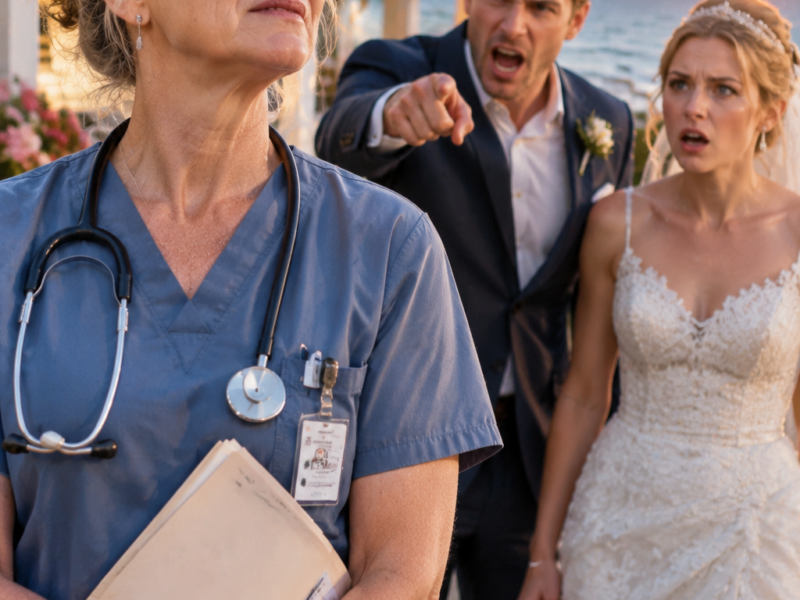
My son, Trevor, stood there in his navy wedding suit, staring at the long table stretching across my lawn. His bride-to-be, Shelby, looked as though someone had pulled the floor out from beneath her. Behind them, 80 wedding guests were slowly getting off two shuttle buses, trying to understand why the wedding venue looked nothing like the pictures they’d been shown.
There was no wedding arch.
No decorated aisle.
No photographer waiting to capture the happy couple.
Instead, there were 80 chairs, plates of food, glasses of lemonade, 26 yellow paper stars hanging from a clothesline, and a banner that read, “Shift’s Over.”
And at the head of the table was one empty chair.
My chair.
I had spent 30 years taking care of other people’s families in an emergency room. That afternoon, for the first time in my life, I had arranged for my own family to see exactly what those 30 years had meant.
But to understand why my son had just walked into that scene, you need to know what happened ten weeks earlier, when I was simply a retired nurse who had finally bought himself a little cottage by the ocean.
My name is George Garden. I was 66 years old when this happened, and until that spring, I’d spent nearly my entire adult life working at Legacy Emanuel Medical Center in North Portland.
Thirty years.
Twenty-five of them on the night shift.
I’d been bled on, spat at, vomited on, and occasionally mistaken for a doctor by people who had never bothered to read my name badge. I’d helped deliver babies, held the hands of dying patients, and stayed beside frightened families until they were ready to hear the words nobody wanted to hear.
For the record, I was a nurse.
The doctor wrote the orders. The nurses made sure those orders didn’t kill anybody.
It was an important distinction, although I had learned not to waste too much energy explaining it.
My final shift ended at seven o’clock on the morning of Friday, April 17, 2026.
I’d specifically requested no retirement party.
No cake.
No speeches.
And absolutely no ridiculous decorations involving turtles and retirement puns.
My colleagues respected the request about the cake. They completely ignored the request about the speeches and hugs.
A respiratory therapist I’d worked alongside for 19 years hugged me so hard that my reading glasses fell onto the floor. Even a trauma surgeon who had barely used my first name during the previous decade stopped me in the hallway to shake my hand.
Then Loretta Hendricks walked me to the parking garage.
Everybody called her Lo.
She was 64 years old, barely five feet tall, and possessed a voice that could make a malfunctioning ambulance reconsider its life choices.
She had trained me when I was a young nurse who still had plenty of hair and considerably less patience.
At my pickup truck, she pressed a manila envelope against my chest.
“Don’t open that until you’re past the freeway entrance,” she ordered.
“What’s in it?”
“Homework.”
“Lo.”
“I don’t do crying, George. I have a reputation.”
She turned around and walked away before I could ask another question.
I made it to the Interstate 5 on-ramp before curiosity got the better of me.
I pulled onto the shoulder, opened the envelope, and immediately understood why she had made me wait.
Inside were 26 little yellow paper stars.
Each one had my name written across it in Lo’s unmistakable block letters. Beneath my name was a year.
On our unit, whoever worked Christmas received a yellow star on the breakroom whiteboard. Every January, somebody took down the decorations and threw them away.
Apparently, Lo had been saving mine.
She had kept all 26 stars in her desk drawer, tied together with a rubber band, arranged in chronological order.
There was a small sticky note attached to the first one.
It read:
“You missed 26 Christmases. Go find out what the 27th feels like. Don’t call me for a month. L.”
I sat there on the shoulder of Interstate 5 and cried.
Not quietly, either.
Thirty years of holding myself together for other people finally caught up with me.
I cried for the Christmas mornings I’d missed, the birthdays I’d attended halfway through, and the years when I had convinced myself that being a good provider was the same thing as being present.
Then I drove home.
The first thing I did was sell my little bungalow in the Kenton neighborhood, where I’d lived for 28 years.
It sold for $498,000.
I added my savings and purchased a small cottage on Salt Hollow Road, just north of Neskowin, Oregon, for $565,000 in cash.
The house wasn’t particularly impressive.
Gray cedar shingles. Two bedrooms. One bathroom with a door that never quite closed properly. A small kitchen, a comfortable living room, and a porch facing the Pacific Ocean.
But the view was magnificent.
Just south of the property stood Proposal Rock, a massive green-topped sea stack rising from the beach like something dropped there by a careless giant.
The road leading to the cottage was a quarter-mile stretch of private gravel off Highway 101. There were seven houses along it, a cluster of mailboxes, and a hand-painted sign reminding drivers to watch for children and dogs.
Mine was the last house on the lane.
The sellers even left behind an old brass ship’s bell beside the front door because it wouldn’t fit in their moving truck.
I loved that little bell.
But the reason I bought that particular cottage had nothing to do with the view.
It had everything to do with my late wife.
Her name was JoAnn.
Back in the summer of 1999, she had torn a photograph out of a magazine and taped it inside one of our kitchen cabinets, right beside the coffee mugs.
It showed a gray-shingled cottage with a porch overlooking the ocean. A woman in a sweater stood outside, looking toward the water.
JoAnn tapped the picture with one finger.
“Retirement,” she said.
I laughed.
She didn’t.
“That’s where we’re going to live when we’re old.”
I told her we would see.
She looked at me with that familiar expression that always meant the discussion was over.
I never won an argument with JoAnn. Somehow, I never lost one either.
She had a remarkable ability to make the right answer feel like my idea.
Unfortunately, she never got to see that cottage.
She died on April 14, 2001, from a brain aneurysm.
It happened on an ordinary Saturday morning in our kitchen.
She was 38 years old.
Our son, Trevor, was sitting at the table eating cereal and arguing with her about whether a hot dog counted as a sandwich.
One minute she was laughing.
The next, she was on the floor.
I was an emergency room nurse. I knew what to do. I performed CPR, called for help, and did everything I could.
But sometimes, knowing exactly what to do isn’t enough.
JoAnn died before the ambulance arrived.
Trevor was seven years old.
I got him through the funeral, the casseroles, the first Christmas without his mother, and all the difficult mornings that followed.
Then the mortgage payment came due.
I did what nurses often do when life becomes impossible.
I worked more.
I moved permanently to the night shift because the differential pay was better. JoAnn’s mother, Beverly, stayed with Trevor during the day and slept on our couch when I left for work.
Between 2001 and 2014, Beverly became the person who raised my son while I worked.
She was a wonderful grandmother.
But I missed things.
A lot of things.
I missed birthday breakfasts, school performances, soccer games, and most Christmas mornings.
I missed so many of Trevor’s birthdays that eventually I started wrapping his presents at three in the morning during my breaks.
When Beverly passed away, Trevor was 20.
By then, I had developed a bad habit.
Whenever I couldn’t give my son time, I gave him something else.
A bicycle.
A guitar he barely practiced.
A car when he turned 16.
Tuition assistance.
A down payment on his condo in Sellwood.
When he needed money, I found it.
When he needed help, I made room.
I told myself that was what love looked like.
But looking back, I realize I had turned fatherhood into an account that I could keep paying into.
I had no idea how much damage that would eventually cause.
On Friday, May 1st, Trevor drove down from Portland to help me move into the cottage.
He was 32, six-foot-two, and worked as an operations manager for a freight company near the airport.
He carried boxes, complained about the stairs, and photographed nearly everything.
The moving truck.
The porch.
The sunset.
And, for some reason, the closing documents I’d left open on the kitchen table.
“For your insurance,” he explained.
I didn’t think much about it.
We ate pizza that evening while sitting on moving boxes.
He told me he was getting married.
His fiancée was a woman named Shelby Dunmore, 30 years old, who operated a vacation rental business along the Oregon coast with her father, Randy.
I’d met Shelby about five times.
She was attractive, confident, and had a handshake that made you feel as though you were signing a business contract.
“You’re going to love her dad,” Trevor said. “He’s a real entrepreneur.”
I thought that was probably true.
I also thought leaf blowers were ambitious, but I didn’t say that.
Trevor left around nine.
After he drove away, I stood on my porch listening to the tide.
For the first time since 2001, I had a house where nothing urgently needed fixing.
Nobody was waiting for me to get up.
Nobody needed a medication.
Nobody was asking where their lunch was.
I went to bed feeling lighter than I had in decades.
The following morning, I woke at 4:30.
Night-shift habits don’t disappear just because somebody hands you a retirement certificate.
I made coffee and carried my mug onto the porch.
The tide was far out, revealing the remains of the ancient ghost forest at Neskowin.
Thousands of years earlier, a massive earthquake had caused the land to drop, drowning an ancient Sitka spruce forest. At unusually low tides, the blackened tree stumps emerged from the sand.
They looked like old teeth rising from the earth.
I watched the ocean for almost an hour.
For the first time in 30 years, nobody needed me before sunrise.
I got approximately four hours of peace.
At 9:10, my phone rang.
It was Trevor.
“Dad, are you sitting?”
“Good morning to you, too.”
“Seriously. Sit down. I’ve got great news.”
I looked around my living room.
“What happened?”
“We’re having the wedding there.”
I waited.
“Where?”
“At the cottage.”
I thought he was joking.
“Trevor, what are you talking about?”
“July 11th. Eighty guests. Shelby’s already booked the florist and the photographer. We’ve got a drone guy coming, too. Dad, it’s perfect.”
I looked at the small living room.
The house had two bedrooms and one bathroom. The bathroom door still didn’t close properly.
“Trevor, there’s one bathroom.”
“Don’t worry. Shelby has a system.”
“A system?”
“Yeah. It’ll be fine. And obviously, you’ll stay at a hotel that weekend. There’s a nice place in Lincoln City. It’s only about 40 minutes away.”
I slowly repeated his words.
“You’re asking me to leave my own house?”
“It’s only for the weekend, Dad.”
Before I could answer, I heard a rustling sound.
Then Shelby’s voice came through the phone.
“George! Hi! Don’t stress. It’s going to be gorgeous.”
“Hello, Shelby.”
“Look, it’s a two-bedroom cottage and you’re one person. You don’t need both bedrooms. We can make this a family thing. You’ll barely notice us.”
I stared at the ocean through my window.
“Actually, I need both bedrooms.”
She laughed.
It wasn’t a particularly friendly laugh.
Then she said something that made my stomach tighten.
“And honestly, we’re keeping it as our summer house. It’s a great investment. We can use it whenever we want.”
I didn’t argue.
I didn’t shout.
I simply pressed the red button and placed my phone on the arm of my chair.
Thirty years in an emergency room had taught me that shouting rarely helped when somebody was already behaving irrationally.
My pulse was steady.
My breathing was normal.
I was angry, but I wasn’t going to let anger make decisions for me.
About 90 seconds later, my phone buzzed again.
It was a screenshot from Trevor.
A motel reservation in Lincoln City.
Room 114.
July 10th through July 12th.
$289 per night.
Prepaid.
The message underneath read:
“Booked you a room. Ocean view. So excited!”
My son had already paid for my exile.
I sat there looking at the reservation for a long time.
Then I turned off my phone and went back to watching the ocean.
I had spent most of my life making room for other people.
Apparently, my family had mistaken that for permission to take up every inch of my life.
What I didn’t know yet was that the wedding was only the beginning.
The following Thursday, May 7th, a neighbor knocked on my door.
She was about 72 years old, five-foot-four, and wore gardening clogs and a sun visor.
She held a foil-covered baking pan.
“Bernice Toliver,” she announced. “Number three down the road. Lemon bars. I made too many.”
“That’s very kind.”
“They’re terrible.”
I laughed.
She walked inside, set the pan on my kitchen table, and looked around the living room.
Then she examined the bathroom door.
“Hmm.”
“Something wrong?”
“No. Just confirming something.”
She sat down.
“George, I need to ask you something, and I need you to tell me the truth.”
“All right.”
“Did you list your house for rent?”
I stared at her.
“What?”
She pulled out her phone.
On the screen was a photograph of my cottage.
My porch.
My Adirondack chair.
My ocean view.
The photograph had been taken on moving day, probably when the sunlight was hitting the water.
Beneath it was a listing titled:
Cove House — Oceanfront Cottage in Neskowin. Sleeps Eight. $695 Per Night.
The listing identified Trevor and Shelby as the hosts.
I slowly scrolled through the photographs.
There were 11 pictures.
Seven of them were mine.
One showed my kitchen. Another showed the living room, including the reading glasses I had left on the side table.
The second bedroom was described as a bunk nook.
I didn’t own a bunk bed.
The calendar was even worse.
Fourteen reservations.
The first check-in was July 13th, two days after the wedding.
The last one was September 27th.
“Bernice, how did you find this?”
“I recognized your chair.”
She leaned back.
“I spent 34 years working in the Tillamook County Planning Department. I notice when somebody advertises a vacation rental on a road that doesn’t have a single vacation rental.”
I kept scrolling until I found a little green badge.
It said:
“Verified owner authorization on file.”
I put the phone down.
“I never authorized this.”
Bernice nodded.
“That’s what I figured.”
She pulled out a notebook.
Then she began explaining something that would change everything.
First, in unincorporated Tillamook County, a property owner needed a county license before advertising a short-term rental.
Not before accepting bookings.
Before advertising.
Second, Neskowin had a waiting list for new short-term rental licenses. The county had restricted new licenses because too many residential properties were being converted into vacation accommodations.
The third problem was even more serious.
Salt Hollow Road was a private road governed by covenants recorded in 1987.
Commercial lodging was prohibited.
Gatherings involving more than 30 people required written approval from every property owner.
Bernice had been chair of the road association for 11 years.
She knew every provision.
“What about the beach?” I asked.
She smiled.
“The beach belongs to everybody. That’s Oregon law. Anyone can walk on the sand. But your lawn, your porch, your house, and this private road are different matters. Shelby doesn’t get to invite 80 people onto your property simply because she likes the view.”
I looked at my hands.
“I don’t want to fight with my son.”
Bernice reached across the table and pushed a lemon bar toward me.
“Then don’t fight. Get organized.”
That evening, I called Lo.
She answered on the second ring.
“It’s been three weeks, George. I’m counting.”
I told her everything.
The wedding.
The motel reservation.
The vacation rental listing.
The forged authorization badge.
She listened without interrupting.
Then she spoke.
“Read back.”
“What?”
“Read back, George.”
I sighed.
“Lo, I’m retired.”
“And I’m still a nurse. You know the rule.”
She was referring to a practice we’d used thousands of times in the emergency room.
Whenever a doctor gave a verbal order, the nurse repeated it word for word.
If something was incorrect, the mistake could be caught before anyone got hurt.
If the doctor confirmed it, the order was documented.
“Don’t argue with them,” Lo said. “Make them say exactly what they’re doing. Get the facts.”
I understood.
On the evening of May 13th, I called Trevor.
I put the phone on speaker, placed a notepad in front of me, and opened a recording application.
Oregon law permits a participant in a telephone conversation to record the call, subject to applicable legal requirements. Bernice had checked the rules carefully before I made the call.
Trevor answered.
“Dad?”
“Hello, son. Put Shelby on, please.”
There was a pause.
Then Shelby came on the line.
“George! Hi. Did you get the motel confirmation?”
“I did. I’d like to read something back to you.”
“Sure.”
“You’re planning a wedding at my house on July 11th.”
“Yes.”
“And you’ve been advertising my house as a vacation rental.”
Silence.
Then Shelby spoke.
“It’s our family property, George. It’s an asset. We’re being strategic.”
“Let me make sure I understand. You listed my house without asking me. You have 14 reservations beginning July 13th.”
“Yes. It’s a launch.”
“A launch?”
“The wedding is part of the marketing. We’ve got a travel couple with 400,000 followers coming to shoot the property. The whole summer is practically booked.”
“How much money have you collected?”
She hesitated.
Then she answered.
“$38,400 in deposits.”
I wrote the number down.
Thirty-eight thousand four hundred dollars.
“Do you have a county license?”
“It’s being handled.”
“That’s not an answer.”
Trevor interrupted.
“Dad, it’s a small thing. You said you wanted peace. We’re giving you peace. You’ll be at a nice motel. You won’t have to cook or clean.”
I closed my eyes.
“Did I say yes to any of this?”
“You didn’t say no right away.”
“I said no twice.”
“Well, Shelby said it would be good for the family.”
Then Shelby changed her tone.
It became softer.
Almost affectionate.
“George, honestly, JoAnn would have wanted this. She loved the ocean. She would have wanted it to be a family place.”
For a moment, the kitchen seemed to shrink.
I could hear the refrigerator humming.
I could see the old photograph of JoAnn in the cabinet beside the coffee mugs.
I gripped the edge of the table.
“Do not say her name again on this call.”
There was silence.
Then Shelby tried again.
“I’m just saying—”
“Don’t.”
She sighed.
“You’re 66, George. You’re alone. Who exactly are you saving the house for?”
I looked at my notepad.
“Read that back to me, Shelby. Tell me exactly what is going to happen on July 11th.”
She exhaled.
“Fine. We’re having the wedding at your house on July 11th. We’re renting it starting July 13th. And you’re staying at the motel.”
“Thank you.”
I ended the call.
I sat there for a long time.
I had a date, a number, and an admission.
And I had learned something important.
A story could be argued.
A documented statement was much harder to deny.
On Saturday, May 23rd, a spotless white Ford pickup pulled into my driveway.
The man who stepped out was 61 years old, silver-haired, and deeply tanned.
He wore an expensive quarter-zip sweater with the logo of Dunmore Coastal Properties embroidered across the chest.
It was Randy Dunmore, Shelby’s father.
“George Garden!”
He shook my hand twice.
“We’ve been meaning to get together.”
I invited him onto the porch.
Bernice happened to be trimming the hedge near the property line.
She had been trimming it for approximately 40 minutes.
Randy settled into my Adirondack chair without asking.
“Lovely place you’ve got here.”
“Thank you.”
He opened a folder.
“Look, I want to be straight with you. Shelby’s a little fired up. She’s passionate. You know how kids are.”
“I know how Shelby is.”
He smiled.
Then he presented a document.
A family use agreement.
It proposed a ten-year arrangement.
I would retain legal ownership of the cottage, but Shelby and Randy would receive summer access and property management rights.
In exchange, they would pay me $50,000 over ten years.
I read the document twice.
Then I did the math.
Five thousand dollars per year.
For a property they were already advertising at $695 per night.
“Randy, that’s a bold way of offering me nothing.”
His smile tightened.
“It’s a lot of money for a retired nurse.”
“It’s pocket change for someone who’s already collected $38,400 in deposits on my porch.”
He leaned forward.
“George, Trevor is your only child. You’ve got a good heart. Do you really want to spend the rest of your life in this place with nobody on the porch?”
I looked at him.
Then at the folder.
Then at Bernice, who was now holding her gardening shears with both hands.
“You’re welcome to leave the folder,” I said. “It’ll make a good coaster.”
Randy stood up.
His pleasant expression disappeared.
“You’re making a mistake.”
“Thirty years in an emergency room, Randy. I’ve seen plenty of mistakes. This isn’t one of mine.”
He walked back to his truck and drove away.
Bernice lowered her shears.
“Well,” she said, “he has a very nice truck.”
I laughed for the first time that week.
But the real trouble arrived on June 9th.
A young man pulled into my driveway in a Subaru.
He wore a faded Portland Trail Blazers cap and carried a drone case.
“Mr. Garden?”
“That’s me.”
“My name’s Dustin Reeves. I’m the wedding photographer.”
He looked uncomfortable.
“Shelby said you’d approved site access for a pre-shoot. We’re planning a couple of drone passes over the lawn this evening.”
“Did she?”
He handed me a tablet.
On the screen was a four-page property authorization agreement.
It granted full commercial access to my house for weddings, events, and vacation rentals.
It identified me as the property owner and Sandstone and Pine Stays as the management company.
At the bottom was my signature.
G. Garden.
I stared at it.
The handwriting looked convincing.
The large loop on the G.
The flat tail on the N.
Then I noticed something.
A tiny ink blot on the left side of the G.
My signature always had that little mark because the pen had skipped when I signed the closing documents in April.
I remembered joking about it with the escrow officer.
The mark on this document was identical.
Not similar.
Identical.
Someone had copied my signature.
And I knew where they had gotten it.
On moving day, Trevor had photographed the closing packet on my kitchen table.
Page 41 contained my signature.
I looked at Dustin.
“Did you ever meet me before you accepted this job?”
“No, sir.”
“Did you ever see me sign this document?”
“No.”
His expression changed.
“Is something wrong?”
I sat down on the porch steps.
“Dustin, this signature is forged.”
He stared at the tablet.
“Oh, no.”
He swallowed.
“I didn’t know.”
“I believe you.”
He looked genuinely sick.
I handed him a glass of water and asked whether he had any emails relating to the arrangement.
He nodded.
Shelby had copied him on several planning messages.
He hesitated because he had signed a confidentiality agreement.
Then he looked at the document again.
“Forgery isn’t covered by an NDA, is it?”
“I’m a nurse, not a lawyer,” I told him. “But I think people are allowed to tell the truth about a signature they didn’t witness.”
He forwarded the emails.
One message, dated June 2nd, caught my attention.
It was from Shelby to her operations manager.
The subject concerned the wedding-day arrival schedule.
One sentence read:
“Owner’s old school. Nurses don’t make scenes, they make coffee. Get the guests there by 3:30 and he’ll fold. People pleasers always do.”
I read it twice.
Then a third time.
For 66 years, I had been the dependable one.
The person who covered the shift.
The person who paid the bill.
The person who absorbed the problem.
Apparently, Shelby had studied that part of my personality and built her entire plan around it.
She believed I would never make a scene.
She believed I would rather lose my home than upset my son.
She believed my silence meant weakness.
I handed the tablet back to Dustin.
“Cancel the shoot. Refund your deposit. You’re not in trouble with me.”
He nodded.
Then he looked at me.
“Mr. Garden?”
“Yes?”
“Nurses make scenes every day. They just do it in rooms with doors.”
I smiled.
“You’re right about that.”
After he left, I sat on the porch with the forwarded emails open on my phone.
For the first time, my anger was completely clear.
I knew exactly what I needed to do.
Father’s Day arrived on June 21st.
I woke up at 4:30 as usual.
My phone contained one message from Trevor.
It was a group text sent to me and 11 other people.
The title was “Wedding Day Shuttle Times.”
Shuttles at 3:30 p.m.
Ceremony at 4:30.
Sparklers at nine.
There was no Father’s Day greeting.
At seven that evening, Trevor drove into my driveway carrying a massive cardboard box.
Inside was a $400 stainless-steel pellet smoker.
“Happy Father’s Day, Dad.”
He placed it on the porch.
I looked at the gift.
Then I looked at my son.
He had learned something from me, although I hadn’t realized it until that moment.
Whenever something went wrong, bring a gift.
Whenever somebody was upset, buy something.
Whenever an apology was needed, find something expensive enough to distract from the problem.
“Come sit down,” I told him.
We sat on the porch and watched the sun sink behind Proposal Rock.
For several minutes, neither of us spoke.
Then I asked him a question.
“Trevor, on moving day, did you send the photographs of my closing documents to Shelby?”
He frowned.
“She asked for them.”
“What did she say she needed them for?”
“Her dad’s company handles property paperwork. She said they needed the documents for their files.”
I nodded.
“Did you know somebody had used my signature to authorize the rental of this house?”
His expression changed.
“No, Dad.”
“Did you know about the document?”
“Shelby said you signed it at closing.”
“Look at me.”
He raised his eyes.
“Did I ever tell you I’d sign an agreement like that?”
He looked toward the ocean.
“You said you needed time.”
“No. I said no.”
He rubbed his forehead.
“That’s not how I remember it.”
“Then let’s do something. Read back to me what I said during our first phone conversation. Not what Shelby told you. Not what you wanted to hear. What did I actually say?”
He was quiet for a long time.
Finally, he spoke.
“You said the house had two bedrooms and one bathroom.”
“And then?”
“You said no.”
“To what?”
“To the wedding.”
“And the rental?”
He lowered his head.
“To all of it.”
I nodded.
“That’s right.”
He began picking at the label on his water bottle.
“Dad, it’s too late now. Randy has invested money. Eighty people have booked flights. Shelby built her whole business around this.”
“Trevor, you know what the problem is?”
He didn’t answer.
“You keep talking about what everybody else has invested. You haven’t once talked about what I have to lose.”
He looked at me.
“I love you, son. But I am not going to surrender my home to keep everybody else comfortable.”
His eyes filled.
“Dad, you’ve always come through.”
There it was.
The sentence that explained almost everything.
I had spent decades teaching him that whenever he needed something, his father would find a way.
He had never learned that his father was allowed to say no.
“Trevor, I’m going to be here on July 11th. I’m having a housewarming party. Everybody is welcome.”
He looked confused.
“You can come as my son. Alone, or with Shelby as my guest. But there will be no wedding on my lawn, and there will be no vacation rental.”
He stared at me.
I repeated it.
“No.”
He stood.
For a moment, I thought he might say something.
Instead, he walked to his car.
He left the smoker on my porch.
I watched him drive away.
The following morning, I climbed into my closet and pulled down an old shoebox.
It was a floor-shine box filled with letters and cards from my 30 years in nursing.
There were 61 of them.
Thank-you notes from families.
Birthday cards from patients.
Crayon drawings.
A note from a man who had suffered a heart attack in the waiting room and wanted to thank me for making sure he didn’t feel embarrassed.
I had saved every one.
But I’d rarely read them.
I had always thought those letters belonged to the person I had been at three in the morning, the person who was too busy to think about himself.
That morning, I realized something.
Those people had remembered me.
And I had forgotten that I was worth remembering.
I took out a stack of cream stationery and began writing.
I wrote to Hannah Lindgren, a little girl I’d treated on Christmas morning in 2003.
I wrote to the family of Lloyd, an elderly man I’d helped during a freezing winter night.
I wrote to Terrence, who had arrived in the emergency room after a motorcycle accident.
I invited every person whose name I could still identify.
I told them I had retired to the Oregon coast and was having a housewarming on July 11th.
They were welcome to bring anyone they wanted.
I wrote 61 letters that morning.
Lo added several names from the hospital.
By July 1st, her spreadsheet showed 80 confirmed guests.
Meanwhile, Bernice organized a meeting of the Salt Hollow Road Association.
Seven households.
Five owners attended in person, one joined by speakerphone from Phoenix, and the seventh, who was usually out on a boat, approved the meeting by text.
Bernice placed the association covenants on the table.
She reviewed the rules.
No commercial lodging.
No gatherings of more than 30 people without the written approval of every property owner.
Then she explained that a commercial wedding involving 80 guests had been scheduled without the owner’s consent.
The association voted to enforce the covenants.
I submitted a written request for my own one-day gathering of 80 people.
Every property owner signed.
Bernice arranged for a notice to be posted at the entrance to Salt Hollow Road.
Private event.
No unauthorized vehicles.
She volunteered to staff the entrance herself.
The certified letter I sent to Shelby and her company on June 24th was short and clear.
I had not authorized any rental listing, wedding, commercial event, or property management agreement.
The signature on the document was not mine.
They were required to stop using my property immediately.
Shelby responded with a voicemail on June 28th.
I saved it.
“George, it’s Shelby. I got your little letter. You’ve lost your mind. You really think a deputy is going to care about a lawn party? I’ve got 80 people, a drone, a travel couple, and a florist driving from Portland. Move your car. We’ll be there at 3:30.”
She sounded like she was reading a weather forecast.
On July 2nd, I drove to the Tillamook County Sheriff’s Office.
A deputy named Hank Sorenson took my report.
He was in his 50s, broad-shouldered, and had a gray mustache and reading glasses hanging around his neck.
I placed the forged agreement beside the original closing document.
He studied the signatures.
“Same ink blot on the G,” he said.
“Yes.”
“Mr. Garden, I’ll be honest. Forgery is a serious matter. These cases take time. We won’t solve everything in a week.”
He tapped the folder.
“But I’ll take your report, and I’ll take it seriously. You said the event is July 11th?”
“That’s correct.”
“Saturday. I’ll be on patrol that day.”
I thanked him.
On July 8th, Bernice drove me to the county planning office.
We submitted the photographs, the rental listing, the forged authorization, the reservation records, and the timeline.
A clerk named Jolene read through the documents.
Her expression became increasingly serious.
She took the folder into the back office.
The following day, a formal notice of violation was issued to Sandstone and Pine Stays for advertising an unlicensed short-term rental.
Then, at 4:55 p.m. on Friday, July 10th, the booking platform’s trust and safety department froze the Cove House listing and all associated payouts pending investigation.
At 4:57, my phone rang.
It was Shelby.
Her voice was completely different.
“George, what did you do?”
“Hello, Shelby.”
“They locked my account! The listing is gone! All the payouts are frozen! The county sent us a violation notice!”
“Is there something you’d like me to fix?”
“Yes! Call them! Tell them it’s a misunderstanding!”
“Read back, Shelby. Tell me exactly what you’d like me to say.”
She became impatient.
“Tell them you authorized it.”
“You want me to say I authorized a listing I never authorized?”
“Yes!”
“What about the deposits?”
There was a pause.
Then she spoke.
“I spent them, okay?”
I looked toward the window.
“How much?”
“About $29,000. On the florist, the drone crew, the travel couple. I was going to make it back in August. It’s how the business works.”
I didn’t say anything.
For a moment, I could hear her breathing.
Then she started speaking faster.
“George, you have to help me. People have booked flights. This is Trevor’s wedding. You can’t do this to your own son.”
I looked at the photograph of JoAnn beside the coffee mugs.
“That’s all I needed to hear.”
“What does that mean?”
I ended the call.
I was done arguing.
The next morning, my friends began arriving.
I had asked Lo for help with a simple housewarming.
What arrived at my cottage looked more like a small military operation.
Three pickup trucks.
A rented van.
A flatbed trailer loaded with folding tables, benches, string lights, and enough supplies to feed a small hospital department.
Lo climbed out wearing a floppy straw hat and orthopedic sandals.
She took one look at my lawn.
“All right. The table runs the length of the grass. Eighty chairs. Don’t touch the one at the head.”
“Why not?”
“Because that’s yours.”
I looked at the empty chair.
“Why do I get the head?”
Lo gave me a look.
“Because you’ve spent your entire life sitting in the corner of every room. It’s your turn.”
She handed me a clipboard.
“Name tags. Everyone writes the date on the back. The night they remember meeting you.”
“What night?”
“Whatever night they remember, you old fool.”
That evening, the 26 yellow paper stars went up.
They were strung between my porch and a fence post.
I stood there watching them move in the ocean breeze.
Each star represented one Christmas I’d spent working instead of sitting beside my son.
They looked small.
Almost insignificant.
But they represented 26 years of my life.
I went inside and took the old photograph of JoAnn from the kitchen cabinet.
I held it for a moment.
Then I returned it to its place beside the coffee mugs.
The following morning, July 11th, I woke at 4:30.
The tide was far out.
The ghost forest stood in the wet sand, dark and motionless.
I carried my coffee onto the porch.
Whatever happened that day, I had told the truth.
I had said no.
I had documented everything.
And I had finally stopped apologizing for protecting my own life.
By noon, the first guests began arriving.
Some were people I hadn’t seen in 20 years.
Others were former colleagues.
A woman in her late twenties stepped out of a Toyota holding a framed photograph.
“Mr. Garden?”
I recognized her name immediately.
Hannah Lindgren.
She had been six years old when a station wagon carrying her family had skidded on ice on Interstate 84 and rolled over.
It happened on Christmas morning in 2003.
When they brought her into the trauma unit, she wasn’t breathing.
I remembered that night.
I remembered compressions.
I remembered the little hospital gown and the sticker on her cheek.
I had performed CPR for 11 minutes.
Eventually, she woke up and asked for a juice box.
Now she was standing on my porch as a grown woman.
“I’m a pediatric nurse,” she said.
She held out the photograph.
It was a faded Polaroid of a little girl in a hospital gown.
“Your Christmas card is still on my refrigerator.”
I frowned.
“I never sent you a Christmas card.”
“You sent one to my mother in 2004. It said I was a tough cookie and that she should keep an eye on me.”
I remembered writing that note.
Hannah smiled through her tears.
“I’ve been keeping an eye on myself ever since.”
I rang the brass bell beside the front door for her.
That was the plan.
Every guest would arrive, ring the bell once, write the date they remembered on the back of their name tag, and take a seat.
Soon, the bell became the loudest thing on Salt Hollow Road.
A woman in her 50s arrived holding a photograph of her late father, Lloyd, the retired merchant mariner I’d once helped after he was found freezing on a bench in Old Town.
Terrence arrived next.
He was the young man who had been brought into the emergency room after a motorcycle accident when he was 17.
He remembered cracking jokes while strapped to a backboard because he was too frightened to do anything else.
Then Gus Pettibone arrived.
Gus was 69, retired, and still wore his old paramedic jacket.
He had been on the ambulance crew that brought Hannah to the hospital.
“You look terrible,” he told me.
“I’m retired.”
“Same thing.”
By 3:15, all 80 chairs were occupied.
There was food from a caterer in Tillamook.
There were glasses of lemonade.
There were people laughing, talking, and sharing memories.
And at the head of the table sat one empty chair.
At 3:20, Bernice took her position at the entrance to Salt Hollow Road.
She had a clipboard, a sun visor, and the determination of someone who had spent four decades telling people that zoning rules were not optional.
At 3:28, two white shuttle buses turned off Highway 101.
A white SUV led them.
Randy Dunmore was driving.
Shelby sat beside him wearing her wedding dress.
Behind them came Trevor in a navy suit.
Several rental cars followed.
Bernice stepped forward and raised one hand.
The SUV stopped.
Randy rolled down his window.
“Ma’am, we’re the Dunmore wedding. Please move.”
“This is a private road,” Bernice replied. “There’s a private event today.”
“We’re here for a wedding.”
“I’m aware. The wedding isn’t authorized.”
Randy looked irritated.
“There are 80 people on these buses.”
“Then they’re welcome to walk. It’s a quarter mile.”
He stared at her.
Bernice pointed toward the posted notice.
“Private event. No unauthorized vehicles.”
The guests began stepping down from the buses.
Some looked confused.
Others were annoyed.
But curiosity won.
They started walking down the gravel road.
Shelby was the first to come around the bend.
Her white dress moved in the breeze.
Trevor followed.
Then Randy.
Then the rest of the wedding party.
And that’s when they saw my lawn.
Eighty chairs.
Eighty people.
A long table.
Twenty-six yellow stars.
The banner.
The brass bell.
And one empty chair at the head.
I was standing on my porch.
I watched Shelby stop.
Her bouquet slipped from her fingers and landed in the gravel.
“What is this?” she demanded.
I walked down the steps.
“It’s my housewarming.”
“Where’s the wedding arch?”
“Haven’t seen one.”
“Where’s the staging crew?”
“Not here.”
“Where are the photographers?”
“Probably somewhere else.”
She turned toward Trevor.
“Say something!”
But Trevor wasn’t looking at her.
He was staring at the stars.
Randy stepped forward with a folder.
“George, this has gone too far.”
I looked at him.
“You still have that agreement?”
“Of course. You signed it.”
“I didn’t.”
He opened the folder and pointed to the signature.
“Right there.”
I took out my phone.
“Then let’s look at something else.”
I read Shelby’s June 2nd email aloud.
“Owner’s old school. Nurses don’t make scenes, they make coffee. Get the guests there by 3:30 and he’ll fold. People pleasers always do.”
The lawn went quiet.
Then I placed my phone on the table and played the recording from the previous evening.
Shelby’s voice rang across the grass.
“I spent them, okay? About $29,000. It’s how the business works.”
The wedding guests turned toward her.
Somebody near the back whispered, “What?”
Shelby went pale.
“That’s illegal! He recorded me!”
A calm voice came from behind the guests.
“Actually, ma’am, that’s not necessarily illegal under Oregon law.”
Deputy Hank Sorenson walked onto the lawn.
He was in uniform.
He had arrived about ten minutes earlier and parked his cruiser near the bend.
He approached Shelby and Randy.
“Ms. Dunmore, I have a forgery report involving a property authorization bearing Mr. Garden’s signature. I’d like to speak with you and Mr. Dunmore.”
Shelby looked at Randy.
Randy looked at the deputy.
Then Bernice appeared beside them, holding her clipboard.
She began reading the private-road covenant aloud.
No commercial lodging.
No unauthorized events.
No gatherings exceeding 30 people without the written consent of all owners.
She had the signed approval documents in her folder.
Nobody could argue with that.
Then Hannah Lindgren stood.
She was still holding the old Polaroid.
“My name is Hannah,” she announced.
Her voice carried across the lawn.
“On Christmas morning in 2003, I stopped breathing. This man performed CPR on me for 11 minutes. I became a nurse because of him. I’m here because he sent me a letter.”
She looked directly at Shelby.
“What are you here for?”
Nobody answered.
Gus stood.
“I was the paramedic on that call.”
He nodded toward me.
“George was the nurse who refused to give up.”
Then he sat down.
Trevor was still staring at the yellow stars.
Finally, he spoke.
“Dad?”
I looked at him.
“Those are all Christmas nights.”
“Yes.”
“All 26?”
“All 26.”
He walked past Randy and Shelby.
He approached the empty chair at the head of the table.
Someone had placed a name tag on it.
On the back, in Lo’s handwriting, were three words:
“George, all yours.”
Trevor looked at the stars again.
“I used to think you chose work over me,” he said quietly.
I didn’t answer.
He continued.
“I never thought about who you were at work.”
I looked at my son.
“Neither did I, until this spring.”
His eyes filled.
“Dad, the signature. I took those pictures. I gave them to Shelby. I swear I didn’t know she was going to do that.”
“I know you took them.”
“I thought you had signed the agreement.”
“Trevor, a forged signature that copies the tiny ink blot on the G is something someone studied carefully.”
He looked down.
“She told me you signed it.”
I nodded.
Then he turned toward Shelby.
“Shelby, you told me he signed it.”
She looked at him with an expression I’d never seen before.
“I told you what you needed to hear.”
Those words hung in the air.
For a moment, nobody moved.
Then I climbed onto the second step of my porch and raised both hands.
It was the same gesture I used in the emergency room when a family needed to hear something difficult.
“Folks, my name is George Garden. I’m Trevor’s father.”
Eighty heads turned toward me.
“I want to speak to the people who arrived on those shuttle buses.”
I looked across the crowd.
I recognized several faces.
My sister-in-law Carol had driven down from Seattle.
Two of Trevor’s cousins were standing near the back.
There were friends, relatives, and people who had probably spent money traveling to attend what they believed was a wedding.
“You were told this wedding was a gift from me,” I said. “It wasn’t. I am sorry you were misled. That wasn’t your fault.”
I paused.
“There won’t be a wedding here today. But there is plenty of food, and there is a long table. You’re welcome to stay as my guests. Every one of you.”
Nobody spoke.
“Nobody here is on trial. You came because you were invited. I understand that.”
I pointed toward the table.
“There’s one chair at the head. That’s mine. The rest of the evening is up to you.”
My sister-in-law Carol walked toward me.
She was 70 years old and wearing a lavender dress.
She took my face in both hands.
“JoAnn would have been mortified,” she whispered.
I lowered my head.
“At them,” she clarified. “Not at you.”
Then she looked toward the empty chair.
“Do you know what Jo wanted most? She wanted you to sit down once in a while.”
That was when I finally broke.
I stood on my porch steps and cried like a man who had spent 30 years waiting for permission.
Twenty-two guests left within the hour.
Fifty-eight stayed.
Lo and the hospital crew somehow produced three additional folding tables from the flatbed trailer.
They served brisket, salads, and desserts.
People ate.
People laughed.
Some cried.
A toddler fell asleep underneath one of the tables.
Hannah sat with several former nurses and talked about her work.
Gus told stories about ambulance calls.
Lo eventually stood up and described the night I’d worked a three-car pileup with a broken wrist and refused to leave the trauma unit until every patient had been stabilized.
People laughed.
I hadn’t realized how many lives had crossed mine.
And I hadn’t realized how many people remembered.
Around six o’clock, Deputy Sorenson finished taking statements.
He escorted Shelby and Randy toward their SUV.
Trevor remained on the lawn.
He was holding the bouquet Shelby had dropped in the gravel.
His suit was wrinkled.
His eyes were red.
He approached me.
“I want to do something,” he said.
“You don’t have to.”
“I want to.”
I looked at him.
“Then start by understanding something. You can’t pay me back for the Christmases, and I can’t pay you back either. Neither of us gets those mornings back.”
He swallowed.
“We just have to be in the room for the next ones.”
He nodded.
“And this house isn’t a bank. It isn’t a gift. It isn’t a summer rental or a family asset. It’s where I sleep.”
I looked at the porch, the stars, and the ocean beyond.
“I spent 30 years being the night shift for your life, Trevor. I’m off now.”
He began crying.
“Mom’s picture,” he whispered. “The one in the cabinet. You still have it?”
“Second shelf. Beside the mugs.”
“Can I see it?”
“Not tonight.”
He looked toward the porch.
Then he nodded.
“Okay.”
He walked to his car alone.
He didn’t follow Shelby and Randy.
He drove in the opposite direction.
That evening, after the guests had gone, I sat on the porch with a glass of water.
The tide was coming in.
The yellow stars moved gently in the wind.
I thought about JoAnn.
I thought about Trevor.
I thought about the 26 Christmases I’d missed and the 30 years I’d spent believing that love meant always saying yes.
I didn’t know what would happen next.
But I knew something had changed.
The booking platform eventually removed Sandstone and Pine Stays permanently.
The 14 guests who had reserved Cove House received full refunds.
The county’s violation notice remained on record, along with a fine.
Two other homeowners who had used Randy’s management company withdrew their properties within the following week.
Randy lost two agents from Dunmore Coastal Properties before Labor Day.
In September, the district attorney’s office offered Shelby a diversion agreement involving a signed admission, restitution to the people whose deposits she had taken, and community service.
I heard she accepted.
I didn’t ask for details.
The engagement ended on August 2nd.
Trevor called me to tell me.
He didn’t ask me to fix anything.
He sounded like a man who had been carrying a terrible cold for years and had only just discovered how sick he really was.
On Saturday, September 5th, at nine in the morning, his gray Honda pulled into my driveway.
He climbed out alone.
No gift.
No pizza.
No expensive apology.
Just my son wearing jeans and an old sweatshirt.
“Can I help with the porch?” he asked.
I looked at the porch.
The wood needed sanding.
“A lot of sanding.”
“I can sand.”
So we did.
We worked for six hours.
We didn’t talk much.
Sometimes he sanded a section while I worked on another. Occasionally, one of us would ask for a tool or move a piece of furniture.
Around two o’clock, I handed him a sandwich in a paper bag.
He sat beside me on the porch steps and ate.
We both looked toward the same stretch of ocean.
At five, he packed his things.
“I’ll call before I come next time,” he said.
“Good.”
He hesitated.
“Would you rather I stayed at a motel? I don’t want to make you uncomfortable.”
I shook my head.
“Come on Saturdays.”
He looked up.
“Bring nothing. Stay until dark.”
He nodded.
“Okay, Dad.”
I’m not going to tell you that everything was suddenly fixed.
It wasn’t.
Trust doesn’t return because somebody spends six hours sanding a porch.
Forgiveness doesn’t erase the past.
And being family doesn’t mean you automatically get access to somebody else’s life.
But the following Saturday, Trevor came back.
And the Saturday after that, he came again.
Sometimes we worked.
Sometimes we ate lunch.
Sometimes we simply sat on the porch and watched the tide.
He started asking about my nursing years.
Not about how much money I had made.
Not about what I could buy for him.
He wanted to know what happened during those Christmas shifts.
He asked about Hannah.
He asked about the people whose letters I’d saved.
One afternoon, he stood in front of the kitchen cabinet and looked at his mother’s photograph.
He didn’t say anything for several minutes.
Then he asked me to tell him about the day I met her.
So I did.
I told him about the way she laughed.
The way she always ordered coffee with too much cream.
The way she could make an entire room feel warmer simply by walking into it.
I told him about the magazine photograph she’d taped inside that cabinet in 1999.
And how she’d tapped it with one finger and called it our retirement home.
Trevor listened.
For the first time, I realized that perhaps we were finally getting to know each other as two adults who had both lost someone.
There is one more thing I did with the cottage.
The second bedroom now has a small wooden sign above the door.
It reads:
“Off-Shift Week.”
The room is available free of charge to nurses, paramedics, and night-shift workers who need a break.
No questions.
No invoices.
No expectations.
They can stay for a week, watch the ocean, sleep as long as they want, and enjoy a place where nobody needs anything from them.
Lo has already booked the first week.
She says she wants seven days without anybody asking her to solve a problem.
I told her she could bring her own pillow.
She said she intended to bring two.
Sometimes, when I sit on the porch in the early morning, I think about everything that happened.
I think about the man I was before retirement.
The father who believed money could make up for missed mornings.
The nurse who knew how to protect everyone except himself.
The widower who spent 25 years working nights because he didn’t know how else to keep his family together.
And I think about the lesson that took me 66 years to understand.
Saying no doesn’t mean you stop loving someone.
It means you finally understand that your own life matters, too.
If somebody asks you for something, you are allowed to think about it.
If somebody makes plans for your property, you are allowed to refuse.
If somebody uses your kindness as a business strategy, you are allowed to expose the truth.
And if someone tells you that your late wife, your late husband, or someone you loved would have wanted you to surrender something that matters to you, remember that nobody gets to use the dead to control the living.
I spent 30 years in an emergency room learning that silence can be dangerous.
But I also learned that a calm voice, a clear statement, and a written record can change everything.
Say no once.
Say it clearly.
Write it down.
And never mistake someone’s ability to make you feel guilty for proof that you’re doing something wrong.
These days, I still wake up at 4:30 in the morning.
Not because I have a shift.
Not because an ambulance is waiting.
I wake up because I like watching the tide pull away from the ghost forest.
I make coffee.
I carry my mug onto the porch.
Sometimes Hannah sends me a photograph from the pediatric unit.
Sometimes Trevor sends me pictures of the things he’s repaired or sanded.
Sometimes he sends a photograph of the ocean from his own drive home.
And sometimes, when the morning light finally breaks over Proposal Rock, I reach toward the old brass ship’s bell beside my front door.
I ring it once.
Softly.
It reminds me of the people who came to my house that July afternoon.
The 80 people who sat at my table.
The 26 yellow stars hanging above them.
The woman who taught me to be a nurse.
The wife who taught me what home should feel like.
And the son I’m still learning how to love without losing myself.
My cottage is quiet now.
But it isn’t lonely.
And every Saturday, when I hear the gravel crunch beneath Trevor’s tires, I know he’s coming because he wants to see his father.
Not because he needs a favor.
Not because he wants something from the house.
Not because somebody else has made a plan for my life.
Just because he wants to be here.
And honestly, after everything, that’s more than enough.









