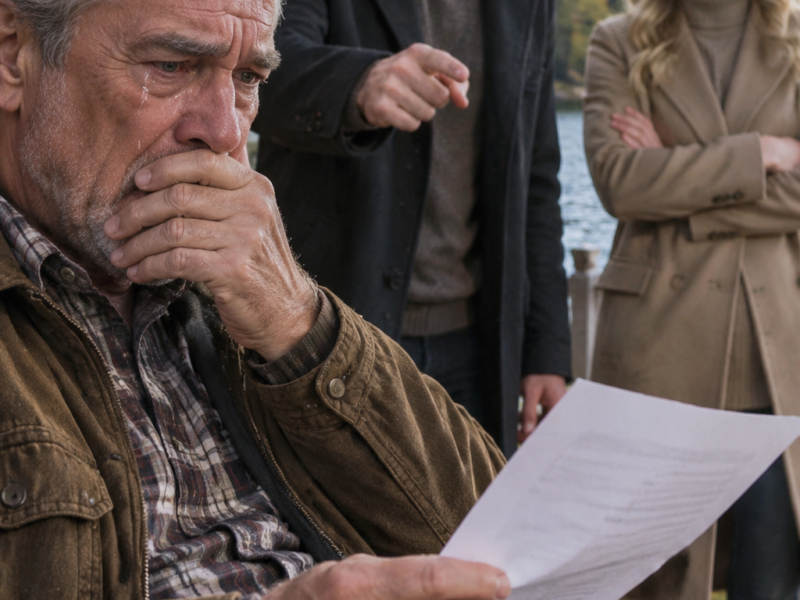
"Dad, We’ve Sold Your Lake House. You Have Until The End Of The Mounth To Move Out". But I …
"Dad, We’ve Sold Your Lake House. You Have Until The End Of The Mounth To Move Out". But I …
The words came through the telephone with such coldness that, for a moment, I wondered whether I had heard them correctly.
“Dad, we’ve made our decision. We’re selling the house at Kerr Lake. You have until the end of the month to move out.”
I sat motionless in my old wooden chair, staring at the lake beyond the window. A gentle breeze moved across the water, sending small waves against the wooden posts of the dock. Somewhere in the distance, a bird called from the trees, and the morning sun reflected off the surface of the water.
Everything around me looked peaceful.
Everything except my life.
My oldest son, Brad, had just informed me that he and his younger brother, Tim, had decided to sell my house without even asking for my permission. They had apparently found a real estate agent, arranged a buyer, and set a deadline for me to leave the place where I had spent more than thirty years of my life.
And he had delivered the news as casually as someone announcing that he had ordered a new television.
I tightened my grip around the armrest of the chair.
“Brad,” I finally said, keeping my voice low, “would you mind explaining exactly what you mean?”
He sighed impatiently.
“Dad, don’t make this complicated. We’ve already discussed everything. The market is excellent right now, and this is the perfect time to sell. You don’t need a huge lake house anymore. You’re getting older, and maintaining that place by yourself doesn’t make any sense.”
I looked toward the living room, where an old family photograph stood on the mantelpiece.
Renee, my wife, was smiling in that photograph. She was holding Brad and Tim when they were still little boys, their faces bright with the kind of innocence that made you believe nothing bad could ever happen to them.
Renee had been gone for several years.
But her presence remained everywhere in that house.
It lived in the wooden staircase she had insisted we build by hand. It lived in the kitchen where she used to prepare breakfast on Sunday mornings. It lived in the small garden outside the back door, where she had planted flowers that still returned every spring.
This wasn’t simply a property.
It was the place where my family had been born, raised, and loved.
And now my own son was telling me to get out.
“Have you already spoken to a real estate agent?” I asked.
“Of course,” Brad replied. “His name is Mark Benson. He’s experienced, and he’s already found interested buyers. We’ve got everything moving.”
“Everything?”
“Yes, Dad. Everything. We’ve even signed the brokerage agreement. We don’t have time to waste.”
I slowly leaned back in my chair.
“Interesting,” I said.
Brad seemed surprised by my response.
“What do you mean, interesting?”
“I mean it’s interesting that you’ve managed to arrange the sale of a house without speaking to the person who owns it.”
There was a brief silence.
Then Brad laughed.
Not a nervous laugh. Not an embarrassed laugh.
He actually laughed.
“Dad, please. Don’t start with that. We are your sons. We’re only trying to make the right decision for the family.”
The right decision for the family.
I almost smiled at the expression.
I had spent forty years working as a structural engineer. I had designed buildings, inspected bridges, evaluated foundations, and calculated the precise amount of pressure a structure could withstand before something began to fail.
I understood the difference between something that looked strong and something that actually was strong.
Unfortunately, I had never imagined that one day I would need those same skills to understand the weaknesses inside my own family.
“Brad,” I said quietly, “I built that house.”
“And we appreciate that,” he replied quickly. “But you can’t live in the past forever. Things change. The property is worth a lot of money now, and selling it makes financial sense.”
“How much money?”
“Three hundred and ninety thousand dollars, approximately. Maybe a little more if negotiations go well.”
I looked out toward the lake again.
Three hundred and ninety thousand dollars.
That was apparently the price my son had placed on his mother’s memories, his childhood, and the home his father had spent decades building.
“Who told you that I wanted to sell?” I asked.
Brad’s patience finally began to disappear.
“Dad, don’t turn this into an argument. We have already made the decision. You have until the end of the month to move out. Tim agrees with me, and we’ve discussed everything.”
I closed my eyes for a moment.
Tim.
My younger son.
I wondered how he had managed to convince himself that this was acceptable.
“Does Tim know you’re calling me?”
“Obviously. We’re doing this together.”
I nodded slowly, even though he couldn’t see me.
“All right, Brad.”
“Good. I knew you’d understand.”
He ended the call without another word.
For several seconds, I continued holding the phone against my ear, listening to the empty silence.
Then I placed it on the table.
I looked at the photograph of Renee again.
“Did you hear that?” I whispered.
Her smile remained unchanged.
And something inside me shifted.
The anger that had been building in my chest slowly disappeared. In its place came a strange, almost frightening calm.
I had spent my entire career studying structural failures. I knew that when a building began to collapse, the most dangerous moment wasn’t necessarily when the first crack appeared.
It was when the people inside believed everything was still perfectly safe.
Brad and Tim had made a serious mistake.
They believed I was an old man who would become frightened when confronted with a difficult decision. They thought I would argue for a few minutes, perhaps shed some tears, and eventually pack my belongings because I had no other choice.
They had forgotten something important.
I was still the same man who had built that house with his own hands.
And I had never been the kind of person who surrendered simply because someone else raised their voice.
I stood up slowly and walked toward the family photograph.
My fingers brushed against its wooden frame.
The photograph had been taken in the summer of 1995, two years after Renee and I began building our dream home at Kerr Lake.
Back then, neither of us had much money.
I was working long hours as a young structural engineer, taking additional projects whenever they became available. Renee managed the household and worked part-time at a local school. We saved almost every dollar because we wanted something that belonged entirely to us.
We didn’t want an enormous mansion.
We wanted a home.
A place where our children could grow up surrounded by trees, where we could watch the seasons change, and where we could grow old together.
I still remembered the spring morning when we poured the first concrete foundation.
The ground was wet from the previous night’s rain. My boots were covered in mud, and my hands were aching from lifting equipment.
Renee stood nearby holding a glass of lemonade.
“You’re going to build the strongest house on this entire lake,” she had said.
I laughed.
“That’s the plan.”
She smiled.
“Then make sure you build it strong enough for all the grandchildren we’re going to have.”
I had kissed her forehead and promised that I would.
We chose every detail together. The cedar panels, the stone fireplace, the windows overlooking the water, and the wooden staircase that connected the bedrooms to the main living area.
I designed the foundation to withstand harsh Wisconsin winters. I calculated the structural loads carefully and personally inspected every important stage of construction.
For more than thirty years, that house had endured freezing temperatures, violent storms, heavy snowfall, and countless seasons of changing weather.
It had never failed us.
It was where Brad took his first steps.
It was where Tim learned to ride a bicycle.
It was where Renee celebrated birthdays, prepared holiday dinners, and spent countless evenings sitting beside me on the porch.
And it was where I held her hand during the final months of her illness.
When she died, the house became painfully quiet.
For months, I couldn’t bring myself to change anything.
Her favorite coffee cup remained in the kitchen cabinet. Her gardening gloves stayed beside the back door. Even the little blanket she used when watching television remained folded over her favorite chair.
I knew she was gone, but I couldn’t bear the thought of erasing the life we had built together.
Now my sons wanted to sell it.
I returned to my chair and looked at the darkening sky.
Perhaps the greatest mistake I had made as a father was believing that providing my children with everything they needed would automatically teach them gratitude.
I had paid for their education.
I had helped them buy their first cars.
I had supported them through difficult periods, offered financial assistance when their careers were unstable, and welcomed them home whenever life became too complicated.
I had believed those sacrifices were investments in a family that would remain close long after Renee and I were gone.
But somewhere along the way, something had changed.
Brad had married a woman who seemed to measure happiness through expensive possessions. Designer handbags, luxury vacations, fashionable restaurants, and parties filled with people whose approval never lasted longer than an evening.
There was always something new she wanted.
A larger house.
A better car.
A more expensive holiday.
Brad had once been hardworking and responsible. But after several years of trying to maintain a lifestyle his salary could barely support, he had become increasingly impatient and obsessed with money.
He no longer looked at things through the eyes of a son.
He looked at them through the eyes of a man searching for another financial opportunity.
And then there was Tim.
Tim had always been quieter than his older brother. As children, he followed Brad everywhere. He admired him, copied his habits, and rarely challenged his decisions.
I had hoped that growing older would make him more independent.
Instead, it seemed to have made him more afraid of disagreement.
I suspected he understood perfectly well that forcing their father out of his home was wrong.
But he had chosen to remain silent.
Sometimes cowardice causes just as much damage as cruelty.
I spent the rest of that afternoon walking through the house.
I stopped in the kitchen, where Renee used to sing while preparing dinner. I stood in the hallway where the boys had marked their heights against the wall. I opened the door to the room that had once belonged to Brad, then the room that had belonged to Tim.
Dust had gathered on the old shelves.
A few childhood trophies were still there.
I wondered whether either of them remembered the day I helped them build the small wooden boat that we later took out onto Kerr Lake.
They had been so proud of that boat.
They had insisted on naming it after their mother.
I smiled sadly.
Somewhere between those childhood summers and the men they had become, the foundation of our family had developed cracks.
And I had been too busy trying to hold everything together to notice how serious they had become.
That night, I barely slept.
Not because I was frightened of losing my house, but because I had begun to wonder what my sons might do next.
People who are desperate for money rarely stop after their first attempt.
If they were willing to hire an agent without permission and announce that I had one month to leave, what else had they already arranged?
The following Sunday, I received my answer.
Rain had been falling since early morning.
Heavy drops struck the windows, and the wind pushed against the trees surrounding the house. I was sitting in my office reviewing some old engineering documents when my phone began vibrating.
It was a group call.
Brad and Tim.
I answered and placed the phone on speaker.
“Hello.”
“Dad,” Brad began immediately. “We need to talk about the sale.”
I could hear the impatience in his voice.
Tim was somewhere in the background, occasionally making small noises as though he wanted to speak but couldn’t find the courage.
“What about it?” I asked.
Brad continued.
“We’ve officially signed the agreement with Mark Benson. He’s handling everything. The property has been evaluated, and we’ve got a buyer who is prepared to move quickly.”
“Who is the buyer?”
“Mr. and Mrs. Marsh. They’re interested in the location and want to complete the purchase as soon as possible.”
I looked at the rain running down the window.
“And what exactly have you signed?”
“The necessary real estate paperwork.”
“Necessary for whom?”
Brad sighed.
“Dad, we’re not doing this again.”
I remained silent.
He continued speaking.
“The house has been valued at three hundred and ninety thousand dollars. That’s a very good price. We need to take advantage of the market while it’s still favorable.”
I slowly placed my pen on the desk.
“Brad, did you tell Mark Benson that you have the legal authority to sell the property?”
There was a pause.
Then he replied, “We are your sons. We’re listed in the family estate documents. We have every reason to handle these matters.”
I noticed Tim moving closer to the phone.
“Dad,” he finally said, his voice barely audible, “I think it would be better if you cooperated. You don’t really need all that space anymore. We could help you find a comfortable apartment downtown.”
I stared at the phone.
For a moment, I genuinely struggled to recognize the voice.
This was the same boy who used to climb into my bed during thunderstorms because he was afraid of lightning.
Now he was helping his brother remove me from the home where I had raised him.
“Tim,” I said, “do you honestly believe this is the right thing to do?”
He didn’t answer immediately.
“I just think we need to be practical.”
“Practical.”
“Yes, Dad.”
I leaned back.
“Have either of you considered asking me what I want?”
Brad interrupted.
“We’re trying to make things easier for everyone. You’re getting older. Managing that house is going to become increasingly difficult. You should be grateful that we’re handling it.”
Grateful.
The word hung in the air.
I had spent decades making their lives easier, yet now they were telling me I should be grateful because they had decided to take control of mine.
I felt something tightening inside my chest.
Still, I kept my voice steady.
“And if I refuse to leave?”
Brad answered without hesitation.
“Then we’ll have someone help you pack. We can’t keep waiting forever. The buyers have schedules, and we’re not going to lose a good deal because you refuse to be reasonable.”
I closed my eyes.
The rain continued striking the windows.
There was no hesitation in his voice. No concern. No trace of affection.
He was threatening to have strangers enter my home and remove my belongings.
I had reached the point where even disappointment seemed too weak to describe what I felt.
“Understood,” I finally said.
Brad sounded relieved.
“Good. That’s all we’re asking.”
“We’ll see each other at the signing appointment.”
“Excellent. I’ll send you the details.”
The call ended.
I remained seated for another minute.
Then I stood up.
It was time to open the drawer.
My office contained an old oak desk that I had owned for more than twenty years. Beneath its right-hand corner was a small security drawer that remained locked most of the time.
I called it my serious drawer.
Inside were documents I rarely needed but had always considered important.
I reached into my jacket pocket and removed a small silver key.
The lock clicked.
I pulled the drawer open and removed a thick blue folder.
For a moment, I simply held it in my hands.
It had been there since 2016.
Inside were the documents relating to a property that neither Brad nor Tim knew existed.
Garrison Lake Lodge.
I opened the folder.
The first photographs showed a large private retreat surrounded by towering pine trees. A beautiful stone fireplace dominated the main living area. The interior was finished with handcrafted cedar, natural stone, and enormous windows overlooking a quiet lake hidden deep inside the forest.
The property was peaceful, private, and extraordinarily beautiful.
I had purchased the land in 2016 using savings from several major engineering projects.
At the time, I had been looking for a place where I could spend my retirement. I wanted somewhere quiet, away from traffic and crowded neighborhoods, where I could sit beside the water and remember the happier years of my life with Renee.
I began developing the property gradually.
I hired skilled builders, carefully supervised the construction, and used the same principles that had guided my work throughout my career.
Every foundation was inspected.
Every beam was calculated.
Every structural connection was checked.
The lodge eventually became something far more impressive than I had originally imagined.
Over the years, its value increased dramatically.
The most recent professional valuation placed it at approximately $1.1 million.
I had never told my sons about it.
My original intention had been to leave the property to both of them as part of their inheritance.
I imagined that after my death, they would discover it together. Perhaps they would spend holidays there with their own children. Perhaps they would remember their mother and understand why I had chosen such a peaceful place.
I had even imagined them sitting on the porch together, watching the sunset over the lake.
That was before I understood what they had become.
I looked at the valuation document again.
One million one hundred thousand dollars.
And my sons were desperately trying to obtain three hundred and ninety thousand dollars by selling a property they didn’t own.
I slowly closed the folder.
The decision became clear.
Their actions had changed the future I had planned for them.
I placed the blue folder inside a black leather briefcase along with the legal documents relating to the Kerr Lake property.
Then I sat down and began writing a list of things I needed to discuss with my attorney.
The following morning, I drove downtown to the office of Raymond Castillo.
Raymond had been my lawyer for many years. He was also one of the few people who had remained close to me after Renee’s death.
He was a careful man, not easily surprised, and someone I trusted to tell me the truth even when the truth was uncomfortable.
When I entered his office, he stood up and shook my hand.
“Jude,” he said, “I was hoping you’d call me before things went any further.”
“I wish I had called sooner.”
He gestured toward the chair opposite his desk.
“I’ve reviewed the information you sent me. Your sons appear to have created a serious problem.”
I placed the briefcase on the desk and opened it.
“Raymond, I want you to examine every document relating to the Kerr Lake house.”
He nodded.
“Of course.”
“And I want you to review the documents for Garrison Lake Lodge.”
He stopped turning the pages.
“Garrison Lake Lodge?”
I gave him a small smile.
“Yes.”
He looked through the photographs, the ownership records, and the latest valuation.
“Jude,” he said slowly, “you’ve been keeping this place secret all these years?”
“I had my reasons.”
He leaned back.
“Your sons don’t know about it?”
“No.”
“And you originally intended to leave it to them?”
I nodded.
“Both of them.”
Raymond remained quiet for a moment.
Then he placed the folder on his desk.
“What are you planning to do?”
I looked directly at him.
“First, I want to stop the unauthorized sale of my home. Second, I want to make a permanent decision about Garrison Lake Lodge.”
He studied my expression.
“Are you planning to fight them?”
“No. I don’t want a shouting match. I don’t want to spend the next several months arguing with my own children. I want everything handled legally and properly.”
“Then we need to establish exactly what authority your sons have attempted to exercise.”
I nodded.
Raymond began reviewing the estate documents.
Renee had made arrangements years earlier to ensure that the Kerr Lake property would remain under my sole ownership and control throughout my lifetime. Although our sons were named as future beneficiaries under certain estate provisions, the documents did not give them the right to sell, transfer, or manage the property while I was alive and legally capable of making my own decisions.
Any transaction required my direct written authorization.
Neither Brad nor Tim had it.
Raymond turned several pages and looked up.
“They’ve made a very serious mistake.”
“I know.”
“The brokerage agreement may create additional complications. The agent should have verified ownership and authority before proceeding.”
“Can we stop the transaction?”
“Yes. We can issue a formal notice immediately and make our position absolutely clear. The sale cannot proceed without your consent.”
I looked down at the blue folder.
“There’s something else.”
Raymond waited.
“I want to transfer Garrison Lake Lodge to a nonprofit organization that supports underprivileged children.”
His eyebrows rose.
“Are you certain?”
“Completely.”
He looked at me carefully.
“You understand what that means for your sons’ inheritance?”
“I do.”
“Jude, you’ve spent years planning this property as a gift to them.”
I nodded.
“I did. But I planned that inheritance for the sons I believed I had raised, not for two men who think their father is an obstacle standing between them and a bank transfer.”
Raymond didn’t interrupt.
I continued.
“I want the lodge to help children who don’t have the opportunities my boys had. I want it to become a place where young people can experience nature, learn practical skills, and spend time somewhere peaceful. If my sons can only see its value in dollars, then perhaps someone else can appreciate what it was built for.”
Raymond slowly closed the folder.
“Then we’ll make sure everything is prepared correctly.”
For the next several hours, we reviewed the legal documents and discussed the necessary arrangements.
I made it clear that I wanted to act carefully, without rushing into anything simply because I was angry.
Raymond explained the ownership transfer process, the nonprofit arrangements, and the documentation required to make the donation legally effective.
We also prepared a formal notice concerning the attempted sale of the Kerr Lake property.
When I finally left his office, I felt lighter.
Not happy.
Not yet.
But I no longer felt helpless.
For the next week, I completely stopped communicating with my sons.
I ignored their calls.
I didn’t answer their messages.
I listened to none of their voicemails.
At first, Brad sent short messages asking whether I had received the closing details.
Then he began sending reminders.
Finally, his messages became increasingly impatient.
One afternoon, I received a message from him.
“Dad, the closing appointment is confirmed. Lakeland office. Nine o’clock next Friday. Bring your identification and be on time.”
I read it twice.
There was no greeting.
No question about my health.
No acknowledgment of what had happened.
Just an instruction.
I placed the phone on the table and smiled faintly.
They still believed I was going to cooperate.
They still believed the entire process was under their control.
And I intended to let them believe it for a little longer.
The morning of the closing arrived with a pale gray sky.
I woke early, made coffee, and sat by the window overlooking Kerr Lake.
The house was quiet.
I could hear the faint sound of the water moving against the dock.
For the first time in several days, I felt a deep sadness rather than anger.
I thought about Renee.
If she were alive, she would have been devastated.
She had always believed our sons would look after each other. She had believed that the values we taught them would remain important no matter how successful they became.
I wondered what she would say if she knew they were trying to sell the home she had helped me build.
Perhaps she would tell me to forgive them.
Perhaps she would tell me that people sometimes lose their way.
But I knew one thing.
She would never have wanted me to surrender my dignity simply to protect their feelings.
I finished my coffee, took the black leather briefcase, and drove to the Lakeland office.
I arrived fifteen minutes early.
The building was modern, with polished floors, glass walls, and expensive furniture. The receptionist greeted me politely and directed me toward the conference room.
I entered and chose a seat near the corner.
The briefcase rested beside my chair.
At exactly nine o’clock, Brad walked in.
He was wearing a tailored jacket, polished leather shoes, and an expensive watch.
He looked pleased with himself.
“Morning, Dad.”
I nodded.
He sat across from me and immediately began checking his phone.
He looked like a man who had already started spending money that didn’t belong to him.
A few minutes later, Tim entered.
Unlike his brother, he seemed uncomfortable.
He avoided my eyes and sat down quietly.
“Hello, Dad,” he muttered.
“Good morning, Tim.”
He nodded but said nothing else.
Then the buyers arrived.
Mr. and Mrs. Marsh entered with Mark Benson, the real estate agent.
They carried several folders containing the transaction documents.
Mark greeted everyone with an enthusiastic smile.
“Good morning, gentlemen. I believe we’re all ready to make this happen.”
Brad immediately stood up and shook his hand.
“Absolutely. We’ve been looking forward to this.”
The buyers exchanged polite greetings and took their seats.
Mark spread the documents across the table.
He explained the remaining steps and pointed out where the necessary signatures were required.
Brad leaned forward.
“Let’s get this finished.”
He picked up the pen and signed the seller’s section without hesitation.
His signature was quick and confident.
He pushed the document toward the center of the table, then turned toward me.
“Dad, your turn.”
I looked at the paper.
There it was.
A document attempting to transfer the home I had built, the home where my wife had lived, the home where my sons had grown up.
Brad tapped the table.
“Come on. We don’t have all day.”
I didn’t move.
He looked at me.
“Dad?”
I slowly placed my briefcase on the table.
The sound was quiet, but everyone seemed to notice it.
Brad’s expression changed slightly.
“What are you doing?”
I opened the briefcase.
He glanced toward Mark Benson, then back at me.
“Dad, what is this?”
I didn’t answer.
Instead, I reached into my jacket pocket and removed my phone.
An incoming call appeared on the screen.
Raymond Castillo.
I placed the phone in the middle of the table and activated the speaker.
“Good morning, everyone,” Raymond’s voice announced.
Mark Benson looked up.
Brad frowned.
“Who is that?”
I remained silent.
Raymond continued.
“My name is Raymond Castillo. I am the attorney and legal representative of Mr. Jude Logan. I am calling regarding the proposed sale of the Kerr Lake property.”
Brad immediately leaned toward the phone.
“I’m his son. What’s going on?”
Raymond ignored the interruption.
“I have an urgent legal announcement. The proposed transaction must stop immediately. The documents presented for today’s closing do not establish the legal authority required to sell this property.”
The room went completely silent.
Brad stared at the phone.
“What?”
Raymond continued in his calm, professional voice.
“According to the relevant ownership and estate documents, Mr. Jude Logan retains sole ownership and control of the Kerr Lake property during his lifetime. The fact that you and your brother are named as future beneficiaries does not give either of you the authority to sell or transfer the property.”
Brad’s face began turning red.
“That’s ridiculous. We’re his sons!”
Raymond’s voice remained steady.
“Your relationship to the owner does not grant you authority to dispose of his property. Any sale requires Mr. Logan’s direct written consent and signature. No such authorization has been provided.”
Mark Benson began flipping through the paperwork.
He looked increasingly uncomfortable.
Raymond continued.
“Your brokerage agreement and the proposed transaction cannot override the ownership documents. Any attempt to proceed without proper authorization is legally unacceptable. I am formally notifying all parties that the transaction must be suspended.”
For several seconds, nobody spoke.
Then Brad pushed his chair backward.
“This is insane!”
He pointed toward me.
“Dad, what did you do?”
I looked at him calmly.
“I didn’t do anything, Brad. I simply refused to sign a document I never authorized.”
Mark Benson was now visibly sweating.
He began examining the ownership paperwork more carefully.
Mr. Marsh stood up.
“Are you telling us that this house was never legally available for sale?”
Raymond answered through the phone.
“That is correct. Mr. Logan has not authorized the transaction.”
Mrs. Marsh looked furious.
“We’ve spent time and money preparing for this purchase. We were told everything was arranged.”
Mark tried to speak.
“I was informed that the family had authority to handle the property.”
Mr. Marsh interrupted.
“Did you verify the ownership?”
Mark looked down at the documents.
He didn’t answer.
The buyers gathered their folders.
“We’re withdrawing from this transaction,” Mr. Marsh announced. “We’ll be speaking to our attorney about the circumstances surrounding this agreement.”
Mrs. Marsh looked directly at Brad.
“You should have been honest with us from the beginning.”
Then they left.
Mark remained standing beside the table.
He looked at Brad with an expression that was no longer friendly.
“You told me your family had the authority to proceed.”
Brad began shouting.
“Don’t put this on me! You’re the agent. You’re supposed to know what you’re doing!”
Mark shook his head.
“I need to speak with my brokerage immediately.”
He collected his papers and walked out.
Within minutes, the room had become almost empty.
Only my sons and I remained.
Brad slowly sat down.
His face had lost its color.
Tim stared at the table.
Neither of them seemed capable of understanding what had just happened.
Finally, Brad looked up.
“Dad, why would you do this to us?”
I studied him.
He looked frightened now.
Not ashamed.
Not remorseful.
Frightened.
“Why would you do this?” he repeated. “We really need that money.”
I almost laughed.
There it was.
Even now, after everything, he was still thinking about the money.
“You really need it?” I asked.
“Yes! You know our situation. We were counting on this sale.”
I turned toward Tim.
“And you?”
He began crying.
“Dad, I’m sorry.”
I looked at him.
“For what?”
He lowered his head.
“I shouldn’t have agreed to it.”
“But you did.”
“I know.”
“You knew I hadn’t given permission?”
He nodded.
“And you still helped your brother?”
He couldn’t answer.
I slowly stood up and buttoned my jacket.
Then I looked at Brad.
“You were willing to sell your mother’s memory for three hundred and ninety thousand dollars.”
His mouth opened, but no words came out.
I continued.
“You were willing to force your father out of the home he built. You hired an agent, found buyers, signed documents, and gave me a deadline. You didn’t even ask whether I wanted to leave.”
Brad shook his head.
“Dad, you don’t understand. We were trying to help.”
“Help?”
I looked around the empty conference room.
“Is that what you call it?”
He looked away.
I picked up the briefcase.
But I wasn’t finished.
There was still one final thing they needed to see.
I placed the briefcase back on the table and opened it again.
This time, I removed the thick blue folder.
Brad watched me carefully.
“What is that?”
“Something you should have known about a long time ago.”
I placed the folder in front of him.
“Open it.”
He hesitated before pulling the folder toward himself.
The first photographs showed a beautiful property surrounded by enormous pine trees.
He turned another page.
There was a large stone fireplace.
Then a handcrafted cedar interior.
Then a private lake surrounded by forest.
His eyebrows slowly drew together.
“What is this place?”
“Garrison Lake Lodge.”
He continued turning the pages.
“Where is it?”
“In Wisconsin. Deep inside a private forest.”
Tim leaned closer.
“What are we looking at?”
I pointed toward the ownership documents.
“I purchased the land in 2016. Over the years, I developed it into a private retreat.”
Brad stopped turning pages.
“Wait. You own this?”
“Yes.”
He looked down again.
Then he reached the valuation report.
His eyes moved across the final page.
For several seconds, he didn’t speak.
Finally, he whispered the number.
“One point one million dollars?”
I nodded.
“That’s the current estimated value.”
Tim stared at the document.
“Dad, how long have you had this?”
“Ten years.”
“Ten years?” Brad repeated.
“Yes.”
He looked genuinely stunned.
“But why didn’t you tell us?”
I gave him a long look.
“Because I had planned to surprise you both after I was gone.”
They stared at me.
I continued.
“I originally intended to leave Garrison Lake Lodge to both of you. It was supposed to be part of your inheritance. I wanted you to have something valuable, something beautiful, something that would bring the family together after I was no longer here.”
Brad’s hands trembled slightly.
I watched him examine the photographs again.
Perhaps he was imagining the money.
Perhaps he was already calculating what his share would have been.
I couldn’t know.
But I could see the realization spreading across his face.
They had been fighting over three hundred and ninety thousand dollars while destroying their relationship with the owner of a property worth almost three times as much.
For a moment, neither son spoke.
Then Tim began crying harder.
“Dad, we didn’t know.”
I looked at him.
“That is exactly the problem.”
Brad closed the folder.
“Dad, listen. We made a mistake. We shouldn’t have handled things that way. But we can fix this. We can sit down, talk about everything, and figure out what happens next.”
I nodded slowly.
“You’re right. We can talk about what happens next.”
A small trace of hope appeared on his face.
Then I continued.
“But the inheritance I planned for you no longer exists.”
His expression changed.
“What do you mean?”
I placed another set of documents on the table.
“After our meeting last Sunday, I contacted Raymond. I made my decision, and I completed the legal arrangements to transfer full ownership of Garrison Lake Lodge to a nonprofit organization that supports underprivileged children.”
Brad stared at me.
Tim stopped crying.
I continued.
“The property will be used to provide educational programs, outdoor experiences, and opportunities for children who don’t have the advantages you had growing up.”
Brad slowly shook his head.
“No. Dad, you can’t be serious.”
“I am completely serious.”
“But that’s our inheritance!”
I looked directly into his eyes.
“No, Brad. It was my property. It was always my property. I had simply planned to leave it to you one day.”
He leaned forward.
“You can’t just give away something worth that much money!”
“I can, and I have.”
He looked toward Tim.
Tim appeared devastated.
I took a breath.
“When I purchased that lodge, I imagined both of you enjoying it with your families. I imagined grandchildren running through those pine trees, fishing by the lake, and sitting around the fireplace during winter. I imagined you remembering your mother and appreciating the life we built.”
My voice became quieter.
“But after the way you treated me, I realized that I had been planning an inheritance for people who no longer valued what it represented.”
Brad looked down.
I continued.
“You saw your father’s home as an opportunity to get money quickly. You treated your mother’s memories as something you could sell. And you believed that because you were my children, you had the right to decide what happened to my life.”
I paused.
“Your greed erased you from the blueprint of my future.”
The room fell silent.
I closed the briefcase.
Then I stood up.
“I hope you both think carefully about what happened here. Not because you lost money, but because you nearly lost something far more important.”
I looked at Tim.
“And you should remember that doing nothing when something wrong is happening doesn’t make you innocent.”
Then I turned toward the door.
Behind me, Brad called my name.
“Dad! Wait!”
I stopped but didn’t turn around.
“Please. We can work this out.”
I looked over my shoulder.
“You had plenty of opportunities to work things out before today.”
Then I walked away.
The door closed behind me.
For the first time in weeks, I felt that I could breathe.
The consequences began arriving sooner than I expected.
Within days, the failed sale created serious problems for Brad.
The Marsh family, angry about the circumstances surrounding the proposed purchase, sought legal advice and pursued claims connected to the attempted transaction. Mark Benson’s brokerage also began investigating how the property had been presented and whether the required ownership checks had been properly completed.
Brad suddenly found himself facing questions he had never expected to answer.
His financial problems became worse.
The lifestyle he and his wife had been maintaining was already expensive. They had accumulated debts, committed themselves to payments they could barely afford, and relied on the assumption that the money from the Kerr Lake sale would provide some relief.
When that money disappeared, their situation deteriorated rapidly.
But the greatest shock came from the woman he had sacrificed so much to impress.
His wife had always enjoyed the appearance of wealth.
She loved designer clothing, luxury restaurants, expensive vacations, and the attention that came with being associated with a successful man.
For years, Brad had worked hard to maintain that image.
But when his financial situation became unstable, her enthusiasm began to disappear.
She didn’t want to discuss how they could rebuild their finances.
She didn’t want to reduce their expenses.
She didn’t want to stand beside him while he dealt with the consequences of his decisions.
Instead, she began distancing herself.
Eventually, she filed for divorce.
Brad was left dealing with legal expenses, debt, and the collapse of the lifestyle he had spent years trying to protect.
The same man who had confidently told his father to leave his home was suddenly struggling to maintain his own.
Tim’s situation was different.
He didn’t lose a marriage or face the same financial pressure.
But guilt seemed to consume him.
He began sending messages almost every day.
At first, they were short.
“Dad, I’m sorry.”
Then they became longer.
He wrote about how he had been afraid to disagree with Brad. He admitted that he knew the sale was wrong but had convinced himself that everything would somehow work out.
He said he hadn’t wanted to hurt me.
He said he missed me.
He said he wished he could go back and make a different decision.
One evening, he sent a message that was longer than the others.
He wrote that he remembered the day we built the little boat at Kerr Lake. He remembered how I had spent an entire afternoon helping him repair a broken wooden paddle. He remembered Renee bringing sandwiches down to the dock and laughing when the boys accidentally dropped half the food into the water.
He said he finally understood what the house meant to me.
I read the message several times.
Then I placed the phone down.
I didn’t hate Tim.
In some ways, his betrayal hurt more deeply because I had always believed he was the gentler one.
But forgiveness and trust are not the same thing.
A person can apologize sincerely and still need to understand that the damage they caused cannot simply be erased.
Trust is built over years.
It can be destroyed in a single afternoon.
And rebuilding it requires far more than a few emotional messages.
For the time being, I needed distance.
I had spent too many years putting my sons’ needs before my own.
Now I needed to learn how to live without constantly worrying about what they expected from me.
A few weeks after the closing disaster, I began moving my belongings to Garrison Lake Lodge.
The decision was easier than I had imagined.
The lodge had been built with retirement in mind. It was comfortable, spacious, and surrounded by the natural beauty I had always loved.
The main living room opened toward the lake through enormous windows.
A stone fireplace stood against the far wall.
The kitchen was large enough to prepare meals for a family, even though I was usually cooking for one.
Outside, a wooden porch extended along the front of the building.
Beyond it, the lake stretched between tall pine trees.
The first evening I spent there, I sat outside with a glass of red wine.
The sunset was slowly fading behind the forest.
A cool breeze moved through the branches, carrying the smell of pine and damp earth.
I placed a framed photograph of Renee on the small table beside me.
She was smiling.
The same smile I remembered from the day we poured the first concrete foundation at Kerr Lake.
I lifted my glass.
“Well, Renee,” I whispered, “I finally made it here.”
For a long time, I simply sat there.
I thought about the life we had shared.
I thought about the boys when they were young.
I remembered their laughter, their arguments, their birthdays, and the countless evenings when the four of us had sat together around the dinner table.
Those memories were still beautiful.
What Brad and Tim had done couldn’t erase them.
But it had changed the way I understood my family.
I had once believed that being a good father meant sacrificing everything for my children.
I had believed that if I provided enough, protected enough, and forgave enough, they would naturally grow into people who understood the value of love and responsibility.
I had been wrong about something important.
A parent can provide a child with opportunities, but cannot force that child to develop character.
You can teach honesty, but you cannot make someone choose it.
You can demonstrate gratitude, but you cannot make someone feel it.
And you can leave behind an inheritance, but you cannot guarantee that the people who receive it will understand what it represents.
The house at Kerr Lake had been built with concrete, cedar, stone, and steel.
But the family that lived inside it had been built with something more delicate.
Trust.
Respect.
Love.
Those were the materials that mattered most.
And unlike a damaged foundation, they could not always be repaired simply by bringing in better tools and stronger materials.
I looked toward the water.
The lake was almost completely still now.
For the first time in years, I wasn’t worrying about the next financial problem, the next family argument, or the next demand from someone who believed I owed them something.
I was simply an old man sitting beside a lake, remembering the woman he loved.
And that was enough.
I eventually learned that the nonprofit organization had begun preparing plans for Garrison Lake Lodge.
They intended to organize educational retreats for disadvantaged children, giving them opportunities to experience nature, learn practical skills, and spend time in an environment where they could feel safe and encouraged.
The idea made me happier than I had expected.
Perhaps the property would become something even more meaningful than the inheritance I had originally imagined.
Instead of remaining a private asset that two greedy men would argue over, it would become a place where children could create memories they would carry throughout their lives.
Maybe one day, a child who had never seen a lake would stand on that wooden dock and watch the sunlight dance across the water.
Maybe another would sit beside the stone fireplace during a winter evening and discover a love for books, nature, or engineering.
Maybe they would learn that their circumstances did not determine their future.
If that happened, then Garrison Lake Lodge would have fulfilled a purpose far greater than simply increasing in value.
As for my sons, I didn’t know what the future would bring.
Brad eventually sent another message.
He apologized for the way he had spoken to me and admitted that he had allowed financial pressure and his desire for an expensive lifestyle to influence his decisions.
He said he had been wrong to treat my home as though it belonged to him.
I read his words without responding immediately.
I hoped he would eventually understand that money was not the only thing he had lost.
Tim continued reaching out occasionally.
His messages became less desperate and more thoughtful.
He began asking about my life at the lodge. He asked whether the weather had been good, whether the trees had started changing color, and whether I had been fishing.
Those were small questions.
But they were different from the demands and instructions I had received before.
I answered a few of them.
Not because everything was suddenly forgiven, but because I wanted to leave room for the possibility that people could change.
Still, I made one thing clear.
If either of my sons wanted a relationship with me, it would have to be built on honesty and respect.
They could no longer treat my age as permission to control me.
They could no longer mistake my generosity for weakness.
And they would never again be allowed to make decisions about my life without my consent.
I was their father.
I loved them.
But I was also a man who had spent an entire lifetime building something of his own.
I deserved dignity just as much as anyone else.
One evening, several months after moving into Garrison Lake Lodge, I walked down to the dock.
The sun was setting behind the trees, painting the sky in shades of orange and gold.
I remembered Renee standing beside me on the porch at Kerr Lake all those years ago.
I remembered her lemonade, her laughter, and the way she had looked at the house when the final pieces of construction were completed.
She had told me that I was building a strong home.
I had thought she was talking about the structure.
Now I understood that she had meant something much bigger.
A home isn’t defined by its market value.
It isn’t defined by the number of bedrooms, the size of the kitchen, or the beauty of the view.
A home is defined by the people who fill it with kindness.
And a family is not held together by blood alone.
It is held together by the choices people make when they have the opportunity to hurt one another.
My sons had forgotten that.
They had looked at their father’s house and seen a number.
They had looked at their mother’s memories and seen an opportunity.
They had looked at their future inheritance and seen money waiting to be collected.
But in chasing those things, they had damaged the very relationship that could never be replaced.
I stood at the edge of the dock and watched the last sunlight disappear.
The water moved gently beneath my feet.
I thought about the years I had spent designing buildings, calculating structural loads, and searching for weaknesses before they became disasters.
I had learned that even the strongest-looking structure could fail if its foundation was defective.
Greed was like that.
It could make a person appear successful for a little while. It could provide expensive possessions, impressive appearances, and the illusion of power.
But eventually, it weakened everything underneath.
And when the pressure became too great, the entire structure came crashing down.
That was what had happened to Brad.
That was what Tim had nearly allowed to happen to himself.
And that was what I had finally refused to let happen to me.
I returned to the porch and picked up Renee’s photograph.
For a moment, I held it against my chest.
“I hope I did the right thing,” I whispered.
The wind moved softly through the pine trees.
I placed the photograph back on the table and lifted my glass.
There was no longer anything I needed to prove.
I had protected the home I had built.
I had protected my right to make my own decisions.
And I had found a way to turn something I had once planned as an inheritance into an opportunity for children who might otherwise never have experienced such a place.
Perhaps that was the greatest lesson of all.
A legacy isn’t simply what you leave behind when you die.
It is what you choose to build while you are still alive.
And sometimes, protecting that legacy means having the courage to disappoint the very people you once imagined would inherit it.
I took one final sip of wine.
The lake shimmered beneath the moonlight, and the pine trees stood quietly around the property.
For the first time in a very long while, I felt completely at peace.
My sons had believed they were taking control of my future.
They had believed that my age made me powerless, that my silence meant surrender, and that my love for them would prevent me from standing up for myself.
They were wrong.
I had spent my life building structures designed to withstand enormous pressure.
And when the greatest pressure of my life finally arrived, I discovered that my own foundation was still strong.
The old engineer had completed one final project.
Not a house.
Not a bridge.
Not a building made of concrete and steel.
This time, I had rebuilt my life.
And the final blueprint contained no place for greed, no room for betrayal, and no obligation to sacrifice my dignity for anyone.
It contained only the memories worth keeping, the people who understood the meaning of respect, and the quiet peace I had spent so many years searching for.
I looked once more at Renee’s photograph.
Then I smiled.
The house at Kerr Lake would always belong to the memories we had created there.
But my future belonged to me.
And that was something no one, not even my own children, would ever be allowed to take away again.
THE END









