The moment the base’s entire airspace network went dark, every pilot in the control room froze.
“Sir, we just recovered something from the drone’s transmission.”
I tightened my grip on the controls.
“What did you find?”
There was a long pause.
“Sir, this changes everything. You need to see the identification attached to that signal.”
The fighter trembled as I climbed through the clouds, the sky around me turning a deep, bruised gray. My instruments were unreliable. The radar showed nothing but static, and the warning lights flickered as if the aircraft itself were struggling to stay alive.
“Send it to my display,” I ordered.
A moment later, a string of encrypted characters appeared on the corner of my screen. Then an image loaded.
My blood ran cold.
It was a symbol I hadn’t seen in twenty-two years. Three narrow white lines crossing a black circle, the mark of a unit that officially had never existed.
I stared at it longer than I should have.
“Where did you get this?” I asked.
“Recovered from the drone’s identification packet. We’ve never seen anything like it, but the system flagged it as a historical military signature.”
“It’s not historical,” I whispered.
The controller hesitated. “Sir?”
“That unit was supposed to be dismantled.”
The voice in my headset became sharper. “What unit?”
I didn’t answer immediately. I could feel the past climbing into the cockpit with me.
Twenty-two years earlier, I had flown with a group of men who operated outside the records of any nation. We weren’t officially assigned. We weren’t supposed to be captured, and if we were killed, our names would never appear on a memorial.
We were called the Black Meridian.
And the drone in front of me carried the signature of the man who had once betrayed us.
“Commander,” I said, “I need you to pull up an old file. Operation Nightglass. October 14th, twenty-two years ago.”
Silence followed.
“That’s a restricted archive,” the commander replied.
“Then break the restriction.”
“Sir, I can’t—”
“Commander, listen to me. That drone isn’t just targeting this base. It’s looking for something. If you don’t open that file, you may not understand why it’s here until it’s too late.”
A few seconds passed.
Then he said, “The file is coming through.”
The display changed.
I saw the photograph of a mountain facility, a burned transport aircraft, and six names. Five were crossed out in red.
The sixth was mine.
Beneath the photograph was a sentence that made my hands tighten around the controls.
**Mission status: unresolved.**
The drone had been built to finish something that had started twenty-two years ago.
And I knew exactly what that something was.
The Nightglass mission had been the last operation of the Black Meridian. We were sent to extract a defecting scientist from a mountain installation before enemy forces could reach him. The scientist, Dr. Elias Voss, had designed an experimental guidance system that could make unmanned aircraft nearly impossible to detect or intercept.
The mission was supposed to be simple.
Get in. Recover the scientist. Destroy the research. Get out.
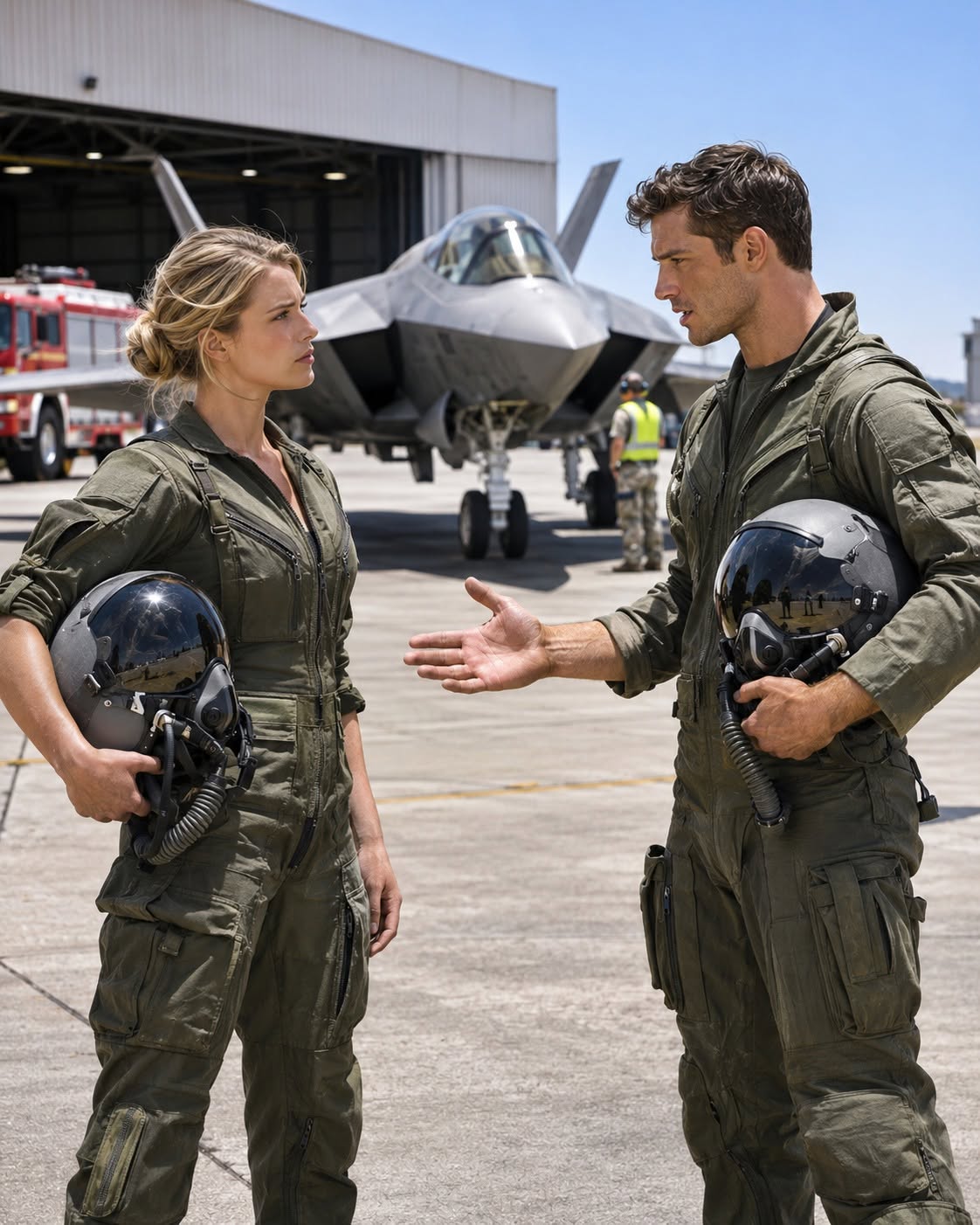
But someone had changed the coordinates.
We arrived at the extraction zone and found no scientist, only a trap. Our aircraft were attacked before we could land. Two pilots died in the first few minutes. Another was forced down in the mountains.
I had been ordered to abandon him.
Instead, I turned back.
My wingman, Daniel Reeves, stayed behind to cover me. He was the best friend I ever had, the kind of man who could make you laugh in the middle of a nightmare. He took the final hit while I was pulling the stranded pilot out of the valley.
I never saw Daniel again.
The official report said he had been killed in an equipment failure.
I knew better.
Someone had given the enemy our coordinates.
And now, twenty-two years later, that same symbol was flying toward the base.
“Ghost,” the controller said, “we have another problem. The drone just changed course.”
I looked at the tracking data.
It wasn’t heading for the runway anymore.
It was heading toward the underground communications center.
The base’s emergency command bunker.
“It’s targeting the command facility,” I said.
“Can you intercept?”
I looked at the distance, the speed, the remaining fuel, and the unreliable systems.
“I’m going to try.”
I pushed the fighter forward, but the drone was faster. Its trajectory shifted with almost unnatural precision, weaving between cloud banks and avoiding every attempt our limited tracking system made to predict its path.
It wasn’t simply autonomous.
It was anticipating.
Every time I moved to intercept, it adjusted.
I remembered a phrase Dr. Voss had once used when explaining his guidance system.
“It doesn’t follow a target,” he’d said. “It follows the target’s decisions.”
That was the difference.
The drone wasn’t reacting to our movements. It was predicting what we would do next.
I stopped trying to chase it.
Instead, I let the fighter level out and watched the few fragments of data still coming through. I began thinking about the old mission, about the way our extraction had gone wrong, and about the one thing that had never made sense.
Why had the enemy known our route before we arrived?
Why had they been waiting at the exact coordinates?
Why had Daniel’s aircraft been hit before he even reached the valley?
The answer came suddenly.
Nightglass hadn’t been a failed extraction.
It had been a demonstration.
Someone had wanted to see the guidance system work under real combat conditions.
And we had been the targets.
“Commander,” I said, “who authorized the Nightglass operation?”
“We’re pulling the records.”
“Who signed the mission order?”
“Stand by.”
My heart began pounding.
There was a name I hadn’t wanted to see for two decades.
A name I had spent years convincing myself was impossible.
“Ghost,” the commander said, his voice suddenly uneasy, “the mission was approved by General Adrian Cross.”
I closed my eyes.
Adrian Cross had been my commanding officer. He had trained me, promoted me, and stood beside me at Daniel’s memorial. He had told me that the men we lost had died serving a noble cause.
He had even written me a letter when I retired.
I had kept it in a drawer for years.
Now I knew why.
“Get him on the emergency channel,” I said.
“Sir, General Cross retired eight years ago.”
“Then find him.”
The drone slipped below the cloud layer.
My warning system flashed red.
The base was less than a minute from impact.
I made a decision.
I stopped pursuing the drone and turned toward the mountains.
“Ghost, what are you doing?” the controller shouted.
“I’m going to find the answer.”
“That’s not your mission!”
“No,” I said. “It never was.”
The drone disappeared from my display.
I had lost visual contact, but the mountains below were familiar. The old Nightglass coordinates lay in a narrow valley east of the base. If the drone was following a route tied to its original programming, there was a chance it would pass through the same terrain.
I wasn’t chasing the aircraft anymore.
I was chasing the man who had built its purpose.
As I approached the valley, an emergency frequency crackled.
“Ghost.”
I froze.
The voice was older, rougher, but unmistakable.
“Daniel?”
For several seconds, all I could hear was the sound of my own breathing.
Then the voice spoke again.
“It’s been a long time, brother.”
I nearly lost control of the aircraft.
“Where are you?”
“Somewhere you should have forgotten.”
“Daniel, we buried you.”
“No. You buried the story they gave you.”
My eyes burned.
“Are you alive?”
“Not for long, if that drone reaches the bunker.”
“Who sent it?”
“Cross.”
I felt the old anger rise, but Daniel’s next words stopped me.
“He doesn’t want to destroy the base. He wants to destroy the evidence inside it.”
“What evidence?”
“The original Nightglass recordings. Everything that proves what happened to our team. The drone is carrying a recovery program. If it reaches the bunker, it will erase the archive and kill everyone standing in its way.”
“Why didn’t you contact me?”
“I tried. Your retirement file was sealed. Cross made sure nobody could reach you.”
The drone appeared in the distance, a dark shape cutting through the clouds.
“Daniel, where are you?”
“Below the old facility.”
I looked down at the valley.
There it was.
A concrete structure hidden beneath the mountain, the entrance partially collapsed and surrounded by abandoned equipment. It had been the site of our original mission.
“I’m coming,” I said.
“No,” Daniel replied. “You need to stop the drone.”
“I’m not leaving you again.”
“Listen to me. You already saved me once. Now you have to save the people who are still alive.”
I looked toward the base.
The drone was closing in.
Daniel was right.
I had spent twenty-two years living with the belief that turning back had cost me my best friend. Now I had another chance, and this time I couldn’t allow the past to make the decision for me.
I turned toward the base.
“Control, I need every remaining ground unit evacuated from the communications bunker. Immediately.”
“Evacuation is underway. The drone is less than thirty seconds away.”
“Then keep them moving.”
I dove toward the drone, but it changed course again, moving toward the bunker entrance with frightening speed.
I could not afford a mistake.
I thought about the young pilots who had laughed at me, the men and women who had never seen combat outside a training exercise, and the commander who was trying to keep his people alive with systems that had suddenly become useless.
They didn’t need a legend.
They needed someone to make the right choice.
I made one last attempt to reach the drone’s control frequency.
“Black Meridian,” I said. “This is Ghost.”
The channel went silent.
Then a voice answered.
“Identification confirmed.”
The drone slowed.
For one impossible moment, it seemed to hesitate.
I knew that was my only chance.
I transmitted the old Nightglass cancellation code, a phrase designed to stop the mission if the extraction team discovered that the operation had been compromised.
The code had never been used.
The drone’s lights flickered.
Its trajectory changed slightly.
“It’s responding!” the controller shouted. “Ghost, whatever you did, it’s working!”
But the drone didn’t stop.
It continued toward the bunker.
I had only bought a few seconds.
Then I noticed something on the drone’s display. A small secondary signal was transmitting beneath the main identification packet.
Someone had built a second command into the system.
A command that would override the cancellation code.
Cross hadn’t simply sent a drone to destroy the evidence.
He had made sure it would never be stopped.
I thought about Daniel’s voice.
*Save the people who are still alive.*
The drone wasn’t going to be stopped by an old code.
It was going to have to be stopped by someone willing to risk everything.
I looked at the runway beyond the base, at the emergency lights flashing against the morning sky.
Then I made my final decision.
“Control,” I said, “tell the commander I need him to trust me.”
“Ghost, what are you planning?”
“Something I should have done twenty-two years ago.”
I turned the fighter toward the drone and climbed.
The aircraft’s engines screamed as I pushed it to the edge of its limits. I wasn’t trying to catch the drone anymore. I was trying to get ahead of it, to place myself between its trajectory and the bunker.
I had one chance.
I pulled the fighter into a sharp turn, forcing the drone to adjust its course. It followed, its guidance system locking onto the aircraft.
For a moment, I thought it had worked.
Then the drone accelerated.
The warning alarms sounded again.
I was out of time.
I glanced at the control panel, then at the valley below.
The drone’s guidance system was designed to follow a target’s decisions.
So I stopped making predictable ones.
I pulled away from the base, toward the empty mountain range, and let the drone follow me.
“Ghost, you’re heading away from the intercept zone!” the controller shouted.
“That’s the idea.”
The drone followed.
The bunker was no longer in its path.
I led it toward the open valley, away from the base, away from the people who had no idea how close they had come to dying.
My fuel warning flashed.
The drone was still gaining.
I could feel the fighter shaking beneath me.
Then, just as the drone closed the distance, I heard Daniel again.
“Ghost, there’s a manual shutdown at the old facility. If you can get it to follow the signal, I can stop it.”
“Can you reach it?”
“I’m already there.”
I looked at the mountains.
“Daniel, I need you to do something dangerous.”
“That’s why you called me.”
I turned toward the old facility, dragging the drone behind me.
The valley narrowed.
The mountain walls rose on both sides.
The drone followed my fighter into the canyon.
I could see the abandoned facility ahead, a rusted antenna standing above the entrance.
“Daniel, I’m approaching.”
“Copy.”
The drone’s signal strengthened.
I knew what that meant.
It was receiving the override.
The old system was still alive.
The fighter’s warning lights flashed one final time.
My fuel was nearly gone.
I pulled away from the canyon, giving the drone a clear path toward the antenna.
The drone changed course.
For the first time, it stopped following me.
It followed the signal.
“Daniel!”
“Now!”
A burst of light flickered across the old antenna.
The drone’s engines cut out.
Its wings locked.
It dropped from the sky like a stone.
I watched it disappear behind the mountain, then heard a distant explosion.
The valley fell silent.
For several seconds, I couldn’t breathe.
Then the controller’s voice came through.
“Ghost… the drone is gone.”
I closed my eyes.
“Confirm the base is safe.”
“Confirmed. The bunker is intact. Everyone’s accounted for.”
I let out a breath I hadn’t realized I was holding.
The fighter began losing altitude.
I had just enough fuel to make it back to the runway.
As I approached the base, the emergency lights faded. The radar slowly came back online, and the control room began filling with voices again.
When I landed, the ground crew rushed toward the aircraft.
Captain Miller stood near the runway, his face pale.
He didn’t say anything at first.
Then he stepped forward.
“Sir… I owe you an apology.”
I climbed out of the cockpit and looked at him.
“You don’t owe me anything.”
He shook his head.
“I judged you without knowing who you were.”
I glanced toward the hangar.
“That’s the mistake most people make. They see someone’s position, not their experience.”
The commander arrived a few minutes later.
He was holding a tablet.
“Ghost, we found the archive. And we found something else.”
I looked at him.
“What?”
“General Cross is alive. He was at a private facility outside the country. We’ve already sent a team to bring him in.”
I felt no satisfaction.
Only exhaustion.
“Make sure he gets a fair trial,” I said.
The commander frowned.
“After what he did?”
“Especially after what he did.”
The old facility was opened that afternoon.
Daniel was found inside, injured but alive. He had spent years hiding from the people who wanted the Nightglass records erased. When the drone was activated, he had risked everything to reach the shutdown system.
When I saw him, I didn’t know what to say.
He looked older than I remembered, his hair gray, his face scarred, but his eyes were the same.
He smiled.
“You took your time.”
I laughed, then broke down.
We embraced, two men who had spent more than two decades believing the other had disappeared forever.
The Nightglass archive was recovered.
The truth about the Black Meridian was finally made public. The names of the five pilots who died were restored to the official records. Their families received the truth, not the fabricated story of an equipment failure.
And General Cross was brought to trial.
He had betrayed his own men for the sake of a weapon he believed would make him untouchable. But in the end, the technology he had created became the very thing that exposed him.
Months later, I stood in front of a group of young pilots in the simulator room.
Captain Miller was among them.
He no longer laughed when someone corrected him. He listened.
I placed my old clipboard on the desk.
“Today’s lesson,” I said, “isn’t about speed, skill, or how many medals you can earn.”
I looked around the room.
“It’s about knowing when to trust your instincts, when to question an order, and when to protect the people who depend on you.”
Miller raised his hand.
“Sir, how did you know you could stop that drone?”
I thought about Daniel, the five men we had lost, and the years I had spent believing that silence was the only way to survive.
“I didn’t know,” I said. “I just knew I couldn’t let fear make the decision for me.”
The room was quiet.
Then I picked up the clipboard and walked toward the simulator.
Outside, the morning sun was rising over the runway.
For the first time in twenty-two years, the sky didn’t feel like a battlefield.
It felt like a place where people could begin again.
And sometimes, the greatest heroes aren’t the ones who never fall.
They’re the ones who finally find the courage to come home.