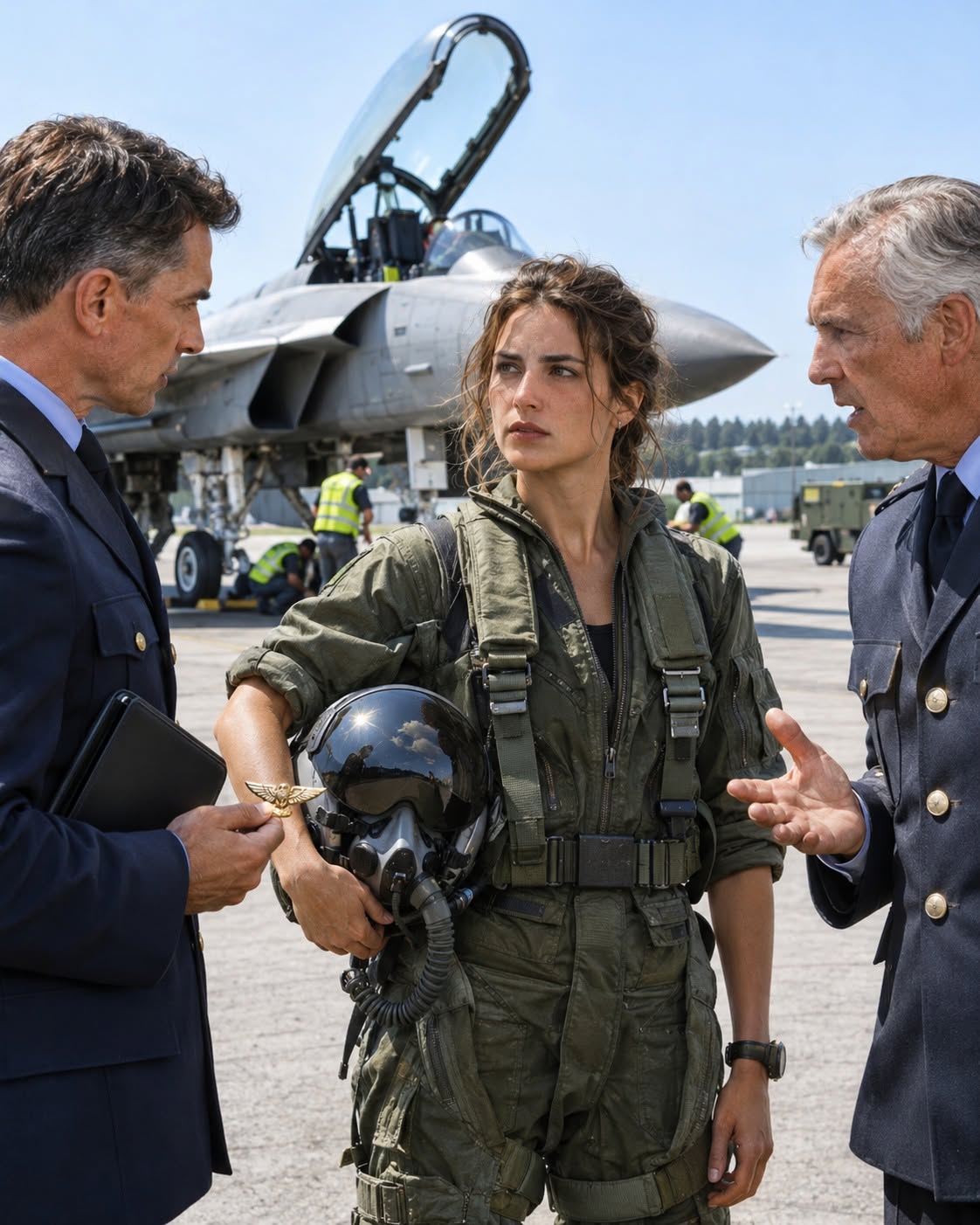
The day they took away my pilot wings, I knew someone had gone too far. But I never imagined that the same people who grounded me would one day need me to save their lives.
The general opened the folder and began reading.
At first, he said nothing. He simply turned one page after another, his expression growing colder with every document. The room was quiet except for the rain tapping against the windows and the occasional radio transmission coming from the operations desk.
My former superior, Colonel Marcus Hale, stood near the doorway with his arms folded.
“Sir, I believe these documents have been taken out of context,” he said. “Captain Bennett has a history of refusing to follow direct instructions.”
The general didn’t look up.
“Then explain why three different reports contain the same wording, yet were supposedly written by three different officers.”
Hale shifted his weight.
“Administrative language is often standardized, sir.”
The general finally raised his eyes.
“Standardized language is one thing. Identical accusations submitted within eleven minutes of one another, with identical errors in the timestamps, is another.”
My stomach tightened.
I had noticed those timestamps weeks earlier, but I hadn’t been able to prove who had manipulated them. Now the general had spotted it without my saying a word.
He reached the last page, placed it on the desk, and looked directly at me.
“Captain, did you collect these records yourself?”
“Yes, sir.”
“Why?”
“Because I knew the official investigation wasn’t going to ask the questions that needed asking.”
For the first time since I had been grounded, I felt like someone was actually listening.
The general leaned back in his chair.
“Colonel Hale, I want you to surrender your command authority pending an independent review. You will not contact anyone involved in this case, and you will not interfere with the investigation.”
Hale’s face turned red.
“Sir, with all due respect, you cannot remove me based on a disgruntled pilot’s private collection of paperwork.”
“I haven’t removed you based on paperwork,” the general replied. “I’ve removed you because your explanation doesn’t match the records.”
Two security officers appeared at the doorway.
Hale stared at me as they escorted him out.
His eyes weren’t filled with anger anymore.
They were filled with something far more unsettling.
Fear.
I should have felt victorious. Instead, I felt as if I had just opened a door to something much larger than my suspension.
The general stood and walked toward the window.
“Captain Bennett, how long have you suspected this was deliberate?”
“Since the first week, sir.”
“And why didn’t you report it through another channel?”
“I did. Twice.”
He turned sharply.
“Where are those reports?”
“Both were marked received. Neither was ever acknowledged.”
The general looked toward the operations desk.
“Get me the audit trail on those submissions. Every access log. Every routing change. I want to know where they disappeared.”
That was the moment I realized this wasn’t going to be a simple disciplinary reversal.
Someone had been burying complaints.
And if they had done it to me, they might have done it to others.
By midnight, the rain had weakened, but the investigation had only begun.
I was taken to a secure office where a civilian investigator named Evelyn Shaw waited. She was in her forties, with short silver-streaked hair, a worn leather notebook, and the kind of expression that made it impossible to tell whether she was impressed or suspicious.
She introduced herself as the lead investigator assigned to the general’s inquiry.
“I’m going to ask you some questions,” she said. “And I want you to understand something. Saving an aircraft today doesn’t make you automatically right about everything that happened before.”
“I understand.”
“Good. Because if you’re telling the truth, the records will support it. If you’re not, they’ll expose that too.”
I liked her immediately.
She spent the next four hours examining my folder. She asked me to explain every document, every handwritten note, every date, and every conversation I had recorded in my personal log.
She didn’t praise me.
She didn’t comfort me.
She simply checked everything.
At 2:17 a.m., she stopped on a page containing a copy of an order I had been instructed to execute shortly before my suspension.
“Did you refuse to sign this?”
“Yes.”
“Why?”
“The aircraft maintenance status was listed as complete, but the inspection had never been performed. I was being told to approve a flight that I believed wasn’t safe.”
Evelyn looked at me over the paper.
“Who gave you the order?”
“Colonel Hale.”
“Did you report the safety concern?”
“I filed a discrepancy report. Then I was told to withdraw it.”
“Did you?”
“No, ma’am.”
She turned the page.
“That’s when your disciplinary action began.”
“Yes.”
Evelyn closed the folder.
“Captain, I think we have a problem.”
I almost laughed.
“Just one?”
She didn’t smile.
“Your case is connected to at least four others.”
My laughter disappeared.
She pulled a second file from her briefcase.
It belonged to Lieutenant Daniel Reeves, a young pilot who had been reassigned after questioning a maintenance discrepancy. Another file belonged to a flight engineer whose promotion had been delayed after he reported a suspicious parts substitution. The third was a ground crew supervisor who had been transferred to another base after refusing to certify equipment he hadn’t inspected.
All three had been accused of being difficult.
All three had lost opportunities.
And all three had their complaints mysteriously disappear from the official system.
“Colonel Hale has been in charge of operations here for nearly six years,” Evelyn said. “If this pattern is real, it won’t stop with him.”
I stared at the files.
For weeks, I had believed my fight was about getting my wings back.
Suddenly, it was about making sure nobody else lost theirs for doing the right thing.
The following morning, I was summoned to the general’s office.
He stood behind his desk, looking as though he hadn’t slept.
“Captain Bennett, the aircraft you assisted last night carried a black-box recording system. Preliminary review indicates the emergency was made worse by an earlier maintenance discrepancy.”
I felt a chill.
“Sir?”
“The aircraft had an issue with a hydraulic pressure sensor. It had been reported several days before the flight. The discrepancy was closed without the required verification.”
I thought about the emergency call. The storm. The crew struggling to keep the aircraft stable.
“Was that report connected to Colonel Hale?”
“We’re still confirming that.”
He paused.
“But I need to ask you something. If you had been in command of that aircraft yesterday, would you have made the same decision to fly?”
I knew what he was asking.
“Absolutely not, sir.”
“Even if the mission had been considered important?”
“Especially then, sir. Important missions don’t make unsafe aircraft safe.”
The general nodded slowly.
“That’s what I thought you’d say.”
He walked around the desk and handed me a document.
It was a temporary reinstatement order, authorizing me to return to flight duties under supervision while the investigation continued.
I stared at it.
“Sir, I thought my suspension would remain in effect until the case was closed.”
“It was issued under a process now under investigation. I’m not going to pretend the entire system is clean while we review it. But your flying qualifications remain valid, and your emergency assistance yesterday was documented. You’ll return under an independent chain of oversight.”
My hands were shaking slightly as I took the paper.
After weeks of staring at grounded aircraft from a window, I was going back to the cockpit.
But the general wasn’t finished.
“Don’t mistake this for a reward, Captain. You’re returning because the evidence supports it and the unit needs qualified people. I expect the same discipline from you that I expect from every pilot.”
“Yes, sir.”
“And if you discover anything else, report it. Don’t try to carry an entire investigation by yourself.”
That last sentence stayed with me.
I had spent weeks gathering evidence alone because I no longer trusted anyone.
Now I was being told that trust wasn’t supposed to mean blind obedience, and courage wasn’t supposed to mean isolation.
Three days later, I returned to the flight line.
The first thing I noticed was the smell.
Jet fuel, wet concrete, and the familiar metallic scent of the hangar.
I hadn’t realized how much I missed it until it hit me.
Lieutenant Reeves was standing beside a training aircraft when he saw me.
“Captain Bennett?”
“That’s me.”
He grinned.
“I heard you got your wings back.”
“Temporarily.”
“Still counts.”
We shook hands. He told me he’d been afraid his career was over after his reassignment. I told him I knew the feeling.
Before we could say much more, our flight instructor called us over.
My first flight back wasn’t glamorous. It was a routine proficiency check under supervision, and every maneuver was assessed. I made one minor correction during the approach, caught it, and adjusted.
When I climbed out of the aircraft, the instructor handed me the evaluation.
“Good work,” he said. “You’re rusty, but you’re safe. Keep your head clear.”
I smiled.
“That’s the plan.”
For the first time in months, I went home exhausted in a way that felt good.
But the investigation was far from over.
Evelyn Shaw had begun interviewing people from other units. Some were willing to speak openly. Others requested anonymity. A few suddenly remembered that they had never seen anything unusual.
Then, on the sixth day, a security officer discovered something that changed the entire case.
An encrypted storage device had been found in a locked cabinet inside Colonel Hale’s former office.
It contained draft disciplinary reports, altered maintenance records, and a spreadsheet tracking personnel who had filed safety complaints.
My name was near the top.
Beside it was a note:
“Remove from flight rotation before inspection cycle. Uncooperative. Potential liability.”
I read the line three times.
Potential liability.
That’s what I had become in the eyes of someone who wanted to avoid accountability.
But beneath my name were several others.
Daniel Reeves.
Sergeant First Class Nolan.
Flight Engineer Patel.
And a name I didn’t recognize.
Major Thomas Ward.
Evelyn called me into her office that afternoon.
“Do you know Major Ward?”
“No, ma’am.”
“He was the deputy maintenance officer at this base two years ago. He filed a report about unauthorized replacement parts. A month later, he was reassigned. Six months after that, he resigned.”
“Was he forced out?”
“We’re looking into it.”
She tapped the spreadsheet.
“This is not just an attempt to silence people. It looks like someone was systematically identifying personnel who might interfere with a procurement arrangement.”
I felt my mouth go dry.
“Procurement?”
“That’s what we suspect. Several contracts are under review. Some equipment deliveries were approved despite discrepancies between the invoices and the actual components received.”
I looked at the list of names.
“Then we need to find Ward.”
Evelyn nodded.
“We already tried. His address on file is outdated.”
I remembered something Reeves had told me earlier that day.
Major Ward had once been a guest speaker at a safety workshop. He’d left behind a handwritten contact card with a personal email address on it, tucked into an old training binder.
I had kept the binder because his lecture had been one of the few that made me feel proud of being a pilot.
I found the card that evening.
The next morning, Evelyn contacted Ward through an official channel and requested a voluntary interview.
He agreed.
Major Ward arrived two days later.
He was a quiet man with a tired face and a slight limp. He sat across from Evelyn, placed a small envelope on the table, and said,
“I knew this would happen eventually.”
Inside the envelope were copies of purchase orders, inspection reports, and photographs of components that had been delivered but never installed.
Ward had kept them after his resignation.
He hadn’t known whether they would ever matter.
Now they did.
The investigation widened. Auditors traced the procurement records. Several suppliers were questioned. Two officers were placed under review. A civilian contractor was suspended from further work pending investigation.
Colonel Hale’s case became a federal inquiry.
And the more evidence they uncovered, the more obvious it became that the system hadn’t failed by accident.
People had learned to look away because looking too closely was dangerous.
The hardest part wasn’t proving that Hale had done something wrong.
The hardest part was proving how many people had allowed it to happen.
A month later, I was called to a hearing.
The room was filled with officers, legal advisers, investigators, and several people who had been affected by the decisions under review.
Colonel Hale sat at the far end of the table.
He looked older than I remembered.
When it was my turn to testify, I stood, raised my hand, and answered every question as carefully as I could.
Hale’s attorney asked whether I had ever disliked the colonel.
“Yes,” I said.
“Had you ever disagreed with his decisions?”
“Frequently.”
“Were you angry when he suspended your flying privileges?”
“Of course.”
“Then isn’t it possible that your documents are simply the product of a resentful officer trying to damage his superior?”
I took a breath.
“It is possible for me to be angry and for the documents to be true. That’s why I preserved the originals, why I reported through official channels, and why I asked for an independent review. I didn’t expect anyone to believe me just because I was upset. I expected them to verify what I had submitted.”
The room fell quiet.
I wasn’t trying to sound brave.
I was simply telling the truth.
When the hearing ended, I walked outside into the cool afternoon air. Reeves was waiting on the steps.
“How’d it go?”
“I think I told them everything I know.”
He nodded.
“That’s all anyone can do.”
For the first time, I believed him.
Two weeks later, the general called me into his office.
The inquiry had concluded its preliminary findings. Colonel Hale had been formally charged with misconduct, falsification of records, obstruction of reporting procedures, and abuse of authority. The procurement investigation was still ongoing, but several fraudulent approvals had already been identified.
My suspension was officially overturned.
The disciplinary record was cleared.
My flight status was fully restored.
I was offered a choice of assignments, including a position in a training squadron where I could help develop a new safety reporting program.
The general looked at me.
“Captain Bennett, you’ve earned the right to choose what comes next.”
I expected to ask for the cockpit.
I expected to request the most demanding flight assignment available.
But I found myself thinking about the people whose names were still in that spreadsheet. The ones who had been reassigned, dismissed, or discouraged from speaking. The people who might never know that their complaints had mattered.
“Sir,” I said, “I’d like to work with the safety and training division.”
He raised an eyebrow.
“You’re giving up an operational assignment?”
“Not giving it up. Just changing how I serve.”
He studied me for a moment.
“Why?”
“Because I know what it feels like when the only thing you can do is watch someone else fly. And I know what it feels like when nobody believes you. I want to make sure the next pilot who raises a concern doesn’t have to choose between their career and their conscience.”
The general nodded.
“That’s a good reason.”
Six months later, the base had changed in ways I never expected.
The new reporting system allowed personnel to submit safety concerns through an independent channel. Every report received a tracking number. The status could not be changed without an audit record. Personnel could see whether their concern had been reviewed, investigated, or resolved.
Reeves became a flight instructor.
Sergeant Nolan returned to his original unit.
Major Ward’s testimony helped expose the procurement scheme, and several contracts were canceled.
The aircraft I had helped save that stormy afternoon became part of the story that people told when discussing the reforms.
But I never allowed myself to believe that one emergency landing had fixed everything.
Systems didn’t change because one person was brave.
They changed when people stopped treating courage as an inconvenience.
On the day I received my permanent reinstatement, I stood near the runway and watched a new group of pilots prepare for their first training flight.
A young lieutenant approached me, holding a clipboard.
“Captain, can I ask you something?”
“Of course.”
“Is it true you were grounded for refusing an order?”
I looked at the aircraft, then back at him.
“It’s true I was grounded. But that’s not the part you should remember.”
He frowned.
“What should I remember, then?”
I thought about Hale. The general. Evelyn. Ward. The people who had stayed quiet because they were afraid. The ones who had finally decided fear wasn’t worth the cost.
I answered carefully.
“Remember that following orders is part of being a professional. But protecting people is the reason those orders exist in the first place. If you ever have to choose between protecting your career and protecting lives, make sure you understand what you’re protecting.”
The lieutenant nodded slowly.
Then he climbed into the aircraft.
I watched him taxi toward the runway.
For years, I had believed that my wings were the proof that I belonged.
I had been wrong.
My wings were never the thing that made me a pilot.
It was the judgment I used when the pressure was greatest, the honesty I kept when it cost me something, and the responsibility I accepted when nobody was watching.
The storm had taken my career away for a time.
But it had also shown me what mattered more than rank, reputation, or applause.
And when the aircraft lifted into the sky, I finally understood that the greatest victory wasn’t getting my wings back.
It was making sure no one else had to lose theirs for doing the right thing.
THE END