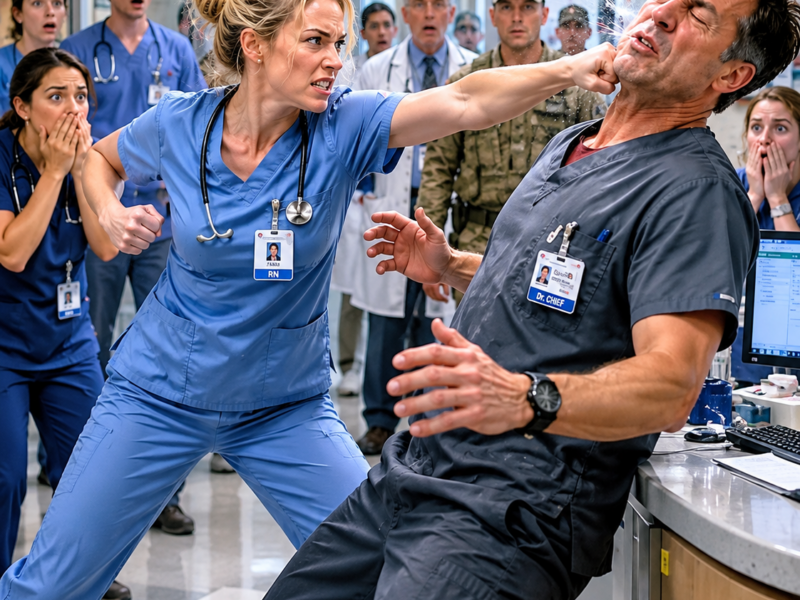
“You’re just a nurse. Go back to overflow before you get someone killed.”
The admiral had asked to see me.
Not the hospital director. Not the attending physician. Not even Captain Richard Hayes, the officer who had spent the better part of the afternoon treating me like an inconvenience.
The admiral wanted me.
And as I followed the uniformed officer down the corridor of Harbor Point Medical Center, I felt seven years of memories pressing against the walls I had built around them.
I had left the military for a reason. I had traded field uniforms for blue scrubs, operational briefings for patient charts, and the constant possibility of losing someone for the quieter hope of helping people recover.
I had wanted to become Emma Mitchell again.
Not the combat medic whose name appeared in classified reports. Not the woman who had carried a wounded teammate through smoke while bullets struck the ground around her. Not the person who still woke some nights hearing a radio call that had ended too soon.
Just Emma.
A nurse who showed up for her patients and went home at the end of her shift.
But when the officer opened the conference room door, I knew that version of my life had just become more complicated.
A four-star admiral stood beside the window, looking out over the hospital parking lot. The military physician who had questioned me earlier sat at the table with a thick folder in front of him.
And Captain Hayes was there, too.
He stood beside the door with his arms crossed, his expression suggesting that he considered this entire meeting an unnecessary interruption.
“Lieutenant Commander Mitchell,” the admiral said.
My heart seemed to stumble.
I hadn’t heard anyone use my former rank in years.
“Sir,” I replied automatically.
He turned toward me.
“Thank you for coming. Please sit.”
I took the empty chair.
Captain Hayes glanced at me, then at the admiral.
“Admiral, with respect, I believe there’s been a misunderstanding. Nurse Mitchell is a new civilian employee. She overstepped her authority during a medical emergency today, and I was attempting to correct that.”
The admiral didn’t sit.
“Is that what happened, Captain?”
Hayes straightened.
“Yes, sir.”
“Interesting.”
The admiral opened the folder.
“Because the report I received describes a nurse who identified a rapidly deteriorating casualty, communicated a critical concern to the attending physician, and assisted the trauma team during resuscitation.”
He turned a page.
“It also describes a senior officer who repeatedly interrupted clinical care to argue about the nurse’s job title.”
The silence was immediate.
Hayes’s jaw tightened.
“With respect, sir, I was concerned about the chain of command.”
“The chain of command does not replace medical judgment,” the admiral replied. “And it certainly doesn’t authorize you to interfere with a hospital’s clinical team.”
Hayes said nothing.
The admiral looked at me.
“Emma, I want to make one thing clear. Your military history does not exempt you from hospital protocols. You did the right thing by raising your concern to the attending physician, and the clinical decisions remained with the treating team. That’s exactly how it should work.”
“Yes, sir.”
“But your history is relevant to another matter.”
He slid a document across the table.
The first page contained my name, my former rank, and a photograph I hadn’t seen since I left the service.
I was younger in it, wearing a combat uniform and a medical pack, my face streaked with dust. Six exhausted service members stood behind me.
One of them was my brother, Daniel.
My breath caught.
For a moment, the room disappeared.
I was back in a temporary medical station overseas, listening to Daniel tease me about the way I tied my boots. He had been alive then. Tired, wounded, and still making jokes because he knew I was frightened.
I forced myself to look down at the document.
“What is this, sir?”
“An official review of Operation Black Harbor,” the admiral said. “A review that was reopened three weeks ago after new information came to light.”
I lifted my eyes.
“Why?”
He exchanged a glance with the military physician.
“Because a former member of that operation recently came forward with information that contradicts part of the original report.”
My fingers tightened around the edge of the table.
“What information?”
The admiral’s expression softened.
“The report states that six special operations personnel were recovered after their transport vehicle was disabled during an extraction. It credits the medical team for stabilizing the wounded, but it fails to identify the individual who crossed an exposed stretch of ground to reach the casualties and provide emergency treatment.”
“I was part of a team, sir.”
“Yes. But you were also the medic who went back.”
I looked away.
I remembered the smoke.
The overturned vehicle.
The radio operator who could no longer feel his legs.
I remembered Daniel shouting at me to stay behind cover, then realizing that I was already moving toward the wounded.
I remembered telling myself that I wasn’t going to leave anyone there.
And I remembered the moment I realized my brother had been hit.
I closed my eyes briefly.
“I did what I was trained to do.”
“You did more than that,” the admiral replied. “You continued treating casualties after you were injured yourself.”
Captain Hayes shifted beside the door.
The admiral noticed.
“Captain, you may find the rest of this conversation instructive.”
Hayes’s face reddened.
“Sir, I had no idea she was—”
“You had no idea because you didn’t ask.”
The admiral’s voice wasn’t loud. It didn’t need to be.
“You saw a civilian nurse and decided you already understood her capabilities. Then you publicly humiliated her. That’s not leadership, Captain. That’s prejudice dressed up as authority.”
Hayes stared at the floor.
I should have felt satisfied.
Instead, I felt tired.
I hadn’t wanted a public apology or a room full of people suddenly treating me differently because of a photograph. I wanted to know why the past had returned, and whether it would take away the ordinary life I had fought so hard to build.
“Admiral,” I said carefully, “what does this have to do with Petty Officer Cole?”
The admiral closed the folder.
“His condition is serious, but the surgical team has stabilized him for now. He’s not out of danger.”
I nodded, fighting the urge to ask for more details before the treating team was ready to provide them.
“The reason I came here,” he continued, “is that Petty Officer Cole was part of a unit whose personnel have been reviewing the events surrounding Operation Black Harbor. He recognized your name when it appeared in his medical records.”
“Why would he recognize my name?”
“Because Daniel Mitchell was his instructor during his early training.”
The words landed like a physical blow.
I stared at him.
“Daniel was never assigned to Cole’s unit.”
“Not permanently. But he helped train several personnel before his final deployment. Petty Officer Cole remembers him.”
For several seconds, I couldn’t speak.
My brother had been dead for seven years.
I had spent those years trying to make peace with the pieces of him I could still hold: a photograph in my bedside drawer, his handwriting on an old birthday card, the occasional memory that arrived without warning while I was driving home from work.
And now a wounded stranger had carried his name back into my life.
“What did Mason say about him?” I finally asked.
The admiral glanced at the physician.
“He hasn’t been able to speak with us at length. But before he went into surgery, he asked whether the nurse who treated him was Daniel Mitchell’s sister.”
I lowered my head.
A tear slipped onto the back of my hand.
I quickly wiped it away.
The admiral waited until I looked up again.
“Emma, nobody expects you to return to military service. This isn’t a recruitment meeting, and your civilian career is yours to protect. But we need your help understanding one part of the original operation report.”
I took a breath.
“What part?”
He turned to the final page.
“Daniel’s last recorded communication.”
My entire body went cold.
I knew that the military had preserved recordings from the operation. I had never requested them. After Daniel’s death, I couldn’t bear the thought of listening to his voice trapped in a recording, unable to answer me.
The admiral continued carefully.
“The original report classified his final transmission as incomplete. The review team believes that the recording may contain additional information about the evacuation and the decision to redirect the team.”
I stared at him.
“Are you saying the original report was wrong?”
“I’m saying it may have been incomplete. We have no evidence that anyone deliberately concealed information, but the discrepancy warrants a proper review.”
He paused.
“Your memory of the operation could help us establish the timeline.”
I looked down at Daniel’s photograph again.
I had spent years believing that the hardest part of losing my brother was learning to live without him.
Now I was being asked to revisit the final hours of his life.
I didn’t know whether I was ready.
But I knew I couldn’t ignore the possibility that the truth had been misunderstood.
“I’ll help,” I said quietly. “As long as the investigation follows the proper procedures and doesn’t compromise the patients I’m responsible for.”
The admiral nodded.
“Agreed.”
Then he turned toward Captain Hayes.
“Now, Captain, we need to discuss your conduct today.”
Hayes swallowed.
“Yes, sir.”
“Your request to remove Nurse Mitchell from military casualty cases is suspended pending review. You will not interfere with her clinical duties or attempt to influence the hospital’s assignment decisions.”
“Yes, sir.”
“And you will provide a written account of today’s events. An accurate one.”
Hayes’s face had lost its earlier confidence.
“Yes, sir.”
The admiral closed the folder.
“That will be all.”
I stood.
As I reached the door, Captain Hayes spoke.
“Lieutenant Commander Mitchell.”
I turned.
He looked uncomfortable, almost as though the words physically hurt him.
“I owe you an apology.”
I waited.
“I was wrong to speak to you that way. I shouldn’t have questioned your professionalism in front of your colleagues, and I shouldn’t have allowed my assumptions to interfere with the situation.”
His eyes briefly met mine.
“I’m sorry.”
I studied him for a moment.
“Thank you, Captain.”
He seemed to expect more.
Perhaps anger. Perhaps a lecture. Perhaps a declaration that his apology had arrived too late.
But I had patients waiting.
And I had learned a long time ago that not every difficult moment needed to become a battle.
“I hope you’ll remember this the next time someone doesn’t fit your expectations,” I added.
Then I left the room.
I had no idea that Captain Hayes would soon face a far more difficult test of his own leadership.
Or that, before the week was over, he would have to choose between protecting his pride and doing what was right for the people under his command.
When I returned to the emergency department, everything looked exactly as I had left it.
The phones were ringing. A child was crying near the registration desk. Two nurses were arguing over a missing supply cart, and Patricia was trying to convince a patient that a blood pressure cuff wasn’t a personal attack.
But people looked at me differently.
A resident who had barely acknowledged me that morning stepped aside to let me pass.
One of the senior nurses approached me with an awkward smile.
“Emma, I heard you used to work with special operations.”
I kept walking.
“I used to work in military medicine.”
“That’s incredible. Why didn’t you tell anyone?”
I stopped.
Because I was tired of being introduced through the worst moments of my life.
Because I didn’t want Daniel’s death to become a conversation starter.
Because I had spent years trying to build an identity that didn’t depend on surviving something terrible.
Instead, I said, “It didn’t seem relevant until today.”
The nurse nodded, looking slightly embarrassed.
I understood her curiosity. But I also understood that a person’s history wasn’t public property just because it was impressive.
Patricia appeared beside me and gently steered me toward the nurses’ station.
“You don’t have to explain yourself to anyone,” she said.
I looked at her.
“Thank you.”
“And for the record, you were right to speak up about Mason. Your experience helped you recognize the warning signs, but what mattered most was that you communicated your concern and the physician acted on it.”
I smiled faintly.
“I’m glad he did.”
“Me too.”
She glanced toward the trauma bay.
“Now go check your patients. The hospital is still falling apart.”
I laughed.
For a few minutes, I was simply a nurse again.
Then the operating room called.
Mason Cole had survived surgery.
His condition remained critical, and the next twenty-four hours would be important, but the surgical team had managed to stabilize him.
I leaned against the counter and closed my eyes.
“Thank you,” I whispered.
I wasn’t sure whether I was speaking to God, to the doctors, or to the memory of a brother who had taught me never to give up on someone who still had a chance.
Perhaps it was all three.
The following morning, Captain Hayes returned to the hospital.
He found me reviewing a patient’s chart near the intensive care unit.
“Mitchell. May I speak with you?”
I looked up.
“Of course, Captain.”
He seemed less certain of himself than he had the day before.
“I submitted my report to Commander Reeves.”
“Thank you.”
“I also spoke with the attending physician about yesterday’s incident.”
I waited.
“He explained the clinical concerns you raised. He said your assessment was appropriate and that your communication helped the team respond quickly.”
“I’m glad Mason is receiving the care he needs.”
Hayes rubbed his forehead.
“That’s not all I wanted to say.”
He took a breath.
“When I arrived yesterday, I saw a nurse who didn’t have the rank or experience I expected. I assumed she was overstepping because she spoke with confidence.”
He paused.
“I was wrong.”
I didn’t interrupt.
“I’ve spent years believing that leadership means being the person with the answers. Yesterday, I was so concerned about maintaining control that I nearly stopped listening to people who were trying to help.”
His eyes moved toward Mason’s room.
“I can’t undo what I said. But I can make sure I don’t repeat it.”
I considered his words.
“Then start by listening to the people around you, Captain. Not because they have impressive backgrounds, but because they may see something you don’t.”
He nodded.
“That’s fair.”
For the first time, I saw something other than pride in his expression.
I saw embarrassment, certainly.
But beneath it was a willingness to learn.
“Would you be willing to meet with my medical team next week?” he asked. “We want to review how we communicate with hospital staff during multiple-casualty incidents.”
I raised an eyebrow.
“Are you asking me to help?”
“Yes.”
“Without telling me to go back to overflow?”
A reluctant smile appeared on his face.
“I’ll try to resist the temptation.”
I laughed.
“All right, Captain. I’ll meet with your team.”
He offered his hand.
I shook it.
It wasn’t friendship. Not yet.
But it was a beginning.
And sometimes, a beginning was more valuable than an apology.
Mason woke three days later.
I wasn’t assigned to his room, but I was passing the intensive care unit when I heard his voice.
“Where’s the nurse?”
A young nurse looked up from his chart.
“Which nurse?”
“The one who kept yelling about my chest.”
I smiled before I could stop myself.
The nurse glanced toward me.
“Do you mean Emma?”
Mason nodded weakly.
“She here?”
I stepped into the room.
“I’m here, Petty Officer.”
He turned his head toward me.
For a moment, he looked confused.
Then he smiled.
“You were right.”
“About what?”
“My chest. The whole thing.”
I pulled a chair beside his bed.
“I’m glad the team was able to treat you.”
He looked down at his hands.
“Captain Hayes told me what happened. He said you used to be military.”
“I did.”
“Were you a corpsman?”
“I worked in military medicine.”
He studied my face.
“Did you know Daniel Mitchell?”
My heart tightened.
“Yes. He was my brother.”
Mason’s expression changed.
He tried to sit up, then winced.
“Easy,” I said, helping him settle back against the pillows. “You need to take your time.”
“Sorry.”
“You don’t have to apologize.”
He swallowed.
“Your brother was one of the best people I ever met.”
I looked at him, suddenly unable to speak.
Mason continued slowly, pausing when his breathing became uncomfortable.
“He helped train our team. He was strict, but he never made anyone feel stupid for asking questions. If you got something wrong, he explained it until you understood.”
I smiled through the ache in my chest.
“That sounds like him.”
“He told us about you once.”
My head lifted.
“He did?”
Mason nodded.
“He said his little sister was stubborn enough to argue with an entire room full of senior officers if she thought someone was being treated unfairly.”
I laughed, startled by the sound.
“He said that?”
“His exact words were, ‘Emma has never met an authority figure she couldn’t annoy.’”
I covered my face.
“Oh, that’s definitely him.”
Mason laughed, then immediately regretted it when his ribs protested.
“Don’t make me laugh,” he muttered.
“I’m a nurse. Making people laugh isn’t part of my official job description.”
“Could’ve fooled me.”
We sat quietly for a moment.
Then Mason’s expression grew serious.
“I heard what happened during Black Harbor. About your brother.”
I looked toward the window.
“I was there.”
“I’m sorry.”
“Thank you.”
He hesitated.
“There’s something else. I don’t know if it’ll help, but I think you should hear it.”
I turned back.
“What is it?”
“Daniel saved my life that day.”
The room seemed to grow still.
Mason took a slow breath.
“Our team was moving through the extraction area when we came under fire. I was separated from the others after the vehicle was hit. I couldn’t move my left leg properly, and I thought I was going to die there.”
He looked at me.
“Daniel came back for me.”
I remembered.
I remembered Daniel shouting over the radio that he had found another casualty. I remembered ordering him to wait for support. I remembered the broken transmission that followed.
I had never known the full details.
Mason’s voice trembled.
“He stayed with me until help arrived. He kept talking the entire time. He asked about my family, my plans, what I wanted to do when I got home.”
He smiled faintly.
“I told him I wanted to buy a house. He told me I should probably start by learning how to keep a plant alive.”
A laugh escaped me, followed by a tear.
“That sounds exactly like him.”
“He made me promise that if I got home, I’d stop putting off the things that mattered.”
Mason looked down.
“I haven’t always kept that promise.”
I reached for the box of tissues beside his bed and handed it to him.
“Neither have I.”
He looked at me.
“Do you think he knew he wasn’t going to make it?”
The question hurt.
I thought about the final letter Daniel had sent me. It had contained a photograph of him standing beside a dusty military vehicle, smiling like he had the whole world figured out.
He had written that he missed home.
He had written that he hoped I would finish my nursing qualifications.
And he had written that, no matter how far apart we were, he would always be proud of me.
“I don’t know,” I answered honestly. “But I know he wasn’t thinking about being a hero. He was thinking about the person in front of him who needed help.”
Mason nodded slowly.
“That’s what he was like.”
When I left his room, I went into the staff restroom and cried.
Not because I had learned something terrible.
Because, for the first time in seven years, someone had given me a memory of Daniel that wasn’t about his death.
It was about his life.
The review of Operation Black Harbor took several weeks.
I met with the military review team after my shifts, answering questions about the evacuation, the medical response, and the final radio transmissions I could still remember.
I was careful not to claim certainty where my memory was incomplete.
The years had blurred some details, and grief had a way of sharpening certain moments while obscuring others.
The investigators compared my recollections with surviving communications logs and witness statements.
They found that the original report had omitted several details about the evacuation sequence. The available evidence did not establish deliberate wrongdoing, but it did support a more complete account of the events.
Daniel’s role in returning for the wounded was formally documented.
So was the work of the other service members who had helped evacuate the casualties.
When the revised report was completed, the admiral invited me to a small meeting at the naval medical facility.
I almost declined.
I didn’t want a ceremony. I didn’t want to stand in front of a room full of people while strangers described my brother as though they had known him better than I had.
But the admiral explained that the meeting would be private, attended by the personnel involved in the review and the families who wished to participate.
So I went.
Captain Hayes was there.
Mason, still recovering, joined by video from the rehabilitation unit. Commander Reeves sat near the front, beside two of the service members who had been evacuated during Black Harbor.
The admiral stood at the head of the room.
“Today’s meeting isn’t about creating heroes,” he began. “It’s about making sure the record reflects what happened, including the actions of those whose contributions were not fully documented.”
He spoke about the revised findings, the limits of what the investigation could establish, and the importance of accurately preserving the experiences of everyone involved.
Then he turned to me.
“Lieutenant Commander Mitchell, your testimony helped us complete the record. On behalf of the review team, thank you.”
He handed me a copy of the revised report.
My hands trembled slightly as I opened it.
There, on one of the final pages, was Daniel’s name.
Not as a casualty number.
Not as a footnote in a military incident.
But as a service member who had returned to help a wounded teammate and contributed to the survival of the people who came home.
I pressed my lips together.
For years, I had feared that the final story of my brother would always be the same: he went away, something terrible happened, and he never returned.
Now, there was more to the story.
There was the man who had made people laugh during difficult training exercises.
The brother who teased me about my terrible cooking.
The sailor who had refused to leave someone behind.
And the friend who had helped a young service member believe he might have a future.
When the meeting ended, Captain Hayes approached me.
“I wanted to tell you something,” he said.
I waited.
“After what happened at the hospital, I reviewed the way my team communicates with medical personnel. I realized there were times when I had dismissed concerns because they came from people I assumed had less experience than I did.”
He looked uncomfortable, but he continued.
“We’re changing that. We’ll be reviewing how we communicate during medical emergencies and how we make sure concerns are heard, regardless of who raises them.”
I nodded.
“That’s good to hear.”
He glanced at the report in my hands.
“Your brother sounds like he was an extraordinary man.”
“He was.”
Hayes lowered his head briefly.
“I wish I’d known that before I spoke to you.”
I looked at him.
“Captain, you shouldn’t have needed to know who my brother was to treat me with respect.”
He held my gaze.
“You’re right.”
This time, he didn’t offer an excuse.
And that mattered.
Six months later, Harbor Point Medical Center held a small recognition ceremony for the emergency department staff who had responded to a series of challenging military casualty cases.
I almost skipped it.
Public recognition still made me uncomfortable, and I had no interest in becoming the hospital’s unofficial “former military hero.”
But Patricia threatened to hide my coffee if I didn’t attend.
So I showed up.
The conference room was full of nurses, physicians, paramedics, and military personnel. Mason was there, walking with a cane and looking considerably healthier than the pale, motionless man I remembered from the trauma bay.
When he saw me, he raised his hand.
“Still causing trouble, Mitchell?”
“Only when necessary.”
“Good. I was worried you’d become respectable.”
I laughed.
The hospital director spoke briefly about teamwork and the importance of communication during emergencies.
Then Captain Hayes stepped forward.
He had asked to say a few words.
“I came to this hospital six months ago convinced that I understood what leadership looked like,” he began. “I believed experience meant having the answers, and authority meant making sure people followed my instructions.”
He paused.
“Then I watched a nurse identify a serious concern, communicate it to the treating physician, and continue helping a team save a life while I was busy arguing about her position.”
Nobody moved.
“I told her she was just a nurse.”
His eyes found mine.
“I was wrong. Not because she had a military background or an impressive record. I was wrong because I had forgotten that every professional deserves to be heard when patient safety is at stake.”
He took a breath.
“Emma Mitchell reminded me that leadership isn’t about making yourself the loudest person in the room. It’s about making sure the right people can do the right thing.”
He turned toward the nursing staff.
“I apologize for the way I behaved. And I intend to do better.”
The room remained quiet for a moment.
Then Patricia began to clap.
Others joined her.
I didn’t feel triumphant.
I felt relieved.
Because the apology wasn’t about proving that I had been right and Hayes had been wrong.
It was about ensuring that the next nurse who spoke up would be heard before an argument could put someone at risk.
After the ceremony, Mason found me near the refreshments table.
“Can I ask you something?”
“Of course.”
“Do you ever regret leaving the military?”
I considered the question.
“Sometimes I miss the people. I miss the sense of purpose, and I miss knowing that everyone around me understands why the work matters.”
He nodded.
“But I don’t regret becoming a civilian nurse,” I continued. “I still help people. I still get to be there when someone needs me. And I get to go home at the end of my shift and have a life outside the job.”
“Sounds like a good deal.”
“It is.”
He glanced at the small silver pin attached to my dress.
It had belonged to Daniel.
I wore it on difficult days, though I rarely told anyone why.
“Your brother would be proud of you,” Mason said.
I swallowed.
“I hope so.”
“He would be.”
This time, I didn’t argue.
That evening, I went home and opened the drawer where I kept Daniel’s letters.
I hadn’t read them in months.
For a long time, I had avoided them because I was afraid that remembering his voice would make his absence unbearable again.
But the revised report had changed something.
It hadn’t erased the pain. It hadn’t given me a different ending.
It had simply reminded me that his life had been much bigger than the way it ended.
I took out his last letter.
The paper had softened along the folds, and his handwriting slanted slightly to the right.
I read it slowly.
He had written about the weather, the terrible coffee, and a joke one of his teammates had told him. Near the end, he had written that he hoped I wouldn’t give up on nursing, even when it became difficult.
You have a way of making people feel safe, Em. Don’t ever lose that. The world needs people who keep showing up when things get hard.
I pressed the letter against my chest.
Then I cried.
Not the desperate, breathless crying of the first months after his death.
These were quieter tears.
They carried sadness, gratitude, and a kind of peace I hadn’t known I was still waiting for.
For years, I had thought moving forward meant leaving Daniel behind.
Now I understood that I could carry him with me without remaining trapped in the moment I lost him.
I could remember his jokes, his stubbornness, his kindness, and the way he had always believed I was capable of more than I thought.
I could let his memory encourage me instead of punish me.
And I could keep doing the work we both believed mattered.
The next morning, I returned to Harbor Point Medical Center.
A new nurse was standing near the emergency department entrance, staring anxiously at a crowded waiting room.
She looked about twenty-three. Her badge was slightly crooked, and she was clutching a clipboard as though it might protect her from the entire hospital.
I recognized the expression immediately.
I walked over.
“First week?”
She nodded.
“First day in the emergency department.”
“That’s a big first day.”
“I think I’m going to make a mistake.”
I smiled gently.
“You probably will make mistakes at some point. Everyone does. What matters is asking questions, following the protocols, listening to your team, and speaking up when something doesn’t look right.”
She looked at me uncertainly.
“What if someone gets angry?”
I thought about Captain Hayes.
I thought about Mason.
I thought about Daniel.
“Then stay professional,” I told her. “Explain what you’re seeing, involve the right people, and keep the patient’s safety at the center of the decision. You don’t have to be the loudest person in the room to make a difference.”
She nodded, looking a little less frightened.
I pointed toward the nurses’ station.
“Come on. I’ll show you where we keep the supplies.”
As we walked down the corridor, the hospital came alive around us.
Monitors beeped. Phones rang. A physician called for assistance. Somewhere nearby, a child began to cry.
It was ordinary chaos.
The kind that had once made me wonder whether I had made the wrong choice.
Now, I understood it differently.
Every shift offered another opportunity to listen, to learn, and to help someone through the worst moment of their life.
I was still Emma Mitchell.
I was still a nurse.
My military past had not made me more deserving of respect than anyone else. It had simply taught me lessons I continued to use: remain calm, speak clearly, trust your training, and never allow pride to become more important than a human life.
As I passed the trauma bay, I glanced at the place where Mason had arrived six months earlier.
For a moment, I remembered Captain Hayes’s voice.
Go back to overflow. You’re just a nurse.
The words no longer hurt the way they once had.
Because I had finally understood something important.
Being a nurse was never something I needed to defend.
It was something I was proud to be.
And the most meaningful part of my story wasn’t that I had once served in an elite military unit, or that an admiral had recognized my name, or that a senior officer had eventually apologized.
It was that, when a wounded man needed help, I had done what nurses are trained to do.
I had paid attention.
I had spoken up.
And I had stayed.
Just as Daniel had taught me.
Just as I hoped the next generation of nurses would learn.
Because a person’s worth isn’t measured by rank, reputation, or the secrets hidden in their past.
Sometimes, it is measured in the quiet decision to step forward when someone needs you most.
And sometimes, the person everyone underestimates is simply the person who remembers what matters when everyone else has forgotten.
I straightened my badge, picked up the next patient’s chart, and walked into the room.
“Good morning,” I said with a smile. “I’m Emma. Let’s see how we can help you.”
And for the first time in a very long time, I felt completely at home.
THE ENd.









