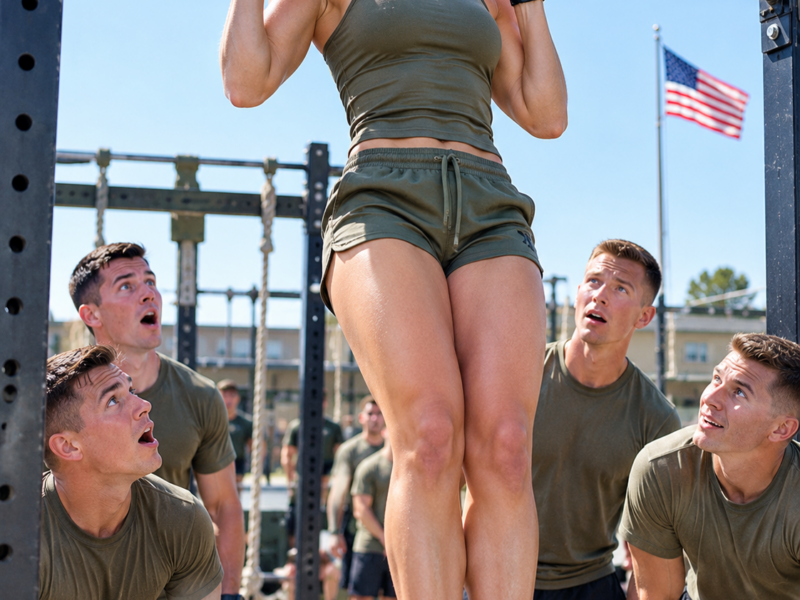
““Would you mind if I tried?” I asked, standing beside the Navy SEALs’ training course at Coronado while their toughest operators laughed at the idea of a woman challenging their record
The paper beside the stopwatch was folded twice, as if whoever had left it there wanted me to find it but did not want anyone else to notice. I picked it up without changing my expression. Around me, the SEALs had stopped laughing. Tyler Grant stood with his hands on his hips, staring at the timing display as though the numbers might rearrange themselves if he looked long enough.
“Thirty-nine point eight,” the instructor repeated. “That’s the official time.”
“I heard you,” Tyler said.
He wasn’t looking at the instructor anymore. He was looking at me.
I unfolded the paper.
My name was written in dark blue ink, followed by a single sentence: Do not let Bennett finish the evaluation.
I knew the handwriting.
For six years, I had tried to convince myself I would never see it again.
“Commander Bennett?” Rear Admiral Michael Donovan said.
I looked up. He stood several feet away, his expression calm enough to be mistaken for indifference. Beside him was Commander Harris, whose face had gone noticeably pale.
“Is there a problem, Admiral?”
“That depends on what you found.”
I folded the paper and slipped it into my pocket.
“Nothing I can’t handle.”
Donovan studied me for another second. “I hope that’s true. Because the man who left it was supposed to be nowhere near this base.”
“Who was he?”
“A civilian contractor named Peter Vale. He worked on a training evaluation program that was officially closed six months ago.”
“Officially?”
The admiral’s eyes narrowed slightly.
“That word is doing a lot of work in your sentence, Commander.”
Before he could say more, a security petty officer approached and whispered something into Harris’s ear. The commander turned toward Donovan.
“Sir, the east vehicle gate just reported an unauthorized departure. A gray utility truck left without completing its exit inspection.”
“Driver?”
“Unknown. The camera feed was interrupted for ninety seconds.”
Donovan’s attention returned to me.
“Bennett, come with us.”
I glanced once at the course. Tyler was still standing beside the timer. His expression had changed. The arrogance was gone, replaced by something closer to concern.
He opened his mouth as if he wanted to say something, then shut it again.
I followed the admiral.
The briefing room was in a low concrete building beyond the main training area. Inside, the air smelled of burnt coffee and cold metal. Donovan dismissed the staff, leaving only Commander Harris, a security officer, and me.
He placed a thin folder on the table.
“Six months ago, a training evaluation was terminated after an incident during an advanced readiness exercise. The program involved measuring how operators responded when the mission parameters changed without warning.”
“Stress testing.”
“More than that. The team was given incomplete information, conflicting instructions, and simulated threats. The objective was to observe decision-making under pressure.”
“Who ran it?”
“Peter Vale managed the technical side. Lieutenant Commander Nathan Cross oversaw the operational evaluation.”
My fingers tightened around the edge of the chair.
Cross.
The name had been absent from official conversations for years, but it had never disappeared from my memory.
Nathan Cross had been my mentor when I was a younger officer. He had taught me how to read a room, how to recognize when a simple question was really a test, and how to remain calm when everyone around me wanted an immediate answer.
He had also been the last person to see my brother alive.
“What happened during the exercise?” I asked.
Donovan opened the folder.
“An operator received an instruction that conflicted with the official mission plan. He followed the unofficial instruction. A simulated casualty scenario escalated into a real medical emergency when the exercise continued beyond its approved limits.”
“Was anyone disciplined?”
“Several people were investigated. The findings concluded that a communication failure had occurred. The program was suspended, its records were sealed, and the personnel involved were reassigned.”
“That sounds convenient.”
“It was supposed to be a closed matter.”
I took out the folded note and laid it on the table.
“Then why is someone leaving warnings with my name on them?”
Donovan did not answer immediately.
Harris shifted beside the door.
“Commander, there’s something you should know about the evaluation you were scheduled to deliver today.”
I turned to him.
“The sealed packet?”
He nodded.
“It contains the final review of a readiness assessment that uses some of the same methodology as the suspended program. Your role was to deliver it to the review panel and provide an independent assessment.”
“Who requested me?”
“Admiral Donovan.”
Donovan held my gaze.
“I requested an officer with a reputation for separating evidence from assumptions. Your selection was approved through the normal channels.”
“Did you know my name was on that note?”
“No.”
“Did you know Peter Vale was here?”
“No.”
I believed the second answer. I wasn’t yet certain about the first.
“Why me?” I asked. “There are dozens of officers qualified to review a training program.”
“Because your record includes experience with the original evaluation framework,” Donovan said. “And because the incident six months ago was not the first time that framework produced a questionable result.”
The room seemed to grow quieter.
“What does that mean?”
He slid a second document toward me. It contained a list of names, dates, and exercise references. Halfway down the page was a designation I recognized from an old operational file.
My brother’s last assignment.
I kept my face still.
“Where did you get this?”
“From the archive that held the suspended program’s records.”
“Those records were sealed.”
“Yes.”
“Then someone accessed them.”
“That is what we are trying to establish.”
I looked at the date beside my brother’s assignment. It was three days before the operation that had killed him.
For six years, I had been told that his team had acted on verified intelligence. The operation had gone wrong because the target moved unexpectedly and the extraction window collapsed. That was the official explanation. I had accepted it because every review, every briefing, and every senior officer I questioned had given me the same answer.
But the designation on Donovan’s document was not part of that explanation.
It was a reference to a behavioral assessment.
My brother had been included in the same experimental framework that later governed the suspended training program.
“Who authorized this?” I asked.
“We don’t know yet.”
“Then find out.”
Donovan’s expression hardened.
“That is why you’re here.”
I stood.
“No, Admiral. I’m here because someone knew I would be at Coronado today, knew I would run that course, and knew the evaluation packet would pass through my hands. Someone has planned this sequence.”
“Possibly.”
“And if you want me to review the evidence, I need access to the original records, the chain of custody, and every version of the report that was filed.”
Harris frowned. “Some of those files are restricted.”
“Then request the access.”
“You can’t simply—”
“I can refuse to certify an evaluation if the supporting material has been compromised,” I said. “That is precisely what an independent reviewer is supposed to do.”
Donovan raised one hand, ending the argument.
“Commander Harris, arrange the access. Bennett, you will work with our security team until we understand why Vale appeared here.”
“And if the evaluation is being used to draw me into something?”
“Then we will find out what the something is.”
I looked at the note again.
Do not let Bennett finish the evaluation.
For the first time that morning, I wondered whether the warning had been written to protect me—or to make certain I followed it.
The security team located the abandoned utility truck less than an hour later. It had been left near a maintenance road beyond the eastern perimeter, its engine still warm. The driver was gone. Inside the cab, investigators found a visitor badge issued under a false company name and a small storage device taped beneath the passenger seat.
The device was encrypted.
While technicians worked on it, I went to the records building with Commander Harris. The archive was colder than the briefing room, its shelves lined with locked cases and numbered containers. A civilian archivist named Elena Ruiz met us at the entrance.
She checked our authorization twice before allowing us through.
“The original program files were transferred here after the suspension,” she explained. “The sealed copies have not been removed.”
“Who has access?”
“Four people, including me. Every access request is logged.”
“Can I see the log?”
She hesitated, then looked at Harris.
He nodded.
Ruiz brought up the access history. Most entries were routine. One entry, however, had been made two weeks earlier under an authorization code belonging to Nathan Cross.
I stared at the screen.
“Was Cross physically here?”
“The system records the authorization used, not necessarily the person who used it.”
“Who else could use his code?”
“Anyone who had access to his credentials.”
Harris leaned closer.
“Was a file opened?”
Ruiz selected the entry.
A single document had been viewed: the final evaluation report from the exercise involving my brother.
“Was it copied?” I asked.
“The system says no.”
“That doesn’t mean it wasn’t.”
“No,” she admitted. “It doesn’t.”
I requested the access log, the original report, and the version history. Ruiz began preparing the files while Harris spoke quietly to the security team.
When the first report appeared on the screen, I knew immediately that something was wrong.
The official summary said my brother’s team had received an updated target location through a verified intelligence channel. The revised location had been approved at 0210 hours. The operation had launched at 0340.
But the underlying communication record showed that the location change had been introduced earlier, during a controlled decision-making exercise. The notation beside it read: UNVERIFIED INPUT — OBSERVE RESPONSE.
Someone had taken information intended to test a team’s judgment and allowed it to influence a real operation.
I read the line again.
“Commander?” Ruiz asked quietly.
“Show me the version history.”
The report had been revised four times. The first version recorded the unverified input. The second identified the input as a training artifact. The third removed the reference entirely. The fourth, which became the official record, described the revised location as verified intelligence.
The final edit had been made by Nathan Cross.
I felt the old grief rise so sharply that I had to rest one hand against the table.
For years, I had imagined the last moments of my brother’s life in a thousand different ways. I had imagined mistakes, bad luck, and decisions made under impossible pressure. I had never imagined that a warning designed for a training exercise might have been mistaken for a real instruction—or deliberately allowed to masquerade as one.
“Print the version history,” I said.
Ruiz did not move.
“Commander, there’s another problem.”
She opened a separate audit panel.
“The final report was accessed again this morning.”
“By whom?”
“An administrative account associated with the evaluation office.”
“Name?”
“The account belongs to Lieutenant Commander Nathan Cross.”
I turned toward Harris.
“Where is he?”
“We’re checking.”
“Check faster.”
My voice was sharper than I intended, but Harris did not object. He stepped into the corridor and began making calls.
I remained beside the archive terminal, staring at the record of the final edit. It was evidence, but it was not yet proof of intent. Cross could have altered the report to hide a failure, protect the program, or conceal something even worse. I could not let my anger decide which explanation was true.
The storage device from the truck was decrypted just after noon.
It contained several video files, a spreadsheet, and a scanned letter. The videos showed portions of the suspended exercise, recorded from cameras that had not appeared on the approved equipment list. Operators were visible receiving conflicting instructions. In one clip, an instructor could be heard telling a participant that the exercise had ended, while another voice continued feeding new commands through the communications system.
The spreadsheet was more disturbing. It listed participants, their responses, and notes about how they behaved when given incomplete or contradictory information. Beside some names were labels such as “compliant,” “resistant,” and “predictable.”
My brother’s name appeared near the bottom.
Beside it was a note: “Questions source of revised intelligence. Requests confirmation. Delays action pending verification.”
I stared at the words until they blurred.
That sounded like him. He had always been careful with information that did not fit. He trusted people, but he trusted evidence more.
The next column was labeled “Operational consequence.”
It contained a single entry: “Removed from primary decision loop.”
I felt the room tilt around me.
“Who wrote this?” I asked.
The technician shook his head. “The spreadsheet metadata has been stripped. We’re trying to recover the original author information.”
“And the videos?”
“Some timestamps are inconsistent. The files may have been copied and reassembled.”
“Can you verify whether the footage is genuine?”
“We can establish whether the equipment and environment match the facility. We can’t establish intent from the footage alone.”
That was the distinction I needed to remember.
Evidence first. Conclusions later.
I asked to speak with the personnel who had worked on the original evaluation. One name from the file stood out: Tyler Grant, the SEAL who had held the course record until my run.
His name was on the participant list.
I found him in the training building, cleaning mud from a pair of boots. When I entered, he rose immediately.
“Commander.”
“Sit down, Grant.”
He did, though his posture remained rigid.
“You were involved in the suspended evaluation program.”
His eyes flicked toward the door.
“Yes, ma’am.”
“Why didn’t you mention it this morning?”
“Because we were told the program was classified and that discussing it outside the approved review process would compromise an investigation.”
“Who told you that?”
“Lieutenant Commander Cross.”
“Did he tell you not to speak to me?”
Tyler hesitated.
“He told us that if you showed up, we were to treat you as a potential evaluator, not as someone who needed to know our history.”
“Did he explain why?”
“No.”
“Did he know I was coming?”
“I think so.”
“Why?”
Tyler rubbed his palms against his trousers.
“Because he said the evaluation would only work if the subject believed it was routine.”
I held his gaze.
“What subject?”
He swallowed.
“You.”
The room went silent.
Tyler explained that the training course had been selected as a controlled environment. The official objective was to compare performance under familiar conditions with performance under social pressure. A visiting officer would be allowed to attempt the course after the team had established a record. The operators would be encouraged to express doubt, not to sabotage the attempt, but to create a predictable social challenge.
“That still doesn’t explain the note,” I said.
“No, ma’am.”
“Did Cross tell you what was going to happen after I ran?”
“No. He said the course was a baseline exercise and that an observer would review the results.”
“Who was the observer?”
“I don’t know.”
“Did you see Peter Vale?”
Tyler nodded.
“He was near the timing station. I thought he was there to check the equipment.”
“Did he speak to you?”
“He asked whether the old course record had been officially certified. Then he asked whether anyone had changed the timing system.”
“Had anyone?”
“Not that I knew of.”
“Why did you look worried when I found the paper?”
Tyler took a long breath.
“Because I recognized the handwriting.”
“Whose?”
“Cross’s.”
I took out the note and placed it on the bench between us.
Tyler looked at it, then nodded.
“He used that same block lettering in the old exercise reports.”
“Are you certain?”
“Yes, ma’am.”
“Then why would Cross warn me not to finish an evaluation he arranged?”
“I don’t know.”
I believed him. His fear was real, and so was his confusion. But there was something he had not yet told me.
“What happened during the original exercise?” I asked.
Tyler’s jaw tightened.
“We were given a mission with two possible routes. The briefing said the intelligence had been verified. During the exercise, a second instruction came through a different channel, directing us toward a new location. Some of us thought it was part of the scenario. Others thought it was an update.”
“And you?”
“I followed the new instruction.”
“Why?”
“Because it sounded authoritative, and because the instructor said we were being evaluated on our ability to adapt.”
“What happened?”
“The scenario escalated. One of the simulated casualties was changed to a real medical event. We lost time responding because the communications were still active. Afterward, we were told the exercise had been stopped because of a technical failure.”
“Did you know about my brother?”
Tyler’s eyes dropped.
“I knew his name. I didn’t know he was connected to the program until the records were sealed.”
“Did you know the same method was used in a real operation?”
“No.”
His answer came quickly, but not carelessly.
I believed that, too.
Before I left, Tyler gave me the name of another participant, a former communications specialist named Mara Voss. She had resigned from the service shortly after the program was suspended and now worked as a civilian contractor in Virginia.
“She was the one who questioned the second instruction,” Tyler said. “She told Cross the source was not authenticated. He ordered her to continue monitoring the channel.”
“Did she obey?”
“She kept the channel open, but she logged the warning. She said later that if anything went wrong, the log would matter.”
I thanked him and left the building.
By late afternoon, we had located Mara. She agreed to speak over a secure video link, but only after Donovan confirmed that the interview would be entered into the official investigation record.
Her face appeared on the screen, tired and guarded.
“I wondered when someone would come asking about those files,” she said.
“Did you know about my brother’s operation?”
“I knew that the training framework had been used outside its approved boundaries. I didn’t know the full details of his mission until months later.”
“Why didn’t you report it?”
“I did. Twice.”
“To whom?”
“Cross first. Then the program director.”
“And what happened?”
“Cross said I had misunderstood the test parameters. The director said the records would be reviewed and told me not to circulate unverified allegations. A week later, my access was revoked.”
“Did you keep copies?”
Mara looked away for a moment.
“I kept the communications log. Not the classified mission details, just the record showing that I had flagged the source as unverified and asked for confirmation.”
“Do you still have it?”
“Yes.”
“Will you provide it?”
“If the investigation gives me written protection against retaliation for reporting a breach I had already tried to report.”
Donovan, who had joined the interview, assured her that the request would be handled through counsel and the appropriate oversight office. Mara agreed to provide the log.
Before the call ended, she looked directly at me.
“Commander Bennett, I need you to understand something. Your brother did not ignore the warning.”
I felt my throat tighten.
“What do you mean?”
“He requested verification. The request was acknowledged, but the response never came through his official channel. Someone sent a second instruction using a route that looked legitimate. Your brother questioned it, and then his role in the decision loop changed.”
“Who changed it?”
“I saw Cross’s authorization on the communications record. I can’t tell you whether he acted alone.”
The call ended.
For a long time, no one spoke.
The evidence was beginning to form a picture, but the center remained dark. Cross had altered the report. His credentials had been used to access the archive. His handwriting appeared on the warning. Yet the records did not tell us whether he had manipulated the operation deliberately, whether someone had used his access, or whether he had later changed the report to hide a mistake that he could not bear to admit.
Donovan ordered an immediate search for Cross. Security found his government vehicle at a temporary residence outside the base, but the house was empty. His phone had been left on a kitchen counter. The last outgoing message was to Peter Vale, sent that morning.
The message contained only five words: “She has seen the first file.”
There was no doubt now that Cross knew I was involved.
That evening, an envelope arrived at the security office. It contained no return address, no fingerprints that could be usefully identified, and no letter. Inside was a small printed photograph of my brother standing beside Cross outside a briefing room. On the back, someone had written: “Ask what happened before the order.”
I knew the date immediately. It was taken two days before my brother’s final operation.
I remembered the phone call I had received that night. My brother had sounded exhausted, but there had been a strange hesitation in his voice. He had started to tell me something, then changed the subject. At the time, I thought he was simply being careful about what he could discuss.
Now I wondered whether he had been trying to warn me.
I asked Donovan for permission to review the original operational timeline. He agreed, but made it clear that the review would be conducted under formal oversight, not as a personal inquiry.
“I’m not asking for special treatment,” I told him. “I’m asking for the same standard we would apply if the name on that report belonged to a stranger.”
“Good,” he said. “Because if you let grief make the decision for you, Cross will be able to dismiss every conclusion you reach.”
I knew he was right.
The next morning, Mara’s communications log arrived through the official channel. Its timestamps matched the operation timeline. The first instruction had come from an authorized source. The second had been routed through a relay associated with the evaluation program. The warning requesting verification was recorded and acknowledged. The acknowledgment, however, had been generated by a credential assigned to Cross.
The record did not prove that Cross personally sent the second instruction. It proved that he had authorized the process that allowed it to reach the team, and that he had acknowledged a warning without correcting the record.
Then we found the missing link.
A technical audit of the relay showed that a temporary access token had been issued to Peter Vale on the night of the operation. The token was valid for the training environment, not for operational communications. It should never have been used outside the controlled exercise.
Someone had bridged the two systems.
The audit identified the account that approved the bridge: Nathan Cross.
When we finally found Cross, he was waiting in a small conference room at a naval facility two hours from Coronado. He had contacted Donovan through counsel and agreed to surrender his devices and provide a statement. He looked older than I remembered, with gray at his temples and deep lines around his mouth. But his eyes were unchanged.
He stood when I entered.
“Claire.”
“Commander Bennett,” I corrected.
He accepted the correction without protest.
Donovan and two investigators remained in the room. A recorder was activated. Cross was informed that the interview was part of a formal inquiry and that he could request counsel before answering any question.
He said he understood.
I sat opposite him.
“Did you write the note at Coronado?”
“Yes.”
“Why?”
“Because I knew the evaluation would be used to put you in a position where you would either trust the process or challenge it.”
“You arranged the course?”
“I approved the observation plan. I did not tell the SEALs to humiliate you or interfere with your performance.”
“You knew I would be there.”
“Yes.”
“You knew Peter Vale would be there.”
“I knew he might try to contact you.”
“Why didn’t you tell Admiral Donovan?”
Cross looked at the recorder.
“Because I had spent six years trying to contain the damage from a decision I made, and I was afraid that if I opened the entire record, the people who had helped me conceal it would destroy the remaining evidence.”
“Contain the damage,” I repeated. “Is that what you call it?”
“No. It is what I told myself.”
He looked directly at me.
“Your brother was not supposed to be part of the program’s real-world application. The evaluation was designed to test how teams responded to conflicting instructions in a simulated environment. Vale believed he could improve the model by using real operational data. I approved a limited technical bridge so the exercise could draw from current communications patterns. I was told the bridge would not transmit instructions into an active mission.”
“But it did.”
“Yes.”
“Did you know before the operation ended?”
“I knew there was a problem when Mara’s warning came through. I thought the second instruction was part of the test until I saw the emergency traffic. By then, the team had already moved.”
“Why didn’t you shut it down?”
“I tried. The relay had been configured with an independent override. Vale had access to it.”
“So you lost control.”
“Yes.”
“And then you changed the report.”
Cross closed his eyes.
“Yes.”
The word hung between us.
“Why?”
“Because the truth would have exposed an unauthorized system, a chain of command that had failed, and my own decision to approve the bridge. I believed I could protect the program from being dismantled before we understood what had happened. I told myself the report could be corrected later.”
“But you never corrected it.”
“No.”
“My brother died while you protected the program.”
“I know.”
“No, you know the words. You don’t know what it was like to receive a folded flag and a summary that never explained why the mission had changed. You don’t know what it was like to spend six years wondering whether he had made a mistake that cost his team their lives.”
Cross did not interrupt.
“You took away the chance to understand what happened,” I said. “You took away the truth.”
“I did.”
For the first time, his composure broke. He looked down at his hands.
“I thought if I could identify exactly how the bridge had been used, I could reconstruct the sequence and make the correction without exposing every person who had been involved. Then the records were sealed. Vale disappeared from the official process. The director told me to wait. Every month I waited made it harder to admit what I had done.”
“Why leave the note now?”
“Because Vale told me he had recovered a copy of the original files and intended to destroy them unless I helped him regain access to the program. He believed the evaluation you were bringing to Coronado would give him a way to restart the system under a new name.”
“And you thought a warning would stop it?”
“I thought you would refuse to certify the evaluation if you saw evidence of interference. I also thought Vale would try to remove the files before anyone could trace them.”
“You could have reported him.”
“I should have.”
“Why didn’t you?”
Cross met my eyes.
“Because I was still afraid of what the truth would say about me.”
The answer was not enough. It could never be enough. But it was the first answer he had given that did not attempt to hide behind the language of procedure.
The investigators continued questioning him for hours. Cross identified the officials who had approved the original program, the contractor accounts that had access to the relay, and the people who had later authorized the records to be sealed. Some had acted negligently. Others had accepted incomplete summaries without demanding supporting evidence. At least one had knowingly instructed staff not to circulate Mara’s warning.
The inquiry did not end with Cross’s confession. His statement was checked against the logs, the audit records, and the recovered files. Peter Vale was located two days later and taken into custody for questioning. The investigation established that he had retained unauthorized copies of the training data and had attempted to use the new evaluation as a route back into a restricted system.
The review panel suspended the evaluation I had been sent to certify. The program’s successor was placed under independent audit, and all related reports were reopened. Cross was removed from his duties pending formal proceedings. He faced disciplinary action for authorizing the bridge, concealing the communications failure, and altering the final report. Other officials were investigated according to the evidence against them.
I was not asked to decide his punishment.
That was appropriate. My job was to tell the truth about the evidence, not to turn the investigation into a personal verdict.
Three weeks later, I returned to Coronado to submit my final statement. The training course was open again, but the atmosphere had changed. The timing equipment had been independently inspected. The observation plan had been withdrawn. The SEALs were training without hidden cameras or undisclosed evaluators.
Tyler Grant approached me as I walked past the course.
“Commander.”
“Grant.”
He looked toward the obstacle wall.
“I wanted to apologize for the way we acted that morning.”
“You were told to create pressure. You chose how to respond to that instruction.”
“Yes, ma’am.”
“That distinction matters.”
He nodded, accepting the answer without trying to defend himself.
“Can I ask you something?”
“You can ask.”
“When you ran the course, did you know we were watching you?”
“Of course.”
“Then how did you keep your focus?”
I considered the question.
“Because I wasn’t trying to prove I belonged there. I was trying to finish the task in front of me.”
He looked at the course again.
“I think I forgot the difference.”
“Then remember it next time.”
He gave a small, serious nod.
I left him there and walked toward the water. The Pacific was bright beneath the afternoon sun, its surface broken by the wakes of boats moving beyond the harbor. For years, I had believed that the hardest part of losing my brother was living without him. I had been wrong. The hardest part was living with a story that everyone insisted was complete when the most important pages were missing.
The truth did not bring him back. It did not erase the choices Cross had made or restore the years spent wondering. But it gave his final decisions their proper meaning. He had questioned the information. He had requested verification. He had tried to protect his team from an instruction that did not make sense.
He had done what we train people to do: think clearly when authority and evidence point in different directions.
The failure had not been his refusal to obey. It had been the system’s refusal to listen.
Before I left the base, Donovan met me outside the administration building.
“The panel accepted your report,” he said.
“Good.”
“You were right to demand the original records.”
“I was right to demand evidence.”
He smiled faintly.
“Those are often the same thing.”
“Not always.”
“No,” he agreed. “Not always.”
He handed me a copy of the official finding. It was thicker than the original report, filled with corrections, documented uncertainties, and clear statements about what could and could not be proven. For once, the record did not pretend to know more than the evidence supported.
I placed it in my bag.
At the parking lot, I paused and looked back toward the course where the SEALs had laughed when I asked to try. Their laughter had never been the real test. Neither had the stopwatch, the record, or the obstacle wall. Those were visible challenges, easy to measure and easy to understand.
The real test had begun when someone tried to control what I would see, what I would believe, and which questions I would be allowed to ask.
I had finished the course in thirty-nine point eight seconds. The more difficult evaluation had taken years, and it had not ended with a record on a screen. It ended with a report that finally told the truth, even where the truth was incomplete, painful, and costly.
I drove away from Coronado knowing that some records could be corrected and some wrongs could be acknowledged, even when neither could be undone.
And for the first time in six years, when I thought about my brother’s final mission, I no longer wondered whether he had failed to recognize the warning.
I knew he had seen it.
I knew he had questioned it.
And now, at last, the official record said so.
THe end.









