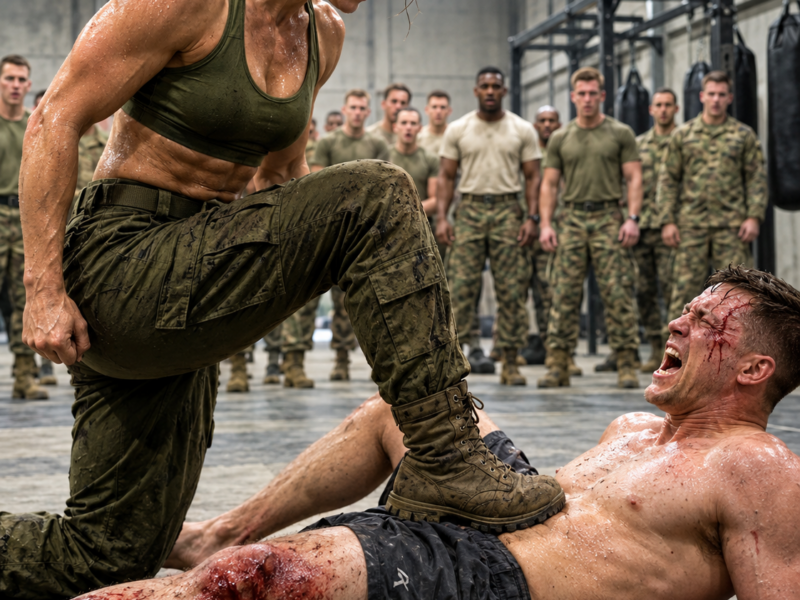
“With 500 soldiers watching at Fort Bragg, I saw a cocky Army captain try to kick a woman standing alone on the training mat
The black SUV lurched away from the curb before the admiral could finish dialing.
I watched it accelerate past the equipment sheds, its tires throwing gravel across the access road.
Two military police officers ran toward their vehicle, but Commander Hayes raised her hand.
“Don’t pursue it blindly,” she called. “Get the plate number from the gate cameras first.”
The admiral stared at her.
“Rebecca, who was that?”
She glanced toward the road where the SUV had disappeared.
“Someone who wants today’s incident to become the only thing anyone remembers about me.”
Colonel Whitaker stepped between them.
“Commander, you will explain that statement in my office.”
“Of course, sir.”
She followed him without argument.
I remained in formation, but my attention had shifted from the empty training mat to the admiral’s face.
He looked like a man who had just realized that a problem he’d hoped was buried had returned with witnesses.
Behind me, soldiers began whispering.
Some had seen Mercer attempt the kick.
Others had only heard the crack and his scream.
By lunchtime, I knew, there would be a dozen versions of what had happened.
And whoever had been in that SUV seemed prepared to make sure one version reached the world before the truth did.
My name is Sergeant Daniel Brooks, and I was assigned to assist with the readiness demonstration because my platoon had been responsible for setting up the training area.
I had met plenty of officers who mistook confidence for competence.
Captain Travis Mercer was the first I’d seen turn that mistake into a personal philosophy.
He believed a soldier’s reputation depended on how effectively he could intimidate the people around him.
He also believed that if a senior officer laughed at his jokes, his behavior must be acceptable.
That morning, five hundred soldiers had watched him learn otherwise.
But as the formation broke up, I realized the injury wasn’t the only thing troubling the officers.
The admiral, whose name was Daniel Price, remained beside the reviewing platform while a military police officer showed him something on a tablet.
He read it, then asked the officer to repeat the information.
“What do you mean the vehicle entered under a temporary media authorization?”
The officer lowered his voice.
“The credential was approved through the installation’s public affairs office, sir. The registration doesn’t match the name on the request.”
Admiral Price looked toward the access road.
“Find out who authorized it. Preserve the original request and the entry logs.”
“Yes, sir.”
He turned and found me watching.
“Sergeant, did you see the vehicle arrive?”
“Yes, sir.”
“Did you see the driver?”
“Not clearly. I saw someone in the driver’s seat holding a camera.”
“Did the person appear to be filming Commander Hayes before the incident?”
I thought back to the SUV.
“I saw the camera pointed toward the platform before Captain Mercer went down. I can’t say when the recording started.”
Price nodded.
“That’s an important distinction. Don’t speculate beyond what you saw.”
“Understood, sir.”
He started toward the administration building, then paused.
“Sergeant, if anyone asks you to change your account of what happened today, report it immediately.”
The warning was quiet, but it made the back of my neck tighten.
“Is someone likely to do that, sir?”
His expression hardened.
“I hope not.”
He continued walking.
I watched him disappear through the building’s glass doors.
For the first time, I wondered whether the demonstration had been arranged for reasons that had nothing to do with training.
Inside Colonel Whitaker’s office, Commander Hayes stood beside a chair without sitting.
Colonel Whitaker closed the door.
“Do you understand how serious this is?”
“Yes, sir.”
“A captain has suffered a potentially career-ending injury during a demonstration under my command. Five hundred soldiers witnessed it. And now you’re suggesting an unknown person arrived expecting a confrontation.”
“I’m not suggesting the confrontation was arranged. I’m saying someone was recording before it happened.”
“That’s not the same thing.”
“No, sir. It isn’t.”
Whitaker studied her.
“Then tell me what you know about Lieutenant Foster.”
For several seconds, Hayes said nothing.
“Lieutenant Ethan Foster was assigned to a joint evaluation team last year. He raised concerns about the way certain readiness assessments were being reported.”
“What kind of concerns?”
“Records showing personnel had completed training they hadn’t actually received. Equipment marked operational before it had passed inspection. Incidents being described as individual mistakes when the underlying procedures hadn’t been followed.”
Whitaker frowned.
“Those are serious allegations.”
“They were. Lieutenant Foster documented what he could verify and submitted his findings.”
“And?”
“He was accused of mishandling restricted information. His access was suspended, and he was reassigned pending review.”
“Was he cleared?”
“Partially. The review found insufficient evidence to support the most serious allegation, but several administrative findings remained unresolved.”
Whitaker folded his arms.
“Why are you telling me this now?”
“Because he contacted me three weeks ago.”
“About the readiness assessments?”
“About the person who had been sending him messages.”
Hayes reached into her pocket and removed a small notebook.
She opened it to a page with several dates written in neat handwriting.
“Foster believed someone was using internal records to discredit people who questioned the assessments. He didn’t know who was coordinating it. He had some evidence, but not enough to establish a complete picture.”
“Where is he now?”
“I don’t know.”
Whitaker stared at her.
“You don’t know?”
“Our last conversation was interrupted. He said he needed to meet someone and would contact me afterward. He never did.”
“Did you report his disappearance?”
“He hadn’t been declared missing. He was an adult, and I had no verified reason to believe he was in danger. I reported my concerns through the appropriate channels.”
“And those channels did nothing?”
“They opened a preliminary inquiry. I was told to wait.”
Whitaker exhaled slowly.
“Commander, you can’t assume that every administrative failure is part of a conspiracy.”
“I’m not, sir.”
“Then what do you believe?”
Hayes closed the notebook.
“I believe someone knew I was coming here. I believe that person wanted footage of me in a confrontation with Captain Mercer. And I believe the timing is worth investigating.”
Whitaker looked toward the window.
“Why would anyone want that?”
“Because if the footage shows only the moment his leg was injured, they can portray me as unstable or violent. They can make every concern I’ve raised look like a personal grievance.”
“That assumes they can control what the footage shows.”
“Not the footage, sir. The story.”
Whitaker turned back toward her.
Before he could respond, the door opened.
Admiral Price entered with a military police investigator named Major Lauren Mitchell.
Mitchell carried a tablet and a thin folder.
“We have a preliminary identification on the SUV,” she said. “The plate was obscured by a temporary cover, but the vehicle’s entry credential was issued to a media contractor who was not on the approved list.”
“Who authorized the credential?” Whitaker asked.
“We’re tracing that now.”
Price glanced at Hayes.
“Did you recognize the driver?”
“No. But I recognized the camera.”
Mitchell looked up.
“How?”
“The same model was used by a contractor who filmed an earlier readiness exercise. He was present when Lieutenant Foster’s findings were publicly challenged.”
“Do you know his name?”
“Mark Ellison. I can’t say the person in the SUV was him.”
Mitchell made a note.
“That’s useful. We’ll verify it.”
Price placed a hand on the folder.
“There’s another issue. A short video has already been sent to a local news desk.”
Whitaker’s face tightened.
“Already?”
“Yes. It shows the end of the confrontation, beginning with Captain Mercer on the ground.”
“Does it show the kick?”
“Not in the version we’ve seen.”
Hayes looked at the tablet.
“Then it’s been edited.”
“We don’t know that yet,” Mitchell said. “It may have been recorded from a different angle.”
“Then find the original recording.”
Mitchell nodded.
“That’s what we’re trying to do.”
Whitaker sat down heavily.
“Five hundred witnesses, an injured officer, an unauthorized camera, and a missing lieutenant. I want to know what happened before this becomes an international embarrassment.”
Hayes met his gaze.
“Then start with the facts, sir. Not with the embarrassment.”
For a moment, I imagined what would happen if I had spoken that way to a colonel.
Hayes didn’t seem interested in imagining it.
Price studied her, then gave a short nod.
“Major Mitchell, take the lead on the incident investigation. Coordinate with the appropriate command and investigative offices regarding Lieutenant Foster. Keep the two inquiries separate unless the evidence connects them.”
“Yes, sir.”
“And preserve everything. No informal requests to delete files, no edits to original footage, no private arrangements.”
Mitchell closed her folder.
“Understood.”
The meeting was over.
But as Hayes turned toward the door, the admiral stopped her.
“Rebecca, one question.”
She looked back.
“Did you know Mercer would attack you?”
“No, sir.”
“Did you suspect he might?”
“I knew he had a reputation for pushing people beyond agreed training limits. I didn’t expect him to attempt an uncontrolled kick in front of five hundred soldiers.”
“Why didn’t you end the demonstration earlier?”
“I tried.”
Price nodded slowly.
“All right.”
He didn’t say he believed her.
He didn’t say he doubted her.
He simply let her leave.
And somehow, that seemed more honest than an immediate declaration of support.
By early afternoon, the video was circulating.
The clip showed Mercer on the mat, Hayes stepping away, and soldiers staring in silence.
Its caption described her as a Navy officer who had broken an Army captain’s leg during a routine training exercise.
The words “routine training exercise” appeared repeatedly.
There was no footage of Mercer grabbing her shoulder.
No warning.
No attempted kick.
The missing seconds transformed the entire encounter.
Some people called her dangerous.
Others argued that no officer should ever use force against another officer during a demonstration.
A few soldiers who had been there posted that the clip omitted important context, but the comments quickly buried their accounts.
I watched it once in the barracks and felt my stomach tighten.
The camera angle was too convenient.
It began just before Mercer fell, as though the person recording had been waiting for precisely that moment.
My platoon sergeant, First Sergeant Ellis, found me staring at my phone.
“Put it away, Brooks.”
“Yes, First Sergeant.”
He glanced at the screen before I locked it.
“That the clip?”
“Yes, First Sergeant.”
“What happened out there?”
I told him what I’d seen.
He listened without interrupting.
When I finished, he leaned against the locker beside mine.
“Then make sure your statement says exactly that.”
“Already gave one.”
“Good. You’ll probably be asked again.”
“Do you think Commander Hayes is in trouble?”
Ellis considered the question.
“She’s already in trouble. The question is whether the investigation follows the evidence or follows the noise.”
He pushed away from the locker.
“And you need to understand something, Sergeant. You don’t fix a bad story by making up a better one. You fix it by telling the truth, even when the truth doesn’t fit neatly into a headline.”
That evening, Major Mitchell interviewed me again.
She asked where I had been standing, whether I had seen the kick clearly, and whether Hayes had used any force after Mercer was no longer a threat.
I answered each question.
Then she showed me two still frames from the recording.
In the first, Mercer was standing with his right leg slightly behind him.
In the second, Hayes had moved off his line and Mercer was beginning to lose his balance.
“Did you see this movement?” Mitchell asked.
“Yes.”
“Could you tell what caused his leg injury?”
“I saw his kick miss and saw Hayes redirect him. I heard the impact when he went down. I can’t tell you exactly what happened inside his leg.”
“That’s appropriate,” she said. “We have medical evidence to establish the injury. We need witnesses to establish the sequence.”
She closed the tablet.
“One more question. Did Captain Mercer appear to know the camera was there?”
I remembered his repeated glances toward the reviewing platform.
“I can’t be certain. But he looked toward that side of the field several times before the confrontation.”
Mitchell wrote it down.
“Thank you.”
As I stood to leave, she added, “The person who recorded the clip may have captured more than they intended.”
“What do you mean?”
“We’ve located another camera near the equipment sheds. Its angle includes the approach road and part of the training area.”
She didn’t tell me what it showed.
But I could tell from her expression that the investigation had just acquired something important.
The next morning, Captain Mercer was transferred from the hospital to a rehabilitation unit after surgery confirmed a severe fracture in his lower leg.
His injury was real.
So was the pain he had suffered.
But neither fact established that Hayes had acted improperly.
A formal review of the demonstration began, with military investigators examining witness accounts, available recordings, the approved training plan, and the medical findings.
Mercer claimed Hayes had attacked him without provocation.
Hayes maintained that she had acted to stop an imminent strike.
The difference between those accounts mattered enormously.
Then the second camera recording arrived.
It showed Mercer shoving Hayes.
It showed her stepping backward and raising an open hand.
It showed him advancing despite her warning.
And it showed his attempted kick.
The recording wasn’t dramatic.
There was no music, no slow motion, no narrator explaining who deserved sympathy.
Just a man making a choice and another person responding to the danger in front of her.
When the investigators played it during a preliminary review, nobody spoke until it ended.
Mercer’s representative asked whether the recording could be authenticated.
Mitchell confirmed that investigators had preserved the original file, documented its source, and were conducting the required verification.
The representative requested additional time to examine it.
The request was granted.
The review proceeded.
The footage strongly supported Hayes’s account, but investigators still examined whether her response had been proportionate and consistent with the agreed training procedures.
They also interviewed the medics who had treated Mercer.
One of them confirmed that Hayes had immediately stopped applying force and had instructed Mercer not to move.
That detail mattered, too.
Hayes had not continued the confrontation after the danger passed.
She had stepped away and allowed the medical team to take over.
Within days, the narrative began to change.
The full recording was not released publicly, but the installation issued a statement correcting the earlier description of the event.
It confirmed that the incident had not occurred during an approved exchange of techniques and that the investigation had found evidence of an attempted strike before Hayes’s defensive response.
The statement did not declare anyone guilty.
It simply corrected the record.
For Hayes, that was a start.
For the person who had recorded the edited clip, it was a problem.
Major Mitchell received the first significant lead from the installation’s access logs.
The temporary media credential had been approved using an account belonging to a civilian public affairs employee.
That employee denied authorizing it.
The account had been accessed remotely using credentials that should not have been available outside the office.
Investigators traced the access to a device used by Mark Ellison, the contractor Hayes had recognized.
Ellison was located and interviewed.
He admitted filming the event but claimed the edited clip had been prepared by an independent media partner.
He said he had been asked to obtain footage of Hayes because there were concerns about her conduct.
“Who asked you?” Mitchell questioned.
Ellison initially refused to answer.
When shown the access records, he requested legal counsel.
The interview ended.
That wasn’t a confession, and investigators didn’t treat it as one.
But Ellison’s devices were examined under the appropriate legal authority, and the team found messages discussing the demonstration several days before it took place.
One message described Hayes as “the subject.”
Another instructed Ellison to capture any physical confrontation and avoid recording the lead-up unless it became necessary.
The sender’s identity was concealed behind an account that investigators could not immediately attribute to a specific person.
Yet the messages established something they hadn’t known before.
The recording hadn’t been a spontaneous response to Mercer losing control.
Someone had planned to document Hayes.
The next question was why.
Lieutenant Ethan Foster was found two days later.
He had been staying with a former service member outside Fayetteville, using personal leave while trying to arrange legal representation and resolve the remaining issues surrounding his reassignment.
He had not been abducted.
He had not been held against his will.
He had simply stopped communicating with people he believed might compromise his position.
When investigators reached him, he initially refused to discuss the readiness reports.
He had already watched the edited video of Hayes.
“They’ve started again,” he told Mitchell.
“Who has?”
“The people who decided I was the problem.”
Mitchell asked him to explain.
Foster described how he had raised concerns about readiness records that appeared more complete than the underlying training and equipment checks justified.
He had not accused every supervisor of misconduct. He had documented specific discrepancies and asked for them to be reviewed.
Afterward, he found himself answering questions about his own handling of information.
His original concerns became secondary.
He was reassigned.
His professional reputation suffered.
He began to believe that anyone who challenged the reporting system could be made to look unreliable.
“Why didn’t you contact Commander Hayes directly?” Mitchell asked.
“I did.”
“She said your last conversation was interrupted.”
Foster looked down at his hands.
“I told her I had evidence connecting the altered reports to a review contractor. Then I realized I couldn’t prove who had ordered the changes. I didn’t want her making accusations based on what I suspected.”
“Did you send her any documents?”
“One summary. Nothing classified, and nothing I wasn’t authorized to retain. I asked her to verify it through the proper channels.”
“Did you tell anyone else about it?”
“One person.”
“Who?”
Foster hesitated.
“Deputy Director Alan Rusk.”
Mitchell’s expression remained neutral, but she made a note.
Rusk was a senior civilian administrator responsible for coordinating several readiness assessment programs.
He had previously overseen the review that resulted in Foster’s reassignment.
He had also been copied on emails concerning the contractor whose work appeared in the disputed records.
That did not make him guilty of anything.
But it made him relevant.
Foster provided investigators with a timeline, copies of correspondence he had lawfully retained, and the names of people who had handled the original reports.
Some of the material supported his earlier concerns.
Other parts required verification.
Investigators compared his account against system logs, archived emails, and signed assessment records.
They found that several readiness entries had been amended after the underlying exercises were completed.
In some cases, the amendments corrected legitimate clerical mistakes.
In others, completion dates had been moved forward, and required verification fields had been filled in by people who had not witnessed the assessments.
The changes had made certain units appear ready earlier than the supporting evidence justified.
The records did not prove that anyone had deliberately endangered soldiers.
They did establish that the reporting process had been manipulated.
Investigators also found that a small group of officials had repeatedly treated internal complaints as disciplinary problems rather than examining their substance.
One of those officials had communicated with Ellison about Hayes’s appearance at Fort Bragg.
The messages referred to the need to “restore confidence in the evaluation process” and to document “any further conduct concerns.”
No message explicitly ordered Mercer to attack Hayes.
No evidence established that he had been promised anything in return.
The investigation could not honestly claim to know why he chose to kick her.
But it could establish that someone had prepared to use the confrontation against her if an opportunity arose.
That was enough to widen the inquiry.
When Hayes learned that Foster had been located, she requested permission to speak with him.
The meeting took place in a small conference room at the installation, with investigators present.
Foster looked thinner than he had in the photograph Hayes remembered.
He sat with his hands clasped on the table.
“I’m sorry,” he said before she could speak.
Hayes pulled out the chair opposite him.
“For what?”
“For leaving you with half a story.”
“You were trying to protect yourself.”
“I thought if I stayed quiet, they’d stop looking at me.”
“Did they?”
He shook his head.
“No.”
She waited.
Foster glanced toward the investigators.
“I should have given you everything I had.”
“You should have given the investigators everything you could verify,” Hayes replied. “That’s what matters now.”
He swallowed.
“I saw the video. They made it look like you attacked him for no reason.”
“They did.”
“And now you’re caught up in this because I contacted you.”
“No, Ethan. I’m caught up in this because someone decided that accurate reporting was a threat.”
His eyes grew wet, but he blinked the feeling away.
“I don’t know if I can go back.”
Hayes didn’t rush to reassure him.
“Do you want to go back?”
“I don’t know.”
“Then don’t decide your entire future today.”
He looked at her.
“What if they ruin my career?”
“That possibility is real. I’m not going to lie to you about it.”
She leaned forward slightly.
“But you have the right to make your decisions based on the truth, not on what someone might threaten to do.”
Foster sat quietly for a long time.
Then he opened the folder he had brought with him.
Inside were copies of emails, handwritten notes, and a timeline of the reports he had submitted.
“I want to cooperate,” he said. “But I want everything documented.”
Mitchell nodded.
“That’s reasonable. We’ll record what you provide and explain the process before we proceed.”
Foster signed the initial statement.
It was a small action, almost anticlimactic after months of fear and uncertainty.
But when he placed the pen on the table, Hayes’s shoulders relaxed.
One person who had been driven into silence was speaking again.
That didn’t resolve the case.
It gave the investigators a better chance of finding out what had happened.
The most difficult confrontation came several weeks later.
Hayes was summoned to a formal review meeting regarding the use of force during the demonstration.
The panel consisted of senior officers and an independent legal adviser.
They examined the training plan, the witness statements, the medical evidence, and the authenticated footage.
Mercer’s representative argued that Hayes should have withdrawn from the demonstration after the first verbal exchange.
The panel asked whether she had been authorized to stop the exercise.
She had.
It asked whether she had given a clear warning.
The witnesses and recordings supported that she had.
It asked whether Mercer had attempted a physical strike.
The footage showed that he had.
Finally, it examined whether Hayes had continued using force after the immediate threat ended.
The evidence showed that she had not.
The panel did not praise her for injuring Mercer.
It did not need to.
Its task was to determine whether her actions were justified under the circumstances and whether she had followed the applicable standards.
After reviewing the evidence, the panel concluded that Hayes had acted in self-defense and had used force to stop an imminent attack.
The review found no basis for disciplinary action against her for the injury.
Mercer’s own conduct was referred for separate administrative proceedings.
When the decision was delivered, Hayes sat without moving.
The legal adviser asked whether she understood the findings.
“Yes, ma’am.”
“Do you have anything to add?”
Hayes took a breath.
“Only that I hope the next demonstration is conducted the way this one was supposed to be.”
The panel chair looked at her.
“Explain.”
“The purpose was to teach soldiers how to respond under pressure. Instead, we spent the first part of the event watching an officer test whether he could ignore boundaries without consequences.”
Nobody interrupted her.
“I don’t want the lesson to be that a person who knows how to defend herself is dangerous. I want the lesson to be that training requires discipline, and rank does not make a person exempt from it.”
The chair nodded.
“Your statement will be included in the record.”
When Hayes left the room, Admiral Price was waiting in the corridor.
“It’s over,” he said.
“The review is over.”
He gave a tired smile.
“You never did learn to let me simplify things.”
“I learned that simple answers aren’t always accurate, sir.”
He laughed softly.
“That’s precisely what makes you difficult.”
She looked at him, unsure whether he was joking.
Then his expression became serious.
“I should have asked more questions when Foster’s report first reached my office. I saw the administrative findings and assumed the underlying concern had been handled.”
“You weren’t the only person who did.”
“That doesn’t excuse it.”
“No, sir.”
He nodded.
“I’ve requested an independent review of the reporting process. It won’t undo what happened to Foster, but it may prevent someone else from being pushed aside the same way.”
Hayes looked down the corridor.
“Then make sure the review has access to the original records.”
“It will.”
“And make sure people can challenge its findings.”
Price paused.
“You’re asking a great deal.”
“I’m asking for a process that can survive being questioned.”
The admiral studied her, then extended his hand.
“That’s fair.”
She shook it.
This time, there was no audience, no camera, and no one waiting for either of them to lose control.
The investigation took months to reach its conclusions.
The findings were complicated, and they did not support every suspicion that had circulated during the early days.
Investigators found that some readiness reports had been deliberately altered to make incomplete assessments appear finished.
They also found that the complaint process had been used improperly in several cases, allowing concerns about the records to be overshadowed by allegations against the people who raised them.
Two officials received formal disciplinary action for their roles in the reporting failures.
Another was removed from a position overseeing readiness assessments while further proceedings continued.
The contractor’s role was examined separately, and several of its submissions were rejected after investigators found that supporting documentation had been incomplete or inaccurate.
The investigation did not establish that every defect was deliberate, nor did it prove that someone had orchestrated Mercer’s physical attack.
It established something narrower and more defensible.
The edited recording had been prepared to portray Hayes in a damaging light, and the person who commissioned the filming had expected to use any confrontation as evidence against her.
That effort failed because the original footage survived.
Ellison cooperated after being confronted with the messages and access records.
His account helped investigators identify the person who had requested the footage.
The evidence showed that Deputy Director Rusk had asked for a recording of Hayes’s appearance and had discussed using any “conduct concerns” to support an existing review of her professional suitability.
Rusk denied intending to provoke a physical confrontation.
Investigators could not prove that he had directed Mercer to attack her.
But they established that he had arranged for selective recording and had attempted to influence how the incident was described before the full evidence was available.
He was removed from his administrative duties pending the outcome of separate proceedings.
Mercer was also held accountable for his conduct.
The review found that he had ignored direct instructions, escalated a controlled demonstration into an uncontrolled confrontation, and attempted to strike another officer.
His injury was taken into account during the proceedings, but it did not erase his responsibility for the choices he had made.
His career would be decided through the proper process rather than through public outrage.
For Hayes, the outcome brought relief without celebration.
She had been cleared, but she knew that the case had cost her months of uncertainty.
Foster’s status was reviewed separately. He received a formal correction to portions of his personnel record and was offered a path to return to active duty if he chose.
He eventually decided to return, though not to his previous assignment.
When Hayes heard his decision, she simply said, “I hope they give you the chance to do your job.”
Foster smiled faintly.
“So do I.”
A year after the incident, Fort Bragg held another readiness demonstration.
This time, the schedule included a detailed safety briefing, clearly defined stopping conditions, and an independent review of the exercise plan.
Hayes was invited back.
She accepted on one condition.
“The demonstration needs to be about the techniques,” she told the organizers, “not about me.”
The event was smaller than the previous one, but the audience still filled the training area.
I stood in the third row, wearing my uniform and watching as Hayes stepped onto the mat.
There was no dramatic entrance.
No taunting.
No one tried to make a point by questioning whether she belonged there.
She introduced the first exercise and explained how to recognize a physical threat before it became unavoidable.
Then she demonstrated a controlled escape with a volunteer who followed the instructions carefully.
She stopped the exercise twice to correct his stance.
The second time, she asked him to repeat the movement more slowly.
“Speed matters,” she explained to the audience. “But understanding what you’re doing matters first.”
The volunteer nodded.
They tried again.
It worked.
A few soldiers took notes.
Others watched the footwork.
At the end of the demonstration, a young private raised his hand.
“Commander, how do you know when to stop?”
Hayes considered the question.
“When the threat has stopped, you stop. You don’t continue to punish someone because you’re angry. Your job is to make the situation safe.”
The private nodded.
“And what if the other person says you went too far?”
“Then the evidence matters. What happened before, what happened during, and what happened after. You don’t get to choose only the part that makes you look good.”
I felt those words settle somewhere deep in my chest.
After the event, I found Hayes near the equipment table.
“That went better than last time,” I said.
She smiled.
“Nobody tried to kick me.”
“That helps.”
We laughed, and for a moment she looked like any other officer at the end of a long workday.
Then I asked the question I’d been carrying for a year.
“Do you ever wish you’d handled the first demonstration differently?”
She didn’t answer immediately.
“I wish it hadn’t happened,” she said. “I wish Mercer had listened when I told him to stop. I wish Foster hadn’t spent months believing his career was over. And I wish the people responsible for the reporting failures had corrected them before anyone had to risk their future to get attention.”
She looked toward the soldiers gathering their equipment.
“But I don’t wish I’d pretended the kick was an accident.”
I nodded.
“That’s fair.”
“Daniel, can I ask you something?”
“Of course.”
“When you first saw him move toward me, why didn’t you step onto the mat?”
The question caught me off guard.
I’d thought about it more times than I could count.
“I was waiting for someone senior to stop him,” I admitted. “I thought if I moved, I’d make the situation worse.”
She didn’t criticize me.
“Would you make the same choice now?”
I looked at the empty mat.
“No.”
“Why?”
“Because I know now that waiting for someone else to act is still a choice.”
She nodded.
“Just remember that stepping in doesn’t always mean fighting. Sometimes it means calling for help, making a clear statement, or refusing to repeat a lie.”
I thought about the soldiers who had watched Mercer shove her.
Some had been afraid.
Some had been confused.
Others had simply assumed an officer would handle it.
I had been one of them.
“I should have spoken sooner,” I said.
“You spoke when you were asked, and you told the truth. That’s important.”
“But I saw him shove you.”
“And now you know what to do when you see something like that again.”
She gathered her notebook and tucked it beneath her arm.
There was no accusation in her voice, only an expectation that the next moment would be handled better than the last.
We walked toward the edge of the training area together.
The afternoon sun had begun to sink, turning the buildings beyond the fence a soft gold.
A group of young soldiers passed us, discussing the techniques they’d just learned.
One of them glanced at Hayes, then turned back to his friend and said, “That was actually useful.”
She heard him.
She smiled but didn’t interrupt.
I watched her continue toward the administration building, carrying the same notebook she’d brought to the first meeting with Colonel Whitaker.
She had not become a symbol because she broke a man’s leg.
She had become someone worth listening to because she refused to let that injury replace the truth of what had happened.
The recording, the investigation, and the hearings had all mattered.
But the moment I remembered most clearly was much smaller.
It was the instant Hayes stepped away from Mercer, raised both hands, and told him to stop moving while the medics rushed to help him.
Even after he had tried to hurt her, she had not treated his pain as a victory.
She had stopped the threat and left the rest to the people responsible for establishing the facts.
That was the difference between strength and revenge.
And after watching five hundred soldiers learn it the hard way, I finally understood that the most dangerous person in a room isn’t always the one who can break a bone.
Sometimes it’s the one who believes that nobody will ever ask why.
The end.









