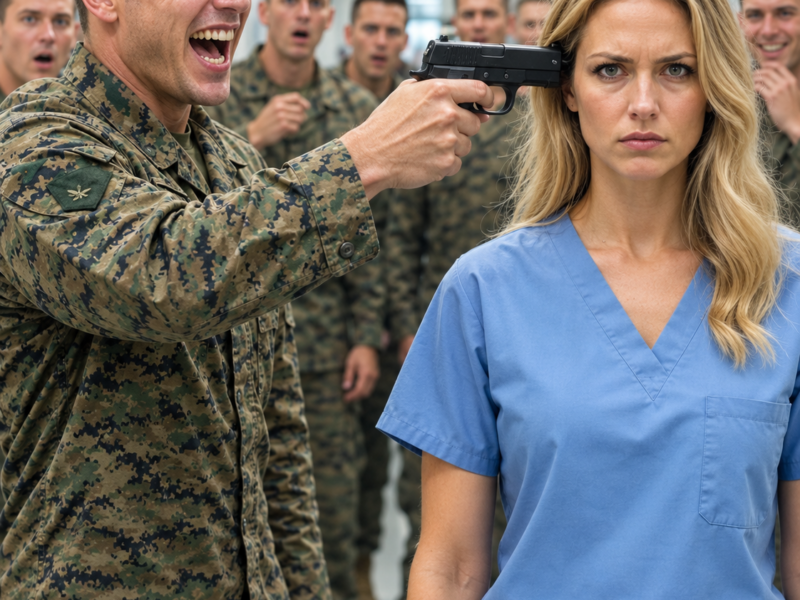
“When three arrogant Navy cadets pressed a loaded pistol against my temple in the training barracks at Norfolk, Virginia, they laughed at the terrified rookie nurse kneeling before them
“You should have stayed dead.”
Brandon’s words hung in the equipment room long after Petty Officer Daniels raised his radio.
For several seconds, nobody moved.
Then Daniels stepped between Brandon and me.
“Put the weapon on the floor. Slowly.”
Brandon looked from the petty officer to me, his face losing what little color remained.
“I didn’t mean—”
“On the floor!”
The pistol slipped from his hand and struck the concrete with a metallic crack.
Two armed security personnel rushed in behind Daniels. One secured the weapon while the other forced Brandon to his knees. Tyler and Mason were ordered against the wall, their hands raised and their faces suddenly drained of the confidence they’d worn moments earlier.
I remained where I was, one hand pressed against my wrist.
My pulse was racing, but I refused to let my knees buckle.
Daniels turned toward me.
“Ma’am, are you injured?”
“No.”
“Did he strike you?”
“No.”
He glanced at the fading red mark around my wrist.
“Are you certain?”
I nodded.
He looked as though he wanted to ask another question, but the words caught in his throat.
Instead, he straightened and addressed the security team.
“Separate all three cadets. Preserve the weapon and the room. Nobody discusses this incident outside the official investigation.”
Brandon lifted his head.
“You can’t do this! My father is Captain Mitchell!”
Daniels didn’t even blink.
“Then your father will be informed that his son is under investigation for threatening a medical officer with a firearm.”
“You don’t understand who I am!”
“I understand exactly what you did.”
Brandon turned toward me.
“You told him something, didn’t you?”
I stared at him.
“I asked you to put the gun down.”
He opened his mouth, but one of the security officers pulled him to his feet and escorted him out.
Tyler followed without resistance.
Mason, however, glanced at me as he passed.
There was no longer any amusement in his eyes.
There was recognition.
And that frightened me more than Brandon’s anger.
When the room finally emptied, Daniels shut the door.
For the first time since he’d entered, he allowed himself to look directly at me.
“Commander Hayes,” he said quietly, “I thought you were dead.”
I felt the blood drain from my face.
“I’m a nurse.”
“I know what your assignment says.”
“Then you know I’m not a commander.”
His jaw tightened.
“Your current personnel file says that. The original one says something different.”
I took a step back.
“Who are you?”
“Petty Officer First Class Marcus Daniels. I served with the men who brought you out of Kandahar.”
The name struck a distant memory.
A young corpsman with a crooked smile. A man who used to hum old country songs while changing dressings in a makeshift medical station. Someone who had once handed me his last clean pair of gloves because mine were covered in blood.
I studied his face.
He was older now, with silver beginning to show at his temples.
“Marcus?”
His eyes softened.
“You remember.”
I had not spoken that name in years.
I had spent years trying not to remember anything about the operation that had nearly killed me.
I glanced toward the door.
“What did Brandon mean when he said I should have stayed dead?”
Daniels looked down at the floor.
“That, ma’am, is what I was hoping you’d tell me.”
I shook my head.
“I don’t understand.”
“Neither do I. But if Captain Mitchell’s son recognized your tattoo, someone has been talking about you.”
“People have been talking about me for years?”
He didn’t answer.
That was answer enough.
An hour later, I sat in a small conference room inside Naval Medical Center Portsmouth, wrapped in a blanket someone had brought from the nurses’ station.
A security officer stood outside the door.
Daniels sat across from me, his hands folded over a thin folder.
I had changed out of my uniform because the sleeve had been torn when Brandon grabbed my wrist. The tattoo was visible now, a black trident crossed by a silver line.
I’d gotten it eleven years earlier, after completing a selection course that most people never knew existed.
I had been twenty-two, stubborn, and convinced that if I worked hard enough, I could prove I belonged anywhere I was willing to serve.
The tattoo had meant something different to me then.
It represented the people I’d trained beside, the promises we’d made, and the belief that nobody should be left behind.
Now it felt like a name carved into a grave.
“Tell me what you know,” I said.
Daniels opened the folder.
Inside was a photograph of a dozen service members standing in front of a transport aircraft. Most wore desert camouflage. A few were medical personnel.
I recognized nearly everyone.
My gaze stopped on a tall man standing near the center.
Lieutenant Commander Jack Mercer.
He had been our team leader.
The man who had taught me to trust my instincts when the official briefing didn’t match what I saw with my own eyes.
The man who had died during the operation in Afghanistan.
I touched the photograph.
“Where did you get this?”
“An archived file. It was supposed to have been destroyed.”
“Why?”
Daniels hesitated.
“Because the operation never officially happened.”
I stared at him.
“That doesn’t make sense.”
“Your team was sent to evacuate a group of intelligence personnel from a compromised location. The mission went wrong. Several members were killed, including Mercer.”
“I know what happened.”
“Do you?”
His question landed like a slap.
I looked up.
“What are you suggesting?”
He turned to the next page.
It was an after-action report, with entire paragraphs blacked out.
According to the official record, our aircraft had been delayed by enemy fire. The team had attempted an unauthorized extraction, resulting in multiple casualties.
But I remembered a different night.
I remembered reaching the landing zone with three wounded men.
I remembered the aircraft never arriving.
I remembered Jack ordering me to take the injured to a stone building while he and two others went back for a missing intelligence officer.
And I remembered the radio call that came minutes later.
Jack’s voice, strained and breathless.
“Hayes, listen to me. If they ask you what happened tonight, you tell them we never received the coordinates.”
Then static.
Then an explosion that shook dust from the ceiling.
I had carried the injured men through the darkness until my legs stopped working. When a rescue team finally reached us, I was barely conscious.
I woke up in a military hospital three days later.
They told me Jack was dead.
They told me I had suffered a head injury and that some of my memories might be unreliable.
They told me my team had been lost because the extraction coordinates were incorrect.
I had spent months believing I had somehow failed them.
“What does this have to do with Brandon?” I asked.
Daniels slid another photograph across the table.
This one showed Captain Robert Mitchell, Brandon’s father, standing beside Jack Mercer.
Both men were younger.
Both were smiling.
I felt my throat tighten.
“Captain Mitchell served with Jack?”
“He was the operations officer responsible for approving the extraction plan.”
“That’s impossible. Jack told us the coordinates had been verified.”
“That’s what the report says, too.”
I looked at the photograph again.
“Then why would his son know anything about me?”
Daniels leaned forward.
“Because Captain Mitchell was one of the officers who signed the order declaring you dead.”
The room seemed to fall silent around me.
I stared at him.
“I wasn’t declared dead.”
“Your current personnel record says you were medically discharged after the operation. The classified casualty report lists you as killed in action.”
“Why?”
“I don’t know.”
I pushed the folder away.
“No. I want someone who can explain this to me.”
Daniels nodded.
“I’ve requested a meeting with Admiral Nathaniel Ward. He’s the senior officer overseeing the investigation.”
“An admiral?”
“He served with Mercer before the operation. If anyone can help us understand why your records were changed, it’s him.”
I looked down at my tattoo.
“What if he already knows?”
Daniels didn’t answer.
For the first time, I wondered whether coming to Norfolk had been a mistake.
Admiral Ward arrived shortly before midnight.
He was in his early sixties, with a lean face and silver hair cut close to his scalp. His uniform was immaculate, but he moved with the careful stiffness of a man who had spent too many years carrying injuries he refused to acknowledge.
He entered the room alone.
“Commander Hayes.”
I remained seated.
“Admiral.”
He studied me for several seconds.
“I was told you had no memory of the incident in the barracks.”
“I remember everything.”
His expression tightened.
“Then I owe you an apology.”
“For what?”
“For allowing the official account of your service to stand unchallenged.”
I let out a quiet, humorless laugh.
“You’re going to have to be more specific.”
He sat opposite me.
“Eleven years ago, your team was sent to recover a source who had obtained evidence of unauthorized weapons transfers. The source was supposed to be moved to a secure facility before dawn.”
“Jack told us we were evacuating an intelligence officer.”
“You were.”
“Then why did the aircraft never arrive?”
Ward looked at Daniels, who stood near the door.
Daniels shook his head once.
The admiral turned back to me.
“Because the extraction coordinates were changed.”
“By whom?”
“We never established that conclusively.”
“Captain Mitchell signed the plan.”
“Yes.”
“Did he change the coordinates?”
“We found evidence suggesting that someone used his authorization.”
I leaned forward.
“That’s not an answer.”
“No,” Ward admitted. “It isn’t.”
I looked at the report.
“Why was I listed as dead?”
“After you were recovered, you suffered severe injuries and spent several weeks in intensive care. You were moved to a restricted medical unit while the operation was investigated.”
“I remember the hospital.”
“You were given a new identity after the investigation concluded that the source had been compromised.”
I stared at him.
“A new identity?”
“Your previous assignment was classified. The transfer to nursing was arranged under a separate medical personnel record.”
I felt something cold settle beneath my ribs.
“You mean my career as a nurse was arranged to hide me?”
“Initially, yes.”
“By whom?”
Ward’s eyes dropped to the table.
“By me.”
The words came quietly.
I stood so abruptly that the chair scraped against the floor.
“You decided what happened to my life?”
“I believed it was the only way to keep you alive.”
“You let me believe my team died because I failed them.”
“I didn’t know what you remembered.”
“You didn’t ask!”
My voice cracked, and I hated that it did.
For eleven years, I had carried the memory of Jack’s last radio call. I had blamed myself for every second between that call and the explosion.
And this man had apparently known that the official story was incomplete.
Ward remained seated.
“I understand your anger.”
“No, you don’t.”
I walked to the window and pressed my palm against the cool glass.
“What happened to the source?”
“We never recovered him.”
“Was he killed?”
“We don’t know.”
I turned around.
“Then why did you say the source had been compromised?”
“Because someone leaked the extraction plan before the operation began.”
I looked at Daniels.
He was staring at the floor, his expression unreadable.
“Who had access to the plan?” I asked.
Ward took a slow breath.
“Your team leader, Lieutenant Commander Mercer. Captain Mitchell. Myself. And a small number of intelligence personnel.”
I returned to my chair.
“That’s four groups of people who could have changed the coordinates.”
“Correct.”
“Jack is dead. The intelligence personnel were transferred. You’re sitting here telling me you don’t know who did it.”
Ward accepted the accusation without protest.
“I’ve spent eleven years trying to find the answer.”
“Then why am I only hearing about this now?”
“Because the evidence recently resurfaced.”
He opened a second folder and removed a photograph.
It showed the same trident tattoo I wore, but on the wrist of another service member.
A woman with dark hair stood beside Jack Mercer.
Her face was turned away from the camera.
I leaned closer.
“Who is she?”
“Petty Officer Sarah Collins. She was attached to the intelligence unit supporting your team.”
I searched my memory.
I remembered Sarah.
Quiet. Sharp-eyed. Always carrying a small notebook.
She had vanished from the hospital two days before I was discharged.
We had been told she was transferred to another command.
“Where is she now?”
“We don’t know.”
Ward placed a printed message on the table.
It had been recovered from an encrypted account that had recently become active.
The message contained just one sentence.
**The nurse is alive. The Mitchell boy has found her.**
My hands went cold.
“Who sent this?”
“The account was registered to a retired Navy intelligence officer. He died six months ago.”
“Someone is using his account.”
“That’s our assessment.”
I stared at the sentence.
“Why would anyone care whether I’m alive?”
Ward’s expression darkened.
“Because the source you were sent to recover may have survived.”
I thought of Jack’s final radio call.
*If they ask you what happened tonight, you tell them we never received the coordinates.*
He hadn’t said the coordinates were wrong.
He’d said we never received them.
As though the distinction mattered.
“What did Jack know?” I whispered.
Ward looked at me.
“We believe he discovered that the extraction plan had been altered before the mission began.”
“And he tried to tell someone?”
“We found a partial transmission from his radio. It was never included in the official report.”
“Play it.”
Ward hesitated.
“It’s incomplete.”
“Play it.”
He nodded to Daniels.
Daniels took a small audio device from the folder and pressed a button.
Static filled the room.
Then Jack’s voice emerged.
“Control, this is Mercer. We have the package. Coordinates do not match the approved plan. Repeat, coordinates do not match—”
A burst of interference swallowed the next few words.
Then Jack spoke again, quieter.
“Mitchell, if you can hear me, don’t send the second team. They’re waiting for us.”
The recording ended.
I gripped the edge of the table.
“Who was he talking to?”
Ward answered carefully.
“The transmission was addressed to the operations channel. Several officers could have received it.”
“Did Mitchell respond?”
“No.”
“Did you?”
Ward’s face tightened.
“I wasn’t on the channel that night.”
I studied him.
“Then how do you know the message was never received?”
He looked away.
For the first time, I understood that the admiral might be hiding something—not necessarily because he was guilty, but because he had spent eleven years believing that the truth could destroy the institution he served.
I knew that kind of fear.
I’d seen it in patients who refused to report abuse because they were afraid of losing their careers.
I’d seen it in young sailors who accepted blame because the alternative meant accusing someone with more power.
But I wasn’t twelve years old anymore.
I wasn’t the injured young woman who had woken in a hospital and accepted whatever explanation the doctors gave her.
“I’m going to find Sarah Collins,” I said.
Ward stood.
“We have investigators working on that.”
“Then I’ll work with them.”
“You’re not cleared for operational duty.”
“I’m not asking to carry a weapon. I’m asking to find the woman who might know why my team was sent into a trap.”
He watched me for a long moment.
Finally, he nodded.
“I’ll authorize your access to the archived medical records.”
“That’s not enough.”
“It’s what I can offer tonight.”
I gathered the photographs and slipped them into the folder.
“Then it’s where I’ll start.”
The first clue came from a medical record filed under a name I’d never seen before.
Sarah Collins had been admitted to a military hospital in Virginia two weeks after our operation, suffering from a fractured wrist and a concussion.
The record listed her as discharged.
The destination field was blank.
But the attending nurse had added a handwritten note at the bottom.
*Patient requested transfer to civilian facility. Expressed concern that personnel from former command were monitoring her movements.*
I read it twice.
“Who signed this?” I asked Daniels.
He checked the signature.
“Dr. Michael Ellison.”
“Can we find him?”
“He retired and moved to Richmond.”
Within an hour, we had an address.
Admiral Ward assigned two investigators to accompany us, though I insisted that no one contact the local police until we’d spoken with the doctor.
We arrived at his home shortly after sunrise.
Dr. Ellison was a thin man in his seventies who opened the door wearing a cardigan over his pajamas.
When he saw my face, he stopped breathing for a moment.
“Emily Hayes,” he whispered.
I stepped forward.
“You remember me?”
He looked past me toward the investigators.
“Of course I remember you.”
“Then you know why I’m here.”
He opened the door wider and let us inside.
His living room smelled of coffee and old books. A faded Navy photograph hung above the fireplace.
I recognized Sarah Collins standing at the edge of a group of medical personnel.
Dr. Ellison followed my gaze.
“She came to see me three months ago,” he said.
My pulse quickened.
“Where is she?”
“I don’t know. She left a number and told me to call if anyone started asking questions about the operation.”
“Did you call?”
“No.”
“Why?”
He looked down at his hands.
“Because the last time I tried to help someone from that team, I received a visit from two men who knew my grandchildren’s names.”
The room went silent.
I sat across from him.
“Doctor, I know you’re afraid. But I need to understand what happened to my friends.”
He studied me, his eyes brightening.
“Your team saved my life once.”
I blinked.
“What?”
“Years before your operation, I was serving as a medical adviser overseas. Your team evacuated me after the clinic where I worked was attacked. I never forgot it.”
He opened a drawer and removed a small envelope.
“Sarah left this for you.”
My name was written across the front.
Inside was a handwritten note.
*Emily, if you’ve found this, then they know you’re alive. Don’t trust the official report. Jack discovered that the source wasn’t the only person being evacuated that night. There was a child.*
I stared at the page.
“A child?”
Dr. Ellison nodded.
“Sarah told me the source had been protecting a young girl whose family had been killed. The girl had witnessed something she shouldn’t have seen.”
“What did she witness?”
“I don’t know. Sarah wouldn’t say.”
I read the note again.
*Jack discovered that the source wasn’t the only person being evacuated.*
Suddenly, the details of the operation began to rearrange themselves in my mind.
The second extraction team.
The coordinates that didn’t match.
Jack’s warning that someone was waiting for us.
“Did Sarah mention where the child was taken?”
Dr. Ellison shook his head.
“But she said something else.”
“What?”
He looked directly at me.
“She said the child might have been brought to the United States under a protected identity.”
My stomach tightened.
“Do you know the child’s name?”
“No.”
I folded the note carefully and placed it in my pocket.
For the first time in eleven years, I had something more than grief and a damaged radio transmission.
I had a reason to believe Jack had not died for nothing.
As we prepared to leave, Dr. Ellison caught my arm.
“Emily, there’s one more thing.”
I turned.
“Sarah said the person who changed the coordinates wasn’t trying to kill your team.”
“Then what were they trying to do?”
He swallowed.
“They were trying to make sure the child never reached the extraction point.”
We returned to Norfolk that afternoon.
Admiral Ward was waiting in the conference room with Captain Robert Mitchell.
I recognized him immediately from the photographs.
He was in his late fifties, broad-shouldered, with carefully combed gray hair and the expression of a man accustomed to being obeyed.
Brandon’s eyes and jawline were unmistakable.
Mitchell stood when I entered.
“Commander Hayes.”
I didn’t offer my hand.
“Captain.”
Ward gestured toward the table.
“We’ve asked Captain Mitchell to explain his involvement in the operation.”
Mitchell looked at the folder in my hands.
“I understand you’ve been reviewing classified records.”
“I’ve been reviewing the report that says my team died because of a coordinate error.”
“An unfortunate error.”
“Jack Mercer warned you that the coordinates didn’t match.”
Mitchell’s expression barely changed.
“I don’t recall receiving that transmission.”
“We have a recording.”
“Then you have a recording that should be reviewed by the proper authorities.”
“That’s what we’re doing.”
He looked at Ward.
“Admiral, with respect, this investigation is becoming unnecessarily personal.”
Ward’s voice was cold.
“An officer’s identity was altered, a casualty report was falsified, and a mission was compromised. It is personal.”
Mitchell leaned back.
“You’re relying on the recollections of an injured woman and a retired doctor.”
I placed Sarah’s note on the table.
“I’m relying on evidence.”
His gaze dropped to the paper.
For the first time, I saw a flicker of recognition.
It vanished almost immediately.
“Where did you get that?”
“From someone who knew Sarah Collins.”
Mitchell folded his hands.
“Sarah was unstable after the operation. She made accusations against several officers.”
“Was she lying?”
“I believe she was confused.”
“Then why did you sign the report declaring me dead?”
His jaw tightened.
“I signed the report I was given.”
“Without checking whether I was alive?”
“I was told you had died during transport.”
“But I was in a hospital.”
Mitchell said nothing.
I leaned forward.
“You knew I was alive.”
He stared at me.
“I knew there were concerns about your medical status.”
“Concerns?”
“The operation was classified. We were instructed to limit the distribution of sensitive information.”
“And you decided the best way to protect classified information was to declare an injured nurse dead?”
His expression hardened.
“You have no idea what was at stake.”
“Then explain it.”
For a long moment, I thought he would refuse.
Instead, he glanced at Ward and then back at me.
“The source was carrying evidence of a weapons-smuggling network that had penetrated several military supply contracts. The child was a witness. If she reached the United States, people connected to that network would be exposed.”
“Who were they?”
“I don’t know all the names.”
“Did you change the coordinates?”
“No.”
“Did you know who did?”
He looked away.
The silence stretched.
Finally, he said, “I received a message instructing me to redirect the extraction team to a secondary landing zone. The message appeared to come from a senior intelligence office.”
“Did you verify it?”
“No.”
The admission fell heavily into the room.
“Why not?”
“Because I was told the original location had been compromised.”
“By whom?”
Mitchell pressed his lips together.
“I was never given a name.”
I stared at him.
“Did you know Jack was going to that location?”
“Yes.”
“Did you know the team was walking into an ambush?”
“No.”
“Then why didn’t you respond when he called?”
His face tightened.
“I was ordered to maintain radio silence until the second team reached the landing zone.”
“By whom?”
He looked at Ward.
Then he looked at me.
“Admiral Ward.”
The room fell silent.
I turned slowly toward the admiral.
He didn’t move.
Mitchell continued.
“Ward was the senior officer overseeing the operation. He told me that the source had to be recovered without alerting the people monitoring the original channel.”
Ward’s voice was quiet.
“That’s true.”
I felt something twist inside my chest.
“You knew about the coordinate change?”
“I knew a secondary extraction had been authorized.”
“Did you know Jack was in danger?”
“No.”
“Did you order the radio silence?”
Ward looked directly at me.
“Yes.”
The word struck harder than I expected.
“Why?”
“Because we had reason to believe the communication channel was compromised. I feared that any response would reveal the second team’s position.”
“So you left Jack without an answer.”
“I made a decision based on the information I had.”
“And he died.”
Ward lowered his head.
“Yes.”
For a moment, nobody spoke.
I wanted to hate him. It would have been easier if he had smiled or made excuses.
Instead, he sat there carrying the weight of a decision that had killed people he had once commanded.
But the question remained.
“Who ordered the coordinates changed?”
Ward looked at Mitchell.
Mitchell looked back at him.
Neither answered.
Then Mitchell reached into his jacket and removed a folded piece of paper.
“I kept this because I was afraid that one day someone would ask me that question.”
He placed it on the table.
It was a copy of the message that had redirected the extraction.
At the bottom was a digital authorization code.
Ward leaned forward.
His expression changed.
“That code belongs to the intelligence liaison office.”
“Who ran that office?” I asked.
Mitchell’s voice dropped.
“Deputy Director Charles Harlan.”
I recognized the name from the old reports.
Harlan had retired years earlier after a distinguished career.
He had been publicly praised for strengthening military intelligence coordination.
And according to the message, he had ordered the extraction changed.
Ward picked up the document.
“We need to locate him immediately.”
Mitchell shook his head.
“You won’t find him at his home.”
“Why?”
“Because he died last year.”
I stared at the page.
Another dead officer.
Another missing answer.
Then Mitchell said something that made the room go cold.
“Before he died, Harlan told me that the child had been found.”
I leaned forward.
“Found where?”
“He didn’t say.”
“Who found her?”
“He only told me that she was safe and that the operation had been contained.”
I felt a strange chill crawl up my spine.
“Contained?”
Mitchell looked at me.
“Those were his words.”
The same word that had appeared in the margins of the classified report.
Not rescued.
Not protected.
Contained.
That night, I sat alone in my apartment with Jack Mercer’s photograph resting on the kitchen table.
I had spent eleven years believing his final transmission was a warning meant to save the rest of us.
Now I wondered whether it had been a warning about something much larger.
My phone rang at 11:47 p.m.
The number was blocked.
I almost let it go to voicemail.
Then I answered.
“Emily Hayes?”
A woman’s voice.
Older. Tired.
“Who is this?”
“My name is Sarah Collins.”
I gripped the phone.
“Where are you?”
“I can’t tell you that.”
“Sarah, I’ve been looking for you.”
“I know.”
“Then tell me what happened to Jack.”
There was a long silence.
When she spoke again, her voice was trembling.
“Jack didn’t die because the coordinates were wrong.”
I closed my eyes.
“Then why did he die?”
“Because he discovered the second extraction wasn’t meant to save the child.”
“What was it meant to do?”
“To make her disappear.”
I stared at the photograph on the table.
“Who was the child?”
Sarah inhaled shakily.
“Emily, I need you to listen carefully. The little girl we were sent to recover wasn’t a random witness. Her father was an American contractor who had been murdered after discovering the weapons network. Her mother was killed the same night.”
“Why did Jack risk his life for her?”
“Because he learned that the people trying to silence her were inside the chain of command.”
I swallowed.
“Where is she now?”
Sarah’s voice broke.
“She grew up in the United States under a protected identity. She doesn’t know what happened to her family.”
“What’s her name?”
Sarah hesitated.
Then she said a name I recognized.
“Brandon Mitchell.”
For several seconds, I couldn’t speak.
“That doesn’t make sense. Brandon is Captain Mitchell’s son.”
“Not biologically.”
My hand tightened around the phone.
“Explain.”
“Captain Mitchell and his wife had lost a child years earlier. After the operation, they were approached by someone who offered them a chance to adopt a baby girl who had no surviving family. They were told the child had been recovered from a foreign evacuation and that the paperwork would be handled quietly.”
“But Brandon is a man.”
“I know.”
Sarah took a shaky breath.
“The original records were altered. The child wasn’t Brandon. It was a girl named Anna. She was the witness.”
I stared at the photograph of the young cadet.
“What happened to Anna?”
“Someone realized the identity had been compromised. The child was moved again. Brandon was born later, and the family was told to destroy the old records.”
My mind raced.
“Then why does Brandon know about my tattoo?”
“Because his father kept the old file. He showed Brandon the photograph years ago, warning him never to ask questions about the woman with the trident.”
I remembered Brandon’s face when he saw the tattoo.
His shock.
His fear.
And the words he’d spoken.
*You should have stayed dead.*
“Sarah,” I whispered, “why would he threaten me?”
“Because he thought you knew where Anna was.”
“But I don’t.”
“I believe you.”
Her voice softened.
“Jack trusted you. He knew you would never abandon that child.”
I pressed a hand to my mouth.
“Where is Anna now?”
“I don’t know. The last record I saw placed her with a family in Virginia. But if someone has started looking for her again, then they may be trying to erase the last witness.”
“Who?”
Sarah’s answer came in a whisper.
“The person who ordered the extraction changed is dead. But the person who benefited from it is still alive.”
I looked at the clock.
“Who is it?”
Before she could answer, I heard a sound on her end of the line.
A door opening.
A man’s voice.
“Sarah?”
She gasped.
“Emily, listen to me. The evidence isn’t in the reports. Jack hid it before the extraction.”
“Where?”
“His last message wasn’t a warning. It was a location.”
“Sarah—”
“Find the place where the coordinates never changed.”
The line went dead.
I called back.
The number was disconnected.
I sat motionless, listening to the silence.
Then I remembered the old radio transcript.
Jack’s words.
*Coordinates do not match the approved plan.*
He hadn’t simply been reporting an error.
He had been telling someone that the plan had been changed.
And his final instruction had been even more precise.
*We never received the coordinates.*
Not that they were wrong.
That they had never received them.
I pulled the original operation map from my folder and spread it across the table.
The approved landing zone was marked in red.
The redirected landing zone was marked in blue.
But there was a third location on the map, an abandoned medical station that had been crossed out before the mission.
The coordinates beside it had never been altered.
I checked the numbers twice.
Then I remembered the old stone building where we’d taken the wounded men.
The place where Jack had ordered me to wait.
The place from which I had heard his final transmission.
It was the only location on the map that hadn’t changed.
I grabbed my coat and called Daniels.
He answered on the second ring.
“Hayes?”
“I need a favor.”
“What happened?”
“I think I know where Jack hid the evidence.”
There was a pause.
“Are you sure?”
“No.”
I looked at the photograph of my team.
“But I know where to start.”
“Send me the coordinates. I’ll meet you there.”
I hesitated.
“Marcus, there’s something else.”
“What?”
“Sarah called me. She said someone is trying to find the child from our operation.”
His voice hardened.
“Did she give you a name?”
“No. But I think the child was connected to the Mitchell family.”
Another pause.
“Emily, listen to me. Don’t go anywhere alone.”
“I won’t.”
I ended the call and looked at the clock.
Midnight.
For the first time in eleven years, I wasn’t running from my past.
I was going back to the place where it had begun.
The abandoned medical station stood on a low ridge outside a former military training area.
Most of the building had collapsed. Weeds pushed through cracks in the concrete, and the rusted frame of a sign leaned against the entrance.
Daniels arrived with two investigators just after dawn.
We entered cautiously, flashlights sweeping across the empty rooms.
The air smelled of damp stone and old dust.
I recognized the room immediately.
A broken table stood near the wall.
The window where I’d watched for the aircraft was still there, its glass shattered.
I walked toward the corner where Jack had left me with the wounded men.
Nothing remained but a rusted cabinet and a pile of debris.
Daniels crouched beside the cabinet.
“Hayes, look at this.”
A small metal plate had been screwed to the inside of the lower drawer.
It bore three numbers.
The coordinates of the original landing zone.
I touched the plate.
“He wanted someone to know the plan hadn’t changed.”
Daniels examined the screws.
“One of them is newer than the others.”
We removed the plate.
Behind it was a narrow cavity containing a waterproof envelope.
Inside were a flash drive, a folded map, and a letter addressed to me.
My hands shook as I unfolded it.
*Emily,*
*If you’ve found this, then the operation went wrong and I couldn’t come back for you.*
I had to stop reading.
The words blurred.
Daniels placed a hand on my shoulder but said nothing.
I took a breath and continued.
*I don’t know who changed the coordinates. I know only that someone in command wants the child removed before she can testify. The original extraction plan was correct. The secondary order came through an authorization code that should never have been used.*
*I was told to maintain radio silence. I refused to accept the order until I could confirm that the second team was safe.*
*If I’m wrong, this letter means nothing. If I’m right, the people who sent us here will do everything they can to make sure no one reads it.*
The letter ended with a line written in Jack’s unmistakable handwriting.
*You were never responsible for what happened here. Don’t let them make you carry it.*
I pressed the paper against my chest.
For eleven years, I’d imagined that Jack’s last moments had been filled with anger at me for failing to bring the team home.
Now I understood that he’d been trying to protect me from the blame he knew would follow.
Daniels waited until I could speak again.
“What else is in the envelope?”
I handed him the flash drive.
The files contained copies of the original extraction plan, communications logs, and a list of payments made through a network of military contractors.
One name appeared repeatedly.
Robert Mitchell.
Another appeared beside it.
Nathaniel Ward.
I stared at the screen.
“Ward?”
Daniels read the records carefully.
“Payments to a consulting company. They could be legitimate, or they could be part of the network.”
I shook my head.
“Then we don’t assume anything. We verify everything.”
We copied the files and sent them to the investigative team.
An hour later, Admiral Ward arrived at the medical station.
He read Jack’s letter in silence.
When he finished, he looked at me.
“I didn’t know he had hidden this.”
“Did you order him to maintain radio silence?”
“Yes.”
“Did you know the coordinates had changed?”
“I knew a secondary order had been issued. I didn’t know the original team had been redirected into an ambush.”
“Then why are your name and Mitchell’s attached to the payments?”
Ward closed the folder.
“The consulting company was used to fund a legitimate intelligence operation. Someone may have diverted the payments.”
“Someone with access to the accounts.”
“Yes.”
“Someone who knew about the extraction.”
He nodded.
“Possibly.”
I looked at the files again.
There was a final document, encrypted and marked with a date from six months earlier.
Daniels opened it using the key recovered from the flash drive.
A list of names appeared.
At the bottom was a photograph.
A young woman in her early twenties, standing outside a community college in Virginia.
Her name was Anna Mitchell.
I looked at Ward.
“Is this the child?”
He studied the photograph.
“I don’t know.”
Daniels enlarged the image.
The woman had the same distinctive birthmark beneath her left ear that had been mentioned in the old medical report.
I remembered the report.
A small, crescent-shaped mark noted during the original evacuation.
“It’s her,” I whispered.
The room fell silent.
The girl we’d risked our lives to recover had grown into a young woman, living under a name that might not even be hers.
And someone had spent years making sure she remained hidden.
My phone buzzed.
A message from an unknown number.
**Stop looking for Anna. You have already cost enough lives.**
I showed it to Daniels.
He immediately called the investigators.
Ward’s face hardened.
“We need to get to her before whoever sent that message does.”
I looked at the photograph.
“Then we go now.”
We found Anna at a small apartment complex near the college.
She answered the door wearing jeans and an oversized sweatshirt, her dark hair tied back in a loose knot.
She looked frightened when she saw the uniforms.
“Am I in trouble?”
“No,” I said gently. “My name is Emily Hayes. I think someone has been looking for you for a very long time.”
She stared at me.
“I don’t know who you are.”
“I know.”
I showed her the photograph from the medical station.
Her face changed.
“Where did you get that?”
“It was taken the night you were evacuated from Afghanistan.”
She stepped back.
“I was born in Virginia.”
“That’s what your records say.”
Her eyes filled with confusion.
“What are you talking about?”
I explained as carefully as I could, telling her about the operation, the compromised extraction, and the records that had been hidden.
I didn’t tell her what I suspected about her family until she asked.
“Was I adopted?”
I nodded.
“According to the records, yes.”
She covered her mouth.
“My parents told me I was born prematurely. They said the hospital had lost some of the paperwork.”
“Your adoptive parents may not have known the full story.”
“Why would someone hide my identity?”
“Because you may have witnessed something that could expose a criminal network.”
She stared at the floor.
Then she looked up.
“Is that why my father never lets me travel alone?”
I felt a chill.
“Your father?”
“Robert Mitchell. He’s my adoptive father.”
I exchanged a glance with Ward.
“Does he know you’re here?”
Anna shook her head.
“He told me that if anyone ever asked about my childhood, I should call him immediately.”
“Did he explain why?”
“No. He just said some people would do anything to keep old secrets buried.”
Her voice began to tremble.
“Is my life in danger?”
I didn’t want to frighten her.
But I wouldn’t lie.
“It may be. We’re going to make sure you’re protected.”
She looked at me for a long time.
“Why are you helping me?”
I thought of Jack’s letter.
*You were never responsible for what happened here.*
“Because someone risked everything to get you out alive,” I said. “And I don’t want that sacrifice to have been for nothing.”
Anna began to cry.
I sat beside her until she could breathe again.
For the first time, the child we’d been sent to recover wasn’t a name on a classified report.
She was a young woman who had spent her life wondering why her past was full of missing pieces.
And I realized that protecting her would mean more than recovering a file.
It would mean giving her the chance to choose what happened next.
The investigation took months.
The recovered records were authenticated by independent forensic analysts. The financial transfers were traced through several shell companies, and investigators uncovered evidence that senior contractors had been paying for access to classified logistics schedules.
Captain Mitchell admitted that he had approved the secondary extraction order without independently verifying its source.
He denied knowingly sending Jack’s team into an ambush.
The evidence supported part of his account, but it also showed that he had ignored warnings that the authorization code might have been compromised.
He was relieved of his command pending a formal review.
Admiral Ward was also investigated for his decision to order radio silence and for failing to question the altered extraction plan. He cooperated fully and accepted responsibility for the consequences of his decisions.
The evidence did not establish that he had participated in the weapons network, but his judgment was found to have contributed to the mission’s failure.
He retired after the investigation concluded.
Sarah Collins was found alive in a protected residence in another state. She had spent years moving between locations because she believed the people responsible for the operation were still watching her.
Her testimony helped investigators identify the contractor who had arranged the diversion of the weapons and the false extraction order.
The contractor was arrested.
Several others faced charges for conspiracy, fraud, and the unauthorized disclosure of classified information.
The investigation also confirmed that Jack Mercer had died while attempting to protect Anna and the rest of his team.
For the first time, his official record was corrected.
He was no longer listed as an officer who had led an unauthorized extraction.
He was recognized for refusing to abandon a civilian child when the mission had been compromised.
I attended the ceremony where his name was restored to the record.
The room was filled with officers, sailors, and families who had waited years for the truth.
When they called Jack’s name, I stood with my hands folded in front of me.
I didn’t cry.
Not because I wasn’t grieving.
Because, for the first time in eleven years, I wasn’t grieving a lie.
Brandon Mitchell’s disciplinary hearing took place several weeks later.
He had been charged with threatening a medical officer, mishandling a firearm, and conduct unbecoming a cadet.
His father attended the hearing but did not speak on his behalf.
When Brandon was given the opportunity to address the panel, he looked directly at me.
“I thought you were someone who had been involved in my family’s past,” he said. “My father told me that the woman with the trident had destroyed everything we had worked for.”
I remained silent.
“He said you were dangerous. He said you had lied about the operation.”
His voice faltered.
“I believed him.”
The hearing officer asked whether he understood the seriousness of what he’d done in the barracks.
Brandon nodded.
“I understand now.”
He was dismissed from the training program and referred for further military and legal proceedings.
Outside the hearing room, he approached me.
I watched his hands carefully.
He stopped several feet away.
“I want to apologize.”
I waited.
“I thought the gun would make you tell me what you knew. I didn’t think I’d actually hurt you.”
“That doesn’t make it better.”
“I know.”
He looked down.
“My father never told me the whole story. He made me believe that if I asked questions, I’d be putting my family in danger.”
“Then you should have asked questions.”
He nodded, tears gathering in his eyes.
“I know that now.”
I studied him.
I could see the frightened young man beneath the arrogance, someone who had been taught to confuse obedience with loyalty and power with safety.
But I could also remember the cold metal against my temple.
“I hope you learn from this,” I said. “But I can’t tell you that what you did was forgivable just because you’re sorry.”
He swallowed and nodded.
“I understand.”
I walked away.
Forgiveness, I had learned, wasn’t a debt someone could collect simply by admitting they’d done wrong.
Anna chose to keep the name she’d grown up with.
She said it belonged to the woman she had become, even if it wasn’t the name she had been born with.
She also began working with investigators to reconstruct the records of her early childhood.
The first time she visited the memorial for Jack Mercer, she stood in front of his name for nearly ten minutes without speaking.
Then she turned to me.
“Did he know he might not come back?”
“I think he did.”
“Why did he do it?”
I looked at the engraved letters.
“Because he believed your life mattered, even when the people around him treated it like a problem to be contained.”
Anna wiped her eyes.
“I wish I could have thanked him.”
I put a hand on her shoulder.
“I think he knew.”
She took a small folded paper from her pocket.
It was a copy of Jack’s final letter, the one we’d found in the abandoned medical station.
She had read it several times.
“He told you not to blame yourself,” she said.
“Yes.”
“Have you stopped?”
I looked at the memorial.
For years, I’d believed that surviving meant I had somehow failed the people who hadn’t.
I had carried their names into every hospital room, every night shift, every quiet moment when I wondered whether I’d chosen the right life.
“I’m trying,” I said.
Anna nodded.
“Then maybe we can both keep trying.”
I returned to my nursing assignment after the investigation ended.
The hospital was the same as it had been before the barracks incident. The corridors smelled of disinfectant, the monitors beeped through the night, and patients still needed someone to sit beside them when the pain became too much.
I found that I no longer minded being overlooked.
I knew who I was, even when nobody else did.
Marcus Daniels visited me on my first shift back.
He stood at the nurses’ station with two cups of coffee.
“Thought you might need this.”
I smiled.
“You still drink it black?”
“Some habits survive classified operations.”
We sat in the staff lounge and talked about Jack, the team, and the lives we’d built after the mission.
Before he left, Daniels glanced at the faded trident on my wrist.
“Are you going to cover it?”
I looked down.
For a long time, I’d thought of the tattoo as a reminder of everything I’d lost.
Now I saw it differently.
It reminded me of the people who had trusted me, the promises we had made, and the truth that had survived even when every official record tried to bury it.
“No,” I said. “I think I’ll keep it.”
Daniels smiled.
“Jack would have liked that.”
That evening, after my shift, I visited the memorial alone.
The sun was setting, casting long shadows across the names engraved in stone.
I placed a small photograph at the base of Jack’s name—the picture of our team standing in front of the transport aircraft, all of us younger, tired, and convinced we had enough time to make things right.
“I found the truth,” I whispered.
The wind moved through the trees.
For a moment, I could almost hear Jack’s voice through the static of an old radio.
Not a command.
Not a warning.
Just the steady reassurance of someone who had never believed that doing the right thing meant doing it without fear.
I touched the trident on my wrist one last time.
Then I turned and walked back toward the hospital, where another patient was waiting, another family needed help, and another ordinary night was beginning.
The Navy had once tried to erase my name.
A reckless cadet had once pressed a gun to my head because he believed I was powerless.
But neither the classified report nor the weapon had the final word.
I was still here.
And this time, nobody was going to make me disappear.
The End.









