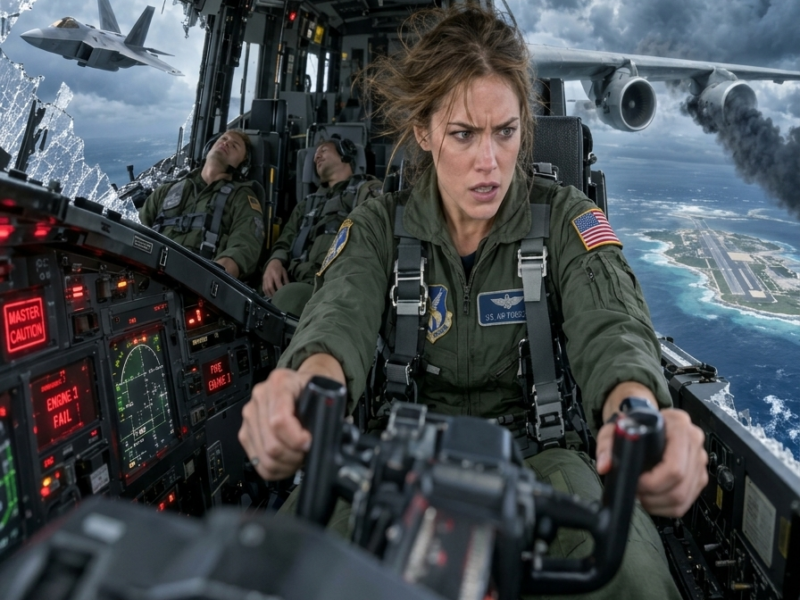
When the young woman in a faded leather jacket landed a crippled passenger jet alone at Dallas–Fort Worth International Airport
The runway lights blurred through the windshield as I fought to keep the aircraft steady, my hands trembling against controls I had never expected to touch again. Behind me, 164 passengers were praying, screaming, or clutching the people they loved. The cabin was a cauldron of pure, unadulterated terror. Smells of ozone, burnt hydraulic fluid, and acrid smoke filtered through the air conditioning vents, stinging my eyes and filling my throat with a metallic dryness.
The captain was unconscious, slumped heavily to the left with a severe head wound sustained when the forward galley overhead bin sheared off during extreme atmospheric turbulence. The first officer was dead—his pulse had ceased fifteen minutes ago after a massive, sudden cardiac arrest triggered by the initial explosive depressurization in the forward cargo bay. And somewhere beneath the cabin floorboards, a damaged hydraulic line was bleeding the Boeing 737 of its vital ability to actuate its control surfaces and bring its massive weight to a full stop.
I had boarded Flight 718 in Denver wearing jeans, worn leather boots, and the distressed leather flight jacket my father had left me when he died twelve years ago. To everyone else in the boarding area, I was just another quiet traveler heading south, avoiding eye contact, carrying no baggage other than a battered canvas rucksack. Nobody knew I had once spent four intense years flying high-altitude tactical aircraft that most citizens would never see outside a classified Pentagon photograph. Nobody knew why I had vanished overnight into the vastness of rural Montana, changing my phone number, leaving behind an honorable discharge paper stamped with red security classifications, and burning every uniform I owned except my father’s jacket.
And I intended to keep it that way for the rest of my life.
“Is anyone there who can fly this aircraft?” the senior flight attendant, a terrified woman named Sarah whose uniform was stained with dark coffee and engine soot, had shouted over the cabin chaos forty minutes ago.
I had sat in seat 14B, closing my eyes, praying that someone else—a commercial airline pilot on vacation, a private twin-engine enthusiast, anyone—would raise their hand. But no one did. The cabin had remained a chorus of weeping children and desperate prayers. Slowly, as if pulled by an invisible cable woven from duty and ghosts, I had raised my hand.
Now, thirty thousand feet above the dark expanse of North Texas, I listened through the heavy aviation headset as the Dallas–Fort Worth air traffic control tower questioned my identity for the third agonizing time.
“Ma’am, you’re telling us you have no commercial pilot license on file?” the controller’s voice crackled, laced with undertones of rising panic and sharp skepticism.
“That’s correct, DFW,” I answered, keeping my voice down in the lower register, forcing my vocal cords to adopt the icy, mechanical calm that had been drilled into me at the Nevada testing grounds. “I do not hold a FAA Part 121 or Part 91 commercial certificate.”
“And you expect us to hand over cleared airspace and let you attempt a manual landing with a crippled twin-jet?”
“I expect you to give me local altimeter, vector me toward the longest strip you have, and help me keep 164 human beings alive for another twenty minutes,” I shot back, adjusting the throttle levers with millimeter precision to compensate for the asymmetrical thrust dragging us down to the left. “So stop checking your database and start clearing my glidepath.”
A heavy silence followed over the frequency, filled only by static and the deep, rhythmic hum of the failing left engine.
Suddenly, the aircraft shuddered violently. A harsh metallic groan vibrated through the floorboards beneath my boots. The primary amber warning light on the glare shield flashed bright against the dark cockpit instruments. The left engine was undergoing a severe compressor stall. Smoke billowed from the engine cowl, visible in the faint reflection of the wing strobe.
I swallowed the bitter cold panic rising in my throat. I squeezed the yoke until my knuckles turned white, forcing my brain to tune out the alarm chimes and retreat to a quiet, distant corner of memory. I remembered my father’s voice, calm, resonant, and unwavering inside the cramped cockpit of an old T-38 Talon training jet over the Mojave Desert when I was nineteen years old.
Fear is just a passenger, sweetheart. It gets to ride in the back seat, but you never, ever give it the controls.
I manually adjusted our pitch, trimmed the rudder to counteract the leftward drag, and requested the absolute longest runway available at DFW—Runway 18R.
The tower controller’s voice returned, his skepticism replaced by a stark, somber tone. “Flight 718, you are cleared for approach, Runway 18R. Emergency equipment is rolling. God speed.”
Before I could acknowledge the landing clearance, another voice sliced through the frequency—crisp, authoritative, overriding the civilian tower channel on a secure military frequency that somehow bridged into my comm set.
“Unidentified civilian aircraft, this is United States Air Force flight commander. Maintain current heading and altitude. Two tactical fighters are closing on your six o’clock position.”
I glanced out the left cockpit window. Emerging from the heavy grey underdeck of the clouds, two sleek, angular gray shadows cut through the mist like apex predators of the sky. F-22 Raptors. Their twin tail fins reflected the faint moonlight. The lead Raptor executed a flawlessly tight banking maneuver, sliding down beneath my left wing, close enough that I could clearly see the pilot’s dark helmet, gold-visored face, and the intricate unit patch on his shoulder.
My breath caught in my chest. The air in the cockpit felt instantly thin.
The second gray fighter matched our airspeed, locking into a tight formation on my right wingtip. Then the military frequency crackled again with high-grade cryptographic clearance tones.
“Flight 718, confirm the identity of the person currently manipulating the flight controls. Give us your call sign.”
I stared straight ahead at the illuminated horizon, my heart hammering against my ribs like a trapped bird. “I’m a civilian passenger named Maya Lin. I am flying an emergency aircraft.”
The voice in my headset returned, dropping its official military posture, growing lower, quieter, and filled with a strange, haunting reverence.
“Negative, civilian. We recognize that exact asymmetric slip-compensation pattern anywhere. There was only one pilot in the tactical inventory who ever flew a damaged bird with that precise left-rudder trim bias. Ghost Seven… if you can hear us on this channel, give us a wing dip.”
My fingers went completely numb against the yoke.
Twelve years earlier, I had flown classified low-altitude recon missions under the military call sign Ghost Seven. It was a black-budget tactical wing operating out of an unmapped dry lake bed in the Great Basin. On my final mission over dark mountains in a region that officially didn’t exist, my wingman—a brilliant pilot named Marcus—had been hit by an unidentified ground-launched system. His aircraft had disintegrated into a fireball. I had barely brought my crippled jet back across the border.
When I woke up in a military hospital three days later, I was met not with honors, but with a wall of brass and men in dark suits. The official report had been altered. They claimed Marcus died because I had panicked, disobeyed direct orders, breached formation, and abandoned him to save myself. I was quietly stripped of my flight status, given an administrative discharge, and warned that a single word to the press would land me in a federal maximum-security penitentiary for treason. My father, General Arthur Lin, the highly decorated commander who had fought fiercely to defend my name and expose the cover-up, was killed six months later in a high-speed rollover car crash on an isolated mountain highway.
I had spent twelve excruciating years carrying the crushing weight of guilt, believing my father had died in disgrace, knowing his only daughter had been branded a coward and a traitor.
Now, high above the clouds of Texas, an F-22 commander was calling me by the ghost name that had obliterated my life.
“Who is this?” I whispered into the oxygen mask I had pulled over my face.
“Major Daniel Reeves,” the pilot answered, his voice steady through the static. “I was a lieutenant in the 42nd Squadron. I flew under your father’s command, Ghost Seven.”
My throat tightened so hard I could barely draw breath. “My father died because of what I did.”
There was a long, heavy pause on the radio. The Raptor on my left wing dipped its wings slightly in a crisp military salute.
“No, ma’am,” Major Reeves said softly. “General Lin didn’t die because of you. And he never believed that lie for a single second. Before his death, he told a few of us the truth. He told us you were the only surviving witness who held the flight recorder key to what really happened that night.”
The runway lights of DFW flared bright through the rain-streaked windshield, piercing the low fog. We were five hundred feet above the ground. The airspeed was dropping into the critical stall margin.
“We have to talk later, Reeves,” I slammed the throttles to balance our final glide. “I’m putting this building down.”
I slammed the landing gear lever downward. The mechanical thud of the three main gear assemblies locking into place vibrated through the fuselage. I fought the crosswind, wrestling the massive steering yoke with every ounce of physical strength remaining in my arms, refusing to let the ghosts of the past steal the lives of the 164 innocent people behind me.
The heavy tires struck the wet asphalt of Runway 18R with a deafening screech that shook the cabin to its rivets. For one agonizing, heart-stopping second, the plane skidded sideways on the rain-slicked surface as the damaged hydraulic brakes failed to equalize pressure. The left wing dipped low, terrifyingly close to scraping the runway.
I stomped on the right rudder pedal with all my weight, manually reversing the thrust on the remaining good engine. The metal groaned in protest. The aircraft straightened out, violently decelerating, spraying twin plumes of water high into the night air.
We ground to a halt with less than three hundred feet of runway remaining before the perimeter fence.
Silence descended upon the cockpit, broken only by the high-pitched whine of the spooling-down turbines and the distant, rising wail of approaching airport fire trucks and emergency sirens. From behind the armored cockpit door, a deafening roar of applause, weeping, and joyful screams erupted from the cabin.
I sat completely motionless in the captain’s seat, staring at my trembling hands resting on the dark control column. Sweat soaked through my father’s leather jacket. I had brought them home. I had saved them.
As red and blue emergency lights washed across the wet glass of the nose cone, Major Reeves’s voice came through the radio one final time.
“Ghost Seven, clear the aircraft immediately, but whatever you do, do not leave the airport terminal building.”
I unbuckled my heavy harness, my heart beating frantically against my ribs. “Why? What are you talking about, Reeves?”
His next words made every drop of blood drain from my face, leaving me cold and breathless in the dark cockpit.
“Because your father’s car accident was staged, Maya. He didn’t die twelve years ago. He’s been in deep hiding. And the men who ordered us to bury the truth about your wingman just saw this landing on live television. They know Ghost Seven is alive.”
My head snapped up toward the massive glass windows of the main DFW terminal, illuminated brightly against the night sky. Up on the third-floor observation deck, amidst the crowd of airport workers and shocked bystanders, stood a tall man in a tailored charcoal suit. He wasn’t watching the emergency trucks. He was looking directly through binoculars at the cockpit window.
Directly at me.
As I watched, he lowered the binoculars, pulled a encrypted satellite phone from his jacket, and pressed it to his ear. I couldn’t hear his voice across the tarmac, but through twelve years of survival instincts and tactical training, I could read his lips perfectly as he spoke into the receiver:
“She’s back. Execute protocol Omega.”
The cockpit door was nearly torn off its hinges by the airport emergency response crew. Firefighters in silver heat-resistant suits and armed airport police surged into the forward cabin, screaming for everyone to remain seated while paramedics rushed forward to attend to the unconscious captain and the body of the first officer.
Sarah, the senior flight attendant, grabbed my shoulder as I stepped out of the flight deck into the narrow galley. Her eyes were red, brimming with tears of overwhelming gratitude. “You saved us,” she sobbed, holding onto my leather sleeve. “Who are you? The paramedics are asking for your name for the passenger manifest.”
“Tell them I was just a lucky passenger,” I said quietly, gently unclasping her hand from my jacket. “If anyone asks, I vanished in the chaos.”
Before she could process my words, I slipped past the medical team carrying the gurney and blended into the flood of traumatized passengers being escorted down the emergency jetway into Terminal D. The terminal was a scene of absolute pandemonium. Alarm sirens were ringing through the concourse, news networks were broadcasting live breaking footage of the miraculous landing on massive overhead monitors, and passengers were weeping, embracing loved ones, and shouting into their mobile phones.
I pulled the collar of my father’s leather jacket up around my chin, kept my head down, and pressed through the surging crowd. My mind was spinning violently. My father is alive. The sentence echoed in my mind like a recurring explosion. For twelve painful years, I had visited a cold marble headstone in Arlington National Cemetery. I had laid flowers next to a grave that held an empty coffin or a stranger’s body.
I reached the central atrium of Terminal D, navigating around a cluster of armed security officers who were setting up temporary perimeter tape. I needed to find a vantage point to locate the man in the charcoal suit I had seen from the tarmac. He wasn’t law enforcement. He wasn’t military. The cold, mechanical efficiency in his demeanor belonged to the privatized intelligence contractors that had operated in the dark fringe of the defense industry twelve years ago—the same contractors who had designed the classified avionics suite on my wingman’s ill-fated aircraft.
Suddenly, a hand clamped onto my upper arm with iron strength.
Instinct took over instantly. I dropped my center of gravity, pivoted on my right heel, and drove my left elbow backward toward my attacker’s solar plexus.
The man caught my elbow in his open palm, absorbing the blow with trained precision, though he gasped slightly at the force. He wore a dark navy flight suit without unit patches, a dark cap pulled low, and carried a tactical radio earpiece.
“Easy, Maya,” he rasped in a low, urgent whisper. “It’s Reeves. Daniel Reeves. Stand down.”
I froze, scanning his face. He was in his late thirties, with a sharp jawline, intense gray eyes, and a fresh scar running along his left temple. He looked like a man who hadn’t slept a full night in a decade.
“You took a massive risk coming inside this concourse,” I said, my voice dropping to a dangerous whisper as I pulled my arm back. “Where are your Raptors?”
“Diverted to Carswell Joint Reserve Base,” Reeves replied, keeping his body positioned between me and the large glass windows overlooking the concourse. “I ejected from my flight plan, claimed a hydraulic indicator emergency, landed my bird at the private military ramp on the south end of DFW, and ran through the service tunnels to get to you before they do.”
“Who are ‘they’, Daniel?” I demanded, gripping the front of his flight suit. “And don’t give me the sanitized Pentagon version. Who killed my wingman? And why did you tell me my father is alive?”
Reeves grabbed my shoulder and guided me quickly into a dimly lit janitorial maintenance corridor away from the main passenger flow. He locked the heavy steel door behind us, standing in the yellow glare of a single overhead fluorescent bulb.
“Twelve years ago, your wingman Marcus didn’t get shot down by an enemy missile, Maya,” Reeves said, his voice deadly serious. “His aircraft was remotely hijacked through a backdoored satellite control system installed by a private defense firm called Aegis Defense Dynamics. They were testing an autonomous aerial override program called Project Titan. Marcus realized his jet was being controlled by an off-site contractor, and he tried to manually override the system to bring the flight data back to base.”
The realization hit me like a physical blow. “So they detonated his aircraft in mid-air.”
“They triggered the onboard self-destruct sequence to prevent him from landing,” Reeves confirmed grimly. “You survived because you were flying outside their encrypted data link radius. But you saw the secondary explosion. You saw that the kill-switch originated from inside our own tactical command center.”
“My father,” I whispered, the puzzle pieces falling into place with terrifying speed. “He found out.”
“General Lin uncovered the financial paper trail connecting Aegis Dynamics to three high-ranking officials in the Defense Intelligence Agency,” Reeves explained, pacing the small concrete room. “The night before he was supposed to testify before a closed Senate Select Committee on Intelligence, his vehicle was forced off the road and blown up. But your father was one step ahead. He knew the hit was coming. He swapped places with a body double from a black-ops preservation program, staged his death, and went completely dark.”
“Where is he?” Tears burned behind my eyes, but I forced them back with fierce determination. “Daniel, where is my father?”
Before Reeves could answer, a soft, electronic beep emitted from his tactical earpiece. He tapped his collar mic, listening intently. His face went completely pale.
“They’re inside the terminal,” Reeves whispered, pulling a suppressed 9mm pistol from beneath his flight jacket. “Aegis security teams are dressed as TSA supervisors and private terminal officers. They’ve locked down all public exits under the guise of an airport terrorism lockdown.”
“They know I’m with you?”
“They know Ghost Seven is in Terminal D. And they have orders to eliminate any witnesses who can link the 2014 Titan data back to their current board members.” Reeves checked the magazine of his weapon and slid it back into the receiver with a sharp clack. “There’s an underground baggage transport tunnel that leads to the air cargo depot on the east side. That’s our only way out.”
“Wait,” I said, reaching into my pocket and pulling out the small, heavy silver key my father had given me on my twenty-first birthday—a key I had worn on a chain around my neck for twelve years until I put it in my pocket before boarding Flight 718. “My father gave me this. He said if I ever found myself in a corner where the sky was closed, I should find a lockbox marked 718.”
Reeves stared at the key, his eyes widening in shock. “Flight 718… it wasn’t a coincidence you were on that plane today, Maya. Your father set this chain of events in motion years ago. He knew Aegis would eventually try to move the original physical servers through a commercial courier route.”
Suddenly, the heavy steel door of the janitorial closet vibrated as a heavy boot slammed against the exterior lock.
BANG.
The metal frame groaned. Sparks showered from the strike plate.
“DFW Security! Open this door immediately!” a harsh voice shouted from the corridor outside.
Reeves pointed his weapon at the door, but I grabbed his hand, pushing it down. “No gunfire in a crowded airport. It’ll cause a stampede and give them cover to execute us in the chaos.”
I looked up at the ceiling. A heavy ventilation grate, roughly two feet wide, was screwed into the concrete wall near the ceiling beams.
“Boost me up,” I commanded.
Reeves didn’t argue. He cupped his hands, lifting me toward the vent. I pulled a heavy steel screwdriver from a maintenance rack nearby, jammed it into the corner of the aluminum grate, and pried it open with a sharp metallic snap. I hoisted myself into the dark, dusty ductwork just as the steel door burst open behind us.
Gunfire, suppressed and hollow, echoed below.
“Clear!” a voice shouted from the room. “They’re in the air ducts! Flush them out!”
I crawled frantically through the cold metal shaft, the sound of my father’s jacket scraping against the galvanized steel ringing in my ears. Behind me, Reeves scrambled into the duct, pulling the damaged grate closed behind him.
We crawled through the maze of commercial air ducts for what felt like miles, guided only by the dim light filtering through lower grates. Below us, the terminal was in absolute lockdown. Sirens blared continuously. Tactical teams in unmarked black gear were pushing through terrified crowds of stranded passengers, searching every lounge, bathroom, and shop.
Finally, we reached a large vertical junction above the central luggage sorting facility. Through the floor grill, I could see automated conveyor belts carrying thousands of suitcases through scanner arches.
“Down there,” I whispered, pointing to an access ladder leading down into the mechanical room. “The baggage subterranean track.”
We dropped down from the vent, landing lightly on the steel catwalk above the sorting machinery. The air down here was thick with the smell of rubber, grease, and exhaust fumes.
“Maya, look,” Reeves whispered, pointing toward a secure storage cage located near the central power generator.
Inside the cage sat a heavy, military-grade tactical transit case stamped with red security wax and the digits: 718-ALPHA. Standing right outside the wire cage were three men in dark suits. Among them was the man I had seen from the cockpit—the man who had spoken into his phone on the observation deck.
He was holding an electronic keycard, swiping it through the access scanner of the secure cage.
“That’s Thomas Vance,” Reeves whispered, his voice cold with hatred. “Former Deputy Director of Defense Intelligence. Current CEO of Aegis Dynamics. The man who signed the order on your wingman.”
Vance pulled a heavy, reinforced hard drive array from the transit case and slid it into a briefcase. He turned to his head of security, a heavily built man with a radio harness.
“Is the passenger dead yet?” Vance asked, his voice echoing clearly over the roar of the baggage belts.
“Our teams are sweeping Terminal D, sir. She hasn’t exited the perimeter.”
“Find her,” Vance said coldly, closing his briefcase. “She is the only person alive who holds the cryptographic master key that can unlock this drive and expose our government contracts. If she leaves this airport alive, everything we built collapses by morning.”
I gripped the cold steel railing of the catwalk, my heart pounding violently against my ribs. The key in my pocket felt impossibly heavy.
Suddenly, my foot shifted on a patch of engine oil on the steel catwalk. A loose bolt clattered against the metal frame, falling twenty feet through the air and landing with a loud metallic CLANG directly on top of the transformer unit below.
Down in the illuminated baggage area, Vance and his armed security team snapped their heads upward.
Vance’s eyes locked directly onto mine in the shadows above. A slow, terrifying smile spread across his face.
“Ghost Seven,” Vance whispered into his collar mic, his voice amplified through the facility speakers. “I was hoping you wouldn’t make me hunt for you.”
He raised a sleek, suppressed weapon, aimed straight at my chest, and pulled the trigger.
The suppressed round slammed into the steel catwalk an inch from my right boot, sending a shower of burning sparks into the dark air.
“Move!” Reeves yelled, shoving me backward down the narrow catway as a hail of submachine gun fire chewed through the aluminum flooring behind us.
We scrambled down the spiral iron staircase, ducking behind massive steel support pillars as heavy 9mm rounds ricocheted off the heavy machinery around us. The luggage sorting facility transformed into a warzone, the rhythmic clatter of automated conveyor belts punctuated by the sharp crack of silenced gunfire.
“They’ve got us pinned against the outer concrete wall!” Reeves shouted over the noise, squeezing off three precise shots from his pistol that forced two advancing Aegis guards to dive behind a row of luggage carts. “We can’t reach the main vehicle exit!”
“We don’t need the vehicle exit!” I called back, my tactical instincts firing with absolute clarity. “Look at the main conveyor line! It runs straight through the subterranean tunnel to the international cargo hangar a mile away!”
I ducked beneath a burst of fire, grabbed a heavy steel wrench from a nearby tool rack, and jammed it directly into the primary drive gear of the central baggage carousel.
The heavy iron gears ground together with a deafening, ear-splitting metallic shriek. Sparks erupted high into the air as the drive belt jammed, causing electrical breakers along the wall to blow out one after another. The entire subterranean sorting level was instantly plunged into pitch-black darkness, save for the flashing amber emergency strobe lights.
“Go! Go!” I screamed.
Reeves and I vaulted over the sorting counter, landing hard on the rubberized surface of the high-speed baggage conveyor belt just as it came to a jerky halt. We sprinted down the dark, enclosed concrete tunnel following the conveyor tracks, the darkness swallowing us whole as the shouts of Vance’s security team faded into the distance behind us.
We ran through the dark underground artery for ten agonizing minutes, our lungs burning, our boots echoing against the concrete walls. The air grew colder and damper as we moved further away from the main passenger terminal and deeper into the airport’s industrial infrastructure.
Finally, the tunnel sloped upward, terminating at a heavy industrial fire door marked: CARGO SECTOR 4 – RESTRICTED ACCESS.
Reeves pushed the heavy crash bar open, and we tumbled out into the cold night air of the outer ramp. Rain was falling in heavy, vertical sheets now, washing the sweat and grease from my face. Ahead of us stretched the vast, dark tarmac of the international freight apron, illuminated only by high-mast floodlights. Dozens of massive cargo freighters sat parked in rows, their hulking silhouettes looking like sleeping giants in the storm.
“Over there,” Reeves panted, pointing toward a small, dimly lit maintenance hangar at the far edge of the tarmac, miles away from the main terminal activity. “That’s where my unit kept our off-book transport vehicles.”
We ran across the wet, slick pavement, keeping low behind parked luggage tractors and fuel trucks. We slipped inside the side service door of Hangar 12. The air inside smelled of jet fuel, hydraulic oil, and old leather—a smell that brought an overwhelming flood of memories rushing back to my chest.
Parked inside the center of the dark hangar was not a military transport, but a pristine, vintage 1970 Beechcraft King Air twin-turboprop aircraft, its black paint gleaming under the overhead lights.
Sitting in a folding chair next to the aircraft’s left landing gear, calmly sipping coffee from a dented thermos, was an elderly man wearing a faded green flight suit. He had thick white hair, a weathered, lined face, and a deep scar running along his jawline.
My feet froze to the concrete floor. The breath left my lungs in a sharp, painful gasp.
The thermos in the old man’s hands trembled slightly. He set it down on a wooden workbench, slowly stood up, and looked across the dimly lit hangar straight at me. His eyes were the exact same shade of pale blue as mine.
“You always did land a plane a little too hot on the nose gear, Maya,” he said, his voice deep, raspy, and thick with emotion.
“Dad?” I whispered, my voice breaking.
General Arthur Lin took three slow, deliberate steps forward, his hands open at his sides. Twelve years of grief, twelve years of rage, twelve years of feeling entirely alone in a hostile world collapsed inside my chest in a single fraction of a second. I closed the distance between us and threw my arms around his shoulders, burying my face into his flight jacket. He wrapped his arms around me, holding me with a fierce, trembling strength that proved he was real—not a ghost, not a dream, but my father.
“I’m sorry, sweetheart,” he whispered into my hair, his tears wet against my cheek. “God, I’m so sorry I had to let you carry that weight for so long. I had to make them believe you were abandoned and that I was dead, or they would have put a bullet in your head the day you walked out of that military court.”
“You’re alive,” I sobbed, pulling back to look at his face. “Reeves told me… but I couldn’t believe it until I saw you.”
“There’s no time for a reunion, General,” Reeves interrupted urgently, keeping watch at the hangar door with his weapon raised. “Vance knows Maya is alive. He knows about the drive in Cargo 718. His contractors are sweeping every sector of DFW right now. We have less than ten minutes before they trace this hangar.”
My father’s emotional expression instantly hardened into the sharp, commanding posture of a combat general. He stepped toward the workbench, picking up a ruggedized tactical laptop connected to a high-gain satellite array.
“They won’t need ten minutes,” my father said calmly. “Because I just broadcasted our location directly to Vance’s personal terminal.”
I stared at him in utter disbelief. “You wanted him to find us?”
“For twelve years, I’ve been piecing together the encrypted source code from the Titan project,” my father explained, typing rapidly on the keyboard. “The physical drive Vance retrieved from the baggage facility contains the master activation protocols for their autonomous weapon systems. But that drive is useless without the hardware encryption key.” He turned and looked at me, pointing to the silver key I was still clutching in my hand. “The key your mother left you.”
I looked down at the silver key. “It’s not just a key to a lockbox?”
“It’s a solid-state quantum cryptographic drive,” my father said. “Your mother was the chief mathematician for the Titan guidance module. Before she died of cancer, she encoded the hard-reset protocol into that silver key. She knew what Aegis was building, Maya. She knew they intended to sell a completely un-hackable, un-traceable autonomous kill-system to the highest bidder.”
Suddenly, the heavy steel hangar doors were slammed open from the outside with a deafening hydraulic roar.
Bright, high-intensity tactical spotlights flooded the interior of the hangar, blinding us with searing white light. The deep, rhythmic thrum of a heavy helicopter rotor roared directly overhead as an unmarked black attack helicopter hovered forty feet above the tarmac outside.
Dozens of heavily armed men in black tactical gear poured through the hangar doors, forming a lethal perimeter, their rifle laser sights painting red dots across our chests.
Walking slowly through the center of the armed line was Thomas Vance, holding his briefcase, a cold, triumphant smile playing on his lips.
“General Lin,” Vance said, his voice echoing loudly through the massive cavern of the hangar. “I must admit, I was impressed when you faked your death in 2014. But bringing your daughter back into the line of fire? That seems remarkably foolish for a former three-star general.”
My father stepped in front of me, shielding my body with his own. “It ends tonight, Vance. You murdered Marcus. You framed my daughter. You turned defensive technology into an illegal private assassination engine.”
Vance chuckled softly, a hollow, soulless sound. “History is written by the survivors, General. And in five minutes, there will be no one left alive in this hangar to offer a dissenting opinion.” He pointed his weapon directly at my father’s head. “Hand over the key, Maya. Hand it over, and I’ll make sure your father’s death is fast this time.”
I looked at my father. He gave me a tiny, almost imperceptible nod.
I stepped out from behind my father, holding the silver key high above my head, letting the bright spotlights catch its metallic glint.
“You want the key, Vance?” I shouted over the deafening roar of the hovering helicopter. “Come and take it.”
Vance’s eyes flared with greedy anticipation. He motioned for his lead tactical officer to step forward and retrieve the key. “Intelligent choice, Ghost Seven. You always were a survivor.”
As the tactical officer reached out his gloved hand to snatch the silver key from my fingers, I executed a move I had practiced ten thousand times in tactical survival training.
I slammed the edge of my hand violently into the officer’s throat, shattering his windpipe. Before he could fall, I grabbed his tactical rifle, ripped it from his sling, and swept the barrel across the front line of Aegis guards, firing a continuous burst of automatic fire into their body armor plates.
“COVER!” Reeves roared, leaping behind the heavy steel landing gear of the King Air and returning rapid, precise pistol fire that dropped two advancing contractors.
My father ducked behind the heavy workbench, slamming his thumb down on the enter key of his ruggedized laptop.
“The drive is syncing!” my father yelled over the deafening storm of gunfire. “Maya! Insert the key into the array port under the workbench!”
Bullets punched holes through the skin of the vintage aircraft above us, spraying aviation fuel across the concrete floor. The smell of high-octane fuel filled the air, posing an immediate, lethal danger. A single spark would ignite the entire hangar into a blazing inferno.
I dove across the oil-slicked floor, bullets chewing into the concrete inches behind my trailing boots. I hit the base of the workbench, reached up, and jammed the silver key into the custom cryptographic reader attached to the satellite terminal.
The laptop screen instantly flashed from bright red to deep, brilliant green.
A high-pitched digital chime sounded through the terminal, followed by an automated mechanical voice echoing from the laptop speakers:
[QUANTUM ENCRYPTION KEY ACCEPTED. UNEXPIRED MASTER PROTOCOL UNLOCKED. BROADCASTING GLOBAL DECRYPTION VECTOR.]
Vance’s face transformed from cold confidence to sheer, unadulterated panic. “Kill them! Kill them all now! Destroy that computer!” he screamed hysterically, scrambling backward behind his armored SUV as his security detail unleashed a relentless barrage of gunfire toward the workbench.
“It’s too late, Vance!” my father shouted, a look of fierce, unyielding victory on his face as he watched the progress bar on the screen reach 100%. “The Titan source code, the off-shore banking records, the video footage of Marcus’s aircraft destruction, and the full list of your co-conspirators in the Pentagon are currently downloading to the servers of the Department of Justice, the FBI, and every major news network on the planet!”
Outside the hangar, the sky suddenly lit up with blinding white illumination flares.
The heavy, deep thunder of multi-engine military turbines shook the very foundation of the building. The unmarked black helicopter hovering outside was suddenly boxed in by two massive, dark shadows descending through the rain.
US Air Force Special Operations Pave Hawk helicopters, packed with heavily armed FBI Hostage Rescue Teams and Air Force Special Tactics Operators, dropped from the clouds. Bright searchlights cut through the rain, locking onto Vance’s security forces.
“ALL AEGIS PERSONNEL! THIS IS THE UNITED STATES FEDERAL BUREAU OF INVESTIGATION!” a booming voice echoed from a loudspeaker overhead. “DROP YOUR WEAPONS AND SURRENDER IMMEDIATELY! YOU ARE SURROUNDED!”
Panicked, Vance’s contractors realized their private war was over. They threw their weapons onto the concrete, raising their hands above their heads as federal tactical teams flooded into the hangar, flex-cuffing the contractors and securing the perimeter.
Vance, desperate and unhinged, grabbed the heavy briefcase containing the hard drive, turned, and sprinted out the rear service exit into the dark, rain-soaked alley behind the hangar.
“Maya!” Reeves shouted, pointing toward the exit. “He’s escaping with the primary hardware!”
“Not this time,” I snarled.
I grabbed a tactical flashlight, shoved past the entering federal agents, and burst out into the storming darkness behind the hangar.
Vance was slipping on the wet asphalt, running toward a black, un-marked getaway sedan parked near the perimeter fence. Rain pelted my face as I sprinted after him, my father’s leather jacket heavy and soaked on my shoulders. Twelve years of running, twelve years of hiding in the shadows, twelve years of carrying a dead man’s dishonor crystallized into a single, unstoppable surge of momentum.
“Vance!” I screamed through the thunder.
He spun around, drawing a small concealed sidearm from his jacket, his hands shaking uncontrollably as he aimed at my head. “Stay back! I built an empire! You’re nothing but a burnt-out pilot!”
Before he could squeeze the trigger, I dove beneath his line of sight, slammed my shoulder into his knees, and brought him crashing violently onto the flooded pavement. The gun flew from his hand, skidding across the wet asphalt into a drainage grate.
I pinned him to the ground, pulling his arm behind his back until he shrieked in pain, pressing his face into the cold, rain-filled puddle.
“You took twelve years of my life,” I whispered into his ear, my voice shaking with pure, cold fury. “You took Marcus. You tried to destroy my father. But you forgot one thing about Ghost Seven.”
I pulled his briefcase from his grip and held it high above him.
“We don’t crash,” I said. “We recover.”
Federal agents rounded the corner of the hangar, their rifle lights locking onto us.
“Federal agents! Don’t move!”
I stood up slowly, raising my hands into the rain, letting the cold water wash over my skin as they rushed forward to tackle and handcuff the weeping, broken CEO of Aegis Dynamics.
I turned around. Walking slowly through the rain, supported by Major Reeves, was my father. He stopped a few feet away, looking at me with eyes filled with immense pride, grief, and love.
The storm above DFW began to break, revealing small patches of clear, star-filled sky through the dissipating clouds.
Three days later.
The quiet morning sun rose over the majestic granite monoliths of Arlington National Cemetery. The rain from earlier in the week had cleared, leaving the grass vibrant green and the air crisp and cold.
I stood in my full, restored United States Air Force dress uniform—the silver pilot wings pinned proudly over my heart, the rank of Lieutenant Colonel resting on my shoulders. Next to me stood Major Daniel Reeves, his cap held under his arm, looking silently at the polished black granite monument in front of us.
Inscribed on the stone was the name of my wingman: CAPTAIN MARCUS VANE – HONORED DEFENDER OF THE FREEDOM SKIES.
A official military ceremony had just concluded. The President of the United States had issued a full, formal executive pardon, restoring my military record, expunging every false allegation of cowardice, and posthumously awarding Marcus the Air Force Cross for his heroic sacrifice to stop Project Titan.
The story had dominated every global news outlet for seventy-two hours. The arrest of Thomas Vance and nine senior defense officials had sent shockwaves through Washington, dismantling the corrupt military-industrial shadow syndicate that had operated with impunity for over a decade. The story of the miraculous civilian landing of Flight 718 at DFW had become an international legend—the day a “ghost” returned from the grave to save 164 lives and pull down an empire of corruption.
Footsteps echoed softly on the gravel path behind us.
I turned to see my father walking slowly toward us. He wore a sharp civilian suit, leaning lightly on a polished wooden cane, but his posture was upright, dignified, and filled with a peace I had never seen in him during my entire life.
“The Department of Defense offered me my full three-star commission back this morning,” my father said, stopping beside me and placing a warm hand on my shoulder. “They wanted me to take over the Directorate of Special Operations.”
I smiled softly, looking at his weathered face. “And what did you tell them, General?”
My father let out a soft, hearty laugh that warmed the crisp morning air. “I told them I’m seventy-two years old, I’ve been dead for twelve years, and I’m long overdue for a quiet fishing trip in Montana.” He looked at me, his blue eyes twinkling. “Unless, of course, my daughter is too busy flying jets to join me.”
I reached up and touched the silver pilot wings on my chest. “The Air Force offered me command of the newly restructured 42nd Tactical Evaluation Squadron at Nellis.”
Reeves turned to me, a bright smile breaking across his face. “Are you taking it, Maya?”
I looked up at the endless blue sky above Virginia. A formation of four jet aircraft streaked high overhead, their vapor trails cutting clean, white lines across the brilliant morning light. The sound of their engines was a deep, resonant hum—a music that had called to me since I was a little girl sitting in the cockpit of my father’s trainer.
I thought about the 164 passengers on Flight 718 who were alive today, living their lives, hugging their children, drinking their morning coffee. I thought about Marcus, whose name was finally clean and free. And I thought about the scared young woman in the worn leather jacket who had taken the controls of a falling airliner over Texas, refusing to let fear drive the plane.
“I accepted the command, Daniel,” I said, my voice steady, strong, and certain. “But on one condition.”
“What condition?” Reeves asked.
“That my call sign remains Ghost Seven,” I said, adjusting my flight cap. “Because sometimes, the world needs a ghost to remind them that the truth never dies.”
My father put his arm around my shoulder, and together, the three of us walked down the peaceful gravel path of Arlington toward the bright, unwritten horizon of a brand-new day.
The enD.









