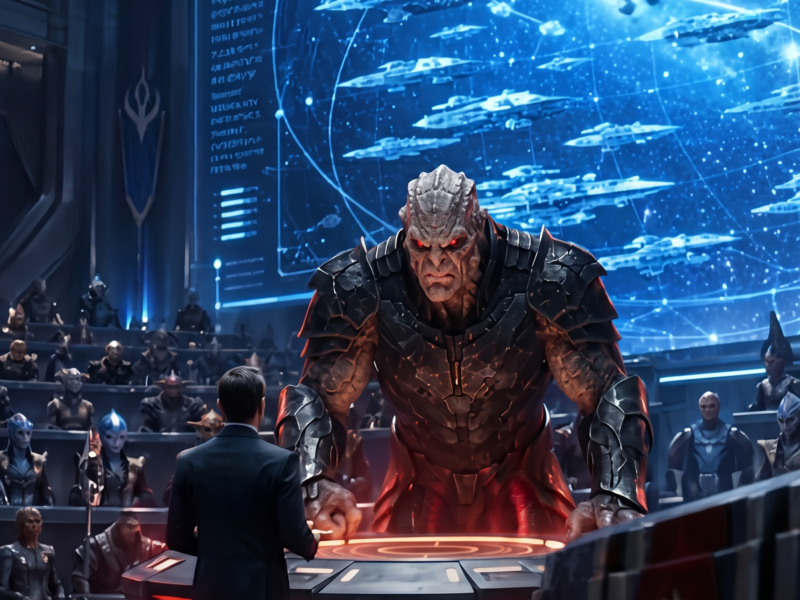
When the Supreme Galactic Empire declared war on humanity before thousands of witnesses in the Grand Hall of Orion
The resonant roar of a voice older than the stars rippled through the obsidian pillars of the Grand Hall of Orion, rattling the crystal chandeliers and sending shockwaves through the thousands of alien delegates assembled beneath the artificial sky.
It was not a sound transmitted through standard speakers; it was a physical vibration that rattled teeth, hummed in marrow, and warped the heavy atmospheric shielding of the imperial spire.
Emperor Vael’s grip on my forearm faltered. His four golden eyes, usually cold and calculating, widened as his secondary pupils dilated in instinctual, biological terror. The twelve golden battle-cruisers hovering on the holographic display behind his throne flickered violently, their targeting sensors overwhelmed by a sudden, massive influx of gravimetric distortion.
“What… what is that?” Vael gasped, his chest heaving under his ornate silver armor.
I looked down at his trembling hand, gently removed his clawed fingers from my sleeve, and smoothed the fabric of my suit jacket.
“That, Your Majesty,” I said, taking a calm sip of my lukewarm coffee, “is the reason humanity never bothered building an empire. When you have a guardian that swallowed the last elder civilization eleven million years ago, military expansion feels a bit redundant.”
“Lies!” grand Marshal Kael, a towering, chitin-armored warrior standing beside the throne, roared as he drew his plasma blade. “This is a human trick! A sensory spoof! A localized spatial anomaly!”
“Check your long-range arrays, Marshal,” I replied, pointing toward the sweeping trans-panoramic windows overlooking the imperial plaza.
Beyond the crystalline walls, the glittering skyline of Orion Prime was changing. The stars—the brilliant, eternal dust of the galactic core—were vanishing. It wasn’t cloud cover or atmospheric smog. Dark, non-reflective tendrils of distorted space were stretching across the sky like ink bleeding into water. Whole star systems were simply being covered, occluded by something so vast that it bent light around its perimeter without emitting a single particle of heat.
On the central tactical hologram, every red icon representing humanity’s sparse trade fleets and orbital stations turned grey.
“Sire!” the Chief Science Officer yelled from the lower gallery, his scales turning a sickly, pale yellow. “Humanity’s homeworld… Earth… it’s gone!”
“Gone?” Vael demanded, rushing toward the lip of the dais. “Destroyed? Did their sub-surface reactors overload?!”
“No, Sire!” the officer screamed over the rising alarms. “It hasn’t been destroyed! The entire Sol system has dropped behind an absolute quantum event horizon! Their planetary mass hasn’t shifted, but they are no longer in our continuum! And… and something is emerging from the spatial fold where their moon used to be!”
I checked my watch again. “Three minutes ahead of schedule. General Hayes always was punctual when it came to planetary evasive maneuvers.”
“Who are they?!” Vael turned back to me, his voice cracking, the regal composure of an eleven-thousand-year dynasty shattering into panic. “Who answered that signal?!”
I set my ceramic mug on the edge of the Emperor’s obsidian console. “When human beings were still painting mammoths on cave walls in southern France, we looked up at the stars and saw things that terrified us. You thought we were primitive because we didn’t invent hyper-drives until fifty years ago. You never asked why it took us so long.”
I stepped closer to the trembling Emperor, my voice dropping to a low, quiet whisper that carried across the frozen hall.
“We didn’t invent spaceflight because every time our ancestors looked up, something whispered from the dark, telling us to stay quiet, stay down, and grow strong. We didn’t build an empire because we didn’t need to conquer the stars. We were sitting on top of the leash.”
“The leash…” Vael whispered.
“And you,” I said, pointing a finger at the twelve grand warships suspended outside the glass, “just kicked the dog.”
The central display flashed crimson. A sound like tearing metal echoed across the planet as space itself tore open directly above the imperial fleet.
Out of the rift slid a structure that defied physical geometry. It was not made of metal, composite alloy, or energy fields. It was an endless, geometric spire of dead-black stone, wrapped in bands of burning blue fire that devoured the starlight around it. It was easily the size of a small moon, yet it moved with zero inertia, stopping dead in front of the Imperial Navy’s flagship.
The twelve imperial battle-cruisers, the pinnacle of galactic engineering, looked like children’s toys beside it.
The radio frequencies exploded into static. Every communicator, every neural link, every public broadcast tower on Orion Prime was overridden by the same low, rhythmic breathing that hummed through the core of the planet.
“THE AGREEMENT IS BROKEN,” the voice rumbled, echoing not in our ears, but directly inside the cerebral cortex of every living being in the hall. “THE IMPERIAL THRESHOLD HAS PASSED THE BOUNDARY. THE SPECIES KNOWN AS HUMANITY WAS MARKED FOR SANCTUARY.”
Marshal Kael charged forward, his plasma blade raised high. “Die, terrestrial parasite!”
I didn’t even turn around.
Before Kael’s blade could descend, a thread of blue light, no thicker than a needle, shot from the ceiling, passing through Kael’s shoulder, chest, and knees in a microsecond. The Marshal didn’t explode. He didn’t bleed. His armor, his weapon, and his flesh simply disintegrated into fine grey ash that drifted down onto the red carpet.
The hall went dead silent.
“Now,” I said, turning back to the pale, trembling Emperor Vael. “As I was saying before we were interrupted… do you want to sign the unconditional non-aggression treaty now, or should I wait until your fleet is converted into cosmic dust?”
Emperor Vael sank back onto his obsidian throne, his silver cloak pooling around his boots like liquid metal. His hands shook so violently that the gem-encrusted rings on his fingers rattled against the armrests.
“What is that thing?” Vael whispered, his four eyes fixed on the monolithic spire hovering outside the crystalline walls. “That is not a ship. That is… that is an apex entity.”
“We call them the First Architects,” I replied, pulling a crisp linen handkerchief from my pocket and wiping a smudge off my watch face. “Or at least, that’s the closest translation our linguists could manage when we found their ruins beneath the Antarctic ice sheet in 1998.”
The thousands of alien delegates in the galleries were scrambling over one another to reach the exit corridors, but the heavy blast doors had slammed shut, locked by the spire’s automated containment protocols. The high-ranking representatives of the Centauri Coalition, the Silurian Hegemony, and the Orion Fleet sat paralyzed, staring at me as if I were a demon raised from the abyss.
“You… you knew,” Vael said, his voice barely audible over the hum of the alien leviathan outside. “When you walked into this hall four hours ago, when you submitted your credentials as a simple diplomatic envoy from an insignificant fringe world… you knew this would happen.”
“I hoped it wouldn’t,” I admitted softly. “Do you have any idea how much paperwork I had to fill out just to bring the signal activator into this sector? The United Earth Council spent thirty years debating whether we should even keep the key. Half our politicians wanted to bury the subterranean relays beneath five miles of concrete and pretend we were just another young species trying to figure out plasma physics.”
“Why didn’t you?” Vael demanded. His fear was turning into the bitter, desperate rage of a ruler who realized his entire worldview was a delusion. “If you had this power, why did you let us dictate trade tariffs? Why did you pay our transit fees through the Orion Gates? Why did you endure our insults?!”
“Because power corrupts, Your Majesty,” I said, looking him dead in the eyes. “And absolute power makes a species arrogant. We saw what happened to the civilizations that came before us. We saw the burnt-out shells of ring-worlds orbiting dead stars in the outer rim. We realized that the moment a species thinks it owns the galaxy, it starts looking for enemies to crush.”
I took a step up the dais, approaching the throne. The Emperor’s personal guard didn’t move to stop me; they were staring at the grey ash that had been Marshal Kael three minutes ago.
“We wanted to be normal,” I continued. “We wanted to build cargo ships, farm hydroponic wheat, write music, and trade wine with the Centauri. We wanted to grow up slowly, naturally, without relying on a monster sleeping in our basement. But you couldn’t just leave us alone, could you? You had to bring twelve dreadnoughts to a diplomatic table.”
Outside, the monolithic spire began to shift.
The dead-black stone opened like the petals of an iron flower, revealing a core of swirling, white-hot plasma that radiated no heat, only absolute gravitational pressure. The imperial battle-cruisers, designed to withstand nuclear bombardment and antimatter charges, began to groan. Their hull plates twisted, their heavy shields buckling under the mere presence of the entity’s passive mass.
“Order them to power down their weapons, Vael,” I said, my tone slipping from diplomatic polite to icy command. “If one of your captains so much as glances at a targeting array, that core will open completely. And when it opens, it doesn’t just destroy ships; it erases the sub-atomic bonds of everything within three light-years.”
Vael snapped his head toward his surviving communications officer. “Signal the fleet! All ships, drop shields! Stand down weapons! Disengage tactical locks immediately!”
“Sire!” a voice screamed through the tactical radio. “Flagship Vanguard reporting! Our engines are locked! Our reactors are being drained into the void! We have no control—”
“Stand down, you fool!” Vael roared into the microphone. “That is an imperial decree!”
On the holographic display, the red targeting grids vanished as the imperial warships dropped their energy barriers, drifting like dead leaves in the shadow of the ancient spire.
The intense, bone-rattling pressure in the room subsided slightly, though the air remained thick with the smell of ozone and burnt copper.
My communicator chirped. I unclipped it from my belt and raised it to my ear.
“Hayes here, Ambassador,” the voice of the human General came through, clear and crisp, unaffected by the spatial interference that had blinded the rest of the galaxy. “We’ve confirmed the deployment of Entity Prime. The Sol system is secure in shifted space. How are things on your end?”
“The Emperor is considering my proposal regarding the invasion schedule, General,” I said smoothly.
“Understood. Be advised, Ambassador: Entity Prime’s logic core is running on ancient sub-routines. It responded to the breach of the Sanctuary Treaty, but its secondary command protocols require a human biometric sign-off within twenty minutes, or it will execute an automated purge of all offensive assets in the sector.”
“Define ‘offensive assets,’ General.”
A brief pause answered me over the radio. “Every warship, military station, and armory within five hundred parsecs.”
I looked down at Emperor Vael, whose face had gone completely gray as he overheard the conversation.
“Did you catch that, Your Majesty?” I asked gently. “We have about sixteen minutes before that thing outside decides your entire military infrastructure is a structural hazard that needs to be demolished.”
Emperor Vael fell forward off his throne, dropping to his knees on the polished obsidian floor. The proud ruler of two hundred and thirteen star systems, the man who had declared humanity’s doom six hours ago, was now clutching the hem of my suit trousers.
“Please,” Vael whimpered, his imperial pride completely stripped away. “Tell it to stop. We yield. The Empire yields! We will withdraw all claims to the outer sectors. We will dismantle the border blockades. We will grant humanity full, unrestricted access to the trade gates!”
“You’re missing the point, Vael,” I said, stepping back so he wasn’t touching my shoes. “This isn’t about trade gates or border tariffs anymore. You brought us here under the pretense of a diplomatic summit, backed us into a corner, and tried to force a species of eight billion people into eternal servitude.”
“I was mistaken!” Vael cried out, looking up at the delegates locked behind the blast doors. “We were all mistaken! We didn’t know!”
“That’s the problem with bullies,” I said, pacing slowly across the elevated platform. “They only regret their actions when they realize the kid they’re pushing around has a bigger brother sitting in the woods.”
I turned toward the glass walls. The ancient spire—Entity Prime—was glowing brighter now. Patterns of ancient runes, the same language that had appeared on the central screens minutes ago, were creeping across its dark stone hull like burning liquid gold.
“What is that language?” Vael asked, his voice shaking as he watched the light reflect off his silver breastplate. “Our archives have fragments of it dating back to the foundation of the galaxy, but no translator has ever decoded it.”
“It’s not an alien language, Vael,” I said quietly.
The Emperor blinked, his four eyes squinting in confusion. “What?”
“It’s ancient Proto-Sumerian,” I replied, leaning against the obsidian console. “Mixed with high-frequency mathematical algorithms. The entities that built these spires didn’t come from another galaxy. They came from Earth. Three hundred million years ago, during the Carboniferous period, before the first dinosaur ever walked the land, there was another civilization. They built monuments, mastered spatial mechanics, and reached for the stars.”
The delegates in the hall sat in stunned, unbroken silence.
“What happened to them?” a soft voice asked from the Centauri delegation—a frail, blue-skinned matriarch who had spent decades advocating for human rights in the Imperial Senate.
“They got arrogant,” I answered, turning to face her. “Just like the Orion Empire. They expanded too far, fought a war that scorched half the Orion Arm, and realized too late that they had destroyed the ecosystem of their homeworld. Before their civilization collapsed, their last surviving engineers created a network of automated guardians—deep-space anchors designed to protect the cradle of their species from ever being destroyed by outside threats.”
I walked back over to Vael. “When humanity evolved millions of years later on the same planet, those guardians recognized our DNA. They didn’t see us as an alien species. They saw us as the second chance. They went to sleep beneath our crust, waiting for the day we would stumble upon their vault.”
“And you found it,” Vael whispered.
“We found it sixty years ago,” I said. “We spent decades trying to understand what we were sitting on. We realized that if the galaxy knew Earth was guarded by a three-hundred-million-year-old super-weapon, you wouldn’t respect us—you’d fear us. You’d build massive alliances, invent horrifying new weapons, and plunge the galaxy into a dark age of paranoia.”
I tapped my communicator. “So we made a pact among ourselves. We hid the vault. We pretended to be weak. We built small, slow ships. We let you laugh at us in your grand halls. We drank your cheap wine and accepted your absurd trade quotas. Because we knew that as long as you thought we were harmless, the galaxy would stay at peace.”
“Until today,” Vael said, his chest heaving.
“Until today,” I agreed. “When you decided that six hours was all the time humanity had left to exist.”
The communicator in my hand beeped twice.
CRITICAL TIMELINE WARNING: 10 MINUTES TO AUTOMATED SECTOR PURGE.
“Ambassador,” General Hayes’ voice crackled over the line. “Entity Prime’s energy readings are peaking. The gravimetric web is spreading toward the local star gate. If you’re going to enter the override code, you need to do it now.”
Vael lunged forward, grabbing my wrists, his eyes pleading. “Please! The override! I will sign anything! I will dissolve the military tribunal! I will give your species permanent immunity under imperial law!”
“Immunity?” I smiled softly, pulling my hand away. “We don’t need your immunity, Emperor. We need your resignation.”
Vael froze. “My… my what?”
“You showed the galaxy today that the Supreme Galactic Empire is built on coercion, violence, and vanity,” I said, pulling a sleek, silver data-slate from my inner jacket pocket and laying it on the armrest of his throne. “This is a document of total imperial restructuring. You will step down. The Senate will be granted full legislative authority over all sectors. The military fleets will be converted into joint defensive units managed by a multi-species council.”
“That… that destroys eleven thousand years of imperial tradition!” Vael stammered.
“And the alternative,” I said, pointing out the window at the glowing core of Entity Prime, “destroys eleven thousand years of imperial history in about eight minutes.”
Vael looked at the data-slate. He looked at the glowing golden runes reflecting off the glass walls. He looked at the ash of his Grand Marshal scattered across the floor.
Slowly, with hands that could barely hold the stylus, the Emperor of two hundred and thirteen worlds began to write his name.
The silver stylus clicked against the glass screen of the data-slate, sealing the signature with an authoritative electronic chime.
DOCUMENT VERIFIED: IMPERIAL TRANSITION CHARTER ACCEPTED.
I picked up the slate, checked the biometric hash, and tucked it neatly back into my jacket. Then, raising my communicator to my lips, I entered a twenty-four-digit string of mathematical constants—the override sequence we had pulled from the Antarctic vault six decades ago.
“General Hayes,” I said quietly. “Authentication code: Alpha-Zero-Zero-Nine-Sumer. Stand down Entity Prime.”
For a long, agonizing moment, nothing happened.
The white-hot core of the ancient spire held its position outside the glass, its gravitational pull pulling the air out of my lungs, making the steel structure of the hall groan under the stress.
Then, with the silent grace of a shadow receding at dawn, the petals of dead-black stone slowly folded back over the plasma core. The burning golden runes dimmed from bright yellow to a dull, slumbering crimson before vanishing entirely into the matte-black surface.
The massive gravimetric field collapsed.
Outside, the twelve imperial battle-cruisers dropped several hundred feet as their anti-gravity systems suddenly re-engaged, their engines sputtering back to life. The dark tendrils that had blocked out the stars slowly retreated into deep space, revealing the brilliant, glittering dust of the galactic core once again.
In the lower gallery, the thousands of alien delegates let out a collective, gasping sigh. Several collapsed back into their seats, weeping softly in relief; others simply stared up at the dais in muted horror.
My communicator chirped. “Override accepted, Ambassador,” Hayes reported. “Entity Prime is returning to sub-spatial stasis. The Sol system is reappearing on standard navigational charts now. Earth is back in real-space.”
“Thank you, General,” I said. “Keep the defense grids on standby. I don’t think we’ll have any more trouble today, but let’s not take chances.”
“Copy that, Ambassador. Hayes out.”
I turned back toward Emperor Vael, who was still sitting on the floor beside his throne, staring blankly at the floor where his grand marshal’s dust lay scattered.
“You can stand up now, Your Majesty,” I said, offering him a hand. “Or rather, former Majesty.”
Vael looked at my outstretched hand for a long moment before slowly pushing himself up. He looked old—far older than his five centuries of life. The silver armor that had seemed so grand an hour ago now looked like an oversized costume.
“What happens now?” Vael asked, his voice hollow, devoid of any royal authority.
“Now,” I said, picking up my long-forgotten ceramic mug from the console, “we open those blast doors. You will address the Senate and announce the transition of power. You will order your fleets back to their home bases. And humanity will take its place at the diplomatic table—not as conquerors, and not as vassals.”
“And that monster?” Vael gestured vaguely toward the empty sky where the spire had been seconds before. “Where has it gone?”
“It went back to sleep,” I said, taking a sip of the cold coffee and grimacing slightly at the taste. “Where it will stay, as long as everyone remembers their manners.”
The heavy blast doors at the rear of the hall finally hissed open, revealing a line of terrified imperial guards who had been trying to breach the seals from the outside. The delegates began to trickle out, stepping around each other in quiet, orderly panic, avoiding eye contact with me as they passed the dais.
The blue-skinned Centauri matriarch was one of the last to leave. She paused at the bottom of the steps, looking up at me with a mixture of profound awe and deep, unsettling sorrow.
“Ambassador,” she said softly, her vocal tendrils trembling. “You have saved our worlds today from a terrible war… but at what cost to your own people?”
I looked down at her, setting my empty mug on the throne’s armrest. “What do you mean, Matriarch?”
“You have revealed the demon in your basement,” she whispered. “The galaxy will never look at humanity the same way again. They will not see your art, your music, or your kindness. They will only see the shadow of the weapon you walk beside.”
I stood there on the high platform, listening to her words echo through the emptying hall.
“We knew that sixty years ago, Matriarch,” I replied quietly. “We knew that the moment we used the key, we would lose our innocence in the eyes of the galaxy. But when someone brings a blade to your children’s throat, you don’t worry about how history will judge your shadow. You just make sure your children live long enough to have a history.”
She nodded slowly, made a traditional gesture of deep respect, and walked out through the high obsidian arches.
Three hours later, the Grand Hall of Orion was nearly empty.
The artificial stars overhead had been set to a soft, twilight purple, casting long, cool shadows across the rows of vacant velvet seats. Maintenance droids moved silently through the aisles, repairing the cracked stone tiles and clearing the shattered glass from the earlier gravimetric shockwaves.
I sat on the bottom step of the Emperor’s dais, my jacket unbuttoned, my tie loosened, eating a sandwich I had managed to buy from a vending machine in the lower diplomatic concourse.
Footsteps echoed against the polished floor.
I looked up to see General Arthur Hayes walking down the central aisle. He was dressed in his standard olive-drab Earth Defense Force uniform, his chest adorned with a modest row of ribbons, his grey hair neatly cropped. He carried a leather briefcase under his arm and looked remarkably unfazed for a man who had spent the morning moving solar systems through alternate dimensions.
“I brought you fresh coffee,” Hayes said, reaching into his coat and pulling out a silver insulated flask. “I figured whatever was in that mug three hours ago had turned into industrial sludge.”
“You have no idea,” I laughed, taking the flask from him and unscrewing the cap. The rich, steamy scent of real Colombian roast filled the quiet hall. “How are the numbers looking?”
Hayes sat down on the step beside me, setting his briefcase between his boots. “The Orion fleet is officially standing down. Three hundred warships have already powered down their tactical drives and entered orbital holding patterns across the sector. Their high command is in complete disarray. Vael’s resignation broadcast hit the subspace networks twenty minutes ago.”
“How are the other factions reacting?”
“The Centauri Coalition has offered to host the emergency constitutional convention next week,” Hayes said, pulling a digital tablet from his pocket and tapping the screen. “The Silurian Hegemony sent an official envoy to Earth five minutes ago bearing three tons of rare metals as a ‘gesture of perpetual goodwill.’ And the outer rim colonies… well, they’re celebrating like it’s New Year’s Eve 2199.”
I took a long, hot sip of the coffee, feeling the warmth spread through my tired limbs. “And Earth? Any side effects from the quantum shift?”
“Minor orbital drift on Neptune, easily corrected,” Hayes shrugged. “The moon’s phase shifted by about six hours, so high tide in London was a bit higher than usual, but no casualties, no structural damage. Entity Prime went straight back into the crust beneath Queen Maud Land. The readings are completely flat again.”
I stared out at the massive trans-panoramic windows. Beyond the glass, the stars were quiet, peaceful, indifferent to the political collapse that had just rewritten the history of the galaxy.
“Did we do the right thing, Arthur?” I asked softly, using his first name for the first time all day.
Hayes was silent for a moment. He reached into his pocket, pulled out his old brass pocket watch, and clicked it open, watching the mechanical hands tick away the seconds.
“My grandfather used to tell me a story about our hometown,” Hayes said, his voice low and contemplative. “There was an old timber wolf that lived in the woods behind our farm. It was huge, grey-muzzled, and powerful enough to tear through any fence we built. The local farmers were terrified of it. They wanted to hunt it down, trap it, put it in a cage.”
He closed the watch with a sharp snap.
“Then one winter, a pack of rabid feral dogs came down from the northern ridges,” Hayes continued. “They pushed into the town, killing livestock, cornering people in their homes. My grandfather walked out onto the porch with his rifle, but before he could fire a shot, that old wolf came out of the treeline. It didn’t bark. It didn’t roar. It just stood on the hill, looking down at those dogs.”
“And?” I asked.
“The dogs took one look at something that belonged to the wild, turned around, and ran back into the mountains,” Hayes said, turning to look at me. “The wolf didn’t attack them. It didn’t claim the town. It just went back into the trees.”
“Did the farmers still fear it?”
“Of course they did,” Hayes smiled thin, dry smile. “They never walked into those woods alone again. But they never had to worry about rabid dogs, either.”
I looked out at the glittering expanse of Orion Prime’s skyline. Ships were moving through the transit lanes again—not warships, but civilian transports, trade vessels, and medical shuttles, their lights blinking softly against the purple twilight.
“I suppose we’re the wolf now,” I said quietly.
“We always were, Ambassador,” Hayes replied, standing up and straightening his uniform jacket. “We just put on suits and learned how to drink coffee so nobody would notice the claws.”
He offered me a hand, and this time, I took it, pulling myself up off the cold stone steps.
“Come on,” Hayes said, gesturing toward the high exit doors. “The diplomatic corps is waiting at the shuttle bay. We have a galactic senate to restructure, seventy trade agreements to rewrite, and about five hundred alien delegates who want to know if we’re going to eat them.”
I buttoned my suit jacket, smoothed my tie, and picked up my silver flask.
“Tell them we’re strictly vegetarians,” I said with a faint smile, walking side-by-side with the General down the grand central aisle toward the open doors. “Unless, of course, someone interrupts my lunch again.”
THe end.









