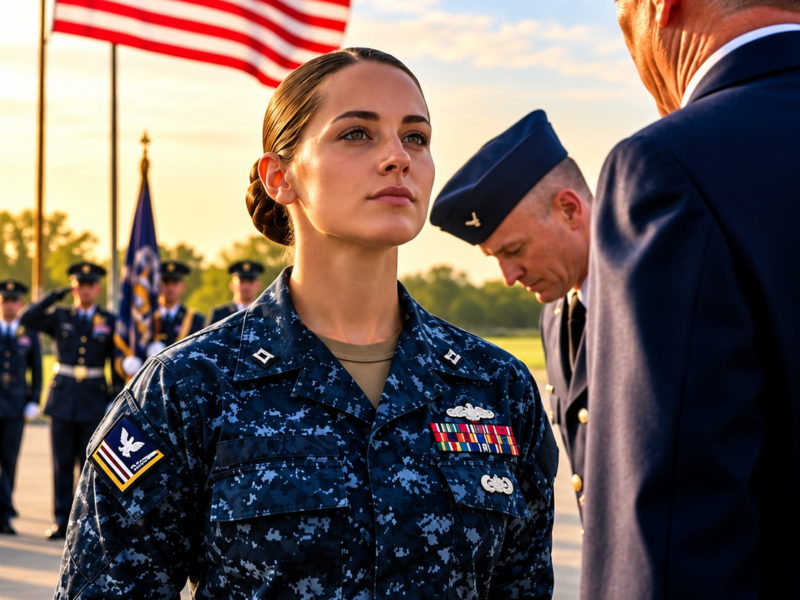
“When Admiral Hayes asked for my call sign in front of two dozen Navy officers, he was smiling like he’d found an easy joke
The name on the signature line was Vice Admiral Thomas Whitmore.
For several seconds, nobody in the briefing room spoke.
I watched Admiral Hayes read it twice, his eyes moving from the screen to the colonel and then back to me. Whitmore had been retired for three years, but his name still carried weight throughout Naval Special Warfare. He had helped shape the command structure that half the officers in that room had spent their careers following.
Hayes gripped the back of a chair.
“Close the file.”
The communications officer looked at him. “Sir?”
“I said close it. Lock the terminal and preserve the access log.”
“Yes, Admiral.”
The photograph disappeared, replaced by a gray classification screen.
But it was too late. Everyone had seen the signature.
Colonel James Walker remained standing beside the display. He was a broad-shouldered man in his late fifties, with silver hair and a habit of pressing his lips together whenever someone said something he didn’t like.
At that moment, he looked as if he had forgotten how to breathe normally.
“Richard,” he said, “we need to suspend this briefing.”
Hayes turned sharply. “On whose authority?”
“Mine, if I have to make it formal.”
“You’re asking me to shut down an operational review because a junior chief has a disputed historical record?”
“No,” Walker replied. “I’m asking you to stop treating a seven-year-old classified incident as if it were an administrative discrepancy.”
I stood beside the screen, feeling the familiar pressure building behind my ribs.
Seven years earlier, I had learned that the truth could be dangerous even when every person involved had sworn an oath to defend it.
I had hoped I wouldn’t have to learn that lesson twice.
Hayes looked at me again.
“Chief Carter, I want to hear your account. Not a sanitized version. Not a reference to classified restrictions. I want to know what happened on that mountain.”
I glanced at Walker.
He gave the smallest shake of his head.
It was barely noticeable, but I saw it.
So did Hayes.
“Colonel,” the admiral said, “why are you signaling her not to answer?”
“I’m not.”
“You just did.”
Walker slowly lowered his hand.
I had spent seven years trying to forget the last conversation I had with him. Apparently, he had spent those same seven years hoping I would never remember it.
“Admiral,” I said, “I can give you my account, but not here, and not without the original mission records.”
Hayes’s expression hardened.
“You’re in a secure facility surrounded by cleared personnel.”
“Then you shouldn’t have any objection to bringing in the original records.”
For a moment, I thought he might order me out.
Instead, he turned to the communications officer.
“Contact the archive custodian. I want the complete file for Operation Glass Harbor, including the raw communications logs, extraction requests, and every revision to the after-action report.”
The officer paused.
“Sir, that operation’s records are under special access restrictions.”
“I’m aware.”
“The archive may require confirmation from the original authorizing office.”
“Then call them.”
Hayes looked at me.
“Until those records arrive, nobody leaves this room with copies of the material we’ve seen. Understood?”
A chorus of yes, sir followed.
I returned to my seat.
My hands were steady, but the inside of my cheek hurt where I had been biting it.
Operation Glass Harbor.
I hadn’t heard the name spoken aloud in seven years.
The mission had been officially described as a failed intelligence-recovery effort in a remote Afghan valley. The public-facing summary mentioned severe weather, disrupted communications, and the loss of several personnel.
It didn’t mention that we had gone in expecting to recover a captured intelligence officer who had been held inside a fortified compound.
It didn’t mention that our intelligence source had warned us the compound was about to be abandoned.
And it certainly didn’t mention that the warning had reached command before we deployed.
Five men had entered that valley with me.
Two had come out.
One of those two was me.
The other was Daniel Mercer, my instructor, team leader, and the closest thing I’d ever had to an older brother.
The official record said he died covering our withdrawal.
That part was true.
What it didn’t say was why we needed to withdraw in the first place.
Or who had known the extraction route was compromised before we ever landed.
A knock sounded at the door.
A security officer entered and approached Hayes with a sealed tablet.
“Sir, the archive custodian has confirmed receipt of the request. The original file is being transferred to the command review terminal.”
“How long?”
“Approximately twenty minutes.”
Hayes nodded.
“Thank you.”
The officer left.
Walker took his seat without looking at me.
I watched him for a while.
Seven years ago, he had been a captain assigned to coordinate intelligence support for our operation. He had sounded calm over the radio, even when the first reports of enemy movement reached us.
His voice had been the last one Daniel heard from command.
Now he sat with his fingers interlaced, staring at a blank notepad.
I wondered whether he remembered the words he had spoken that night.
I remembered every one of them.
“Night Fox, hold your position. Extraction is delayed.”
Daniel had looked at me across the dark interior of the ruined building where we were sheltering.
“Delayed by what?” he had asked.
I had relayed the question.
The answer came back thirty seconds later.
“Command is reviewing the situation.”
Then the gunfire started.
The twenty minutes passed slowly.
Hayes ordered coffee. Nobody touched it.
The officers who had laughed at my call sign earlier now avoided looking directly at me. I couldn’t blame them. They had walked into a briefing expecting a discussion about training protocols and found themselves sitting inside a story that had apparently been rewritten by people more powerful than any of us.
At last, the terminal chimed.
The communications officer turned toward Hayes.
“Sir, the original archive has arrived.”
Hayes moved behind the desk.
“Open it.”
The screen displayed a list of files: mission planning documents, intelligence assessments, encrypted communications, medical evacuation records, and several versions of the after-action report.
Hayes pointed to the first entry.
“Start with the original intelligence assessment.”
The officer opened it.
A map of the valley appeared beside a summary of the target compound. The document was dated three days before our deployment.
I recognized the formatting, the reference codes, and the annotation in the lower right corner.
The intelligence warning had been marked as low confidence.
That was the first discrepancy.
“Can you show the revision history?” I asked.
Hayes nodded to the officer.
The revision history appeared.
The original assessment had rated the warning as credible. Twelve hours later, someone had downgraded it and removed a note recommending that the operation be delayed until the extraction route could be verified.
The authorizing initials belonged to Whitmore’s office.
A murmur traveled around the table.
Hayes leaned closer to the screen.
“Could this have been a routine intelligence revision?”
“Yes, sir,” I said. “If the supporting evidence had changed.”
“Did it?”
“Not according to the version we received in the field.”
The officer opened the next file.
It was the operational briefing we had been given before deployment. The compromised landing zone was clearly marked as the primary extraction point, with the backup route dependent on the same communications relay.
The same flaw I had identified in the training simulation.
Hayes glanced at me.
“You’re saying this wasn’t an isolated planning error.”
“I’m saying the mission used the same kind of failure point we’re discussing today.”
He said nothing.
The officer opened the communications log.
Most of the entries were routine. Position updates. Weather reports. Confirmation of equipment checks.
Then we reached the timestamp I had spent years trying to forget.
02:13:08.
A transmission from our forward intelligence source.
The source had reported that armed personnel were moving toward the western ridge and that the planned extraction area was no longer secure.
I remembered hearing the message in my headset.
I remembered Daniel leaning over the map.
And I remembered Walker’s reply.
The communications log displayed it in plain text.
“Message received. Continue mission. Do not alter extraction plan without command authorization.”
Walker shifted in his chair.
Hayes noticed.
“Colonel, is that your transmission?”
Walker stared at the screen.
“Yes.”
“Why did you instruct the team to continue after receiving a warning that the extraction area was compromised?”
“The intelligence was unverified. We had a target window, and the source had been wrong before.”
“Was the warning investigated?”
“Not in time.”
“Why not?”
Walker rubbed a hand across his mouth.
“Because the command element believed the source might have been compromised.”
“Who made that determination?”
“The intelligence coordination cell.”
“Under whose direction?”
Walker didn’t answer.
Hayes turned to the officer.
“Continue.”
The next entry appeared at 02:19.
A second warning from the source, more urgent than the first.
Then a request from Daniel for permission to shift to an alternate extraction point.
And then the message that had followed.
“Request denied. Maintain assigned route.”
My fingers tightened around the edge of the table.
Daniel had looked at me when that order came through.
He hadn’t argued. He had simply folded the map, checked the magazine in his rifle, and said, “We do what we can with what we have.”
That was Daniel. He never wasted time hating an order while there was still someone alive who needed him to follow it.
I had followed him into that valley because I trusted him.
I had followed his last instruction because I trusted him, too.
“Next entry,” Hayes said.
The screen changed.
02:27.
An emergency transmission from our team.
The first rounds had struck the building.
Daniel reported that the western approach was blocked and requested immediate extraction at the alternate location.
The reply arrived almost four minutes later.
“Negative. Alternate extraction not authorized. Hold position.”
Hayes looked at Walker.
“Why was the alternate extraction denied?”
“The aircrew was committed to another task.”
“What task?”
Walker swallowed.
“I don’t recall the details.”
“Then we’ll find them.”
The officer opened the flight assignment record.
A helicopter had been diverted to support a separate operation forty miles south of our position.
The reassignment had been approved before our team deployed.
I felt the room shift around me, though nobody had moved.
Our extraction aircraft hadn’t been delayed by weather.
It hadn’t been diverted because of an unexpected emergency.
It had been assigned elsewhere before we ever entered the valley.
Hayes stared at the record.
“Who approved this?”
The signature block appeared.
Vice Admiral Thomas Whitmore.
Again.
Walker leaned back as if the chair had suddenly become uncomfortable.
“Richard, this is not the complete operational picture.”
“Then explain the missing part.”
“The southern operation involved a sensitive intelligence asset. The decision was made at a higher level.”
“And the men in this valley?”
“We were trying to protect a broader mission.”
I turned toward him.
“Did you know our extraction aircraft had been reassigned before we landed?”
Walker looked at me.
For the first time, I saw something besides fear in his face.
Shame.
“Yes,” he said.
The word was quiet.
But everyone heard it.
“Why didn’t you tell us?” I asked.
“Because the mission was still considered viable.”
“You knew the route was compromised.”
“We had incomplete intelligence.”
“You knew the extraction aircraft was gone.”
“I believed another aircraft could be made available.”
“Did you tell Daniel that?”
Walker lowered his eyes.
“No.”
I had imagined this conversation in a hundred different ways. In some versions, I screamed. In others, I calmly laid out every fact and watched him confess.
In reality, I sat perfectly still, listening to the man who had helped send us into that valley admit that he had withheld information that might have changed our decision to go.
“Why?” I asked.
He didn’t answer immediately.
Hayes stepped between us verbally, if not physically.
“Colonel Walker, you will answer the question.”
Walker looked down at his hands.
“Whitmore believed the source inside the compound was about to be moved. If we delayed, we risked losing the intelligence officer and compromising a separate investigation.”
“So you sent the team in without a reliable extraction plan.”
“We believed we could recover them.”
“Belief isn’t a contingency,” I said.
Walker flinched.
I hadn’t raised my voice.
I didn’t need to.
The officer at the terminal opened the next file.
It was the after-action report.
The first draft was dated two days after the operation. It contained a detailed account of the failed extraction, including the command decisions, the reassigned aircraft, and the intelligence warnings.
The final version had been submitted six days later.
Whole paragraphs had disappeared.
The warnings were described as inconclusive.
The aircraft reassignment was attributed to an unforeseen operational conflict.
And the denial of the alternate extraction route had been characterized as a tactical decision made by the field team.
I read that sentence twice.
Then I leaned toward the screen.
“That isn’t what happened.”
Hayes’s face had gone rigid.
“Who made those revisions?”
The officer opened the document history.
Several changes had been made under accounts belonging to Whitmore’s office. Others had been approved by a command legal review.
But the last major revision carried a different name.
James Walker.
The colonel closed his eyes.
Hayes slowly turned toward him.
“You signed the final report.”
“Yes.”
“You removed the original communications record from the summary.”
“Yes.”
“You attributed the failed extraction decision to the field team.”
Walker opened his eyes.
“I was told the report had to protect the larger operation.”
“By Whitmore?”
“Yes.”
“Did he order you to falsify the report?”
Walker stared at the table for several seconds.
“He told me the mission would be reviewed by people who didn’t understand the operational context. He said that if the full account became part of the permanent record, it could expose intelligence sources, compromise ongoing work, and destroy careers before the facts could be properly assessed.”
“That’s not an answer.”
“He didn’t use the word falsify.”
I let out a slow breath.
There it was.
The familiar machinery of a lie.
No single order that could be quoted cleanly. No one person who claimed responsibility for every decision. Just a chain of people making small compromises, each insisting that the next person had the authority to stop them.
And five men in a valley who had no idea how many of those compromises had already been made.
Hayes pulled out a chair and sat down.
For the first time that morning, he looked older than the rank on his uniform.
“Why was Chief Carter declared missing?”
Walker glanced at me.
“Because we couldn’t establish what happened after the last transmission.”
“That doesn’t explain the personnel record.”
I answered for him.
“Because I wasn’t supposed to be there.”
Every face turned toward me.
I had spent seven years choosing my words carefully. Now, with the original records open in front of us, the truth felt less like a confession than a door I had been ordered never to open.
“After Daniel was killed, I moved toward the eastern drainage route. Our radio was damaged, and I couldn’t reach the command element. I spent two days moving between abandoned structures, trying to reach the emergency pickup point.”
I looked at the photograph on the screen.
“On the third day, I found a local family sheltering in a storage building. Their son had been wounded when armed men searched the area. I treated him as best I could, and they helped me reach a road used by a humanitarian convoy.”
“You made contact with our embassy?” Hayes asked.
“Eventually. I was moved to a medical facility under an alternate identity because the operation was still classified, and the intelligence source was considered at risk.”
“Who ordered that?”
“An intelligence liaison. I was told the official report would be corrected once the investigation was complete.”
“And it wasn’t.”
“No, sir.”
Hayes rubbed his forehead.
“Why didn’t you challenge it?”
“I did.”
The words came out more sharply than I intended.
I reached into the inside pocket of my uniform and removed a small, worn envelope.
I’d carried it through three duty stations, two moves, and years of telling myself I didn’t need to look at it again.
I placed it on the table.
“Six months after I returned, I submitted a sworn statement with my account of the operation. I included the radio log I’d reconstructed from memory and the name of the officer who had arranged my medical transfer.”
Hayes opened the envelope.
Inside were copies of the statement, a receipt from a military legal office, and a letter informing me that my submission had been referred for review.
The final paragraph stated that no further action was warranted.
“Who reviewed it?” Hayes asked.
I turned the last page toward him.
The signature belonged to the legal adviser who had approved the final after-action report.
Hayes set the paper down carefully.
“Did you ever receive an explanation?”
“No, sir. I received orders to refrain from discussing the operation outside authorized channels. A year later, I was offered a transfer to a training assignment.”
“And you accepted.”
“Yes.”
“Why?”
I looked at Daniel’s photograph.
“Because I was tired, sir. Because I had spent a year waking up every night at the same time, hearing the last transmission again. Because I thought if I stayed close to the people who trained the next teams, I could prevent another group from being sent into a bad plan.”
I paused.
“And because I thought Daniel’s family deserved to remember him as a man who made a choice, not as a name buried under an inaccurate report.”
The room was silent again.
Hayes glanced toward the colonel.
“Did you know she had submitted a sworn statement?”
Walker nodded.
“Yes.”
“Did you read it?”
“Yes.”
“Then why was no corrective action taken?”
Walker looked at me, and I saw the answer before he spoke.
“Because the final report had already been accepted. Reopening it would have exposed the revisions, and Whitmore had convinced us that the consequences would extend far beyond this operation.”
“You’re a colonel in the United States Navy,” Hayes said. “You are telling me you knowingly allowed an inaccurate report to stand because correcting it would have been inconvenient.”
“Not inconvenient,” Walker replied. “Potentially catastrophic. There were intelligence assets involved. There were people whose identities could have been exposed.”
“Were those concerns ever independently reviewed?”
Walker said nothing.
That silence answered the question.
Hayes stood.
“Security will preserve every record connected to this operation. The communications logs, all report versions, access histories, and the original intelligence assessments. Nobody is to alter, remove, or destroy a single file.”
He turned toward the security officer at the door.
“Contact the Inspector General’s office and request an independent review. Notify command legal that the existing after-action report is under formal challenge.”
The officer nodded.
“Understood, sir.”
Walker pushed his chair back.
“Richard, you can’t simply reopen a classified operation because a document looks bad seven years later. There are people who could be harmed if this goes public.”
“Then we’ll protect the people who need protecting,” Hayes said. “We will not protect a false report.”
“You’re risking careers and operations that you don’t fully understand.”
“Perhaps. But I’m not going to make that decision based on an account we now know was altered.”
Walker looked toward me.
“Chief, you don’t understand what you’re asking for. If this goes forward, every decision will be examined. Every person who was involved will have to answer for what they did.”
I met his gaze.
“That includes me.”
He seemed taken aback.
I continued.
“I made decisions in that valley, too. I chose which route to take after the radio failed. I chose to leave our original position. I chose to trust that the people at command would eventually send help. If I made a mistake, I’ll answer for it.”
My voice stayed level.
“But I’m done accepting responsibility for decisions I wasn’t allowed to know about.”
Walker looked away.
For the first time, he had nothing to say.
The formal review began three days later.
I spent the first morning in a secure interview room with two investigators, a recorder, and a stack of documents thick enough to cover the table.
They asked about the operation from the beginning.
What I had been told during the briefing.
Which warnings I had received.
What Daniel had said.
When the radio had failed.
How long we had waited for extraction.
What I had done after the last transmission.
I answered each question as carefully as I could.
Some details came back clearly. Others were blurred by exhaustion, fear, and the years I’d spent trying not to revisit them.
When I didn’t remember something, I said so.
When a record contradicted my memory, I explained the discrepancy.
I refused to guess.
The investigators also asked about my sworn statement and the years that followed.
I showed them the receipt proving that my complaint had been received. I gave them the names of the people who had handled my transfer and the dates of the correspondence I had kept.
At the end of the second day, one of the investigators removed her glasses.
“Chief Carter, do you understand that this review may not result in the outcome you’re expecting?”
“I do.”
“Some decisions may have been made under authorities that are not fully represented in the records available to us.”
“Then I hope you find those records.”
She watched me for a moment.
“Is this about clearing your name?”
I thought about Daniel’s mother, who had once asked me whether her son had been afraid at the end. I had told her he had been focused on getting his people home.
That was true.
I had left out the fact that he had asked me to tell her something if I survived.
“No,” I said. “It’s about making sure the next team gets the information we didn’t.”
The review lasted four months.
During that time, I was removed from duties involving operational planning, not as punishment but to preserve the integrity of the investigation. I returned to routine training work and spent my days teaching young operators how to recognize compromised communications, incomplete intelligence, and the dangerous confidence that comes from believing a plan is safe because it has been approved.
Some of them knew who I was.
Most didn’t.
I preferred it that way.
The command did not release the details of the investigation publicly. The operation remained classified, and several intelligence sources required continuing protection.
But the internal findings were substantial.
The investigators confirmed that the extraction aircraft had been reassigned before deployment. They established that the warning about the western ridge had been received and that the alternate extraction request had been denied. They traced the changes to the after-action report and documented the failure to act on my sworn statement.
They also found that the decision to downgrade the intelligence warning had been made without the independent validation required by the command’s own procedures.
Vice Admiral Whitmore was interviewed twice.
He maintained that his decisions had been made to protect a broader intelligence operation. He denied directing anyone to falsify records, but he acknowledged approving changes to the mission summary after being told that the original language could expose sensitive sources.
The investigators did not conclude that every decision had been made with malicious intent.
They did conclude that the command had prioritized institutional protection over an accurate account of the operation.
Colonel Walker cooperated with the review after the first week.
He provided additional correspondence from Whitmore’s office and acknowledged that he had approved language he knew was incomplete. His cooperation did not erase his responsibility, but it helped investigators establish how the revisions had occurred.
He was relieved of his command responsibilities while the review proceeded and later received formal disciplinary action for his role in the inaccurate reporting.
Whitmore’s retirement status did not shield him from scrutiny. His actions were referred to the appropriate authorities for further administrative review, and his former office’s handling of the operation was examined as part of a broader assessment of intelligence oversight.
The final report did not give me everything I had wanted.
It could not explain every conversation that had taken place outside the recorded channels. It could not restore the years Daniel’s family had spent believing the official account was complete.
But it corrected the central facts.
The record no longer said that our team had failed to follow the assigned extraction procedure. It acknowledged that we had requested an alternate route and that the request had been denied. It documented the warning that had been received before the team was committed to the mission.
My status was formally corrected from missing in action to returned from the operation, and the record of my subsequent transfer was amended to reflect the circumstances of my recovery.
The command also revised its procedures for emergency extraction requests and required independent review when intelligence warnings conflicted with mission assumptions.
I read the findings alone in my quarters.
When I reached the section describing Daniel’s final actions, I stopped.
The report said he had remained with the team until the last possible moment, helping two injured operators reach cover while maintaining communication with command.
It stated that his actions had enabled my escape and contributed to the survival of the second operator who made it out.
For years, I had carried the memory of leaving him behind as if it were a debt I could never repay.
The report did not absolve me of that pain.
It simply put the responsibility where it belonged.
Daniel had not died because he failed to follow a plan.
He had died trying to keep his people alive after the plan had failed them.
I closed the document and sat in silence until the afternoon light faded across the floor.
A week later, I drove to Virginia to visit Daniel’s mother.
Margaret Mercer lived in a small brick house with white shutters and a porch that needed repainting. She had planted hydrangeas along the walkway, and a faded American flag hung beside the front door.
I had visited her twice in the first year after the mission. After that, the conversations became harder. I could never answer the questions she wanted answered, and she eventually stopped asking them.
When she opened the door, she looked at me for a long moment.
“Emily.”
She hadn’t called me Chief in years.
“Hi, Margaret.”
She stepped aside and let me in.
The house smelled of coffee and lemon furniture polish. Daniel’s photograph still sat on the mantel, beside a small wooden box containing his medals and the folded flag from his memorial service.
She noticed the envelope in my hand.
“Did something happen?”
“Yes.”
I sat across from her at the kitchen table and placed the report between us.
“The official account of Daniel’s mission was wrong,” I said. “The command received warnings that the extraction route was compromised. The aircraft assigned to us had been diverted before we deployed, and the team was denied permission to use an alternate route.”
Margaret didn’t move.
I told her what the investigators had confirmed and what the corrected report now said. I explained that the command had acknowledged its failures and that the findings had been entered into the official record.
I didn’t soften the parts that hurt.
When I finished, she looked down at her hands.
“Did Daniel know?”
“He knew the plan was failing. He didn’t know everything we know now.”
She swallowed.
“Was he afraid?”
I remembered the ruined building, the dust drifting through the broken roof, and Daniel sitting beside a wounded operator while he tried to keep the radio working.
“Yes,” I said. “I think he was. But he never let his fear make the decisions for him.”
Margaret closed her eyes.
For a while, the only sound was the refrigerator humming in the next room.
Then she asked, “Did he say anything about me?”
I had carried Daniel’s last words for seven years, not because I had forgotten them, but because I had never known how to deliver them without making them sound like a goodbye.
I leaned forward.
“He told me that if I got home, I should tell you he was thinking about the porch.”
Margaret looked up.
“The porch?”
“He said you kept telling him to fix the loose board by the steps. He said he was going to do it the first weekend he got home, and you weren’t allowed to hire anyone else because he’d promised.”
For the first time, her mouth trembled into something that almost resembled a smile.
“He hated that board,” she whispered. “Every time he visited, he complained about it.”
“He said he knew exactly how to fix it.”
“He never did.”
“No,” I said. “He didn’t.”
She reached for the report but didn’t open it.
“Thank you for coming back,” she said.
I shook my head.
“I should have come sooner.”
“Perhaps. But you came now.”
She took my hand across the table.
I had expected anger. I had prepared myself for questions I couldn’t answer, for the possibility that she would blame me for surviving, or for staying silent.
Instead, she held my hand as if she understood that I had spent seven years carrying something too heavy to set down alone.
“I can’t get my son back,” she said. “But I can know the truth about him.”
I stayed until evening.
Before I left, she walked me to the porch and pointed at the loose board near the steps.
“Would you look at that?”
I crouched and pressed it with my palm.
“It needs two new screws.”
She nodded.
“Daniel said the same thing.”
I found a screwdriver in her garage and secured the board before I drove away.
It wasn’t enough to repay what I owed him.
But for the first time in seven years, I left her house without feeling that I had abandoned him twice.
The following spring, Admiral Hayes invited me to return to Naval Special Warfare Command.
I expected a brief meeting about the investigation’s final administrative actions.
Instead, he met me outside the same briefing room where the story had begun.
The door was open. Inside, a new group of officers sat around the table, reviewing a training plan.
Hayes gestured for me to follow him.
“I’m going to ask you something, Chief,” he said. “And this time, I want a direct answer.”
“Yes, sir.”
“Would you be willing to lead the review of our contingency-planning curriculum?”
I looked through the doorway.
On the screen was a map with three possible extraction routes. The primary route was highlighted, but the two alternatives used separate communications systems and independent verification procedures.
Someone had listened.
“I’d be willing to help, sir,” I said. “But I’d want authority to challenge a plan before it gets approved, not just after it fails.”
Hayes nodded.
“That’s exactly why I’m asking.”
He paused at the door.
“I owe you an apology, Chief.”
I didn’t know what to say.
“When you told me your call sign, I treated your service like a joke. I assumed that because you were quiet, you had nothing worth hearing.”
He looked directly at me.
“I was wrong.”
I thought about the first briefing, the laughter, and the photograph that had appeared on the screen.
“You didn’t know the story, sir.”
“I could have asked without making you prove you deserved to be in the room.”
That answer mattered more than I expected.
“Thank you, Admiral.”
He opened the door.
The officers inside stood when he entered. Their attention shifted to me, the woman in a plain khaki uniform who had once been the easiest person in the room to overlook.
Hayes introduced me as the new lead adviser for contingency planning.
He didn’t mention my call sign.
He didn’t need to.
I walked to the front of the room and studied the map.
“Before we start,” I said, “I want everyone to understand one thing. A plan isn’t safe because a senior officer approved it. It’s safe because we’ve tested what happens when the assumptions fail.”
A young lieutenant raised his hand.
“What if command tells us to continue anyway, ma’am?”
I looked at him.
“Then you communicate the risk clearly, document what you know, and keep asking the questions that matter. Rank determines who carries responsibility for a decision. It doesn’t make a bad decision less dangerous.”
The lieutenant nodded and lowered his hand.
I began the review.
No one laughed.
Later that afternoon, I stood alone outside the building, listening to the distant sound of helicopters crossing the coast. The air smelled of salt and warm pavement, and the Pacific glittered beyond the rooftops.
For years, I had believed that Night Fox was a name tied to the worst night of my life.
I had treated it like a wound I could keep hidden as long as I never spoke it aloud.
But Daniel had given me that name for a reason.
He used to say that a fox survived because it noticed what others overlooked. It watched the edges of a field, listened for changes in the wind, and never confused the loudest voice with the wisest one.
I had spent seven years trying to bury the name.
Now I understood that I didn’t have to bury the memory with it.
My radio crackled with a routine call from the training floor.
“Chief Carter, we’re ready for your next review.”
I pressed the transmit button.
“On my way.”
Then I turned toward the building, leaving the ocean at my back and Daniel’s memory beside me, where it had always belonged.
I couldn’t change the night he died. I couldn’t return the years his mother had spent waiting for answers, or erase the decisions that had sent us into that valley.
But I could make sure that the next young operator who noticed a flaw in a plan would be heard before the helicopters lifted off.
And when someone asked for my call sign again, I would no longer answer as if it were a secret I had to apologize for.
“My call sign is Night Fox,” I would say.
And this time, I would let the silence that followed mean something different.
The end.









