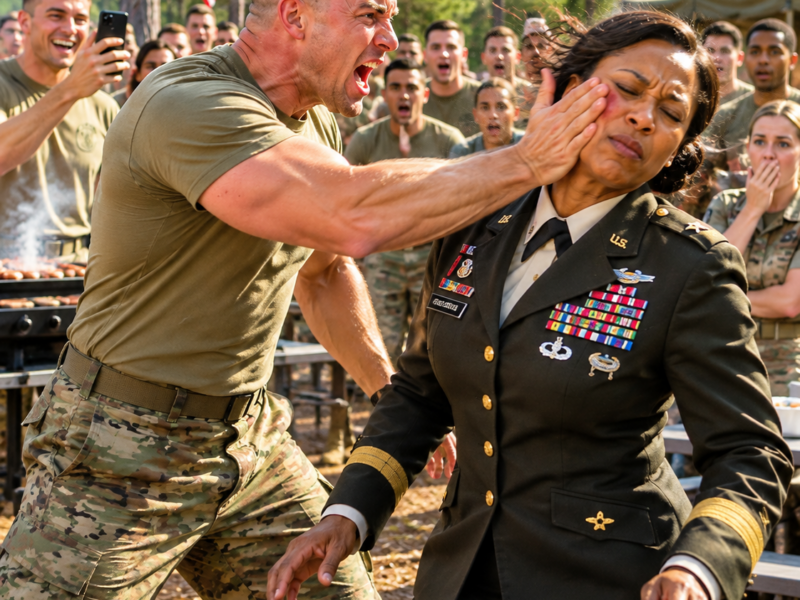
“Three soldiers laughed at me outside the Fort Liberty command building, with one of them calling my uniform a cheap costume in front of a dozen witnesses
The name on the first page was Sergeant Miller.
For a moment, I thought I had misunderstood what I was seeing. I leaned closer to the folder in General Whitaker’s hands, reading the name again beneath a bold heading that said **PRELIMINARY FINDINGS: COMMAND ACCOUNTABILITY REVIEW**.
Sergeant Miller had not simply been assigned to the security detail outside the command building. He was one of the soldiers named in an internal complaint that had been submitted six weeks earlier. The complaint alleged that personnel records had been altered, reports of misconduct had been dismissed, and soldiers who questioned certain decisions had been quietly removed from important assignments.
My name appeared near the bottom of the page.
Not as a subject of the investigation, but as the officer who had requested an independent review.
“Colonel Brooks,” General Whitaker said, his voice low enough that only Major Ellis and I could hear him, “I believe we need to have a conversation about what happened here today.”
I looked past him toward the three soldiers standing near the security checkpoint. Their earlier confidence had disappeared. Miller was staring at the ground, while the other two kept glancing toward their sergeant as though he might somehow explain what was happening.
“I agree, sir,” I said. “But I would prefer that we begin with the facts.”
Whitaker nodded. “That is exactly why I came.”
He motioned for Major Ellis to join us, then directed the security guard to preserve the camera footage from the entrance. No one was to delete, edit, or overwrite anything recorded that afternoon. The general also instructed the guard to notify the duty officer and arrange for the soldiers’ commanding officer to meet us.
Miller raised his head.
“General, sir, there has been a misunderstanding.”
Whitaker did not turn toward him immediately. He looked at me first.
“Colonel, would you like to explain what happened?”
“I arrived for the scheduled command review at approximately 1300,” I said. “The three soldiers challenged my authority to enter the building. Sergeant Miller referred to my uniform as a costume, questioned whether I belonged here, and demanded that I surrender the documents I was carrying. I presented my credentials. The security guard verified them.”
I kept my voice even. I had learned long ago that anger could be used as an excuse to ignore the facts. I would not give anyone that opportunity.
“Did you identify yourself as a colonel?” Whitaker asked.
“Yes, sir.”
“And did they continue challenging you after you presented your credentials?”
“Yes, sir.”
The general finally faced Miller.
“Is any part of that account inaccurate?”
Miller swallowed. “Sir, we were trying to maintain security. There have been impersonation concerns.”
“Then you should be familiar with the procedure for verifying credentials,” Whitaker replied. “Not inventing your own procedure based on whether you think someone looks like an officer.”
The two soldiers beside Miller shifted uneasily.
Whitaker continued, “And a security concern does not authorize you to insult a person, seize official documents, or disregard verified identification. You had a responsibility to follow protocol. Did you?”
“No, sir,” Miller said quietly.
It was the first honest answer I had heard from him.
I might have accepted it as a beginning if the matter had ended there. But the folder in the general’s hand told me this was not an isolated incident. Miller had appeared in the records before I ever set foot on the installation, and the behavior I had witnessed outside the command building might have been connected to something far more serious.
“General,” I said, “I would like to know why Sergeant Miller’s name appears in the accountability review.”
Whitaker’s expression tightened.
“That is what we need to establish. Major Ellis, please take Colonel Brooks to the conference room. I will join you shortly.”
He then looked at the three soldiers.
“You will remain available for questioning. You are not to discuss your statements with one another or attempt to influence anyone who witnessed this incident. Your commanding officer will explain the next steps.”
Miller opened his mouth as if to object, but one look from the general stopped him.
Major Ellis escorted me inside.
The conference room overlooked the central courtyard. From the window, I could see the three soldiers standing beneath the building’s overhang while a duty officer approached them. A few minutes earlier, they had treated me as though I had wandered onto the installation wearing someone else’s uniform. Now they were waiting for instructions from people whose authority they had never questioned.
I set my document case on the table and took a seat.
Major Ellis remained standing.
“Colonel, I want to apologize for what happened at the entrance.”
“You were not there when it happened, Major.”
“I know. But I work in this building. Those soldiers were assigned to a post that falls under our security structure. What happened reflects on all of us.”
I studied him. He seemed genuinely uncomfortable, though I had learned not to confuse discomfort with accountability.
“Then let us make sure we understand why it happened,” I said. “An apology matters, but it cannot replace an examination of the system that allowed it.”
He nodded slowly.
“That is why General Whitaker requested your review.”
I opened my case and removed a thick binder. Inside were interview summaries, personnel timelines, training records, and copies of reports submitted by soldiers from three different units. The material had taken weeks to assemble. Some witnesses had spoken openly. Others had agreed to be interviewed only after receiving assurances that their statements would be documented accurately.
The complaint that had brought me to Fort Liberty involved more than one sergeant’s conduct. It concerned a pattern of informal punishment, selective enforcement, and questionable personnel decisions. Soldiers who raised concerns about unsafe training conditions or improper orders were reportedly labeled difficult. Some lost opportunities. Others were reassigned without a clear explanation.
The initial evidence suggested that the pattern was not limited to a single unit.
I had been asked to conduct an independent review because my previous assignment involved evaluating command accountability procedures. I had no personal connection to the people involved, and I had made it clear from the beginning that I would not decide whether the allegations were true until I had examined the records.
But the more records I examined, the more inconsistencies I found.
A counseling statement appeared in one soldier’s file but not in the official archive. A training complaint had been marked resolved even though the soldier who submitted it said no one had interviewed him. Two reassignment requests carried nearly identical wording despite having been filed months apart by different commanders.
And in several cases, Sergeant Miller’s name appeared in the chain of personnel actions.
Not always as the decision-maker. Sometimes he was listed as the witness who had recommended that a complaint be closed. Sometimes he had forwarded documents to an office that no longer retained the original correspondence.
At first, I had assumed he was a minor participant in a larger administrative failure. I had not yet established whether he had knowingly contributed to it.
Now I had met him.
The door opened, and General Whitaker entered with a woman in civilian clothes carrying a laptop and a folder of her own. She introduced herself as Lieutenant Colonel Rebecca Shaw, the installation’s inspector general representative.
“I have been reviewing the preliminary findings,” Shaw said as she took a seat. “The general asked me to join because the allegations involve both personnel management and the handling of complaints.”
Whitaker placed his folder in the center of the table.
“Colonel Brooks, please walk us through your findings. Start with what you can substantiate.”
I appreciated the distinction. Too many investigations began with a conclusion and searched for evidence to support it. I intended to do the opposite.
I explained the timeline of the original complaints, the missing records, and the repeated involvement of a small group of personnel. I described the discrepancies between the official archive and the copies provided by the soldiers who had filed the complaints.
Then I showed them the document that concerned me most.
It was a closure memorandum for a safety complaint submitted by a specialist named Aaron Price. According to the official system, Price had withdrawn his complaint after meeting with his chain of command. Yet the copy he had retained contained a handwritten note stating that he had requested a formal investigation.
The note had been initialed by Sergeant Miller.
“Have you interviewed Price?” Shaw asked.
“Twice,” I replied. “His account has been consistent. He says he never withdrew the complaint and that he was told the matter had already been resolved. He did not know the closure memorandum existed until I showed him a copy.”
“Could the initials have been added later?”
“They could have been,” I said. “That is why I requested a document examination. I have not represented the initials as authenticated.”
Whitaker leaned back.
“What did the complaint concern?”
“An alleged failure to correct a recurring equipment issue before a scheduled training exercise. Price reported that the problem could place personnel at risk. The complaint was closed without a documented inspection in the file.”
“Was anyone injured?”
“Not in that exercise. But the absence of an injury does not establish that the concern was unfounded.”
The room fell quiet.
Shaw looked through the pages. “And Miller appears on other records?”
“Yes. His role varies. In some cases, he acknowledged receiving complaints. In others, he recommended that they be closed or forwarded. I have not established that he controlled the final decisions.”
“Then we must be careful not to turn his name into a conclusion,” she said.
“Agreed,” I replied. “The evidence supports further examination, not a final judgment.”
Whitaker looked at me for several seconds.
“That is precisely why I wanted you here.”
I had heard that sort of praise before. It could be sincere, or it could be an attempt to secure cooperation. I returned my attention to the documents.
“There is another concern,” I said. “Several witnesses described an environment in which questioning an instruction was treated as disloyalty. They said that certain personnel could challenge others without consequences, while people outside the favored group were expected to prove themselves repeatedly.”
Shaw closed the folder.
“Are you suggesting that what happened at the gate was connected to the complaints?”
“I am suggesting that we should not assume it was unrelated.”
Whitaker’s jaw tightened. “Explain.”
“Sergeant Miller challenged my identity before checking my credentials. When the credentials were verified, he still appeared unwilling to accept them. That does not prove discrimination or establish his motive. But when we compare the incident with witness accounts describing selective treatment and informal gatekeeping, we should examine whether the same attitudes are present in other parts of the command.”
I paused before continuing.
“I am a Black woman in uniform, General. I know that some people will see that fact and decide what the incident means before the evidence is collected. I will not do that. But I will not pretend the possibility is irrelevant, either.”
Whitaker nodded.
“Nor should you.”
The general requested a formal incident report, the original camera footage, and statements from every witness who had been present. Shaw would coordinate the independent review, while I would continue analyzing the documents already collected.
The meeting lasted another hour.
By the time we finished, the incident at the entrance had become an official part of the accountability inquiry. It would be examined separately from the earlier allegations, but the investigators would also determine whether any personnel involved in both matters had acted under the same informal practices.
Before leaving, I asked Whitaker a question that had been troubling me.
“Sir, how did you recognize me so quickly?”
He looked surprised.
“Your photograph was included in the briefing package. I was expecting you this afternoon.”
“That explains recognizing my name. It does not explain why Sergeant Miller seemed convinced I did not belong here.”
“No,” he said. “It does not.”
His answer was honest, but incomplete.
As I gathered my papers, I noticed that he had turned one page in the folder face down. I could see the edge of a signature at the bottom, along with a date that matched one of the personnel actions I had flagged.
“General,” I said, “is there something in that file that I should know about?”
Whitaker looked down at the page.
“There may be. But I need to verify it before I discuss it with you.”
I accepted that answer, though I did not like it.
My work had taught me that missing information could be innocent. It could also be the part of a story someone most wanted to keep hidden.
That evening, I stayed in my temporary office long after most of the building had emptied. The installation had settled into its nighttime rhythm. Somewhere outside, vehicles moved along the road, and the distant sounds of training drifted through the closed window.
I reviewed the witness summaries again.
One statement stood out. A young corporal had written that he had once been instructed to “keep certain people in their place” when they questioned a senior noncommissioned officer’s decisions. He had not identified who gave the instruction. When I interviewed him, he had hesitated before describing the conversation, then asked whether his name would appear in the final report.
I had told him the truth: his identity would be protected to the extent permitted by the process, but I could not promise absolute secrecy if the evidence required further action.
He had agreed to continue.
I was thinking about that conversation when my phone rang.
It was Lieutenant Colonel Shaw.
“Colonel Brooks, I have something you need to see. Can you return to the conference room?”
“Is it urgent?”
“I believe it is relevant. I would rather show you the record than explain it over the phone.”
I returned upstairs.
Shaw had two documents spread across the table. One was a copy of the closure memorandum from Price’s complaint. The other was a personnel authorization bearing a digital approval stamp.
“Where did you get this?” I asked.
“It was located in a backup archive that had not been included in the original records request.”
I read the authorization. It showed that a senior officer had approved the reassignment of two soldiers who had filed complaints. The stated reason was routine personnel balancing. Yet the approval had been entered after the reassignment dates, and the supporting notes were incomplete.
The name at the bottom was Colonel Daniel Mercer, a former deputy commander who had left the installation several months earlier.
I recognized it from my preliminary timeline.
Mercer had been mentioned in multiple interviews, but none of the witnesses had directly accused him of misconduct. Some described him as distant. Others said he had been known to settle disputes quickly, often without a formal written record.
“Is Mercer still in the Army?” I asked.
“Yes,” Shaw said. “He has been assigned elsewhere. We have requested the relevant records from his current command.”
“And Miller?”
“We have not interviewed him about these documents yet. We need to establish which records he handled and whether he had access to the archive.”
I studied the approval stamp again.
“Someone authorized these actions. Someone entered the dates. Someone marked the complaint resolved. We need to know who did what, and when.”
“Agreed.”
Shaw slid a third page toward me.
“This is the part I wanted you to see.”
It was an email printed from the backup archive. The message had been sent from an administrative account to several members of the personnel office. The subject line read: **Handling of Pending Complaints Before Review**.
The body was brief. It instructed recipients to ensure that all outstanding matters were “properly categorized and closed where appropriate” before an upcoming inspection. The wording was not inherently improper, but the attached list included complaints that had not been investigated.
At the bottom was a distribution line.
Sergeant Miller’s account had been copied.
So had Colonel Mercer’s.
And so had the account of a senior official whose name had not appeared in any of the witness interviews.
General Whitaker.
I stared at the page.
Shaw watched my expression carefully.
“We do not know whether he read the message,” she said. “Being copied does not establish that he directed anything. The archive does not include a read receipt, and the account may have received hundreds of messages that day.”
“Then we need to ask him.”
“Yes.”
I looked at the date. It was four months before the original complaint that had triggered my review.
Until then, I had viewed Whitaker as the senior leader willing to confront a problem others had avoided. I had watched him preserve the footage and demand an honest account of the incident at the gate. Those actions mattered.
But an investigation could not stop at the first person who appeared willing to help.
If the general had known about the closure process, his role needed to be examined. If he had not known, we needed to establish why the process had operated beneath his command without his awareness.
Either possibility carried consequences.
“Has he seen this email?” I asked.
“Not yet. I wanted to confirm the archive source first.”
“Then let us arrange a meeting with him and make sure the record is preserved exactly as we found it.”
The next morning, General Whitaker arrived at the conference room at 0800. He had been briefed that we had recovered additional records, but he had not been told the contents of the email.
Shaw presented the document and explained its source.
Whitaker read it once, then again more slowly.
“I do not remember seeing this,” he said.
“That is not the same as saying you did not receive it,” I replied.
“No, Colonel. It is not.”
He placed the paper on the table.
“I want the original message preserved and its routing information examined. I also want the personnel office to provide every related communication, including deleted items if they can be recovered.”
“Sir,” Shaw said, “because your account appears on the distribution line, we need to document your statement and ensure that any assessment of your role remains independent.”
Whitaker’s expression hardened—not in anger, but in recognition of what that meant.
“You are right.”
He turned to me.
“Colonel Brooks, I invited you here because I wanted an independent assessment. I will not ask you to exempt me from the same standards.”
“Then I will apply the same standards, General.”
“Good.”
He rose from his chair and walked to the window. For several seconds, he said nothing.
“When I took command here, I was told the personnel system was functioning properly,” he said at last. “I received routine summaries. Complaints were described as resolved. Reassignments were presented as administrative necessities. I did not examine every file myself.”
“Commanders cannot personally review every document,” I said. “But they are responsible for ensuring that the system gives them reliable information.”
“I understand that.”
His voice carried no defensiveness now.
“If those summaries were inaccurate, I need to know who made them inaccurate. And if I failed to recognize warning signs, I need to know that, too.”
That was the first moment I believed he might be prepared to accept the full implications of the investigation.
It was also the moment the inquiry became more difficult.
Over the next several days, we interviewed the personnel officers who had handled the complaints. We collected sworn statements, compared digital timestamps, and examined the access history for the recovered archive.
The evidence did not produce a simple story.
One clerk admitted that she had marked several complaints as resolved after receiving instructions from a supervisor. She insisted she believed the decisions had already been approved. Another employee said he had been pressured to use standard closure language because the office was behind schedule and senior leaders wanted the inspection completed without a backlog.
Neither account absolved the people involved, but both suggested that the process had become normalized. Staff members had learned that a complaint could be made to disappear administratively without anyone openly declaring that it should be ignored.
Sergeant Miller’s role was more complicated than I had initially expected.
The records showed that he had forwarded several complaints and had recommended closure in two cases. In another, he had warned a supervisor that a soldier’s concern had not been adequately addressed. That warning had not appeared in the official file.
When we interviewed him, he sat rigidly across from Shaw and me.
“I did what I was told,” he said.
“By whom?” Shaw asked.
Miller looked down.
“My section chief. Sometimes the personnel office.”
“Did anyone instruct you to challenge Colonel Brooks at the entrance?” I asked.
“No, ma’am.”
“Did anyone tell you that she was not a legitimate officer?”
“No.”
“Then why did you refuse to accept her credentials?”
He rubbed his hands together.
“I thought she was trying to get access to a restricted area. I made a judgment.”
“After the security guard verified her credentials?”
He did not answer immediately.
“Yes, ma’am.”
“Why?”
He stared at the table.
“I had already decided something was wrong. When the guard said she was cleared, I thought he was making a mistake.”
“Because you had evidence that her credentials were invalid?”
“No, ma’am.”
“Because you had a reason to believe she was impersonating an officer?”
“No, ma’am.”
“Then what was the basis for your decision?”
His shoulders sagged.
“I don’t know how to explain it.”
“Try.”
He looked up, and for the first time his expression showed something other than embarrassment or fear of punishment.
“I saw you walk up, and I didn’t expect you to be the person the general was waiting for. I thought someone had sent you to the wrong place. Then you corrected me, and I felt like I had to prove I was right.”
There it was: not a complete explanation, but a beginning.
“You were willing to defend your assumption even after the evidence contradicted it,” I said.
“Yes, ma’am.”
“And you used your position to make that assumption everyone else’s problem.”
He nodded.
I did not raise my voice. I did not need to.
“Sergeant, security procedures exist to protect the installation. They are not a license to turn personal suspicion into authority. You can ask for identification. You can verify access. You cannot decide that someone is illegitimate because they do not match your expectations.”
“I understand, ma’am.”
“Do you? Because the concern in this investigation is not only what happened to me. It is what happens to people who do not have a general waiting to recognize them.”
He looked away.
For a moment, I thought he might become defensive again. Instead, he said, “I never thought about it that way.”
“That is part of the problem.”
Miller admitted that the culture in his section rewarded confidence more than careful judgment. He said that questioning someone’s authority had become a way to demonstrate toughness, particularly when the person being questioned was younger, less senior, or unfamiliar to the group. He did not admit to deliberately targeting Black officers, and we had no evidence to establish that he had been instructed to do so. But his own account confirmed that he had relied on assumptions rather than procedure.
The investigation would have to determine what disciplinary action was appropriate. My job was not to decide that in the interview room.
My job was to make sure his conduct was documented accurately and that the system did not treat it as a harmless joke.
The two other soldiers gave separate statements. Both acknowledged that they had joined in the mockery. One admitted that he had laughed because Miller was a senior noncommissioned officer and he did not want to appear disloyal. The other said he had assumed the situation was funny because everyone else was laughing.
Neither had verified my identity before participating.
Their statements became part of the incident record.
Meanwhile, the document review revealed a deeper failure in the personnel office. The instructions to close pending complaints had come from a deputy administrator who said he had been responding to pressure to prepare for the inspection. He claimed Colonel Mercer had emphasized the need for clean records. Mercer, when contacted through his current command, denied ordering anyone to falsify information. He said he had asked only for overdue cases to be reviewed and properly categorized.
The recovered emails did not fully support either account.
There were messages showing that Mercer had been concerned about the backlog. There were also messages from staff members asking whether they should close complaints that had not been investigated. Those questions had gone unanswered in writing, even though the records showed that several cases were subsequently marked resolved.
It was possible that Mercer had failed to challenge a process he should have questioned. It was also possible that others had interpreted his broad instructions in ways he had not intended. The evidence was not yet sufficient to settle the matter.
General Whitaker cooperated with the review. His calendar, email records, and briefing summaries were examined. We found no message in which he directly instructed anyone to conceal complaints. But we did find that he had received a summary stating that all pending cases were closed shortly before the inspection, even though multiple complaints had not received substantive review.
When Shaw presented that finding, Whitaker did not dispute it.
“I accepted the summary,” he said. “I should have asked how the cases were resolved.”
“Did you know the complaints remained unresolved?” I asked.
“No.”
“Did you verify the closure figures?”
“No.”
“Then the report should state that you accepted a summary that was inaccurate and did not independently verify it.”
He took a long breath.
“Yes. It should.”
That answer mattered more than a speech about leadership ever could.
The final report would not label every failure as deliberate misconduct. It would distinguish between documented actions, unverified allegations, and conclusions supported by the evidence. It would identify the personnel who altered records, the supervisors who authorized or permitted improper closures, and the command practices that allowed the system to function without effective oversight.
It would also address the incident at the entrance.
By the end of the second week, the installation had implemented temporary safeguards. Complaint closures required a documented explanation and independent review. Personnel actions connected to pending complaints were flagged for examination. Records were preserved, and employees were given a protected channel for reporting pressure to alter or misclassify information.
The changes were not dramatic. There were no speeches in the courtyard and no public announcement declaring that the institution had been transformed.
There were forms that could no longer be closed with a single unexplained selection. There were new checks on the archive. There were supervisors required to show what they had reviewed instead of simply signing a summary.
Those were the kinds of changes that could prevent the next person from being dismissed with a click of a mouse.
The soldiers’ commanding officer handled the disciplinary process for the incident at the gate, with the investigation’s findings provided through the proper channels. Miller was removed from the security assignment while the review proceeded. The two other soldiers were also relieved from that post pending their command’s determination. Their final dispositions were not decided by me, and I made no effort to influence them beyond insisting that the evidence be considered.
Before I left Fort Liberty, General Whitaker asked me to attend a final review meeting.
The conference room was crowded. Major Ellis sat beside Shaw, while several officers from the personnel and security sections filled the opposite side of the table. Miller and the other two soldiers were not present; their individual personnel matters were being handled separately.
I presented the findings in a clear sequence.
First, the incident at the gate: the soldiers had challenged my authority without a reasonable evidentiary basis, continued after my credentials were verified, and used language inconsistent with professional conduct.
Second, the complaint-handling process: several cases had been marked resolved without sufficient documentation that the underlying concerns had been investigated. The records supported findings of improper administrative practices, but the responsibility for each action varied and had to be assigned individually.
Third, command oversight: senior leaders had received inaccurate summaries and had not consistently verified whether complaints had been resolved in substance rather than in paperwork.
Finally, the recommendations: preserve all relevant records, complete the remaining personnel investigations, establish independent checks for complaint closures, and require leaders to review patterns of reassignment that followed protected reporting or formal complaints.
When I finished, no one spoke for several seconds.
General Whitaker looked around the room.
“Do we disagree with any finding supported by the evidence?”
One of the officers shifted in his chair.
“Sir, I believe some of the wording regarding command oversight could be interpreted as an accusation of intentional concealment.”
“It says what the evidence supports,” I replied. “It does not accuse every leader of deliberate misconduct. It states that the process failed and that some leaders accepted inaccurate information without adequate verification.”
The officer looked at the report again.
“I see the distinction.”
“Then the distinction should remain.”
Whitaker nodded.
“The report will not be softened to make any of us more comfortable. If the language is accurate, we will stand behind it. If a finding is unsupported, we will correct it. Those are the only acceptable options.”
The meeting continued for another hour. Questions were raised, wording was refined, and two recommendations were expanded to include follow-up reviews after implementation.
When the final draft was approved for submission through the proper command channels, I felt no sense of victory.
A report could document a failure. It could recommend corrective action. It could identify responsibility. But it could not erase the experience of every soldier who had tried to report a problem and been told, directly or indirectly, that speaking up would cost more than staying silent.
That evening, I walked past the entrance where the incident had occurred.
The same security desk stood near the door. The same cameras watched the pavement. A different group of soldiers occupied the post.
One of them stepped forward when I approached.
“Good evening, ma’am. May I see your identification, please?”
“Of course.”
I handed him my credentials. He examined them, checked the system, and returned them.
“Thank you, ma’am. You’re cleared to enter.”
His voice was ordinary. His manner was professional. He neither exaggerated the formality nor acted as though verification was an insult.
I thanked him and continued inside.
That small exchange should have been unremarkable. It was the procedure working as intended.
At the end of the corridor, Major Ellis caught up with me.
“I heard the final report was accepted,” he said.
“It was accepted for submission. The follow-up work is only beginning.”
He smiled faintly. “You never let anyone celebrate early.”
“Celebration is fine,” I said. “As long as it doesn’t become an excuse to stop checking.”
We walked toward the administrative offices.
After a moment, Ellis asked, “Can I ask you something personal?”
“You can ask.”
“When those soldiers mocked you, did you know you were going to report it?”
I considered the question.
“I knew it needed to be documented. I did not know what the investigation would find.”
“Were you angry?”
“Yes.”
He seemed surprised by the directness of my answer.
“I was angry,” I continued. “I was also tired. I have spent years preparing for my responsibilities, learning the regulations, earning the trust of the people I serve, and accepting that the job will sometimes be difficult. When someone dismisses all of that before checking a fact, it is insulting.”
Ellis nodded.
“But anger cannot be the only thing that guides your response,” I said. “If I had treated the incident as proof of everything I suspected, I would have risked making the same mistake they made. The answer was to establish what happened, preserve the evidence, and make sure the people responsible were held accountable.”
“And if the investigation had found nothing else?”
“Then the report would have said that. Their behavior would still have mattered.”
He looked toward the entrance.
“I think some people assumed you would either make a scene or let it go.”
“That is a choice people often try to force on others. Either you accept the disrespect quietly, or you are accused of overreacting when you challenge it.”
“So what should someone do?”
“Follow the facts. Use the process. And refuse to let a process become a substitute for courage.”
Ellis was quiet for the rest of the walk.
The next morning, I attended a brief handover meeting before departing the installation. General Whitaker was there, along with Shaw and several members of the command staff.
The general thanked the team for its work and made no attempt to portray the review as a personal accomplishment. He acknowledged that the command had accepted inaccurate information and that oversight had been insufficient. He committed to reviewing the implementation of the recommendations and ensuring that the remaining inquiries proceeded independently.
Then he turned to me.
“Colonel Brooks, I owe you an apology.”
I waited.
“Not for the soldiers’ actions. I did not witness them, and I cannot claim responsibility for every decision they made. But I am responsible for the command climate and for the systems under my authority. If our procedures allowed complaints to be dismissed without proper review, and if our personnel believed they could judge an officer’s legitimacy based on assumptions rather than evidence, then we have work to do. I should have seen the warning signs sooner.”
His apology was not a solution. It did not restore the opportunities lost by the soldiers whose complaints had been mishandled. It did not determine every individual’s responsibility. But it recognized the difference between feeling sorry that something had happened and accepting responsibility for changing the conditions that allowed it.
“Thank you, General,” I said. “The important thing now is what happens after this meeting.”
“That is my intention.”
I shook his hand, gathered my case, and left the room.
At the vehicle outside, I paused to look back at the command building. A group of soldiers crossed the courtyard, talking quietly among themselves. One held a door open for another. Near the security checkpoint, a young guard checked an identification card before returning it with a polite nod.
Nothing about the scene suggested that an investigation had taken place. There were no visible signs of the hours spent comparing records, the difficult interviews, or the conversations in which people had finally admitted that they had followed instructions without asking whether those instructions were right.
But the records existed now. The witnesses had been heard. The gaps had been documented. The command had been required to confront facts it could no longer dismiss as administrative noise.
I had come to Fort Liberty to examine accountability.
I was leaving with a reminder that accountability begins long before a formal investigation. It begins when someone receives a complaint and decides whether to take it seriously. It begins when a supervisor sees a questionable instruction and asks for clarification. It begins when a soldier is given the authority to verify credentials and understands that authority is a responsibility, not a personal privilege.
And sometimes, it begins at a gate, with three people laughing at a woman they have already decided does not belong.
They had saluted me before sunset because the commanding general had recognized my rank. That moment had silenced them, but it was not the most important part of the day.
The salute had established what the uniform already meant.
The investigation had established what the institution still needed to learn.
I climbed into the vehicle and closed the door. As we pulled away from the building, I opened my notebook and wrote one final line beneath the list of follow-up actions:
**Never allow the person who raises a concern to become the problem simply because the concern is inconvenient.**
I underlined it once, closed the notebook, and looked ahead.
My assignment at Fort Liberty was finished for the moment. The work of making its lessons permanent would belong to the people who remained. I could not guarantee that every recommendation would be implemented perfectly, or that every leader would respond with the same willingness to examine uncomfortable facts.
I could only ensure that the evidence had been preserved, the findings stated honestly, and the responsibility placed where it belonged.
For me, that was what wearing the uniform meant.
Not being recognized at a glance.
Not receiving a salute from a general.
Not winning an argument with three soldiers who had underestimated me.
It meant being willing to serve the truth even when the truth implicated people with more authority than I had, and being disciplined enough to distinguish what I knew from what I merely suspected.
The uniform had never been a costume.
It was a commitment.
And no one standing at a gate had the power to take that commitment away from me.
The end,









