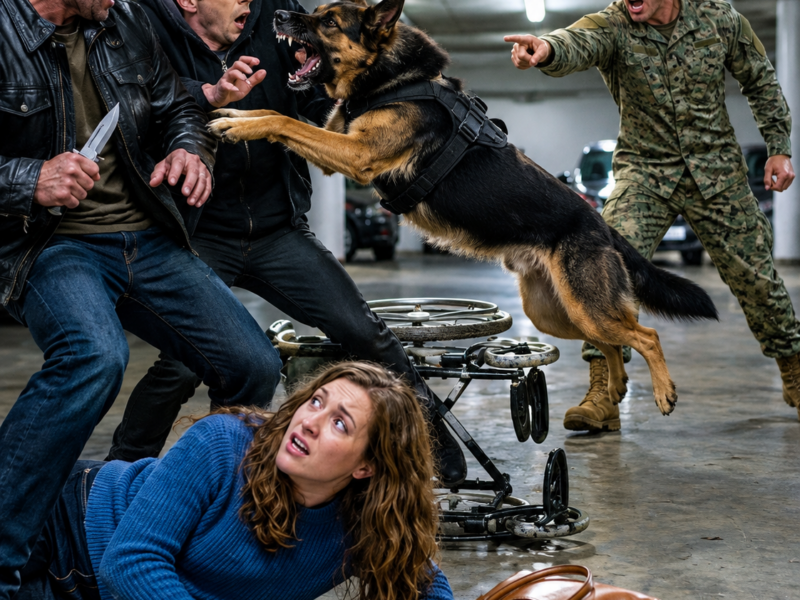
“Three men surrounded a woman in a wheelchair outside a quiet Charleston pharmacy, laughing as one grabbed the handles and threatened to drag her into their van
The man in the black SUV had a badge clipped inside his jacket, but he kept it hidden as he stepped toward me. That told me more than the badge itself ever could. Honest men wanted you to know who they were. Men with something to hide preferred to make sure you were afraid before you could ask questions.
“Bennett,” he repeated, his voice sharp enough to cut through the traffic noise. “Move away from the woman. This is a federal matter.”
Duke stepped forward until his shoulder pressed against my leg. His ears stood straight, his eyes fixed on the man’s hands. He wasn’t barking. Duke had been trained to distinguish between noise and danger, and the quiet tension in his body told me he’d already decided this man belonged in the second category.
I kept my hands visible. “Then show me your badge.”
The man hesitated.
It was barely a second, but I saw it.
Behind me, Rachel gripped the wheels of her chair. The three men who had tried to force her into the van were no longer laughing. The one in the red cap had backed toward the passenger door, while the tattooed man watched the SUV as if he were waiting for permission to run.
The younger man had already started moving.
“Duke,” I said softly.
My dog shifted his weight, blocking the narrow path between the younger man and the street. The man stopped.
“Everybody stays where they are,” I said. “Nobody gets in a vehicle until I understand what’s happening.”
The man with the hidden badge reached inside his jacket.
I moved half a step, putting myself between his hand and Rachel.
“Slowly,” I warned him.
He withdrew a wallet and opened it just long enough for me to see an identification card. The seal looked legitimate. The photograph matched his face. But the name—Victor Shaw—meant nothing to me, and he made sure to close the wallet before I could examine it.
“Special agent Shaw,” he said. “You’re interfering with an active operation.”
“What operation involves three men dragging a woman in a wheelchair toward a van?”
“They’re assisting with a protected witness.”
Rachel let out a bitter laugh. “That’s what you’re calling kidnapping now?”
Shaw’s expression hardened. “Rachel, you were instructed to remain at the safe location.”
“I was instructed to wait for someone I could trust.” She looked at me. “I never said I trusted you. I said you were my only chance.”
I glanced down at the silver identification tag lying beside her spilled canvas bag. The numbers stamped into it had dragged me six years backward, to a classified mission in a place that officially didn’t exist on any map.
My younger brother, Daniel, had worn a matching tag.
Daniel had been a Navy intelligence specialist attached to a joint operation overseas. He wasn’t a SEAL, but he had been trained to work alongside our teams, gathering information that could keep men alive. Six years earlier, I had received a short notification stating that he’d been killed during a transport incident. The report contained a time, a location, and a few cold sentences about hostile activity.
There had been no body returned to us.
No meaningful explanation.
Just a flag folded into a triangle and a government official telling my mother that her son had died serving his country.
I had spent years asking questions. Every answer led to another locked door. Eventually, the people who once returned my calls stopped answering altogether.
And now a stranger in a wheelchair was carrying a tag connected to that mission.
“Rachel,” I said, never taking my eyes off Shaw, “tell me what you know about Daniel.”
Her face changed. The anger remained, but beneath it I saw exhaustion so deep it looked like grief.
“Your brother didn’t die in that transport incident,” she said.
For a moment, the street seemed to go silent.
I could hear the low rumble of the SUV’s engine, the distant clatter of a delivery truck, and Duke’s steady breathing beside me. Everything else disappeared.
“Explain,” I said.
Shaw stepped forward. “That is enough. She is not authorized to discuss classified information with you.”
“Then you can explain it.”
“I don’t answer to you.”
“No,” I said. “But you’re standing between me and the first person who has given me a reason to believe my brother’s death was a lie.”
Shaw’s jaw tightened. “Your brother was involved in a compromised intelligence operation. His status was sealed for national security reasons. Whatever Rachel has told you, it does not change the fact that you need to leave this matter alone.”
Rachel leaned forward in her chair. “He wasn’t compromised. Daniel discovered that someone inside the operation was selling the names of local informants. People who had helped American personnel were being exposed, and the information was reaching the wrong hands before extraction teams could get them out.”
The tattooed man swore under his breath.
That was when I understood the three men weren’t random street criminals. They weren’t improvising. They were part of a plan that had just fallen apart in public.
“Who are they?” I asked Rachel.
“Contractors,” she replied. “At least, that’s what they called themselves. They worked for a private security company that handled transportation and protection for intelligence operations. The company was called Meridian Strategic.”
I knew the name. Meridian had won several government contracts after the wars overseas, providing transport, communications, and security for sensitive assignments. Their executives appeared at charity dinners and congressional hearings, smiling beside politicians and promising accountability.
“What did Daniel find?” I asked.
Rachel looked toward Shaw before answering. “A ledger. Payment records, extraction schedules, informant identities, and messages proving that the compromised information was being sold. Daniel copied part of it before the operation collapsed. He gave the original evidence to someone he believed could protect it.”
“Who?”
“Me.”
Shaw took another step toward us. “She’s lying.”
Rachel’s hand trembled as she reached into the lining of her jacket. She pulled out a small plastic sleeve containing a photograph, worn at the edges and folded twice. She held it toward me.
I took it carefully.
The picture showed Daniel standing beside a dusty military vehicle, one arm resting on the shoulder of a local man I didn’t recognize. Daniel was smiling, squinting against the sun. He looked younger than I remembered, though the photograph couldn’t have been taken long before his reported death.
On the back, in my brother’s handwriting, were six words.
“Jack will know what the numbers mean.”
My fingers tightened around the photograph.
“What numbers?”
Rachel pointed toward the silver tag on the pavement. “Those are not a service number. They’re coordinates encoded with a date. Daniel used the same system to mark the locations of evidence drops. He said you taught him the method when you were kids, back when you used to leave clues for each other around the house.”
I remembered.
Daniel had been thirteen when I taught him how to use a simple grid cipher on graph paper. We used it to hide birthday presents from our mother and to leave ridiculous messages for each other. Years later, when he entered intelligence work, he joked that the old game had turned into a useful professional habit.
I had forgotten about it.
Apparently, Daniel hadn’t.
I looked at the tag again. The numbers were arranged in two groups, followed by a date code. It wasn’t enough to identify a location without the key, but I recognized the structure.
“Where’s the rest of the message?” I asked.
“Somewhere safe,” Rachel said. “Or it was safe until Meridian found me.”
Shaw reached for the photograph. I pulled it back.
“You’re going to hand over every piece of evidence,” he said. “Then you and the woman will come with me.”
“On what authority?”
“Federal authority.”
“Then call local police and explain why three men were trying to force a disabled woman into a van.”
For the first time, Shaw looked uncertain. A few pedestrians had stopped to watch. Someone across the street had lifted a phone and was recording us. The men in the van knew it, too. Red Cap was now staring at the pavement, while the younger man kept glancing toward the traffic.
Shaw lowered his voice. “You have no idea what you’re stepping into. Daniel’s death was part of a larger national security matter. People died because of what he uncovered. If you continue, you could put more lives at risk.”
“Then help us protect them.”
“You think it’s that simple?”
“No. I think you’ve had six years to tell me the truth, and you chose not to.”
His face gave me nothing.
Rachel suddenly grabbed my wrist. “Jack, we need to leave. They’re waiting for someone.”
“Who?”
Before she could answer, the tattooed man pulled a phone from his pocket and stared at its screen. His expression drained of color.
“They’re here,” he muttered.
Shaw turned sharply. “Who’s here?”
The man didn’t answer. He looked at the street behind us, then bolted toward the van.
The younger man followed. Red Cap hesitated for one fatal second, caught between running and obeying the man who had hired him.
Duke lunged forward, not to attack, but to cut off his path. The man stumbled to a halt and raised both hands.
“Don’t let them take her!” he shouted. “You don’t understand. We were told she was carrying stolen government property. They said we were bringing her to a secure site.”
“Who told you?” I demanded.
He glanced at Shaw.
That was answer enough to make Shaw reach for his phone.
I didn’t chase the men. I wasn’t about to leave Rachel alone with a stranger whose story kept changing. Instead, I pulled out my own phone and called emergency services, clearly reporting an attempted abduction, a suspicious vehicle, and a man claiming federal authority who had not established the legitimacy of his orders.
Shaw’s eyes narrowed. “You’re making a serious mistake.”
“Then you’ll have no trouble explaining yourself when they arrive.”
The younger man made it to the van, but the driver had already thrown it into gear. The vehicle shot into traffic, leaving him behind. He ran several steps after it before realizing he had been abandoned.
Red Cap sank onto the curb.
Shaw turned away from us and began speaking into his phone in a low, hurried voice. I caught only fragments: “public exposure,” “the witness,” and “move the secondary team.”
Rachel heard them, too.
“Secondary team,” she whispered. “They’ve already found the archive.”
“What archive?”
“The place Daniel hid the original files.”
Before I could ask another question, two Charleston police cruisers arrived with their lights flashing. The officers separated everyone and took statements. Shaw presented his identification, but one of the officers asked him to remain until his agency could confirm the operation. For the first time since arriving, he seemed unable to make the world obey him simply by speaking.
The man in the red cap gave the officers a different account from Shaw’s. He admitted that he and the others had been paid to intercept Rachel, but claimed he had never been told to hurt her. He said the van was supposed to take her to a warehouse outside the city, where someone else would collect her.
He didn’t know who that person was.
Or so he claimed.
Rachel refused an ambulance, though a paramedic examined her wrists where the men had grabbed her. I crouched beside her chair while Duke settled at my feet.
“Can you tell me where Daniel is?” I asked.
She looked at me for a long time.
“I can tell you where he was the last time I saw him.”
My chest tightened. “When?”
“Three weeks ago.”
I felt the words land with the force of a physical blow.
“Three weeks ago?”
Rachel nodded. “He’s alive, Jack. I know that because I spoke to him. I saw him. He gave me the evidence and told me to find you if Meridian ever discovered where he was hiding.”
I had imagined this moment so many times that I thought I knew how I would react. I had imagined anger, relief, disbelief, even the possibility that I would fall apart.
Instead, I felt cold.
“Why didn’t he come to me himself?”
“Because he believed you were being watched. He said the people who buried his case had access to military records, law enforcement databases, and private surveillance. If he contacted you, he might lead them directly to you.”
“And you waited three weeks?”
“I spent those weeks trying to verify that I could trust you. Daniel gave me a list of people who might be compromised. Your name wasn’t on it, but that didn’t mean you were safe. I needed to see how you reacted when the men came for me.”
I stared at her. “You used me as a test?”
“I’m sorry.” Her eyes shone, but she didn’t look away. “I had no way to know whether you were working with them. I’m not proud of it. But Daniel said you were the one person who would recognize the tag and understand what it meant.”
I wanted to be furious. Part of me was. But another part was still trapped on the words she had spoken.
My brother was alive.
Six years of grief had been built on a lie.
“Where is he?” I asked.
Rachel reached into her canvas bag and withdrew a folded piece of paper. On it was an address outside Charleston, along with a series of numbers that matched the format on the tag.
“He told me not to go there unless I was sure no one was following me,” she said. “I think the men who came for me were trying to force me to reveal it. They may already have enough information to find the place.”
I looked toward Shaw. He was standing beside a patrol car, talking to a uniformed supervisor. He glanced at us once, then quickly looked away.
“Can you get out of the chair?” I asked.
Rachel’s expression sharpened. “What kind of question is that?”
“I mean, can you transfer into a vehicle without help? Do you have any injuries that would make it unsafe?”
“My legs are paralyzed,” she said plainly. “I can transfer if I have a stable surface and enough room. I don’t need you to carry me.”
“Understood.”
That earned the faintest hint of a smile.
I asked one of the officers to arrange for Rachel’s chair and bag to be transported safely, then gave him my contact information and requested the incident number. I didn’t try to take charge of the police investigation. I simply made sure the attempted abduction had been documented and that the officers knew the SUV and van were separate vehicles.
By the time we left, Shaw had been instructed to remain available for further questions. He watched us from the sidewalk, his face unreadable.
I drove an old pickup, which made getting Rachel and her chair settled a slow process. Duke rode in the back seat, alert and quiet. Before we pulled away, I checked the mirrors and made two turns through busy streets, watching for any vehicle that seemed to be following us.
Nothing obvious appeared.
That didn’t mean we were alone.
The address led us to a modest house on the outskirts of Mount Pleasant, tucked behind a line of live oaks. The place looked empty. Dust coated the front windows, and weeds had grown along the walkway. A mailbox stood crooked beside the road.
Rachel studied the house through the windshield.
“This isn’t where Daniel was staying,” she said. “It’s where he told me to go if the first location became unsafe.”
“Then why bring us here?”
“Because the numbers on the tag don’t point to a house. They point to a storage unit behind it.”
We found the storage building at the back of the property, partly hidden by overgrown shrubs. Its door was secured with an old padlock. Rachel handed me the paper with the coded numbers. I used the childhood grid cipher Daniel and I had created, matching the sequence to a date and a set of coordinates.
The result pointed to unit seventeen.
I found a small brass key taped beneath the metal lip of the doorframe.
Inside the unit were plastic storage bins, a battered folding table, and an old radio. At first glance, it looked like the sort of place someone used to store furniture between moves. But the table held a sealed envelope with my name written across it in Daniel’s handwriting.
I stood very still.
Duke moved to the entrance and sat facing outward, keeping watch while Rachel rolled beside me.
I opened the envelope.
Inside was a letter, a flash drive, and a photograph of Daniel standing in front of a small fishing boat. He looked older than in the picture Rachel had shown me, with a short beard and a scar across his left eyebrow. But it was unmistakably my brother.
The letter began with the words I had needed to hear for six years.
“Jack, if you’re reading this, I’m sorry I let you believe I was dead.”
I had to stop reading.
Rachel remained silent beside me. She didn’t touch my shoulder or tell me everything would be all right. I was grateful for that. Some pain needed room before it could become anything else.
I forced myself to continue.
Daniel explained that the operation had been compromised before his team reached the extraction point. The convoy carrying several informants had been diverted after someone leaked its route. The attack was blamed on hostile forces, but Daniel had found communications showing that the route had been deliberately exposed by a Meridian supervisor working with an intelligence officer.
Daniel had survived because the vehicle he was riding in had been separated from the convoy during the attack. A local doctor treated him, and a small group of people helped him disappear before the compromised team could find him. He later learned that the official casualty list had been altered to include his name.
He had tried to report the evidence through proper channels. Every attempt was blocked. A contact who agreed to help him vanished. Another was found dead under circumstances that were officially ruled accidental. Daniel eventually concluded that someone with access to classified investigations was protecting the people involved.
He had gone underground to preserve the records and protect the informants whose identities appeared in the files.
The last paragraph was shorter.
“I know you’ll be angry. You have every right to be. I wanted to come home more times than I can count. But if I had brought the people hunting me to our family, I would have risked losing you, Mom, and everyone else I love. I’m close to finishing this. If Rachel reaches you, it means I’ve run out of safe options. Please don’t come looking for me alone.”
I lowered the letter.
“He’s still out there,” I said.
Rachel nodded. “He said he would try to reach this place if the archive was compromised.”
“Where is the archive?”
She looked at the flash drive. “Daniel said the digital files were only part of the evidence. The original records were kept in a physical archive controlled by Meridian. If we can get into it, we can prove who ordered the leak and who helped cover it up.”
I examined the flash drive. It was labeled with a single word: LANTERN.
Operation Lantern.
The name I had spent six years trying to forget.
I had thought it was just another classified mission buried under bureaucratic language. Now I understood it was the thread connecting Daniel’s disappearance, the leaked informant identities, and the people who had tried to silence Rachel.
But we couldn’t simply hand the drive to the first official who promised to help. If Daniel was right, the corruption reached far beyond one private contractor.
“We need someone independent,” I said. “Someone who can verify the files and protect the evidence from being buried again.”
Rachel nodded. “There’s a federal prosecutor in Columbia. Her name is Elena Brooks. Daniel trusted her because she prosecuted a contractor fraud case without letting the agency involved control the investigation. He gave me her contact details, but I was supposed to approach her only when I had the physical records.”
“Then we do it properly. We make copies, document how we found everything, and contact her through an official channel. No breaking into warehouses, no running around pretending we’re invincible.”
Rachel gave me a tired look. “Daniel said you’d say something like that.”
“He knows me.”
“He said that was both your best quality and your biggest problem.”
For the first time that day, I almost laughed.
We photographed the storage unit and its contents before touching anything else. I kept the letter and drive secure, and we contacted the prosecutor’s office using a publicly listed number rather than any private contact supplied in the note. We explained that we had evidence potentially related to a federal conspiracy and an attempted abduction. The person who answered transferred us to an investigator, who arranged a secure meeting at a federal building the following morning.
I also called my mother.
I had rehearsed the words a dozen times on the drive back into town, but when she answered, all I managed at first was her name.
“Jack? Is something wrong?”
I swallowed. “Mom, I need you to sit down.”
Her breathing changed. “What happened?”
“I have reason to believe Daniel may still be alive.”
Silence.
Then a small, broken sound I had never heard from her before.
“Don’t,” she whispered. “Please don’t give me hope unless you know.”
“I don’t know everything yet. But I have a letter in his handwriting, and a photograph taken recently. I’m going to find out the truth.”
She began to cry quietly. I closed my eyes and listened. For six years, I had believed that the only thing left to do for my brother was remember him. Now I had to learn how to hope without promising her something I couldn’t guarantee.
The next morning, Rachel and I met with Assistant U.S. Attorney Elena Brooks and two investigators assigned to the case. Brooks was in her forties, with an unassuming manner and questions that showed she was listening carefully. She didn’t promise instant justice. She asked us to describe exactly what had happened, then arranged for the evidence to be copied and examined by specialists outside the agencies named in the files.
The flash drive contained messages, payment schedules, and partial records linking Meridian executives to the compromised operation. It also contained references to a second archive maintained at a private logistics facility near the port. The records suggested that a senior Meridian executive named Paul Voss had coordinated the diversion of the convoy and arranged payments to the intelligence officer who supplied the route.
The evidence did not prove every allegation on its own, but it gave investigators a clear path to follow.
Brooks secured preservation orders for relevant company records and contacted the appropriate oversight office. She also arranged protection for Rachel and for the surviving informants identified in Daniel’s files. For the first time, the investigation had a chance to move forward without relying on the same people who might have helped conceal the original crime.
That afternoon, a message arrived through the secure contact channel Daniel had included in his letter. It contained no greeting, only a time and a location: a public marina outside Charleston, just before sunset.
Brooks advised us not to go alone and arranged for investigators to maintain a discreet presence nearby. I agreed. I had spent too many years imagining my brother’s last moments to gamble with his life now that there was a chance to see him again.
We arrived early.
The marina smelled of saltwater, diesel, and damp rope. Fishing boats rocked gently against their moorings. Families walked along the pier, and a group of teenagers laughed beside an ice machine. Everything looked ordinary, which somehow made the waiting harder.
Duke sat beside my leg, scanning the people moving through the marina.
Then I saw a man step out from behind a small boat shed.
He was thinner than I remembered. His beard had gone streaked with gray, and he carried himself with the caution of someone who had spent years checking every doorway before entering a room. But when he turned his head, I saw the familiar crease beside his left eye.
Daniel.
For a second, neither of us moved.
Then he looked directly at me.
“Jack.”
His voice was older, rougher, but it was his voice.
I crossed the distance between us so quickly that I nearly stumbled. When I reached him, I grabbed his shoulders, half expecting him to vanish like a dream the moment I touched him. He didn’t.
I pulled him into an embrace.
He held on just as tightly.
I wanted to hit him. I wanted to demand answers. I wanted to ask how he could have let our mother mourn him for six years while he remained somewhere on the same continent, breathing, thinking, living.
Instead, I pressed my forehead against his shoulder and whispered, “You’re alive.”
“I’m sorry,” he said.
“You’re alive.”
“I know.”
I stepped back and looked at his face. “Mom thinks you’re dead.”
His eyes filled with tears. “I know.”
“She still sets out an extra plate on your birthday.”
Daniel lowered his head.
That was the moment the anger finally broke through the shock. I shoved him once in the chest—not hard enough to hurt him, but hard enough to make him look at me.
“You should have found a way to tell us.”
“You’re right,” he said. “I should have.”
I had expected excuses. I had prepared arguments for every reason he might give me. His agreement left me with nowhere to direct the fury except at the years we could never get back.
“Why didn’t you come home when you had the chance?”
“Because I thought they would follow me. I thought I could finish this first, clear the people who were compromised, and then come back with proof. Every time I got close, someone else was threatened. I kept telling myself one more week, one more month. Then the months became years.”
“You could have trusted me.”
“I did trust you. That was what scared me most.” He looked toward Rachel. “If they knew I was alive and knew you were helping me, they would have used you to get to me. I thought staying away was the only way to protect you.”
“You don’t get to decide for everyone what kind of pain they can survive,” I said.
Daniel absorbed the words without arguing.
“No,” he said quietly. “I don’t.”
For a while, we stood together beside the water, neither of us knowing how to cross the distance six years had created. Then Daniel knelt to greet Duke, who sniffed his hand and gave a low, uncertain whine.
“You remember him?” I asked.
“Of course I remember him.” Daniel scratched behind Duke’s ears. “He once stole an entire roast chicken from Mom’s counter and blamed it on you.”
“He had excellent taste.”
Daniel laughed, and for one brief moment, the years between us seemed to loosen.
Then he grew serious.
“Rachel told you about the files?”
“She did. We’ve given the digital evidence to a federal prosecutor. Investigators are tracing the records to Meridian.”
“Good. But there’s more. The original archive contains signed authorizations. It proves who ordered the convoy route changed and who approved the false casualty report. The digital copies show the money. The originals connect the people who made the decisions.”
“Where is it?”
“At Meridian’s logistics facility near the port. In a locked records room they use for old contract files. I know the location, but I couldn’t get close without exposing myself.”
“You’re not going near it alone,” I said.
“I wasn’t planning to.”
For the first time since we reunited, he looked relieved.
We briefed Brooks and her investigators. They did not ask us to conduct an unauthorized raid or put ourselves in danger. Instead, the information Daniel provided helped them obtain the legal authority needed to secure the records. Investigators coordinated with the relevant oversight officials, and a team entered the facility under warrant the following morning.
The records were there.
Among them were signed authorizations for the convoy diversion, payment approvals routed through shell companies, and internal messages discussing how Daniel’s disappearance could be used to close the investigation. One document listed him as deceased before the official incident report had even been completed.
The evidence triggered a broader inquiry. Paul Voss and several Meridian executives were arrested on charges related to conspiracy, fraud, obstruction, and the unlawful disclosure of protected identities. The intelligence officer named in the files was suspended and later charged after investigators corroborated the records with financial evidence and witness testimony. Special Agent Victor Shaw was removed from the case and investigated for his role in attempting to seize Rachel outside the pharmacy. His explanation—that he had been trying to recover classified material—did not account for the use of private contractors or the absence of proper documentation.
The men in the van were charged in connection with the attempted abduction. Their statements helped investigators establish how the operation had been arranged and who had paid them.
The case took months to unfold. There were hearings, delays, denials, and headlines that treated the truth like a contest between opposing public-relations teams. Some defendants pleaded not guilty. Others agreed to cooperate. Not every person named in Daniel’s records was convicted, and Brooks cautioned us that evidence had to meet the legal standard for each individual charge.
But the central facts could no longer be buried. Daniel had not died in the transport incident. The operation had been compromised from inside. The official report had been falsified, and the cover-up had protected people who profited from exposing informants to danger.
For the first time in six years, my brother’s name appeared in public records as a living witness rather than a casualty.
The hardest conversation was still waiting at home.
When Daniel and I arrived at our mother’s house, she opened the door and stared at him without moving. He stood on the porch, hands at his sides, looking suddenly like the boy who used to come home late and invent terrible excuses.
“Hi, Mom,” he whispered.
She slapped his shoulder.
Then she grabbed his face in both hands, searching it as if she needed to prove every feature was real. She struck his chest once more, then pulled him into her arms and held him so tightly that he winced.
“You let me bury you,” she sobbed.
Daniel closed his eyes. “I know.”
“You let me mourn you.”
“I know.”
“I prayed for you every night.”
“I know, Mom.”
She pushed him away just enough to look at him. “Don’t say you know. You don’t know what that was like.”
He had no answer. He simply nodded, tears running down his face.
She hugged him again.
I stood behind them, unable to speak. There was no single embrace that could repair six years of grief, no explanation that could give our family back every holiday, birthday, and ordinary afternoon we had lost. But my mother was holding her son, and for that moment, the world was allowed to be imperfect and still give us something miraculous.
Later, after the sun went down, Daniel and I sat on the back steps while Duke slept nearby. We talked about the years he had spent in hiding, the people who had helped him, and the choices he regretted. I told him about my own struggle to keep living after his reported death, about the nights I replayed the official story and wondered what I had missed.
“I can’t give those years back,” he said.
“No,” I replied. “You can’t.”
“I don’t expect you to forgive me quickly.”
“I don’t know how quickly I can forgive you.”
He nodded. “That’s fair.”
I looked out into the yard. For years, I had believed closure meant discovering the truth about Daniel’s death. I was beginning to understand that truth was only the beginning. We would have to learn how to be brothers again, not the people we had been before the operation, but the people who had survived what came after it.
“You’re going to help Mom with everything you missed,” I told him.
A faint smile appeared. “Everything?”
“Every birthday. Every holiday. Every broken appliance she’s been saving for me to fix.”
“That sounds worse than an undercover assignment.”
“It probably is.”
He laughed, and this time the sound stayed with us.
A few weeks later, Rachel came by for dinner. Her investigation continued, but she had been placed under protection and was finally able to move around without looking over her shoulder at every passing vehicle. She had begun working with the legal team to help identify the people whose names appeared in the files, and she insisted that the case wasn’t finished until the affected families had answers.
I respected that.
Before she left, she stopped beside Duke and rubbed his head.
“I still owe you an apology,” she told me.
“For what?”
“For making you prove you were trustworthy before I told you everything.”
“You had reasons.”
“That doesn’t mean it was fair.”
I thought about the silver tag, the men at the pharmacy, and the first moment she had said my brother’s name. “You made a difficult choice in a bad situation. Just don’t make a habit of turning sidewalks into tests.”
She smiled. “I’ll try.”
After she left, I found the silver tag on the shelf above my desk. Brooks had returned it after the evidence had been documented, and Daniel had asked me to keep it. The numbers no longer looked like a code designed to drag me back into a nightmare. They were proof that a small thing, carried by the right person, could survive years of lies.
I placed the tag beside Daniel’s photograph.
Duke rested his chin on my knee.
For six years, I had believed the hardest part of being a Navy SEAL was learning how to walk away from the battlefield and live with the people you couldn’t save. I was wrong. Sometimes the hardest part was accepting that the battle had followed you home, hiding inside paperwork, sealed reports, and official statements that sounded too clean to be true.
Sometimes courage meant charging toward danger. Sometimes it meant admitting that the people you loved had been hurt by your choices, even when you had made those choices believing you were protecting them.
And sometimes the first step toward justice began with nothing more than a woman in a wheelchair refusing to get into a van, a retired military dog recognizing a threat, and a silver tag that should never have existed.
Daniel was home. The truth was finally in the hands of people who could act on it. The men who had profited from the cover-up would face their day in court, and the families whose lives had been shattered would have the chance to learn what really happened.
We couldn’t reclaim the years we had lost.
But we could decide what to do with the years we had left.
For the first time in a long time, that felt like enough.
THE End.









