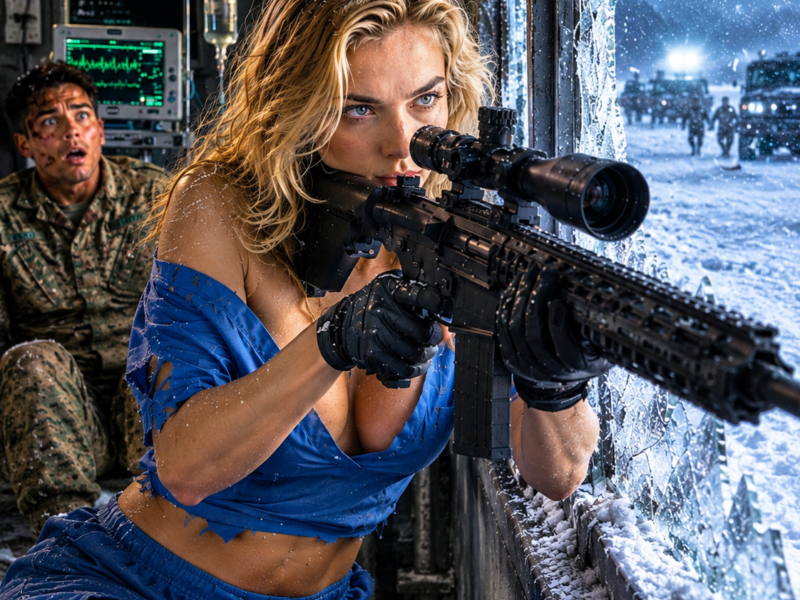
“They laughed when I told them I was just a nurse, right up until the first sniper round punched through the wall above the wounded Marine
The voice coming through the radio belonged to a man I had watched disappear beneath a burning helicopter four years earlier. I had seen the fire. I had heard the explosions. I had carried the guilt of leaving him behind through every hospital shift and every sleepless night since.
Now he was asking me to come to the eastern ridge alone.
“Rebecca Hayes. If you want those Marines alive, come to the eastern ridge alone.”
Captain Cole reached for the radio, but I caught his wrist.
“Don’t answer him yet.”
His eyes narrowed. “You know who that is?”
“Yes.”
“Who?”
I stared at the speaker. My hands had gone cold, but the rest of me was painfully alert. Somewhere in the compound, a generator hummed. The operations room smelled of burnt coffee and warm electronics. Around us, Marines waited for orders, and two of their brothers were missing beyond the perimeter.
“His name is Lieutenant Adrian Cross,” I said. “He was the team leader during my last overseas operation. Officially, he died four years ago.”
Major Vance stopped arguing.
“That is impossible,” he said.
I turned toward him. “You knew him?”
Vance hesitated just long enough to answer the question without speaking.
Cole noticed it too.
“Major, stay right there,” Cole ordered. “Nobody leaves this room. Nobody touches a radio log, a weapons record, or a computer terminal unless my communications officer is watching.”
Vance’s face reddened. “Captain, you don’t have the authority to detain me based on a voice transmission.”
“I’m not detaining you. I’m securing an active incident scene. If you have nothing to hide, you’ll have no problem waiting.”
Cole turned back to me.
“Hayes, I need the truth. All of it. Who is Cross, what happened four years ago, and why does somebody out there think you’re the person they need to threaten?”
I looked at the map on the screen. The eastern ridge rose beyond the training perimeter, a jagged line of stone and scrub. Two blinking markers showed the last known positions of the missing guards. A third marker indicated the area where the unauthorized shooter had been spotted earlier.
I wanted to tell Cole everything.
But four years ago, telling the truth had cost me my unit, my career path, and the only family I had known in uniform.
And if Adrian Cross was alive, it meant the report that destroyed my life had been a lie.
“First, we find your Marines,” I said. “Then I’ll tell you what I know.”
Cole studied my face, then nodded.
“Fine. What’s your plan?”
“Give me the perimeter map, the original exercise boundaries, and every confirmed radio transmission since the first shot. I also need a medical team ready at the western access point. If we find those guards alive, I want a clear route to bring them out.”
“You’re not going up there alone.”
“He asked for me alone because he wants me separated from everyone else. That doesn’t mean we give him what he wants.”
I pointed at the map.
“We approach from the western side, where the ridge blocks the line of sight from the first firing position. Your team stays behind cover and maintains communications. Nobody fires unless there’s a clearly identified immediate threat. If Cross is using the missing Marines to draw us into a trap, we don’t walk into it just because we’re angry.”
Cole looked at the map, then at his communications officer.
“Make it happen.”
Major Vance stepped forward. “This is becoming a disaster. You cannot base a military response on the speculation of a nurse.”
Cole turned slowly.
“Then it’s fortunate I’m basing it on two missing Marines, unauthorized live ammunition, a compromised exercise, and a threat delivered over our own communications network.”
Vance’s mouth tightened.
I noticed his right hand move toward the pocket of his uniform.
“Major,” I said.
He froze.
“Take your hand out of your pocket.”
His expression changed from irritation to disbelief.
“Excuse me?”
“Your hand. Out of your pocket. Slowly.”
Two Marines shifted closer. Vance withdrew his hand, revealing a phone.
Cole held out his palm.
“Set it on the table.”
“This is my personal property.”
“And right now, it’s potentially relevant evidence. Set it down.”
Vance obeyed, but the look he gave me promised that this was not over.
I knew that look. I had seen it on the face of a man who understood that the truth was closing in and had not yet decided how far he would go to stop it.
A communications specialist approached Cole with a headset.
“Sir, the last transmission from the missing guards was traced to a relay near the old observation station. We’re also detecting a signal from a second device operating on a restricted frequency.”
“Can you identify the device?”
“Not yet. But it’s using a channel associated with the training control system.”
I leaned closer to the map.
“The old observation station,” I murmured.
Cole glanced at me. “You’ve been there?”
“No. But I know the terrain. There’s a dry wash running along the western slope. It offers cover almost to the lower ridge. If we use it carefully, we can get close without exposing the team to the main firing lane.”
“You’re certain?”
“Certain enough to recommend it. Not certain enough to promise it’s safe.”
Cole gave a brief nod.
“That’s the first honest answer I’ve heard all evening.”
He ordered a small team to prepare, then pulled me aside while the others worked.
“Before we move, I need to understand one thing. If Cross is alive, why didn’t he contact you in four years?”
I looked down at my hands.
“Because the last time I saw him, he was trying to get us out of an ambush. The helicopter was hit before we could load the last casualties. I heard him order the rest of us to withdraw. Then the aircraft exploded.”
“And you saw him die?”
“No. I saw the helicopter burn. I saw debris fall across the landing zone. I never saw a body.”
Cole absorbed that.
“Who declared him dead?”
“Command. The recovery report said the remains were too badly damaged to identify individually. Cross was listed as killed in action, and the operation was classified.”
“Did you question it?”
“Of course I did. But I was a medic, not the officer in charge. I filed a statement describing exactly what I’d seen. Two weeks later, I was given a revised report to sign. It claimed Cross had ordered us to move into the compromised route despite warnings from the team.”
“And you refused.”
“I knew what he had actually said. He’d ordered us to pull back. The revised report turned him into the man responsible for the ambush.”
Cole’s expression hardened.
“Who changed it?”
“I never found out. My objections were treated as emotional distress. I was removed from operational duty and reassigned. Cross was buried with honors, and everyone was told the investigation had settled the matter.”
“Why didn’t you fight harder?”
The question stung because I had asked myself the same thing for years.
“I did fight. I filed formal objections. I asked for the radio logs. I requested an independent review. Every request was denied or delayed. Eventually, I was warned that continuing to challenge the report could jeopardize my medical career.”
I lifted my eyes to his.
“I was exhausted, Captain. I had spent weeks trying to keep people alive, and then months trying to convince people that the dead deserved the truth. I chose to keep working as a nurse because at least I could still save someone.”
Cole was quiet for a moment.
“Then we’ll make sure you don’t have to fight this alone.”
I wanted to believe him.
But I had learned that promises made in a brightly lit room often became much less convincing once the people making them faced real consequences.
A Marine called from the doorway.
“Team is ready, sir.”
Cole picked up his rifle and turned toward the exit.
“Let’s bring our people home.”
I checked my medical bag, secured the straps across my shoulders, and followed him into the night.
The desert air had cooled, but the rocks still radiated the day’s heat. Beyond the perimeter lights, the training grounds were almost completely dark, broken only by the pale glow of the moon and the occasional red indicator on a communications tower.
We moved in a staggered line toward the western access point. Cole led the team, with Staff Sergeant Mercer close behind him. Two Marines carried rifles and additional medical supplies, while a communications specialist monitored the radio traffic. I stayed near the middle, where I could reach the wounded without obstructing the team.
Nobody made jokes about the nurse anymore.
That should have pleased me. Instead, it reminded me how quickly people could change their opinions when they discovered a person’s history. I had never wanted respect because of a callsign or a weapon. I wanted people to listen when I told them someone was bleeding, a route was unsafe, or a report was wrong.
We reached the dry wash after ten minutes.
I crouched beside the bank and studied the ground. The sand was disturbed in several places, and a narrow line of footprints led toward the ridge.
“Two people,” I whispered. “One walking normally. The other favoring a leg.”
Mercer examined the prints.
“Could be our missing guards.”
“Could be,” I replied. “We don’t know until we find them.”
Cole signaled the team to continue. We followed the wash until it curved behind a low rock formation. From there, I could see the abandoned observation station on the ridge above us.
It was a small concrete structure left over from an older training program. The roof had partially collapsed, and a rusted antenna leaned against one wall. The station had been decommissioned months earlier, but its location made it useful for anyone who wanted to watch the eastern road without being seen.
A faint light flickered inside.
Cole raised a closed fist. Everyone stopped.
The communications specialist checked his headset, then shook his head.
“No signal from the guards.”
I looked toward the building.
“There’s someone inside.”
“Can you tell who?”
“No.”
Cole glanced at the two Marines beside him, then at me.
“Stay here until we know what we’re dealing with.”
I nodded.
He and Mercer moved forward, keeping close to the rocks. I watched them reach the edge of the station, then saw Cole signal that the immediate entrance was clear.
A moment later, a voice rose from inside.
“Don’t come any closer!”
Cole answered calmly. “We’re Marines. We’re here to get our people out.”
“Then tell the nurse to come forward.”
My stomach tightened.
Cole looked back at me.
I stood.
“Rebecca Hayes,” the voice called. “I know you’re there.”
I recognized the voice, but hearing it from inside that building made the recognition feel impossible all over again.
Adrian Cross had been tall, with a deep voice that carried easily over a crowded room. He had also possessed a slight rasp from an injury he sustained during an earlier deployment. The man inside the station sounded exactly the same.
“Adrian,” I called. “Let the guards go.”
A brief laugh came from the darkness.
“You haven’t changed, Rebecca. Always giving orders before asking questions.”
“I’m asking now. Are they alive?”
“They’re alive.”
“Are they injured?”
“One has a head wound. The other has a damaged ankle. Neither will die tonight unless somebody makes a stupid decision.”
“Then let me treat them.”
“Not yet.”
I took a step forward.
Cole’s hand lifted slightly, warning me not to move farther.
I stopped.
“Four years,” I called. “You had four years to contact me. Why bring two innocent Marines into this?”
“Because nobody listens when I tell the truth.”
“Then give me the truth.”
For several seconds, there was no answer.
Then Cross said, “Come inside. Alone.”
“No.”
“Rebecca—”
“I won’t leave the guards exposed, and I won’t walk into a building where someone has already demonstrated a willingness to use live ammunition against my people. You want to talk to me, talk to me from where you are.”
Silence.
I heard a faint scraping sound from inside the station.
Then Cross spoke again.
“Still stubborn.”
“Still alive, apparently.”
This time, his laugh sounded genuine, though it ended abruptly.
“You have no idea how close I came to staying dead.”
I felt anger rise through the fear.
“You let me believe you were dead.”
“I didn’t have a choice.”
“You always had a choice about what you did to other people.”
The words came out sharper than I intended. I thought of the nights I had spent wondering whether I had abandoned him, whether I should have ignored the withdrawal order, whether I could have reached the helicopter before the explosion.
Cross said nothing.
Then a new voice spoke from inside the station.
“Rebecca, please. He’s not the only one who needs you.”
A man’s voice, strained with pain.
I recognized Staff Sergeant Owen Price, one of the missing guards.
“Price?” I called. “Can you hear me clearly?”
“Yes, ma’am.”
“Are you bleeding heavily?”
“No, ma’am. My head’s cut, but I can stay awake.”
“Good. Keep talking to me. What’s your partner’s condition?”
“Corporal Lewis twisted his ankle pretty badly. He can move his toes, but he can’t put weight on it.”
“Tell him not to try. Keep both of you away from the windows.”
Cross interrupted.
“They’re safe as long as everyone does what I say.”
I looked at Cole. His expression had become rigid, but he was listening carefully.
“Adrian,” I said, “if you wanted to hurt them, you wouldn’t be keeping them alive and answering my questions. So tell me what you actually want.”
“I want the original mission recording.”
My mouth went dry.
“What recording?”
“The unedited radio log from Operation Lantern. The one that proves I never ordered the team down that compromised route.”
I felt as if the ground had shifted beneath my boots.
Operation Lantern.
The name had not appeared in any document I was allowed to keep after my reassignment. It had been removed from my official service summary, replaced with a vague reference to a classified casualty evacuation.
“How do you know I have it?” I asked.
“Because I saw what you did before the helicopter went down. You copied the field communications buffer onto a medical incident drive. You were preserving the casualty timestamps.”
I remembered.
In the chaos of the operation, I had saved a temporary copy of the communications log to reconcile casualty times with treatment records. It was standard medical documentation, nothing more. After the ambush, the copy had been collected with the rest of my equipment.
I had never seen it again.
“I don’t have that drive,” I said.
“Maybe not. But someone kept a copy. Someone who knew you were the last person to hear my withdrawal order.”
“Who?”
“Major Vance.”
Behind me, Mercer swore under his breath.
Cole’s face hardened.
“Vance is at the command post,” he said quietly.
Cross heard him.
“Then you should ask him why he signed the revised report.”
I looked at the dark entrance.
“Why didn’t you come forward yourself?”
“I tried.”
“When?”
“After the operation. Before they officially declared me dead. I contacted the review team and told them the route had been changed without my approval. They said they would investigate. Two days later, the transport taking me to a secure medical facility was attacked. The escort was killed. I escaped into the hills.”
“You escaped for four years and never contacted anyone?”
“I contacted people. Every person I trusted was either transferred, silenced, or told I was dead. The first time I tried to send evidence, the person who agreed to carry it disappeared.”
His voice grew harder.
“By the time I understood how far the cover-up went, I couldn’t tell who was working for whom. I survived by staying out of sight.”
“And now you’re threatening Marines because you think I have a recording?”
“I’m trying to force the people responsible to stop hiding behind paperwork.”
“By creating another incident that could get people killed?”
He didn’t answer.
That silence told me more than any confession could have.
I had wanted the man in the station to be Adrian Cross. I had wanted him to be the person who had ordered us to withdraw, who had stayed behind to help the wounded, who had trusted me to keep his people alive.
But the man I was speaking to had taken two Marines hostage and allowed an unauthorized shooter to turn a training ground into a battlefield.
Whatever had been done to him, those choices belonged to him.
“Adrian,” I said, “you can still end this. Let the guards walk out. Put down your weapon. I’ll listen to what happened, and I’ll help get your evidence to investigators who aren’t connected to Vance.”
“You expect me to trust the system that buried me?”
“No. I expect you to stop making innocent people pay for what the system did.”
Another long silence followed.
Then I heard movement inside.
Price called out, “Ma’am, he’s looking at something on the table.”
“Don’t touch anything,” Cross snapped.
I exchanged a glance with Cole.
We were running out of time. Cross was agitated, the guards were injured, and we still didn’t know whether someone else was watching the station from the ridge.
I needed him focused on me, not on the men surrounding the building.
“Adrian, do you remember Kandahar?” I asked.
The question came out before I had fully considered it.
He was silent.
“Do you remember the young corpsman who refused to leave his wounded interpreter? You told him he had done enough, and he told you to go to hell.”
A small, broken laugh came from the station.
“Daniel.”
“Yes. Daniel Cross.”
“My younger brother.”
“I know.”
“He died believing I had abandoned the team.”
I swallowed.
“He died after someone delayed his evacuation. That wasn’t your decision.”
“You don’t know that.”
“I know what I heard on the radio. I know what the records said before they were changed. And I know that if you keep doing this, the truth about Daniel will get buried beneath another report about a hostage situation.”
For the first time, Cross sounded uncertain.
“You remember Daniel?”
“I remember every patient I treated that night.”
I had treated Daniel after a blast injury during a previous operation. He had been frightened, stubborn, and painfully young. He had kept asking about his brother even while I worked to stabilize him.
I had never told Adrian that Daniel’s last coherent words had been about the men still waiting for evacuation.
“He wanted you to know he wasn’t afraid,” I said. “He told me to tell you he had done his job.”
The station fell quiet.
I could hear the wind moving through the scrub and the faint click of a radio somewhere behind me.
Then Cross spoke, his voice stripped of its earlier anger.
“They told me Daniel died because I failed him.”
“They lied to you.”
“And you think that’s supposed to make it better?”
“No. I think it means you have a choice about what you do next.”
A shadow appeared in the doorway.
Cross stepped into the moonlight.
He looked older than I remembered. His face was thinner, and a scar ran from his temple toward his jaw. His hair had grown long enough to curl beneath the collar of his jacket. He held a rifle low, but his grip was tight.
For one terrible second, I saw the man from four years ago standing in front of me, alive and wounded and asking me to forgive him for something he hadn’t done.
Then I saw the weapon in his hands.
“Put the rifle down, Adrian,” I said.
He looked at me, then at Cole.
“You bring me the original recording, and I’ll surrender.”
“I don’t have it.”
“Then find it.”
“We will. But not while you’re holding those men hostage.”
His jaw worked as if he were fighting to contain something that had been building for years.
Behind him, Price appeared briefly in the doorway, supporting himself against the frame.
“Sir,” Price said to Cole, “Lewis needs medical attention.”
I moved instinctively, but Cross raised his rifle a few inches.
“Stay where you are.”
I stopped.
“Adrian, he’s injured. Let me treat him.”
“Once I know you’re not going to arrest me before I can prove what happened.”
“You don’t get to decide that.”
His eyes flashed.
“And you don’t get to tell me what it feels like to be buried alive.”
The words struck deeper than I expected.
“No,” I said. “I don’t. But I know what it feels like to survive something and spend years wondering whether you should have died with the others.”
For a moment, his expression softened.
Then a sharp sound came from the eastern ridge.
A rifle shot.
Cross spun toward the noise. His weapon rose instinctively, and Cole shouted for everyone to get down.
I dropped behind the rock bank as another round struck the concrete station. Dust burst from the wall beside the doorway.
Cross staggered backward.
He had been hit.
The rifle fell from his hands, clattering across the ground.
“Adrian!”
I ran toward him before anyone could stop me.
He collapsed against the doorway, clutching his upper arm. Blood spread quickly through the sleeve of his jacket. I dropped beside him and pressed my hands against the wound.
“Keep your arm still,” I ordered.
He stared at me in disbelief.
“You came anyway.”
“I’m not going to let you bleed out just because you’re an idiot.”
Despite the pain, a faint smile touched his face.
“Still the same Rebecca.”
“Save your breath.”
I packed the wound and applied firm pressure. The bleeding slowed, but the bullet had passed close to the shoulder joint, and I needed a proper assessment before deciding how to move him.
Cole and Mercer took cover near the station while the rest of the team watched the ridge.
“Shooter’s position?” Cole called.
The communications specialist answered from behind the rocks.
“Unknown! We have no visual. The shot came from the upper eastern slope!”
I looked at Cross.
“Was that your man?”
He shook his head, teeth clenched.
“No.”
“Then who is it?”
His eyes moved toward the ridge.
“The person who knows I’m alive.”
A second shot struck the station’s roof.
The concrete cracked overhead, and a shower of grit fell around us.
I pulled Cross lower behind the doorway and continued applying pressure.
“Captain!” I shouted. “We need cover and an evacuation route. He’s losing blood.”
Cole relayed the request while Mercer moved to help Price and Lewis. The team was now trapped between the unknown shooter on the ridge and a wounded man who had become both a suspect and a potential witness.
I looked at Cross.
“Tell me where the shooter is.”
“I can’t see him.”
“Then tell me what you know about the station.”
Cross swallowed and forced himself to focus.
“There’s a maintenance tunnel beneath the west wall. It runs to an old drainage channel. We used it during the original training exercises.”
“Where does it come out?”
“Below the ridge, near the dry wash.”
I glanced toward Cole.
“We have a way out.”
Cross caught my sleeve.
“Rebecca, listen to me. If Vance is involved, don’t trust the command post. He’ll have people watching the exits.”
“Then we’ll preserve the evidence and keep everyone alive long enough to expose him.”
“You still think evidence is enough?”
“No. But it’s a start.”
We moved the wounded men toward the tunnel while the team maintained cover. Cross insisted on walking, but I refused to let him put weight on his injured arm. Mercer and another Marine supported him between them, while I stayed close enough to monitor his condition.
The tunnel was narrow and smelled of damp earth. We moved slowly, using small lights and keeping the radios on low volume. Halfway through, Price stumbled, and I caught him before he fell.
“Easy,” I said. “How’s your head?”
“Throbbing, ma’am.”
“Any nausea? Blurred vision?”
“A little dizzy.”
“Then you don’t get to be a hero. You follow instructions and let us get you to a doctor.”
He gave a weak grin.
“Yes, ma’am.”
Behind us, Cross let out a pained breath.
“She’s always been like that.”
“Like what?” Price asked.
“Impossible to argue with.”
I kept my eyes on the tunnel ahead.
“I’m still here, Adrian.”
“I know.”
For the first time since I had heard his voice over the radio, he sounded less like a man trying to control the situation and more like someone who had finally run out of ways to hide from it.
We emerged from the drainage channel beneath the western slope. A medical vehicle was waiting at the access point, and two corpsmen rushed forward with stretchers.
Price and Lewis were taken first. I gave the medical team a quick report on their injuries, then turned back to Cross.
He was pale, and the pressure dressing was already soaked through.
“Get him into the vehicle,” I said. “He needs surgical evaluation.”
A Marine approached with handcuffs.
Cross looked at them, then at me.
“So that’s it?”
I kept my voice steady.
“You’ll receive medical treatment. After that, you’ll answer questions about the hostage-taking, the weapon, and the events tonight.”
He looked away.
“I suppose I deserve that.”
“You deserve a fair investigation. So do the Marines you put at risk.”
He nodded once.
As the corpsmen lifted him onto the stretcher, he caught my hand.
“Rebecca.”
I leaned closer.
“The original recording isn’t the only copy.”
I froze.
“What do you mean?”
“Vance kept a backup. He was supposed to destroy it after the review, but he never did. He told someone it was insurance.”
“Insurance against whom?”
Cross looked toward the darkness beyond the vehicle.
“Everyone.”
Then the corpsmen closed the doors.
And for the first time that night, I realized that the man we had rescued might not be the most dangerous person involved.
By the time we returned to Camp Redstone, the base had been placed under restricted movement orders.
The missing guards were alive. Price had a concussion and a deep cut above his hairline. Lewis had a badly sprained ankle and several bruised ribs. Cross had lost enough blood to require surgery, but the medical team believed he would recover.
Those were the facts I held on to while everything else began to unravel.
The shooter had vanished from the ridge. No weapon was recovered from the position where the rounds appeared to originate, and the search teams found only a disturbed patch of earth and a few boot prints leading toward the northern access road.
Whoever had fired the shots had known how to leave quickly.
More troubling was the fact that the perimeter cameras had stopped recording for eleven minutes. The system had logged a routine maintenance interruption, but no maintenance crew had been scheduled.
Someone had planned the gaps.
I went straight to the operations room with Cole. Major Vance was still there, flanked by two senior officers. He looked furious, but when he saw me, his anger became something colder.
“Captain Cole,” he said, “I expect an immediate explanation for why a civilian medical officer was allowed to participate in an unauthorized armed response.”
“I’m not a civilian,” I replied.
Vance ignored me.
“Two guards were taken hostage, a classified individual was allowed into the facility, and an armed suspect was transported to our medical center without prior authorization. This is an operational failure.”
Cole set a folder on the table.
“An unauthorized rifle was used during a live-fire incident. A warning about the threat was withheld from the training teams. Two guards were abducted, and an unknown shooter fired at personnel attempting to recover them. That is the operational failure we’re investigating.”
Vance’s face reddened.
“You have no proof that I had anything to do with this.”
“Then you’ll have no objection to preserving your communications records, your access logs, and the contents of your phone.”
Vance glanced toward the phone lying in a sealed evidence bag.
“That’s an unlawful seizure.”
“The installation security officer is documenting the chain of custody,” Cole replied. “The relevant authorities will determine what can be examined and under what authority. Until then, no one is touching that device.”
I watched Vance carefully.
He had been angry when we first confronted him. Now he seemed almost relieved to be arguing about procedure rather than the missing recording.
That was when I understood something.
He was buying time.
“Captain,” I said quietly, “we need to find out who authorized the camera maintenance interruption.”
Cole turned to the communications specialist.
“Run the access logs.”
The specialist began typing.
Vance moved toward the door.
“I’m done with this circus. I’ll speak to the appropriate investigator in the morning.”
Two Marines stepped into his path.
“Sir,” one said, “please remain here until the installation commander arrives.”
Vance looked from the Marines to Cole.
“This is a mistake.”
“Then help us correct it,” Cole said. “Start by telling us who else had access to the operations system.”
Vance said nothing.
The silence lasted nearly a minute before the communications specialist spoke.
“Captain, the camera system was placed into maintenance mode using an account assigned to the operations section. The command came from a terminal in this building.”
“Which terminal?”
The specialist looked at the screen.
“Terminal four.”
I turned toward the row of desks.
Terminal four belonged to the operations supervisor.
The supervisor was not in the room.
“Where is Sergeant Dwyer?” Cole asked.
Nobody answered.
The duty officer checked the personnel roster, then reached for the radio.
“Sergeant Dwyer was assigned to the eastern control station. He was supposed to return forty minutes ago.”
My stomach tightened.
“Is that the station near the northern access road?” I asked.
“Yes, ma’am.”
The same road the unknown shooter had used to disappear.
Cole immediately ordered a team to locate Dwyer. This time, no one moved without a recorded order and an assigned witness. Every communications device was logged. Every access point was monitored. The command post was finally treating the incident as something more than a training accident.
But the most important evidence was still missing.
Cross had said Vance kept a backup of the original recording.
If that was true, it could establish who had ordered the route change during Operation Lantern and whether Cross had actually been responsible for the ambush.
I needed to find that recording before someone else destroyed it.
“Captain,” I said, “I want to speak to Cross as soon as the doctors allow it.”
Cole shook his head.
“Not until he’s stable, and not without an investigator present.”
“I understand.”
“And Hayes?”
I looked at him.
“You’re not going to conduct this investigation by yourself. You’re a witness, and you’re personally connected to the events. I’ll make sure an independent team handles the evidence.”
I almost argued.
Then I remembered how often I had mistaken carrying a burden alone for being strong.
“Fine,” I said. “But I want to be there when they question him about the recording.”
“I’ll request it.”
The installation commander arrived shortly after midnight. He was a quiet man named Colonel Andrew Whitaker, with silver at his temples and the exhausted expression of someone who had been called away from sleep too many times in his career.
He listened to Cole’s account without interruption, then reviewed the evidence collected from the ridge. When he reached the section concerning Operation Lantern, he stopped.
“Hayes,” he said, “your file contains a reference to a formal objection you submitted four years ago.”
“Yes, sir.”
“It also contains a notation that the matter was resolved.”
“It wasn’t.”
He studied me for several seconds.
“Do you have a copy of your original statement?”
“I kept a personal copy of the statement I submitted. It doesn’t contain classified operational details beyond what I was authorized to record, but it documents the changes I challenged.”
“Where is it?”
“In a secure storage file at my previous duty station. I haven’t accessed it in years.”
Whitaker nodded.
“We’ll request it through the appropriate channels. I want the original report, every revision, and the complete review history. No summaries. No excerpts selected by the people who wrote the report.”
He turned toward Vance.
“Major, until this is clarified, you are relieved of your duties related to the exercise and its investigation. You will remain available to the investigators and will not access the relevant systems.”
Vance stood rigidly.
“Colonel, I assure you—”
“Do not assure me of anything. Provide the records requested, cooperate with the inquiry, and let the evidence speak.”
For the first time, Vance looked genuinely afraid.
Not because he had been accused.
Because the people in charge were finally asking for the original documents.
At three in the morning, a team located Sergeant Dwyer.
He was found in a locked storage building near the northern access road, shaken but physically unharmed. He claimed he had been ordered to inspect a communications relay and had lost track of time. His account changed twice during the initial interview.
The investigators discovered that he had accessed terminal four shortly before the cameras went offline.
They also found a message on his duty account directing him to disable the eastern perimeter cameras and leave the control station unattended for eleven minutes. The message had been sent from an account assigned to Major Vance.
That did not, by itself, prove Vance had personally issued the instruction. Someone could have used his credentials. But it established a clear link between the operations section and the gap in surveillance.
Dwyer eventually admitted that he had received payment to carry out the interruption.
He claimed he had been told it was part of a security test and that no one would be placed in danger. He refused to identify the person who paid him until he had legal representation.
The investigation continued.
I went to the medical center just after sunrise.
Cross had come through surgery. His arm was immobilized, and a monitor beside his bed tracked his pulse. A military police officer sat outside the room. Another stood just inside the doorway.
Cross looked smaller lying in the hospital bed than he had standing in the doorway of the observation station.
He turned his head when I entered.
“Good morning, Raven.”
“Don’t call me that.”
A tired smile crossed his face.
“Right. Rebecca.”
I pulled a chair beside the bed but didn’t sit immediately.
“How are you feeling?”
“Like I got shot.”
“That’s a promising sign. It means you’re awake enough to complain.”
He chuckled, then winced.
I sat down.
For a while, neither of us spoke.
There had been a time when silence between us was comfortable. We had shared long nights waiting for evacuation, quiet meals after difficult missions, and conversations about the lives we would build when the deployments ended. He had once told me he wanted to open a small workshop near the coast, where he could repair boats and never hear a radio again.
I had believed him.
Now, looking at the scar on his face and the restraints of his bandaged arm, I wondered how much of the man I remembered had survived the last four years.
“Why didn’t you tell me you were alive?” I asked.
He stared at the ceiling.
“I tried to contact you once.”
“When?”
“About six months after the operation. I found a secure line through someone I trusted. I left a message at your duty station.”
“I never received it.”
“I know that now.”
“What did the message say?”
“That I was alive. That the report was false. That I needed someone to verify the communications log.”
I looked at him.
“Who did you contact?”
“An officer in the review section. He told me he’d pass it on.”
“Name?”
“Commander Ellis.”
I recognized the name. Ellis had been one of the officers who signed the final review of Operation Lantern.
“Did he ever respond?”
“No. A few days later, the person helping me contact him disappeared. After that, I stopped using the channels I knew.”
I let the information settle.
“So you decided nobody could be trusted.”
“I decided that the people I trusted had either betrayed me or been silenced.”
“And you never considered that I might have been trying to find you?”
Cross turned his head toward me.
“I thought you might have been watched. I thought contacting you could put you in danger.”
“So instead, you let me believe you were dead.”
His face tightened.
“Yes.”
The honesty was painful, but at least it was honest.
“I spent four years wondering whether I should have stayed at that landing zone,” I said. “I wondered whether I had left you behind. I questioned every decision I made that night. And while I was doing that, you were alive somewhere, making decisions of your own.”
“I know.”
“No, Adrian. You know the words. You don’t know what it felt like.”
He looked down at his bandaged arm.
“You’re right.”
I had expected an excuse. A defense. Another explanation about the people who had hunted him.
His admission left me with nowhere to direct my anger.
I leaned back in the chair.
“Why come here now?”
“Because I found out Vance was running another exercise using the same communications system involved in Operation Lantern. I thought I could get the backup recording before he transferred it.”
“You thought you could break into a military training installation, take hostages, and force me to appear?”
“I didn’t plan for anyone to get hurt.”
“But you knew there were armed Marines on the perimeter. You knew your actions could trigger a response.”
He closed his eyes.
“I thought if I created enough pressure, they’d have to expose the evidence.”
“Pressure isn’t the same thing as justice.”
“I understand that now.”
I watched him for a moment.
“Do you?”
He opened his eyes again.
“Price and Lewis trusted us to protect them. I used them to get to you. Whatever happened to me, that was my decision. I won’t ask you to excuse it.”
That was the first thing he had said that made me believe he might be ready to face what he had done.
I stood.
“An investigator will interview you later. Tell them everything, including your role in the hostage-taking and the unauthorized weapon. If you have evidence, give it to them. Don’t hold anything back because you think you can trade it for a better outcome.”
He nodded.
“Rebecca?”
I paused at the door.
“Daniel really said he wasn’t afraid?”
I thought of the young corpsman, his voice weak but stubborn, asking me to make sure his brother knew he had done his best.
“Yes,” I said. “He did.”
Cross looked away, and I left him with that truth.
It wasn’t enough to repair four years of silence. It wasn’t enough to make the hostage-taking disappear. But it was one thing the people who had rewritten the report could never take from him.
Daniel had been brave.
And his brother finally knew it.
The first breakthrough came two days later.
The investigators recovered an encrypted storage device from a locked cabinet in the operations section. It had been listed as obsolete equipment, but its contents showed that it had been accessed several times during the previous month.
The device contained a backup of the Operation Lantern communications log.
It also contained a folder labeled ORIGINAL REVIEW — DO NOT DISTRIBUTE.
Colonel Whitaker summoned Cole, the lead investigator, and me to a secure briefing room. Cross was not present; his medical condition and legal status required that his interview be handled separately.
A civilian forensic specialist connected the storage device to an isolated system. She verified its contents, created a forensic copy, and documented the process before opening the first file.
The room fell silent as the recording began.
At first, I heard the familiar noise of the old operation: radio static, distant gunfire, the clipped voices of people trying to coordinate movement under pressure.
Then Adrian’s voice came through.
“Command, the eastern route is compromised. We have movement on the ridge and possible enemy observation over the evacuation lane. Requesting permission to use the western approach.”
A different voice answered.
“Negative. Maintain the assigned route. The western approach has not been cleared.”
Adrian replied immediately.
“Then clear it. We have wounded personnel, and the current route is exposed.”
There was a pause.
Then the same voice returned.
“Maintain your position until the secondary objective is secured.”
I felt my fingers curl against my palms.
I knew what came next.
Adrian argued that the wounded could not wait. He requested evacuation twice more. Each time, the answer was the same: hold position.
Then another voice entered the recording.
Mine.
“Command, medical status is deteriorating. We need extraction now. I have multiple casualties who cannot move without assistance.”
The response was clipped and impatient.
“Stand by.”
I closed my eyes briefly.
Four years earlier, I had thought the failure to evacuate us had been the result of confusion, a broken chain of command, or someone making a terrible decision under pressure.
Now I was hearing the order that had kept us there.
The recording continued until the moment the first shots struck the landing zone. After that, voices overlapped. Someone called for cover. Another Marine reported a casualty. Adrian ordered the team to withdraw by the western approach.
He did not order us down the compromised route.
He ordered us away from it.
The room remained silent when the recording ended.
The lead investigator leaned forward.
“Hayes, can you identify the second voice?”
I swallowed.
“Yes.”
“Who is it?”
“Colonel David Harlan. He was the operations liaison during that mission.”
The investigator made a note.
“His name does not appear in the final review as having issued any operational instruction.”
“Because the report was changed.”
“We’ll establish who changed it and when.”
She opened the next file.
This one contained the review history. The original draft identified the evacuation delay and recorded Adrian’s request to change routes. A later revision removed those passages and attributed the delay to a failure by the field team to follow instructions.
The final report also stated that Adrian had selected the eastern route despite being warned that it was compromised.
I stared at the screen.
The man who had spent years believing he had failed his team had been blamed for a decision he had tried to prevent.
And I had spent years wondering whether I could have saved him.
The investigator turned toward Colonel Whitaker.
“Sir, the evidence indicates material changes were made after the initial report. We need to establish who authorized those revisions, whether the original recording was deliberately withheld, and whether the same personnel were involved in the current incident.”
Whitaker nodded.
“Proceed. Keep the original evidence protected and refer any criminal allegations to the appropriate authorities. Nobody at this installation is to conduct an independent inquiry or contact potential witnesses without authorization.”
The investigation widened that afternoon.
Commander Ellis was located and interviewed. At first, he denied receiving any communication from Adrian after the operation. When investigators presented the recovered correspondence, he admitted that he had received a message indicating Adrian might still be alive.
He claimed he had forwarded it to the review section and assumed it had been handled.
The records showed something different.
Ellis had also received an instruction to close the inquiry into Adrian’s status. The instruction had come through an account associated with Colonel Harlan.
Investigators eventually located Harlan, who had retired from active service and was working as a consultant for a defense contractor. He denied wrongdoing and described the altered report as an administrative correction made during a chaotic operation.
But the original recording contradicted his account.
So did the timestamps.
So did the statements from other members of the team.
One by one, the explanations that had sustained the official story began to collapse.
Major Vance was placed under formal investigation for his role in the recent incident, including the alleged misuse of operational credentials and his connection to the unauthorized surveillance interruption. Sergeant Dwyer provided a fuller account of the payment he had received, identifying an intermediary connected to a contractor working with the training program.
The intermediary denied knowing anything about the shooting.
Investigators continued examining the financial records and communications before drawing conclusions. No one was allowed to declare the entire case solved simply because the first pieces of evidence pointed in one direction.
That was something I had learned the hard way: finding a lie was not the same as proving every part of the truth.
Meanwhile, Cross began cooperating with investigators.
He admitted that he had entered the installation without authorization, used threats to compel my attendance, and detained Price and Lewis. He also provided the names of people he had contacted while trying to locate the recording.
Some of those people confirmed that he had approached them. Others denied it. Every statement was checked against the evidence.
He did not ask for immunity.
He did not demand that his actions be excused because he had been wronged.
When Cole visited him at the medical center, Cross gave a formal statement and accepted responsibility for the danger he had created.
The legal process would take months. There would be hearings, reviews, and difficult questions about the handling of classified evidence. His medical recovery would not erase the charges he faced, and the truth about Operation Lantern would not automatically free him from accountability.
But he was no longer hiding.
For the first time in four years, the investigation was following the evidence rather than trying to protect the report.
Three weeks after the incident, Colonel Whitaker asked me to attend a formal review meeting.
I entered the room carrying a folder of my own. Inside were copies of my original medical notes, the statement I had submitted four years earlier, and the correspondence documenting my attempts to challenge the report.
Whitaker looked at the folder.
“Is that your original record?”
“Yes, sir. The original statement and copies of the correspondence. I’ve kept them secured since my reassignment.”
He nodded to the investigators.
They reviewed the documents, comparing them with the recovered recording and the successive versions of the report.
My statement matched the audio.
My casualty timestamps matched the medical logs.
My description of Adrian’s withdrawal order matched the original communications record.
The final report had not merely omitted details. It had reversed the meaning of the order.
When the review concluded, the lead investigator looked at me.
“Your objections were supported by the evidence available at the time. The records show that you raised legitimate concerns and that those concerns were not properly addressed.”
I had imagined hearing those words many times.
In some versions, I argued with the people who had dismissed me. In others, I demanded apologies from every officer who had signed the revised report.
But when the moment finally came, I felt no triumph.
Only exhaustion.
“Will the record be corrected?” I asked.
“Yes. The official review will be amended to reflect the original communications, the evacuation delay, and the findings regarding the route-change order. The responsibility for those decisions will be addressed through the appropriate proceedings.”
“And Adrian?”
“His role in the original operation will be reassessed separately from his actions at Camp Redstone. The evidence does not excuse the hostage-taking, but the investigation will no longer treat him as the officer responsible for the compromised route.”
I nodded.
That was all I had wanted four years earlier: a fair assessment based on what actually happened.
Not a perfect ending.
Not a promise that nobody would ever make the same mistake again.
Just the truth, recorded where it belonged.
After the meeting, Cole found me outside the administrative building.
He held two paper cups of coffee.
“I figured you could use one.”
I accepted it.
“Is this an apology for the first day?”
He smiled faintly. “I’m still working on that.”
“You should. You were remarkably unpleasant.”
“I’ve been told.”
We stood beneath the covered walkway, watching Marines cross the courtyard.
After a while, Cole said, “The commander wants you to remain with the training unit. He believes your experience could improve the medical program.”
I looked at him.
“Does that mean I’m going to spend the next year teaching people how to use tourniquets while they pretend they already know?”
“Probably.”
“Sounds terrible.”
“There’s also a proposal to establish a more realistic casualty-response program, with medical personnel involved in planning from the beginning instead of being brought in after the decisions are made.”
That made me pause.
“Who proposed that?”
“I did.”
I looked at him more carefully.
“Why?”
“Because watching you work made me realize how often we treat medical support as something that happens after the important decisions are made. We train people to move, shoot, and communicate, but sometimes we forget that every operational plan eventually becomes a medical problem when it goes wrong.”
I took a sip of coffee.
“That’s the first sensible thing I’ve heard you say.”
He laughed.
“I’ll put that in my performance review.”
For the first time since arriving at Camp Redstone, I felt something loosen inside me.
I was still a nurse. I was still responsible for the people who came through the clinic doors. I was not interested in returning to the life I had left behind, and I had no desire to prove myself by carrying a rifle in every emergency.
But I no longer felt that the only way to protect my peace was to keep my history hidden.
I could acknowledge what I had done, what I had lost, and what I had learned without allowing any of it to dictate the rest of my life.
A week later, Price and Lewis returned to the base.
Price had recovered from his concussion, though he still complained about headaches when the weather changed. Lewis wore a supportive brace around his ankle and had been ordered to limit his activity.
They came to the clinic together.
Price stood at attention in front of my desk.
“Ma’am, we wanted to thank you.”
I gestured for him to relax.
“You don’t owe me a ceremony. I’m glad you’re both recovering.”
Lewis shifted his weight carefully.
“Captain Cole told us what happened on the ridge. He said you were the one who figured out how to get us out.”
“The team got you out. I helped.”
Price shook his head.
“With respect, ma’am, when we were inside that station, I thought we were going to die. I heard you talking to Cross, and you never sounded afraid.”
I looked at him.
“I was afraid.”
He seemed surprised.
“Really?”
“Of course. Being afraid doesn’t mean you stop thinking. It means you pay attention to what matters and try not to let panic make your decisions for you.”
I checked the dressing on his head and asked about his symptoms. Then I reviewed Lewis’s mobility restrictions and gave him instructions for managing his ankle.
Before they left, Price turned back toward me.
“Ma’am, are you really Raven?”
I studied him for a moment.
“Someone told you that?”
“Word travels.”
“Then you should know that a callsign isn’t a qualification. What matters is whether you can do the job in front of you.”
He nodded.
“Yes, ma’am.”
“And next time you’re assigned to a training exercise, follow the safety rules and report anything that doesn’t look right. Don’t assume somebody else will take care of it.”
“We will.”
They left the clinic walking side by side, arguing about which one of them would recover first.
I watched them go and thought about the young men I had treated over the years. Some had returned to their families. Some had not. Some had carried their injuries where nobody could see them.
For a long time, I had believed that my job was to save lives and leave the rest to someone else.
Now I understood that preserving the truth could be part of the same responsibility.
Not because every medical professional needed to become an investigator, but because records were not just paperwork. They shaped what happened next. They determined who received credit, who carried blame, and which mistakes were allowed to repeat themselves.
A false report could injure the living as surely as it could dishonor the dead.
And silence could keep that injury alive for years.
Two months after the incident, Adrian was transferred to a secure medical facility while the legal proceedings continued. Before he left, he requested one final conversation with me.
I almost declined.
There were things I still hadn’t forgiven him for, and I didn’t want the fact that he had been wronged to erase the harm he had caused.
But I agreed to meet him in a supervised interview room.
He looked healthier. His arm had healed enough that he could move it carefully, and the color had returned to his face. The scar near his temple was more noticeable in daylight.
He sat across from me without the guarded posture he had maintained at the observation station.
“I wanted to tell you something before I leave,” he said.
“Go ahead.”
“I’ve been thinking about what you said. About how I used Price and Lewis to force you to come.”
I waited.
“I told myself I was doing it for Daniel. I told myself that if I could expose what happened, then everything I’d lost would mean something. But I stopped thinking about the people standing in front of me. I treated them like pieces in a plan.”
He looked down at his hands.
“That’s what I used to hate about the people who buried the report. They decided other people were expendable. And then I did the same thing.”
I didn’t offer him an easy answer.
“What are you going to do about it?”
“Tell the truth. Accept the consequences. Help the investigators find everyone who was involved, even if it makes my own case worse.”
“That’s a start.”
He nodded.
“I don’t expect you to forgive me.”
“Good. Because I haven’t decided what forgiveness means here.”
He accepted that without argument.
Then he reached into the small property envelope beside him and removed a folded piece of paper.
“This was Daniel’s. I found it among my belongings after the operation.”
He slid it across the table.
It was a note written in Daniel’s cramped handwriting. The paper had been creased so many times that the edges were soft.
It contained only a few lines about his brother, a joke about the terrible coffee at their staging area, and a promise that they would take a fishing trip when they returned home.
At the bottom, Daniel had written: You don’t have to carry everything by yourself, Adrian.
I read the words twice.
Adrian’s eyes shone, but he didn’t look away.
“I thought I had to fix everything alone,” he said. “I thought if I could prove what happened, I could make the last four years disappear.”
“You can’t.”
“I know.”
“But you can decide what you do with the years ahead of you.”
He folded his hands.
“Will you come to the hearing?”
“If I’m asked to testify, I’ll tell the truth.”
“That’s all I wanted.”
I looked at him for a long moment.
“No, Adrian. You wanted me to rescue you. You wanted me to find the recording and prove that you were right. You wanted someone else to carry the burden you couldn’t manage anymore.”
He flinched, but he didn’t interrupt.
“I can testify to what I saw. I can tell them what Daniel said. I can explain the original order and the medical records. But I can’t make your decisions for you. And I can’t promise that telling the truth will erase what happened at the station.”
He nodded slowly.
“I understand.”
“I hope you do.”
I stood to leave.
“Rebecca?”
I turned.
“I’m sorry you spent four years thinking you left me behind.”
For a moment, I couldn’t speak.
Then I answered with the one thing I knew was true.
“I left that landing zone because you ordered us to withdraw. I followed the order that gave the wounded a chance to survive. I have spent four years blaming myself for a decision that was never mine to make.”
I held his gaze.
“I won’t carry that blame anymore.”
He lowered his head.
“I wouldn’t ask you to.”
When I walked out, I felt no sudden release, no dramatic sense that the past had finally vanished.
The past was still there.
But it no longer had the authority to tell me who I was.
The formal review of Operation Lantern was completed several months later. Its findings corrected the original account of the evacuation delay and confirmed that the initial report had omitted material communications. The responsible authorities pursued the allegations arising from the altered records and the more recent incident through separate proceedings.
The outcome was not as simple as a single villain being exposed and every damaged life returning to normal. Some people denied wrongdoing. Others faced disciplinary or legal consequences. Certain questions remained under review, and some records could not be released publicly.
But the central lie had been broken.
Adrian Cross had not ordered his team into the compromised route. He had requested a change and repeatedly sought evacuation. The delay had been imposed by command, and the official report had later obscured that fact.
Daniel Cross’s death was no longer presented as the consequence of his brother’s failure.
My original statement was attached to the corrected record.
When the notice arrived, I read it once in my office, then placed it in a folder beside my medical notes.
I didn’t frame it.
I didn’t send copies to everyone who had dismissed me.
I simply closed the folder and went back to work.
Because the people who needed me that day were not waiting for me to celebrate being vindicated. They were waiting for medical training, properly stocked equipment, and someone who would take their concerns seriously.
Captain Cole helped establish a new casualty-response program that required medical staff to participate in exercise planning. The program included realistic evacuation decisions, communications failures, and procedures for identifying when a training scenario had moved beyond safe limits.
He also changed how the unit handled reports of unsafe equipment and unauthorized orders.
He never became the kind of commander who agreed with me about everything. We still argued about training schedules, supply requests, and how much coffee should be considered medically acceptable.
But when I raised a concern, he listened.
That was enough.
On a cool morning in early spring, I stood at the edge of the training ground and watched a group of Marines carry a simulated casualty through a narrow passage. They moved slowly, communicating with one another and checking their route before advancing.
One of the young corporals noticed me watching.
“Everything look right, ma’am?”
I examined the stretcher, the spacing between the team members, and the position of the medic.
“Better,” I said. “But your rear carrier is taking too much of the weight. Adjust your grip before you move again.”
He nodded, corrected the position, and signaled the team to continue.
No one laughed.
No one asked whether a nurse could understand what they were doing.
They simply listened and got back to work.
I turned toward the clinic, where a fresh shipment of medical supplies had arrived. There were patients to see, training records to update, and a long list of small tasks that would never make a dramatic story.
I welcomed them.
For years, I had thought surviving Operation Lantern meant learning how to live without the people I had lost. Then I had thought it meant accepting that the truth might never be known.
Both ideas had been incomplete.
Survival wasn’t the same as forgetting, and peace wasn’t the same as silence.
I could remember the men who had died without treating every new day as a punishment. I could acknowledge that I had once served in a role most people would never understand without needing to prove that I could still carry a rifle. I could be a nurse without pretending I had never been a soldier.
The day at Camp Redstone had forced those parts of my life together in a way I had never wanted.
But it had also reminded me why I had chosen medicine in the first place.
A weapon could stop an immediate threat. A well-placed order could move a team out of danger. A steady hand could keep someone alive until help arrived.
Yet none of those things mattered if the people making decisions stopped seeing the human beings who would live with the consequences.
I had picked up the rifle because Marines were trapped, a wounded man was running out of time, and someone had to make a decision.
I had put it down because the next decision required restraint.
And I had stayed to testify because the truth was another kind of responsibility, one that could not be handed to someone else simply because it was difficult.
The Marines at Camp Redstone would probably remember the day the quiet nurse picked up a sniper rifle. Some would remember the shots, the ridge, and the sudden discovery that the woman they had underestimated had once served in a world they knew only through briefings.
But I hoped they would remember something else, too.
That courage wasn’t always loud.
Sometimes it was the person who kept pressure on a wound while everyone else panicked. Sometimes it was the commander who admitted he had been wrong. Sometimes it was the witness who refused to change a statement to make powerful people more comfortable.
And sometimes it was simply the decision to stop carrying a lie that had never belonged to you.
I walked back into the clinic, tied my hair away from my face, and washed my hands.
The next patient was already waiting.
I opened the door and went to work.
The end.









