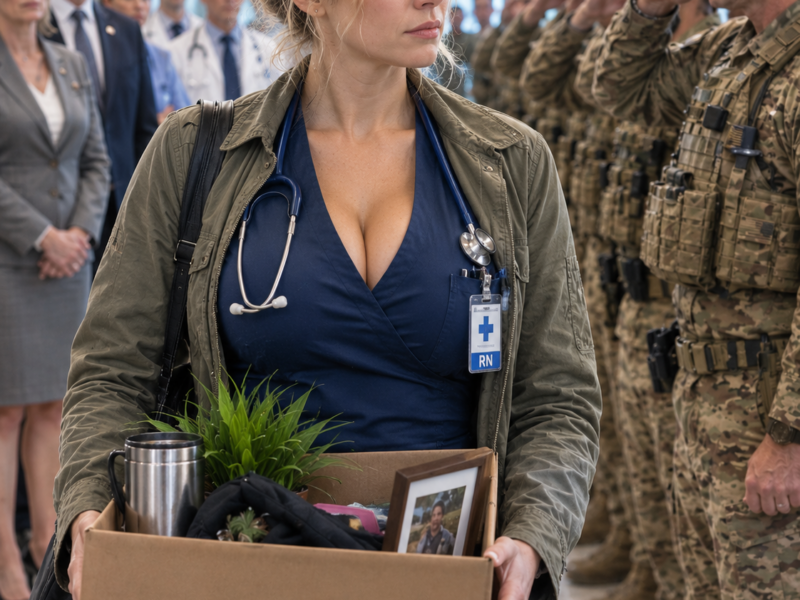
“They fired me for refusing to falsify a patient’s medical report. Three days later, I was sitting alone in my apartment
Colonel Walker opened the file, and the room seemed to lose every bit of warmth it had left.
The name printed across the top of the medical record was Lieutenant Commander Daniel Hayes.
For a moment, I couldn’t breathe.
Five years earlier, I had knelt beside that man in the darkness of a ruined compound, pressing both hands against a wound in his chest while bullets struck the walls around us. I had been ordered to keep him alive, no matter what it cost. I had followed that order until my own blood soaked through my uniform.
Then the mission ended, Daniel disappeared into military custody, and I was told never to speak about Operation Black Harbor again.
Now his name was on the record of a patient who had arrived at Westbridge Medical Center with a gunshot wound.
“That’s impossible,” I whispered.
Colonel Walker watched me carefully. “Tell me why.”
I looked at the photograph attached to the file. The patient’s face was thinner than I remembered, his hair darker with sweat, and a short beard covered his jaw. But I recognized the scar beneath his left eye.
It was Daniel.
“He was reported dead,” I said.
“No,” Walker replied. “He was reported missing during a classified transfer. His death was never officially confirmed.”
I slowly raised my eyes toward Dr. Richard Collins.
The man who had fired me stood near the window, his arms folded tightly across his chest. Until that moment, he had looked irritated, as though the officers had interrupted an important meeting.
Now he looked frightened.
“Why was this name placed on the patient’s medical record?” Walker asked him.
Collins swallowed. “I’ve never seen that name before.”
“Then perhaps you can explain why you instructed Nurse Mitchell to change the mechanism of injury from a gunshot wound to a vehicle accident.”
“I was following information supplied by hospital administration.”
“Which administrator?”
Collins glanced at Melissa Grant.
She immediately shook her head. “Richard, don’t.”
That small exchange told me more than either of them intended.
Colonel Walker closed the folder.
“Everyone in this room is going to have an opportunity to explain what happened,” he said. “But before we discuss the hospital, I need Sarah to tell us what she saw.”
I stared at Daniel’s photograph.
Five years of carefully buried memories were rising to the surface.
And for the first time since leaving the military, I understood why the past had finally found me.
Daniel Hayes was alive.
And someone had tried to make sure I never discovered it.
“Start at the beginning,” Colonel Walker said.
I sat down because my knees had begun to tremble.
“My shift started at six that morning. The patient arrived just before nine. Two men brought him through the ambulance entrance, but neither one was wearing a hospital badge or identifying themselves as emergency personnel.”
“Did they give you a name?”
“No. One said the patient had been injured in a vehicle accident. The other kept looking toward the entrance.”
“Did you recognize either man?”
“No.”
“Describe the patient.”
“Male, approximately forty. Severe blood loss. Gunshot wound to the upper abdomen, with possible internal bleeding. Bruising around both wrists. Abrasions along the right side of his face. His breathing was shallow, and he was showing signs of shock.”
I paused.
“There was something else.”
Walker leaned forward. “What?”
“He was conscious for a few seconds while we transferred him to the trauma bed. He grabbed my wrist and said, ‘Black Harbor.’”
The room went silent.
Even the officers standing behind Walker seemed to stiffen.
“You’re certain?” Walker asked.
“Yes.”
“What happened next?”
“He lost consciousness. I started treatment and asked for imaging, blood products, and a surgical team. Dr. Collins arrived shortly afterward.”
I looked at Collins.
“He told me the injury had already been evaluated by an outside physician and that I should document a vehicle accident. I told him that was inconsistent with the wound.”
“And he ordered you to change your report?”
“He told me to remove the phrase ‘penetrating ballistic injury’ and replace it with ‘blunt abdominal trauma.’ He also wanted me to remove my observations about the wrist bruising.”
“Why did you refuse?”
I almost laughed, but there was no humor in it.
“Because I was a nurse. Because the patient was bleeding internally. Because an accurate record could affect the treatment he received. And because someone had apparently decided that a lie was more important than his life.”
Walker nodded slowly.
“That answer sounds like the Sarah Mitchell I remember.”
I turned toward him.
“You knew me?”
“I was a lieutenant colonel when you served. I wasn’t part of your immediate team during Black Harbor, but I reviewed the medical reports afterward.”
“You reviewed the official reports,” I said. “Those weren’t the same thing.”
“No,” he admitted. “They weren’t.”
That admission unsettled me more than a denial would have.
Walker opened another folder.
“Five years ago, Operation Black Harbor was described as a successful extraction of intelligence personnel from a hostile location. The official report stated that Lieutenant Commander Hayes had been killed during an engagement, and that the remaining team had withdrawn according to plan.”
“That wasn’t what happened.”
“I know.”
I stared at him.
“Then why did nobody listen?”
His face tightened.
“Because the first report was signed by people with more authority than the people who survived the operation. And because several witnesses changed their statements.”
I remembered the night with painful clarity.
The smoke.
The broken radio.
The sound of Daniel calling for an extraction that never came.
And the voice in my headset telling me to keep him alive.
I had spent five years trying to forget that voice.
Now I could hear it as clearly as if someone were speaking beside me.
“Who changed their statements?” I asked.
Walker looked down at the file.
“Two officers, one intelligence liaison, and a medical officer assigned to the post-operation review.”
“Names.”
“I’ll give you the names when we establish what happened at Westbridge. Right now, we have reason to believe Daniel’s appearance at your hospital was not accidental.”
I looked again at the photograph.
“Who shot him?”
“We don’t know yet.”
“And why did he say Black Harbor?”
“Because he was trying to reach someone who could understand what he was telling them.”
“Me?”
“Possibly.”
I shook my head.
“Daniel knew I left the service. He knew I wanted nothing to do with that operation.”
“Maybe that’s exactly why he needed you. He knew you wouldn’t be working for the people who buried the truth.”
I wanted to reject that explanation.
I wanted to go back to my apartment, lock the door, and return to the quiet life I’d built with so much effort.
But the patient had been injured, restrained, and delivered to a hospital under a false identity. Someone had then attempted to erase the evidence.
I knew what those facts meant.
“Where is he now?” I asked.
“Westbridge transferred him to a private medical facility shortly after you were fired,” Walker said. “The transfer was authorized by the hospital administrator.”
“Without a proper discharge?”
“That is what we’re trying to determine.”
“Then we need to find him.”
Walker studied me.
“Sarah, I need you to understand something. If Daniel is alive, there are people who will do almost anything to keep him from talking.”
“I understand.”
“You’ve been out of the military for five years. You don’t have a unit behind you anymore. You don’t have operational authority.”
“I know.”
“And if you help us, you may become a witness in an investigation that reaches far beyond this hospital.”
I looked at Collins and Grant.
They were still standing near the window, looking as though they had suddenly realized the floor beneath them might collapse.
“I already became a witness,” I said. “That’s why they fired me.”
For the first time that morning, Colonel Walker smiled.
It wasn’t a happy smile.
It was the expression of a man who had finally found someone willing to walk into a difficult room and tell the truth.
“Then let’s find Daniel Hayes.”
We left Westbridge under escort just after noon.
The hospital administrator, a man named Peter Lawson, had been summoned to a conference room downstairs. Walker’s legal officer was interviewing him, while two military investigators secured copies of the original electronic medical records.
I had expected to feel vindicated.
Instead, I felt sick.
A patient had been brought into an emergency department bleeding and barely conscious. I had done what my training required, and the institution I worked for had punished me for it.
My career at Westbridge had been over in less than ten minutes.
Now the same people who had escorted me out were being asked to explain their decisions to military investigators.
I should have felt satisfied.
I didn’t.
All I could think about was Daniel.
The last time I had seen him, he had been lying beneath a collapsed section of concrete. His uniform was torn, and his skin had turned gray from blood loss. I had packed the wound and pressed down until my hands shook.
“Sarah,” he had whispered.
“Save your strength.”
“They’re not coming.”
“They’re coming.”
I had said it because he needed hope.
I had said it because I needed to believe it.
Then the radio had crackled.
The voice on the other end ordered our team to hold position. The extraction had been delayed because command needed additional intelligence from the target site.
I had stared at Daniel’s face and felt something inside me break.
He was not an objective.
He was a person.
He was a man who had trusted the people giving those orders.
And I was being asked to keep him alive while the clock ran out.
I managed to stabilize him long enough for the team to move. During the withdrawal, I took shrapnel in my shoulder and kept working until another medic dragged me behind cover.
By the time I reached the field hospital, I was told Daniel had died during transport.
The report said the evacuation had proceeded according to protocol.
When I questioned the timeline, I was advised to focus on my own recovery.
When I refused to sign the final medical summary, a senior officer told me that my objections could damage the reputations of men who had served honorably.
I signed nothing.
Two months later, I was awarded a medal for saving three members of the extraction team.
Daniel’s name wasn’t mentioned.
Neither was the delayed evacuation.
I accepted the medal because the ceremony was already scheduled and because I didn’t know how to explain that recognition felt like an insult when the truth remained buried.
Five years later, I still kept the medal in a drawer.
Now Colonel Walker was driving me toward a medical facility outside the city, and I could feel the same old anger moving beneath my skin.
“Why did you come yourself?” I asked him.
“Because the people who knew the original story have been disappearing from the record. Some retired. Some transferred. One died unexpectedly. And some simply stopped answering questions.”
“That doesn’t explain why you came to my apartment.”
“Your name was in the original medical review.”
I turned toward him.
“What?”
“You submitted an independent statement after the operation. It was removed from the final packet, but a copy survived in a restricted archive. Your statement included the exact time Daniel requested evacuation and the time command acknowledged his request.”
I stared at the road ahead.
“I thought that statement had been destroyed.”
“So did the people who removed it.”
“Then why wasn’t it used to reopen the case?”
“Because we didn’t know where the original recording was. Your statement proved the timeline, but it didn’t establish who issued the order to delay the extraction.”
“And now you think Daniel has that proof.”
“We think he found something connected to it.”
I pressed my fingers against my forehead.
“Why would he wait five years?”
“Maybe he couldn’t come forward. Maybe he was being held somewhere. Maybe he thought the people involved had enough influence to silence him.”
“Or maybe he was afraid.”
Walker didn’t answer.
He didn’t need to.
Fear had shaped every decision I had made since leaving the service. I had been afraid of the memories, afraid of the people who had told me to stay quiet, and afraid that speaking up would cost me the only life I had left.
I had thought walking away meant I had escaped.
Now I understood that walking away had only made it easier for someone else to control the story.
The medical facility was a low, modern building surrounded by trees and a high fence. It looked more like a private rehabilitation center than a military installation.
A physician met us at the entrance.
“Colonel Walker,” she said. “We weren’t expecting you this early.”
“Where is Daniel Hayes?”
The physician hesitated.
“His room is on the second floor. But I need to tell you that he has been asking for a nurse named Sarah.”
My heart lurched.
“He knows I’m here?”
“He asked for you before he was sedated for surgery. He was very specific.”
I followed her upstairs.
Daniel was in a private room at the end of the corridor. A monitor tracked his heartbeat, and a thick bandage covered his abdomen. His left arm was secured to an IV line. There were bruises along his cheekbone and a healing cut above his eyebrow.
He looked older than the man I remembered.
Five years had passed, and whatever had happened during that time had taken more from him than age ever could.
I stopped beside the bed.
“Daniel?”
His eyelids moved.
For a moment, nothing happened. Then his eyes opened, and he stared at me as though he were afraid I might disappear.
“Sarah,” he whispered.
I gripped the bed rail.
“You’re alive.”
His mouth trembled into the faintest smile.
“Apparently.”
A laugh escaped me, sharp and broken. I covered my mouth, but the tears came anyway.
I had imagined seeing him again hundreds of times. In some versions, I shouted at him. In others, I demanded answers. Sometimes I imagined telling him how angry I was that I had spent years believing he was dead.
But standing beside his bed, I could barely form a sentence.
“I thought you died.”
“I know.”
“I treated you until I couldn’t feel my hands anymore.”
“I know.”
“They told me you died during transport.”
“I know, Sarah.”
“Then why didn’t you come back?”
His eyes filled with tears.
“Because the people who said I was dead were the same people who controlled where I went.”
I leaned closer.
“Tell me what happened.”
Daniel took a shallow breath.
“After you got me out of the compound, I was taken to a field facility. I remember a doctor asking questions, then a man from intelligence telling everyone that my condition was too unstable for a formal debrief.”
“That doesn’t make sense.”
“It didn’t to me either. I was unconscious for most of the first two days. When I woke up, I was in a different facility. They told me the rest of the team had been extracted and that the operation was classified.”
“Were you a prisoner?”
“Not officially. They called it protective medical custody.”
He looked toward the door before continuing.
“I couldn’t contact my family. I couldn’t contact my unit. Every time I asked about the mission, someone told me I was confused because of the medication.”
“Who?”
“An intelligence liaison named Mercer. He said command had determined that I had deviated from the approved route and compromised the operation.”
I felt the old anger rising again.
“You requested a route change because the original path was exposed.”
Daniel nodded.
“I had surveillance showing armed personnel moving toward the extraction point. I asked for permission to reroute the team. Command denied the request. Then the route was changed in the official record to make it look like I had ignored orders.”
“Who denied it?”
“Colonel David Harlan.”
The name landed heavily in the room.
I remembered Harlan as a senior officer who had visited the field hospital after the operation. He had spoken in a calm, reassuring voice and told us that the team had performed admirably under difficult circumstances.
He had also been the man who asked me to sign the final report.
I had refused.
Daniel watched my face.
“You remember him.”
“Yes.”
“He was the one who told me the extraction was delayed because command needed confirmation of a secondary objective. He knew the team was taking fire. He knew we were running out of time.”
“Why would he do that?”
“Because the objective wasn’t just intelligence collection. Someone wanted a specific person extracted from the target site, and the mission was not allowed to end until that person was secured.”
“Who?”
Daniel closed his eyes for a moment.
“An intelligence source named Elias Voss. He had been working with a private defense contractor. He possessed records of payments made to officials who were helping move weapons through a regional network. Some of the money was being used to fund operations that were never authorized.”
I thought of the patient record at Westbridge.
The false accident report.
The unexplained restraints.
The effort to erase my observations.
“Voss was at the compound?”
“He was supposed to be. But he wasn’t there when we arrived. We found his records instead. I requested an immediate extraction because the enemy had identified our position. Harlan ordered us to hold until the search was complete.”
“And the report was changed afterward.”
“Exactly.”
I looked at Daniel’s bandaged abdomen.
“Who shot you this time?”
His expression hardened.
“I was trying to get the original mission recording to an investigator. Someone found out.”
“What recording?”
“The command channel. Every transmission was supposed to be archived, including Harlan’s order to delay the evacuation.”
“Where is it?”
“I don’t have the complete recording. I have a copy of part of it, but it doesn’t include the authentication data. Without that, they’ll claim it was edited.”
“Who has the original?”
Daniel looked directly at me.
“Elias Voss.”
I stared at him.
“I thought he disappeared after Black Harbor.”
“He did. But he contacted me six months ago. He said he had kept copies of the financial records and the original communications archive. He wanted to testify.”
“Then why hasn’t he?”
“Because he was killed two weeks ago.”
The room seemed to tilt.
“Who killed him?”
“We don’t know. Before he died, he sent me a message saying the archive was being moved. He gave me a location and told me to retrieve it before the people involved found it.”
“And you went alone?”
“I didn’t have anyone I could trust.”
“You could have contacted me.”
Daniel’s face crumpled.
“I wanted to. More than once. But I didn’t know if you were being watched. I thought if I stayed away, they couldn’t use you to reach me.”
I shook my head, tears burning behind my eyes.
“You don’t get to decide that for me.”
“I know.”
“You don’t get to disappear for five years and call it protection.”
“I know, Sarah.”
His voice broke.
“I am sorry.”
For a long moment, I couldn’t speak.
Then I took his hand carefully, avoiding the IV.
“I don’t know if I can forgive you for making me believe you were dead,” I said. “But I’m here now. And I’m not going to let them erase you again.”
Daniel closed his eyes, and a tear slipped down his temple.
“That’s why I asked for you.”
The next morning, Colonel Walker assembled the investigation team in a conference room at the facility.
Along the wall sat two military investigators, a civilian prosecutor, a forensic analyst, and a representative from the Inspector General’s office. A secure screen displayed a timeline of Operation Black Harbor, followed by a list of names connected to the original mission.
Colonel David Harlan appeared near the top.
So did Dr. Richard Collins.
I stared at the screen.
“Collins?” I asked.
Walker nodded.
“Before joining Westbridge, Collins worked as a medical consultant for a defense contractor that provided services to several military facilities. That contractor had a relationship with the organization connected to Black Harbor.”
“Are you saying Collins knew who Daniel was?”
“We believe he recognized the patient or was given instructions to identify him.”
“Then he didn’t just falsify a medical record. He helped conceal a man who had evidence of a crime.”
“That is one possibility under investigation.”
The civilian prosecutor, a woman named Elena Ruiz, leaned forward.
“We need to be precise. We have reason to suspect coordinated interference, but we still need admissible evidence linking each person to a specific action.”
I appreciated her caution. I had spent too many years watching certainty get manufactured before the facts were established.
“What do we have?” I asked.
The forensic analyst brought up the original Westbridge chart.
“The electronic record shows that Nurse Mitchell entered her findings at 9:14 a.m. At 9:32, Dr. Collins accessed the chart. At 9:41, an administrator account changed the mechanism of injury. At 9:47, Nurse Mitchell’s access was revoked.”
“Whose administrator account?”
“Peter Lawson’s credentials.”
“Did Lawson make the changes?”
“We can’t say that yet. The system logs establish which account was used, not necessarily who was at the keyboard.”
Ruiz nodded.
“We’ll need workstation logs, security footage, and interviews.”
“And the original chart?” I asked.
“Preserved. We also recovered an earlier version from the hospital’s backup system.”
For the first time since entering the room, I felt something like relief.
My notes still existed.
The truth had not been completely erased.
Walker switched to another screen.
“We also recovered a message from Daniel’s personal effects. It contains a partial location reference believed to correspond to the archive Voss mentioned.”
A map appeared.
The location was an abandoned communications station in the hills east of the city, decommissioned several years earlier.
Daniel had been too weak to travel, but he had confirmed the reference.
“He said the archive might be there,” Walker explained. “We have authorization to secure the site and recover any records. Sarah, you will not be part of the entry team.”
I didn’t argue.
I wasn’t an active-duty medic anymore, and I knew the difference between wanting to help and being qualified to do a particular job.
“What do you need from me?”
“Your statement about the original operation. Your recollection of the medical timeline. And, if Daniel agrees, help documenting his account while his memory is clear.”
“I can do that.”
Walker hesitated.
“There is one more thing. Harlan has learned that Daniel is alive.”
My stomach tightened.
“How?”
“We don’t know. The information may have leaked before we secured the facility.”
“Then Daniel isn’t safe here.”
“He has additional protection now. And the investigation team is moving quickly.”
“Quickly isn’t the same as safely.”
“No,” Walker said. “It isn’t.”
I thought of the men who had brought Daniel to Westbridge, the way they had avoided giving names, and the bruises on his wrists.
Someone had wanted him hidden.
Someone had known that I might recognize the injury and had tried to stop me from documenting it.
And someone had been willing to destroy my career to protect that secret.
“Find the archive,” I said. “Whatever is in it, that’s what they are afraid of.”
The team reached the abandoned station before sunrise.
I remained at the medical facility with Daniel, helping Ruiz record his statement in short sessions so he could rest between questions.
He described the original route change, the repeated requests for evacuation, and Harlan’s order to hold position until the secondary objective was secured. He identified the officers who had been on the command channel and explained how the official report had been rewritten after the mission.
He also described what happened after he was declared dead.
For months, he had been moved between facilities under a restricted identity. He was told that he was being protected from a threat to his life, but his communications were monitored and his access to outside contact was denied.
Eventually, he realized that the restrictions were not temporary.
“They weren’t protecting me,” he said during a break. “They were protecting the story.”
Ruiz set down her pen.
“Did you ever receive an official notice declaring you deceased?”
“No. I was told the report had been filed, but I never saw it.”
“Did you try to contact your family?”
“Several times. My messages were intercepted. After a while, I stopped trying because I was afraid someone would retaliate against them.”
He looked at me.
“That was the worst part. Not knowing whether the people I loved were safe.”
I understood more than I wanted to.
After leaving the military, I had changed my phone number and moved to a different city. I had stopped attending reunions. I had avoided old colleagues because every conversation seemed to lead back to the same unanswered questions.
I had told myself I was choosing peace.
In reality, I had been living around an absence.
“What happened six months ago?” Ruiz asked.
“An independent attorney contacted me. He said someone had information about Black Harbor and wanted to reopen the investigation. A week later, the attorney’s office was broken into.”
“Did you report it?”
“I tried. The local officer told me there was no evidence of a crime because nothing valuable had been taken.”
“What did you do afterward?”
“I met Voss in a public place. He showed me a portion of the archive and told me the original records proved Harlan had ordered the delay.”
“Why didn’t you take the evidence directly to authorities?”
“Because he said at least one person inside the review system had already been compromised. He wanted to verify which office could receive it safely.”
Ruiz nodded.
“And then Voss was killed.”
“Yes.”
Daniel swallowed.
“I should have gone to the press.”
“Perhaps,” Ruiz said gently. “But you were making decisions under a credible fear of retaliation. The investigation will consider that context.”
When the interview ended, Daniel looked exhausted.
I helped him settle back against his pillows.
“You should rest,” I said.
“I have one more thing to tell you.”
I waited.
“The person who arranged my transfer to Westbridge was not Harlan.”
“Who was it?”
“Lawson. The hospital administrator.”
I stared at him.
“Peter Lawson?”
“He was on a call with someone before I was moved. I heard him say that the nurse had recognized the injury and that the chart needed to be corrected before the patient was transferred.”
“Did he mention Collins?”
“Not by name. But he said the physician had handled it.”
A cold feeling settled in my chest.
“So Lawson knew what was happening.”
“I think he knew enough to be afraid.”
I thought of Melissa Grant standing beside the window while Collins lied. I thought of the way she had whispered, “Richard, don’t,” as though she already knew the truth would destroy them.
“Did you hear anything else?”
Daniel closed his eyes, searching his memory.
“One phrase. The person on the other end said, ‘The Black Harbor file must stay buried.’”
Before I could ask another question, the secure phone on Ruiz’s table rang.
She answered, listened, and looked toward Walker, who had just entered the room.
“What happened?” I asked.
Ruiz lowered the phone.
“They found the archive.”
“And?”
“The storage unit had been forced open. Several drives were missing.”
My heart sank.
“Then we lost it.”
“Not entirely,” Walker said. “The team recovered a damaged backup drive hidden inside the equipment housing. Our technicians are trying to reconstruct the files.”
“Is there anything usable?”
He glanced at Ruiz.
“There is an audio fragment.”
He placed a small speaker on the table.
The recording crackled, filled with static, and then a man’s voice emerged.
“—team reports compromised route. Request immediate extraction.”
Another voice answered.
“Negative. Hold position until the secondary objective is secured.”
The first voice came again.
“Sir, we have wounded personnel. We cannot maintain this position.”
The second voice was unmistakable.
Colonel David Harlan.
“Maintain position. That is a direct order.”
Then came Daniel’s voice.
“Sir, if we stay here, people are going to die.”
A pause.
“Then you will make sure they don’t.”
The recording ended.
I stood motionless.
I had heard those words before, although not in exactly that sequence. The memory of the radio had haunted me for five years, but hearing the actual recording made the past feel suddenly undeniable.
Walker turned to the technicians.
“Can you authenticate it?”
“We’re comparing the signal characteristics with archived communications and the surviving mission logs,” one replied. “We can establish whether the audio is consistent with the original system. We still need the complete file to verify the chain of custody and identify any missing segments.”
Ruiz nodded.
“We will not present this as conclusive by itself. But it gives us a strong investigative lead.”
“Does it name Harlan?” I asked.
“Not in the fragment,” she said. “But the voice can be compared with authenticated recordings, and the surrounding logs may establish which officer was transmitting.”
I looked at Daniel.
He was staring at the speaker with an expression I couldn’t read.
“You were right,” I whispered.
He shook his head.
“I wish I hadn’t been.”
The next forty-eight hours changed everything.
Investigators recovered more data from the damaged drive, including fragments of the command log and a list of personnel authorized to access the mission archive. Independent forensic specialists verified that the audio fragments were consistent with the original communications system. The surviving logs placed Harlan on the command channel during the delay.
The evidence did not prove every allegation, but it was enough to trigger formal proceedings.
A separate review of the financial records recovered from Voss’s archive revealed payments routed through two contracting companies. Investigators traced several transactions to intermediaries who had worked with the intelligence liaison responsible for the post-operation report.
The records suggested that the secondary objective had involved retrieving material that could expose unauthorized financial arrangements. The delay had bought time for the search, while the casualties and subsequent confusion provided cover for the altered report.
Daniel’s requests for evacuation had been removed from the official timeline.
His route warning had been rewritten as a failure to follow orders.
His disappearance had been treated as confirmation of his supposed death.
And the people who had tried to question the story had been told that they were risking careers, reputations, and national security by continuing to ask questions.
The investigation expanded beyond Black Harbor.
Colonel Harlan was suspended from his advisory position pending a formal inquiry. His access to restricted records was revoked. The contractor linked to the financial transactions was ordered to preserve all documents, and investigators began interviewing former personnel whose statements had changed after the operation.
At Westbridge, the hospital board placed Peter Lawson on administrative leave and commissioned an independent audit of medical-record access. Dr. Collins was suspended while the hospital reviewed his actions and his relationship with the contractor. Melissa Grant was interviewed after investigators recovered messages showing that she had been warned not to interfere with the patient’s transfer.
She eventually admitted that Lawson had instructed her to keep the incident away from the hospital’s compliance office.
She claimed she had believed the instruction came from a government authority.
That explanation did not excuse her decision to remain silent, but it helped investigators establish how the concealment had moved through the hospital.
The most important evidence was not a dramatic confession.
It was the paper trail.
My original nursing note.
The timestamps showing when it was entered.
The record of Collins accessing the chart.
The administrator credentials used to change the mechanism of injury.
The transfer request that bypassed normal review.
The messages instructing staff to limit discussion of the case.
Each piece had seemed small when considered alone. Together, they revealed a coordinated effort to control what would be recorded about Daniel’s injuries and where he would go afterward.
My termination letter became part of the evidence.
The hospital had stated that I was dismissed for refusing reasonable supervisory instructions and failing to follow documentation policy. The independent review found that the language used against me was inconsistent with the actual sequence of events.
The board withdrew the stated grounds for my termination and offered to reinstate me.
I declined.
Not because I wanted revenge, and not because I believed every person at Westbridge was corrupt. I knew there were good nurses and physicians there who had never been told what was happening.
But I could not return to a workplace where my first question had been whether the truth was permitted.
I accepted a written correction to my employment record and cooperated with the investigation. The hospital agreed to revise its reporting procedures, strengthen independent compliance review, and require that requests to alter significant clinical findings be documented and escalated.
Those measures could not undo what had happened to Daniel.
They could, however, make it harder for someone else to repeat it.
A week after the archive was recovered, I sat beside Daniel as he received a video call from his younger sister.
She had spent five years believing he was dead.
At first, she simply stared at him.
Then she covered her mouth and began to cry.
Daniel tried to speak, but his voice broke.
“I’m sorry,” he said.
She shook her head.
“Don’t say that yet. Just let me look at you.”
So he did.
He sat quietly while she studied his face, the bandage, the lines around his eyes, and the man who had returned from the dead without warning.
When the call ended, Daniel leaned back against the pillow.
“I thought seeing her would make everything better,” he said.
“It won’t make everything better.”
“No.”
“But it’s a beginning.”
He turned toward me.
“Do you think I’ll ever be able to explain why I didn’t come back?”
“I think you can explain it. Whether everyone can forgive you is something you can’t control.”
He absorbed that quietly.
“And you?” he asked. “Will you forgive me?”
I looked down at my hands.
For years, I had imagined Daniel’s death as the final fact of Black Harbor. It had given my grief a boundary, even if the boundary had been built on a lie.
Now I had to learn how to be angry with a living man.
“I don’t know yet,” I admitted. “I was grieving you while you were alive. I lost years believing there was no way to find you.”
“I know.”
“And I can’t pretend that doesn’t matter.”
“You shouldn’t.”
His answer surprised me.
I had expected him to defend himself, to remind me of the threats he had faced, or to insist that his silence had been necessary.
Instead, he looked at me with the same exhausted honesty I remembered from the field hospital.
“I thought I was protecting you,” he said. “But I was also protecting myself. I was afraid that if I reached out and they found me, I would lead them straight to you.”
“That fear was real.”
“Yes.”
“But it doesn’t erase what it cost.”
“No,” he said. “It doesn’t.”
For the first time, I felt that we might be able to speak honestly about what had happened without letting the past dictate every word.
I took his hand.
“I can’t promise you forgiveness today.”
“I wouldn’t ask you to.”
“But I can promise that I won’t lie about what happened to you.”
His fingers tightened around mine.
“That is more than enough.”
Three months later, I sat in a hearing room and watched Colonel Harlan enter with his attorney.
He looked older than I remembered, but he carried himself with the same controlled confidence. For years, that confidence had made me question my own judgment.
Perhaps I had misunderstood the order.
Perhaps I had been too emotional.
Perhaps a nurse who had witnessed a terrible event could not see the strategic picture.
Those doubts had followed me into civilian life. They had made me reluctant to trust my instincts, even when a patient’s condition demanded that I act.
Now the evidence was laid out before an independent review panel.
The panel examined the communications archive, the mission logs, the conflicting statements, and the changes made to the post-operation report. Investigators presented testimony from former team members who had originally been told not to discuss the delayed extraction.
I gave my own statement.
I described the wound I had treated, the timeline of the evacuation request, the order to hold position, and the moment I refused to sign a report that did not match what I had seen.
I did not embellish anything.
I did not claim to know why Harlan had issued the order. I described what I heard, what I observed, and what I recorded.
When his attorney asked whether I understood the operational pressures facing command, I answered carefully.
“I understand that decisions in combat are difficult. I understand that information can be incomplete and that commanders sometimes have to choose between risks. But medical records must reflect what happened. If a commander makes a decision that costs lives, the answer is not to rewrite the record until the decision disappears.”
The room fell silent.
I looked directly at the panel.
“My responsibility was to treat the wounded and document their condition honestly. I did both. I will not apologize for either.”
The hearing did not produce an instant verdict.
There were further interviews, forensic reviews, and legal questions to resolve. The financial allegations required separate proceedings, and the full chain of responsibility was still being investigated.
But the central finding was clear: the official account of Operation Black Harbor could no longer stand as written.
The review board ordered the military record corrected to reflect Daniel’s evacuation requests and the delay in extraction. His status was formally restored, and the prior account of his death was withdrawn.
The inquiry also referred Harlan’s conduct for further disciplinary and legal review. The evidence of altered records and concealed communications became part of a broader investigation into the contractor’s role.
Daniel would still have to answer questions about his own decisions, including his unauthorized efforts to retrieve evidence and his failure to contact authorities sooner. He did not ask to be exempted from that scrutiny.
Neither did I.
For the first time in five years, accountability did not feel like a threat hanging over the people who had spoken.
It felt like a process that might finally reach the people who had ordered everyone else to stay quiet.
I saw Melissa Grant one last time in a small conference room at Westbridge.
She had asked to meet before the hospital completed its employment review. I agreed because I wanted to hear what she had to say, not because I expected an apology to fix anything.
She sat across from me with her hands folded on the table.
“I should have stopped Collins,” she said.
“Yes.”
“I knew the report didn’t make sense.”
“Yes.”
“I was afraid Lawson would fire me. He told me the case was sensitive and that questioning the transfer could put the hospital’s relationship with the government at risk.”
I waited.
“I told myself I was protecting the staff. I told myself that if I stayed out of it, someone else would make sure the patient was safe.”
“But you knew I was being fired for refusing to change the record.”
Her eyes filled with tears.
“I did.”
“Why didn’t you say anything?”
“Because I was afraid.”
I recognized that fear. I had lived with it myself.
But understanding it did not make her choice harmless.
“I can’t tell you that I would have been brave in every situation,” I said. “I know how powerful people can make you feel small. I know how easy it is to convince yourself that silence is temporary.”
She nodded, crying quietly.
“But the patient was bleeding. The record was being altered. And I was standing there alone while you watched.”
“I know.”
“I hope you learn from this. I hope the next time someone asks you to choose between protecting your position and protecting a patient, you remember what happened.”
“I will.”
I stood.
She looked up.
“Do you hate me?”
“No,” I said honestly. “But I don’t trust you.”
That was the truth she needed to hear.
I left the room without offering the easy forgiveness she seemed to want.
Some things could be repaired. Others had to be carried as reminders.
Six months after Daniel arrived at Westbridge, I visited him at a rehabilitation center near the coast.
He was walking without assistance, although he still moved carefully when he was tired. The abdominal wound had healed, but the psychological injuries were harder to measure. He attended counseling, cooperated with investigators, and began rebuilding contact with his family.
The formal review of Black Harbor continued, and Harlan’s case moved into disciplinary proceedings. Several officials connected to the contractor faced their own investigations. The findings were not a fairy-tale ending in which every wrongdoer confessed and every wound disappeared.
They were something more realistic.
The evidence was preserved.
The records were corrected.
The people who had lied could no longer rely on the official version to protect them.
Daniel sat on a bench overlooking the ocean while I handed him a cup of coffee.
“Do you ever miss it?” he asked.
“Miss what?”
“Being in the service.”
I thought about the question.
“I miss knowing exactly what my job was. I miss the people who understood without needing everything explained. I miss the feeling that, when something went wrong, everyone would move toward the problem together.”
“And the rest?”
“The rest, I don’t miss.”
He nodded.
“I used to think coming home would fix me. Then I thought staying away would protect everyone. I spent years waiting for the right moment to start living again.”
“What changed?”
“You found me.”
I shook my head.
“You were the one who asked for me.”
“Because I remembered what you did at Black Harbor. You kept writing down what happened even when people told you to stop.”
I looked out at the water.
“I wasn’t brave every day, Daniel.”
“You don’t have to be.”
“I was afraid when Collins threatened my job. I was afraid when the officers came to my apartment. I was afraid when I saw your name in that file.”
“Yet you kept going.”
“Because someone was hurt, and I knew what the record needed to say.”
He smiled faintly.
“Maybe that’s what bravery looks like when nobody is shooting at you.”
I considered that.
For years, I had thought my military service was the only part of my life that required courage. After leaving, I had tried to build a quieter identity, one that would not be defined by danger or sacrifice.
But courage had followed me into the emergency department.
It had been there when I refused to change the chart.
It had been there when I told Colonel Walker what I knew.
And it had been there when I admitted that I was still angry with a man I had once believed dead.
I had not needed a uniform to recognize the truth.
I had only needed to decide that fear would not make the decision for me.
A year after the day I was fired, I began working at a community trauma clinic that treated veterans, first responders, and patients who struggled to navigate the medical system.
The clinic was small. The staff was overworked, the waiting room chairs were mismatched, and the coffee was terrible.
I loved it.
My employment record had been corrected, and the medal I had kept in a drawer was no longer a symbol of a mission I couldn’t discuss. I had placed it in a frame beside a copy of the corrected Black Harbor timeline.
Not because I wanted people to admire what I had done.
Because I wanted to remember what happened when people decided that a clean report mattered more than an honest one.
On my first day, a young nurse named Olivia came to me with a chart in her hand.
“Sarah, can I ask you something?”
“Of course.”
She hesitated.
“I noticed a discrepancy in a patient’s record. The attending physician says it’s probably a clerical error, but the timeline doesn’t make sense. I don’t want to accuse anyone of anything.”
“Then don’t start with an accusation,” I said. “Start with what you observed. Document it clearly. Ask for clarification. If the discrepancy remains, follow the reporting process.”
“What if they get angry?”
“They might.”
“What if they tell me I’m making trouble?”
I thought of Collins standing in the trauma room. I thought of Lawson’s administrator account and Melissa’s frightened silence. I thought of Daniel lying in a hospital bed while someone tried to turn a gunshot wound into a vehicle accident.
“Then you remember why the record matters,” I said. “A patient may not be able to speak for themselves. Sometimes your documentation is the only thing that keeps someone else’s version of events from becoming the official truth.”
Olivia nodded, holding the chart a little more firmly.
“Thank you.”
After she left, I sat quietly at my desk.
I had spent five years believing that leaving the military meant leaving Black Harbor behind. Then I had spent months believing that exposing the truth would somehow return those lost years to me.
Neither belief was entirely right.
I couldn’t recover the time Daniel and I had lost. I couldn’t undo the fear that had shaped his decisions or the silence that had shaped mine. I couldn’t guarantee that every person involved would face the consequences they deserved.
But I could decide what happened next.
I could care for the person in front of me.
I could document what I saw.
I could refuse to make a lie easier simply because the truth was inconvenient.
And I could stop treating my past as something shameful that had to remain hidden.
I was Sarah Mitchell, a nurse who had been fired for refusing to falsify a patient’s medical report.
I was also a decorated combat medic who had once kept three wounded officers alive under fire.
Those two identities had never been enemies.
They had always been parts of the same promise: when someone is hurt, you do everything you can to help them, and you tell the truth about what happened.
The officers who came to my apartment had not asked me to become the person I used to be.
They had asked me to remember who I had always been.
And this time, I didn’t look away.
The end.









