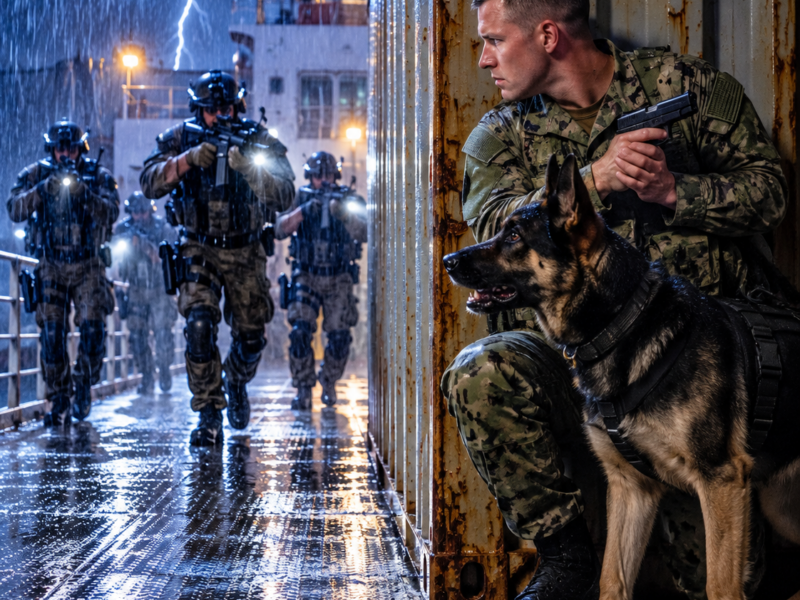
“They cornered me at the stern of a passenger ship, put a gun against my ribs, and told me my dog would die first if I made a sound
The engines had stopped, but the ship was still moving.
I felt it through the soles of my boots, the heavy momentum of thousands of tons of steel carrying us forward even as the machinery beneath our feet fell strangely silent. Somewhere above us, alarms echoed through the passageways. The taller man stood frozen with his radio pressed to his ear, waiting for a response that never came.
Duke remained between me and the gun.
His growl had settled into a low, steady rumble. I could see the muscles working beneath his coat, every part of him ready to protect me if the man raised that pistol another inch.
“Who else did you bring on this ship?” the gunman demanded again.
“I already told you. Nobody.”
He studied my face, trying to decide whether I was lying. Then the radio crackled.
“Team One, respond immediately. The bridge is compromised. Repeat, the bridge is compromised.”
The shorter man swore. “We need to move.”
“Not without him,” the taller man replied.
He turned the pistol toward my chest.
“Get the dog under control and walk to the door.”
I glanced at Duke. “Stay.”
His ears twitched, but he obeyed.
I moved slowly, keeping my shoulders loose and my breathing steady. Years of training had taught me that panic was contagious. If I lost control of myself, Duke would feel it. If Duke lost control, these men might shoot him.
I wasn’t going to let that happen.
The shorter man unlocked the door and looked into the corridor. “Clear.”
The taller man grabbed the back of my shirt and shoved me forward.
We had barely stepped outside when a deafening bang rang out from somewhere above us. The lights went dark. A moment later, emergency strips along the floor illuminated the passage in dim red.
The shorter man stumbled.
Duke moved.
He shot forward with a burst of speed that sent the shorter man crashing against the wall. The pistol in the taller man’s hand swung toward the dog, but I caught his wrist and drove it away from Duke. The gun discharged with a deafening crack, the bullet striking a metal panel overhead.
The man shouted and tried to wrench free.
I turned with the movement, broke his grip, and forced him against the wall. The pistol clattered across the floor.
“Duke, back!”
My dog immediately withdrew, though his eyes remained fixed on the fallen weapon.
The shorter man scrambled to his feet and charged me. I shifted aside, used his momentum to send him stumbling into the open maintenance-room door, and slammed it shut behind him. He struck the other side with his fists.
For a second, I stood in the red emergency light, listening.
Two armed men were contained, one pistol was out of reach, and Duke was unharmed.
Then I heard footsteps approaching from the stairwell.
I retrieved the pistol, kept it pointed safely away from everyone, and backed toward the corner. I didn’t know who was coming, and the last thing I needed was to mistake another crew member for an attacker.
A woman appeared at the top of the stairs.
It was the passenger in the navy-blue dress, the one who had dropped the towel earlier. Her hands were raised, and blood trickled from a small cut near her hairline.
“Please don’t shoot,” she said.
“I won’t if you tell me who you are.”
“Dr. Sarah Cole. I’m a passenger.”
“Passengers don’t usually know when the bridge is compromised.”
She swallowed. “I’m not just a passenger. I’m a former Navy intelligence analyst. I recognized those men when they boarded the ship in Charleston. They’ve been following me for two days.”
I looked at the closed maintenance-room door.
“Are they working for you?”
“No.” Her answer came too quickly to be rehearsed. “They want something I have.”
“What?”
“Evidence.”
“Evidence of what?”
She glanced toward the ceiling as another alarm began sounding.
“Of what happened at Kandar Ridge.”
The name seemed to make the corridor colder.
I lowered the pistol a fraction.
“Start talking.”
Sarah looked at Duke, then back at me. “Not here. There are cameras in this passage, and the ship’s internal network has been compromised. If they can see us, they can track where we’re going.”
“Who is they?”
“People who believe the dead should stay dead.”
Before I could ask another question, the ship shuddered. A distant crash rolled through the structure, followed by shouting over the shipwide announcement system.
Then a man’s voice came through the speakers.
“Attention, passengers. This is the captain. Due to a technical emergency, all guests must remain in their cabins. Crew members are to report to their assigned stations immediately.”
The announcement ended with a burst of static.
Sarah shook her head. “That wasn’t the captain.”
“How do you know?”
“Because the captain is being held on the bridge.”
A new alarm sounded, louder than the first.
I looked down at Duke. “Stay close.”
Then I followed Sarah up the stairs.
We emerged into a service passage on Deck Five, where two crew members were crouched behind a linen cart. One of them looked up at me with wide, frightened eyes.
“Sir, you can’t be out here.”
“Where’s the security team?”
“They locked themselves in the control office. Someone has taken over the cameras.”
Sarah knelt beside them. “Have you seen anyone moving toward the passenger decks?”
The younger crew member nodded. “Three men in dark uniforms went toward the elevators. They said they were evacuating people, but they weren’t wearing the ship’s security badges.”
“How long ago?”
“Maybe five minutes.”
Sarah closed her eyes briefly.
“They’re searching cabins.”
“Looking for you?” I asked.
“And you.”
I stared at her. “I didn’t even know you existed until twenty minutes ago.”
“That doesn’t mean they don’t know who you are.”
She pulled a small waterproof pouch from beneath her jacket. Inside was a memory card and a folded photograph.
The photograph showed a military transport plane on a dusty runway. Beside it stood the same man from the picture my captors had shown me.
My throat tightened.
“Where did you get that?”
“From a source who died trying to expose the operation.”
“What’s his name?”
“Lieutenant Marcus Reed.”
The name hit me harder than I expected.
Marcus had been my teammate. He had served with me during the operation at Kandar Ridge, and he was the man in the photograph—the man I had watched disappear behind a wall of smoke after an explosion tore through the compound.
We had been told his remains were recovered.
We had been told everyone on that side of the ridge was accounted for.
I had spent six years believing it.
“Marcus is dead,” I said.
Sarah looked at me with an expression I couldn’t read. “That’s what the official report says.”
I felt my jaw tighten. “I saw the explosion.”
“You saw an explosion. You didn’t see a body.”
I wanted to reject her words. I wanted to tell her that she knew nothing about the men I had lost, about the decisions made in seconds, about the images that had followed me into every sleepless night since.
But I remembered the grainy photograph.
I remembered how carefully the men in the maintenance room had watched my reaction.
They hadn’t brought me there to ask about a random mission.
They had brought me there because someone believed I knew something important.
“Why me?” I asked.
“Because you were the only person from the original team who survived without being officially reassigned, imprisoned, or declared dead. And because Marcus left a message specifically for you.”
Sarah held out the memory card.
I didn’t take it.
“What’s on it?”
“A recording made shortly before he disappeared. It contains a name, a location, and proof that the Kandar Ridge mission was deliberately compromised.”
“Whose name?”
Before she could answer, Duke’s ears rose sharply.
He turned toward the corridor behind us.
I heard a faint metallic click.
Then a voice called from the darkness.
“Jack Bennett. Step away from the woman.”
Three men appeared at the far end of the passage. They wore dark uniforms with security patches that looked almost convincing. The one in the middle carried a compact rifle, while the other two spread out to block the stairwell.
The leader smiled without warmth.
“Thank you for saving us the trouble of searching every cabin.”
I moved Sarah behind me.
“Who are you?”
“Someone who’s been trying to talk to you.”
“You could have booked a cabin like everybody else.”
His smile disappeared.
“Give us the memory card.”
Sarah tightened her grip on the pouch.
I studied the men, the narrow corridor, and the glass fire door behind them. We were outnumbered, and I had a dog to protect and an injured woman beside me. A direct fight would put all three of us in danger.
I needed time.
“Tell me what happened at Kandar Ridge,” I said.
The leader looked almost amused.
“You already know what happened.”
“I know what my government told me happened. Apparently, that wasn’t the truth.”
For the first time, his expression changed.
“Your government gave you a story that allowed you to go home and sleep at night. You should have been grateful.”
“I haven’t slept well in six years.”
“Then perhaps you’ll understand why some secrets are worth protecting.”
He raised his rifle slightly.
“Last chance. The card.”
Sarah leaned toward me and whispered, “There’s a crew access door behind the fire panel. It leads to the laundry service lift.”
I didn’t turn to look.
“Can you reach it?”
“Yes.”
“Then wait for my signal.”
The man with the rifle took another step forward.
“Don’t make this difficult, Bennett. We know about your sister. Emily, right? Lives in Charleston. Works at the medical center.”
My blood went cold.
He saw the change in my face and smiled again.
“That’s what I thought. We know where your family lives. We know your routines. We know your dog’s veterinary clinic. You don’t have to get anyone else hurt.”
Duke growled.
I felt the old, familiar anger rise, but I forced it down. Anger made a man predictable. I had learned that lesson the hard way.
“Let Sarah go,” I said. “I’ll give you the card.”
Sarah looked at me in disbelief.
The leader extended his free hand.
“Smart decision.”
I took one step forward, then another. When I was close enough to see the tiny scar under his right eye, I held the memory card between two fingers.
“Before I hand it over, tell me one thing.”
He sighed. “What?”
“Who gave the order at Kandar Ridge?”
The leader’s eyes narrowed.
“You know the answer.”
“No. I know who signed the report. I want to know who gave the order.”
For half a second, he hesitated.
That was all I needed to know.
The man behind him shifted his rifle toward Sarah.
I dropped the memory card.
Every eye followed it.
“Now!” I shouted.
Sarah threw herself toward the fire panel. Duke charged forward, barking hard enough to fill the corridor. I moved sideways as the leader lunged for the card, forcing him to collide with his own teammate. A burst of gunfire tore through the ceiling, showering us with dust and fragments of plaster.
I reached Sarah just as she pulled open the concealed service door.
We slipped inside and slammed it shut.
The narrow compartment smelled of detergent and hot metal. Sarah pressed a button on the wall, and the service lift began to descend.
“Where does this go?” I asked.
“Lower service deck. There’s a crew passage that connects to the storage area.”
“And then?”
“If the men haven’t sealed it off, we can reach the stern.”
I looked at her. “Why the stern?”
“Because there’s a lifeboat station and a satellite emergency beacon. If we can send a distress signal, we can get outside help before they take over the entire ship.”
“Why not call from the passenger deck?”
“Because the ship’s communications have been rerouted. Anyone using an internal phone is talking to them.”
The lift stopped with a hard jolt.
Sarah opened the door a few inches and listened.
Voices drifted through the passage.
Two men were arguing about a locked hatch. One complained that the engine-room crew had refused to cooperate. The other told him the captain would be forced to make a statement once they secured the remaining officers.
Sarah’s face went pale.
“They’re not just looking for us. They’re trying to control the whole ship.”
I peered through the gap.
A metal cart sat near the hatch, stacked with emergency equipment. Beyond it, a narrow corridor led toward the stern.
I waited until the voices moved away, then opened the door.
We moved quickly but quietly. Duke stayed beside me, occasionally glancing back to make sure Sarah was keeping pace.
At the end of the passage, we found a crew member kneeling beside an injured man. The injured man wore the uniform of the ship’s security chief. His face was bruised, and one hand was pressed against his ribs.
“Please,” the crew member whispered when he saw us. “They’re taking everyone who refuses to help them.”
I crouched beside the security chief.
“Can you walk?”
He grimaced. “If I have to.”
“Who has the bridge?”
“Three armed men. They locked the captain and first officer in the chart room. They said they were conducting a security operation, but I recognized one of them from a private contractor who was banned from our company after a previous incident.”
Sarah knelt beside him. “Do you know the name of the group?”
“Blackwater Maritime Solutions. Or something close to that. They changed their name after a contract scandal.”
Sarah and I exchanged a look.
“Meridian?” I asked.
She nodded slowly. “A subsidiary. The same company that supplied security for Kandar Ridge.”
The pieces were beginning to connect.
The men on the ship weren’t simply trying to recover a memory card. They were using the passenger vessel to contain a witness, seize evidence, and keep the entire incident away from the mainland until they could finish whatever they had planned.
“Can you get us to the emergency beacon?” I asked the security chief.
He pointed down the passage.
“Behind the lifeboat station. But you’ll need a key from the bridge.”
“Where’s your spare?”
“On my belt.”
I took it carefully.
The security chief gripped my arm. “Listen to me. There are passengers in the forward lounge. Families. Children. If those men think they’ve lost control, they might use them as leverage.”
I looked down the corridor.
That changed everything.
I could fight my way to the beacon and try to call for help, but if the attackers panicked, innocent people could pay the price. I needed to slow them down, keep them focused on me, and get the passengers away from the danger.
“Sarah, can you help the crew move people away from the forward lounge?”
“Yes, but how?”
“Tell them there’s a security lockdown and they need to move passengers toward the interior conference rooms. No one should use the elevators. Keep everyone calm, and don’t mention the weapons unless you have to.”
She nodded.
“And Jack?”
“Yeah?”
“Don’t let them get that card.”
I looked at the pouch in her hand.
“They won’t.”
We separated at the next junction. Sarah went with the crew member toward the passenger areas while I moved toward the stern with Duke.
The emergency station was behind a heavy door secured with an electronic lock. The key from the security chief worked on the manual override, and the door opened with a hiss.
Inside, I found a red emergency beacon, a radio console, and a laminated procedure sheet. The console’s main display was dark, but a backup unit remained powered.
I started the distress sequence.
The system asked for the vessel’s identification, location, and nature of emergency. I entered the information as accurately as I could, then transmitted a short message stating that armed individuals had seized control of the bridge and were threatening passengers.
A green indicator flashed.
The transmission was sent.
I let out a breath I hadn’t realized I was holding.
Then a voice came from the doorway.
“That’s very impressive, Bennett.”
I turned.
The leader from the corridor stood in the entrance, holding a pistol. His rifle was slung across his back, and a thin line of blood ran down his forehead.
Duke stepped between us.
The man raised the pistol.
“Call him off.”
I held my hands open.
“You’ve lost the ship.”
“Not yet.”
“Your people are scattered, your bridge team is trapped, and an emergency signal has already gone out. You can still surrender before someone gets killed.”
He laughed quietly.
“You think the cavalry is coming? You have no idea how far this reaches.”
“Then tell me.”
He shook his head.
“You’re still asking questions. That’s why they never should have let you leave Kandar Ridge.”
The words hit me like a fist.
“Who gave the order?”
He stared at me, and I saw something beneath his anger. Not loyalty. Fear.
“Admiral Nathaniel Cross.”
The name was one I knew.
Cross had been a senior officer overseeing special operations support when my team deployed. He had attended the memorial service for Marcus Reed and personally signed the letter confirming that the mission had been compromised by hostile intelligence.
He had shaken my hand and told me the country owed us a debt it could never repay.
“You’re lying,” I said.
“Check the records.”
“Why would he order his own men into a trap?”
“Because the mission wasn’t what you were told. Kandar Ridge wasn’t an extraction operation. It was a cleanup.”
The word seemed to hang in the air between us.
“What were we cleaning up?”
“People who knew too much. Files that could bring down men who had spent their entire careers building power. Your team was sent to recover a data package, but the package had already been copied. Marcus found out who had ordered the transfer and tried to get the evidence out.”
“And you killed him?”
The man looked away.
That was all the answer I needed.
“You left me there,” I said. “You abandoned my team and called it a hostile attack.”
“We followed orders.”
“That’s what cowards say when they don’t want to admit what they’ve done.”
His face twisted with anger.
He raised the pistol.
Duke sprang.
The man fired, but the shot struck the doorframe as Duke hit his legs. I moved in, knocked the pistol from his hand, and drove him against the console. He struggled fiercely, but he was off balance and out of position. I forced him to the floor and secured his wrists with a plastic restraint from the emergency kit.
Duke backed away when I called him, breathing hard but unharmed.
I checked the man for injuries, then stepped away and called the ship’s security chief over the radio.
“Suspect secured at the aft emergency station. Send someone to take custody.”
The response was weak and broken, but I heard enough to know the crew was still fighting to regain control.
I turned back to the leader.
“What’s your name?”
He stared at me in silence.
“Your name,” I repeated.
“Evan Rourke.”
“Who hired you, Evan?”
He looked toward the ceiling.
“Cross didn’t hire us directly. A man named Daniel Voss handled the contracts. He told us the card contained evidence that could destroy the entire network. We were supposed to recover it, eliminate the witnesses if necessary, and make the incident look like a maritime accident.”
I felt my stomach turn.
“You planned to kill everyone on this ship?”
“Not everyone. Just the people who could identify us.”
“There are families aboard.”
“Collateral.”
The word came out as casually as if he were discussing damaged equipment.
I wanted to hit him. I wanted to make him feel even a fraction of the fear he had brought into the lives of hundreds of strangers.
Instead, I stepped away and waited for the security team.
I had learned long ago that justice and revenge were not the same thing.
When the security chief and two unarmed crew members arrived, I handed Rourke over and explained what he had confessed. I made sure they understood that he was dangerous and should not be left alone with anyone.
Then I went looking for Sarah.
I found her in a conference room on Deck Four, helping the crew organize passengers. Children sat on the floor with blankets around their shoulders. Several elderly guests were being checked by the ship’s medical team. A young father held his daughter while she cried into his shirt.
Sarah looked up when I entered.
“Are you okay?”
“I’m fine. Rourke is in custody.”
Her shoulders sagged with relief.
“Did you get the signal out?”
“Yes.”
“Then we have a chance.”
I looked around the room.
“How many passengers are accounted for?”
“Most of them. The crew is still checking cabins. They haven’t found anyone else injured, but there are reports of a struggle near the bridge.”
I nodded. “Keep everyone here until the captain gives the all-clear. No one goes into the corridors alone.”
Sarah studied my face.
“You heard the name, didn’t you?”
“Admiral Cross.”
She closed her eyes.
“I was afraid of that.”
“Tell me everything.”
She sat beside a table and opened the waterproof pouch. This time, she removed the memory card and placed it in my hand.
“Marcus sent the recording to me six years ago. He knew the operation had been compromised and that he might not make it out. The file was encrypted, but I managed to recover part of it. I was trying to verify the information when the men found me.”
“Why didn’t you take it to the authorities?”
“I did. I gave it to an inspector general’s office. Two weeks later, the investigator assigned to the case was transferred, and the evidence disappeared. My office was searched. My supervisor warned me to stop asking questions.”
“So you went quiet.”
“I left government service. I thought I could find another way to expose it without putting anyone else at risk.”
“And now?”
“Now they know I still have the recording.”
I looked at the memory card.
“Let’s hear it.”
We used the conference room’s secure laptop, disconnected from the ship’s network. Sarah entered a password and opened the recovered audio file.
Static filled the speakers.
Then a voice emerged, strained and hurried.
“This is Lieutenant Marcus Reed. If this recording reaches Jack Bennett, then the extraction has failed, and the people who ordered it have likely falsified the report. The Kandar Ridge operation was compromised before our team reached the compound. The route change came from command, not from hostile surveillance.”
I closed my eyes.
Marcus continued.
“I have documents showing that the data package we were sent to recover was already transferred to a private contractor. The contractor’s name is Meridian Strategic. The authorization came from Admiral Nathaniel Cross. I don’t know whether Cross understands the full extent of the operation, but the orders bearing his approval are real.”
There was a pause, followed by a sharp breath.
“If Jack survives, tell him I didn’t abandon the team. I tried to get the evidence out. I tried to go back for everyone. I couldn’t.”
The recording ended.
For several seconds, neither Sarah nor I spoke.
I had spent six years blaming myself for surviving. I had replayed the last minutes at Kandar Ridge so many times that I could remember the sound of every explosion and the way Marcus had shouted my name over the radio. I had believed I had failed him.
Now I understood that someone had designed the mission to fail before we ever arrived.
It didn’t erase what happened. It didn’t bring the men back.
But it changed the meaning of my survival.
Sarah folded her hands on the table.
“There are two possibilities,” she said. “Cross ordered the operation knowing your team would be sacrificed, or someone used his authorization to make it look that way. We need the original documents before we can prove which one is true.”
“Where are they?”
“Marcus said he hid copies with a contact before he disappeared. I never learned the location.”
“Then we find it.”
She looked at me carefully. “You’re not going to chase after this alone, are you?”
I glanced at Duke, who had settled beside my chair.
“No,” I said. “Not this time.”
The ship’s lights flickered back to full brightness.
A moment later, the public-address system crackled.
“Ladies and gentlemen, this is your captain. The security situation is being brought under control. Please remain in the designated safe areas while our crew completes its checks. Emergency services have been contacted, and assistance is on the way.”
The captain’s voice sounded exhausted but steady.
Sarah exhaled.
“Maybe it’s over.”
I looked toward the closed door.
“Tonight’s part might be.”
Within an hour, the ship’s security team had secured the remaining attackers. The captain and first officer were released from the chart room. Crew members checked the decks, and passengers were gradually escorted back to their cabins or to designated gathering areas.
The emergency signal had been received by the Coast Guard, and a response vessel was on its way. When the ship was finally able to establish a reliable connection, the captain provided a full report of the armed takeover.
By dawn, the horizon had turned pale gold.
I stood on the open deck with Duke beside me, watching the first Coast Guard vessel approach. The sea looked almost peaceful, as if nothing had happened during the night.
Sarah joined me, carrying two cups of coffee.
“I thought you’d be asleep by now,” she said.
“I’ve never been very good at sleeping after someone points a gun at me.”
She handed me a cup. “For what it’s worth, you handled yourself well.”
“I was trying to keep a hundred strangers from getting caught in the middle.”
“You did more than that.”
I looked down at Duke. He had rested his head against my leg, his eyes half closed.
“He did most of the work.”
Sarah smiled.
“Your dog may have saved this entire ship.”
I scratched behind Duke’s ears.
“He’d say he was just doing his job.”
When the Coast Guard team boarded, I gave a detailed statement. Sarah provided the recording and explained how the attackers had pursued her. The ship’s security staff handed over Rourke and the other suspects, along with the weapons and communications equipment they had recovered.
Federal investigators took custody of the evidence. They confirmed that the attackers had used false credentials and had interfered with the vessel’s security systems. The case expanded quickly as investigators traced the contracts, payments, and communications linking the operation to Meridian Strategic and its network of private security firms.
Admiral Cross denied authorizing an operation to eliminate witnesses. His lawyers argued that his signature had been misused and that the recording did not establish the full context of the orders. Investigators found, however, that the authorization had been routed through an account assigned to his office, and that Cross had met privately with Meridian representatives before the Kandar Ridge mission.
The evidence didn’t settle every question overnight. It took months of hearings, interviews, and forensic analysis to establish which individuals had knowingly participated in the conspiracy. Some defendants cooperated. Others fought the charges. Cross was eventually charged with conspiracy, obstruction, and related offenses, while additional officials faced investigations over their roles in the cover-up.
The inquiry also uncovered the truth about Marcus Reed.
He had survived the explosion at Kandar Ridge, though he suffered serious injuries. A local family had helped him escape, and he spent months recovering under an assumed identity. He later contacted Sarah through a trusted intermediary, but before he could arrange a safe meeting, he disappeared again.
Investigators eventually located him living quietly in a small town in the Pacific Northwest. He had been afraid that returning to public life would expose the people who had protected him, but the new investigation gave him a reason to come forward.
When I finally saw him again, it was in a plain federal office with beige walls and a coffee machine that tasted like burned cardboard.
Marcus entered wearing a simple jacket and carrying a walking stick. His hair was grayer than I remembered, and one side of his face bore the scars of the explosion. But when he saw me, the old crooked smile appeared.
“Bennett,” he said. “You look terrible.”
I laughed before I could stop myself.
“You look dead.”
“That’s what I’ve been told.”
For a moment, we just stared at each other.
Then I crossed the room and pulled him into an embrace.
I had imagined this reunion in a hundred different ways, but none of them had prepared me for the reality of feeling his arms around my shoulders. He was alive. He was breathing. And the man I had mourned for six years was standing in front of me, making terrible jokes.
“You should have contacted me,” I said when I stepped back.
“I tried once. The message never reached you. After that, I learned your communications were being monitored.”
“You could have found another way.”
“I know.”
I shook my head. “Everyone keeps saying that.”
Marcus’s smile faded.
“Jack, I am sorry. I thought staying away would protect you. I thought if I could get the evidence to someone trustworthy, I could come back and explain everything. Then the people helping me started getting threatened, and I couldn’t risk bringing the danger to their doors.”
I looked at him for a long moment.
“I spent six years believing I had left you behind.”
“You didn’t.”
“I heard you on the radio. I heard you call for help.”
“And I heard you trying to reach me. Neither of us had the whole picture.”
I swallowed hard.
“I should have gone back.”
“You would have died with the rest of us, and then the truth would have died too.”
There was no easy answer to that.
Marcus reached into his jacket and handed me a small envelope.
“I kept this for you.”
Inside was a photograph of our original team at the start of the deployment. We were standing in front of a transport aircraft, squinting into the sun, looking far too young to understand how much the next few years would cost us.
On the back, Marcus had written the names of the men who never came home.
I read each one silently.
Then I folded the photograph and held it against my chest.
“We’re going to make sure they aren’t forgotten,” I said.
Marcus nodded.
“We already started.”
The legal process continued, and the truth about Kandar Ridge became public in stages. Families who had been given incomplete or false explanations received new information. The surviving members of the team were formally cleared of wrongdoing, and the official record was corrected to reflect the deliberate compromise of the operation.
Not every question was answered. Some people who had helped arrange the cover-up were dead, others remained silent, and some details stayed classified to protect informants who were still at risk. But the central lie had been exposed, and the men who had tried to erase the truth could no longer pretend nothing had happened.
I returned to Charleston with Duke a few weeks later.
Emily met me at the door of her house and hugged me so hard I thought she might crack a rib.
“I knew your vacation was a bad idea,” she said.
“You told me I needed a break.”
“I meant a weekend at a beach resort. Not a hostage situation on a floating metal city.”
“Technically, it was a passenger vessel.”
She punched my arm.
Duke received a far warmer welcome. Emily had bought him a new bed, a bag of treats, and a ridiculous blue bandana that read WORLD’S BRAVEST DOG.
He tolerated the bandana for approximately thirty seconds before shaking it off.
For the first time in years, I found myself laughing without having to force it.
Life didn’t instantly become simple. There were interviews, legal proceedings, and difficult nights when the memories returned. I still woke sometimes to the sound of a gunshot that existed only in my mind. But now, when I thought of Kandar Ridge, I no longer saw only smoke, fire, and the faces of men I couldn’t save.
I also saw Marcus standing in that office, alive.
I saw Sarah choosing to protect evidence when it would have been easier to disappear.
And I saw Duke standing between me and a gun, refusing to move even when a stranger threatened to kill him.
One evening, months after the cruise, I took Duke to the waterfront in Charleston. The sun was setting behind the harbor, turning the water bronze and gold. Sailboats drifted past, and the air carried the familiar smell of salt and warm wood.
I sat on a bench and watched Duke sniff the grass beside me.
My phone buzzed.
It was a message from Marcus.
“Coffee tomorrow? My treat. And no government buildings.”
I smiled and typed back, “Only if you promise not to fake your own death again.”
His reply came almost immediately.
“No promises.”
I shook my head, laughing.
Duke looked up at me as if he wanted to know what was so funny. I scratched behind his ears and leaned back against the bench.
For years, I had thought courage meant being willing to die for the people beside you. My time in the Navy had taught me how to move toward danger, how to follow orders under pressure, and how to keep going when everything around me seemed lost.
But that night on the ship taught me something else.
Courage also meant refusing to let fear decide what kind of man you became. It meant protecting people who couldn’t protect themselves, demanding answers when powerful people wanted silence, and trusting others enough to let them stand beside you.
The men who had tried to kill me and Duke had believed they were hunting a retired soldier whose past could be buried with a few threats. They had mistaken my quiet life for weakness and my loyalty to my dog for a vulnerability they could exploit.
They had forgotten one simple truth.
A SEAL doesn’t stop caring about his team when he leaves the service.
Sometimes the team is a brother you thought you’d lost. Sometimes it’s a friend who survived when the world said he hadn’t. And sometimes it’s a German Shepherd who has no idea what a classified operation is, but knows exactly when the person he loves is in danger.
Duke rested his head on my knee.
I looked out across the harbor, breathing in the cool evening air.
The sea had nearly swallowed the truth that night. Instead, it had carried it into the open.
And for the first time in six years, I could look toward the horizon without wondering which part of my past was waiting to pull me under.
The End.









