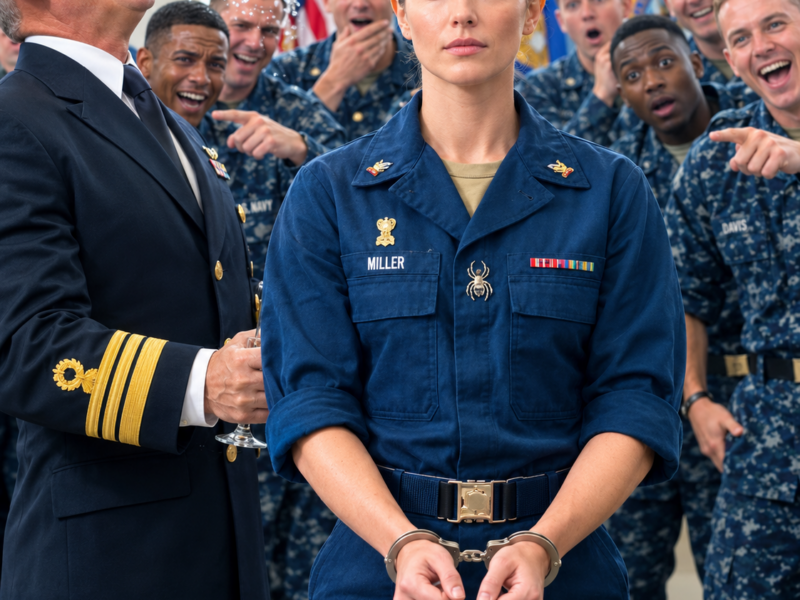
The SEAL Admiral Asked Her Call Sign as a Joke — Until “Iron Widow” Made Him Collapse in Shock
The SEAL Admiral Asked Her Call Sign as a Joke — Until “Iron Widow” Made Him Collapse in Shock
The first threat arrived before I reached the parking lot.
My secure phone vibrated once inside my jacket. No caller ID. No message preview. Just a single line of text glowing against the dark screen.
LEAVE THE PAST BURIED, IRON WIDOW.
I read it twice, then deleted it.
For twenty-two years, I had waited for someone to admit that Operation Nightfall had never been a rescue mission. For twenty-two years, I had carried the names of eleven men who had trusted me to bring them home. Now, less than an hour after returning to Naval Special Warfare Command, someone had confirmed what I had suspected all along.
The people responsible were still watching me.
I slipped the phone into my pocket and continued toward the parking lot.
The afternoon sun reflected off the windshields of government vehicles. Sailors crossed between buildings, carrying folders and coffee. A maintenance truck rumbled past the security checkpoint, and two officers stood near the entrance discussing an upcoming training exercise.
Everything looked ordinary.
That was what frightened me.
In my experience, danger rarely announced itself with a weapon pointed at your chest. More often, it arrived as a familiar face, an unexplained delay, or an order that made perfect sense until you understood who benefited from it.
I reached my vehicle but didn’t get inside.
Across the parking lot, a black SUV sat beneath a row of trees. Its windows were tinted. Its engine was running.
When I turned toward it, the driver switched on the headlights.
Then the SUV pulled away.
I memorized the license plate before it disappeared through the gate.
Someone wanted me nervous. Someone wanted me to understand that the past was not finished with me.
They had made a serious mistake.
They had assumed that surviving the mountains of Afghanistan had made me afraid of dying.
It hadn’t.
It had made me afraid of leaving the truth behind.
I climbed into my vehicle, locked the doors, and drove straight to the secure intelligence facility where the original mission archives were stored.
My assignment had been approved that morning by Naval Special Warfare Command. The written authorization gave me temporary oversight of a classified review concerning an operation conducted twenty-two years earlier. The official purpose was to reconcile conflicting mission records.
The real purpose was to find out why twelve operators had been abandoned in enemy territory.
I had spent most of my adult life trying to answer that question.
Now I intended to finish the job.
At the facility entrance, a security officer examined my credentials, checked the authorization code, and frowned at his terminal.
He checked again.
Then he looked up at me.
“Commander Cross, the archive administrator has been notified of your arrival.”
“Good. Please grant me access.”
He hesitated.
“There’s been an issue with your request.”
“What kind of issue?”
“The original files have been placed under an emergency security hold.”
I didn’t move.
“By whose authority?”
He looked back at the screen.
“Admiral Richard Hale.”
For a moment, I could hear nothing but the blood moving through my ears.
Hale had collapsed when I gave him my call sign. He had looked at me as if the dead had returned to accuse him. Yet he had recovered quickly enough to freeze the records before I could examine them.
Fear had not made him honest.
It had made him careful.
“Contact the archive administrator,” I said. “Tell them I’m requesting the legal basis for the hold.”
“Ma’am, I don’t have authorization to—”
“Then contact the officer who does.”
My voice never rose. It didn’t need to.
The guard reached for his telephone.
I stepped away from the desk and called the officer who had assigned me to the review. He answered on the second ring.
“Cross.”
“Admiral Hale has frozen access to the mission archives.”
A pause followed.
“That’s unusual.”
“He also recognized my call sign before anyone in that room had time to explain it to him.”
Another pause, longer this time.
“Give me ten minutes.”
The line went dead.
I waited beneath the security cameras, watching the officers move through the lobby. I had learned long ago that impatience made people careless, and carelessness was a luxury I could no longer afford.
At 14:17, the security officer returned.
“Your access has been restored, Commander.”
“Who approved it?”
“Rear Admiral Thomas Mercer.”
The name landed like a stone in still water.
Thomas Mercer.
He had served in intelligence during the final years of the Afghanistan conflict. According to the records I remembered, he had occupied a senior planning position at the time our team disappeared. I had never met him face-to-face, but his name appeared in the margins of several mission documents.
And now, after Admiral Hale had blocked my access, Mercer had personally restored it.
Either he wanted the truth exposed, or he wanted to control which parts of it I discovered.
I thanked the guard and entered the facility.
The archive room was cold, quiet, and filled with the soft hum of encrypted workstations. Rows of terminals stood beneath recessed lights. Each computer was isolated from ordinary military networks, and access to the most sensitive records required multiple authentication steps.
A technician waited beside the workstation assigned to me.
“Commander Cross?”
“Yes.”
“Everything connected to the operation has been transferred to your review folder.”
He entered a command and turned the monitor toward me.
The file appeared under a designation I had never seen before.
OPERATION SILENT LANTERN.
I stopped breathing for a moment.
The mission I remembered had been identified in our field briefings as Operation Nightfall. We had been told we were entering hostile territory to extract an intelligence asset who possessed information about an imminent attack.
Now the same mission had another name.
Another identity.
Another layer of secrecy.
“Who assigned this designation?” I asked.
“The archive index lists it as the original operation name.”
“Who entered the index?”
The technician checked.
“Unknown. The entry was migrated from a legacy system.”
I looked at him.
“Has anyone modified the files today?”
“I can check the audit history.”
“Do that. And don’t print anything or transmit any files until I authorize it.”
He nodded.
I sat down and opened the mission folder.
The first document was a personnel roster.
Twelve names appeared in a single column, each accompanied by a rank, service number, and operational role.
Captain Michael Torres.
Senior Chief Daniel Brooks.
Lieutenant Aaron Pike.
Petty Officer First Class Samuel Reed.
Eight more names followed.
I recognized every one of them.
Torres had been our team leader, a quiet man who never raised his voice and never asked anyone to do something he wouldn’t do himself. Brooks had been old enough to remember when field radios were heavier than the men carrying them. Pike had been the youngest member of our team, a brilliant marksman who sent money home to his mother every month.
Reed had been a medic.
He had saved my life twice during the first three years of our deployment cycle.
The last time I saw him, he was kneeling beside Pike, pressing both hands against a wound while rounds tore into the rocks around them.
I remembered Reed looking up at me.
“Go,” he had shouted. “I’ll get him moving.”
I had wanted to stay.
He had ordered me to go.
I had obeyed because he was my friend, because he was a medic, and because I believed there would be another chance to reach him.
There had never been another chance.
The official record listed all twelve operators as presumed killed in action. A later amendment changed the status to killed in action, citing intelligence reports and the absence of recoverable remains.
My name appeared at the bottom of the roster.
COMMANDER EVELYN CROSS.
STATUS: PRESUMED KILLED IN ACTION.
I stared at those words.
I had spent twenty-two years being alive in a world that believed me dead. I had served under restricted assignments, worked with intelligence units that never appeared on public organizational charts, and watched my own history disappear behind layers of classification.
I had accepted the secrecy because I believed it protected people still serving.
But this record had not protected anyone.
It had erased them.
“Commander?” the technician asked quietly.
“Open the approval section.”
He did.
The operation had been authorized by Colonel Richard Hale, who was a senior officer at the time. His digital signature appeared beneath the mission order.
Below it sat a second authorization.
THOMAS MERCER.
I leaned toward the screen.
The signature had been added after the mission, not before it.
I opened the audit history and compared the timestamps. The original document had been modified six hours after the team disappeared. The added approval had not existed in the first version of the record.
“Who changed this?” I asked.
The technician examined the audit trail.
“The original user credentials are no longer active. The modification was made through a legacy command account.”
“Can you identify the terminal?”
He shook his head.
“The hardware record was purged during a system migration.”
I looked back at Mercer’s name.
He had restored my access, but his signature was hidden inside a document that someone had altered after twelve operators vanished.
It was not proof of his guilt.
It was enough to tell me that he had a reason to be interested in what I found.
“Open the communications log,” I said.
The technician entered another command.
A timeline filled the screen.
The first transmissions were routine. Checkpoints confirmed. Weather stable. Target compound located. The team moving according to plan.
At 02:41, the first discrepancy appeared.
EXTRACTION COORDINATES UPDATED. ACKNOWLEDGE IMMEDIATELY.
The order carried Hale’s authorization code.
I remembered receiving it.
We had been moving through a narrow valley beneath a moonless sky when Torres stopped us and checked the new coordinates against his map. The change was small enough to look reasonable. It shifted our extraction point east, closer to the compound, but still within what we believed was the aircraft’s operating range.
Torres had frowned.
“That’s not what we briefed.”
Brooks had checked the radio.
“Command says the original route is compromised.”
Torres had looked at me.
I had shrugged. The order came from headquarters, and we had no independent evidence that it was wrong.
We acknowledged it.
At 02:53, another message arrived.
HOLD POSITION. EXTRACTION DELAYED. AWAIT FURTHER INSTRUCTIONS.
That was the order I remembered most clearly.
The enemy had begun closing in from the south. Our overwatch reported movement along the ridgeline, and Torres requested immediate extraction. The answer was that the aircraft had been delayed by weather and that we should maintain our position.
We had held.
At 02:58, a new message appeared.
ABORT EXTRACTION. TEAM COMPROMISED. NO FURTHER AIR SUPPORT AUTHORIZED.
My hands went cold.
The official report stated that headquarters had lost contact with our team and could not verify our condition.
But the communications log showed that command had received our distress signals.
At 03:06, Brooks transmitted our exact position.
At 03:08, headquarters acknowledged receipt.
At 03:11, another command arrived.
ALL SURVIVING PERSONNEL ARE TO REMAIN IN PLACE. RESCUE IS NOT AUTHORIZED.
I read the message again.
Then a third time.
The wording was clinical. There was no explanation, no acknowledgement of the casualties, no indication that anyone was trying to find another way to reach us.
Just an order to stay where we were and wait.
I remembered the sound of incoming fire. I remembered Torres trying to reach command through a damaged radio. I remembered Pike calling for help and Reed answering him through the smoke.
We had believed headquarters was working to bring us home.
We had believed the silence meant someone was trying.
The log showed otherwise.
“Open the attachments,” I said.
The technician clicked on a secondary file.
A transcript appeared.
PRIVATE COMMAND CONVERSATION — 03:14 LOCAL.
The first speaker was Hale.
“We cannot risk the aircraft reaching that position.”
A second voice answered.
“If they survive, they’ll know the asset was never there.”
My heartbeat slowed.
I knew that voice.
I had heard it in countless briefings, on secure conference calls, and in recordings played during our training. It belonged to Thomas Mercer.
Hale continued.
“The team was briefed on a standard extraction. They have no reason to suspect the actual objective.”
“Not anymore,” Mercer replied. “The target has been moved. The original intelligence was deliberately falsified.”
Silence followed.
Then Hale asked the question that had haunted me for twenty-two years.
“What about the operators?”
Mercer answered without hesitation.
“They’re expendable.”
I gripped the edge of the desk.
The mission had not failed because intelligence was wrong.
It had been designed to leave twelve Americans in a place where no one would be able to question what happened.
And the man who had approved the mission knew exactly what was happening.
I scrolled to the end of the transcript.
The final line contained an instruction issued by Mercer.
“Once the site is secured, all remaining records will be consolidated under Silent Lantern. The team is to be listed as lost in action. No recovery operation is to be authorized without my direct approval.”
The transcript ended.
For a long moment, I couldn’t move.
I had spent years asking myself whether I should have disobeyed the order to hold position. Whether I should have taken the team north instead of east. Whether I could have saved Torres if I had left Reed and Pike behind sooner.
The guilt had followed me through every assignment, every promotion, every quiet room in which I tried to sleep.
Now I understood that those questions had been built on a lie.
We had been sent into a trap.
Our decisions had mattered, but they had never been the reason we were abandoned.
I closed my eyes.
I could still hear Torres calling for a head count.
I could still see Brooks holding a radio against his chest as he tried to get command to answer.
I could still feel Reed’s hand pushing me toward the ridge.
I had survived because I had disobeyed the final order and moved into the mountains alone. I had spent three days evading enemy patrols before reaching a remote village, where a local family hid me until a friendly intelligence team found me.
When I finally returned to American control, I was told that my teammates had been declared dead and that the details of the mission were classified.
I was warned that discussing the operation could endanger national security.
I had believed them.
For years, I believed that silence was the price of protecting the men who had died.
Now I knew whose silence I had protected.
“Commander Cross,” the technician said, his voice suddenly tense. “Something’s happening to the system.”
Every monitor in the archive room went black.
The lights flickered.
A sharp electronic tone sounded above the door.
The technician stood so quickly that his chair rolled backward.
“That shouldn’t happen.”
I looked at the terminal.
The screen returned, displaying a single warning.
EMERGENCY SECURITY LOCKDOWN.
ACCESS SUSPENDED.
Then the file disappeared.
I reached for the external authentication device attached to my wrist and checked the encrypted drive I had used to create a local evidence package. The copy had completed seconds before the system shut down.
The files were still there.
My phone vibrated.
A new message appeared.
YOU WERE WARNED. LEAVE NOW.
I slipped the encrypted drive into an interior pocket.
“Commander, security is locking down the building,” the technician said. “You need to stay here until the system administrator clears the alert.”
I looked toward the door.
“That’s exactly what they want.”
I stepped into the corridor.
The emergency lights cast a dull red glow across the walls. Magnetic locks engaged in sequence, sealing the doors behind me. Somewhere above, an alarm began to pulse, not loud enough to cause panic but persistent enough to tell everyone that something had gone wrong.
At the far end of the corridor, two armed security personnel stepped into view.
“Commander Cross,” one called. “We need you to come with us.”
I stopped.
“Whose orders?”
“Admiral Mercer’s.”
I looked at the weapons resting against their tactical vests.
“Am I being detained?”
“Ma’am, we just need you to come with us.”
“That wasn’t my question.”
The guards exchanged a glance.
They had been given an instruction, but they didn’t seem certain what it meant. Neither man wanted to be the first to say the wrong thing in front of a senior commander.
I kept my hands visible.
“Record the authorization,” I said. “If Admiral Mercer has issued a lawful detention order, I expect to see it.”
One guard reached for his radio.
Before he could speak, another voice came from behind them.
“Stand down.”
Admiral Richard Hale stepped into the corridor.
His face was still pale from his collapse in the briefing room, but his expression had changed. The shock was gone. In its place was the exhausted determination of a man who had finally realized that avoiding a decision was itself a decision.
The guards immediately lowered their hands.
Hale looked at me.
“Give me the drive.”
“No.”
His jaw tightened.
“You don’t understand what you’ve uncovered.”
“I understand that you abandoned twelve American operators after receiving their distress signal.”
The words echoed through the corridor.
Hale glanced at the guards.
“Leave us.”
Neither man moved until he repeated the order.
When they were gone, he stepped closer.
“I was following orders.”
“From Mercer?”
He said nothing.
“Did you know the intelligence was fabricated before we deployed?”
His gaze dropped to the floor.
That was enough.
For twenty-two years, I had imagined the man who signed our death certificates as a monster who never cared whether we lived or died.
The truth was more complicated, and somehow worse.
He had cared enough to understand what he was doing.
He had known there were men waiting in that valley for an extraction that would never arrive. He had known our coordinates. He had known our distress signals had been received.
And he had signed the order that abandoned us.
“Why are you helping me now?” I asked.
Hale looked up.
“Because Mercer has just authorized your detention and ordered the archive destroyed.”
“Then tell me what he was protecting.”
He glanced toward the security camera mounted above the door.
“Not here.”
He entered a code on his tablet. A nearby service door unlocked.
“There’s a secure conference room below this level. No network access. No recording equipment.”
I studied him.
“You expect me to trust you?”
“No.” His voice was rough. “I expect you to understand that if Mercer gets that drive, the truth disappears again.”
I followed him through the door, keeping several feet between us.
The room below the archive was small, concrete, and windowless. A metal table stood beneath a single light. The ventilation system hummed overhead, and a thick security door sealed behind us.
Hale entered another code to confirm the room was isolated.
Then he removed his admiral’s insignia and placed it on the table.
It was a small gesture, but I understood what he meant.
He was no longer speaking as the officer who had ordered my team abandoned.
He was speaking as the man who had spent twenty-two years living with the decision.
“Operation Silent Lantern was never an extraction mission,” he began.
“I gathered that.”
“The target was a defense contractor who had obtained evidence of an illegal intelligence program. Mercer believed that evidence could expose several senior officials. The program involved unauthorized surveillance, the transfer of sensitive military intelligence, and operations that had never received proper oversight.”
“And my team was sent to recover the evidence?”
Hale shook his head.
“Your team was sent because Mercer needed the operation to appear legitimate. The intelligence package was fabricated. The extraction route was changed. The entire mission was designed to leave no witnesses.”
“Why us?”
“Because your team was experienced enough to be trusted with a sensitive assignment, but isolated enough that your disappearance could be explained as a combat loss.”
I stared at him.
“You knew the mission was compromised.”
“I knew something was wrong. I did not know the full plan until it was too late.”
“But you knew enough to cancel the extraction.”
Hale closed his eyes briefly.
“Yes.”
“Why?”
“Mercer had evidence that could have destroyed my career. He had records of decisions I had approved, communications I had signed, and reports I had allowed to remain classified. He told me the operation was necessary to protect national security.”
“So you believed him?”
“I wanted to believe him.”
“That isn’t an answer.”
“No,” he admitted. “It isn’t.”
I leaned forward, placing both hands on the table.
“Did you know there was no asset at the compound?”
Hale took a long breath.
“I was told the asset had been moved before your arrival. I was also told that the extraction site was compromised and that sending an aircraft would expose other personnel.”
“And you accepted that explanation.”
“Yes.”
“Even after Brooks transmitted our position?”
His eyes filled with something that looked almost like shame.
“Yes.”
I thought of Brooks trying to keep the radio alive while the rest of us moved between rocks. He had believed that if command knew where we were, someone would come.
Instead, Hale had acknowledged the transmission and left us there.
“Why didn’t you tell the truth afterward?”
“Because Mercer controlled the investigation. He provided the intelligence assessment, the operational summary, and the casualty determination. By the time I realized what he had done, the official record was already in motion. The team had been declared dead. Families had been notified. The operation was classified.”
“You could have stopped it.”
“I could have tried.”
“But you didn’t.”
“No.”
The word came out quietly.
For the first time since I had met him, Hale looked older than his years.
“I told myself I was protecting the institution,” he continued. “I told myself that exposing the operation would damage national security, endanger sources, and destroy the careers of people who had not been involved. I convinced myself that the truth could wait until I had enough evidence to act.”
“And then the years passed.”
He nodded.
“And the years passed.”
I sat back.
I had expected excuses. I had expected him to blame the fog of war, the pressure of command, or the impossible decisions officers sometimes faced in combat.
I hadn’t expected him to admit that his silence had been a choice.
But an admission was not justice.
“Who was the asset?” I asked.
Hale hesitated.
“Someone inside our own command structure.”
“Who?”
He turned his tablet toward me.
A photograph appeared on the screen.
Thomas Mercer, younger by twenty years, stood beside a military transport aircraft. His uniform bore the insignia of an intelligence command, and his expression carried the easy confidence of a man accustomed to being obeyed.
I looked at the photograph.
“Mercer wasn’t trying to recover evidence from the contractor,” I said. “He was trying to eliminate the person who had it.”
“Yes.”
“And the contractor?”
“His name was Peter Lang. He was an analyst for a private defense company that had been contracted to build part of the intelligence program. He discovered that operational data was being sold to intermediaries outside authorized channels. He tried to report it through official channels, but his complaints disappeared.”
“So he went outside the system.”
“He contacted a source he believed he could trust. That source arranged a meeting near the compound. Mercer learned about it and turned the meeting into an operation.”
I studied the photograph again.
“Did Lang survive?”
Hale’s silence answered before his words did.
“We don’t know.”
“You don’t know, or you didn’t look?”
“We were told he was killed during the initial engagement. No remains were recovered.”
“Just like my team.”
“Yes.”
The room seemed smaller.
I thought about the fabricated briefing, the changed coordinates, the orders that had arrived at precisely the moments when we still had a chance to escape.
The plan had been simple. Send an elite team into a hostile area using false intelligence. Wait until the situation became dangerous. Cancel the extraction. Let the enemy do the killing. Then classify the operation and write a report that blamed the losses on combat conditions.
The perfect crime was not one that left no evidence.
It was one that convinced everyone the evidence was too dangerous to examine.
I looked at Hale.
“What else is in the files?”
“The communications records are only the beginning. Mercer had a secondary archive. Financial transactions, contractor agreements, intelligence transfers, and internal correspondence. He kept copies because he didn’t trust anyone else with the full picture.”
“Where?”
“I don’t know.”
I studied his face.
“You’re lying.”
He flinched.
“I know where the archive was stored,” he admitted. “I don’t know whether it’s still there.”
“Where?”
“An old communications facility outside the main installation. It was decommissioned years ago, but part of the secure storage system remained active. Mercer used it for materials that couldn’t be entered into the ordinary network.”
“Why are you telling me this now?”
“Because I received a message this morning.”
He unlocked his tablet and showed me a short, encrypted communication.
The sender was listed as an unknown account.
The message contained only one sentence.
CROSS HAS RETURNED. COMPLETE THE CLEANUP.
I read it twice.
“When did you receive this?”
“Forty minutes before your briefing.”
“And you didn’t tell anyone?”
“I wanted to confirm who had sent it.”
“Did you?”
Hale looked at me.
“The authorization key belongs to Mercer.”
A knock struck the security door.
Three hard blows.
Both of us turned.
A voice came through the speaker.
“Admiral Hale, step away from Commander Cross and open the door.”
Mercer.
His voice was calm, almost courteous. The tone of a senior officer who expected the world to arrange itself around his wishes.
Hale went pale.
“He knows we’re here.”
I secured the encrypted drive more tightly inside my jacket.
“Then we should stop wasting time.”
Hale moved toward the door controls, but I caught his wrist.
“Not yet.”
He looked at me.
“What are you doing?”
“Making sure this conversation doesn’t end with another report saying everyone involved died in an unfortunate accident.”
I took out my secure phone and opened the emergency communications channel assigned to the review. It could transmit a short authentication burst to the oversight office without connecting to the building’s internal network.
I entered the review code and attached a single line.
OPERATION SILENT LANTERN. EVIDENCE OF DELIBERATE ABANDONMENT. SENIOR OFFICERS INVOLVED. PRESERVE ALL RELATED RECORDS. REQUEST INDEPENDENT OVERSIGHT.
The message was too short to tell the whole story, but it was enough to establish that the evidence existed and that I had discovered it.
I pressed transmit.
A confirmation symbol appeared.
Hale watched me.
“You’ve just made this much bigger than you realize.”
“It was already bigger than I realized.”
I opened the door.
Mercer stood in the corridor with six armed security personnel behind him. He wore his uniform perfectly, his silver hair neatly combed, and his expression carefully arranged into mild concern.
His eyes moved from Hale to me, then settled on the encrypted drive beneath my jacket.
“Commander Cross,” he said. “I believe you have something that belongs to the United States government.”
I met his gaze.
“No, Admiral.”
I stepped into the corridor.
“I have something that belongs to twelve dead Americans.”
For the first time, Mercer’s expression changed.
Only slightly.
A tightening around the eyes. A brief pause before his next breath. A flicker of calculation as he reconsidered the situation.
But I saw it.
Fear.
He recovered quickly.
“I’m afraid you’ve been misled. The files you’re examining contain sensitive intelligence, and your current authorization does not permit you to remove classified material from the archive.”
“My authorization permits me to review the mission records.”
“It does not permit you to make independent copies.”
“Then you should explain why the archive was remotely disabled while I was examining evidence of a falsified mission report.”
Mercer’s eyes narrowed.
“Security systems are automated. There are procedures for handling anomalies.”
“Anomalies like a command log showing that headquarters received our distress signal and deliberately denied rescue?”
The security personnel behind him exchanged glances.
Mercer did not look away from me.
“You’re making serious allegations, Commander.”
“They’re supported by the communications record.”
“Records can be altered.”
“That’s why I preserved the audit history.”
For the first time, he looked toward Hale.
It was a quick glance, but it carried a warning.
Hale straightened.
“Thomas, this needs to go to independent review.”
Mercer gave him a cold smile.
“Richard, you’ve been under considerable stress today. I suggest you step aside and let the appropriate authorities handle this.”
“No,” Hale said.
The word seemed to surprise him as much as it surprised Mercer.
Hale took one step forward.
“I signed the order that canceled the extraction. I allowed the official report to stand. I have spent twenty-two years telling myself I was protecting the command. I won’t do it again.”
Mercer’s expression hardened.
“You have no idea what you’re doing.”
“I know exactly what I did,” Hale replied. “That’s why I’m done hiding it.”
For a moment, no one spoke.
Then Mercer nodded to the security team.
“Take Commander Cross into custody. Secure all devices and recover the classified material.”
The guards shifted their weight.
I didn’t move.
“Before you act,” I said, “you should know that I have already transmitted an evidence-preservation notice to the independent oversight office. If I disappear, if this drive is destroyed, or if the original records are altered, the notice will trigger an immediate inquiry.”
That wasn’t entirely true. The message would not automatically trigger an investigation. It would, however, establish a timestamped record of the allegations and direct oversight personnel toward the archive.
Sometimes, the difference between a threat and a useful warning was simply how carefully it was worded.
Mercer studied me.
“You’ve put yourself in a very dangerous position.”
“I’ve been in dangerous positions before.”
“You think your call sign makes you untouchable?”
“No. I think you remember what happened the last time you tried to make me disappear.”
His jaw tightened.
For a moment, I saw the man he had been twenty-two years earlier: a planner sitting safely behind a desk, treating lives as numbers in a report.
Then he smiled again.
“You survived one operation, Commander. Don’t mistake survival for victory.”
I stepped closer.
“And you made one mistake, Admiral.”
“Which was?”
“You assumed that because you could bury the truth, no one would ever come looking for it.”
A distant alarm sounded.
The security personnel turned their heads toward the corridor entrance.
Someone was approaching at a fast walk. A moment later, three officers in formal service uniforms appeared, accompanied by a civilian attorney carrying a hard case.
The lead officer displayed his identification.
“Rear Admiral Mercer, we’re here under authority of the independent oversight office. All records relating to Operation Silent Lantern are to be preserved pending review. No individual is to be detained or removed without written authorization from the investigating authority.”
Mercer’s face went rigid.
“That order hasn’t been routed through my office.”
“It’s been routed through the appropriate authority,” the officer replied. “Your office is specifically excluded from the preservation process.”
The civilian attorney stepped forward.
“Admiral, we also require your government devices and access credentials pending the preliminary review.”
Mercer stared at the documents.
For the first time, he had no immediate answer.
I watched the security team lower their hands. The corridor seemed to exhale. The situation had not become safe, but it had changed. Mercer could no longer control every door, every file, and every person who might hear the truth.
The officer turned to me.
“Commander Cross, are you in possession of evidence connected to this inquiry?”
“Yes.”
“Can you preserve it without altering the original data?”
“Yes.”
“Then you’ll accompany our technical team to a secure location and provide a statement. Admiral Hale will be interviewed separately.”
I nodded.
Mercer suddenly stepped forward.
“You have no idea what this will do to the Navy,” he said. “You will expose operations that protected American lives. You’ll give our enemies information they can use against us. You’ll undermine every commander who ever had to make an impossible decision.”
I looked at him.
“No, Admiral. I’m exposing an operation that used American lives to protect a secret.”
“You can’t know the consequences.”
“I know the consequences of silence.”
I thought of the families who had received casualty notifications. The parents who had buried empty caskets. The wives who had spent years wondering whether their husbands had suffered before they died. The children who had grown up believing their fathers had been lost in a mission no one could explain.
Those consequences had lasted twenty-two years.
Mercer’s consequences were only beginning.
As the oversight officers escorted him down the corridor, he turned back once.
“You’ll regret this, Cross.”
I held his gaze.
“I’ve regretted enough.”
Then he was gone.
For several seconds, I stood still, listening to the footsteps fade.
Hale remained beside the conference room door. He looked at the insignia he had removed from his uniform, then slowly picked it up.
“Do you think the truth will make any difference?” he asked.
I considered the question.
“Not by itself.”
He looked at me.
“Then what happens now?”
“Now we find the original archive. We verify every communication. We identify everyone who approved the operation, everyone who altered the reports, and everyone who helped keep the truth buried.”
“And after that?”
“After that, the families get answers.”
Hale lowered his head.
“I can’t give you back your team.”
“No.”
“I can’t undo what I did.”
“No.”
He swallowed.
“But I can testify.”
I studied him for a long moment.
“Then tell the truth this time. All of it. Even the parts that destroy you.”
He nodded once.
It wasn’t forgiveness.
It wasn’t redemption.
It was the beginning of accountability, and that was all I was willing to offer.
The following days were a blur of interviews, evidence transfers, security reviews, and late-night briefings. The independent oversight team took custody of the encrypted drive and created verified copies under a strict chain of custody. Specialists compared the communications logs against archived satellite records and transmission metadata. Every document was examined for alterations.
The evidence held.
The original extraction coordinates had been changed under Hale’s credentials. The cancellation order had been acknowledged by headquarters. The order denying rescue had been issued while our team was still transmitting.
The after-action report had been modified six hours later.
And the financial records showed that a contractor linked to Mercer’s intelligence program had received payments through a chain of shell companies shortly after the operation.
Those records did not answer every question, but they established a pattern that could no longer be dismissed as a clerical error.
Three weeks after my return, the oversight office located the secondary archive at the decommissioned communications facility Hale had described.
The building stood behind an old security perimeter, its exterior stained by years of salt air and weather. The main entrance had been sealed, and the power system was officially listed as inactive. But a backup circuit still fed a small server room beneath the facility.
Inside, investigators found encrypted storage devices, archived correspondence, and a collection of operational records that had never been entered into the official system.
Among them was the original intelligence package for Operation Silent Lantern.
It contained no verified intelligence about an imminent attack. The supposed asset was never scheduled to meet our team. The coordinates had been selected to place us inside an area controlled by a hostile militia known to be operating near the compound.
The extraction plan had been designed to fail.
The report also contained a handwritten note from Mercer.
CROSS MUST NOT BE RECOVERED ALIVE.
I read those words in a secure conference room while the lead investigator watched my face.
I didn’t ask whether the note was authentic. The forensic team had already established that the handwriting matched other documents in the archive.
Instead, I asked the only question that mattered.
“Who else knew?”
The investigator closed the folder.
“We’re still tracing the approvals. We have evidence connecting several former officials to the program, but we won’t speculate until the interviews and financial analysis are complete.”
“Good.”
“We also need to discuss your status. The original report listed you as killed in action. That designation affected your service history and several subsequent assignments.”
I looked through the glass wall at the officers moving between conference rooms.
For twenty-two years, I had carried a life that officially did not exist. I had served under restricted identities, accepted assignments that could not be discussed with friends or family, and watched promotions and awards become complicated by a record that said I was dead.
Now the truth was emerging, but the consequences would not disappear overnight.
“Will my record be corrected?” I asked.
“Yes, Commander. The review board has recommended an immediate correction, subject to final approval.”
“And the families?”
“Each family will receive a formal notification and a complete account of the findings that can legally be disclosed. The team is also preparing individual briefings.”
I nodded.
“Make sure they hear it from someone who understands what those men were like. Not just what their records say.”
The investigator paused.
“We’ll arrange that.”
That evening, I returned to my quarters and opened the old notebook I had carried through several deployments.
The first page contained twelve names.
I had written them down shortly after escaping the mountains, afraid that if I didn’t preserve them somewhere, the world would eventually erase them completely.
Below the names, I had written a single sentence.
I WILL FIND OUT WHAT HAPPENED.
For years, that promise had been the only thing that kept me moving.
I turned to a fresh page and wrote another sentence.
THEY WERE NOT ABANDONED BY ACCIDENT.
Then I closed the notebook.
The investigation continued for months. Mercer was suspended from duty while the case proceeded through the appropriate military and legal channels. Hale gave a detailed statement acknowledging his role in the cancellation of the extraction and the subsequent failure to challenge the official report. Other former officials were interviewed, and several records were referred for further investigation.
The final findings did not restore the lives we had lost.
They did something different.
They restored the truth.
The report concluded that Operation Silent Lantern had been based on deliberately falsified intelligence, that the extraction had been canceled despite verified communications from the team, and that the official casualty report had been altered to conceal decisions made by senior officers.
The report also rejected the claim that the team had simply become unreachable in hostile territory.
We had called for help.
Command had heard us.
Help had been denied.
The Navy arranged a formal memorial at a military cemetery overlooking the water. The ceremony was closed to the public, but the families were invited, along with members of the original unit and the officers who had participated in the review.
I stood in the front row wearing my full uniform.
For the first time in twenty-two years, my name appeared on the official roster beside the names of the eleven men who had died.
Not as a casualty.
As a survivor.
The chaplain read each name aloud.
When he reached Captain Michael Torres, I remembered the way he had smiled at me before our final briefing, tapping the map with two fingers and telling me that a good plan always included a way home.
When he reached Senior Chief Daniel Brooks, I remembered his stubborn refusal to abandon a radio, even when the battery was nearly dead.
When he reached Samuel Reed, I remembered the medic who had pushed me toward the ridge and ordered me to survive.
I had obeyed.
For twenty-two years, I had wondered whether that made me a coward.
Standing beside their families, I finally understood the answer.
Survival had never been a betrayal of the dead.
Silence had been.
After the ceremony, a woman approached me with a folded photograph in her hand. She was in her sixties, with silver hair and tired eyes.
“Commander Cross?”
“Yes, ma’am.”
“I’m Daniel Brooks’s sister.”
I stood straighter.
“I remember Senior Chief Brooks.”
She smiled faintly.
“Of course you do. Everyone who served with him remembers him.”
She held out the photograph.
It showed Brooks standing in front of a small house, one arm around a young woman, his face breaking into the kind of smile he rarely allowed himself in uniform.
“He sent this to me a few months before the mission,” she said. “He told me he was going to come home and finally take a real vacation. He wanted to see the mountains in Colorado. He’d never been.”
I accepted the photograph carefully.
“He talked about it all the time,” I said. “He wanted to take a train across the country. He said it was the only sensible way to travel because no one could order a train to change its route halfway through the journey.”
She laughed softly, then covered her mouth.
For a moment, neither of us spoke.
“Did he know what was happening?” she asked.
I could have softened the truth. I could have told her that he had died quickly, that he had never understood the betrayal, that he had gone without fear.
But she deserved better than another official story.
“He knew the extraction had been canceled,” I said. “He kept trying to reach command. He believed that if he could get our position through, someone would come.”
Her eyes filled with tears.
“Did he suffer?”
I held the photograph between us.
“I won’t lie to you. It was a difficult night. But he wasn’t alone. He stayed with his team, and he helped save lives until he couldn’t continue.”
She pressed her lips together.
“Thank you for telling me.”
I handed the photograph back.
“He deserved to come home.”
“Yes,” she whispered. “He did.”
She walked away, carrying the picture against her chest.
I remained by the memorial until the last family had left.
The names on the stone were clean and permanent now. No longer hidden behind classified reports or false casualty summaries. No longer described as men who had disappeared because circumstances had made recovery impossible.
They had names.
They had families.
They had lives that mattered.
And their deaths had been the result of decisions made by people who believed rank could protect them from consequences.
I touched the edge of the memorial and lowered my head.
“I’m sorry it took so long,” I whispered.
The wind moved across the cemetery, carrying the distant sound of gulls from the water.
For the first time since Afghanistan, I didn’t feel as if I were standing in that valley again, waiting for an aircraft that would never arrive.
I was home.
Not because the past had stopped hurting.
Because the truth had finally caught up with it.
Later that afternoon, Admiral Hale approached me near the cemetery entrance. He was no longer wearing the insignia of his former command. The investigation had removed him from operational authority pending the final proceedings, and his future would be decided through the appropriate process.
He stopped several feet away.
“Commander Cross.”
“Admiral.”
He looked toward the memorial.
“I’ve spent a long time trying to find a way to explain what I did.”
“Did you find one?”
“No.”
He swallowed.
“I don’t expect forgiveness.”
“Good.”
He looked at me, surprised by the bluntness.
I continued before he could answer.
“Forgiveness isn’t something you get to request because you’ve finally admitted what happened. It’s something the people you hurt decide for themselves. Some of them may never forgive you.”
“I understand.”
“I hope you do.”
He nodded slowly.
Then he held out a sealed envelope.
“It’s a copy of my full statement. Everything I knew before the mission, everything I learned afterward, and every decision I made that helped keep the truth buried. The oversight office has the original, but I wanted you to have this.”
I accepted it.
“Why?”
“Because the report shouldn’t be the only thing that remembers what happened.”
I studied him for a moment.
“Then make sure you keep telling the truth when it becomes uncomfortable.”
“I will.”
He walked away without asking me to shake his hand.
I watched him go, then slipped the envelope into my bag.
The investigation was not over. The legal proceedings would take time, and the full extent of the program had yet to be established. There would be more hearings, more documents, and more difficult conversations with people who had spent years believing the official account.
But the most important part was no longer hidden.
Twelve operators had been sent into a trap.
Their calls for help had been received.
Their rescue had been deliberately denied.
And the report that declared them lost had been used to conceal the decisions that killed them.
I had spent twenty-two years searching for the person who could explain why.
In the end, I found something more important than an explanation.
I found the evidence.
A month later, I received my corrected service record. The official documents restored my status as a surviving member of the operation and confirmed the classified service I had completed afterward. My name was no longer listed among the dead.
I placed the record beside my old notebook.
Twelve names on one page.
My name on the next.
For years, the call sign Iron Widow had been a reminder of the mission that took my team from me. It had followed me through deployments, investigations, and nights when I woke convinced I could still hear Brooks calling for extraction.
Now it meant something else.
It meant the woman who survived.
The woman who remembered.
The woman who returned when powerful men believed the past had been buried too deeply to disturb.
I closed the notebook and stood by the window, watching the sun lower over the base.
I knew there would be people who called me reckless. Others would say I had endangered the institution by challenging senior officers. Some would insist that the truth should have remained classified to protect the Navy’s reputation.
They were entitled to their opinions.
But I knew what secrecy had protected.
It had protected a lie.
And the lie had cost twelve men their lives, their names, and twenty-two years of truth.
My secure phone vibrated on the desk.
A message from the oversight office appeared on the screen.
PRELIMINARY FINDINGS ACCEPTED. FULL INVESTIGATION CONTINUES. YOUR STATEMENT WILL REMAIN PART OF THE PERMANENT RECORD.
I read it once, then set the phone down.
There was no celebration. No triumphant music. No sudden feeling that everything had been made right.
There was only a quiet room, a corrected record, and the knowledge that the men I had lost would no longer be remembered as casualties of an unfortunate mission.
They would be remembered as the operators they had been.
Brave.
Loyal.
Human.
And betrayed.
I straightened my uniform, looked at my reflection in the darkened window, and finally allowed myself to say the words I had carried for twenty-two years.
“Mission complete.”
For the first time, Iron Widow was not a warning whispered by frightened officers.
It was a name attached to the truth.
And this time, no one would be allowed to bury it again.
Three months later, the final review board invited me to speak before a closed session of senior officers. I stood beneath the same kind of American flag that had hung behind Admiral Hale when he mocked my call sign. This time, no one laughed when I entered.
The board chairman asked whether I believed the operation could have ended differently.
“Yes, sir,” I answered.
“Can you explain?”
“Every operator in that team followed the information provided to us. We trusted the intelligence, trusted our command, and trusted that an extraction order meant someone was coming. The mission could have been stopped before deployment. It could have been aborted when the coordinates changed. It could have been rescued when we transmitted our position. At every stage, someone had the opportunity to make a different decision.”
“And what would you say to the officers who argue that the circumstances were too complicated to judge from a distance?”
I looked around the room.
“I would tell them that circumstances may complicate a decision, but they don’t erase responsibility. If you send Americans into danger, you owe them the truth. If you make a mistake, you owe them accountability. And if you abandon them deliberately, no classification stamp can turn that betrayal into an honorable act.”
The room remained silent.
When I finished, the chairman thanked me and adjourned the session.
Outside, a young SEAL lieutenant waited beside the corridor window. He looked familiar, though I couldn’t remember meeting him.
“Commander Cross?”
“Yes?”
“I’m Lieutenant Harris. I was in the briefing room the day you told Admiral Hale your call sign.”
I nodded.
“I remember.”
He looked embarrassed.
“I laughed when he started making jokes. I didn’t know anything about you, but I laughed anyway.”
“You weren’t the first person to underestimate someone because of how they looked.”
“That’s not an excuse.”
“No,” I said. “It isn’t.”
He straightened.
“I wanted to apologize.”
I studied him for a moment, then nodded.
“Remember this the next time someone walks into a room and doesn’t look like what you expected. Ask what they’ve done before deciding what they’re capable of.”
“Yes, ma’am.”
He left with his shoulders a little straighter.
I watched him disappear around the corner and thought about the next generation of operators. They deserved to serve in a command where asking questions wasn’t treated as disloyalty and where following orders didn’t require surrendering their judgment.
That was the last thing I could do for the men I had lost: help ensure their deaths were not reduced to a secret footnote in someone else’s career.
That evening, I returned to the memorial alone.
The sky was turning gold above the water. I placed twelve small American flags at the base of the stone, one for each member of the team, then stood quietly before their names.
“I found the truth,” I told them.
The wind stirred the flags.
“I wish I could have brought you home instead.”
I remained there until the light faded, remembering the men as they had been before the mission: arguing over bad coffee, trading stories in the transport aircraft, laughing at jokes that weren’t particularly funny, and making plans for lives they believed were waiting for them.
They had been more than names on a roster.
They had been friends.
And now the world knew what had happened to them.
I turned toward the gate.
My phone remained silent. No threats arrived. No anonymous warnings appeared. The black SUV was gone, and the officers who had tried to bury the evidence were finally answering questions they had avoided for decades.
The danger had not vanished completely. Investigations took time, and powerful people rarely surrendered quietly. But the truth had escaped the room where they had locked it away.
That was enough for tonight.
I walked toward the parking lot with my hands in my pockets and my head held high.
Once, Admiral Hale had asked for my call sign as a joke, expecting the room to laugh with him.
When I answered, he collapsed because he remembered the operation he had tried to erase.
He had feared Iron Widow because he believed the name belonged to a ghost from his past.
He had been wrong.
Iron Widow was still alive.
And I was no longer carrying the truth alone.
THe end.









