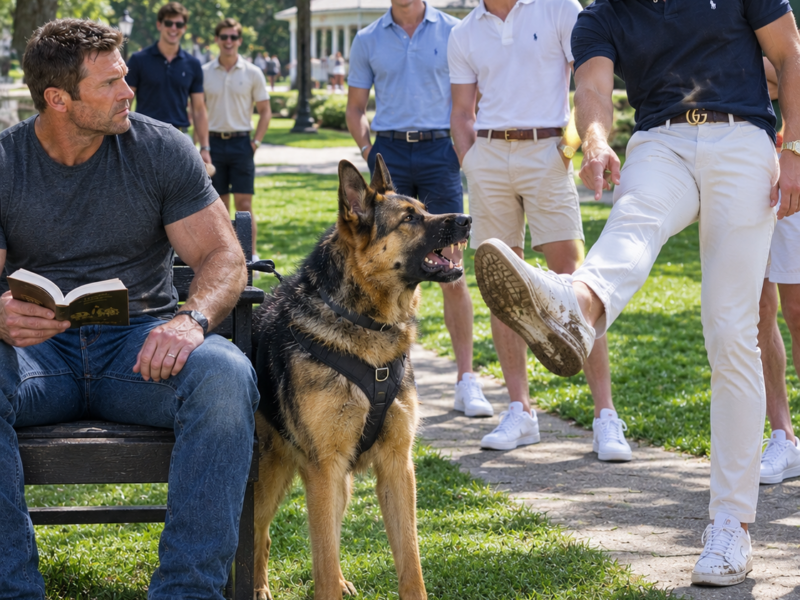
“The rich men laughed when they kicked a wounded Navy veteran’s German Shepherd into the dirt, telling him to kneel and apologize for letting his dog near their luxury cars
The message on Mason’s phone was only the beginning.
By the time I reached my truck, Ranger was trembling in my arms, trying to hide his injured leg against my chest. I had carried wounded men through worse conditions than that parking lot, but somehow the sound of my dog crying hurt more than any battlefield memory.
I eased him onto the passenger seat and rolled up a jacket beneath his head.
“Stay with me, boy,” I whispered. “We’re getting you help.”
Ranger licked my hand.
That small gesture nearly broke me.
I drove straight to the nearest emergency veterinary clinic, ignoring the phone vibrating in my pocket. Behind me, the waterfront café disappeared into the afternoon traffic, but I knew the confrontation wasn’t over.
People like Blake Thornton didn’t apologize when they lost control.
They looked for someone to blame.
At the clinic, a veterinary technician rushed Ranger into an examination room while I followed close behind. Dr. Emily Foster, a woman in her forties with kind eyes and a no-nonsense voice, examined him while another technician prepared an X-ray.
“Tell me exactly what happened,” she said.
“Three men attacked him. One kicked him in the ribs. Another pulled hard on his leash while he was down.”
Her expression tightened.
“Was this a random assault?”
“I don’t think those men consider anything random when they believe they can get away with it.”
She glanced at Ranger’s records, which I’d brought with me.
“You said he’s a retired military working dog?”
“Yes.”
“That’s what I thought.”
She gently ran her fingers along his side. Ranger flinched.
“We need to check for internal injuries and a fracture. His breathing is elevated, but his gums look good. That’s encouraging.”
I nodded, unable to do much else.
While the technicians took Ranger for imaging, I stepped into the hallway and checked my phone.
Twenty-three missed calls.
Fourteen messages.
And a notification showing that Mason’s video had been viewed hundreds of thousands of times.
The first message was from an unknown number.
YOU HAVE NO IDEA WHO YOU JUST EMBARRASSED.
The second was from a local number.
My father says you’re going to regret this.
The third came from a name I hadn’t seen in almost three years.
Marcus Reed.
My old team leader.
The message was short.
DANNY, CALL ME. NOW.
I stared at the screen.
I hadn’t heard Marcus’s voice since the ceremony where we buried one of our closest friends. After that, I’d stopped answering most calls from the old unit. I told myself I needed peace, but the truth was uglier.
I was tired of explaining why I had survived when other men hadn’t.
I was tired of being called a hero by people who had never watched a friend die.
And I was tired of waking up in the middle of the night with my hands clenched and my heart racing.
So I had walked away from the noise.
I’d bought a house, adopted Ranger permanently, and built a life small enough to manage.
Now three spoiled men had dragged my past into the light by hurting the one creature who had helped me survive it.
I called Marcus.
He answered before the first ring finished.
“Where are you?”
“Veterinary clinic outside Charleston.”
“Is Ranger alive?”
“Yes.”
“Good. Stay there.”
“Marcus, what is this about?”
“I saw the video. So did half the country.”
“It’s a dog getting kicked in a parking lot.”
“No, Danny. It’s a man putting his hands on a retired military working dog, then grabbing the handler who served with one of the most decorated special operations teams in the region.”
I closed my eyes.
“That’s exactly what I was trying to avoid.”
“Too late. Someone recognized you.”
“Who?”
“An old friend of ours. He sent the footage to me because he recognized your tattoo.”
I leaned against the wall.
“Tell him to take it down.”
“It’s already copied everywhere. We can’t put it back in the phone.”
“Then tell him not to make this bigger than it needs to be.”
Marcus was silent for a moment.
“Danny, listen to me. You didn’t do anything wrong. You protected your dog, and you walked away instead of turning that parking lot into a battlefield. That’s exactly what we would have expected from you.”
“You didn’t see Ranger when he got kicked.”
“No. But I know what he means to you.”
My throat tightened.
Marcus had been there when Ranger first came to our team. The dog had been trained to detect explosives, track missing personnel, and work in dangerous environments where a single mistake could cost several lives.
During a deployment, an explosion had thrown me against a wall and buried me beneath debris. I remembered the dust, the ringing in my ears, and the terrible weight pressing against my chest.
I remembered thinking I was going to die there.
Then Ranger had appeared through the smoke.
He pulled at my vest until I could move, dragged me toward cover, and stayed over me while the team secured the area. He didn’t leave until the medics reached us.
After that, he became more than a working dog.
He became family.
When my injuries ended my military career, Ranger was approaching retirement himself. I fought to have him placed with me rather than sent through another transfer. It took months of paperwork, medical reviews, and signatures, but eventually he came home.
Marcus had been the one to sign the final recommendation.
“I’m not asking for a fight,” I said.
“Neither am I. I’m asking you not to handle this alone.”
“I’ve handled things alone for three years.”
“And look how well that worked. You bought a house, adopted a dog, and stopped answering the phone.”
“That’s called peace.”
“No, Danny. That’s called hiding with better furniture.”
Despite everything, I almost smiled.
Then Dr. Foster appeared at the end of the hallway.
“Daniel?”
I ended the call.
“How is he?”
“Ranger has bruising along his ribs and a fracture in one of the smaller bones in his hind leg. Thankfully, we don’t see signs of major internal bleeding. We’re going to keep him overnight for observation and pain management.”
My shoulders sagged with relief.
“Will he recover?”
“We expect a good recovery, but he’ll need rest and rehabilitation. No running or jumping for several weeks.”
I looked through the glass into the treatment room.
Ranger lay on a padded table with a bandage around his leg, his eyes following every person who passed.
“Can I sit with him?”
“Of course.”
I pulled a chair beside the table and rested my hand against his neck.
“You scared me, old man.”
His tail moved once.
“I know. You’re going to hear about this for the rest of your life.”
He closed his eyes.
For the first time since the café, I could breathe normally.
Then the clinic receptionist knocked on the open door.
“Mr. Hayes? There are two police officers here asking to speak with you.”
I stood.
“Tell them I’ll be out in a minute.”
The officers were waiting near the reception desk. One was a middle-aged woman named Officer Bennett. The other was a younger man whose expression suggested he had already decided what kind of person I was.
“Mr. Hayes,” Bennett said, “we’re investigating an incident at the waterfront café. We understand you were involved in a confrontation with three local residents.”
“Those residents attacked my dog.”
“We’ve seen the video. We’d like your account of what happened.”
I described the confrontation in precise detail, from Blake’s first threat to the moment he kicked Ranger. I explained that I had warned them to leave, that I had not struck anyone, and that I had asked the café manager to preserve the security footage.
Bennett took notes.
“Did you threaten Mr. Thornton?”
“I told him he had one chance to make things right before the police arrived.”
The younger officer looked up.
“That sounds like a threat.”
“It was a warning that I intended to report an assault.”
Bennett gave her colleague a brief look, then returned her attention to me.
“Did you make any physical contact with the men?”
“No. Blake grabbed my wrist. I pulled free.”
“Were you carrying a weapon?”
“No.”
“Do you have witnesses?”
“The café manager, several customers, and the security cameras.”
She closed her notebook.
“We’ll collect the footage and contact the witnesses. For now, don’t communicate with the three men directly.”
“I have no intention of doing that.”
As I turned to leave, the younger officer spoke again.
“Just so you know, Mr. Thornton’s father has already contacted the department. He’s a major donor to several local programs.”
I looked at him.
“Then I hope his donations are enough to buy a working security camera.”
Officer Bennett hid a smile.
The younger man didn’t.
I returned to Ranger’s room and sat beside him until the clinic closed to visitors. By then, the video had crossed a million views.
People were sharing it with captions about animal abuse, privilege, and military veterans. Some praised me for staying calm. Others argued that I should have fought back.
I didn’t read most of the comments.
I knew the internet could turn a real person into a symbol before anyone bothered to ask what that person actually wanted.
I wasn’t interested in becoming a symbol.
I wanted my dog to heal.
At nine that evening, I drove home alone.
The house felt wrong without Ranger padding behind me. His food bowl stood beside the kitchen counter, his favorite blanket was folded near the couch, and a battered tennis ball sat beneath the coffee table.
I picked it up and placed it on the shelf.
Then someone knocked on my front door.
I checked the security camera.
A tall man in a dark suit stood on my porch. Behind him, a black SUV idled at the curb.
I opened the door but left the security chain attached.
“Can I help you?”
The man showed me an identification card.
“Special Agent Thomas Walker. Naval Criminal Investigative Service.”
I stared at the badge.
“NCIS?”
“Yes, sir. I was hoping we could talk about your former service.”
“My former service has nothing to do with a dog getting kicked.”
“Perhaps not. But your name has attracted attention, and I’d rather speak with you before other people start asking questions.”
I removed the chain.
“Come in.”
Walker stepped inside and glanced at the framed photograph on my bookshelf. It showed my old team standing in front of a transport aircraft, all of us filthy, exhausted, and grinning.
His eyes paused on the men in the center.
“Chief Petty Officer Marcus Reed,” he said.
“You know him?”
“I know his reputation.”
“Then you know he doesn’t like strangers discussing him in my living room.”
Walker almost smiled.
“Fair enough.”
He sat at the kitchen table while I made coffee I didn’t really want.
“Mr. Hayes, I want to be clear. You’re not under investigation. We’re aware of the incident at the café, and nothing we’ve seen suggests you initiated the confrontation.”
“Then why are you here?”
“Because a photograph of your tattoo has been circulating alongside your name. Someone has been asking questions about your last deployment.”
My hand stopped above the coffee pot.
“What kind of questions?”
“Your unit, your assignments, the names of people you served with, and the circumstances under which you left active duty.”
“People online ask a lot of stupid questions.”
“These aren’t ordinary internet searches. Someone contacted a retired officer and requested personnel information that isn’t publicly available.”
I set the coffee pot down.
“Who?”
“We’re working on that.”
“Then come back when you know.”
Walker accepted the dismissal without taking offense.
“There’s one more thing. The video has drawn attention to the Thornton family. Blake’s father, Richard Thornton, has extensive business interests, including contracts with private security firms. We have no evidence that those contracts are related to you or your former unit. But I would be negligent if I didn’t tell you that someone has been trying to identify every member of your old team.”
I felt the familiar tension settle into my shoulders.
“Why would anyone care about my team?”
“That’s what I’d like to find out.”
He stood and handed me a card.
“If you receive threats or notice anyone following you, call me directly. Don’t confront them.”
“I think I’ve heard that advice before.”
“I’m sure you have.”
At the door, Walker paused.
“One final question, Mr. Hayes. Did Mr. Thornton recognize your tattoo before or after he assaulted your dog?”
“After.”
“Are you certain?”
“Absolutely.”
Walker nodded.
“Thank you. I hope your dog recovers quickly.”
When he left, I stood at the window and watched the SUV disappear down the road.
For the first time in three years, I wondered whether the quiet life I’d built was as separate from my old one as I’d believed.
The next morning, I returned to the veterinary clinic.
Ranger was sitting up when I entered, his ears lifting at the sound of my footsteps. He gave a low whine and tried to stand.
“Don’t even think about it,” I told him.
His tail thumped against the table.
Dr. Foster explained the care instructions, medication schedule, and rehabilitation plan. Ranger would need several weeks of limited activity, followed by gradual exercises to rebuild strength in his injured leg.
I signed the paperwork and carefully helped him into the truck.
As I drove home, I noticed a black SUV several cars behind me.
It stayed there through two turns.
I took a third turn into a gas station, parked near the entrance, and waited.
The SUV continued down the road.
Maybe it was coincidence.
Maybe not.
I didn’t intend to find out by pretending I hadn’t noticed.
At home, I settled Ranger on his blanket and checked the locks. Then I called Marcus again.
“I think someone is watching me.”
His voice changed immediately.
“Describe the vehicle.”
I gave him the details.
“Did you get the plate?”
“No.”
“Next time, don’t chase it. Take a picture if it’s safe, record the time and location, and call Walker. We can help you figure out whether it’s connected.”
“We?”
“Danny, you really thought I’d let you deal with this alone?”
“I was hoping you’d respect my retirement.”
“I respect it. I just don’t respect your talent for making terrible decisions when you think nobody is looking.”
I rubbed my forehead.
“What’s your plan?”
“First, we make sure Ranger is safe. Second, we find out who is trying to dig into your service history. Third, we let the police handle the assault.”
“And if the three men come back?”
“Then you call the police. You do not turn a parking-lot incident into a private war.”
I looked at Ranger.
“I’m not interested in a war.”
“Good. Because the best thing you can do for that dog is stay out of trouble long enough to take care of him.”
For once, I had no argument.
Over the next two days, the public pressure intensified.
The café’s security footage confirmed my account. Multiple witnesses identified Blake as the person who kicked Ranger, and Mason’s own video showed him filming while Tyler kicked the water bowl aside. The police opened a formal animal-cruelty investigation.
The Thornton family released a statement claiming the incident had been exaggerated and that Blake had been attempting to protect himself from an aggressive animal.
The video made that claim difficult to defend.
Ranger had been lying quietly beside me when Blake approached. He hadn’t barked, lunged, or threatened anyone.
The statement only made the public angrier.
Then the threats began.
Someone left a note beneath my windshield wiper.
YOU SHOULD HAVE APOLOGIZED.
Another message arrived from an unknown number.
YOUR DOG ISN’T THE ONLY THING THAT CAN GET HURT.
I forwarded both to Agent Walker.
He called within minutes.
“Don’t respond to either message. We’ll document them and see whether we can trace the source.”
“Can you tell me if they’re connected to the Thornton family?”
“Not yet.”
That answer frustrated me, but I understood it.
Evidence mattered. Guesswork could ruin an innocent person and give the guilty one an excuse to escape.
On the third afternoon, I was cleaning Ranger’s bandage when a knock came at the door.
This time, the security camera showed a young woman holding a folder.
She introduced herself as Olivia Price, a local attorney representing several animal-welfare organizations.
“Mr. Hayes, I know you’ve been approached by reporters,” she said. “I’m not here to ask for an interview. I want to make sure the incident is handled properly.”
I invited her inside.
She explained that her organization was monitoring the investigation and had offered to help cover Ranger’s veterinary expenses if needed.
“I appreciate that,” I said. “But I can pay the bills.”
“I expected you could. This isn’t about money. It’s about making sure the case doesn’t quietly disappear.”
She placed a copy of the public incident report on the table.
“Several witnesses have already provided statements. The café has preserved the footage. The veterinary report documents Ranger’s injuries. Those are important pieces of evidence.”
“What’s your concern?”
“Richard Thornton has a history of using aggressive legal threats to silence people who criticize his businesses. I can’t tell you whether he’ll do that here, but I want you to know your options before anyone pressures you into signing something.”
I looked at the folder.
“What kind of something?”
“A settlement agreement with a confidentiality clause. Sometimes people offer to pay veterinary expenses in exchange for a promise not to discuss the incident. If anyone presents you with one, have an independent attorney review it before you sign.”
“I have no intention of signing anything from them.”
“Good. But people can be persuasive when they’re frightened or exhausted.”
She gave me her card and left.
I watched her drive away, then looked at Ranger.
“Apparently, you’re famous now.”
He yawned.
I envied his ability to ignore the world.
That evening, Blake Thornton finally called.
I almost didn’t answer. But I wanted to hear what he would say when there was no audience to impress.
“Mr. Hayes,” he began, his voice unusually measured. “I think we got off on the wrong foot.”
“You kicked my dog.”
“I was frustrated.”
“That doesn’t explain anything.”
“I’d like to resolve this privately.”
“Have you spoken to the police?”
A pause.
“My attorney is handling the situation.”
“Then speak to your attorney.”
“Look, I understand you’re upset. I can cover every expense your dog has incurred. The clinic, medication, rehabilitation—whatever it takes.”
“Ranger isn’t for sale.”
“That’s not what I’m suggesting.”
“Then what are you suggesting?”
He lowered his voice.
“I want to keep this from getting worse. For both of us.”
There it was.
Not remorse.
Fear of consequences.
“You should have thought about that before you kicked him.”
“I made a mistake.”
“No. You made a choice. A mistake is taking the wrong road. You chose to hurt an animal that was lying peacefully beside its owner.”
His voice hardened.
“You don’t know anything about my life.”
“And you don’t know anything about mine.”
I ended the call.
For several seconds, I stood motionless in the kitchen.
Then my phone rang again.
It was Agent Walker.
“Mr. Hayes, I need you to listen carefully. We have reason to believe the inquiries about your former unit are connected to a private intelligence contractor. We’re still verifying the details, but the company has business ties to one of the Thornton family’s investment groups.”
I looked toward the window.
“Are you saying Blake’s father is involved?”
“I’m saying there is a connection worth investigating. We don’t have enough evidence to make an accusation.”
“What’s the contractor called?”
“Blackridge Strategic Solutions.”
The name struck a memory.
I had seen it before.
Not in my civilian life.
During my final deployment, Blackridge had supplied logistics and security support to several operations. Its employees had worked near our staging areas, though our team had little direct contact with them.
After the incident that ended my career, I’d heard rumors about missing equipment and falsified records. Nothing we could prove at the time.
“Why are they looking into my team?” I asked.
“That is exactly what we’re trying to establish.”
I sat down slowly.
“Walker, I want to be very clear. I’m not going after anyone.”
“Good.”
“But if somebody is using this dog incident to threaten my family or dig into classified information, I expect you to take it seriously.”
“We are.”
He paused.
“And Mr. Hayes? Don’t assume the men who hurt Ranger understand what they’ve stumbled into. The person asking questions may be someone entirely different.”
After the call, I checked the doors and windows again.
Ranger watched me from his blanket.
I knelt beside him and rubbed his ears.
“I promise you something, boy. Whatever happens, we’re going to do this the right way.”
His eyes softened.
Outside, a car passed slowly along the road.
I didn’t move toward the window.
I didn’t reach for anything.
I simply stayed beside my dog.
The following morning, Marcus arrived with a paper bag of breakfast sandwiches and a look that told me he’d already made up his mind about something.
“You look terrible,” he said.
“Good morning to you, too.”
He set the bag on the counter and crouched beside Ranger.
“Hey, partner.”
Ranger’s tail began to thump.
Marcus smiled, scratching the dog’s neck with the familiarity of a man who had once trusted him with his own life.
Then he stood and looked at me.
“I’ve been talking to Walker. We have a way to help without dragging you back into operational work.”
“I’m listening.”
“We’re going to document every threat, every suspicious contact, and every attempt to interfere with the investigation. Walker will handle the criminal side. Olivia can help protect your legal interests. You focus on Ranger.”
“And Blackridge?”
“That’s Walker’s investigation. We don’t speculate, and we don’t go looking for trouble.”
I poured coffee into two mugs.
“Since when did you become the reasonable one?”
“Since you became the guy who needs supervision.”
I laughed despite myself.
It was the first real laugh I’d had since the café.
For a moment, the house felt normal again.
Then Marcus’s phone rang.
He listened without speaking, his expression growing more serious with every passing second.
When he ended the call, he looked at me.
“The café owner found something on the security footage that wasn’t included in the first copy.”
“What?”
“Before Blake approached you, a man in a gray jacket walked into the parking lot. He spoke to Blake, showed him something on his phone, and pointed directly at you.”
I felt the room grow still.
“Do they know who he is?”
“Not yet. But the man left in a vehicle registered to a company connected to Blackridge Strategic Solutions.”
I looked at Ranger, then at the old photograph on my bookshelf.
The three rich men had not known who I was when they first approached me. That much was clear.
But someone else might have.
Someone had pointed them toward me.
Someone had known my name, recognized my past, and used an ordinary afternoon at a waterfront café to put me under a spotlight.
The question was no longer why Blake Thornton had attacked my dog.
The question was who had wanted him to notice me in the first place.
And why.
I looked at Marcus.
“Have Walker call me.”
He nodded.
Then I sat beside Ranger, careful not to disturb his injured leg, and rested my hand on his head.
I had spent three years trying to leave the past behind.
Now the past had found my front door.
But this time, I wasn’t the young operator who believed every problem could be solved by moving faster, hitting harder, or accepting one more dangerous assignment.
I had a dog who needed me.
I had friends who refused to let me face the world alone.
And I had learned something the hard way: courage wasn’t always about charging toward danger.
Sometimes it was about staying calm, protecting the vulnerable, and insisting that the truth be brought into the light.
Whatever Blackridge wanted, it would not get to use Ranger as leverage.
And whatever happened next, I would make sure the men responsible for hurting him answered for what they had done.
THE end.









