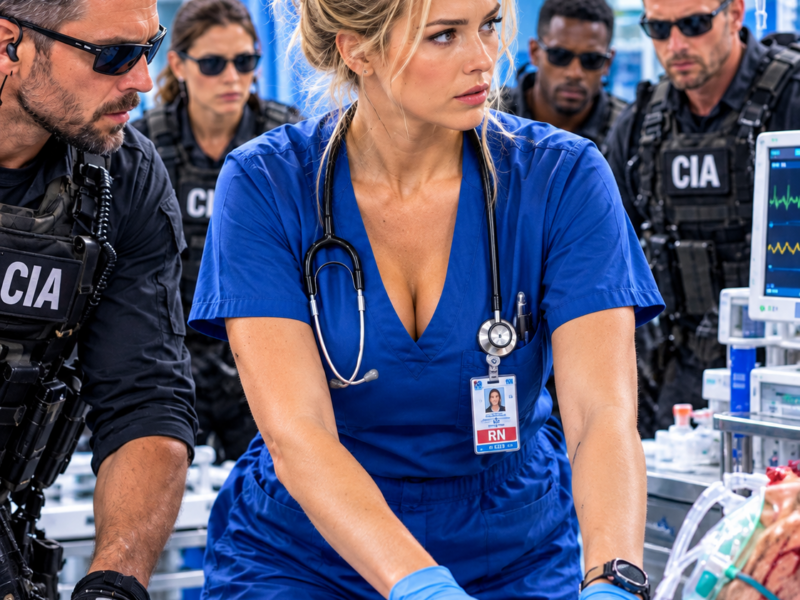
“The night a black SUV pulled up outside my emergency room, three armed men walked straight past hospital security
The drive to the facility took forty minutes.
I sat in the back of an unmarked SUV between Major Brooks and a man who hadn’t introduced himself.
Neither spoke.
I kept looking at the silver dog tag in my hand.
Jack Mercer had given it to me eight years ago, the night before our final operation in Eastern Europe.
I’d handed it back after the mission.
Or at least, I’d thought I had.
The tag was scratched with two words I’d carved into it myself: TRUST NO ONE.
I used to think it was a joke between us.
Now I wasn’t sure it had ever been one.
The facility stood behind two layers of fencing outside a small Virginia town.
No sign.
No windows on the ground floor.
A keypad guarded the entrance, and the cameras followed our vehicle all the way to the loading bay.
Brooks escorted me through a concrete corridor into a room with a steel table and four chairs.
Colonel Adrian Hayes was already waiting.
He looked older, but not as old as he should have.
His hair had gone gray at the temples. His posture was still perfect.
His eyes were exactly the same.
“Emily.”
“Colonel.”
He gestured toward a chair.
I remained standing.
“Where is Jack?”
“Safe.”
“That’s not an answer.”
“He’s being evaluated.”
“By whom?”
Hayes glanced at Brooks.
“Major, give us a moment.”
Brooks didn’t move.
“She came because you said Mercer was alive. She stays informed.”
For the first time, Hayes looked irritated.
“Fine.”
He placed a folder on the table.
Inside were photographs of a man sitting on a narrow bed, his face bruised, his beard uneven, his left hand wrapped in gauze.
Jack.
Alive.
The picture had been taken recently.
I recognized the scar above his eyebrow and the small crescent-shaped mark near his jaw.
But there was something else.
His right wrist was bare.
Jack never went anywhere without the black cord bracelet I’d tied around it after our first deployment.
“Where is his bracelet?” I asked.
Hayes closed the folder.
“That isn’t relevant.”
“It is to me.”
“Emily, you need to understand that Mercer has been through a traumatic extraction. His memory is unreliable.”
I felt my stomach tighten.
“Then why did you bring me here?”
“Because he keeps asking for you.”
“Then let me see him.”
Hayes leaned back.
“First, I need to know what he told you.”
I stared at him.
“You said he was alive. You showed me a photograph. You brought me here. And now you’re asking me to give you information before I can see him?”
“You’re making this more difficult than it needs to be.”
“No. I’m finally making it difficult enough.”
Brooks shifted beside me.
Hayes opened another folder.
This one contained a copy of the mission report from eight years earlier.
I knew the first page by heart.
Operation Black Lantern.
Eastern Europe.
Medical support attached to a special operations unit.
Five personnel listed as deployed.
Two returned.
Three declared missing and presumed dead.
Jack Mercer was listed as one of the dead.
Except the report had a detail I’d never seen.
A handwritten notation appeared beside Jack’s name.
“Asset recovered. Identity suppressed.”
I read it twice.
“What is this?”
Hayes reached for the folder.
I pulled it away.
“Don’t.”
“That document is classified.”
“Then you shouldn’t have put it in front of me.”
The room went quiet.
I turned to the last page.
There was a signature beneath the recovery notation.
Not Hayes’s.
It belonged to Daniel Brooks.
I looked at the major.
He didn’t deny it.
“You signed this?”
“Yes.”
“Eight years ago?”
“Yes.”
“Why?”
Brooks glanced at Hayes.
“Because I was ordered to.”
Hayes’s expression hardened.
“That’s enough.”
“No,” Brooks said. “It isn’t.”
He turned toward me.
“Your team wasn’t supposed to be extracted that night. The operation was officially terminated before your final position was compromised.”
I remembered the radio.
The sudden silence.
Jack shouting my name as the building shook.
The smoke.
The blood on my hands.
And the voice in my earpiece telling me the extraction route was closed.
“You told us the extraction team was on its way,” I said.
Hayes didn’t answer.
Brooks continued.
“Someone changed the authorization after the operation was terminated. A recovery unit entered the area under a valid command code. They found Mercer alive.”
“Why wasn’t he brought home?”
“Because he saw something.”
“What?”
Hayes stood.
“Major, stop.”
Brooks ignored him.
“Jack discovered that the mission’s target wasn’t the person listed in the briefing. The actual objective was a former intelligence officer carrying evidence of an illegal detention program.”
I felt cold.
“We were told we were recovering a captured informant.”
“You were given a cover story.”
“And Jack found out?”
“He found the original transfer records. He learned that the officer had been moved through facilities that weren’t supposed to exist.”
I looked down at the report.
“Why would that make Jack a threat?”
Hayes finally spoke.
“Because Mercer took the records.”
“And you wanted them back.”
“We needed to contain the situation.”
“You left him there.”
“We prevented a wider intelligence breach.”
“You left him there.”
Hayes’s jaw tightened.
“Emily, you were a medical specialist. You weren’t cleared to understand the entire operation.”
“I was cleared to keep my teammates alive.”
“Not at the expense of national security.”
I almost laughed.
“That’s what you told Jack?”
Hayes looked away.
That was answer enough.
Brooks slid a small envelope across the table.
“I found this in the recovery unit’s archived equipment.”
Inside was a photograph.
Jack stood beside a concrete wall, thinner than I remembered, with a split lip and a dark bruise across his cheek.
The date on the back was eight years old.
Beneath it, in handwriting I knew immediately, were six words.
“Emily didn’t know. Keep her safe.”
My fingers tightened around the paper.
“He knew I wasn’t part of it.”
Brooks nodded.
“He insisted you be left out of the investigation.”
“Investigation?”
“Jack had copied the transfer records before he was captured. He hid them somewhere. The recovery team couldn’t find them.”
“Where?”
“We don’t know.”
I looked at Hayes.
“Do you?”
He didn’t answer.
A heavy door opened at the far end of the corridor.
A guard appeared.
“Sir. Mercer is refusing medication again.”
My heart lurched.
“Take me to him.”
Hayes stepped between me and the door.
“Not until we finish.”
I looked at the colonel.
For eight years, I’d carried the memory of Jack dying in a building I couldn’t save.
I’d spent those years convincing myself that leaving the work behind was the only way to survive it.
Now the man who had signed the report was standing between me and the person I’d mourned.
“Move.”
“Emily, listen to me. Mercer is unstable. He may accuse people. He may tell you things that aren’t true.”
“Then I’ll decide what I believe after I hear him.”
Hayes held my gaze for several seconds.
Then he stepped aside.
The guard led us down another corridor.
We passed two locked doors and a security station before reaching a room with a narrow observation window.
Jack sat on the edge of a bed.
His hair was longer. His shoulders were thinner. His face carried scars I didn’t recognize.
But when he looked up, I knew.
He stood too quickly and grabbed the bedframe.
“Ghost?”
My throat closed.
“Hey, Jack.”
For a moment, neither of us moved.
Then he crossed the room.
I stepped through the door, and he stopped inches away, as if he wasn’t sure I was real.
“You came.”
“You asked.”
His eyes moved over my face.
“You’re older.”
“So are you.”
He gave a weak laugh.
Then his expression changed.
“You shouldn’t be here.”
“That’s a strange thing to say to someone you asked for.”
“I asked for you because I didn’t know who else I could trust.”
I glanced toward the observation window.
“That’s not reassuring.”
Jack lowered his voice.
“Hayes knows you’re here?”
“He’s the reason I’m here.”
Jack shut his eyes.
“Then we don’t have much time.”
I took his injured hand.
“What happened to you?”
He looked at our hands.
“They told me you died.”
My chest tightened.
“What?”
“They showed me a report. Said the building collapsed before extraction. Said there were no survivors.”
I stared at him.
“They told me you were dead.”
“I know.”
For eight years, we’d both been grieving ghosts.
Jack swallowed.
“They used your voice.”
I felt the room tilt.
“What?”
“During the first week after I was captured, they played a recording of you. You were asking me to identify the location of the files.”
“I never made that recording.”
“I know that now.”
“How?”
“Because they made a mistake.”
He reached beneath the mattress and pulled out a folded piece of paper.
It was a medical intake form, creased and stained.
On the bottom was a series of numbers.
A date.
A facility code.
And a signature.
My signature.
I looked up sharply.
“Where did you get this?”
“It was in the first recovery file. They used your credentials to authorize my transfer.”
“I never authorized anything.”
“I know.”
Jack pointed to the signature.
“Look at the date.”
I did.
It was three days after the operation.
Three days after the report said I was dead.
Someone had used my credentials while I was still in a hospital bed recovering from the injuries that ended my field career.
“Who had access to my medical authorization?”
Jack’s face tightened.
“Hayes.”
The door opened.
Brooks entered, followed by Hayes.
“Time’s up,” Hayes said.
Jack moved in front of me.
“Don’t let him take the paper.”
Hayes looked at the form in my hand.
For the first time, his composure slipped.
“Where did you get that?”
“That’s what I’d like to know,” I said.
He held out his hand.
“Give it to me.”
“No.”
“Emily, that document is evidence from a compromised file.”
“Then it should be preserved.”
Hayes took one step forward.
Brooks blocked him.
“Colonel, don’t.”
Hayes stared at the major.
“You have no idea what you’re interfering with.”
“I know exactly what I’m interfering with.”
Brooks reached inside his jacket and produced a small recording device.
“Your office has been under a lawful evidence-preservation order since yesterday.”
Hayes went still.
“By whose authority?”
“An inspector general investigation. The authorization was issued this morning.”
I looked between them.
Brooks continued.
“We recovered the original transfer logs. We also recovered the command record showing that your credentials were used to alter the extraction authorization.”
Hayes’s voice dropped.
“Those records are incomplete.”
“Then you’ll have an opportunity to explain them.”
For a moment, I thought Hayes might try to leave.
Instead, he looked at Jack.
“You don’t understand what you did.”
Jack’s voice was quiet.
“I understood enough.”
“You destroyed careers. You compromised an operation that protected people.”
“You mean the people who disappeared into those facilities?”
Hayes said nothing.
Jack turned toward me.
“There’s more.”
He reached for the paper and tapped the facility code.
“This is where they moved the original records. The files weren’t destroyed. They were transferred to an archive under a medical procurement contract.”
I looked at the code again.
It matched the number on the dog tag’s reverse side.
A number I hadn’t noticed before.
“How did you know I’d recognize it?”
“I didn’t. I hoped you would.”
Jack looked toward Brooks.
“Did you bring the key?”
Brooks removed a small evidence bag from his pocket.
Inside was a thin metal key.
Jack stared at it.
“Where did you find that?”
“Inside the lining of your old field jacket.”
I remembered the jacket.
I’d packed it away after the mission, unable to throw it out.
It had disappeared from my apartment during the first year after I left the service.
I’d assumed it had been discarded.
Jack’s expression darkened.
“They took it from you.”
“Who?”
“Hayes’s people. They were looking for the archive key.”
Brooks held the bag up.
“We found it in a storage unit registered to a contractor who worked under Hayes.”
Hayes shook his head.
“This is absurd.”
Brooks didn’t look at him.
“The key opens a physical archive locker. We have a team waiting to secure it.”
Jack exhaled.
“Then we need to move.”
“No,” Brooks said. “You need medical care.”
“I need those records secured before they disappear.”
“They’re already under surveillance.”
Jack looked at me.
“Ghost, listen. There are names in those files. People who were held without charges. People whose families were told they vanished. Some are still alive.”
I felt the old instinct return.
The need to move, to protect, to do something before another person disappeared.
But I wasn’t a soldier anymore.
I was a nurse.
And Jack was injured.
“You’re not going anywhere until someone checks that hand.”
He looked down at it.
“Still giving orders?”
“Only when people are being stupid.”
For the first time since I’d entered the room, he smiled.
Brooks arranged for Jack to be transferred to a secure medical center under independent supervision.
Hayes was escorted away before sunset.
He didn’t resist.
As he passed me, he stopped.
“You think this makes things right?”
I met his eyes.
“No. It makes them visible.”
He looked as if he wanted to say more.
Then the guards moved him down the corridor.
The archive was opened two days later.
I wasn’t allowed inside, but Brooks called me after the first review.
The files contained transfer orders, medical records, and internal communications that had been concealed behind legitimate procurement codes.
They also contained a list of twenty-three people who had been detained outside the legal process.
Nine were still alive.
Four had died in custody.
The others remained unaccounted for.
Jack’s copies had been enough to establish the pattern.
The original records made it impossible to deny.
The investigation expanded beyond Hayes.
Several contractors lost their clearances. Two senior officials resigned. Criminal charges followed against people who had signed false transfer orders and destroyed evidence.
Brooks testified.
So did Jack.
And eventually, so did I.
I told investigators exactly what I remembered from the night of the operation.
I told them about the altered extraction route, the radio silence, and the voice that had told us no team was coming.
I told them what happened after I woke up in the hospital.
I told them I had spent eight years believing Jack Mercer was dead.
No one asked me to make the story easier to hear.
For the first time, the truth didn’t need to be softened to fit inside a report.
Jack stayed in the hospital for several weeks.
His hand healed slowly.
His sleep didn’t.
Some nights he woke convinced he was back in the concrete room.
Sometimes he couldn’t bear to have the door closed.
I learned not to ask him to explain.
I learned to leave the hallway light on.
One afternoon, I found him sitting beside the window with the dog tag resting in his palm.
“Still carrying that?”
He looked up.
“I thought you might want it back.”
I sat beside him.
“I gave it to you.”
“You gave it to me before everything went wrong.”
“Maybe I meant for you to keep it.”
He turned the tag over.
The words TRUST NO ONE caught the light.
“I should’ve trusted you.”
I shook my head.
“You were trying to survive.”
“I let them convince me you were dead.”
“They convinced me the same thing about you.”
He stared out the window.
“Eight years.”
“I know.”
“I don’t know how to get those back.”
I didn’t have an answer.
There was no sentence that could return the birthdays, the ordinary mornings, the years we’d spent living around an absence neither of us understood.
So I reached for his hand.
He let me hold it.
A month later, I returned to Mercy General.
My badge still said Emily Carter, RN.
No call sign.
No classified designation.
Just my name.
The first patient I treated that morning was an elderly man who had fallen outside a grocery store.
He apologized three times for bleeding on the sheet.
I told him not to worry about it.
For a moment, I realized how much I had missed the ordinary work.
Not because it was easy.
Because I knew exactly what I was there to do.
Jack came to visit after his final evaluation.
He waited near the nurses’ station until I finished with a patient.
He looked healthier.
Still thin, still carrying shadows behind his eyes, but standing on his own.
“Coffee?” he asked.
“You’re buying.”
“Fair.”
We walked outside together.
The air was cold, and the afternoon sun reflected off the hospital windows.
He reached into his coat and placed something in my hand.
My old field patch.
The black one with the small white word stitched across it.
GHOST.
“I thought it belonged with you,” he said.
I stared at it.
For years, I’d believed that name was the only part of me worth remembering.
Now I wasn’t sure I wanted to wear it again.
I folded the patch and put it in my pocket.
“Thank you.”
Jack nodded.
We stood quietly for a while.
Then he said, “I don’t know what happens next.”
“Neither do I.”
“Does that scare you?”
I looked at the hospital doors.
Inside, someone was calling for a nurse.
A monitor was beeping.
Life was continuing, ordinary and fragile.
“Not as much as it used to.”
Jack smiled.
We walked back toward the entrance.
I didn’t know whether we would ever become what we had been before the mission.
I didn’t know whether the nightmares would stop, or whether the investigation would uncover more names, more lies, more people who deserved to come home.
But I knew one thing.
Jack Mercer was alive.
And this time, when someone wrote his name into a report, I would be there to make sure they told the truth.
The end.









