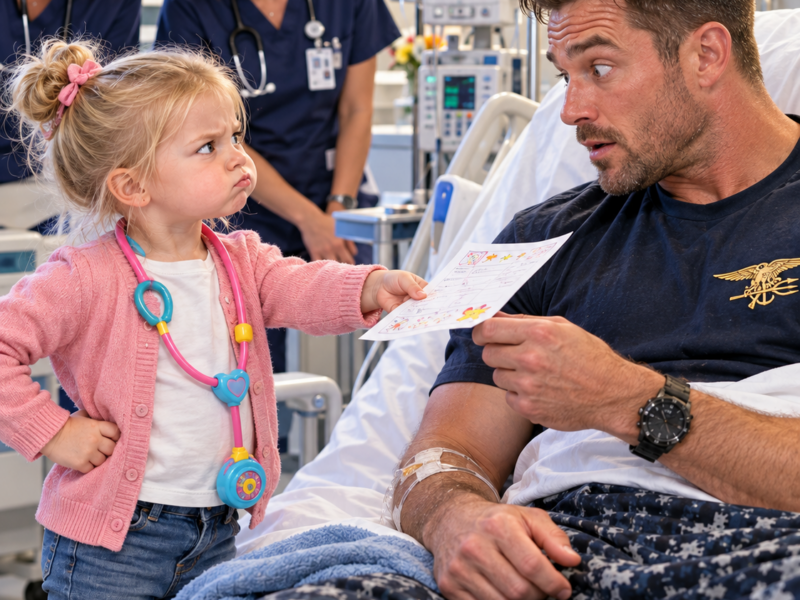
The Navy SEAL had refused every nurse who entered his room
At 7:15 the next morning, I stood outside Chief Petty Officer Jack Sullivan’s hospital room, holding two cups of coffee and trying to convince myself that I wasn’t nervous.
I had barely slept.
The message from Jack’s commanding officer had replayed in my mind all night. There was something about Jack’s refusal to accept help that I didn’t understand, something serious enough that his superior had requested a private conversation.
I had spent eleven weeks learning how to care for injured people, but I was still learning that the hardest wounds were often the ones nobody could see.
And Jack Sullivan looked like a man who had built his entire life around keeping those wounds hidden.
I knocked.
“Come in.”
His voice sounded rough, but not angry.
When I stepped inside, I found him sitting upright in bed. His shoulder was immobilized, his ribs were wrapped, and a breakfast tray sat untouched beside him.
But something had changed.
The little paper contract was propped against his water pitcher, carefully folded so that the gold star Olivia had drawn on the cover was visible.
Jack glanced at the coffee in my hands.
“Bribery?”
“Peace offering.”
“Same thing.”
I placed one cup on his bedside table.
“How are you feeling?”
“Like I was hit by a truck.”
“You were thrown against the side of a military vehicle.”
“Same thing.”
I couldn’t help smiling.
For the first time since I’d met him, his expression softened in response.
Then his eyes moved toward the doorway.
“Is Olivia coming today?”
I raised an eyebrow.
“You’ve known her for less than twenty-four hours, and you’re already asking for her?”
“She’s my supervisor.”
“She’s three.”
“She’s very strict about contractual obligations.”
I laughed.
The sound surprised both of us.
Then I remembered why I’d come.
“Your commanding officer wants to talk to me.”
Jack’s smile disappeared.
“Commander Reeves?”
I nodded.
“He said there’s something I need to know about why you’ve been refusing treatment.”
Jack looked down at his injured hand.
For a moment, I thought he would shut me out again.
Instead, he sighed.
“Then I suppose it’s time somebody told you the truth.”
Before I could ask what he meant, someone knocked on the door.
Commander Thomas Reeves entered wearing his Navy uniform, his expression serious. He was in his early fifties, with silver beginning to show at his temples and the quiet authority of someone who rarely needed to raise his voice.
“Emily Carter?”
“Yes, sir.”
He motioned toward the chair beside Jack’s bed.
“Please sit.”
I sat.
Commander Reeves remained standing for several seconds, looking at Jack as though he were deciding where to begin.
Finally, he spoke.
“Chief Sullivan is one of the finest men I’ve ever commanded. He’s pulled injured teammates out of burning vehicles, stayed behind when everyone else had evacuated, and repeatedly put himself in danger to bring other people home.”
Jack stared at the window.
“Sir, we don’t need to do this.”
“Yes, we do.”
The commander turned back to me.
“Three weeks ago, Jack lost a member of his team during a training exercise.”
My fingers tightened around my coffee cup.
“I’m sorry.”
“Petty Officer First Class Ethan Brooks was twenty-nine years old. He had a wife and a four-year-old daughter. During the exercise, their vehicle overturned after a mechanical failure. Jack was the first person to reach him.”
Commander Reeves paused.
“Jack stayed with Ethan until the rescue team arrived. He did everything he could. But Ethan died before the helicopter reached the medical facility.”
The room seemed to grow colder.
I looked at Jack.
His jaw was clenched so tightly that a muscle moved beneath his cheek.
“Afterward,” the commander continued, “Jack returned to duty too soon. He insisted he was fine. He refused counseling, ignored medical recommendations, and threw himself into training as if he could somehow make up for what happened.”
“Sir,” Jack said quietly.
Commander Reeves ignored the interruption.
“Then Jack’s own vehicle was involved in another accident. He injured his shoulder and cracked three ribs while helping another team member escape.”
I swallowed.
“Was that why he refused treatment?”
“Partly.”
Commander Reeves finally sat down.
“He believes that if he had recognized the danger sooner, Ethan might still be alive. He has convinced himself that being injured is a personal failure and that accepting help somehow dishonors the man he couldn’t save.”
I looked at Jack again.
Suddenly, his anger made sense.
It wasn’t really directed at the nurses, the doctors, or the hospital.
It was directed inward.
Jack finally turned toward us.
“I was the team leader,” he said. “Ethan trusted me to get everyone home.”
His voice was steady, but his eyes were not.
“I gave the order to move. We had a mechanical issue, but I thought we had enough time to clear the training area. I was wrong.”
“You didn’t know the vehicle would fail,” I said.
“I should have known something was wrong.”
“You can’t predict every accident.”
“I was supposed to protect my team.”
The words came out harder than he intended.
Then he looked away.
“And I couldn’t.”
For several seconds, nobody spoke.
I thought about my husband.
Daniel had been a Navy communications specialist. He died during an overseas deployment when Olivia was barely two. I had received the news on an ordinary Tuesday afternoon, while I was folding laundry and planning what to cook for dinner.
One moment, I was annoyed because Daniel had forgotten to call.
The next, I was being told that he wasn’t coming home.
For months, I had replayed every conversation, every disagreement, every ordinary moment I hadn’t realized would become precious.
I had wondered whether I should have called him one more time.
Whether I should have told him I loved him before hanging up.
Whether there had been some small thing I could have done differently.
Grief was a terrible mathematician. It could take a thousand facts and somehow produce one conclusion: If only I had done more.
I looked at Jack.
“You know what I think?” I asked.
He gave me a guarded glance.
“I think you’re trying to punish yourself for surviving.”
His expression hardened.
“You don’t know anything about me.”
“No,” I admitted. “I don’t know everything about you. But I know what it’s like to keep asking yourself what you could have done differently after someone you love dies.”
The room fell silent.
I took a breath.
“My husband died while serving overseas. I spent a long time thinking that if I’d called him one more time, or said something different during our last conversation, I might have changed something.”
Jack’s eyes lifted to mine.
“I knew he was going into danger,” I continued. “But knowing someone is in danger doesn’t mean you can control what happens to them. And loving someone doesn’t mean you can save them from everything.”
My voice trembled.
“I still miss him. I still have bad days. But I finally realized that blaming myself wasn’t bringing him back. It was just making it harder for me to be here for our daughter.”
Jack said nothing.
Then he looked at the little contract on his bedside table.
“Your daughter said her father helped people.”
“He did.”
“She said he was the best.”
“He was.”
Jack swallowed.
“Then I think she knows something most adults spend their whole lives trying to understand.”
“What is that?”
He looked at me.
“That someone can be a good person without being able to save everyone.”
I felt tears sting my eyes.
Commander Reeves stood.
“I’ll leave you two to talk.”
At the door, he paused and looked back at Jack.
“Chief, Ethan’s wife called yesterday. She wanted me to pass along a message.”
Jack went completely still.
“What message?”
“She said she knows you’ve been blaming yourself. She wants you to know that Ethan never blamed you for anything. He spoke about you often. He considered you his brother.”
Jack lowered his head.
For a moment, I thought he might break down.
Instead, he pressed his lips together and nodded once.
“Thank you, sir.”
When Commander Reeves left, the room became painfully quiet.
I picked up the empty coffee cup I had forgotten I was holding.
“I should let you rest.”
“Emily?”
I stopped.
“Would you bring Olivia by later?”
I smiled gently.
“I think she would consider that an official appointment.”
“Good.”
Jack glanced at the contract again.
“And, Emily?”
“Yes?”
“Thank you for telling me about Daniel.”
I nodded.
“Thank you for telling me about Ethan.”
For the first time since I’d met him, I left Jack’s room feeling that perhaps he wasn’t shutting everyone out anymore.
But the real test came that afternoon.
And it arrived wearing pink leggings, a dinosaur backpack, and two tiny ponytails that refused to stay neat.
Olivia came running into the hospital lounge at 2:30 p.m., holding a sheet of paper above her head.
“Mommy! I made an upgrade!”
I crouched to meet her.
“An upgrade to what?”
“My contract!”
She opened the paper.
At the top, she had drawn a crooked picture of Jack lying in a bed. Beside him was a tiny stick figure wearing a nurse’s hat.
Underneath, she had written several letters with my help the night before.
THE GET-BETTER CONTRACT
1. Let the nurses help.
2. Eat some good food.
3. Do your exercises.
4. Don’t be sad alone.
5. Tell someone when your heart hurts.
I stared at the final rule.
“Olivia, who told you to write this?”
She shrugged.
“I thought of it.”
“Why?”
She looked up at me with her father’s serious eyes.
“Because Mr. Jack looks sad when nobody is talking.”
I wrapped my arms around her.
Sometimes children noticed things adults worked very hard to hide.
“That’s a very kind rule, sweetheart.”
“Can I show him?”
I kissed the top of her head.
“Of course.”
When we entered Jack’s room, he was attempting to eat his lunch.
Attempting was the important word.
A plate of vegetables sat untouched beside his chicken, and he was studying it as though the broccoli had personally insulted him.
Olivia marched to his bedside.
“Chief Sullivan!”
Jack straightened.
“Reporting for duty, Supervisor.”
She placed the new contract in his lap.
“I made more rules.”
Jack examined the paper with exaggerated seriousness.
“Five rules? This is getting complicated.”
“It’s because you need extra help.”
“Clearly.”
She pointed at the first four items, explaining each one as if she were presenting a scientific discovery.
Then she reached the fifth.
“Tell someone when your heart hurts.”
Jack stopped smiling.
Olivia leaned closer.
“Does your heart hurt, Mr. Jack?”
I felt my stomach tighten.
“Sweetheart, that’s a very personal question—”
“Sometimes,” Jack answered.
I looked at him.
He wasn’t looking at me.
He was looking at Olivia.
“Sometimes my heart hurts a lot.”
Olivia considered this.
“Then you need a hug.”
Jack’s expression changed.
“I don’t think you’re supposed to hug injured people without asking.”
Olivia immediately folded her hands.
“May I give you a hug?”
He stared at her for a moment.
Then he smiled, small and genuine.
“Yes, ma’am. You may.”
She climbed carefully onto the chair beside his bed and leaned forward, wrapping her tiny arms around his uninjured side.
Jack closed his eyes.
It lasted only a few seconds.
But when Olivia pulled away, his face looked different.
Not happy, exactly.
But less alone.
“Better?” she asked.
“A little.”
“Then the contract works!”
She beamed as if she had personally invented medicine.
Jack laughed softly.
“You might be onto something.”
Olivia pointed at his lunch.
“Now eat your broccoli.”
His smile vanished.
“Let’s not get carried away.”
“Rule two!”
“Could I appeal?”
“No.”
“Could I negotiate?”
“No.”
“Could I request a different supervisor?”
Olivia crossed her arms.
“Not unless you want to lose your sticker.”
Jack sighed with theatrical resignation and picked up a piece of broccoli.
He chewed it.
Olivia watched him closely.
He swallowed.
She clapped.
“Good job!”
Jack looked at me.
“Emily, I need you to understand that this is the most difficult assignment I’ve ever been given.”
I laughed.
“She’s very demanding.”
“She has no respect for rank.”
“She’s three.”
“Exactly. No chain of command whatsoever.”
For the first time in weeks, I heard Jack laugh without immediately swallowing the sound.
And for the first time in a long time, I wondered whether our little family might be able to help someone else heal, even while we were still learning how to heal ourselves.
Over the next several days, a routine developed.
Every afternoon, Olivia visited Jack after I finished my main duties. She brought him drawings, stickers, and occasionally a stuffed rabbit she insisted was a “temporary medical assistant.”
Jack took his contract seriously.
He attended physical therapy, accepted his prescribed medication when appropriate, and began eating more regularly. He still complained, but now his complaints had become part of the routine.
When the physical therapist asked him to perform another set of exercises, Jack would glance at Olivia.
“Does the supervisor approve?”
Olivia would inspect the resistance band.
“Yes. But no cheating.”
“Unbelievable.”
She would nod gravely.
“I’m very professional.”
The nurses began stopping by just to hear their conversations.
Even the attending physician admitted that Jack’s cooperation had improved.
But there was something else happening, something I noticed only gradually.
Jack had started asking Olivia questions about her father.
Not invasive questions. Not questions designed to make her sad.
He asked what Daniel’s favorite food had been, whether he had sung to her, and whether she remembered the games they used to play.
Olivia remembered little details.
Daddy used to make pancakes shaped like animals.
Daddy let her wear his baseball cap.
Daddy once danced around the kitchen with her on his shoulders.
Sometimes, her memories were mixed with stories I’d told her. Sometimes, she repeated a story incorrectly, adding a purple elephant or a talking dinosaur to an event that had happened years before.
Jack never corrected her.
He listened.
One afternoon, Olivia brought a photograph from home.
It showed Daniel in his Navy uniform, holding Olivia when she was only a few months old. He was smiling down at her, his forehead resting against hers.
Jack studied it for a long time.
“He looks like he loved you very much,” he said.
Olivia nodded.
“He did.”
Jack returned the photograph carefully.
“I believe you.”
She tilted her head.
“Did your friend love his little girl?”
Jack’s eyes moved toward the window.
“Ethan? Yes. More than anything.”
“Then you have to tell her stories about him.”
Jack looked back at her.
“What?”
“His little girl. The one your boss told Mommy about.”
I froze.
I hadn’t told Olivia about Ethan’s daughter.
She must have overheard part of our conversation, as children so often did.
Jack looked at the gold star sticker on his hand.
“I suppose I should.”
“Because if you tell her stories, she’ll know he was a good daddy.”
Jack didn’t answer.
Then he nodded.
“You’re right, Olivia.”
She smiled.
“I’m usually right.”
“I’m beginning to suspect that.”
After she ran off to show a nurse her latest drawing, Jack remained quiet.
I sat beside him.
“Have you spoken to Ethan’s family?”
“Not yet.”
“Why not?”
He rubbed his thumb over the edge of the blanket.
“Because I don’t know what to say to his wife. I don’t know how to look at his daughter and explain that I brought everyone else home but couldn’t bring her father home.”
I let the silence settle between us.
“You don’t have to explain everything,” I said. “You can tell them what you remember about him. You can tell them how much he mattered to you. You can tell them you’re sorry.”
Jack’s eyes filled, but he blinked the tears away.
“And if they blame me?”
“Then you’ll have to listen to what they say. But you can’t decide how they feel before you give them the chance to speak.”
He looked at me for a long moment.
“You make it sound easy.”
“It isn’t.”
I thought of Daniel’s empty side of the bed, the quiet house, and the birthdays Olivia had celebrated without her father.
“But avoiding the conversation doesn’t make the loss disappear. It just leaves everyone alone with it.”
Jack nodded slowly.
That evening, he asked Commander Reeves to help him contact Ethan’s wife.
It was the first step he’d taken toward facing the past instead of trying to outrun it.
Two days later, Jack received a visitor.
I was updating a chart when I saw a woman standing outside his room, holding the hand of a little girl with curly brown hair.
The woman looked nervous.
The child looked curious.
I recognized her from a photograph Commander Reeves had shown Jack.
It was Sarah Brooks, Ethan’s widow, and her four-year-old daughter, Lily.
Jack had invited them to visit.
I watched from the nurses’ station as Sarah entered the room.
Jack sat up straighter.
“Sarah.”
“Jack.”
For a few seconds, neither of them moved.
Then Sarah looked at his sling and bandaged ribs.
“You look terrible.”
Jack gave a small, uncertain smile.
“That’s what the doctors keep telling me.”
She didn’t laugh.
Her eyes filled with tears.
“Ethan said you were the most stubborn man he’d ever met.”
Jack looked down.
“He said that about everyone.”
“No. He said you were the only man he knew who could turn a simple lunch into a military operation.”
This time, Jack laughed.
It was a short, broken sound, but it was real.
Sarah wiped her eyes.
“He talked about you all the time.”
Jack’s face crumpled slightly.
“I should have brought him home.”
Sarah went still.
For one awful moment, I thought she might turn and leave.
Instead, she stepped closer.
“Jack, look at me.”
He lifted his head.
“You did bring people home. You helped save the others. Ethan knew the risks of his job. He knew what he was signing up for.”
Jack’s eyes shone.
“But I was in charge.”
“And you loved him. I know you did.”
Sarah took a shaky breath.
“I have spent weeks being angry at the world. I’ve been angry at the military, at the accident, at the fact that I have to explain to my daughter why her father isn’t coming home.”
She looked at Lily, who was holding a small toy airplane.
“Some days, I’m even angry at Ethan for choosing a job that took him away from us.”
Jack didn’t move.
“But I never blamed you,” Sarah continued. “And I don’t want you to spend the rest of your life punishing yourself on my behalf.”
Jack lowered his face into his hand.
His shoulders shook.
He was crying.
Not the quiet tears a person wipes away before anyone notices. Not the single tear that slips down a cheek while someone insists they’re fine.
He was crying like a man who had carried something too heavy for too long and had finally been told he could set it down.
Sarah reached for his uninjured hand.
“I can’t bring Ethan back,” she whispered. “Neither can you. But I can tell you that he loved you like a brother, and he would hate knowing that you were destroying yourself because of what happened.”
Jack covered his eyes.
“I’m sorry.”
“I know.”
“I’m so sorry.”
“I know, Jack.”
Lily tugged on her mother’s sleeve.
“Mommy, is this Daddy’s friend?”
Sarah knelt beside her.
“Yes, sweetheart. This is Jack. Daddy loved him very much.”
Lily looked at Jack.
Then she walked toward his bed and held out her toy airplane.
“You can borrow it,” she said. “But you have to give it back.”
Jack stared at the little airplane.
His lips trembled.
“I promise.”
Lily nodded, satisfied.
Then she leaned forward and gave him a quick hug.
I turned away, wiping my eyes.
Because I understood something in that moment.
Children didn’t know how to repair every wound.
They couldn’t change the past or undo a terrible accident.
But sometimes, they could offer something adults were too frightened to ask for.
A chance to begin again.
Jack’s recovery wasn’t magical.
He still had difficult days.
His shoulder hurt. His ribs ached when he coughed. Physical therapy left him exhausted, and some nights he woke from dreams about the accident with his heart racing and his hands clenched against the sheets.
But he began talking to the hospital counselor.
He began telling Commander Reeves when he was struggling instead of pretending everything was fine.
And he began understanding that strength wasn’t measured by how much pain a person could endure without making a sound.
Sometimes, strength meant admitting that the pain was too much to carry alone.
One morning, I found him sitting beside the window with Olivia’s original contract in his hands.
The paper was creased and smudged from being handled so often. The gold star sticker had lost some of its shine.
“What are you thinking about?” I asked.
Jack looked up.
“Your daughter.”
“That sounds dangerous.”
“She has a remarkable ability to make people do things they don’t want to do.”
“She’s been practicing on me for three years.”
Jack smiled.
Then he turned the contract toward me.
“There’s something I want to ask you.”
I sat down.
“Go ahead.”
“When I’m discharged, would you and Olivia let me take you both to dinner?”
I blinked.
“Dinner?”
“Nothing fancy. Somewhere with pancakes, if that’s what she likes.”
“She likes pancakes shaped like animals.”
“Then I’ll find a place that makes animal-shaped pancakes.”
I studied him carefully.
“Jack, I appreciate everything you’ve shared with us, but I want to be sure you’re asking because you genuinely want to spend time with us—not because Olivia’s been helping you recover.”
He nodded.
“That’s fair.”
He looked down at the contract.
“Your daughter reminded me of something I forgot. I don’t have to earn the right to care about people by saving them. I don’t have to be useful every second of every day to deserve a place in someone’s life.”
His voice softened.
“I want to know you both better. I want to see what happens when I’m not lying in a hospital bed with a little girl threatening me with stickers.”
I laughed.
“That may be the most honest invitation I’ve ever received.”
“So is that a yes?”
I pretended to consider it.
“I’ll consult the supervisor.”
“Of course.”
That afternoon, I asked Olivia what she thought.
She considered the question with great seriousness.
“Will Mr. Jack be there?”
“Yes.”
“Will he eat his vegetables?”
“I assume so.”
“Then we can go.”
She paused.
“But Mommy?”
“Yes, sweetheart?”
“Can Mr. Jack come to our house too? Sometimes?”
I looked at her.
“Why do you want that?”
She hugged her stuffed rabbit.
“Because he looks sad when he goes back to his room.”
I pulled her into my arms.
“We’ll see, sweetheart.”
But I already knew my answer.
Three weeks later, Jack was discharged from the hospital.
His shoulder still needed rehabilitation, and his ribs would take more time to heal completely, but he was finally well enough to continue recovering at home.
On his last afternoon, the nurses gathered in his room.
Patricia brought a card signed by the staff. The physical therapist presented him with a printed list of exercises he promised to follow. Commander Reeves stopped by to tell him that his team was waiting for him when he was ready to return.
Jack thanked everyone.
Then he turned toward Olivia.
She stood beside my chair, wearing her pink star sweatshirt and holding a new piece of paper.
“What’s that?” Jack asked.
She handed it to him.
It was a certificate.
At the top, in large, colorful letters, she’d written:
OFFICIAL RECOVERY HERO
Underneath was a drawing of Jack standing beside a little girl. Both of them had enormous smiles. A gold star floated above their heads.
At the bottom, with my help, Olivia had added one final sentence:
You don’t have to be strong every day. You just have to keep trying.
Jack stared at it for a long time.
Then he crouched carefully in front of her, wincing a little as he moved his injured shoulder.
“Olivia, this is the best award I’ve ever received.”
“Better than your Navy medals?”
He smiled.
“Much better.”
“Why?”
“Because your award reminds me of something important.”
“What?”
“That I don’t have to do everything alone.”
Olivia wrapped her arms around his neck.
Jack hugged her gently.
I watched them, feeling a warmth I hadn’t experienced in a long time.
For months, I had believed that moving forward meant learning to live without Daniel.
I had thought healing meant reaching a point where his absence no longer hurt.
But watching Jack hold my daughter, I understood that healing didn’t mean forgetting the people we had lost.
It meant learning how to carry their love into the lives we still had.
Jack stood and looked at me.
“Ready for pancakes?”
Olivia gasped.
“Animal pancakes?”
“Animal pancakes.”
“And you have to eat your vegetables!”
“I’m beginning to regret this friendship.”
“No, you’re not,” she said confidently.
Jack looked at me.
“She knows too much.”
I laughed.
Then, for the first time in years, I walked out of a hospital not as a nurse rushing toward another shift, not as a widow trying to hide her grief, but as a woman who could imagine a future that didn’t feel quite so lonely.
We went to a small family restaurant near the waterfront.
Olivia ordered pancakes shaped like a bear. Jack ordered eggs, toast, and a side of vegetables he insisted were included only to satisfy the contract.
I ordered coffee and watched them argue about whether the bear’s ears counted as separate pancakes.
At one point, Olivia reached across the table and placed a gold star sticker on Jack’s sleeve.
“What is this one for?” he asked.
“For being brave.”
Jack looked at the sticker.
Then at Olivia.
“Thank you, Supervisor.”
She nodded.
“You’re welcome.”
Outside, the late afternoon sun shimmered over the water. For a moment, the world seemed peaceful enough that I could almost believe nothing terrible would ever happen again.
I knew better than that.
Life would still bring hard days. Jack would still have memories he struggled with. I would still miss Daniel. Olivia would eventually grow old enough to ask questions I couldn’t answer with simple stories about pancakes and brave sailors.
But we didn’t have to face those days alone.
And sometimes, that was enough.
Six months later, Jack stood beside me at Olivia’s preschool graduation.
He had completed his rehabilitation and returned to limited duty, with a gradual transition back to full responsibilities approved by his medical team. He still attended counseling and had learned to recognize when grief was becoming too heavy to carry by himself.
Sarah and Lily had joined us, too.
Lily sat beside Olivia in the front row, both girls wearing paper crowns decorated with stars.
When the children were called forward, Olivia marched onto the little stage and accepted her certificate with the same seriousness she’d shown when handing Jack his contract.
Then she spotted us in the audience.
She waved so enthusiastically that her paper crown slipped sideways.
Jack laughed.
“She gets that from you,” he whispered.
“Her stubbornness?”
“Her determination.”
I looked at him.
“That’s a very generous way to describe it.”
“I’m trying to improve my vocabulary.”
After the ceremony, Olivia ran straight toward us.
“Mr. Jack! I graduated!”
“I noticed.”
“Does that mean I’m a big girl now?”
Jack crouched to her height.
“It means you’re growing up.”
She thought about that.
“Can I still make contracts?”
“Absolutely.”
“Can I make one for you?”
He smiled.
“I was hoping you would.”
She pulled a folded piece of paper from her backpack.
Of course she had prepared one.
Jack opened it.
There were only three rules this time.
OLIVIA’S NEW CONTRACT
1. Keep helping people.
2. Ask for help when you need it.
3. Remember that you are loved.
Jack read the list twice.
Then he looked at me.
His eyes were shining.
“Your daughter has a gift,” he said quietly.
I watched Olivia run off to show Lily her graduation certificate.
“Yes,” I replied. “She does.”
Jack folded the contract carefully and placed it in his pocket beside the original one he still carried.
Then he offered me his hand.
I took it.
We didn’t need to define everything that moment meant. We didn’t need to promise that life would always be easy or that the future would never surprise us.
We only needed to keep showing up.
For Olivia.
For the people we loved.
And for ourselves.
Because the Navy SEAL who had once refused every nurse had finally learned that accepting help didn’t make him weak.
It made room for something he had nearly forgotten how to feel.
Hope.
And it all began with a three-year-old girl, a crumpled piece of paper, and a simple contract that asked him to do the one thing he had spent weeks refusing to do.
Let someone care.
THE END.









