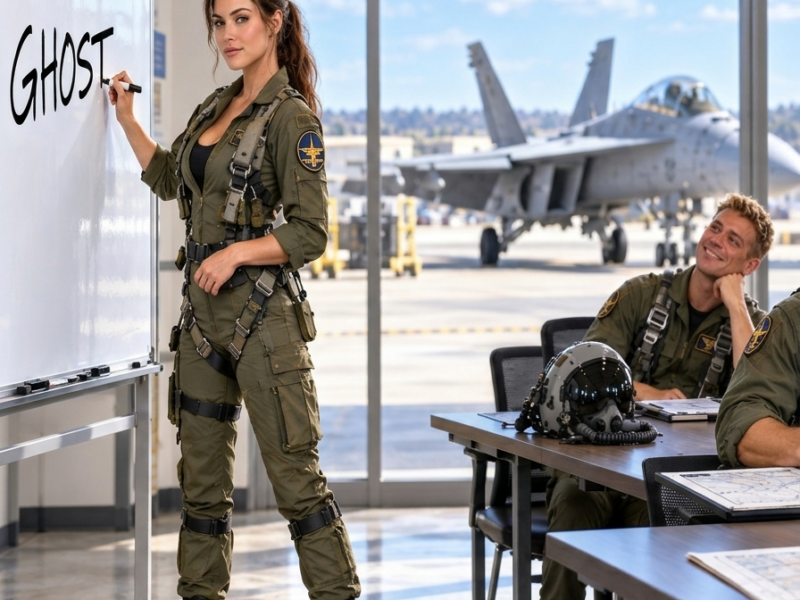
The moment I walked into the TOPGUN briefing room at Naval Air Station Fallon and introduced myself as their new instructor
The laughter died so suddenly that I could hear the cold air conditioner humming high in the ceiling above us. One pilot stopped halfway through opening his plastic water bottle, the cap frozen between his thumb and forefinger. Another leaned forward over the polished oak briefing table, staring at the thick black ink on the whiteboard as if the letters might dissolve under the harsh glare of the fluorescent lights.
Jake Morrison’s cocky, self-assured smile faded into a mask of pure disbelief. His jaw slacked, his pale eyes dilating as he re-read the three words written in sharp, unyielding strokes across the board:
VIPER ACTUAL — 06
“No way,” Jake whispered, his voice losing every trace of the arrogance that had filled the briefing room only ten seconds prior. “That’s… that’s impossible.”
Captain Hayes stepped away from the digital projector screen. He didn’t say a word. He walked with slow, heavy steps toward the reinforced steel door of Briefing Room B, reached out, and turned the heavy brass deadbolt into place with a resounding, metallic CLICK.
That was when the entire atmosphere inside Naval Air Station Fallon changed. The casual air of hotshot TOPGUN instructors dissolved into the cold, suffocating weight of a high-level military operational secret.
Six years earlier, Viper Actual had been the designated flight lead call sign attached to a black-budget intercept mission over the stormy, freezing waters of the North Pacific—a mission that officially never existed in the Department of the Navy’s historical archives. A six-ship formation of specialized F-22s and dark-variant Hornets had been ambushed by an unidentified, low-observable adversary force during a classified radar-testing exercise. Communications had been jammed by ground-based electronic warfare suites. One aircraft had detonated in mid-air. Another had limped back to an emergency strip in Alaska with a completely dead port engine and a shattered canopy.
And the flight commander who had stayed behind in the radar-blind sky, drawing heavy surface-to-air missile fire away from the surviving young lieutenants so they could reach international airspace… had vanished into the clouds.
The Pentagon had declared that pilot lost at sea, presumptive dead. The surviving aviators were subjected to seventy-two hours of intense isolation, debriefed by civilian intelligence officers, and bound under the Espionage Act never to utter the call sign Viper Actual or speak of the mission again under threat of treason charges.
I had been that pilot.
I had spent eight excruciating months in a secret medical facility in Landstuhl, recovering from compound spinal fractures, deep thermal burns, and severe internal trauma caused by a high-G ejection into freezing salt water. I had spent the next four years fighting a quiet, lonely bureaucracy—a battle against shadow contractors and redacted paper trails that no civilian would ever see. When I was finally medically recertified to fly, the world had moved on without me. My name had been quietly scrubbed from Navy flight logs, my decorated combat record had been locked inside a Class-4 security vault, and the impressionable young men whose lives I had saved were told by their superiors that their commanding officer was nothing more than a tragedy of deep-water training exercises.
Jake stood up slowly from his leather chair, his palms pressed flat against the mahogany table. His flight suit patch read LT CDR JAKE ‘OUTLAW’ MORRISON.
“My squadron commander… he was the wingman on the second element that day,” Jake said, his chest heaving as he stared at me. “He told me Viper Actual died getting them home. He told me she bled out over the Pacific so they could cross the radar line.”
I looked directly into his eyes, keeping my hands perfectly still at my sides. “Your squadron commander was giving you the official story he was forced to sign, Commander. He was wrong.”
Jake’s jaw tightened, a mix of anger and phantom grief flashing across his face. “Then why didn’t you come back? Why did you let the Navy print memorial plaques? Why did you let us think you were buried at the bottom of the ocean?”
For the first time that morning, I felt the sharp, familiar pain rise behind my left ribs—the deep ache of scar tissue and broken bones that had never healed quite right.
Because I had tried.
Because the private defense cabal that had engineered that illegal weapon test had threatened to revoke the pensions, flight statuses, and safety of every young pilot I had led that day if I ever stepped back into the light. Because every time I had attempted to file a formal inspector general report, a fresh man in a dark suit would appear in my doorway to remind me how many naval families would be utterly ruined if the scandal broke on national television.
I picked up the dry-erase marker cap and snapped it onto the pen with a loud clack. “I didn’t come to Fallon to tell you my life story, Morrison. I came here to teach you how to survive when your instruments fail, your radio goes dead, and your country lies to you.”
Captain Hayes stepped forward, reaching for the remote console on the podium. “We don’t have time for a historical debate, gentlemen,” the Captain said, his deep voice cutting through the tension like a blade. He clicked the button on the projector remote.
The overhead lights dimmed slightly as a high-resolution, classified intelligence slide materialized on the white wall beside my handwriting. The image showed six dark fighter aircraft cutting through a towering bank of pitch-black storm clouds over an open expanse of ocean.
“At 0600 hours this morning,” Captain Hayes continued, “the Chief of Naval Operations and the Senate Armed Services Committee granted emergency authorization to reopen the full criminal investigation into Operation Cold Horizon.”
The twelve TOPGUN instructors stared at the slide in complete silence.
Hayes clicked the remote a second time.
The image shifted to a high-contrast surveillance photograph. It showed a tall, lean man standing beside the dark fuselage of an unmarked, delta-wing tactical aircraft parked inside an unknown concrete hangar. His face was partially obscured by the dark visor of an advanced helmet, but the distinct scar running down his right jawline was unmistakable.
My knees went weak. The air starved in my lungs. My hand gripped the edge of the briefing table so hard my knuckles turned ghostly white.
I recognized him instantly. He was Captain Ethan Vance—my primary wingman six years ago. The man I had watched disappear into a blinding wall of smoke and enemy fire. The man whose supposed death I had mourned every single night while sitting in dark recovery rooms, staring at old unit photographs.
Beneath his photograph was a single line of bright red text:
STATUS: ALIVE — LOCATION CLASSIFIED — CODE: BLACK
“Ethan…” I whispered, the name tasting like ash and long-buried tears in my throat.
Jake looked frantically from the glowing screen to my frozen face. “Ma’am… what does this mean? If Vance is alive, where has he been for six years? Who has he been flying for?”
Before I or Captain Hayes could offer an answer, the secure landline telephone resting on the instructor’s podium let out a harsh, shrill ring that shattered the quiet of the room.
Captain Hayes grabbed the receiver on the second ring. “Hayes. Briefing Room B.”
He listened in complete silence for three agonizing seconds. As he listened, every drop of color drained from his face, leaving his weathered skin an ashen, ghostly gray. His eyes darted slowly up from the floor until they locked directly onto mine.
“Understood,” Hayes said quietly into the phone. “Clear the primary strip. Lock down the perimeter.”
He slowly lowered the black receiver back into its cradle, his hand trembling slightly.
I stared at him, my heart hammering against my chest like a trapped bird. “Captain? What is it?”
Hayes cleared his throat, his voice dropping an octave into a low, somber tone. “Viper Actual… we have a major tactical anomaly.”
“Speak, Captain,” I demanded.
“Your wingman, Captain Ethan Vance, just broke civilian airspace protocols,” Hayes said, looking at the assembled pilots. “He just pinged Fallon tower on a secure military transponder code. He’s requesting immediate emergency landing rights on Runway 13 Left.”
A heavy pause hung in the air.
“He’s coming in?” I asked, my voice barely audible. “Ethan is coming here?”
Hayes looked down at the desk, then back at me with absolute dread in his eyes.
“He’s on final approach right now, Maya,” Hayes whispered. “And he’s not coming alone. Tower reports he’s being escorted by three unidentified black-world aircraft… and they just armed their radar locks over Nevada.”
“Locking weapons on Fallon airspace?” Jake shouted, slamming his hand down onto the wooden table as he stood up. “That’s restricted military sky! Tower needs to scramble the ready-alert division right now!”
“Sit down, Commander!” Captain Hayes barked, his voice booming through the locked briefing room like thunder. “The ready-alert division is currently sitting in this very room! And if any of you step out onto that tarmac with armed ordnance without understanding the tactical context of what’s landing out there, you’ll start a civil war over Western Nevada!”
I turned away from the whiteboard, my heart pounding violently against my ribs, but my mind suddenly clearing into the cold, crystalline focus that only combat can bring. The phantom pain in my left side vanished. The scar tissue didn’t matter anymore.
“Captain,” I said, my voice dropping into a low, commanding tone that silenced every pilot in the room. “What is the transponder signature of the three escorting birds?”
Hayes stepped over to the podium monitor, tapping the digital radar feed linked directly from the NAS Fallon control tower. “They’re pinging as Aegis Tactical Wing,” Hayes replied, his eyes scanning the telemetry data. “No tail numbers. No country codes. They’re flying modified, low-observable airframes with high-output electronic warfare suites. They’re riding Ethan’s tail feathers like a herd of wolves driving a wounded deer into a pen.”
“Aegis Dynamics,” I growled, the name tasting like venom on my tongue.
It was the same private defense contractor that had built the faulty guidance systems for Operation Cold Horizon six years ago—the same corporate syndicate that had bought off high-ranking Pentagon officials to bury the truth about the disaster and transform dark military tech into an off-the-books commercial weapons empire.
“They aren’t escorting him,” I said, turning to face the twelve young aviators staring at me. “They’re tracking him. Ethan stole something from them, or he’s carrying the physical evidence that can put Aegis executives in federal prison for the rest of their lives. They let him fly this far so he would lead them directly to whoever holds his master decryption key.”
Jake looked at me, the arrogance completely gone from his posture, replaced by the razor-sharp focus of an elite fighter pilot. “And you’re the master key, aren’t you, ma’am?”
“I am,” I answered simply. “Six years ago, before we launched into the Pacific, Ethan and I split the hard-copy flight logs and mission telemetry into two encrypted flash-drive modules. He kept the hardware data. I kept the cryptographic key inside my father’s old service dog tags. Without me, his data is useless. Without him, my key is just a piece of metal.”
Outside the thick concrete walls of the briefing room, a deep, earth-shaking roar vibrated through the floorboards. The deafening twin-engine thrum of a heavy tactical fighter sweeping low over the airfield caused the framed photographs of historic naval aircraft along the walls to rattle violently.
“He’s on the deck,” Captain Hayes said, unlocking the heavy door with a swift turn of his key. “Runway 13 Left. All pilots, you are under strict orders from me: no weapons are to be drawn unless I give the word. We go out there as an escort.”
We flooded out of Briefing Room B and strode down the long concrete concourse of the primary flight operations building. As we burst through the double glass doors onto the sun-blinded asphalt of the flight line, the dry desert heat of Fallon hit us like a blast furnace.
Out on the main runway, half a mile away, a single, dark-gray, wing-battered fighter jet was rolling to a halt, its landing gear tires smoking heavily against the hot concrete. It was an unpainted, radar-absorbent variant of an F-15 Silent Eagle, its fuselage covered in scorched paneling, soot, and bullet-pitting along the tail fins. The canopy was cracked, covered in high-altitude frost that was rapidly melting in the Nevada sun.
Hovering three thousand feet directly above the base airfield were three jet-black, swept-wing tactical aircraft. They circled in a tight, predatory combat air patrol formation, their twin engines whining like mechanical hornets, their radar nose-cones pointed straight down at the Fallon flight line.
“Look at those airframes,” Jake whispered, shielding his eyes from the glare as he stood beside me on the apron. “No national roundels. No branch markings. Those aren’t military birds, ma’am. Those are corporate mercenaries.”
“They’re Aegis interdictors,” I said, watching the three dark shapes in the sky. “They won’t strike the base directly with missiles—not with federal radar tracking them from Nellis and Reno. But the moment Ethan steps out of that cockpit or tries to cross the tarmac, they’ll drop a precision strike or drop ground operators outside the perimeter fence.”
A yellow naval flight-line utility vehicle slammed to a stop beside us. Captain Hayes jumped into the driver’s seat. “Maya, Morrison, get in! The rest of you, establish a perimeter around Hangar 4!”
Jake and I leaped into the back of the utility vehicle. Hayes slammed the accelerator to the floor, and the vehicle rocketed across the wide asphalt taxiway toward the idling, smoking jet sitting on Runway 13 Left.
As we screeched to a halt beneath the massive twin tail fins of the battered F-15, the aircraft’s heavy plexiglass canopy groaned and unlatched, rising slowly into the air with a hiss of pneumatic pressure.
A pilot sat in the ejection seat, clad in a darkened, sweat-stained flight suit without a single patch. He slowly pulled off his oxygen mask, letting it dangle by its rubber hose. He lowered his gold-visored helmet, revealing a pale, exhausted face lined with dark circles, a thick beard, and the deep, jagged scar running down his right jaw.
Ethan Vance looked down from the cockpit at me.
His pale green eyes widened in shock. For a long, painful ten seconds, neither of us said a word over the deafening whine of the aircraft’s cooling fans.
“Maya…” Ethan rasped, his voice raw and raspy, as if he hadn’t used his vocal cords to speak English in years. “God in heaven… you’re really here.”
“You’re late for the debrief, Captain,” I said, my voice trembling despite my absolute best efforts to remain professional. Tears burned behind my eyes, but I forced them back, taking a step up the maintenance ladder on the side of the fuselage. “Six years late.”
Ethan let out a harsh, dry laugh that quickly turned into a violent coughing fit. He reached down into his flight suit pocket and pulled out a small, heavy, titanium-cased drive unit stamped with a red military seal. His hands were trembling, covered in dried blood from a shrapnel cut on his left wrist.
“I kept it safe, Flight Lead,” Ethan whispered, holding the drive out toward me. “Every flight log. Every radar recording. The names of every Aegis board member who ordered the kill-switch on our formation over the Pacific. I spent six years hiding in a private hangar in East Asia, waiting for the right satellite clearance to bring this back to home territory.”
I reached out and took the cold titanium drive from his blood-stained fingers. As my hand touched his, a profound sense of closure washed over me—the ghost that had haunted my sleep for six years was a living, breathing man standing right in front of me.
“You did good, Ethan,” I said softly. “You brought the evidence home.”
“Maya, listen to me,” Ethan urged, leaning forward against the edge of the cockpit, his eyes filled with intense, urgent terror. “The three birds overhead… they aren’t just watching us. They’re running an automated targeting loop linked to a heavy tactical command team currently sitting two miles outside Fallon’s north gate.”
Before I could answer, Captain Hayes’s tactical radio blared with static from the utility vehicle below.
“Tower to Hayes! We have a perimeter breach at North Gate! Two un-marked armored transports just rammed the security barrier! Armed personnel in tactical gear are moving on foot toward Hangar 4!”
Above us, the high-pitched scream of jet engines intensified. One of the three black aircraft circling overhead peeled off from the formation, dipping its nose into a steep, aggressive diving vector pointed directly at the main fuel depot adjacent to the taxiway.
“They’re going to blow the fuel farm!” Jake yelled, pointing up at the descending black shadow. “They’re creating a mass-casualty distraction so their ground team can sweep the hangar and take that drive!”
I looked down at Jake, then at Captain Hayes, and finally up at Ethan in the cockpit. The time for waiting for orders was over. The bureaucratic battle was dead. This was a tactical dogfight on our own home turf.
“Morrison!” I shouted over the rising roar of the engines.
“Ma’am!” Jake responded, snapping to attention.
“Are there two combat-ready F/A-18E Super Hornets sitting fueled in Hangar 3 with hot alert starts?”
Jake’s eyes lit up with fierce, tactical adrenaline. “Yes, ma’am! Fully loaded for weapons school demonstration flights!”
I looked down at the titanium drive in my hand, then looked up at the sky where the corporate mercenaries were diving toward my base.
“Get to Hangar 3,” I commanded, stepping down the maintenance ladder with the drive tucked safely inside my leather jacket. “You’re flying my wing today, Outlaw. Let’s show these mercenaries why you never mess with TOPGUN.”
The heavy steel doors of Hangar 3 rolled back with a grinding mechanical screech, revealing twin F/A-18E Super Hornets sitting under the bright overhead lights like tethered predators. Ground crews were already scattering as Jake and I sprinted across the concrete floor, pulling on our survival vests, G-suits, and flight helmets in a frenzy of coordinated motion.
“Ma’am!” a young Navy crew chief yelled, running alongside me with a clip board. “Those aircraft are prepped for high-altitude tactics demonstrations! They have live AIM-9X Sidewinders on the wingtips and full 20mm cannon drums, but the tactical data-link isn’t calibrated to base radar!”
“We don’t need base radar, Chief!” I shouted back, grabbing the ladder of the lead Hornet—tail number 06. “We’re flying visual engagement rules! Turn on the ground power units and clear the ramp!”
I swung myself into the cockpit of Hornet 06, the smell of jet fuel, leather, and heated electronics enveloping me like an old, familiar armor. My hands moved across the instrument panels by pure muscle memory—switches flipping, fuel pumps humming to life, the twin General Electric F414 engines spooling up with a deep, vibrating whine that shook the frame of the jet.
Beside my canopy, in Hornet 07, Jake Morrison was slapping his helmet visor down, giving me a crisp, sharp hand signal—thumbs up, flight controls clear. The cocky kid who had mocked me two hours ago in the briefing room was gone; in his place sat an elite naval aviator ready to execute orders without a second of hesitation.
“Fallon Tower, this is Viper Actual,” I barked into my helmet microphone, adjusting the oxygen mask over my face. “Two-ship Hornet element rolling onto Taxiway Alpha. Clear the airspace.”
“Viper Actual, Tower,” the controller’s voice cracked through the radio, thick with panic. “You are not cleared for departure! Federal authorities have locked down all regional air corridors!”
“Override code Cold Horizon 06, Tower,” I shot back, slamming the dual throttles forward into military power. “Tell federal authorities they can file a complaint with my debrief team after I clear my sky.”
The twin Super Hornets roared out of Hangar 3, their tires screaming as we executed a tight, high-speed taxi turn onto Runway 13 Left. Without waiting for a formal takeoff clearance, I slammed both throttles past the detent into full afterburner.
Twin plumes of bright blue fire erupted from the tails of our aircraft. The force of the acceleration slammed my back deep into the ejection seat, pressing five Gs of pressure onto my chest as the desert floor blurred into a streak of tan and yellow outside my canopy.
“Rolling!” Jake shouted over the intra-flight channel. “I’m on your left wing, Viper!”
At 160 knots, I hauled back on the control stick. Hornet 06 rotated sharply, its nose pitching up sixty degrees into a near-vertical climb. We tore through the desert heat shimmer, breaking through the low thermal layer at eight thousand feet in less than fifteen seconds.
“Keep your eyes open, Outlaw,” I instructed, leveling off at twelve thousand feet and sweeping my radar screen. “The three Aegis interdictors are flying low-observable profiles. They won’t show up on standard pulse-doppler until we’re within six miles.”
“Contact!” Jake called out instantly, his voice rising in pitch. “Visual! Two o’clock high! Two of the black birds are dropping out of the sun, coming down fast on Ethan’s parked F-15!”
“Engage master arm,” I commanded, flipping the red safety cover on my control stick. “We shoot to protect the flight line. Take the trailing bird, Outlaw. The leader is mine.”
I banked Hornet 06 hard to the right, pulling seven Gs as the high-G suit compressed tightly around my legs and abdomen to keep the blood in my brain. The world outside tilted violently—the brown desert floor spinning above my head while the deep blue Nevada sky dropped below my nose.
The lead Aegis interdictor flashed across my canopy—a sleek, delta-wing black jet with no markings, its belly loaded with hardpoints. He saw us coming. His pilot executed a high-G break to the left, dropping thermal flares that burned bright white against the blue sky.
“He’s fast!” Jake shouted, his Hornet trailing my right wingtip like a shadow. “He’s trying to drag us toward the mountain ridge where his ground jamming unit is operating!”
“Don’t bite the bait!” I ordered. “He’s trying to separate us! Stay tight on my formation!”
I tracked the black interdictor through my Helmet-Mounted Cueing System. A high-pitched, steady tone hummed inside my headset—the heat-seeking seeker head of the AIM-9X Sidewinder missile on my wingtip locking onto the hot exhaust plume of the enemy jet.
BEEP-BEEP-BEEP-EEEEEEEEEEE!
“Viper One, fox two!” I yelled, pressing the red launch button on the stick.
With a heavy flash of light and a cloud of white smoke, the AIM-9X missile detached from my left wingtip. It ignited its solid-fuel rocket motor, instantly accelerating to Mach 3 as its vectoring thrust nozzle made violent, right-angle corrections in mid-air, tracking the evasive black fighter through the desert sky.
The Aegis pilot dropped three more clusters of flares and pulled into a desperate, vertical climb, trying to out-G the missile’s tracking logic.
It was useless.
The Sidewinder struck the interdictor’s right engine cowl with a bright, orange fireball. The explosion sheared off the enemy jet’s tail assembly, sending the black airframe spinning out of control like a broken leaf toward the uninhabited salt flats below. A white parachute blossomed two seconds later as the mercenary pilot ejected into the desert air.
“Direct hit!” Jake roared over the radio. “Target one splash! Hell of a shot, ma’am!”
“Watch your six, Outlaw!” I screamed, my eyes scanning the upper quadrant of my canopy. “Where’s number three?!”
“Viper! He’s behind you!” Ethan’s raspy voice suddenly barked over our tactical frequency from his radio console in the parked F-15 on the ground. “Interdictor Three dropped out of the high cloud layer! He’s locked on your tail feathers!”
A loud, piercing warning chime erupted inside my cockpit:
WARNING. MISSILE LAUNCH. MISSILE LAUNCH.
“Breaking left!” I shouted, slamming the stick to the left stop and stomping on the rudder pedal, dumping three bundles of radar-chaff and infrared flares into the slipstream behind me.
A sleek, radar-guided missile shot past my canopy by less than fifty feet, its sonic boom rattling my cockpit glass before it plummeted harmlessly into the empty desert sand below.
I inverted the Hornet, pulling hard through a Split-S maneuver to reverse my direction of flight. As I pulled out of the dive at two thousand feet above the ground, the third Aegis interdictor flashed directly in front of my nose cone, trying to blow past me into the safety of the northern mountains.
“You picked the wrong day to fly over Fallon,” I muttered through my oxygen mask.
I switched from missiles to the M61A2 Vulcan 20mm rotary cannon. The green reticle on my Heads-Up Display lined up directly over the black jet’s wing root.
I squeezed the trigger.
The 20mm cannon beneath my nose cone roared with a deep, vibrating mechanical buzz that shook the front of my jet, firing high-explosive armor-piercing incendiary rounds at a rate of a hundred rounds per second.
A stream of bright red tracer rounds stitched across the black interdictor’s left wing, tearing through the carbon-composite skin, severing the hydraulic flight control lines, and setting the fuel cell ablaze. The enemy jet lost all lift, its nose pitching violently downward into an unrecoverable flat spin before slamming into the empty desert floor in a massive pillar of black smoke and fire.
“Target three down!” I called out, my breath coming in deep, heavy rasps inside my mask. “Outlaw, report status!”
“Target two turned tail and ran north the second you splashed his flight lead, Viper!” Jake replied, his Hornet sliding back into a tight formation on my right wingtip. “Sky is clear over Fallon!”
I leveled out my jet, looking down through the side canopy at the airfield below.
Emergency vehicles, fire trucks, and federal security transports were surrounding the parked F-15 on Runway 13 Left. Military police were cuffing the black-clad ground contractors who had attempted to breach the north gate. The base was secure.
“Fallon Tower, Viper Actual,” I said, bringing my throttles back to cruising speed. “Airspace is swept clean. Two Hornets returning to the pattern for landing.”
“Copy that, Viper Actual…” the tower controller replied, his voice filled with awe and deep respect. “Runway 13 Left is cleared for your arrival. Welcome back to the sky, Colonel.”
I looked across the sky at Jake’s Hornet. Through his canopy, I could see him look over at me, slowly raising his right hand to his helmet brow in a crisp, reverent military salute.
I returned the salute, turning my aircraft back toward the runway lights of Fallon. The six-year battle in the shadows was over. The dogfight over Nevada was won. But as I lined up my approach path, I knew the final battle—the one that would bring down the men in suits who had started it all—was just about to begin.
The tactical transport flight from Naval Air Station Fallon to Andrews Air Force Base outside Washington D.C. flew through the dark, quiet hours of midnight.
Inside the passenger cabin of the C-37A VIP transport jet sat Captain Hayes, Ethan Vance, Jake Morrison, and myself. On the polished table between us rested the two recovered data drives—Ethan’s titanium hardware module and my cryptographic drive that had been unlocked using the master key from my father’s dog tags.
Ethan sat quietly by the window, wearing a clean, dark blue Navy service uniform that Captain Hayes had provided for him. His hands no longer trembled, but his eyes were fixed on the black clouds passing outside the window.
“I spent six years living in an abandoned warehouse near the docks of Busan,” Ethan said softly, his voice low in the quiet cabin. “A retired Korean Air Force mechanic hid me from Aegis contractors. Every time I heard a helicopter overhead, I thought it was the strike team coming to finish what they started over the Pacific.”
I reached across the table, placing my hand over his. “You don’t have to look over your shoulder anymore, Ethan. The data on those drives is currently being mirrored to the servers of the Department of Justice, the Senate Armed Services Committee, and the Inspector General of the Department of Defense.”
Jake looked up from his secure tablet, where he had been reviewing the decrypted mission logs. His face was pale with anger. “This isn’t just about weapon failures, ma’am. Look at these financial transfer logs. Aegis Dynamics was intentionally sabotaging US Navy radar systems during live exercises to force Congress to approve their private $40-billion autonomous defense contract.”
“And they used our formation as the live testing ground,” Captain Hayes added grimly, resting his elbows on the table. “They jammed our comms, disabled Ethan’s flight computer, and tried to kill Maya so there wouldn’t be any surviving pilots to testify before the Senate committee.”
The transport aircraft began its descent, the lights of the nation’s capital breaking through the low clouds below like a sea of amber stars.
An hour later, a convoy of dark, armored SUVs escorted by federal law enforcement vehicles sped down Pennsylvania Avenue, pulling into the secure underground parking garage of the United States Capitol Building.
The emergency closed-door hearing of the Senate Select Committee on Intelligence was convened at 0200 hours.
Inside the grand, wood-paneled hearing room, three high-ranking US Senators, two federal prosecutors, and the Director of Naval Intelligence sat behind a curved dais. Standing at the witness table, dressed in our sharpest service uniforms with every medal and citation pinned to our chests, were Ethan Vance, Jake Morrison, and myself.
Sitting in the row of public benches behind us, flanked by four federal marshals, were three men in tailored charcoal suits. At the center of them sat Arthur Pendelton—the Chief Executive Officer of Aegis Dynamics and former Assistant Secretary of Defense. His face was a mask of cold, arrogant disdain, his expensive legal team whispering furiously into his ear.
“This hearing will come to order,” the Committee Chairman declared, striking his wooden gavel once against the desk. “We are here to receive testimony regarding Operation Cold Horizon and allegations of high treason, corporate espionage, and murder against Aegis Defense Dynamics.”
The Chairman looked down over his glasses at me. “Colonel, you were declared killed in action six years ago over the Pacific. The Department of the Navy listed you as lost at sea. Can you state for the official record why you are standing before this committee today?”
I stepped up to the brass microphone, my voice clear, resonant, and completely devoid of hesitation.
“I am standing here today, Mr. Chairman, because six years ago, my wingman and I refused to let corporate greed dictate who lives and who dies in the skies above our nation,” I said, my voice echoing off the high marble walls of the chamber.
For the next two hours, the hearing room was locked in dead silence as Ethan and I laid out the complete, step-by-step chronology of the betrayal over the Pacific. We presented the decrypted flight telemetry showing the exact second Aegis technicians had sent an external override command to disable our formation’s navigation systems. We presented the recorded communications logs proving that Pendelton had personally signed the order to delay search-and-rescue operations for forty-eight hours to ensure no survivors were recovered.
As the final video recording—captured from my own cockpit camera six years ago—played on the high-definition monitors inside the chamber, showing my burning Hornet fighting to draw missile fire away from my formation, several Senators sat back in their leather chairs, visibly shaken by the raw intensity of the footage.
Arthur Pendelton leaned forward toward his microphone, his voice dripping with venomous arrogance. “Mr. Chairman, this is an absurd political witch hunt! These officers are presenting altered, un-verified data files! This woman was discharged years ago and is mentally unstable from combat trauma—”
“Shut your mouth, Mr. Pendelton,” the Committee Chairman interrupted, his voice dropping into an icy rage as he struck his gavel down hard. “The digital signatures on these drives have just been independently verified by the National Security Agency and the Federal Bureau of Investigation. Every file is genuine.”
The Chairman stood up from his leather chair, looking down at the federal marshals standing in the back of the room.
“Federal Marshals, arrest Arthur Pendelton and his executive officers immediately,” the Chairman commanded. “Charge them with treason, conspiracy to commit murder, and fraud against the United States government.”
The courtroom erupted into quiet, intense movement as federal agents stepped forward, pulling Pendelton’s arms behind his back and snapping heavy steel handcuffs around his wrists.
Pendelton glared at me as he was dragged past the witness table, his arrogance finally collapsing into pure, pathetic desperation. “You think this changes anything?!” he spat at me. “You’re a ghost! Your career is over!”
I looked him dead in the eye as he was led away through the double doors.
“Ghosts don’t die, Pendelton,” I said quietly. “We just wait for the right light to show up.”
Jake Morrison stood beside me, watching the disgraced corporate titan being escorted into federal custody. He turned to me, a proud, genuine smile spreading across his face.
“That was the finest piece of tactical shooting I’ve ever seen, ma’am,” Jake said softly. “And you didn’t even need a jet for it.”
I looked at Ethan, who was staring up at the grand seal of the United States hanging behind the Senate dais, a single tear cutting through the faint scar on his cheek. For the first time in six years, the shadow that had hung over our lives was completely, permanently gone.
Three weeks later.
The morning sun rose over the vast, open expanse of the Nevada desert, painting the rugged granite peaks around Naval Air Station Fallon in brilliant shades of gold, orange, and crimson. The crisp morning air carried the faint, sweet smell of high-octane aviation fuel and desert sagebrush.
I stood on the concrete apron outside Hangar 3, dressed in my green flight suit, my leather flight jacket worn comfortably over my shoulders. Pinned proudly above the left pocket was the restored gold emblem of my Naval Aviator wings, flanked by the newly awarded Navy Cross medal that had been presented to me by the Secretary of the Navy during a private ceremony at the Pentagon two days prior.
Standing in a neat, disciplined semi-circle in front of me were the twelve aviators of the TOPGUN instructor class.
At the center of the formation stood Lieutenant Commander Jake Morrison. His posture was rigid, his eyes sharp, his flight suit pristine. The cocky smile he had worn on my first day at Fallon was long gone, replaced by the quiet, grounded confidence of a pilot who understood the true cost of the wings he wore.
Beside me stood Captain Ethan Vance, fully reinstated to active flight status and officially appointed as the Deputy Director of Tactical Evaluation for the Naval Strike and Air Warfare Center.
“Atten-shun!” Jake barked, his voice echoing across the quiet tarmac.
All twelve pilots snapped their heels together, standing at absolute attention in the bright morning sunlight.
I walked slowly down the front line of aviators, looking each of them directly in the eye.
“Three weeks ago,” I said, my voice carrying clearly over the gentle desert breeze, “a pilot walked into your briefing room and wrote a call sign on the board. Most of you thought it was a ghost story. Some of you thought it was a joke.”
I stopped directly in front of Jake.
“What did you learn out there in the desert, Morrison?” I asked him.
Jake looked straight ahead, his chin held high, his voice steady and unwavering. “I learned that a real flight lead never abandons their wingman, ma’am. Not in the sky, not in the debrief, and not in the dark.”
I offered a small, genuine smile—the first true smile I had felt in six long years.
“At ease, gentlemen,” I said softly.
The pilots relaxed their posture, a quiet wave of respect and warmth passing through the group.
Captain Hayes stepped out from the shade of the hangar, carrying a small wooden box under his arm. He walked over to me, opening the velvet-lined interior to reveal twelve newly minted silver unit patches.
Inscribed on each patch was the silhouette of a dark fighter jet cutting through a bolt of lightning, surrounded by dark blue thread that spelled out the newly authorized squadron designation:
42ND TACTICAL EVALUATION SQUADRON — VIPER ACTUAL
“The CNO approved the unit reactivation this morning, Maya,” Captain Hayes said, his eyes filled with deep pride. “They wanted to know who you chose to lead the first operational flight.”
I reached into the wooden box, picked up the lead patch, and handed it directly to Jake Morrison.
Jake stared down at the silver patch resting in his palm, his breath catching in his throat. “Ma’am… I… I don’t know what to say.”
“Don’t say anything, Outlaw,” I said, clapping a hand firmly on his shoulder. “Just attach that patch to your flight suit, get to your jet, and precheck your instruments. We’re flying high-altitude tactical intercepts over the Sierra ridge in twenty minutes.”
“Yes, ma’am!” Jake shouted, a bright, fierce grin spreading across his face as he turned to his fellow pilots. “You heard the Colonel! Let me see those preflight checks! Rolling in ten!”
The pilots scattered across the tarmac, running toward their waiting F/A-18E Super Hornets with high-energy purpose and crisp, disciplined camaraderie.
Ethan walked over to my side, watching the young aviators scramble up their boarding ladders. “They’re good kids, Maya. Reminds me of us six years ago.”
“They’re better than we were, Ethan,” I said, pulling my helmet off the workbench and securing the chin strap. “Because they know what happens when you lose sight of the truth.”
I walked over to my own Hornet—tail number 06—which had been freshly painted overnight. Resting beneath the canopy glass, written in crisp, sharp white lettering, was my restored military name and call sign:
COL. MAYA ‘VIPER ACTUAL’ LIN
I climbed the ladder, swung my legs into the ejection seat, and strapped myself into the cockpit that had become my sanctuary, my battleground, and my home. I connected my oxygen mask, switched on the main battery power, and felt the twin powerful engines hum to life beneath me, vibrating through my spine like a familiar, comforting heartbeat.
I looked out through the clear glass canopy at the vast, endless blue sky stretching far over the mountains of Nevada.
The dark clouds were gone. The ghosts were laid to rest. The truth was written in the stars.
I slammed the canopy down, locked the seal, and pushed the throttles forward into the sunlight.
The end.









