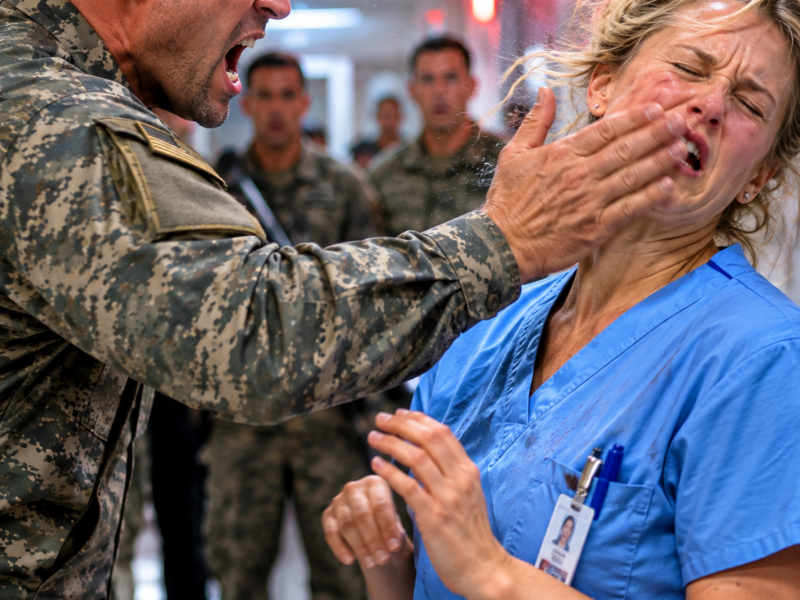
“THE LIEUTENANT SLAPPED A NURSE IN FRONT OF DOZENS OF MILITARY PERSONNEL, THEN ORDERED HER TO APOLOGIZE FOR ‘DISRESPECTING HIS RANK
For three seconds, nobody in the medical corridor moved.
Lieutenant Commander Richard Hayes stared at the photograph in Master Chief Daniel Mercer’s hand as if the image itself had the power to destroy him. The color drained from his face, and the fingers he had curled into fists slowly opened at his sides.
I stood beside the nurses’ station with my cheek still burning, unable to understand how a man who had just struck me could suddenly look more frightened than I felt.
“What does my brother have to do with this?” Hayes demanded.
Mercer didn’t raise his voice. “Everything.”
He placed the photograph on the counter beneath the bright fluorescent lights. It showed a young Navy sailor lying in a hospital bed, his face bruised, his left arm immobilized, and a thick bandage wrapped around his head. Even through the grainy image, I recognized him.
Petty Officer First Class Nathan Hayes.
Six months earlier, I had helped treat him after a training incident that nearly cost him his life.
My stomach tightened.
I remembered the blood on his uniform, the desperate questions he had asked about his brother, and the way he had gripped my wrist when a doctor told him he needed emergency treatment.
But I also remembered something else.
A medical restriction.
A missing report.
And a man who had insisted that everything was fine.
“Emily,” Chief Petty Officer Melissa Grant whispered beside me, “do you know what he’s talking about?”
I swallowed.
“I think I do.”
Hayes snatched a look toward me. “You have no idea what happened six months ago.”
“I remember your brother,” I replied.
“You remember a patient. That’s all.”
Mercer slid a second document out of the folder.
“No, Commander. She remembers a patient who was ordered back into a training environment despite documented symptoms that should have kept him out of it. She remembers reporting those symptoms. And she remembers someone attempting to make that report disappear.”
The corridor seemed to grow colder.
Hayes looked at the document but didn’t touch it.
“That is a serious accusation.”
“Correct,” Mercer said. “Which is why we’re not going to settle it with accusations. We’re going to settle it with evidence.”
He turned to the lieutenant standing behind him.
“Lieutenant, secure the original records and notify the command legal office. No one alters or removes anything from this facility until the preservation order is in place.”
The lieutenant nodded and stepped away.
Hayes’s expression hardened again, but I saw the fear underneath it.
“You can’t walk into my facility and start issuing orders.”
Mercer finally looked him directly in the eye.
“I can when the matter involves a special warfare readiness review, potential medical-record interference, and the public assault of a Navy medical professional who may be a material witness.”
He paused.
“And you should be very careful about what you say next.”
I had served in the Navy for six years. I had watched officers argue over paperwork, seen people mistake rank for permission, and learned how quickly a quiet room could become dangerous when someone powerful felt threatened.
But I had never watched a senior officer lose control of a situation so completely without anyone raising a hand.
Hayes glanced toward the people gathering at the corridor entrance.
“Everyone out,” he snapped. “This is a command matter.”
“No,” Mercer replied. “It stopped being private when you struck a nurse in front of witnesses.”
The words landed with a force no slap could match.
Chief Grant moved closer to me.
“You all right?” she asked softly.
I wanted to say yes. I wanted to straighten my uniform, lift my chin, and pretend the burning on my cheek was the only thing bothering me.
Instead, I said, “I don’t know.”
It was the first honest answer I had given all morning.
Mercer noticed my expression.
“Petty Officer Carter, I need you to tell us what you remember. Not what you think it means. Just what you personally saw, heard, and documented.”
I looked at Hayes.
He stared back at me, and for a moment I saw something that had been missing from his face since he entered the corridor.
Not anger.
Recognition.
He knew exactly what I remembered.
And he knew that I had never forgotten it.
Six months earlier, Nathan Hayes had arrived at our medical facility shortly after dawn, brought in from a special warfare training site outside Norfolk.
He was conscious when the stretcher rolled through the emergency entrance, but his skin was gray, his breathing was shallow, and his answers came slowly. His uniform had been cut away from one shoulder, and dried blood marked the side of his head.
The initial report described a training accident involving a fall and a collision during a high-intensity exercise.
It sounded straightforward until the details stopped matching.
Nathan had complained of dizziness and blurred vision before the exercise. He had told the medic on site that he felt sick, that his balance was off, and that the headache he had been experiencing for two days was getting worse.
Those details were in the notes.
They were also missing from the summary sent with him.
While the medical team assessed his condition, I helped gather the information that had accompanied him from the training site. A small card in his medical packet listed a restriction that had not been cleared. There was also a note recommending further evaluation before he returned to strenuous activity.
Someone had signed the training roster anyway.
When the attending physician asked why Nathan had been permitted to participate, the accompanying officer said the restriction was outdated and that the sailor had been cleared verbally.
There was no signed clearance.
There was no documented reassessment.
There was only a statement from an officer who wanted the incident treated as an unfortunate accident.
I remembered that officer because he had stood at the end of Nathan’s bed with his arms folded, impatiently checking his watch.
Lieutenant Commander Richard Hayes.
At the time, I did not know he was Nathan’s older brother.
I learned that later, when Nathan regained enough strength to ask whether his family had been notified.
The doctors stabilized him and arranged further evaluation. He survived the immediate crisis, but the incident led to questions about his symptoms before training and whether the restrictions placed on him had been properly respected.
I had documented what Nathan told me.
I had recorded the discrepancy between the original notes and the summary.
And when investigators asked me what I had observed, I told them the truth.
I did not accuse anyone of deliberately causing an injury. I did not claim to know why the records differed. I simply explained what had been present in the packet, what Nathan had said, and what I had heard during his treatment.
That testimony mattered because it contradicted the claim that no warning signs had been reported.
The review had expanded beyond the original accident. Several personnel were interviewed, training procedures were examined, and questions were raised about who had approved Nathan’s participation.
Then, before the process reached a conclusion, I was told that the matter had been reviewed and that I should return to my duties.
No one explained what had happened to the missing documentation.
No one told me whether the discrepancies had been resolved.
And after a few weeks, people stopped talking about it.
I assumed the investigation had moved beyond anything I needed to know.
I was wrong.
Now, standing in the same medical corridor where Hayes had struck me, I understood why Mercer had come looking for my testimony.
He wasn’t investigating a single outburst.
He was reopening a door someone had spent six months trying to close.
“I remember the original packet,” I said. “Nathan’s symptoms were documented before the exercise. There was a restriction in the paperwork, and I could not find a signed clearance authorizing him to return to full training.”
Mercer nodded.
“Did you personally see the lieutenant commander approve his participation?”
“I saw him standing with the training paperwork. I heard him tell the attending physician that Nathan had been cleared verbally. I did not see him sign the original restriction, and I can’t say who removed the information from the summary.”
“That’s exactly the distinction we need,” Mercer replied. “What you saw, not what you assume.”
Hayes gave a short, disbelieving laugh.
“This is absurd. My brother was an adult. He knew his own body. He chose to train.”
“Did he?” Mercer asked.
Hayes said nothing.
“Because the statement Nathan gave during his recovery says he reported his symptoms, asked whether he was cleared, and was told that his restriction had been handled.”
“That statement was taken while he was medicated.”
“His later statement was taken after his doctors cleared him to participate in an interview. It says the same thing.”
Mercer opened the folder again and removed a printed email.
“This is a message sent the night before the exercise. It refers to Nathan’s restriction and asks whether he can be removed from the roster. The reply says, ‘He’s good to go. I’ll handle it.’”
Hayes’s jaw tightened.
“That could have been written by anyone.”
“It was sent from your official account.”
For the first time, Hayes looked genuinely unsteady.
I stared at the email. I couldn’t read the entire message from where I stood, but the date was clear. So was the name printed beneath the reply.
Richard Hayes.
My mouth went dry.
“Why?” I asked before I could stop myself.
Everyone turned toward me.
I looked directly at Hayes.
“Why would you tell people he was cleared if he wasn’t?”
His eyes flashed.
“You don’t know anything about my family.”
“No,” I said. “I know what I saw when your brother came through those doors. I know what he told us. And I know how close he came to dying.”
“You have no idea what was at stake.”
“Then explain it.”
For a moment, I thought he might strike me again.
His shoulders rose, and his hands clenched. Chief Grant stepped between us before he could take a single step.
“Commander,” she said, her voice sharp, “you will not approach her.”
Mercer didn’t move. He didn’t need to.
Hayes looked at the witnesses, at the lieutenant returning from the records office, and finally at the photograph on the counter.
Something in him seemed to collapse.
“You think I wanted this?” he asked quietly.
Nobody answered.
“You think I wanted my own brother carried out of a training area? You think I wanted to watch him lie in that bed?”
“No one said that,” Mercer replied.
“You don’t understand what Nathan was doing to himself. He had spent years trying to prove he belonged. He was afraid one medical restriction would end his career. He was afraid they’d send him somewhere else, that he’d never get back to his team.”
“So you decided for him?” I asked.
Hayes turned toward me.
“I was trying to protect him.”
The words came out almost desperately.
And for the first time, I believed that he might have told himself that was true.
But believing his motive did not erase what he had done.
“You protected his career on paper,” I said. “You didn’t protect his life.”
The silence that followed was heavier than any shouting.
Hayes lowered his gaze.
Mercer closed the folder.
“Commander, you will accompany the reviewing officer for a formal interview. You will not contact witnesses or attempt to influence the handling of medical records. The appropriate authorities will determine the next steps.”
“You can’t just remove me based on her word.”
“We’re not,” Mercer replied. “We’re preserving records, collecting statements, and reviewing evidence. Your opportunity to respond will be part of that process.”
He turned toward the lieutenant.
“Make sure the security footage is preserved. Get the names of every witness. And arrange for Petty Officer Carter to receive medical attention and a written record of this incident.”
“I don’t need special treatment,” I said.
“It’s not special treatment,” Mercer replied. “It’s proper procedure.”
Those words should not have affected me as much as they did.
Yet after months of watching questions disappear into administrative silence, hearing someone insist that procedure applied to everyone felt almost unreal.
Hayes looked at me one last time.
“You could have come to me,” he said.
I stared at him.
“I did. Six months ago, when I documented what happened to your brother, I did my job. Today, you hit me because I refused to put my name on a clearance I couldn’t support.”
His face reddened.
“You humiliated me in front of my staff.”
“You did that yourself.”
The words came out before fear could stop them.
For a moment, nobody breathed.
Then Mercer motioned toward the exit, and the lieutenant escorted Hayes away from the nurses’ station.
The corridor remained silent until the doors closed behind them.
Only then did I realize my hands were shaking.
Chief Grant took my arm.
“Come on,” she said. “Let’s get you checked.”
I let her guide me into a small examination room, where a medic assessed the swelling on my cheek and documented the injury. The pain was manageable, but the emotional aftermath was harder to name.
I had expected anger.
Instead, I felt exhausted.
The kind of exhaustion that comes from holding yourself together for so long that you forget what it feels like to stop.
Chief Grant sat beside me while the medic finished the report.
“You did the right thing six months ago,” she said.
“I know.”
“Do you?”
I looked down at my hands.
“I knew the facts. I knew my documentation was accurate. But when everyone stopped talking about the case, I started wondering if I had made things harder for people without actually helping anyone.”
“That’s how these situations wear people down,” she said. “They make you think silence means you were wrong.”
I swallowed hard.
“What if my testimony doesn’t change anything this time?”
“Then the record will still show what happened. And the next person who tries to bury it will have to work harder.”
I wanted to believe her.
But I had learned not to confuse the first sign of accountability with a guarantee of justice.
An hour later, I was asked to provide a formal statement about the assault. I described the argument, the demand for a medical clearance, my refusal, and the moment Hayes struck me. I named every witness I could remember and explained where the security cameras were positioned.
I also described what had happened six months earlier, carefully separating what I had personally observed from what I had learned afterward.
No dramatic accusations.
No guesses.
Just the truth.
When I finished, the reviewing officer asked whether I wanted to add anything.
I thought about Hayes standing beside his brother’s hospital bed. I thought about Nathan trying to prove he was strong enough to continue serving, even when his own body was telling him to stop.
Then I thought about the hand that had struck my face that morning.
“Yes,” I said. “I want it understood that following a medical restriction is not disloyalty. It’s part of the job. A patient should never have to risk their life to protect an officer’s reputation.”
The officer wrote down my words.
For the first time that day, I felt that I had been heard.
Late that afternoon, Master Chief Mercer returned to the medical facility. He asked whether I had time to speak with him privately, and I agreed.
We sat in a small conference room with a window overlooking the parking lot. The sun had begun to lower, turning the glass buildings across the road a muted gold.
“I’m sorry you were put through that,” he said.
“Thank you.”
“I also owe you an explanation about why I came here today.”
I waited.
“Nathan is attached to a special warfare unit that has been under review since the training incident. I was assigned to examine whether the command’s readiness procedures were being followed and whether the earlier review had adequately addressed the discrepancies in his records.”
“So you already suspected something was wrong?”
“We had evidence that the original review might have been incomplete. What we did not have was a reliable account of what happened inside this medical facility.”
“You had my statement.”
“We had a summary of it. We did not have the complete supporting record, and some of the records we requested could not initially be located.”
My stomach tightened.
“Could not be located?”
“That’s why we ordered preservation of the remaining files and the security footage. We need to establish exactly what happened to the documents, when they were moved, and who had access.”
I thought of the missing details in Nathan’s medical summary.
“Does that mean someone deliberately removed them?”
“It means we have to find out. I won’t tell you we know more than we do.”
I appreciated that answer more than he probably realized.
“What about Hayes?”
“His conduct today will be investigated separately from the original incident, although the two may be relevant to one another. His actions don’t prove every allegation about the earlier review. But they do raise serious concerns about his willingness to respect a process he doesn’t control.”
I looked through the window.
“Is Nathan going to be all right?”
Mercer was quiet for a moment.
“He’s recovering. He’s been working with his medical team, and he’s no longer being pressured to prove his fitness by ignoring their advice. The injury changed his life, but he has people around him who want him to recover properly.”
I let out a breath I hadn’t realized I was holding.
“Does he know what happened today?”
“He knows the review has reopened. He doesn’t yet know about the assault.”
“Are you going to tell him?”
“That’s his brother’s responsibility, unless the investigation requires otherwise.”
I nodded slowly.
Then Mercer leaned forward.
“There’s something else. Nathan asked me to give you a message if I found you.”
I stared at him.
“He knows who I am?”
“He remembers you. He remembers that you explained every step before the doctors treated him. He remembers you refusing to tell him what he wanted to hear just because he was frightened.”
My eyes burned.
“He was in terrible shape. I was just doing my job.”
“He said that was what made the difference. You didn’t treat him like a problem to be moved off a roster. You treated him like a person who needed help.”
I turned my face away and blinked hard.
I had spent six months wondering whether my testimony had mattered.
Now, sitting in a quiet room, I learned that the man at the center of the entire case remembered the simplest thing I had done for him.
I had told him the truth.
And I had stayed beside him while he faced it.
“What did he want you to tell me?” I asked.
Mercer took a small folded note from his folder.
“He wrote it himself.”
I opened it carefully.
The handwriting was uneven, but I could read every word.
*Petty Officer Carter, I don’t remember every face from that morning, but I remember yours. You told me I wasn’t weak for needing help. I spent months thinking I had to prove everyone wrong. I’m trying to learn that surviving isn’t the same as failing. Thank you for not letting me disappear inside somebody else’s paperwork.*
I read it twice.
Then I folded it and held it between my palms.
For the first time since the slap, the tightness in my chest eased.
Not because the case was solved.
Not because Hayes had been punished.
But because Nathan was still here, still recovering, and still able to tell his own story.
That mattered.
The investigation continued for several weeks.
The security footage confirmed the assault, and witness statements supported my account. Hayes was relieved of his supervisory duties while the matter was reviewed. He was given an opportunity to respond through the appropriate process, and the findings regarding his conduct were handled separately from the broader review of the training incident.
The records investigation uncovered discrepancies between the original medical documentation and the summary circulated after Nathan’s injury. Investigators examined the electronic access history, interviewed personnel who had handled the paperwork, and traced how the restriction had been represented in the training records.
I was not present for every interview, and I did not pretend to know what each witness said.
I only knew what the evidence established about my own part in the case.
My documentation had been accurate.
My testimony had been consistent.
And the medical restriction had not been properly cleared before Nathan returned to strenuous training.
The final findings did not turn the incident into a simple story of one villain and one hero. Several people had failed to ask necessary questions. Some had relied on assurances instead of verifying the records. Others had accepted incomplete summaries because they were easier to process than a deeper investigation.
Hayes’s role was examined in light of the evidence, including his messages about Nathan’s readiness and the statements he had made during the original incident review.
The reviewing authority concluded that his decisions had contributed to a serious failure in the training and medical clearance process. His attempt to intimidate me after I refused to falsify a clearance, along with the assault, led to formal disciplinary consequences.
I never learned every detail of his private response.
I did hear that he had finally spoken to Nathan without an audience of officers, investigators, or medical staff.
That conversation was not easy.
Nathan later told me that his brother had apologized for making decisions on his behalf and for treating his career as something he had the right to manage. Nathan had accepted the apology, but he had not promised that everything between them would return to normal.
“I told him I still love him,” Nathan said when he visited the facility months later. “I also told him that love doesn’t mean I have to pretend he didn’t hurt me.”
I thought that was one of the bravest things I had ever heard.
Nathan looked healthier than he had in the photograph. He still moved carefully, and there were days when his recovery frustrated him, but he no longer carried the frantic need to prove himself through pain.
We spoke in the same corridor where the incident had begun, although the nurses’ station had long since returned to its ordinary rhythm.
He thanked me for the testimony.
I told him he didn’t owe me anything.
“I know,” he said. “That’s why I wanted to say it.”
Before he left, he paused beside the doorway.
“Can I ask you something?”
“Of course.”
“When my brother hit you, did you think about what happened to me?”
I considered the question.
“Yes,” I said. “I thought about how frightened you were. I thought about how much pressure you must have felt. And I thought about how easily someone can convince themselves that doing the wrong thing is acceptable if they believe they’re protecting someone.”
Nathan nodded.
“That sounds like him.”
“Does it?”
“Sometimes he gets so focused on keeping everything together that he forgets people aren’t things he can arrange.”
He looked down the corridor, then back at me.
“I used to do the same thing to myself.”
We stood quietly for a moment.
Then he offered me a small, tired smile.
“I’m working on that.”
“So am I,” I admitted.
After Nathan left, I returned to my duties.
The work had not changed. Patients still arrived frightened, confused, angry, or convinced that admitting pain would make them less valuable. Medical forms still had to be completed. Restrictions still had to be verified. Every shift brought a new set of decisions, and most of them would never attract the attention of an investigator.
But I changed.
I stopped assuming that a quiet conclusion meant a fair one. I stopped treating discomfort as proof that I had done something wrong. And I stopped apologizing for asking people to follow procedures that existed to protect lives.
A few weeks after the investigation concluded, Mercer visited once more.
He found me reviewing a patient’s file and waited until I finished.
“I wanted to let you know the readiness review has resulted in changes to the way medical restrictions are verified before certain high-risk training exercises,” he said. “The updated process requires confirmation through the appropriate medical authority rather than reliance on an informal assurance.”
“That should have been the process all along.”
“Yes,” he said. “It should have.”
He did not try to make the outcome sound grander than it was.
There would be more reviews, more training, and more opportunities for someone to make a mistake. No policy could guarantee that every officer would act wisely or that every record would be handled honestly.
But the system had been forced to confront a failure it had once allowed to fade into silence.
That was not everything.
It was something.
Before Mercer left, I asked him a question that had been troubling me.
“Why did you mention Nathan when you confronted Hayes? Why not just address the assault?”
“Because the assault was the immediate issue,” he replied. “But I recognized what he was trying to do. He was using his rank to control the conversation before anyone could ask what he was afraid of.”
He paused.
“I wanted him to understand that intimidation would not erase the earlier evidence. And I wanted the witnesses to understand that the situation was bigger than a disagreement over a form.”
I looked at the nurses’ station, where the morning’s events had begun.
“Do you think he understood?”
“I think he understood that he couldn’t control the outcome anymore. Whether he understands why his choices were wrong is something only time can answer.”
I nodded.
That was fair.
I had learned not to confuse a moment of fear with a moment of change.
Months later, I was assigned to help orient a new group of medical personnel. During the session, one young corpsman asked what to do if a senior officer insisted that a patient was fit for duty when the medical record suggested otherwise.
The room grew quiet.
I recognized the look on his face. He was not asking only about policy. He was asking what would happen to him if he said no.
I placed my hands on the table.
“You document what you observe. You follow the established medical process. You ask for clarification through the proper channels, and you don’t sign something you cannot support.”
The corpsman shifted in his chair.
“What if the officer gets angry?”
“Then you document that, too. You don’t insult them, you don’t make assumptions about their motives, and you don’t abandon the patient to protect yourself from an uncomfortable conversation.”
I paused so the words could settle.
“Rank matters. Experience matters. But neither one changes a patient’s medical condition. Your responsibility is to the patient and to the truth in the record.”
The corpsman nodded slowly.
“And if they retaliate?”
“Then you report it. You don’t have to solve the entire system by yourself. But you do have to make sure the truth doesn’t disappear because someone finds it inconvenient.”
After the session, he approached me privately.
“Has that ever happened to you?”
I thought of Hayes’s hand striking my face. I thought of the fear in his eyes when Mercer opened the folder. I thought of Nathan’s note and the years of pressure that had nearly convinced him to ignore his own body.
“Yes,” I said. “It has.”
“Were you scared?”
“Very.”
He looked surprised by my answer.
I smiled faintly.
“Being brave doesn’t mean you aren’t scared. It means you don’t let fear make the decision for you.”
That evening, I stayed a few minutes after my shift to finish my notes.
The corridor was quieter than usual. The overhead lights hummed softly, and the faint smell of disinfectant drifted from the treatment rooms. I could hear the distant movement of a cart and the muted voices of staff finishing their rounds.
For a moment, I remembered the sound of Hayes’s palm against my cheek.
I remembered the humiliation, the sudden heat, and the awful silence that followed.
But that was no longer the only thing I remembered.
I remembered Chief Grant stepping between us.
I remembered the witnesses refusing to look away.
I remembered Mercer insisting that the records be preserved.
And I remembered a wounded sailor writing that he was trying to learn the difference between surviving and failing.
The slap had been public. The truth that followed had been public, too.
That mattered more than I had understood at the time.
The Navy was not made stronger by pretending its people never failed. It was made stronger when people were willing to examine those failures, protect those who reported them, and change the procedures that allowed them to happen.
I could not control whether every officer would act with integrity.
I could not guarantee that every investigation would reach the right conclusion.
I could not undo what had happened to Nathan, or erase the moment Hayes had decided that my refusal deserved punishment.
But I could control the accuracy of my records.
I could speak honestly about what I witnessed.
And I could refuse to let fear turn my silence into someone else’s protection.
The next morning, I walked into the medical facility with my uniform pressed and my head held high.
My cheek had healed.
The memory had not disappeared, but it no longer controlled the way I carried myself.
A patient was waiting near the examination rooms, anxious about a medical restriction that might delay his return to duty. He kept insisting that he was fine, even as he described symptoms that required further evaluation.
I pulled up a chair and sat beside him.
“I know you want to get back,” I said. “But we need to make sure it’s safe first.”
He looked away.
“What if they think I’m not good enough?”
I remembered Nathan’s note.
Then I remembered the truth that had taken six months and one public act of cruelty to bring fully into the light.
“Needing medical care doesn’t make you weak,” I told him. “And following a restriction doesn’t make you a failure. It means you’re giving yourself a chance to serve again without making an injury worse.”
He looked at me for a long moment.
Then he nodded.
I began the assessment, asked the necessary questions, and documented his answers.
Nothing dramatic happened. No senior officer burst through the door. No folder was opened. No hidden secret was suddenly exposed.
It was just another patient, another medical decision, and another opportunity to do the job correctly.
Sometimes, that is how change begins.
Not with a speech.
Not with a powerful person arriving to rescue everyone.
But with someone standing at a bedside, refusing to confuse obedience with integrity.
Six months earlier, I had believed that telling the truth meant risking my place in a system I had spent years serving.
Now I understood something different.
The truth had never been the threat.
The threat was the belief that rank could make a lie acceptable, that fear could silence a witness, and that protecting a reputation mattered more than protecting a life.
Richard Hayes had struck me because he believed he could force me back into silence.
Instead, the sound of that slap brought witnesses into the open, reopened a buried investigation, and forced a command to examine what it had failed to confront.
I did not celebrate his humiliation.
I did not need to.
The real victory was quieter than that.
Nathan was recovering. The medical process had been strengthened. The record reflected what had actually happened. And the next nurse or corpsman facing pressure from someone senior would have a clearer path to stand their ground.
I returned to the nurses’ station and opened the next patient’s file.
My hands were steady.
My name was still on the record.
And this time, I knew exactly what it meant to stand by it.
THe ENd.









