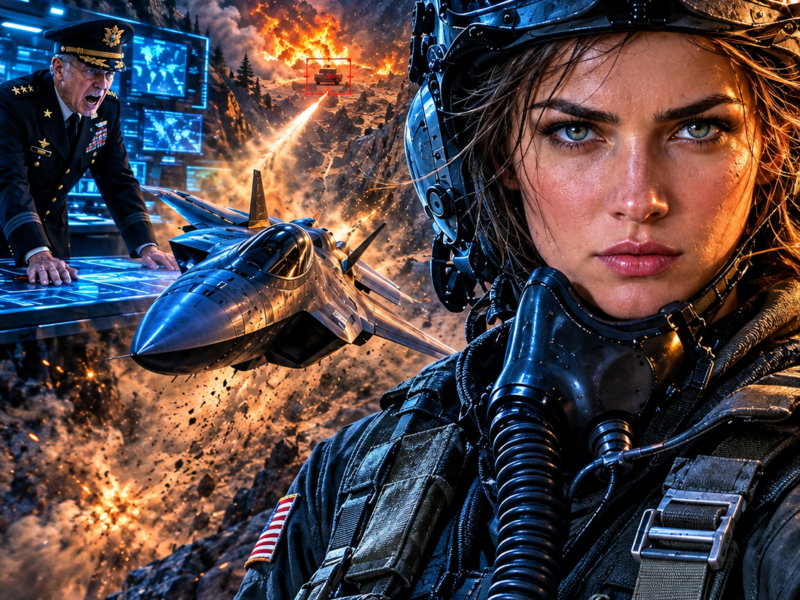
“The general slammed his fist against the command console and shouted, ‘ABORT THE MISSION!’
“Permission to show you what really happened?”
For three seconds, nobody answered.
Then General Whitmore lunged toward the communications console.
“Disconnect that transmission! That’s a direct order!”
I caught his wrist before he could reach the controls.
“Not until she finishes.”
He stared at me as if I’d just pointed a weapon at him.
“Colonel Hayes, you have no idea what you’re interfering with.”
“Then explain it.”
His eyes moved toward the main display.
And that was when I noticed something I would remember for the rest of my life.
He wasn’t looking at the aircraft.
He was looking at the authentication code.
His hand was shaking.
“General,” I said quietly, “what happened to Evelyn Cross?”
He pulled his arm away.
“She died in the line of duty.”
“Then why does her aircraft have an active identification signal?”
“Because someone wants you to believe she’s alive.”
Before I could respond, Evelyn’s voice came through again.
“Daniel, you have twelve seconds before they erase the evidence.”
The technician at the communications station turned pale.
“Colonel, she’s not transmitting from an aircraft.”
I looked at him.
“What?”
“She’s transmitting through the old emergency relay network. The one connected to the original flight recorder archive.”
General Whitmore stepped backward.
“Shut it down.”
The technician shook his head.
“Sir, I can’t. The system has already opened an encrypted file.”
A new window appeared on the screen.
ARCHIVE 17-C.
Below it was a date.
October 14, seventeen years earlier.
Evelyn’s disappearance.
My throat tightened.
“Open it.”
Whitmore moved toward me.
“Hayes, don’t.”
I didn’t take my eyes off the technician.
“Open the file.”
The screen flickered.
A grainy cockpit recording appeared.
For a moment, all I could see was a dark instrument panel and the reflection of a woman’s helmet visor.
Then I heard Evelyn.
“Flight Control, this is Ghost One. I’m approaching the designated test corridor. Instruments are showing an unidentified signal.”
A male voice answered.
“Ghost One, maintain course. Continue the test.”
Evelyn’s aircraft shook.
“Negative. I’ve got a second contact. It’s not on the flight plan.”
The recording crackled.
Then another voice came through.
It was unmistakably General Whitmore’s.
“Captain Cross, maintain your assigned heading.”
Even seventeen years younger, his voice was unmistakable.
Evelyn answered, “Sir, there’s a transport aircraft inside the restricted corridor. Its transponder is disabled.”
Whitmore’s expression changed.
I glanced at him.
“You told the investigation there was no second aircraft.”
He didn’t answer.
The recording continued.
“Ghost One, disregard that contact,” Whitmore ordered.
“Sir, there are people aboard.”
“Maintain course.”
Evelyn’s breathing became audible.
“That’s a civilian transport. I can see the cockpit lights.”
A different male voice interrupted.
“Command, this is Control Two. The transport has entered the exclusion zone.”
Then came a sentence that made the entire room go still.
“Proceed with the scheduled test. The aircraft must not be identified.”
I turned toward Whitmore.
“What was that?”
He looked at the floor.
On the screen, Evelyn was shouting now.
“Control, there are at least twelve people on board! I’m breaking formation to intercept!”
The cockpit camera shook violently.
An alarm began to sound.
Then the recording ended.
No explosion.
No crash.
Just silence.
I felt something cold settle in my chest.
“Who was on that transport?”
Whitmore finally looked at me.
“That’s classified.”
“Seventeen years later?”
“Especially now.”
I turned back to the screen.
“Play the next recording.”
The technician hesitated.
“Colonel, there’s a second file, but it’s encrypted with a separate authorization.”
“Use the authentication we just received.”
He typed.
A progress bar appeared.
Then the system displayed a message.
ACCESS GRANTED — GHOST ONE.
The next recording began with a burst of static.
Evelyn’s voice sounded weaker.
“Flight Control, my aircraft has sustained damage. I’ve lost primary navigation and engine pressure is dropping.”
A voice answered.
“Ghost One, divert to emergency coordinates.”
Evelyn hesitated.
“Those coordinates are not on my flight map.”
“Follow the instructions, Captain.”
“Who authorized this?”
There was no answer.
Then a third voice spoke.
“Captain Cross, this is General Whitmore. You are to maintain radio silence and follow the emergency route.”
I watched the general’s face.
He had stopped pretending not to recognize the recording.
Evelyn spoke again.
“Sir, I need to know what happened to the transport.”
Whitmore’s recorded voice replied.
“You have your orders.”
“Those people are still out there.”
“Your concern is noted.”
“Then send a rescue aircraft.”
The general’s answer was almost inaudible.
“There’s nothing to rescue.”
Evelyn went quiet.
A few seconds later, she said something that made me grip the edge of the console.
“I have the flight recorder. I know what this mission was really testing.”
The recording abruptly ended.
Nobody spoke.
I looked at Whitmore.
“You weren’t testing an aircraft.”
He rubbed his forehead.
“You don’t understand the situation.”
“Then help me understand.”
He stared at the screen for a long moment.
Finally, he spoke.
“The project was called Nightglass.”
I had heard the name before.
Every pilot who had worked in experimental aviation had.
Nightglass was supposedly an advanced defense system designed to identify aircraft that could evade conventional radar and tracking technology.
The program had been shut down after a series of technical failures.
At least, that was what the public report said.
Whitmore continued.
“It was designed to track aircraft that could not be detected by standard systems. We were developing a new method of electronic identification.”
“And the transport?”
He hesitated.
“It was carrying the prototype.”
“Why was a civilian aircraft carrying classified military equipment?”
“Because it wasn’t supposed to be a civilian aircraft.”
I felt my jaw tighten.
“Then what was it?”
“An unregistered test platform. The crew had been told they were conducting a routine equipment transfer.”
“How many people knew?”
“Enough.”
“And Evelyn discovered it?”
“She discovered that the system was generating false identification signals. It could make one aircraft appear to be another.”
I looked at the screen again.
The impossible target.
The two signals.
The old identification number.
Suddenly, the details began connecting.
“Someone could make a military aircraft disappear from radar.”
Whitmore didn’t answer.
I stepped closer.
“Or make it look like it was somewhere else.”
His silence was enough.
A young communications officer raised his hand.
“Colonel, we’re receiving another transmission.”
I turned.
“From Ghost One?”
He nodded.
The radio crackled.
“Daniel, are you still there?”
I leaned toward the microphone.
“I’m here, Evelyn.”
“Did you see the recording?”
“Yes.”
A long pause followed.
Then she asked, “Did he tell you about the people on the transport?”
I looked at Whitmore.
“No. Not everything.”
“Of course he didn’t.”
Her voice sounded exhausted.
“Daniel, there were thirteen people aboard that aircraft. Twelve crew and one passenger.”
“Who was the passenger?”
“My daughter.”
The words barely registered at first.
Then I remembered the photograph from her personnel file.
A little girl with dark hair sitting on Evelyn’s shoulders.
I remembered the funeral.
I remembered the folded flag.
I remembered the name written on the memorial plaque.
My voice came out rough.
“Your daughter was aboard?”
“She was supposed to be at her grandmother’s house that night. But she was frightened of the storm, and the transport pilot agreed to take her to a nearby airfield.”
I looked at Whitmore.
He had gone completely still.
“Evelyn,” I whispered, “the report said your daughter died years ago.”
“That’s what they wanted everyone to believe.”
I felt the room tilt around me.
“Where is she now?”
Evelyn didn’t answer immediately.
Instead, I heard the faint sound of a metallic door closing somewhere near her microphone.
Then she spoke.
“Daniel, I need you to look at the lower-right corner of the original recording.”
The technician enlarged the image.
A small identification number appeared.
Beneath it was a name.
SARAH CROSS.
My eyes moved to the date.
The transport had landed.
Not crashed.
Landed.
A location appeared beneath the timestamp.
MERCY RIDGE — TEMPORARY HOLDING FACILITY.
I recognized the name.
Mercy Ridge had been a decommissioned military communications station in the mountains, abandoned after the Nightglass project was closed.
I looked at Whitmore.
“Was anyone held there?”
He didn’t respond.
“General?”
He finally spoke.
“Captain Cross was ordered to land there after the incident. The transport crew was transferred to another facility.”
“And the child?”
He closed his eyes.
“She was separated from her mother.”
A terrible quiet settled over the room.
I returned to the microphone.
“Evelyn, are you at Mercy Ridge?”
“Yes.”
“Have you been there all these years?”
“No.”
Her answer came too quickly.
“Then where have you been?”
“That’s a longer story than we have time for.”
A warning tone sounded from the main console.
The technician looked up.
“Colonel, something is approaching the testing range.”
“Identify it.”
“Two aircraft. No transponder signals.”
Whitmore stepped toward the screen.
“That’s the recovery team.”
I turned sharply.
“Recovery team?”
He looked at me.
“You’re making this worse, Hayes.”
“Who sent them?”
He didn’t answer.
The radio crackled.
Evelyn spoke with sudden urgency.
“Daniel, listen carefully. The aircraft approaching your position are not coming to rescue anyone.”
I watched two new markers appear.
They were flying low, using the mountains as cover.
“What’s their objective?”
“Destroy the remaining Nightglass archive.”
The technician swallowed.
“Colonel, they’re heading directly toward the underground relay station.”
I looked at the general.
“How long have you known?”
He reached inside his jacket.
For one brief moment, I thought he was reaching for a security badge.
Then I saw the small black device in his hand.
He pressed a button.
Every screen in the room went dark.
Emergency lights flickered on.
Someone shouted.
The building’s heavy security doors began closing.
I grabbed Whitmore’s arm.
“What did you do?”
He pulled free.
“Protected this facility.”
“From whom?”
“From the truth.”
He moved toward the elevator.
Two armed security officers stepped into the room.
I reached for my sidearm, but stopped when I saw their weapons pointed at me.
The general looked directly into my eyes.
“Colonel Hayes, you’re relieved of command.”
I could hear my own breathing.
“You’re going to let them destroy the archive?”
“I’m going to prevent a national security disaster.”
“Those people were your responsibility.”
His expression hardened.
“Some decisions are made to protect millions.”
“And some are made to protect careers.”
For a second, I thought he might order the officers to arrest me.
Then the radio came alive again.
Not through the speakers.
Through the small emergency receiver attached to my belt.
Evelyn’s voice was barely audible.
“Daniel, the archive is not in the control room.”
I looked toward the technician.
He was still standing beside the dark console, one hand hidden beneath the desk.
“What did you say?”
“The original recorder is in the lower maintenance vault. The general doesn’t know I moved it.”
I stared at Whitmore.
His face changed.
“Where did you put it?” he demanded.
The technician didn’t answer.
One of the security officers stepped toward him.
I used the moment to shove a rolling equipment cart into the officer’s knees.
The room erupted.
I heard a gunshot strike the ceiling.
Someone yelled for everyone to get down.
The technician pulled a small access card from beneath his desk and threw it toward me.
“Vault access!”
I caught it and ran.
Behind me, Whitmore shouted my name.
I didn’t turn around.
The maintenance corridor was narrow, cold, and lit by red emergency strips.
I reached the elevator and swiped the card.
Nothing happened.
I tried again.
ACCESS DENIED.
Then I remembered something Evelyn had once told me during a test flight.
When a system stops accepting your commands, stop trying to make it obey.
Find the part that still remembers how it worked.
I pulled open the emergency panel.
Inside was an old mechanical release lever.
I forced it downward.
The elevator doors opened with a metallic groan.
I stepped inside.
The ride to the lower level took less than thirty seconds.
It felt like an hour.
When the doors opened, I found myself facing a long concrete corridor.
At the far end was a reinforced door.
A small screen beside it displayed the same identification code I’d seen on the radar.
GHOST ONE.
I swiped the card.
This time, the door opened.
Inside, a single metal case sat on a table.
Beside it was a photograph.
Evelyn Cross stood beside a little girl wearing a yellow raincoat.
On the back, someone had written:
SARAH — FIRST DAY OF SCHOOL.
My fingers trembled as I picked it up.
Then I noticed another object beneath the photograph.
A military identification badge.
It belonged to Sarah Cross.
But the photograph had been taken only three years ago.
I turned it over again.
There was a handwritten note.
“Mom, if you ever find this, I’m still waiting.”
I heard a sound behind me.
A slow, deliberate footstep.
I turned.
General Whitmore stood in the doorway.
His security officers were gone.
He held no weapon.
For the first time that night, he looked older than his uniform.
“You shouldn’t have come down here,” he said.
I placed the photograph on the table.
“Where is Sarah?”
He looked at it.
Then he looked away.
“She’s alive.”
I stepped closer.
“Where?”
“She’s been living under a protected identity.”
“Why?”
“Because the people who funded Nightglass believed she had information about the program.”
“She was a child.”
“She was aboard the transport. She heard things. She remembered names.”
I felt sick.
“Did Evelyn know?”
Whitmore’s face tightened.
“She knew enough.”
“Why did you let her believe her daughter was dead?”
He didn’t answer.
Then he sat down heavily in the chair beside the table.
“Because I thought it was the only way to keep her alive.”
I stared at him.
“That’s what you told yourself?”
He looked up.
“You weren’t there, Daniel.”
“No. I was the one who signed the memorial report because you told me the aircraft had exploded.”
His eyes filled with something I couldn’t quite identify.
Regret, perhaps.
Or fear.
“I signed it too,” he whispered.
“Then you knew.”
He lowered his head.
“I knew.”
The emergency receiver crackled.
Evelyn’s voice came through.
“Daniel, are you at the vault?”
“Yes.”
“Is the recorder there?”
I looked at the metal case.
“Yes.”
“Open it.”
Whitmore stood.
“Don’t.”
I ignored him.
The case had a mechanical lock and a small biometric panel.
I pressed the authentication button.
A familiar voice spoke from the device.
“Captain Evelyn Cross. Identification confirmed.”
The case opened.
Inside was a compact flight recorder, several printed documents, and a small digital storage unit.
I lifted the first document.
It was a flight manifest.
Thirteen names.
The last entry was Sarah Cross, age eleven.
Beside her name was a handwritten note.
WITNESS TRANSFER — AUTHORIZATION REQUIRED.
The signature beneath it belonged to General Richard Whitmore.
I looked up.
“Why was a child listed as a witness?”
Whitmore closed his eyes.
“Because she saw the second aircraft.”
“What second aircraft?”
“The one that intercepted the transport.”
I turned toward the recorder.
“Was it military?”
He nodded.
“An experimental unmanned aircraft. It had malfunctioned during a test. The Nightglass system concealed its position, and the transport entered its flight path.”
“So the transport was hit?”
“Yes.”
“And Evelyn?”
“She broke formation to guide it down.”
I looked at the photograph.
“She saved them.”
“Some of them.”
His voice cracked.
“Not all.”
For a moment, neither of us spoke.
Then he added, “The transport landed after Evelyn disabled the unmanned aircraft. The people aboard survived the landing. But by then, the project directors had realized that the system could be used to falsify military identification records. They didn’t want the incident investigated.”
I stared at him.
“So they erased it.”
“They classified it.”
“You erased thirteen people.”
He didn’t argue.
I pressed the playback button on the recorder.
A new recording began.
Evelyn’s voice filled the room.
“Daniel, if you’re hearing this, I couldn’t get the truth out in time.”
A faint breath followed.
“I want you to understand something. I didn’t disappear because I was afraid of them. I stayed because Sarah was still alive, and I believed that if I left, they would never let her grow up.”
My throat tightened.
“She was moved between facilities. I was allowed to see her twice. The last time, she was fourteen.”
The recording paused.
Then Evelyn continued.
“She asked me why I never came home.”
I looked down at the photograph.
“I told her I was protecting her. I don’t know if she believed me.”
The next sentence was almost a whisper.
“I don’t know if she ever will.”
The recording ended.
I looked toward the general.
“Where is she now?”
Whitmore rubbed his face.
“Atlanta.”
The word caught me off guard.
“Atlanta?”
“She’s twenty-eight now. She works as an aviation systems engineer. She has no idea where her mother is.”
I stared at him.
“How do you know that?”
“Because I’ve been receiving reports about her for years.”
“Have you ever told her the truth?”
He shook his head.
I picked up the photograph.
“Then we’re going to.”
Before he could answer, the emergency receiver emitted a sharp burst of static.
Evelyn spoke.
“Daniel, they’re at the relay station.”
I looked at the clock.
The two unidentified aircraft were less than four minutes from the facility.
“Can you get out?”
“Not yet.”
“What’s stopping you?”
A long silence followed.
Then she said, “The original aircraft is still here.”
I frowned.
“What aircraft?”
“My F-19.”
I remembered the old experimental fighter from Viper Three’s report.
The aircraft that had appeared beside him.
“You’re telling me you’ve kept that thing operational?”
“Not exactly.”
A faint laugh escaped her.
“Some parts are operational.”
I almost smiled despite everything.
Then her voice changed.
“Daniel, there’s something else. The system is still active. If those aircraft reach the relay station, they’ll be able to destroy the archive and make the remaining evidence look like a fabrication.”
“Can you stop them?”
“I can lock onto them.”
“Then do it.”
“I need a second authorization.”
I looked at Whitmore.
He understood immediately.
“No.”
I held out my hand.
“Your authorization code.”
He shook his head.
“Hayes, you don’t know what you’re asking.”
“I’m asking you to finish what you should have done seventeen years ago.”
For a long moment, he stared at me.
Then he removed a small security token from his jacket.
He placed it in my palm.
“Once you release the archive, every classified record connected to Nightglass will be exposed.”
“Good.”
“Some people will go to prison.”
“Good.”
“Some people will never forgive you.”
I looked at the photograph of Sarah.
“That’s not the worst thing that can happen to a person.”
I inserted the token.
The system powered up.
Across the main screen, a series of old military identification codes appeared.
One by one, they turned green.
The technician’s voice came over the emergency channel.
“Colonel, I’ve restored partial control. You have access to the original targeting network.”
I reached for the microphone.
“Evelyn, this is Daniel. You have authorization.”
For several seconds, nothing happened.
Then the radio crackled.
“Ghost One copies.”
The targeting display flickered.
Aerial images appeared.
Two unidentified aircraft were approaching the relay station.
A third signal was visible behind them.
The old F-19.
I leaned toward the screen.
“Can you get a lock?”
“Working on it.”
The first aircraft changed course.
“Ghost One, target is moving.”
“I see it.”
The second aircraft began climbing.
“Daniel, the system is rejecting the identification.”
“Can you override it?”
“Not from here.”
I looked at Whitmore.
“What’s missing?”
He stared at the display.
Then he spoke.
“The system was designed to reject its own original test aircraft. We built a failsafe into the identification protocol.”
“Why?”
“To prevent the system from locking onto friendly experimental aircraft.”
I turned toward the radio.
“Evelyn, can you hear me?”
“Yes.”
“The system won’t accept your identification.”
“I know.”
“How do we fix it?”
There was a pause.
Then she said, “Use the original flight number.”
I looked at the screen.
The code was still visible.
EVELYN CROSS — FLIGHT 17.
I entered it.
The display flashed.
AUTHENTICATION PENDING.
Then a second line appeared.
PILOT RECOGNITION REQUIRED.
The room fell silent.
I picked up the microphone.
“Evelyn, this is Colonel Daniel Hayes. I need you to confirm your identity.”
Her reply came immediately.
“Captain Evelyn Cross. Flight 17. United States Air Force. Requesting final targeting authorization.”
I pressed the confirmation key.
The display turned green.
TARGET LOCKED.
For the first time in seventeen years, the system recognized her.
The two approaching aircraft suddenly appeared on every radar screen.
Their transponders activated.
Their positions were no longer hidden.
The technician stared at the display.
“Colonel, the aircraft have been identified. They’re breaking formation.”
I leaned closer.
“Can you identify the pilots?”
The screen updated.
Two names appeared.
Both belonged to contractors listed in the original Nightglass security files.
One of them had been declared retired twelve years earlier.
The other was still on active military payroll.
Whitmore stared at the names.
“They told me those men were gone.”
I looked at him.
“Apparently, a lot of people were told a lot of things.”
The aircraft turned away from the relay station.
Evelyn’s voice came through.
“Daniel, the lock is holding.”
“Can you bring the F-19 back?”
“I can try.”
The signal began descending toward the valley.
A moment later, the radar showed the old aircraft crossing the mountain ridge.
Its transponder flashed once.
Then again.
Then the signal disappeared.
I gripped the console.
“Evelyn?”
No answer.
“Evelyn, respond.”
Static.
Then a faint voice.
“I’m here.”
I exhaled.
“Are you all right?”
“Ask me again after I land.”
I laughed once, quietly.
It was the first time I’d laughed that night.
Twenty minutes later, the relay station was secured.
The two unidentified aircraft had been intercepted by conventional defense units and forced to land at a nearby military airfield.
Their pilots were taken into custody.
The Nightglass archive was copied to three independent government servers.
And the original flight recorder was placed under federal protection.
General Whitmore was escorted out of the facility shortly before sunrise.
He didn’t resist.
As he passed me, he stopped.
“Hayes.”
I looked at him.
“Do you think she will forgive me?”
I thought about the seventeen years Evelyn had lost.
The childhood Sarah had spent waiting for a mother who never came home.
The funeral that had never needed to happen.
“I don’t know,” I said.
“But she deserves the chance to decide.”
He nodded.
Then he walked away.
Three days later, I stood outside a small airport in Atlanta.
The morning air smelled of wet pavement and fresh coffee.
A private vehicle pulled up beside the terminal.
The rear door opened.
Evelyn stepped out.
She looked older than the woman I remembered, but her eyes were exactly the same.
For a few seconds, neither of us spoke.
Then she smiled.
“You still hold your left hand on the throttle?”
I laughed.
“Some habits are hard to break.”
She looked toward the terminal.
“Is she here?”
I nodded.
A woman stood near the glass entrance, holding a small photograph.
She had dark hair, tired eyes, and the same unmistakable smile as the little girl in the yellow raincoat.
Sarah Cross.
Twenty-eight years old.
An entire lifetime had passed since she last saw her mother.
Evelyn took one step forward.
Then stopped.
Sarah looked at her for a long time.
Finally, she said, “You look different.”
Evelyn swallowed.
“So do you.”
Sarah’s fingers tightened around the photograph.
“I spent years thinking you were dead.”
“I know.”
“Then I spent years thinking you had left me.”
Evelyn lowered her eyes.
“I know that too.”
Sarah shook her head.
“No, Mom. You don’t.”
Evelyn didn’t try to defend herself.
She didn’t explain the military orders, the classified files, or the men who had controlled their lives.
She simply stood there.
“I’m sorry,” she whispered.
Sarah looked down at the photograph.
It was the picture from the maintenance vault.
The little girl in the yellow raincoat.
“I kept this because I was afraid I’d forget your face.”
Evelyn’s lips trembled.
“I never forgot yours.”
Sarah stepped forward.
It wasn’t an embrace at first.
She only reached out and touched her mother’s hand.
Then Evelyn closed her fingers around hers.
And the years between them finally became something they could begin to cross.
I turned away to give them privacy.
Some reunions don’t need an audience.
The investigation lasted fourteen months.
Nightglass was permanently shut down.
The thirteen people listed on the transport manifest were officially restored to the military and civilian records.
Families who had spent years believing their loved ones were missing finally received the truth.
General Whitmore pleaded guilty to obstruction of justice, falsification of military records, and conspiracy to conceal the Nightglass incident.
Several senior officials were also charged.
Evelyn was formally cleared of every accusation connected to her disappearance.
Her flight status was restored, though she never returned to active combat duty.
When the Air Force asked whether she wanted her old rank and decorations reinstated, she accepted them.
But she refused the ceremony.
“I’ve had enough people telling me what my life means,” she told me.
“Let the records speak for themselves.”
A year after that night, I visited her at a small aviation museum outside Atlanta.
The F-19 had been restored and placed inside the main hangar.
Its dark metal wings reflected the afternoon sunlight.
A new plaque stood beneath the cockpit.
CAPTAIN EVELYN CROSS.
FLIGHT 17.
PILOT. SURVIVOR. WITNESS.
Sarah stood beside her mother, holding a set of keys.
She had recently started working with an aviation safety organization dedicated to preventing experimental flight accidents from being concealed.
Evelyn noticed me looking at the aircraft.
“Still think it was a ghost?”
I smiled.
“At 2:17 that morning, I was ready to believe anything.”
She laughed.
Then she became quiet.
“You know what I remember most?”
“What?”
“The moment I heard your voice on the radio.”
I looked at her.
“I was afraid you’d think I was losing my mind.”
“I nearly did.”
She smiled.
“I knew you would.”
We stood there for a while, listening to the distant sound of an aircraft taking off.
Then Sarah came over and slipped her arm through her mother’s.
“Come on, Mom. We have dinner reservations.”
Evelyn looked at me.
“Are you coming?”
I shook my head.
“Not tonight.”
She nodded.
Before they left, she turned back toward the old fighter.
For seventeen years, that aircraft had been a symbol of everything stolen from her.
Now it was simply an aircraft.
And for the first time, she could walk away from it without looking over her shoulder.
I watched them disappear through the hangar doors.
That night, I went home and opened the old flight report I’d kept in a locked drawer for seventeen years.
My signature was still at the bottom.
I had signed it because I trusted the people above me.
Because I believed the uniform meant honesty.
Because I thought following orders was the same thing as doing the right thing.
I took a pen and wrote one sentence across the first page.
“Captain Evelyn Cross did not disappear. We failed to listen.”
Then I placed the report beside the photograph of Evelyn and Sarah.
Outside, another aircraft crossed the evening sky.
Its lights blinked steadily against the dark.
No hidden signals.
No false identification.
No voice begging someone to believe it was still there.
Just a pilot bringing her aircraft home.
And this time, everyone knew she was coming.
THe end.









