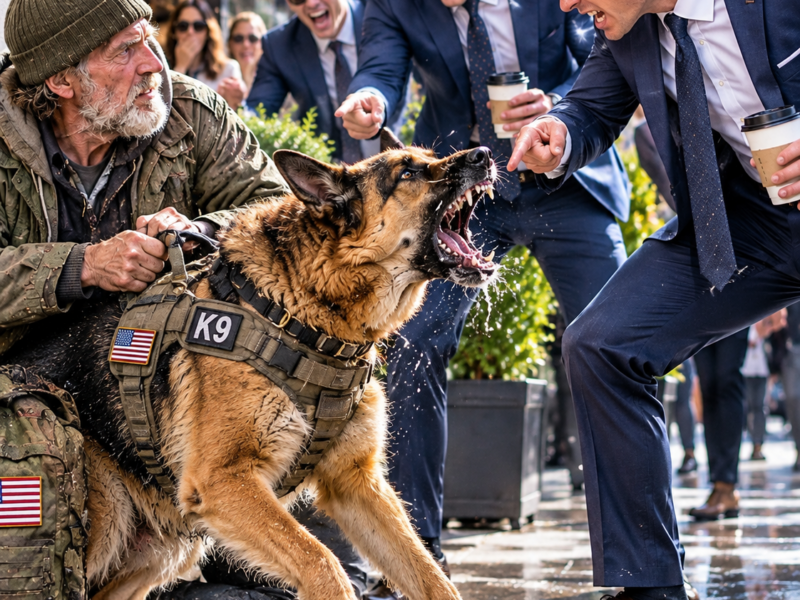
The first time they laughed at the homeless veteran, I almost kept walking
For three seconds, I couldn’t move.
Michael Turner stood in front of me, gripping my wrist with the desperate strength of a man who had spent years expecting the worst. His clothes were filthy, his face was thinner than I remembered, and his eyes carried a kind of exhaustion that sleep alone could never cure.
But he was alive.
The two men from the black SUV crossed the sidewalk toward us.
Rex stepped forward, placing his body between Michael and the strangers. His ears flattened slightly, and a low rumble rose from his chest.
I recognized that posture.
Rex wasn’t simply frightened.
He remembered something.
“Michael,” I said quietly, “stay behind me.”
Michael shook his head.
“You don’t understand. Those men aren’t here to talk.”
“Then let’s not give them a chance.”
I turned toward the men and raised my voice.
“Can I help you?”
The taller one smiled without warmth.
“We’re looking for a man who may need medical assistance. He has a history of mental health problems.”
Michael’s fingers tightened around the leash.
The man continued, “His name is Michael Turner. He’s a danger to himself, and we’re authorized to take him somewhere safe.”
I looked at Michael.
He was staring at the taller man’s left hand.
The man’s fingers were resting inside his jacket pocket.
Not casually.
Deliberately.
“Show me your authorization,” I said.
The second man stepped closer.
“Sir, this doesn’t concern you.”
“Then showing me your authorization shouldn’t be a problem.”
The taller man’s smile disappeared.
For a moment, nobody moved. Traffic passed behind them, and a woman pushing a stroller slowed down to watch.
Then the second man looked toward the grocery store entrance.
“Let’s go,” he muttered.
The taller one gave me a long, calculating stare.
“You’re making a mistake.”
“That’s possible,” I replied. “But right now, you’re the one threatening a veteran in public.”
He leaned closer.
“Some people are better off staying forgotten.”
Then both men returned to the SUV.
I watched until they drove away.
I didn’t relax.
Neither did Rex.
Michael pulled at my sleeve.
“We have to leave. Now.”
I glanced at the dog.
“Can you walk?”
Michael looked offended by the question, then glanced down at his battered shoes.
“I can walk.”
“Good. My truck is around the corner.”
He hesitated.
“Why are you helping me?”
I looked at the man I had mourned for six years.
“Because I know who you are. And because you don’t look like someone who wants to hurt anybody.”
I paused.
“Besides, Rex already made his decision.”
The dog pressed against Michael’s leg.
For the first time since I had recognized him, Michael’s expression softened.
“He always was better at judging people than I was.”
Then he followed me toward the truck.
We had barely reached it when Michael stopped beside the passenger door.
He looked back at the street, scanning the traffic with the practiced anxiety of someone who expected danger to appear from any direction.
“Daniel,” he said.
It was the first time he had used my name.
“Before I get in, there’s something you need to know.”
I waited.
“The report about that convoy attack wasn’t just wrong.”
His eyes met mine.
“It was written to make sure nobody ever looked for us.”
I drove us to a small community center where a friend of mine managed a veterans’ outreach program. It was quiet in the late afternoon, with a few cars in the parking lot and a flag hanging above the entrance.
Michael didn’t speak during the drive.
He kept one hand on Rex’s collar and the other wrapped around the leash. The dog sat close to him, occasionally lifting his head to check on his handler.
When we arrived, I helped Michael inside and asked the center’s coordinator, Denise Parker, whether we could use a private room.
Denise had worked with homeless veterans for more than a decade. She knew how to ask questions without making people feel interrogated, and she understood that trust was something you earned through small, consistent actions.
She brought Michael a clean sweatshirt, bottled water, a sandwich, and a first-aid kit.
He stared at the food for a long time before opening the package.
“Take your time,” she told him.
He ate slowly at first, then with the hunger of someone who had learned not to assume another meal would come.
Rex lay beside his chair.
I sat across from Michael.
“Start wherever you can,” I said. “Tell me what happened after the convoy.”
Michael wiped his mouth with a napkin.
“The explosion threw me into a drainage ditch. I woke up with a broken leg, a concussion, and half the road burning around me.”
He glanced at Rex.
“He found me before the rescue team did. Dragged himself through the wreckage and kept barking until somebody heard him.”
I remembered the radio chatter that day. The conflicting reports. The confusion about the missing personnel.
“What about the rest of the team?”
“Three men died in the initial blast. You know that. But the convoy was carrying more than medical supplies.”
I leaned forward.
“What else?”
“Sealed equipment cases. Electronic components. Records that weren’t on the cargo manifest.”
He took a breath.
“I’d discovered discrepancies in the supply logs several days earlier. Equipment was being reported as destroyed or delivered to locations where it never arrived. Some of it was turning up in private hands.”
My stomach tightened.
“Who was responsible?”
Michael looked toward the door before answering.
“Contractors working with people inside the logistics command. I don’t know how high it went, but the operation was making somebody a lot of money.”
“And the convoy?”
“I think the attack was meant to destroy the evidence.”
I sat back.
In the aftermath of the explosion, our unit had been told the route was secure and the convoy had been struck by enemy fire. We had been ordered to focus on recovery and evacuation.
I had never questioned the official explanation.
Not because I trusted every report I received, but because the chaos had been real, the casualties had been real, and we had been trying to bring our people home.
“You’re saying the attack was arranged?”
“I’m saying somebody knew what was in those cases. Somebody knew our route. And somebody made sure the investigation ended before anyone asked the wrong questions.”
Michael rubbed his face.
“When I woke up in a field hospital, two men came to see me. They told me the mission records were classified and that I needed to sign a statement saying the convoy had been attacked by enemy forces.”
“Did you sign it?”
“No.”
His answer came immediately.
“They offered me a transfer, then threatened to charge me with stealing classified materials. When I still refused, they told me my family could become part of the investigation.”
He looked down at his hands.
“My wife had left months before the deployment. My daughter was six. I didn’t know who they could reach, who they were watching, or whether the threats were real.”
His voice grew quieter.
“So I did the only thing I could think of. I disappeared.”
I stared at him.
“You let everyone believe you were dead.”
“They made it look that way. I escaped from a temporary medical facility during a transfer. A sympathetic local driver helped me get away, but I had no identification, no money, and a leg that barely worked.”
He swallowed.
“By the time I made it back to the United States, my records had been changed. The Army believed I was dead. My bank account was frozen, and every attempt I made to contact someone I trusted seemed to bring another stranger asking questions.”
“Why didn’t you contact me?”
Michael looked straight at me.
“I tried.”
The words landed harder than I expected.
“Twice. The first time, I called a number I remembered from your old unit. The man who answered told me you had died in a training accident.”
I frowned.
“I was alive. I left active duty years later.”
“I know that now. The second time, I sent a letter to a former teammate. It came back unopened with a note saying the address couldn’t be verified.”
I felt a cold anger spreading through me.
Someone had used our own losses to isolate him.
“And Rex?”
Michael’s hand moved to the dog’s collar.
“He was with me when I escaped. He kept me alive through the first months. We slept in abandoned buildings, under bridges, wherever we could get out of the rain. I kept thinking that if I could find one person who believed me, I could put everything right.”
He gave a small, bitter laugh.
“But every time I tried to get close to an official office, somebody appeared. Sometimes they threatened me. Sometimes they offered money. Once, they took Rex for three days.”
I stared at the dog.
Michael’s expression tightened.
“When they brought him back, he wouldn’t leave my side for a week. After that, I stopped asking for help.”
He looked toward the window.
“Eventually, I stopped believing anyone was coming.”
For a long moment, the only sound in the room was Rex breathing.
Then Michael reached inside his jacket and pulled out a small cloth pouch.
“I kept one thing from the convoy.”
He placed it on the table.
Inside was a metal data cartridge, scratched and darkened with age.
“I took it from one of the equipment cases before the explosion. I thought it might prove what was being moved.”
I studied it.
“Why keep it on you all these years?”
“Because I couldn’t trust anyone with it. And because I didn’t know how to read the files.”
I turned the cartridge over in my hand.
There was a tiny serial number etched into one side.
I recognized the prefix.
It matched the equipment system used by a defense contractor called Aegis Strategic Logistics.
A company that had received several lucrative government contracts after the war.
A company whose chief executive had recently appeared in the news beside politicians and military officials.
I looked at Michael.
“Did you know this belonged to Aegis?”
“I suspected. I never had a way to verify it.”
I closed my fingers around the cartridge.
“Then we’ll find out.”
Michael’s face filled with fear.
“Daniel, you don’t understand what that means.”
“Maybe not.”
I stood.
“But I understand what it means when people threaten a veteran and his dog because they’re afraid of what’s in his pocket.”
Rex rose beside Michael.
This time, the dog didn’t look frightened.
He looked ready.
We didn’t try to access the cartridge ourselves.
I had learned long ago that evidence could be destroyed by the wrong hands, and I had no intention of making that mistake.
Instead, I called a retired Navy intelligence officer named Sarah Mitchell. We had served in overlapping units, and she had spent years investigating procurement fraud and suspicious supply chains.
I gave her only the basic facts over the phone.
A missing veteran.
A former military working dog.
A data cartridge linked to a defense contractor.
A convoy attack that might not have been what the official report claimed.
Sarah went silent.
“Where are you?”
I told her.
“Don’t take that cartridge anywhere. Don’t connect it to a computer. Don’t hand it to anyone who contacts you claiming to be from the government.”
“That’s reassuring.”
“I’m serious, Daniel. If the prefix is what I think it is, this could involve people who have spent years making problems disappear.”
She promised to meet us the following morning at a secure office used by her consulting firm.
Then she asked a question I hadn’t expected.
“Does the dog still have his original collar?”
I looked at Rex.
“Yes.”
“Keep it exactly as it is.”
I glanced at Michael.
“Why?”
“I don’t know yet. But if the serial number on that collar matches the records I’m thinking of, it could be more important than the cartridge.”
The call ended.
Michael had been listening.
“What does she know about Rex?”
“Not enough to explain it yet.”
He looked at the old collar.
“I’ve never taken it off him.”
“Good.”
I asked Denise whether Michael and Rex could stay at the center overnight. She arranged a private room and promised to keep their presence confidential.
Before I left, I gave Michael my phone number and told him to call if anything felt wrong.
He studied me for a long time.
“You’re putting yourself in danger for a man you thought was dead.”
I looked at Rex, who was resting his head on Michael’s boot.
“I spent six years thinking I failed to bring you home.”
I paused.
“I’m not making the same mistake twice.”
The following morning, Sarah arrived carrying a secure laptop and a small forensic imaging device.
She greeted Michael with a firm handshake, then crouched to let Rex sniff her hand.
The dog examined her carefully before accepting a gentle scratch beneath his chin.
Sarah smiled.
“He remembers people better than most computers do.”
Michael’s expression softened.
“He remembers everyone who treated him kindly.”
We moved into a private room and closed the door.
Sarah photographed the cartridge and documented its condition before connecting it to the forensic device. She explained each step, preserving an exact copy of the data while leaving the original untouched.
The first files were encrypted.
The second group appeared to contain inventory records.
The third consisted of short, coded messages between individuals using contractor identification numbers.
Sarah worked for nearly two hours before leaning back in her chair.
“I found something.”
She turned the screen toward us.
The records showed shipments of specialized surveillance equipment and military-grade communications components being diverted from approved destinations. Several entries had been altered after delivery. Others were marked as destroyed despite evidence that the shipments had reached private storage facilities.
One name appeared repeatedly.
Victor Hale.
The chief executive of Aegis Strategic Logistics.
I recognized him from the news.
He was the sort of man who stood beside elected officials at ribbon-cutting ceremonies and spoke about supporting service members. His company sponsored veterans’ charities and funded scholarships for military families.
Sarah opened another file.
“This is worse.”
The file contained a series of messages sent shortly before the convoy attack.
One referred to an upcoming transfer that needed to be “closed permanently.”
Another mentioned an “unplanned witness.”
A final message, sent several hours after the explosion, stated that the recovery operation had been completed and all personnel accounted for.
Michael leaned toward the screen.
“That wasn’t true.”
“No,” Sarah said. “It wasn’t.”
She looked at him.
“Your status was changed to deceased before the medical facility reported you missing.”
Michael’s face went white.
Sarah continued carefully.
“Someone had prepared a death record in advance. We need to verify the source and the timestamps, but this suggests your disappearance wasn’t simply covered up afterward.”
I felt anger tighten in my chest.
“Someone planned to erase him.”
“Possibly,” Sarah said. “But we need evidence that will stand up to scrutiny. These files are important, but we can’t assume every message is authentic until the relevant systems are examined.”
Michael looked at Rex.
“And the collar?”
Sarah enlarged a photograph she had taken the previous day.
The metal tag contained Rex’s military identification number. Beneath it, a second number had been stamped into the collar’s inner plate, almost hidden by the worn leather.
Sarah typed it into a secure search.
A record appeared.
She read it once, then again.
“That’s impossible.”
My stomach dropped.
“What?”
Sarah looked at me.
“This collar was registered to a working-dog unit that was officially deactivated after the convoy incident. But the secondary number connects to a separate equipment record. It’s associated with a shipment that was never supposed to exist.”
She opened the linked inventory file.
The screen showed a list of serialized tracking devices and data-storage units.
One entry matched the serial number on Michael’s cartridge.
Another matched the secondary number on Rex’s collar.
For a few seconds, none of us spoke.
Then Michael whispered, “They used the dog to move it.”
Sarah nodded slowly.
“It looks as though the collar was modified to carry or identify a tracking component. If Rex was assigned to the convoy, someone may have used his equipment to move data without listing it as a separate shipment.”
I looked at the worn leather.
Rex had been carrying a piece of the secret around his neck for six years.
And nobody had thought to search him because everyone believed he was dead.
Sarah’s expression darkened.
“Daniel, there’s something else. The last access to this equipment record was three days ago.”
“By whom?”
She rotated the screen.
The access request had been submitted through a contractor account connected to Aegis.
Someone was looking for Rex.
And now they knew we had found him.
The first warning arrived that afternoon.
Denise called me while I was returning from a pharmacy with food and medical supplies for Michael.
“Daniel, two men are here asking about your friend.”
I stopped walking.
“What did they say?”
“They claimed to be from a veterans’ assistance organization. They have paperwork with his name on it, but something feels wrong.”
“Don’t let them near him. I’m on my way.”
I drove back to the center and found Denise standing at the entrance. Through the glass, I could see the two men from the grocery store.
The taller one noticed me immediately.
He smiled.
“You again.”
I entered the building and positioned myself between the men and the hallway leading to Michael’s room.
“You were told to leave yesterday.”
“We’re here on official business.”
“Then call the agency you’re representing and have them confirm your authority.”
The second man reached into his jacket.
Denise stepped back.
I raised one hand.
“Keep your hands where I can see them.”
The man stopped.
The taller one sighed.
“This is getting unnecessarily complicated. We just want the veteran and his dog.”
“Why?”
“His situation has attracted attention. We can provide housing, medical care, and a fresh start.”
I looked at him.
“You could have offered that yesterday without threatening him.”
He shrugged.
“People sometimes misinterpret our intentions.”
Michael appeared at the end of the hallway, supported by a walking stick Denise had found for him. Rex stood beside him.
The taller man’s expression changed.
“There he is.”
Rex moved forward and planted himself between Michael and the strangers.
The dog didn’t bark.
He didn’t lunge.
He simply stood, every muscle alert, refusing to let them pass.
The second man looked at the collar.
His eyes widened slightly.
I saw it.
So did Sarah, who had arrived moments earlier and was standing near the reception desk.
She stepped forward with her phone in hand.
“Before anyone leaves,” she said, “I’ve documented your presence, your statements, and the documents you’ve presented. The local police are on their way.”
The taller man turned toward her.
“You have no idea what you’re involved in.”
“Then you shouldn’t have come here to threaten a witness.”
For the first time, his confidence faltered.
He glanced at his partner.
They retreated toward the door, but the taller man paused beside me.
“Your friend is alive because people allowed him to remain forgotten,” he said quietly. “Don’t confuse that with mercy.”
I met his gaze.
“And you shouldn’t confuse silence with surrender.”
He left.
We watched their SUV pull away.
Sarah immediately called the police and reported the attempted intimidation. She also contacted an attorney who specialized in federal whistleblower cases.
Michael sank into a chair.
His hands were shaking.
“They’ll keep coming.”
“Maybe,” I said. “But now we have witnesses, records, and a documented threat.”
He shook his head.
“You don’t know how long I’ve lived like this. Every time I think I’ve found a safe place, someone comes to take it away.”
I crouched beside him.
“Then we stop trying to handle this alone.”
He looked at me with tired eyes.
“What if they hurt you?”
I glanced at Rex.
“Then we’ll make sure they have to answer for it.”
I wasn’t pretending there was no risk.
But for the first time in six years, Michael had people willing to stand beside him.
That changed everything.
Sarah’s attorney, Rebecca Shaw, helped us establish contact with federal investigators who had no direct connection to the original operation.
We provided the cartridge’s forensic copy, the equipment records, the attempted intimidation report, and Michael’s account of what had happened after the convoy attack.
Michael was terrified when it came time to give his formal statement.
He sat at the table with both hands clasped around a cup of coffee he hadn’t touched.
“What if they don’t believe me?”
Rebecca answered gently.
“Then we keep following the evidence. You don’t have to prove everything in one conversation.”
“What if the evidence disappears?”
“That’s why we have multiple verified copies and a documented chain of custody.”
He looked at me.
I nodded.
“You don’t have to do this perfectly, Michael. You just have to tell the truth as you remember it.”
He took a breath.
Then he began.
He described the convoy, the explosion, the field hospital, and the threats. He explained how his status had been changed and how he had tried to contact people who might help him.
He also described the years he spent homeless, moving between shelters, temporary camps, and abandoned buildings.
He spoke about the winter Rex had suffered an infected wound and how he had traded his last clean blanket for antibiotics from a volunteer clinic.
He described the nights when he had gone hungry so the dog could eat.
At one point, his voice broke.
“I knew how to save other people,” he said. “I didn’t know how to save myself.”
The investigator across the table didn’t interrupt.
When Michael finished, the room remained quiet for several seconds.
Then the investigator said, “Thank you for telling us.”
Michael lowered his head.
It wasn’t a dramatic moment.
No one promised that every wrong would be corrected.
But his statement was officially recorded, and an independent investigation was underway.
For the first time since the convoy attack, the truth had entered a system that could be held accountable for what happened next.
The investigation expanded quickly once authorities verified the records.
Aegis Strategic Logistics had been awarded several contracts involving equipment that was supposed to be delivered to military installations and secure government facilities. Investigators discovered that some shipments had been diverted through shell companies, while other deliveries had been falsely recorded as destroyed.
The financial trail led to executives and subcontractors.
More importantly, it connected several of those transactions to the period before the convoy attack.
The data didn’t prove who had ordered the explosion, but it established a reason to examine the operation much more closely.
Then an unexpected witness came forward.
A retired logistics officer named Peter Lawson contacted Sarah after learning that investigators were reviewing Aegis contracts.
He had signed off on a shipment record shortly before the attack and had later been told that the paperwork was classified.
He had never seen the equipment again.
When investigators showed him the preserved records, he recognized a code used by a supervisor who had repeatedly ordered him to alter delivery reports.
Peter agreed to testify.
He also provided a copy of an old email in which a senior contractor manager warned that the convoy’s cargo contained material that could expose a large-scale fraud scheme.
The email had been sent the night before the attack.
It was not proof that the attack had been ordered by Aegis executives, but it gave investigators a new lead.
Three weeks later, federal agents executed search warrants at several company offices.
They seized computers, financial records, and internal communications.
Victor Hale resigned as chief executive, claiming he had done nothing wrong and would cooperate fully with the investigation.
Two senior executives were arrested on charges related to fraud, obstruction, and witness intimidation.
The investigation into the convoy attack continued.
Michael watched the news from a small room at the veterans’ center.
When the first arrest was announced, he didn’t celebrate.
He simply sat beside Rex, his hand resting on the dog’s collar.
“Do you think it’s enough?” he asked me.
“No,” I admitted. “Not yet.”
He nodded slowly.
“But it’s something.”
“Yes,” I said. “It’s something.”
For years, he’d been forced to live as if the world had already decided his story was over.
Now people were finally listening to what he had to say.
There was still one person Michael wanted to see.
His daughter, Emily.
He had last seen her when she was six years old, before his deployment. She was now twelve, old enough to remember her father but young enough that years of silence had reshaped those memories.
Michael had learned through a former family friend that she lived with her mother in North Carolina.
He had no idea what she had been told.
He was afraid she would hate him.
He was even more afraid that she would believe he had chosen to abandon her.
“I can’t ask her to forgive me,” he said one evening.
“You don’t have to,” I replied. “You can tell her the truth and let her decide what she wants to do with it.”
He looked down at his hands.
“What if she doesn’t want to see me?”
“Then you’ll respect that. But she deserves the chance to know what happened, if it’s safe to tell her.”
With Rebecca’s help, Michael contacted a family lawyer, who reached out to Emily’s mother.
The first response was cautious.
Emily’s mother, Laura, had spent years believing Michael was dead. She had raised their daughter alone, endured the uncertainty of the original investigation, and eventually rebuilt a life without him.
She had every reason to be angry.
She also had every reason to be careful.
After several conversations, she agreed to a supervised meeting at a family support center.
Michael almost canceled twice.
On the morning of the meeting, he stood in front of a mirror wearing a clean shirt borrowed from Denise. He had shaved his beard and combed his hair, but he still looked at himself as if he were a stranger.
Rex sat at his feet.
“What if she doesn’t recognize me?”
I stood in the doorway.
“Then you introduce yourself.”
Michael gave a shaky laugh.
“You make everything sound simple.”
“No. I make the first step sound possible.”
At the center, Laura arrived with Emily.
Michael stood slowly when they entered.
Emily was taller than he expected. Her dark hair was pulled into a ponytail, and she carried a small backpack over one shoulder.
She looked at him with guarded curiosity.
“Hi, Emily,” Michael said.
She didn’t answer.
He swallowed.
“My name is Michael. I’m your dad.”
Emily’s eyes filled with tears, but she didn’t move.
“Mom said you died.”
“I know.”
“Why didn’t you come home?”
Michael’s face crumpled.
He could have told her about the threats, the missing records, the men who had followed him, and the years he had spent trying to survive.
But he understood that she wasn’t asking for a report.
She was asking whether he had wanted her.
“I tried to come home,” he said, his voice breaking. “I tried for a long time. I made mistakes, and I was scared, and I didn’t know how to reach you. But I never stopped loving you.”
Emily looked down at the floor.
Then she noticed Rex.
The dog had been lying beside Michael’s chair, quiet and patient. When Emily stepped closer, Rex lifted his head and sniffed her hand.
She crouched and touched his ears.
“Is he yours?”
Michael nodded.
“His name is Rex. He was my partner when I was in the Army.”
Emily scratched the dog’s neck.
“He’s beautiful.”
“He’s the best friend I’ve ever had.”
For a long time, Emily remained beside Rex.
Then she looked up at Michael.
“Can I sit with you?”
Michael covered his mouth with one hand.
“Yes,” he whispered. “Of course.”
She sat beside him, leaving a small space between them.
It wasn’t a complete reunion.
There were too many years to recover, too many questions to answer, and too much hurt to resolve in one afternoon.
But when the meeting ended, Emily asked whether she could see him again.
Michael nodded, unable to speak.
Outside the center, he leaned against the wall and cried.
Rex pressed his head against Michael’s chest.
I stood nearby, giving him the privacy I’d once wished someone could have given all of us after the convoy attack.
For the first time in years, Michael had a future that wasn’t built entirely around survival.
Months passed.
The investigation continued, and the evidence grew stronger.
Victor Hale and several associates were eventually charged in connection with the fraud scheme and efforts to obstruct the investigation. Prosecutors presented financial records, verified communications, and testimony from former employees.
The case concerning the convoy attack remained more complicated. Investigators established that the official records had been manipulated and that Michael’s disappearance had been concealed, but they continued examining who had ordered the attack and whether the conspiracy reached beyond the contractors already charged.
Michael testified under protective arrangements.
He was nervous, but he did not retreat.
When asked why he had kept the cartridge, he answered simply.
“Because I knew someone would eventually need the truth.”
Rex accompanied him to the courthouse, waiting outside with a handler while Michael gave his testimony.
Afterward, Michael came down the courthouse steps and stood in the sunlight.
He looked tired.
But he no longer looked defeated.
A few months later, the veterans’ center helped him obtain replacement identification documents, access medical care, and apply for housing assistance. He began physical therapy for his old leg injury and started meeting regularly with a counselor.
He moved into a small apartment with a fenced yard.
Rex had a soft bed near the window, a collection of toys, and a food bowl that was never empty.
The first night Michael slept there, he woke up three times, startled by the silence.
Rex climbed onto the floor beside his bed and rested his head on Michael’s hand.
By the fourth night, Michael slept until morning.
His relationship with Emily developed slowly.
They met every other weekend, sometimes with Laura present and sometimes at the community center. They talked about school, music, and the years they had lost. Emily asked difficult questions, and Michael answered them as honestly as he could.
She didn’t forgive him all at once.
He didn’t ask her to.
He simply kept showing up.
That, more than any promise, began to rebuild their trust.
One year after I recognized Rex outside the grocery store, Michael invited me to a small gathering at his apartment.
Denise came. Sarah came. Rebecca came.
Emily was there, too.
She had brought a framed drawing of Rex wearing his old collar.
Michael placed it on the wall beside a photograph of the two of them taken during their first supervised visit.
Rex lay on the rug, his muzzle resting between his paws.
The old leather collar had been preserved in a display case. Investigators had documented its identifying marks and returned it once they no longer needed the original for examination.
Michael had bought Rex a new everyday collar, but he kept the old one safe.
It wasn’t just evidence anymore.
It was a reminder of what the dog had carried through six years of uncertainty.
At one point, Emily approached me while the others were talking.
“Mr. Cross?”
“Daniel is fine.”
She smiled shyly.
“Dad says you knew Rex before I did.”
“I did.”
“Was he always this stubborn?”
I laughed.
“He was stubborn enough to argue with a locked door.”
Emily grinned.
“Dad says he saved his life.”
“He did.”
I glanced toward Michael.
“He saved mine, too.”
Emily looked at me thoughtfully.
“Do you think Rex knew you would find him?”
I considered the question.
“I don’t know. But I think he remembered someone who once cared about him.”
She nodded, apparently satisfied with that answer.
Later, Michael and I stood outside on the small balcony while the evening settled over the neighborhood.
For a while, neither of us spoke.
Then he looked at me.
“I used to think surviving was the same as living.”
I leaned against the railing.
“Most of us learn that lesson the hard way.”
He glanced through the window at Emily, who was sitting on the floor with Rex and showing him a new toy.
“I lost six years with my daughter.”
“You can’t get those years back.”
“I know.”
He took a breath.
“But I can be here for the next six.”
I nodded.
“That’s a good place to start.”
Michael looked at the sky.
“Do you ever wonder why you survived things other people didn’t?”
I thought about the men we had lost, the convoy attack, and the years I’d spent believing Rex and Michael were gone forever.
“Yes,” I said. “More often than I’d like.”
“What do you do with that?”
I watched Rex lift his head when Emily laughed.
“Try to make the time mean something.”
Michael was quiet for a moment.
Then he held out his hand.
I shook it.
It wasn’t a military handshake.
It wasn’t a promise that nothing bad would happen again.
It was simply one man acknowledging another who had made it through something neither of them had expected to survive.
The last time I saw Michael and Rex that year, we met at the same grocery store where everything had begun.
Michael was clean-shaven and wearing a new jacket. His posture was stronger, though his old leg injury still made him walk with a slight limp.
Rex trotted beside him with his head held high.
There was no cardboard sign.
No battered cup.
No crowd laughing at a man they believed had nothing left.
Michael had come to help Denise distribute food vouchers and winter supplies to veterans who needed them.
As we unloaded the boxes, a young man approached the table.
He wore a thin sweatshirt despite the cold, and his eyes moved nervously between the volunteers and the people waiting for help.
He stopped in front of Michael.
“I’m sorry,” he said. “I don’t know if I qualify for this.”
Michael set down the box he was carrying.
“You served?”
The young man nodded.
“Then you qualify to be treated with respect. We can figure out the paperwork together.”
The young man’s shoulders sagged with relief.
Rex approached him slowly and sat beside Michael.
The man reached out, hesitated, then gently stroked the dog’s head.
“Beautiful dog.”
Michael smiled.
“He’s the reason I’m still here.”
I watched them for a moment.
I remembered the scattered coins, the cruel laughter, and the black SUV pulling to the curb.
I remembered Michael’s trembling hand gripping my wrist.
They’re the reason I’m supposed to be dead.
That sentence had once sounded like a warning.
Now it sounded like a challenge that the truth had answered.
The men who had tried to erase Michael’s existence had underestimated the loyalty of a dog, the persistence of a few people who refused to look away, and the power of evidence that survived long enough to be heard.
They had believed a homeless veteran could disappear without anyone caring.
They had believed an old military dog was nothing more than a forgotten animal wearing a damaged collar.
They had been wrong.
Rex came over and nudged my hand.
I crouched to scratch behind his notched ear.
“Still keeping an eye on everyone, huh?”
His tail swept the pavement.
Michael laughed.
“He thinks it’s his job.”
I looked at the old collar resting safely inside its display case at the center.
For years, I had believed the worst day of my career ended with unanswered questions and two names added to a list of the missing and dead.
I had been wrong about that, too.
Sometimes the truth takes years to find its way home.
Sometimes it arrives wearing torn leather, carrying scars no one can see, and walking beside someone the world has decided to forget.
And sometimes, all it takes to change the course of a life is one person who recognizes what everyone else has overlooked.
That afternoon, I watched Michael kneel beside Rex while Emily wrapped her arms around both of them.
For the first time, the dog who had once disappeared into smoke and silence was surrounded by the people who loved him.
Michael looked up and caught my eye.
He didn’t need to say anything.
Neither did I.
We had spent years thinking survival meant being the last one standing.
Now we understood something better.
Survival was only the beginning.
The real victory was getting the people you loved back—and making sure they never had to face the darkness alone again.
THE end.









