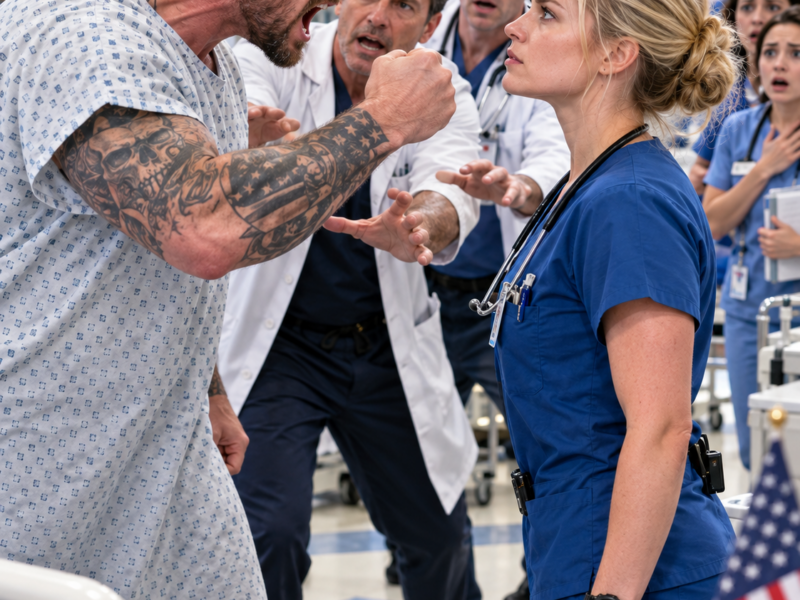
The first thing the patient did when I walked into the Naval Medical Center’s emergency room was look at my uniform
“Commander, I need you to tell me everything you remember about the man you evacuated from Black Tern.”
Admiral Hayes spoke those words inside a small conference room behind the emergency department. The blinds were closed, the door was locked, and two security officers stood outside. A digital recorder sat on the table between us, switched off until I gave my consent.
I had not sat in a room like this in six years.
I lowered myself into the chair opposite him and placed my hands flat on the table.
“His name was Petty Officer First Class Daniel Mercer,” I said. “Communications specialist. Twenty-nine years old at the time. He was injured during the extraction, but he was alive when the medical team took custody of him.”
Hayes nodded slowly.
“According to the report I received this morning, Mercer died before reaching the field hospital.”
“Then the report is wrong.”
“I suspected as much.”
I searched his face. “Why are you asking me now, Admiral? What happened?”
He opened a folder and slid a single sheet of paper across the table.
The document was stamped with a classification marking I recognized immediately. At the top was Mercer’s name. Beneath it was a transfer record dated three days after our extraction. The destination was listed as a military medical facility that had closed years ago.
The line for the receiving physician was blank.
The line for the authorizing officer was not.
Captain Robert Voss.
I felt the muscles in my jaw tighten.
Voss had been the senior officer overseeing the operation. He had also been the man who ordered my team to abandon the eastern communications bunker when enemy fire cut off our planned route.
I had disobeyed that order.
I had gone back for Mercer and two other sailors trapped beneath a collapsed passageway. We got them out, but the delay cost us our extraction window. One member of my team was wounded, our radio failed, and I had to make a decision that could have killed every person under my command.
When we finally reached the helicopter, Mercer was barely conscious.
But he was alive.
“Why was his medical transfer authorized by Voss?” I asked.
“That is what I am trying to determine.”
“Trying to determine?” I repeated. “Sir, this is not a missing form. Somebody documented a living man as dead, then transferred him somewhere else.”
Hayes leaned back.
“I know.”
“Then you know someone concealed what happened.”
“I know there are records that do not agree with one another. I do not yet know who altered them, why they did it, or whether Mercer is still alive.”
I looked at the document again.
“He is alive.”
The admiral studied me.
“You sound certain.”
“I heard him speak. I saw him breathe. I remember the medic asking me to move because Mercer’s pulse was weak. I remember refusing to leave until someone physically pulled me away from the stretcher.”
My voice had become sharper than I intended.
I took a breath.
“I’m sorry, sir.”
“Don’t apologize for remembering.”
For the first time since he had entered the hospital, Hayes looked less like a four-star admiral and more like a man carrying something heavy.
“I signed the operational summary after Black Tern,” he admitted. “I was told that all personnel had been accounted for and that Mercer had died during transport. The documents appeared complete. I accepted the findings.”
“You accepted them without speaking to me?”
“You had already been reassigned. Your after-action interview was conducted through a separate channel, and the transcript was marked restricted. I was told there was no need to reopen the matter.”
“Who told you that?”
He hesitated.
“Robert Voss.”
I stood.
For six years, I had tried to convince myself that what happened during Black Tern was simply the price of serving. Missions went wrong. Orders were misunderstood. People died. The military documented what it could, classified what it had to, and moved forward.
But someone had taken a man I had helped save and erased him from the official record.
And the same officer who had ordered us to abandon him had apparently signed the paperwork that declared him dead.
“Where is Voss now?” I asked.
“Retired. He left active service four years ago. He currently serves as a consultant to a defense contractor.”
“Which contractor?”
Hayes turned the folder around.
The company name was printed across the top of the page.
Northstar Strategic Systems.
I knew the name. Northstar had been involved in several advanced communications and surveillance projects. During Black Tern, our intelligence team had been sent to recover a data package from a facility that was supposedly being used to intercept hostile communications.
We had been told the data was time-sensitive and that the operation could not be delayed.
We had not been told that a civilian technical team was present at the facility.
We had certainly not been told that the equipment we were retrieving belonged to Northstar.
“Was Black Tern a weapons test?” I asked.
Hayes did not answer immediately.
“That question,” he said, “is why I need you to remain available.”
I stared at him.
“Admiral, with respect, I have spent six years being available. I’ve given statements, signed confidentiality agreements, attended debriefings, and answered every question I was permitted to answer. I went back to nursing because I wanted to do something useful without carrying a classified operation into every room I entered.”
“I understand.”
“No, sir. You understand the paperwork. I remember the people.”
The words hung between us.
Then someone knocked twice on the door.
Hayes opened it himself. A woman in a dark suit stood outside, holding a thin laptop beneath one arm. Her identification badge read Special Agent Elena Ruiz, Naval Criminal Investigative Service.
“Admiral,” she said. “The initial review has found something.”
She stepped into the room, glanced at me, and closed the door.
“Lieutenant Commander Brooks, I need to ask you about a man named Daniel Mercer.”
My pulse quickened.
“Petty Officer First Class Daniel Mercer?”
“No. A civilian. Martin Daniel Mercer. Forty-six years old. Communications engineer. He worked as a contractor for Northstar before disappearing six years ago.”
Hayes turned toward her.
“You have a second Mercer?”
“We believe the two men were connected. They were cousins. The civilian worked on the communications architecture installed at the Black Tern facility.”
I looked from one to the other.
“Why would a civilian engineer be inside an operational zone?”
“That is one of the questions we’re investigating,” Ruiz replied. “The records indicate that Martin Mercer was supposed to have been evacuated before your team arrived. But his name appears on a transport manifest created two days after the official report says he died.”
She opened her laptop.
A grainy photograph appeared on the screen. It showed a narrow corridor, a medical stretcher, and two men in military uniforms. The image was timestamped three days after Black Tern.
The face on the stretcher was partially obscured.
But the hand hanging over the edge was unmistakable. A silver ring encircled the index finger.
I remembered that ring.
Daniel Mercer had worn one, too. He had told me it belonged to his grandfather.
“That’s Daniel,” I whispered.
Ruiz shook her head.
“We can’t confirm that from this image. But the medical record attached to the transfer identifies the patient as Martin Mercer.”
“Then why did the admiral receive a report saying Daniel died?”
“Because two different records may have been combined, or one may have been deliberately altered. We don’t know yet.”
I looked at the photograph again.
Something about the corridor bothered me. The wall panels. The emergency lighting. The narrow window at the far end.
I’d seen that layout before.
“Where was this taken?”
Ruiz enlarged the image.
“An annex attached to a military medical facility in Virginia. It was decommissioned five years ago.”
“Who had access to it?”
“Military medical personnel, a small number of contractors, and officers assigned to a restricted recovery program.”
“And Voss?”
Ruiz met my eyes.
“His credentials were used to authorize access to the facility.”
For a moment, I could hear nothing but the steady hum of the ventilation system.
I remembered Voss standing beside the extraction helicopter, his uniform immaculate despite the dust and smoke. He had looked at me with cold disbelief when I reported that Mercer had survived.
“You were ordered to withdraw, Brooks,” he had said.
“There were still people below.”
“The operation was over.”
“Not for them.”
He had stared at me for several seconds before ordering me to medical evaluation and warning me not to discuss the mission outside the official debriefing.
I had assumed he was protecting classified information.
Now I wondered whether he had been protecting something else.
Ruiz closed the laptop.
“We’re going to reopen the case. But I need you to understand that this is not just about a missing service member. There may have been falsified medical records, unauthorized transfers, and deliberate obstruction of a federal investigation.”
“Then investigate it.”
“We will. But if you have any original documents, letters, recordings, or communications related to Black Tern, do not alter them. Preserve everything.”
I thought of the small box in my closet, the one containing my commendations and the few personal items I had kept from the mission.
There was one item I had not shown anyone.
A folded piece of paper, stained at one corner, that Mercer had pressed into my hand on the helicopter.
I had kept it because it was the only thing he had given me before the medics took him away.
I had never opened it.
“Commander?” Ruiz asked.
I looked up.
“I may have something.”
I returned to my apartment after my shift, but I did not turn on the television or change out of my uniform immediately. I went straight to the bedroom closet, pulled a small storage box from the top shelf, and placed it on the bed.
Inside were my medals, an old unit patch, a photograph of my team, and the folded paper.
I held it for a long time.
Then I opened it.
The handwriting was cramped and uneven, as if Mercer had been struggling to write.
Commander Brooks,
If you’re reading this, I hope I’m home. There are things about Black Tern that I was never supposed to tell anyone. The communications system was not being tested the way they claimed. Someone changed the routing data before the operation, and people knew the evacuation route would fail.
I copied the original logs.
If anything happens to me, look for the man who signed the transfer.
D.M.
I read it twice.
Then a third time.
The note was dated two days before the operation.
I sat on the edge of the bed, staring at the final two letters.
D.M.
Daniel Mercer.
He had known something was wrong before we ever entered the facility.
And someone had known he possessed the evidence.
I called Agent Ruiz.
She answered on the second ring.
“Ruiz.”
“I found a note from Daniel Mercer. It says he copied the original communications logs before Black Tern. He believed someone had altered the routing data.”
There was a pause.
“Do you have the original document?”
“Yes.”
“Don’t send it electronically. I’ll arrange for an investigator to collect it and document the chain of custody.”
“Agent, there’s something else.”
“Go ahead.”
“The note says to look for the man who signed the transfer.”
“Captain Voss.”
“Yes.”
Ruiz exhaled.
“Commander, I need you to stay somewhere secure tonight. We have reason to believe someone has been accessing archived files connected to the case. If this note is authentic, whoever concealed those records may realize that we’re getting close.”
I looked toward the apartment door.
“Are you saying I’m in danger?”
“I’m saying I don’t want you taking unnecessary risks.”
After we ended the call, I checked the locks, closed the blinds, and placed the note in a clean envelope.
At 11:46 p.m., someone knocked on my door.
Three short knocks.
Then two more.
I froze.
“Who is it?”
“Federal investigator,” a man’s voice answered. “Agent Ruiz sent me to collect the document.”
I approached the door without opening it.
“What’s your name?”
“Special Agent Paul Carter.”
I checked my phone.
There was a new message from Ruiz.
I’m sending someone to your apartment tomorrow morning. Do not hand over the evidence to anyone tonight. Confirm receipt.
My stomach dropped.
The man outside knocked again.
“Commander Brooks? We need to move quickly.”
I stepped away from the door and called Ruiz.
She answered almost immediately.
“Ruiz.”
“Someone is outside my apartment claiming you sent him.”
Her voice sharpened.
“Do not open the door. What name did he give you?”
“Paul Carter.”
“Stay where you are. I’m checking our personnel roster.”
I heard keys tapping in the background.
Then she said, “We don’t have a Paul Carter assigned to this investigation.”
The knocking stopped.
For several seconds, there was silence.
Then I heard footsteps moving away from my door.
I remained still until Ruiz confirmed that local security was on its way. When I finally looked through the peephole, the corridor was empty.
But something had been pushed beneath my door.
A white envelope.
Inside was a single photograph of me standing beside a military helicopter during the Black Tern extraction. On the back, someone had written six words in black ink.
You should have left him behind.
The next morning, I met Agent Ruiz at a secure NCIS office.
She examined the photograph, sealed it as evidence, and arranged for the building’s security footage to be preserved.
“Whoever left this knew where you lived,” she said. “And they knew about Black Tern.”
“They also knew about the note.”
“Which means someone may have accessed your personnel records or intercepted information from the investigation.”
I leaned forward.
“Can you protect Daniel Mercer if he’s alive?”
“We’re trying to establish where he is. The medical facility records have led us to a private rehabilitation center in Maryland. It received payments from a Northstar subsidiary for several years.”
“Was Daniel there?”
“We don’t know. The patient records are incomplete.”
“And Martin Mercer?”
“His name appears on a billing file from the same organization.”
I looked at her.
“So both men may have been moved through the same system.”
“That is our working theory.”
“Then let’s go.”
Ruiz studied me carefully.
“You’re not an investigator, Commander.”
“No. I’m the person who carried Daniel Mercer out of that building.”
“And if the person behind this decides to threaten you again?”
“Then they’ll discover that threatening me won’t change what I remember.”
Ruiz did not smile, but she nodded.
“I expected you to say that.”
We left for Maryland with two additional agents and a warrant authorizing access to the facility’s archived medical records.
The rehabilitation center stood on a quiet road outside the city, surrounded by bare trees and a high fence. It had been converted into a private neurological care facility several years earlier. The administrator met us in the lobby, visibly nervous when Ruiz presented her credentials.
At first, he insisted that the center had no records relating to Daniel Mercer.
Then Ruiz showed him the payment authorization.
His expression changed.
“I’ll need to speak with our legal department,” he said.
“You may do that after we secure the records,” Ruiz replied.
An hour later, we were in a small office reviewing scanned files.
One record identified a patient as D. Mercer, male, age thirty-five at admission, with injuries consistent with blast trauma and prolonged oxygen deprivation. The admission date matched the week after Black Tern.
The discharge field was blank.
The attending physician’s signature was illegible.
But the authorization code at the bottom belonged to Captain Robert Voss.
I felt the room tilt around me.
“Where is he now?” I asked.
Ruiz turned to the administrator.
“We need the current location of this patient.”
The administrator swallowed.
“He was transferred to a private facility in Arizona nearly four years ago.”
“Under whose authority?”
He looked down at the document.
“Northstar Strategic Systems.”
I gripped the edge of the desk.
Four years.
For four years, someone had been paying to keep a man hidden, using medical facilities and private contracts to make the trail difficult to follow.
“Is he alive?” I asked.
The administrator looked at me.
“The last clinical report indicates that he was.”
I closed my eyes for a moment.
I had carried the memory of that helicopter for six years. I had remembered Daniel’s blood on my gloves, his shallow breathing, and the medic shouting for me to let go.
I had believed the rest of his story belonged to his family and the life he would rebuild after recovery.
Instead, someone had taken that future away from him.
“Agent Ruiz,” I said, “I want to know why.”
“So do I,” she replied.
We reached Arizona two days later.
The facility was smaller than the one in Maryland, tucked between a residential neighborhood and a stretch of desert highway. Its public name was Sonoran Recovery Services. The records showed that it had received substantial payments from a Northstar subsidiary, routed through two intermediary companies.
Ruiz obtained a warrant for the relevant patient files and requested immediate access to the facility.
The administrator tried to delay us.
Then one of the agents found a locked room in the medical records wing.
Inside were boxes of paper files, old computer drives, and a cabinet containing documents labeled with the code BLACK TERN — M-17.
Ruiz looked at me.
“Does M-17 mean anything to you?”
I shook my head.
“Not officially.”
She opened the first box.
The documents inside described a patient who had suffered severe injuries during a classified military operation. His identity had been withheld from the facility’s ordinary records. The paperwork referred to him only as M-17, with authorization for continued treatment under a private funding agreement.
The signature approving the agreement belonged to Robert Voss.
But the most important document was a handwritten note attached to a medical assessment.
Patient repeatedly asks about his team. Staff instructed not to disclose status of other personnel. Patient believes he was abandoned.
I had to look away.
Daniel had survived the operation only to spend years believing the people he trusted had left him behind.
I knew what it meant to wake from a nightmare and wonder whether a memory was true. I knew how easily a person could begin to doubt the decisions that had once kept them alive.
But Daniel had not been abandoned.
We had gone back for him.
We had carried him out.
Someone had taken that truth away from him.
“Where is he?” I asked the administrator.
The man hesitated.
Ruiz placed the warrant on the desk.
“Answer the question.”
“Building C. Second floor. Room twelve.”
I was already moving before he finished speaking.
Agent Ruiz caught up with me at the stairwell.
“Commander, let the medical staff assess him first. We don’t know his current condition.”
I stopped and forced myself to take a breath.
She was right.
I had spent six years learning how to keep emotion from interfering with a medical decision. I would not abandon that discipline now.
We entered Building C through a secured corridor. A nurse met us outside Room 12 and asked who we were.
“I’m here to see Daniel Mercer,” I said.
She looked at the agents, then at my face.
“You know him?”
“Yes.”
She opened the door.
The man sitting beside the window was thinner than I remembered. His hair had gone gray at the temples, and a scar ran from the edge of his jaw to his collar. One hand rested on the arm of his wheelchair. His other hand was curled against his chest, fingers stiff from an old injury.
He turned toward us.
For a moment, he looked confused.
Then his eyes settled on me.
“No,” he whispered.
I stepped into the room.
“Daniel.”
He stared at me as if I were a ghost.
“No. They told me you were dead.”
My throat tightened.
“I’m alive.”
He shook his head repeatedly.
“They said the extraction failed. They said everyone was gone.”
“Not everyone.”
His eyes filled with tears.
I crossed the room slowly, giving him time to tell me to stop. When I reached him, I knelt beside his wheelchair.
“I came back for you,” I said. “We got you out. I watched the medics take you onto the helicopter.”
Daniel covered his mouth with his hand.
“They told me I had imagined it. They said the explosion had damaged my memory. They said I was confused.”
“You weren’t confused.”
He began to cry.
I had seen Daniel under enemy fire. I had seen him keep a broken radio running with a bleeding hand because he knew our team needed one more transmission. I had seen him refuse evacuation until the last wounded sailor was secured.
I had never seen him cry.
I put my hand over his.
“You survived,” I whispered. “You did what you were supposed to do. None of this was your fault.”
He squeezed my hand with what little strength he had.
“Why didn’t anyone come?”
I could not give him the answer he deserved.
Because I had spent years believing the military had handled his care. Because the official reports had said he died. Because the people who knew the truth had allowed me to build a life around a lie.
“I didn’t know where you were,” I said. “But I’m here now.”
He closed his eyes.
For a long time, neither of us spoke.
Then he opened them again.
“There was a second file,” he whispered.
Ruiz moved closer.
“What file, Daniel?”
“The original routing logs. I copied them before the operation. They showed that the evacuation corridor had been deliberately disabled.”
“Who did that?” she asked.
Daniel looked at me.
“Voss didn’t just know about the failure. He knew the corridor would be compromised before we entered the facility.”
The room went quiet.
“Are you certain?” Ruiz asked.
Daniel nodded.
“I saw the authorization. The test was supposed to demonstrate that Northstar’s system could identify hostile transmissions and reroute military communications under pressure. But the system had a flaw. It could misclassify friendly signals as hostile. The company knew. They needed a live operational demonstration to prove it was safe enough for deployment.”
“And the operation was used as that demonstration?” Ruiz asked.
Daniel swallowed.
“They said the facility was under threat. They told us the data had to be recovered. But the routing changes were made before we arrived. When the system failed, Voss ordered the eastern corridor sealed. He knew people were still inside.”
I felt the familiar coldness settle over me.
“Did he know you were alive?”
Daniel nodded.
“He came to the medical facility himself. I heard his voice outside my room. He told someone that the incident had to remain contained. After that, they transferred me and changed my records.”
“Did you hear him order anyone to kill you?” Ruiz asked.
Daniel shook his head.
“No. I don’t know if he wanted me dead. I know he wanted me silent.”
Ruiz exchanged a glance with the other agent.
“Do you know where the original logs are?”
Daniel looked toward a small cabinet beside his bed.
“I hid a backup before the operation. I never told anyone where it was.”
“Where?”
“In a storage unit outside Norfolk. The key was mailed to my sister. I don’t know if she still has it.”
Ruiz immediately contacted her team.
The investigation had finally found its center.
But Daniel was not finished.
“There was someone else,” he said.
I leaned closer.
“Who?”
“A technician. Peter Lawson. He worked for Northstar. He helped me copy the logs, but he disappeared after the operation. I heard Voss say that Lawson had become a problem.”
Ruiz wrote down the name.
“Do you know where he is?”
“No. But if he’s alive, he knows what happened.”
I looked at Daniel’s exhausted face.
“We’ll find him.”
He gripped my hand again.
“Promise me something.”
“Anything.”
“Don’t let them tell the story without us this time.”
I felt the weight of those words settle into my chest.
“I promise.”
Peter Lawson was found three days later.
He had been living under his own name in a small town in Oregon, working as a civilian electronics technician. He had never been charged with a crime, but he had spent years avoiding people connected to Northstar.
When Ruiz and her team approached him, he initially refused to speak.
Then she showed him Daniel’s statement.
Lawson sat silently for nearly a minute.
Finally, he said, “I wondered how long it would take before someone came looking.”
He agreed to cooperate after his attorney reviewed the evidence. He had retained a copy of the original communications logs and a short video recorded from a monitoring station inside the facility.
The video was damaged, but the audio was clear.
A voice identified as Captain Voss could be heard issuing an order.
“Seal the eastern corridor.”
Another officer responded, “There are still personnel below.”
“I understand.”
“Sir, the evacuation is incomplete.”
A pause followed.
Then Voss said, “Proceed with the closure.”
I listened to the recording in the NCIS conference room.
I had heard those words before. Not in that exact sequence, but in the moment that had changed everything. The alarms. The confusion. The sudden loss of communications. The sound of metal collapsing behind us.
For six years, I had questioned whether I had misheard the original order. Whether the chaos had distorted my memory. Whether disobeying Voss had endangered my team.
The recording settled that question.
I had heard him correctly.
He had known people were still below.
And he had ordered the corridor sealed anyway.
Ruiz paused the recording.
“This is powerful evidence,” she said. “But we still need to establish the full chain of command, what Voss knew about the system’s failure, and whether anyone directed the falsification of medical records.”
“Then follow the money,” Lawson said.
He opened another file.
Northstar had paid several consultants through a series of shell companies in the months before and after Black Tern. One of those payments had gone to a private medical management firm. Another had gone to a company controlled by a former officer who had worked directly under Voss.
A third payment had been made just weeks after the operation.
Its description read: incident management and record reconciliation.
The payment was approved by Voss.
Ruiz looked at the screen.
“That’s enough to obtain additional warrants.”
Lawson nodded.
“There is more. The system didn’t just fail during the operation. It recorded the failure. Someone altered the logs afterward to make it appear that the communications network had been compromised by hostile interference.”
“Could the original data prove that?” I asked.
“Yes. The system recorded both the transmitted command and the internal routing response. You can change the report, but the original data contains inconsistencies that are difficult to erase without leaving traces.”
Ruiz closed the file.
“We’ll have the technical team examine every copy.”
For the first time since the admiral had stopped me in the hospital corridor, I felt that the truth was no longer just a memory I carried alone.
It was evidence.
It had dates, signatures, financial records, and a voice on a recording that could no longer be explained away as confusion.
But evidence did not automatically mean justice.
And Robert Voss had spent years making sure he remained beyond the reach of ordinary questions.
The confrontation came two weeks later.
Voss agreed to meet investigators at a federal building after his attorney informed him that a warrant for his financial records was being prepared. He arrived wearing a dark suit, carrying a leather briefcase, and looking as composed as I remembered.
He had aged, but his expression had not changed.
When he saw me in the interview room, he stopped.
“Brooks.”
“Captain.”
“I’m a retired officer now.”
“And I’m still a Navy nurse.”
He glanced toward Ruiz.
“I was told this meeting concerned classified records. I wasn’t told a former subordinate would be present.”
“I’m here as a witness,” I said.
He took a seat.
Ruiz explained the evidence: the altered routing logs, the medical transfers, the payments to Northstar, and the recording of his order to seal the corridor.
Voss listened without interrupting.
When she finished, he folded his hands on the table.
“The operation was complicated,” he said. “The system was being evaluated under operational conditions. Nobody anticipated the severity of the failure.”
“You were told personnel were still inside,” Ruiz replied.
“I was informed that the evacuation had been substantially completed.”
“The recording says otherwise.”
He glanced at me.
“You were ordered to withdraw, Lieutenant Commander. You disobeyed that order.”
“I went back for my people.”
“You endangered the entire extraction team.”
“We brought them home.”
“Not all of them.”
The words struck like a slap.
For a moment, the old guilt rose so quickly that I almost forgot where I was. I remembered the wounded sailor on the helicopter, the medic shouting for more supplies, and the faces of the people who had depended on me.
Then I remembered Daniel in the rehabilitation center, asking why nobody had come.
I leaned forward.
“You knew he survived. You knew where he was. And you let him believe we had abandoned him.”
Voss’s expression tightened.
“I was protecting sensitive information.”
“You erased a man.”
“I preserved a classified program during a period of national security concern.”
“You falsified medical records.”
“I did not personally alter every document.”
“You signed the transfer authorizations.”
He looked toward his attorney.
Ruiz placed a copy of the recording on the table.
“Did you order the eastern corridor sealed after being told personnel remained inside?”
Voss said nothing.
“Did you authorize the subsequent transfer of Daniel Mercer to a private medical facility?”
“I authorized medical treatment under a restricted program.”
“Did you disclose his location to his family or commanding officers?”
“No.”
“Why?”
Voss’s jaw tightened.
“Because Mercer possessed information that could compromise an active defense program.”
“The program was compromised by its own failure,” Ruiz said.
“You don’t understand what was at stake.”
I stood so abruptly that my chair scraped against the floor.
“No. You don’t understand what was at stake.”
Ruiz looked at me, but she did not stop me.
“Those were real people beneath that corridor,” I continued. “They had names, families, and people waiting for them to come home. You knew the system had failed, and you decided the truth was more dangerous than the people trapped inside it.”
Voss stared at me.
“You think I wanted anyone to die?”
“I think you decided that their lives were expendable.”
For the first time, he looked uncertain.
He glanced down at the documents.
“I was told the corridor could be sealed without casualties.”
“By whom?” Ruiz asked.
Voss did not answer.
“Who told you the system was safe?”
Silence.
“Who ordered the records changed?”
Still nothing.
His attorney finally spoke.
“My client will not answer further questions without a formal agreement concerning the scope of this investigation.”
Ruiz closed her folder.
“That can be arranged through counsel.”
The meeting ended without a confession.
But as Voss stood to leave, he looked at me one last time.
“You should have followed the order, Brooks.”
I met his eyes.
“I did what the uniform required of me.”
He walked out without another word.
The investigation lasted eight months.
It moved slowly, through technical reviews, financial audits, witness interviews, and hearings behind closed doors. Some records were still missing. Several former Northstar employees refused to cooperate until they received immunity assurances. One senior executive resigned before investigators could question him.
But the evidence continued to grow.
Independent engineers confirmed that the communications system had misclassified friendly signals during testing. The original logs showed that the eastern corridor had been marked unsafe before the operation began. Northstar’s internal correspondence revealed concerns about the system’s reliability that had not been included in the operational briefing.
Investigators also established that Voss had received warnings about the routing problem before Black Tern.
He had not disclosed those warnings to the team.
After the operation, he authorized the restricted transfer of Daniel Mercer, approved payments connected to the medical facilities, and provided information that investigators later determined was materially false.
Voss maintained that he had acted to protect national security and had never intended anyone to die.
The prosecution did not need to prove that he had planned every consequence.
It needed to prove what he had known, what he had ordered, and what he had done afterward.
The original recordings, transfer records, and financial documents made that possible.
Northstar’s defense contractor status did not shield its executives from scrutiny. Several were charged in connection with falsified records and the concealment of evidence. The company lost major contracts while the government reviewed its conduct.
Voss eventually pleaded guilty to obstruction-related offenses and making materially false statements during the investigation. Other charges were resolved through a separate proceeding. His sentence included prison time and restrictions that ended his ability to work in defense consulting.
The court did not declare him responsible for every injury sustained during Black Tern. The facts were more complicated than that, and some questions remained unanswered.
But the official record could no longer pretend that the evacuation had gone as reported.
Daniel Mercer was alive.
The corridor had been sealed while personnel remained unaccounted for.
And the truth had been concealed by people who believed their careers and programs mattered more than the lives caught inside their decisions.
When Admiral Hayes called me to his office after the final findings were released, he did not begin with a speech.
He stood beside the window, holding a copy of the revised operational report.
“I owe you an apology,” he said.
I remained standing.
“For what, sir?”
“For accepting the original account without demanding an independent review. For allowing the restricted summary to replace the testimony of the people who were actually there. And for not asking why your report had been separated from the official record.”
I studied him.
“You weren’t the one who sealed the corridor.”
“No. But I was responsible for ensuring the truth was examined properly. I failed to do that.”
He placed the report on the desk.
“The Navy has approved a formal correction. Your actions during the evacuation will be fully documented. The record will acknowledge that you returned to the eastern corridor, recovered personnel, and helped secure the extraction under conditions that had been misrepresented in the original report.”
I looked at the document.
For years, I had believed my career had ended with a question mark. I had been praised in public, questioned in private, and quietly encouraged to stop discussing the mission.
I had never been accused of wrongdoing, but I had lived with the feeling that I had somehow failed the people I led.
Now the institution that had allowed that doubt to grow was finally acknowledging what had happened.
“Thank you, Admiral,” I said.
He nodded.
“I know that doesn’t repair the years you lost.”
“No, sir. It doesn’t.”
He accepted the answer without defending himself.
That mattered more than I expected.
Daniel returned to Virginia under the care of a rehabilitation team he had chosen himself. His recovery was not sudden or simple. Years of physical injury, interrupted treatment, and psychological trauma had left him with a long road ahead.
But he was no longer a nameless patient in a private facility.
He had his identity back. He had access to his medical history. His family knew where he was, and the people responsible for hiding him could no longer decide what he was allowed to remember.
I visited him whenever my schedule permitted.
Sometimes we talked about the operation. Sometimes we talked about ordinary things: food, music, the weather, the absurd cost of parking near the hospital.
One afternoon, I brought him a photograph of our original extraction team.
He held it carefully.
“Look at that,” he said. “We thought we were invincible.”
“We were twenty-something and badly informed.”
He laughed, and the sound surprised both of us.
Then his expression softened.
“I thought you had forgotten me.”
I sat beside him.
“I never forgot you.”
“Why didn’t you find me?”
“I didn’t know you were alive.”
He looked down at the photograph.
“I know that now.”
For a while, he said nothing.
Then he turned toward me.
“Do you still have the note?”
“Yes.”
“The one I gave you?”
I nodded.
“I didn’t know whether you’d kept it.”
“I kept it.”
He closed his eyes briefly.
“I think part of me believed that if someone remembered the truth, then maybe I hadn’t imagined everything.”
I reached for his hand.
“You didn’t imagine it.”
He squeezed my fingers.
“And you didn’t fail us.”
Those words broke through the last of the defenses I had built around the memory.
For years, I had carried the belief that my disobedience had put my team in danger. I had replayed every decision, every second of delay, every moment when I had chosen one route over another.
I had wondered whether following Voss’s order would have saved lives.
But the truth had never been that simple.
The danger had been created before we arrived. The system had failed before the first shot was fired. And the order to seal the corridor had been given by a man who knew there were still people below.
My decision to go back had not caused the crisis.
It had given some of us a chance to survive it.
Six weeks later, the Navy held a formal ceremony at the medical center.
There were no television cameras and no dramatic speeches about victory. The room was filled with sailors, medical personnel, investigators, and a few families who had waited years for the official record to catch up with what they had known in their hearts.
Admiral Hayes presented me with a revised commendation recognizing my actions during Black Tern.
I accepted it without feeling triumphant.
The medal was not going to give Daniel back the years he had lost. It would not erase the injuries suffered by the other survivors or restore the trust that had been broken.
But it was a correction.
And corrections mattered.
After the ceremony, a young corpsman approached me near the exit.
“Ma’am?”
I turned.
“I was there the day Mr. Reed grabbed you in the emergency department,” he said. “I thought you were going to destroy him.”
I almost smiled.
“Why would I do that?”
“He was disrespectful. He put his hands on you. Everyone knew who you were after the admiral arrived.”
I looked at the young man for a moment.
“Would it have mattered if the admiral hadn’t known my name?”
He hesitated.
“No, ma’am.”
“Then remember that. You don’t need a medal to deserve basic respect. And you don’t need to know someone’s history before you treat them with dignity.”
He nodded, taking the lesson seriously.
I thought of Mason Reed, who had believed that status made him superior to the person treating his injury. I thought of Voss, who had believed that authority made his decisions unquestionable. And I thought of Daniel, who had been denied the right to tell his own story.
They had all underestimated something different.
Reed had underestimated the nurse standing in front of him.
Voss had underestimated the people who remembered what he had done.
And the people who buried Black Tern had underestimated the stubbornness of the truth.
Several months later, I was working another busy shift in the emergency department when a new patient was brought into triage. He was frightened, angry, and in obvious pain. He snapped at the nurse taking his vital signs and demanded to see someone in charge.
I approached his bed.
“My name is Hannah Brooks,” I said. “I’m one of the nurses here. Tell me what’s hurting.”
He looked at me suspiciously.
“Are you going to listen, or are you going to tell me what to do?”
“I’m going to listen first. Then we’ll work out what needs to happen.”
His shoulders relaxed a little.
It was a small moment, barely worth recording in a chart. But as I checked his pulse and began asking questions, I realized that I was no longer thinking about Black Tern with every breath.
The past was still there. It always would be.
But it no longer had to control every room I entered.
Later that evening, Daniel called me from his apartment.
“I got the letter,” he said.
“What letter?”
“The final correction to my service record. They officially recognize that I survived the operation and was transferred under an unauthorized medical arrangement.”
I leaned against the counter.
“How does it feel?”
He was quiet for a moment.
“Strange. I thought I’d feel angry. I do, a little. But mostly, I feel like I can stop proving that I existed.”
I closed my eyes.
“That sounds like a good place to start.”
“It is.”
We talked for another twenty minutes before he had to leave for a rehabilitation appointment. After we hung up, I returned to the nurses’ station and finished my charting.
On my way out, I passed the corridor where Mason Reed had grabbed my wrist. The memory came back briefly: his contemptuous expression, his demand to see someone important, the sudden silence when the admiral recognized my name.
I had once believed that the most important part of my service was what I could endure under fire.
Now I understood something else.
Courage was not just running toward danger. Sometimes it was refusing to let a lie become the final version of a story. Sometimes it was telling the truth when the person responsible had more authority than you. And sometimes it was walking into an emergency room, putting on your gloves, and caring for someone who had forgotten that the person helping him was human, too.
I was still Lieutenant Commander Hannah Brooks.
I was still a decorated combat Navy SEAL who had served in places most people would never see.
But I was also a nurse.
And when I left the hospital that night, I did not feel the need to prove either fact to anyone.
For the first time in six years, Black Tern was no longer the secret that defined my life. It was a part of my history—painful, complicated, and finally told.
Daniel was alive. The truth was on record. The people who had hidden it had faced consequences.
And I had learned that the strongest thing a person could carry was not a medal, a rank, or the authority to command others.
It was the truth, held long enough that no one could bury it again.
THE END.









