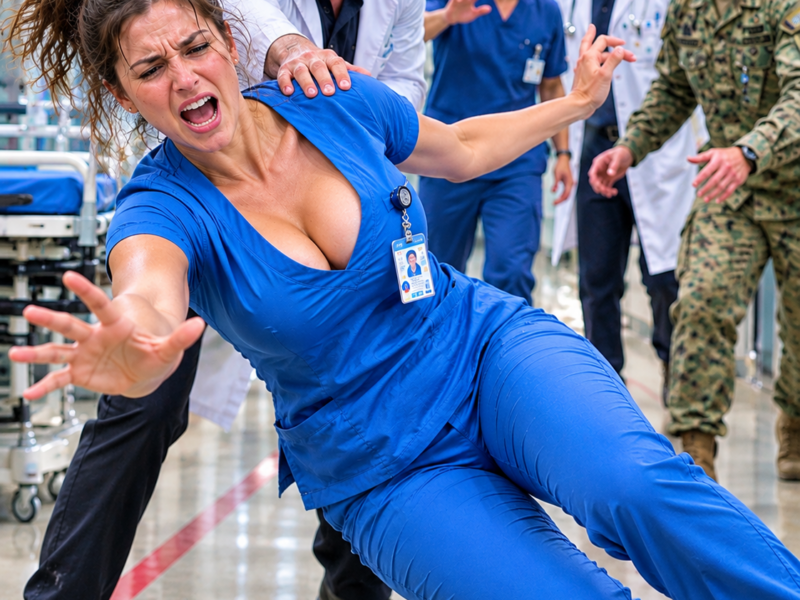
The first thing I noticed was the silence. Not the ordinary silence that falls over a crowded room when someone drops a glass or raises their voice
The identification card remained in Commander Hayes’s hand.
He looked at the photograph, then at me, and finally at the two sailors standing several feet away.
“Captain Elizabeth Morgan?” he asked, his voice noticeably quieter.
“Yes, Commander.”
Petty Officer Daniel Reeves slowly pushed himself off the training room floor.
A few minutes earlier, he had been laughing with his friends while I lay against a stack of plastic equipment crates.
Now he couldn’t seem to meet my eyes.
Hayes turned toward him.
“Do you understand what you’ve just done?”
Reeves swallowed.
“Sir, I didn’t know she was a captain.”
I wiped the blood from the corner of my mouth.
“Would it have mattered if I weren’t?”
Nobody answered.
That question hung in the training facility longer than the sound of the equipment hitting the floor.
I had learned something important during my years in the Navy.
People who respect authority only when they recognize the person wearing it don’t really understand respect.
And that morning, I was about to discover that the problem at this facility went much deeper than two sailors who thought humiliating a woman would make them look powerful.
My name is Elizabeth Morgan.
I was a Navy Captain, a decorated special warfare officer, and the recipient of five extraordinary service commendations earned during operations that had tested every part of my training.
I rarely talked about my military record.
I didn’t wear my accomplishments like a shield, and I had never believed that a collection of awards made me more valuable than the sailors standing beside me.
Three days earlier, I had arrived at the naval training facility under an assignment from a senior command review team.
My responsibility was to evaluate training standards, leadership practices, personnel readiness, and the general working environment.
I had deliberately kept my introduction simple.
I wanted to observe the facility without people changing their behavior because they recognized my name.
That morning, I had been reviewing equipment records near the storage area when Reeves approached me from behind.
His forearm struck across my shoulders.
The impact sent me stumbling into the crates.
My clipboard fell, and several pages scattered across the concrete floor.
“Careful, sweetheart,” he had said. “Wouldn’t want you getting hurt on a real deployment.”
A few sailors laughed.
I told him to let go.
Instead, he grabbed the back of my uniform and pulled me around.
“What’s the matter? You don’t like being surprised?”
I warned him one last time.
He ignored me.
When he lunged again, I redirected his movement and brought him down.
His friend, Marcus Bell, tried to intervene and found himself on the floor moments later.
The entire confrontation lasted less than a minute.
But the silence afterward told me more about that unit than several weeks of paperwork might have.
Hayes immediately ordered the security team to preserve the surveillance recordings.
He also requested medical personnel to examine my shoulder.
“Captain, I want to assure you this kind of conduct isn’t tolerated here,” he said.
I looked at the sailors who had witnessed everything.
“Then let’s find out why so many people seemed comfortable watching it happen.”
Hayes didn’t respond.
He escorted me to his office, where Commander Patricia Lawson, the base legal officer, joined us.
She reviewed the footage on her tablet.
Her expression changed as the recording played.
“There’s no question about who initiated the physical contact,” she said.
“Good. Then we have somewhere to begin.”
She opened another file.
“Captain, there have been previous complaints involving Reeves.”
“How many?”
“Three informal complaints in the last six months. Only one became an official report.”
“What happened to the other two?”
“Both sailors requested reassignment before the complaints were finalized.”
I looked at Hayes.
“Who supervises Reeves?”
“Commander Thomas Whitaker. He runs the training division.”
I recognized the name.
Whitaker had signed several evaluations I had already reviewed.
His reports described Reeves as an exceptional instructor with outstanding leadership potential.
That seemed difficult to reconcile with the footage.
“Get me every complaint, transfer request, and evaluation connected to his training group.”
Lawson nodded.
“I’ll have them ready.”
I thought the matter might end with disciplinary action against two sailors.
I was wrong.
That evening, I was reviewing the personnel files when I noticed one name appearing repeatedly.
Petty Officer Hannah Collins.
Her records contained three separate requests for assistance.
The first described verbal harassment.
The second mentioned pressure to falsify training records.
The third was an unfinished statement dated six weeks earlier.
“I am requesting reassignment because I no longer feel safe reporting to my current supervisor.”
The signature line was blank.
I was still reading when someone knocked softly.
A young woman stood in the doorway.
“Captain Morgan?”
“Yes?”
“I’m Petty Officer Collins.”
She looked at the papers on my desk.
“I heard about what happened this morning.”
“Word travels quickly.”
She gave a nervous smile that disappeared almost immediately.
“I wanted to apologize.”
“For what?”
“For not saying anything when Reeves attacked you.”
I closed the file.
“Hannah, you didn’t attack me. You don’t owe me an apology.”
She looked down.
“You don’t understand. He’s done things like that before.”
“Tell me about them.”
She sat slowly.
She explained that Reeves frequently embarrassed junior sailors during training.
He would make insulting remarks, deliberately provoke arguments, and then accuse anyone who objected of being unable to handle pressure.
If someone complained, he reminded them that their evaluations could affect their future assignments.
“Why didn’t anyone report him?”
“Some people did.”
“And?”
“Commander Whitaker handled the complaints.”
I recognized the name again.
Hannah reached into her folder and pulled out a photograph.
It showed Reeves standing beside Whitaker at a retirement celebration.
“Every complaint went through him,” she said.
“Are you suggesting he protected Reeves?”
“I’m saying the complaints disappeared.”
She opened the folder again and produced a small flash drive.
“I saved copies of the original training records.”
I looked at the device.
“What kind of records?”
“Practical assessments. Safety reports. Evaluation results.”
“What happened to them?”
“Somebody changed them.”
She explained that sailors who had failed certain assessments were later listed as having passed.
Reports involving Reeves were removed or rewritten.
One sailor who had questioned the changes received an unexpectedly poor evaluation.
“Do you have evidence connecting Whitaker to this?”
Hannah hesitated.
“I have emails.”
I didn’t take the flash drive immediately.
Instead, I asked her something.
“Why are you telling me now?”
She looked toward the window.
“Because when Reeves attacked you, I realized he didn’t know who you were.”
I waited.
“He thought you were just another woman he could push around. He thought nobody would care.”
Her voice cracked.
“That’s how he treated me.”
I picked up the flash drive.
“Thank you for trusting me.”
She stood.
“Please don’t let them find out I gave you this.”
“I’ll protect the integrity of the investigation, and we will handle your identity carefully.”
She nodded and left.
For several seconds, I remained alone with the flash drive in my hand.
I had seen misconduct during my career.
I had seen officers abuse authority and people hide behind impressive titles.
But the possibility that training records had been falsified was especially serious.
A sailor who received a qualification without earning it could eventually be placed in a position where someone else’s life depended on skills that person didn’t possess.
This wasn’t simply a question of workplace bullying.
It was a question of readiness and safety.
The following morning, I met with Lawson and Hayes.
The flash drive was secured, and the original records were preserved for examination.
Several discrepancies appeared immediately.
One training assessment had been marked as passed despite the instructor’s original notes showing multiple critical failures.
Another report had been edited three days after its official approval.
A safety complaint had disappeared from the digital system entirely.
Hayes studied the documents.
“Someone has been changing official records.”
“Yes,” Lawson replied.
“And whoever did it knew exactly where to make the changes.”
I looked at her.
“Can we identify the accounts used?”
“We’re working on that.”
Before the meeting ended, the conference room door opened.
Commander Thomas Whitaker walked inside.
He was in his late fifties, with neatly pressed sleeves and the confident expression of someone accustomed to controlling a room.
“I understand we have a problem,” he said.
Hayes stood.
“Commander.”
Whitaker ignored the greeting and looked directly at me.
“Captain Morgan, I believe this investigation has become unnecessarily complicated.”
I remained seated.
“Good morning, Commander.”
“Petty Officer Reeves is an experienced instructor. He’s made a mistake, and I don’t believe we should destroy his career over an unfortunate confrontation.”
I placed the surveillance report on the table.
“Is that what you call it?”
Whitaker glanced at the report.
“You weren’t seriously injured.”
“That doesn’t change what happened.”
He folded his arms.
“With all due respect, you haven’t been here long enough to understand the dynamics of this unit.”
“You’re correct. That’s why I’m reviewing the records.”
I pushed the altered evaluations toward him.
“Perhaps you can explain these.”
His eyes moved across the pages.
For a brief moment, his expression changed.
Then he closed the folder.
“Administrative corrections happen all the time.”
“Changing a failed assessment into a passing qualification isn’t an administrative correction.”
He turned toward Lawson.
“Commander, I expect you to keep this investigation within its proper scope.”
Lawson didn’t move.
“It is within scope, sir.”
Whitaker looked back at me.
“I understand your reputation. Five commendations, special warfare experience, impressive operational history. But this isn’t a battlefield.”
I held his gaze.
“No, Commander. It’s a training facility. Which makes it your responsibility to ensure the people leaving here are actually qualified.”
His jaw tightened.
He picked up his folder.
“Be careful about making accusations you cannot prove.”
I answered calmly.
“That’s why we’re preserving the evidence.”
He walked out without another word.
When the door closed, Hayes exhaled.
“He’s going to make this difficult.”
I looked at the folder he had left behind.
“I think he already has.”
Over the next several days, the investigation expanded.
Petty Officer Reeves and Bell were interviewed separately.
Other sailors were asked to provide statements.
Some came forward immediately.
Others needed several conversations before they felt safe enough to speak.
One sailor described being shoved into a locker after questioning Reeves’s training methods.
Another admitted that he had witnessed a junior sailor being threatened with a poor evaluation.
A third said Whitaker had repeatedly warned personnel that complaints could damage the unit’s reputation.
The pattern was becoming clear.
But we still needed evidence connecting Whitaker to the altered records.
That evidence came from Chief Petty Officer Robert Ellis.
Ellis had served for more than twenty years.
He was respected, experienced, and generally reluctant to involve himself in disagreements.
He requested a private meeting with Lawson and me.
When he entered, he carried a sealed envelope.
“I should have brought this forward sooner,” he said.
I gestured toward the chair.
“Take your time, Chief.”
He removed several printed emails.
“Commander Whitaker asked me to approve Reeves’s evaluation after he failed a practical assessment.”
“Did you approve it?”
“No, ma’am.”
“What happened?”
“I was removed from the review board two days later.”
Lawson examined the documents.
One email contained a direct instruction from Whitaker:
“Adjust the record. We cannot afford another failure in this unit.”
The message had been sent to an administrative officer.
Ellis looked at the table.
“I printed it before the account was deleted.”
“Why did you keep it?” I asked.
He was quiet for a moment.
“Because I knew it was wrong.”
His voice became softer.
“I kept telling myself someone else would deal with it. Someone higher up. Someone with more authority.”
He looked at me.
“Then I watched what happened to those sailors who complained.”
I didn’t interrupt.
“I didn’t want to lose my career. But I also didn’t want to spend the rest of it pretending I didn’t know.”
For the first time, I saw the weight he had been carrying.
“Chief, coming forward now matters.”
He nodded, although I could tell he wasn’t ready to forgive himself.
Two days later, the oversight team arrived.
The evidence was presented to investigators, who began examining the original records, electronic communications, and personnel statements.
Reeves was questioned about the assault.
At first, he claimed he had been joking.
Then investigators played the surveillance footage.
He watched himself approach me from behind.
He watched himself shove me into the crates.
He watched himself grab my uniform after I told him to stop.
Finally, he watched himself attack again.
The investigator paused the recording.
“Petty Officer Reeves, what were you trying to accomplish?”
He rubbed his forehead.
“I was trying to make a point.”
“What point?”
He looked uncomfortable.
“She didn’t seem like she belonged there.”
I leaned forward.
“What made you think that?”
He hesitated.
“She was a woman who didn’t know how things worked in our training unit.”
I studied him.
“You never asked about my qualifications. You never asked about my experience. You decided I didn’t belong before I said ten words.”
He looked down.
“I didn’t know you were a captain.”
I answered quietly.
“You didn’t need to know.”
The investigator continued questioning him.
Eventually, Reeves admitted that he had deliberately targeted junior personnel who challenged him.
He also acknowledged that he had used humiliation to maintain control over the training group.
Bell admitted participating in the assault and helping Reeves intimidate other sailors.
But their statements revealed another troubling detail.
Both men believed Whitaker would protect them.
That belief had been reinforced repeatedly.
A week later, Hannah was called to provide a formal statement.
I sat outside the interview room while she spoke with investigators.
When she finally emerged, her eyes were red.
“Are you okay?” I asked.
She nodded.
“I think so.”
“What happened?”
“I told them everything.”
She sat beside me.
“I told them about the threats, the evaluations, the missing reports. I even told them about the day Reeves cornered me after I questioned a training result.”
I waited.
“He told me nobody would believe me because he was the person responsible for evaluating my performance.”
She looked at her hands.
“I believed him.”
I could hear the pain in those words.
“Did he touch you?”
“No. But he stood so close I couldn’t move without brushing against him. Then he told me my career would be over if I kept making trouble.”
She swallowed.
“I should have said something sooner.”
“Hannah, responsibility for his behavior belongs to him.”
She nodded slowly.
“I know that in my head.”
I understood.
Knowing something intellectually and believing it emotionally were not always the same.
The following week brought a major development.
Investigators discovered that one sailor had received a qualification despite failing a required safety assessment.
His name was Petty Officer James Parker.
When questioned, Parker admitted he had never passed the assessment.
He had told Whitaker that the paperwork was inaccurate.
Whitaker had instructed him to accept the certificate.
Parker explained that he had been afraid of being removed from the program.
“I didn’t want to disappoint my family,” he said during his interview. “I’d worked for years to get here.”
The revelation changed everything.
The investigation was no longer focused only on misconduct within one training group.
It now involved the integrity of military qualifications.
Several certifications were suspended pending verification.
Additional training records were reviewed.
Personnel whose qualifications could not be confirmed were temporarily removed from duties requiring those skills.
It caused disruption.
Some sailors were angry.
Others were embarrassed.
But the process was necessary.
A military qualification was not a favor someone could receive because an instructor liked them.
It was a promise that the person had demonstrated the ability to perform a responsibility safely.
And that promise had been compromised.
Commander Whitaker was relieved of his supervisory duties while the investigation continued.
The formal review later established that he had participated in manipulating official records and suppressing complaints.
His conduct resulted in serious administrative and military consequences, including the end of his command career.
Reeves and Bell also faced formal disciplinary proceedings.
Reeves received punishment for the assault and related misconduct.
Bell was held accountable for his role.
Neither man was permitted to return to the training positions they had previously held.
But the most meaningful moment came after the investigation had been underway for nearly a month.
I was preparing to leave the administrative building when Hannah appeared at my office.
She held a folded document.
“They approved my transfer.”
I looked up.
“Congratulations.”
She smiled, but it was a nervous smile.
“I’ll be joining a different unit next week.”
“Have you met your new supervisor?”
“Yes. She seems nice.”
Hannah hesitated.
“Can I tell you something?”
“Of course.”
“I almost withdrew my statement.”
I put down my pen.
“Why?”
“Because my father called me. He said I should think carefully about making enemies in the Navy. He was worried I would ruin my career.”
She looked away.
“I started wondering if he was right.”
“What made you change your mind?”
She took a breath.
“I remembered what you said.”
“What did I say?”
“That I didn’t owe anyone my safety just to prove I was strong.”
I smiled faintly.
She continued.
“For the first time, I understood that I could choose where I wanted to serve without feeling ashamed of leaving.”
I nodded.
“That’s an important decision.”
She looked at the document again.
“I used to think courage meant staying and fighting until someone finally believed me.”
“Sometimes courage means speaking the truth. Sometimes it means walking away after you’ve said it.”
Her eyes filled.
“Thank you for listening.”
I stood and offered her my hand.
“You did the difficult part, Hannah.”
She shook it.
And this time, she didn’t apologize.
A few days later, the base commander requested that I attend a final leadership briefing.
The room was filled with senior officers, department heads, and training supervisors.
There were no decorations, no photographs, and no speeches about my service record.
I preferred it that way.
The briefing focused on what had gone wrong and what needed to change.
The command introduced new procedures for handling complaints.
Training evaluations would receive independent reviews.
Personnel would have a protected reporting channel outside their immediate supervisory chain.
Original assessment records would be preserved and subject to periodic audits.
Most importantly, the command acknowledged that previous complaints had not been handled appropriately.
Some of the officers in the room looked uncomfortable.
That was understandable.
Change is easy to praise when it doesn’t require anyone to admit a mistake.
At the end of the briefing, Chief Ellis approached me.
“Captain, may I speak with you?”
“Certainly.”
He looked older than he had a month earlier.
“I’ve been thinking about what happened.”
I waited.
“I spent twenty years believing that protecting a command meant protecting its reputation.”
He looked toward the closed conference room door.
“I understand now that I had it backward.”
I nodded.
“Protecting the people is what gives a command its reputation.”
He smiled.
“I wish I’d learned that sooner.”
“Me too, Chief.”
He offered his hand.
I shook it.
Before leaving the base, I attended one final training session.
The facility looked almost exactly as it had on the morning I arrived.
The same equipment racks stood against the walls.
The same plastic crates were stacked near the storage area.
But the atmosphere felt different.
A young sailor was helping another adjust his protective equipment.
An instructor was explaining a difficult maneuver without insulting anyone who struggled.
People were asking questions.
People were answering them.
Nobody seemed afraid of being embarrassed for not knowing something.
I stood near the doorway for a moment.
Then one of the young sailors noticed me.
“Good morning, ma’am.”
“Good morning.”
He glanced at my shoulder.
“Are you the captain from the incident?”
I nodded.
He seemed unsure what to say.
“I heard you took down two sailors.”
I almost smiled.
“That’s not the part I want people to remember.”
He looked curious.
“Then what should we remember?”
I looked around the room.
“That nobody should have to be a decorated officer before they’re treated with basic respect.”
He nodded.
“Yes, ma’am.”
I continued toward the exit.
My shoulder had nearly healed.
The investigation had taken longer than anyone wanted, and its consequences would continue long after I left.
But the important things had changed.
The records were being corrected.
The sailors who had been intimidated were being heard.
The people responsible were facing consequences.
And Hannah was starting somewhere new.
As I reached the parking area, my phone vibrated.
It was a message from her.
A photograph showed her standing outside her new unit, holding a coffee cup.
She was smiling.
Beneath the picture, she had written:
“First morning in months when I didn’t dread walking through the gate.”
I read the message twice.
Then I typed:
“You deserve many more mornings like this.”
A moment later, another message arrived.
“Captain, I hope one day I can become a leader who makes people feel safe.”
I looked back at the training building.
Then I replied:
“You already started becoming that leader the day you decided to tell the truth.”
I put my phone away.
For years, people had asked me about the five stars associated with my service record.
They wanted to know which operation had been the most difficult, which mission had demanded the greatest sacrifice, and which recognition meant the most to me.
I had never found those questions easy to answer.
Awards are important.
They recognize service, sacrifice, and achievements that should never be forgotten.
But they cannot tell you everything about a person.
They cannot measure the courage it takes for a frightened young sailor to walk into an interview room and finally tell the truth.
They cannot measure the strength required to admit that you made a mistake.
And they certainly cannot measure the dignity of someone who chooses to use authority to protect others rather than intimidate them.
When I drove through the base gates that afternoon, I thought about the morning Reeves had attacked me.
He had believed my appearance made me an easy target.
He had assumed that without knowing my rank, he could decide how much respect I deserved.
He had been wrong about my ability to defend myself.
But the more important mistake was his belief that respect belonged only to people with impressive titles.
I had spent years learning how to survive difficult situations.
Yet the experience at that training facility reminded me that the greatest test of strength is not always what happens when someone attacks you.
Sometimes it is what you do when you discover that other people have been suffering in silence.
I never needed Reeves to know about my five commendations.
I never needed Whitaker to recognize my operational record.
And I never needed the sailors in that room to admire me.
I only wanted the next person who walked through those doors to be treated like a human being before anyone knew their name, rank, experience, or accomplishments.
Because the day I left, the most important thing I carried out of that facility wasn’t another recognition or another line on my military record.
It was Hannah’s photograph.
A young woman standing outside a new workplace, smiling without fear.
And every time I thought about those five stars, I remembered that the most meaningful kind of leadership isn’t about making people afraid to challenge you.
It’s about creating a place where they never have to be afraid to tell you the truth.
The end.









