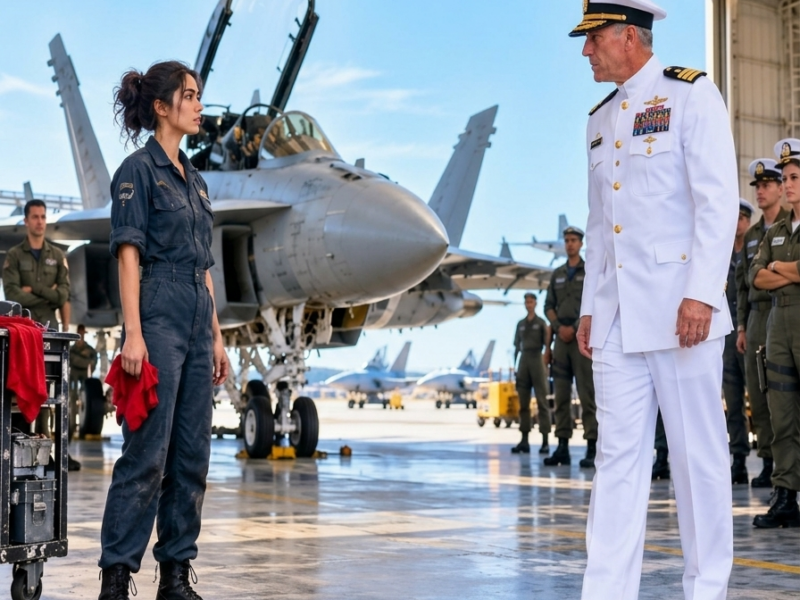
The F-18 pilot slammed his helmet onto the briefing-room table at Naval Air Station Fallon and shouted, “ANY RAPTOR PILOTS IN THIS ROOM?!”
The shattering of porcelain against linoleum sounded like a gunshot in the briefing room of Naval Air Station Fallon.
Coffee pooled dark and scalding across the polished floor, soaking into the leather of Colonel Richard Vance’s dress boots. The older officer didn’t flinch. He didn’t blink. His hand remained suspended in midair, trembling so violently that the silence in the room stretched until it felt physically heavy.
Twenty naval aviators—seasoned F-18 Strike Eagle pilots, weapons instructors, and tactical experts—sat frozen in their chairs. A moment ago, low chuckles had rippled through the rows. Commander Blake Harrison, his flight helmet resting beside his elbow like a severed head, was still leaning forward with a smirk on his face. But the smirk had decayed into something hollow and uncertain.
“Ghost Six…” Colonel Vance whispered again. The name came out as a rasp, carrying the weight of a ghost summoned into daylight. “No. You died in the Alvord Basin. Six years ago. The wreckage was scattered over four miles of playa.”
I stood straight, my hands clasped loosely in front of my faded grey sweatshirt. My jeans were scuffed at the knees, my sneakers worn thin at the soles. To anyone in this room, I looked like a lost civilian, perhaps a contractor’s assistant or a stray technician who had wandered past security.
“They found four miles of wreckage, Colonel,” I said quietly. My voice was low, flat, stripped of all military cadence, yet it echoed sharply off the cinderblock walls. “They didn’t find the airframe. And they didn’t find me.”
Commander Harrison cleared his throat, rising halfway from his chair. His chest was puffed, his shoulders broad under his green flight suit. “Sir? What is this? Who is this woman? We have a active tactical crisis. An F-22 from the 422nd Test and Evaluation Squadron is off radar. The mountain passes are iced over, and desert radar is completely blind. We don’t have time for local legends or…”
“Shut up, Blake,” Colonel Vance said. He didn’t raise his voice, but the tone cut through the room like a razor.
Harrison blinked, stunned. “Sir?”
“I said shut your mouth,” Vance repeated, his eyes never leaving mine. “You weren’t here six years ago, Harrison. You were flying patrol routes over the Persian Gulf. You don’t know what happened during Operation Sand Viper. You don’t know who cleared the skies over northern Nevada when the storm tore the wings off three rescue helicopters.”
Vance stepped forward, his boots crunching on the broken pieces of his mug. The smell of bitter black coffee rose between us. Up close, I could see the fine web of red veins in his eyes, the deep lines carved around his mouth. He looked older than his fifty-eight years. He looked like a man who had spent six years sleeping with a light on.
“Captain Clara ‘Ghost’ Mercer,” Vance said softly, addressing the room without turning around. “The first pilot to execute a dead-stick landing in an F-22 Raptor with a complete fly-by-wire computer failure during a Class 5 sandstorm. She logged more hours in the Raptor than the engineers who built it.”
A quiet murmur rippled through the back rows. The F-18 pilots exchanged uneasy glances. The condescension that had filled the room thirty seconds ago was evaporating, replaced by an uncomfortable, prickling tension.
“She was declared KIA,” Vance continued, his voice dropping an octave. “Memorial service was held at Arlington. Full military honors. Empty casket.”
“I wasn’t in the casket, Colonel,” I said. “I was in a windowless room in Tonopah for eighteen months. Courtesy of Defense Intelligence.”
Vance’s left cheek twitched. “Clara…”
Before he could finish, the main briefing monitor—a massive eighty-inch display showing the high-altitude radar feed of the Nevada Test and Training Range—erupted in a cascade of static. The smooth blue lines of the digital map warped, tearing into jagged bands of red and yellow noise.
The primary speaker on the wall crackled to life.
Static hissed—a dry, rushing sound like wind whipping through sagebrush. Then, beneath the white noise, a sound emerged. It was the rhythm of heavy, labored breathing through an oxygen mask, interspersed with the mechanical click of an emergency locator transmitter.
“…Mayday… Mayday…”
The voice was faint, raspy, soaked in agony.
“…Any station… this is… Flight Lead… system failure… dual engine flameout… I have lost main power…”
Harrison leaned forward, his face suddenly pale. “That’s Lieutenant Miller. That’s the missing Raptor.”
“No, it isn’t,” I said.
Harrison snapped his head toward me. “What are you talking about? That’s Miller’s call sign!”
“Listen to the cadence,” I said, stepping past Vance toward the poding control unit at the front of the room. Nobody stopped me. “Listen to the tongue tap between words. Miller was trained at Luke; he uses standard NATO brevity codes. This pilot is using old Air Combat Command phrasing. And listen to the background hiss.”
I reached out and touched the audio control panel, sliding the frequency equalizer upward to isolate the mid-range tones. The hiss cleared slightly, revealing a metallic pinging sound in the background—the distinct rhythm of a backup oxygen regulator cycling on an older model seat.
“…Ghost Six…” the voice gasped out of the speaker. “If you’re hearing this… they found me… Coordinates… November… Four-Two…”
My pulse froze. My blood turned to liquid nitrogen in my veins.
I knew that voice.
I hadn’t heard it in six years. I had heard it in my sleep, in my nightmares, in the quiet horror of lonely motel rooms across the southwest, but I hadn’t heard it live, over an open tactical guard frequency, since the night the desert swallowed us whole.
“Leo,” I whispered.
“Clara, step away from the console,” Colonel Vance said suddenly. His tone had changed. The shock in his face was gone, replaced by a cold, iron rigidity.
I didn’t step back. “That’s my brother, Vance. That’s Leo.”
“Your brother died in the crash six years ago,” Vance said, his hand moving with quiet, deliberate speed toward the leather holster snapped against his hip. “You know that. His death was verified by the crash site recovery team.”
“…Don’t trust…” the radio crackled again. The voice was weakening, slipping beneath the rising wall of static as the squelch circuits struggled to hold the lock. “Clara… don’t trust… the Colonel…”
The room went completely, terrifyingly still.
Harrison looked from the speaker to Vance, his brow furrowed in utter confusion. “Colonel? What is he talking about? Who is that on the radio?”
Vance didn’t answer Harrison. His eyes were fixed entirely on me. His right hand unsnapped the retention strap on his Beretta M9.
“Harrison,” Vance commanded, his voice dead and emotionless. “Lock the doors. Nobody leaves this room. Secure all communications.”
“Sir?” Harrison hesitated. “We have an aircraft down in the range! We need to launch the SAR unit out of Naval Air Station Fallon immediately—”
“I gave you an order, Commander!” Vance roared, drawing his sidearm in one fluid, practiced motion and pointing the barrel directly at my chest. “Lock the doors!”
The room erupted into chaos. Pilots scrambled back from their chairs, pushing away from the table as steel scraped against leather.
“Colonel, drop the weapon!” one of the younger officers yelled.
“Silence!” Vance snapped, his arm lock-straight, the front sight of the pistol aligned between my eyes. “Captain Mercer is a compromised asset. She is an unauthorized intruder on a secure military installation. Under DoD Directive 5210, I am taking control of this facility.”
I didn’t flinch from the barrel. I had faced worse things than a 9mm pistol in the dark corners of the Nevada desert. My eyes drifted down to the green tactical display behind him. The emergency beacon coordinates were scrolling across the lower margin of the screen in bright yellow text:
LAT: 37°14’06″N — LONG: 115°48’40″W
Groom Lake sector. The restricted perimeter of Area 51.
“You knew he was alive,” I said softly, my voice cutting through the panic in the room. “You kept him out there. In the deep storage bunkers.”
“You don’t understand what was on that airframe, Clara,” Vance said, his trigger finger tightening fractionally. “You were never supposed to come back. And Leo was never supposed to wake up.”
“Then shoot me,” I said, taking one step forward.
“Clara, don’t—”
I didn’t wait for him to finish. I grabbed the heavy glass water pitcher resting on the briefing table and slammed it across Vance’s forearm.
The sound of shattering glass coincided with the sharp BANG of the Beretta discharging into the ceiling.
Plaster rained down on the briefing table. Pilots screamed and ducked for cover. Vance stumbled back, his arm bleeding where the heavy glass had fractured against his wrist, but he held onto the weapon, sweeping it wildly across the room.
“Get her!” Vance shouted, his face contorted in rage. “Stop her!”
Harrison moved, but not toward me. Instinctively, the F-18 commander grabbed Vance’s gun arm, twisting it upward. “Colonel, what the hell are you doing?! This is an unarmed civilian—”
“She’s not a civilian, you fool!” Vance snarled, elbowing Harrison hard in the ribs.
I didn’t watch the fight. I swept my hand across the briefing desk, grabbing Harrison’s flight jacket, his flight helmet, and the hard-drive flight card he had plugged into the console seconds before the briefing began. I hurled myself through the side exit door, slamming the heavy steel crash-bar with my shoulder.
I burst out into the cold, sharp desert air of the Fallon tarmac.
The sky above the mountain range was bruised a deep, unnatural purple. A massive winter storm front was rolling in from the Sierra Nevada, dragging heavy, snow-laden clouds down into the valley like ragged curtains. Wind whipped across the concrete, carrying the bitter scent of aviation fuel and freezing dust.
Behind me, the alarm on the briefing building began to wail—a high-pitched, electronic screech that set my teeth on edge.
ATTENTION ALL PERSONNEL. CONDITION RED. SECURITY BREACH IN BUILDING 102.
I ran. My sneakers slapped against the wet tarmac as I sprinted toward the flight line.
Parked fifty yards away, sitting beneath the bright halogens of the transient maintenance bay, was a lone aircraft. It wasn’t an F-18. It wasn’t part of the Fallon training wing.
It was an F-22A Raptor, painted in dark slate grey, its stealth skin matte and non-reflective under the lights. It belonged to the Skunk Works detachment out of Edwards, brought in two days ago for cold-weather avionics testing. The maintenance ladder was still attached to the port side. The canopy was propped open, and a solitary ground crew technician was standing on the yellow gantry, holding an inspection flashlight.
I bounded up the steel steps of the gantry three at a time.
“Hey!” the crew chief yelled, turning toward me, his face illuminated by his flashlight. “Ma’am! You can’t be up here! This ramp is restricted—”
I didn’t argue. I grabbed the front of his heavy winter parka, pulled him close, and shoved the flight card I’d taken from Harrison into his hand. “Ground lock pin removed?”
“What? Yes, but—”
“Clear the ladder,” I commanded. The voice I used wasn’t the voice of the quiet girl in the gray sweatshirt. It was the voice of Ghost Six—the tactical flight lead who had commanded forty-ship strike packages over hostile territory.
The technician blinked, staring into my eyes. Something in my expression, or perhaps the cold authority in my tone, paralyzed him. He stepped backward off the platform, tumbling down the ladder steps toward the concrete.
I dropped into the tight, cockpit of the Raptor.
The smell hit me immediately: warm hydraulic fluid, recycled oxygen, leather, and fresh ozone. It was the smell of my home. The only place on Earth where I had ever felt entirely in control.
I threw off my grey sweatshirt, pulling Harrison’s green Nomex flight jacket over my arms. It was three sizes too big, but it had the survival harness integrated into the lining. I pulled the helmet down over my head, snapping the bayonet lugs of the oxygen mask into place with two practiced clicks.
Click. Click.
My hands flew across the left-hand console, working purely by muscle memory.
Battery switch: ON.
APU (Auxiliary Power Unit): START.
Deep within the belly of the stealth fighter, a turbine began to whine—a low, terrifying hum that built rapidly into a screaming jet turbine howl. The twin digital displays in front of me flickered to life, bathing the dark cockpit in a cool, green glow.
Outside, three security humvees rounded the corner of the hangar, their red and blue strobe lights flashing violently against the wet asphalt. Armed guards jumped out, unslinging their carbines. Behind them, Colonel Vance sprinted onto the apron, shouting frantically into a radio while pointing his gun at my canopy.
“Raptor One-One, this is Fallon Tower!” a panicked voice burst into my helmet headset. “Abort power-up! Abort immediately! You are not cleared for engine start!”
I reached out and clicked the radio selector to a hard-coded, non-standard TACAN frequency—the private military channel used only by testing squadrons out of Groom Lake.
“Fallon Tower, Ghost Six,” I said calmly, pulling the heavy glass bubble canopy down until it locked into the airframe seals with a heavy pneumatic thud. “I am taking command of this aircraft under Emergency War Orders.”
“Target locked! Ground forces, fire!” Vance’s voice leaked through the base frequency.
Sparks flew.
Muzzle flashes erupted from the security guards’ rifles. High-velocity 5.56mm rounds pinged harmlessly off the reinforced titanium armor of the Raptor’s forward landing gear bay.
I slammed both throttles forward into military power.
The twin Pratt & Whitney F119 engines roared to life, outputting seventy thousand pounds of thrust. The massive aircraft lurched forward, blowing the maintenance gantry and two equipment carts forty feet down the tarmac into Vance’s path.
I didn’t head for the runway. There was no time. The tower would already be turning on the emergency cable traps and setting blockades.
I steered the Raptor directly down the main taxiway, accelerating from zero to one hundred knots in less than five hundred feet. The rain-slick pavement sped past under my nose cone in a blur of grey and white.
“Ghost Six, you are cleared for nothing!” the tower screamed. “We will scramble interceptors!”
“Tell them to bring their best,” I muttered.
At 140 knots, I hauled back on the control stick.
The Raptor’s vectoring nozzles tilted downward, digging into the air. The aircraft rotated instantly, pitching up at an eighty-degree angle. I slammed the throttles past the detent into full afterburner. Two thirty-foot pillars of blue and orange fire erupted from the tailpipes, slamming into the taxiway surface and shattering the asphalt.
The force of the acceleration slammed me back into the ejection seat with the weight of four Gs.
The lights of NAS Fallon shrank away beneath me, dissolving into the swirling vortex of the winter storm clouds within three seconds. I punched through the floor of the storm, climbing through ten thousand, twenty thousand, thirty thousand feet into the black, star-lit vacuum above the weather.
Below me lay a sea of dark, churning clouds that stretched all the way to the horizon, lit from within by constant flashes of dry desert lightning.
I flipped on the Multi-Function Displays, setting the radar to passive synthetic aperture mode. The screen bloomed green, sweeping across the dark expanse of the Nevada Test and Training Range.
Somewhere down in that frozen hell, beneath a cloud deck that was dropping toward zero visibility, my brother was bleeding out.
And now I knew why he had been running.
I looked at the primary data display. Locked deep inside the avionics storage drive I had just booted up was an encrypted file path labeled: PROJECT VANGUARD – SITE 4.
It wasn’t a military test file. It was a casualty log from six years ago.
And at the top of the list was my brother’s name—marked not as KIA, but as Active Asset: Retained.
The storm was worse over the Alvord Basin.
Down at four thousand feet above ground level, the air was a chaotic, violent mess of wind sheer and freezing rain. The Raptor bounced brutally, the fly-by-wire flight control computers working millions of calculations per second just to keep the wide, flat wings from tearing off in the turbulence.
I had turned off my active radar miles ago. If Vance had alerted the Air Defense sectors at Nellis or Creech, they would be scanning the upper airspaces with heavy phased-array radars, looking for any signature. But down here, skimming through the jagged granite canyons of the Kawich Range, I was a shadow moving through a graveyard.
“Leo,” I said into the mask, keeping my voice low, set to the short-range Ultra-High Frequency (UHF) emergency band. “Leo, if you can hear this, key your mic twice. Do not speak.”
Silence answered me. Only the continuous, hollow roar of the storm against the cockpit glass.
I scanned the Terrain-Following Radar (TFR) screen. The ground below was an impenetrable maze of dry lake beds, box canyons, and abandoned Cold War-era radar sites. This was the dark belly of the American military-industrial complex—places that didn’t exist on civilian maps, where decommissioned weapons were buried in deep concrete silos and forgotten.
WARNING: LOW ALTITUDE. PULL UP.
The automated voice of the cockpit warning system barked in my helmet. I muted it with a flick of my thumb.
“Come on, kid,” I whispered. “Where are you?”
Suddenly, the signal-strength indicator on my center display twitched.
Click-click.
A double pulse over the UHF band.
My heart hammered against my ribs. “I have your signal. Give me a bearing.”
The radio hummed, thick with static. Then came a weak, ragged voice. “Clara… you actually came…”
“I told you six years ago I’d never leave you behind,” I said, my eyes scanning the dark canvas of the valley floor through the rain-streaked canopy. “What’s your condition?”
“Leg is pinned… canopy jettisoned… I had to eject when the flight controls locked up…” Leo coughed, a dry, bloody sound. “Clara… it wasn’t a malfunction. They… they commanded my flight computer from the ground. They killed my engines from Vance’s bunker.”
“I know,” I said. “I saw the override codes in the briefing room. Why, Leo? What did you find out there?”
“It wasn’t an exercise six years ago,” Leo rasped. His voice was growing fainter, slipping as his core temperature dropped in the sub-zero mountain air. “The three airmen we were sent to recover… they weren’t downed pilots. They were technicians who tried to walk away from Site 4 with the flight logs. The storm wasn’t what knocked us down. Vance fired an experimental EMP from the ridge line to keep the story from leaving the basin.”
I froze, my hands tightening on the stick.
Six years of guilt. Six years of waking up in cold sweats, believing I had failed my flight package, believing I had misread the weather radar and led my wingman into an unwinnable storm. Six years of living like a ghost because I thought my own mistake had killed my little brother.
It hadn’t been a mistake. It had been an execution.
“They saved you because they needed your biometric keys to access the Raptor’s secondary black box,” I said, the realization settling into my spine like an iron rod. “They kept you in stasis at the facility until they could fully decrypt the data.”
“They got what they needed yesterday…” Leo said, his breathing shallow. “They were moving me to a permanent disposal site… I managed to break the transport guard’s neck… stole his backup bird… but they had a ground kill-switch installed…”
“Hold on, Leo. I’m targeting your beacon now.”
I flipped the Electro-Optical Targeting System (EOTS) to thermal infrared. The high-resolution camera mounted beneath the Raptor’s nose swung downward, piercing through the cloud deck.
The green-and-black thermal image cleared.
There, wedged in a narrow, ice-slick ravine at the base of a towering granite cliff, was the shattered airframe of an F-22. The wings were sheared off, the tail section smashed into kindling. A hundred yards away from the burning wreck, a small white thermal heat signature lay hunched beneath the shelter of a slate overhang.
“I see you,” I said.
Then my tactical display flared bright orange.
ALERT: MULTIPLE THREATS DETECTED. AIR SEARCH RADAR ACTIVE.
Two bright red symbols materialized on the upper edge of my situational awareness map.
Two aircraft, flying low and fast through the mountain passes, breaking through the storm front from the south.
I zoomed in on their radar signatures. They weren’t Air Force. They weren’t flying standard military transponders.
They were two decommissioned Su-27 Flankers—heavy, twin-engine Russian-built fighters, painted in matte black, operated by private defense contractors out of the Groom Lake complex. Vance’s private recovery fleet.
“Ghost Six, this is Vance,” a clear, uncorrupted voice broke into my helmet. He wasn’t using base tactical radios anymore; he was transmitting from an airborne command post high above the storm. “I see you found him. How touching. Reunited at last.”
“Vance,” I said, dropping my voice an octave. “Pull your mercenary birds back. This is over.”
“It isn’t over until the record is clean, Clara,” Vance replied coldly. “You should have stayed dead six years ago. Now, both Mercer children die in the same basin. It makes for such a clean, tragic historical footnote.”
The two Flankers split formation, executing a pincer movement around the canyon.
“Raptor One and Two, clear to engage,” Vance commanded over the open channel. “No survivors. Destroy the wreckage and the crash site.”
“Leo, get down!” I yelled into the mask, shoving the throttles to the wall.
The Raptor screamed into the canyon at Mach 1.2, flying barely three hundred feet above the jagged rocks.
The shockwave from my low pass shattered ice formations off the canyon walls, sending thousands of pounds of frozen rock cascading down into the valley floor.
“Flanker lead, target locked!” the contractor pilot’s voice crackled over the intercepted channel. “Firing radar-guided missile!”
A bright red launch flash illuminated the storm clouds two miles ahead. A Vympel R-27 air-to-air missile ignited, its solid-rocket motor leaving a searing trail of white-hot smoke as it slammed through the turbulence straight toward my canopy.
In a conventional fighter, a missile lock at this distance, inside a canyon with no room to maneuver, was a death sentence.
But I wasn’t in a conventional fighter. And I was Ghost Six.
I pulled the control stick hard right and slammed the rudder pedal home.
The Raptor didn’t just turn—it rotated on its center of gravity. The thrust-vectoring nozzles swung full fifty degrees, slamming the tail around in a maneuver that defied aerodynamics. The jet execute a instantaneous zero-radius turn, facing sideways to its direction of flight while momentum carried it forward.
The R-27 missile streaked past my canopy—less than twenty feet away—fooled by the sudden drop in my radar signature as my stealth profile shifted.
The missile slammed into the canyon wall behind me, exploding in a massive fireball that lit up the granite faces like daylight.
“What the hell was that?!” the Flanker wingman screamed over the radio. “Where did she go?! I lost radar lock!”
“She’s in the shadows!” the lead pilot yelled. “Break off! Break off!”
“Too late,” I said.
I swung the Raptor’s nose down, aligning my crosshairs with the bright thermal exhaust of the trailing Flanker. I didn’t waste a missile.
I hit the trigger for the M61A2 20mm Vulcan cannon.
BRRRRRRRRRRRRRRRRRRRRT.
A two-second burst—one hundred heavy tungsten rounds—erupted from the starboard gun port at six thousand rounds per minute. The stream of armor-piercing shells tore through the trailing Flanker’s right wing and engine casing.
The jet exploded instantly, disintegrating into a shower of burning metal that rained down into the sagebrush below.
“Wingman down! Wingman down!” the lead Flanker pilot panicked, pulling his nose violently upward into the cloud deck to escape. “Vance, this is insane! She’s flying this thing like it’s an extension of her own body! We can’t hit her!”
“Execute profile Bravo!” Vance ordered from his command post, his voice losing its composure for the first time. “Use the ground strike ordnance! Wipe out the canyon!”
The remaining Flanker pulled up to eight thousand feet, rolling inverted above the clouds. On my tactical display, I saw his belly bays open. He was preparing to drop cluster munitions straight down into the ravine where my brother lay helpless.
He didn’t care about a dogfight anymore. He was going to carpet-bomb the canyon.
“Not today,” I growled.
I pulled back on the stick, executing a vertical climb straight up through the storm, following the Flanker’s contrail like a predator hunting through a forest.
My cockpit displays flashed red with multiple warnings:
OVER-G WARNING.
AIRFRAME STRESS CRITICAL.
I ignored the screaming alarms. I pulled the airframe through eight Gs, pulling back until my vision narrowed into a tight, black tunnel—the classic warning of a G-induced loss of consciousness.
I fought the blackness, squeezing my leg muscles, forcing blood back up into my brain.
Through the fog of my fading vision, the grey belly of the lead Flanker materialized out of the rain clouds, its bomb bay doors fully open, a cluster dispenser swinging into release position.
I didn’t wait for a missile lock. I didn’t use the gun.
I rammed the Raptor’s throttles forward, using seventy thousand pounds of thrust to drive the heavy nose cone of my aircraft directly into the Flanker’s exposed ventral weapons bay.
IMPACT.
Metal tore against metal with a deafening metallic screech. The Raptor’s reinforced nose shattered the Flanker’s hydraulic lines and weapons rack. The cluster munitions detached prematurely, bouncing harmlessly off the underside of my aircraft before tumbling down into the empty desert miles away from the target.
The Flanker spun out of control, its tail section sheared completely in two.
“EJECT! EJECT! EJEC—” The contractor pilot’s voice cut off as his ejection seat fired, sending him rocketing into the dark clouds above.
The crippled Flanker plummeted into the storm, crashing into an uninhabited ridge line with a dull, distant thud.
My cockpit was a Christmas tree of red failure warnings.
HYDRAULIC SYSTEM B: FAILED.
NOSE CONE INTEGRITY: COMPROMISED.
LEFT ENGINE TEMPERATURE: OVERHEAT.
I pulled the left throttle back to flight idle, stabilizing the aircraft. The Raptor was battered, its nose cone crushed, its stealth coating torn to ribbons, but the engines were still turning.
“Leo,” I gasped into the mask, my heart hammering against my ribs like a trapped bird. “The sky is clear.”
Silence.
“Leo!”
“…I’m here, Clara…” his voice was a whisper, barely louder than the ambient static. “I saw… I saw the fireballs… You crazy girl… you actually did it…”
“I’m coming down to get you,” I said. “Put your emergency beacon on high sweep. I’m putting this bird on the deck.”
The dead-stick landing in the Alvord Basin was something they taught in flight academies as an impossibility.
An F-22 Raptor is not a glider. Without engine thrust and full hydraulic pressure, it has the flight characteristics of a brick with tiny wings.
I brought the shattered aircraft in low over the dry lake bed, using the remaining pressure in Hydraulic System A to drop the heavy main gear. The nose gear didn’t lock; it dangled uselessly beneath the crushed radome.
“Hold on, sweet heart,” I whispered to the jet.
The main tires slammed into the mud and ice of the playa at one hundred and sixty knots.
The noise was deafening. Mud and frozen gravel erupted across the canopy as the nose dropped, digging into the earth like a plow. Sparks showered sixty feet into the night air as the titanium underbelly skidded across the hardpack basin floor.
The aircraft spun twice, sliding sideways for three hundred yards before finally grinding to a halt in a cloud of steaming rain and smoke, less than fifty feet from the mouth of the ravine.
Silence descended over the desert.
The storm was beginning to break. High above, through a tear in the dark cloud deck, a few pale stars shone down on the Alvord Basin.
I hit the emergency canopy release.
The explosive bolts detonated with a series of sharp pops, and the heavy glass canopy flew backward into the mud.
I unbuckled my shoulder harness, kicked free of the leg restraints, and tumbled out of the cockpit, landing on my knees in the freezing mud. Every muscle in my body burned. My ribs were bruised from the high-G maneuvers, my forehead bled where it had hit the gunsight frame during the collision, but I stood up.
I pulled the survival flare from my flight jacket pocket, struck the ignition cap, and walked into the ravine.
The bright red light of the flare cast long, dancing shadows across the rock walls.
At the end of the narrow canyon, sitting propped against the wheel of his ejection seat, was my brother.
His flight suit was torn, stained dark with blood around his left thigh where an iron strap had pierced his leg during the ejection. His face was pale, smeared with grease and soot, but his eyes—the same sharp, green eyes as mine—were open.
He looked up at me through the flickering red smoke of the flare.
“You’re late, Ghost Six,” he rasped, a thin, painful smile touching his lips.
I dropped the flare into the mud, sank to my knees beside him, and pulled him hard against my chest.
He groaned in pain, but he wrapped his arms around my neck, burying his face in the shoulder of my oversized flight jacket. We stayed like that for a long time, listening to the drip of meltwater from the canyon walls and the cool wind blowing across the playa.
“I thought I lost you,” I whispered, my voice breaking for the first time in six years. “I thought you were buried under the salt.”
“They tried,” Leo said, his breath warm against my neck. “They tried to break me, Clara. They wanted the launch codes… they wanted to use the Raptor’s undocumented reconnaissance data to blackmail half the Armed Services Committee… Vance wasn’t working alone.”
“It doesn’t matter who he was working with,” I said, pulling back to look at his face. “I have the flight recorder from the test jet. Every transmission, every command code Vance sent from Fallon, every file from Site 4 is backed up on my suit drive. It’s already transmitting.”
Leo blinked. “Transmitting where?”
“To the Inspector General of the Department of Defense,” I said quietly. “And to every major news network in North America. I set the automated burst transmission before I stepped out of the cockpit.”
High above us, the low, distant thrum of heavy rotor blades echoed through the mountain passes.
I looked up.
Four heavy MH-60 Black Hawk helicopters, accompanied by two AH-64 Apache escorts, were breaking through the clouds, their bright searchlights sweeping across the valley floor. They weren’t Vance’s men. These were painted with the bold, white lettering of the United States Coast Guard and the Air Force Special Tactics Command—the real Search and Rescue units out of Nellis, dispatched after my broadcast had bypassed base command.
The searchlights swept across the canyon entrance, pinning us in two brilliant beams of white light.
“GROUND UNITS, STAY WHERE YOU ARE!” a loudspeaker boomed down from the lead Black Hawk. “WE ARE SEARCH AND RESCUE! STAND BY FOR MEDICAL EVACUATION!”
I looked down at Leo. He reached out and took my hand, his fingers cold, but his grip firm.
“Is it over?” he asked softly.
I looked back toward the burning wreckage of the Flankers on the ridge, then out toward the shattered, majestic silhouette of the Raptor resting on the mudflats—the machine that had carried me into the dark and brought us both back.
“No,” I said, pulling him close as the helicopter wash flattened the sagebrush around us. “It’s not over. But we’re finally out of the dark.”
The heavy Black Hawk settled onto the playa, its side doors sliding open. Pararescue jumpers spilled out onto the mud, sprinting toward us with medical kits and stretchers.
Behind them, rising above the distant horizon, the first faint gold lines of dawn began to cut through the Nevada sky, washing away the ghosts of the Alvord Basin.
THe end.









