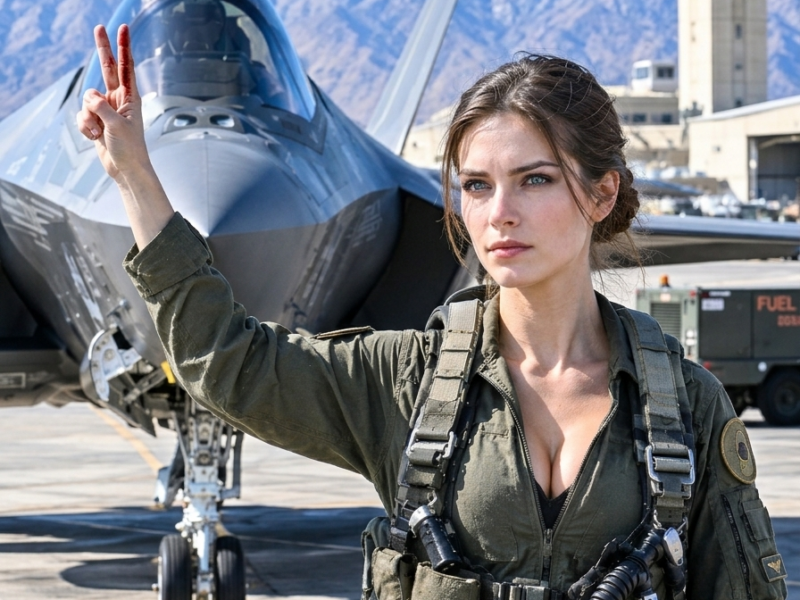
The entire squadron laughed when I was introduced as “just an instructor” at Naval Air Station Fallon
I stared through the thick glass wall of the operations center, my pulse echoing like war drums in my ears. The rotor wash of the unannounced black helicopter kicked up a swirling storm of desert dust across the taxiway of Naval Air Station Fallon.
As the blades spun down into a low, rhythmic thrum, the side door slid open. A tall man in an immaculate dark gray suit stepped down onto the sun-baked asphalt. He wore dark sunglasses, but I didn’t need to see his eyes to know who he was. I knew the exact slope of his shoulders, the precise, rigid cadence of his gait, and the thin, cruel curve of his mouth.
It was Victor Sterling.
The former Undersecretary of Defense for Special Programs. The man whose official state funeral I had attended at Arlington six years ago. The man whose coffin I had watched descend into cold earth while military honor guards fired a twenty-one-gun salute.
“That’s impossible…” I whispered, the paper coffee cup in my hand crumpling into a useless wad of cardboard under my tightening grip. “I saw his obituary. I stood in the rain at his burial.”
“You saw what they wanted the world to see, Colonel,” the intelligence officer standing beside me said, his voice flat and devoid of emotion. “Sterling didn’t die in that helicopter crash in Germany six years ago. He faked his death, walked out of government service with three billion dollars in classified black-budget research, and founded Aegis Global Operations.”
Behind us, Lieutenant Colonel Mason Reed stood motionless near the main radar console. The cocky, condescending smirk that had defined his face for the past three days was gone, replaced by a pale, sweat-sheened mask of utter shock. The twelve fighter pilots of the squadron stood in dead silence, staring back and forth between the radar screen showing the safely landed F-18 and me.
“Ghost Actual…” Reed rasped, his vocal cords straining to produce sound. “Six years ago… the black-ops interception over the Black Sea. The flight lead who drew three radar-guided missiles away from the crippled strike team so we could hit the border…”
“I didn’t draw them away so you could hit the border, Reed,” I said, turning slowly to face him, my voice as cold as deep ocean water. “I drew them away so you and eleven other twenty-four-year-old lieutenants could go home to your mothers. And while you were celebrating your medals, Sterling was busy erasing my name from the naval database and selling my wingman to a private contractor.”
Reed swallowed hard, stepping back as if he had been struck in the chest. “We… we were told you went down in deep water. We were told your canopy failed during ejection.”
“Captain Hayes,” I called out, ignoring Reed entirely.
Captain Hayes walked up beside me, his hands clasped firmly behind his back, his jaw tight. “I’m here, Maya.”
“Why is Sterling landing at a restricted US Naval Air Station without an escort?”
“Because officially, Sterling doesn’t exist, and unofficially, Aegis Global owns forty percent of the tactical satellite infrastructure this base relies on for combat network integration,” Hayes replied grimly. “When that F-18’s flight computer was hijacked twenty minutes ago, it wasn’t a glitch. It was Sterling testing a signal override system called Project Phantom. He wanted to see if anyone at Fallon had the signal key to break his spoofing loop.”
“And I gave him his answer,” I said, looking down at the black folder open on the console table.
In the center of the folder lay a crisp, high-resolution satellite photograph. It showed a remote, heavily fortified airfield built into a deep canyon somewhere in the desolate mountain ranges of Central Asia. Standing on the tarmac beside a dark, delta-wing stealth jet was a man wearing a flight suit.
His face was lined with thin white scars, his hair silvered at the temples, but those eyes—pale grey, fierce, and unyielding—belonged to only one man in the world.
Captain Alex “Vortex” Vance.
My wingman. My partner. The man I had loved and left behind in the burning wreckage of an unmapped war six years ago.
Beneath the photo, printed in bold red lettering, were the words that made my blood run cold: TARGET LOCATED — SUBJECT: VORTEX — STATUS: ACTIVE IMPRINT — PURGE UPON DETECTION OF GHOST ACTUAL.
“He’s using Alex as a hostage,” I said, my voice shaking with a dangerous mixture of grief and rage. “Sterling knew I survived that crash. He knew if I ever resurfaced, I would come for Alex.”
“And now he’s here to finish the job,” Hayes said softly.
The heavy hydraulic doors of the operations center hissed open. Cold air blew into the room as Victor Sterling stepped through the frame, flanked by four heavily armed private contractors wearing matte-black tactical gear without national flags or unit patches.
Sterling removed his sunglasses, tucking them into his breast pocket. He scanned the room, bypassing Reed, ignoring Hayes, until his eyes locked onto mine. A slow, terrifying smile spread across his face.
“Maya,” Sterling said, his voice smooth, echoing with cultured arrogance. “I must admit, when my network engineers reported that someone had broken our electronic override on that Hornet using an obsolete 2018 encryption sequence, I thought it was a ghost in the machine. But here you are. Older, a bit rougher around the edges, but still clinging to that ridiculous hero complex.”
“Sterling,” I said, stepping away from the console and standing tall in my worn flight jacket. “You’re trespassing on a military installation.”
Sterling let out a soft, amused chuckle. “Trespassing? Colonel, I own the digital architecture of this base. Captain Hayes knows that if I press one button on this encrypted terminal, every radar screen from here to Nellis goes black, and every jet on this tarmac stays grounded for forty-eight hours.”
He stepped closer, his contractors fanning out to cover the room. Reed and his pilots instinctively shifted, their hands moving toward their sidearms, but Sterling’s men already had their submachine guns raised in a low-ready stance.
“Six years ago, you ruined a multi-billion-dollar acquisition deal over the Black Sea, Maya,” Sterling continued, his voice dropping into a harsh, venomous whisper. “You survived a crash that should have vaporized you. You hid in the civilian world as a nobody. You should have stayed dead.”
“Where is Alex?” I demanded, my eyes burning into his.
Sterling smiled wickedly. “Alex is currently preparing to fly a demonstration flight for a group of international buyers who are very interested in buying an autonomous pilot override system. He doesn’t remember you, Maya. Six years of neural conditioning and tactical re-education have erased every memory he had of his previous life. To him, you are just a threat profile.”
He tapped a key on his wrist terminal. “Which brings me to why I’m here. I can’t have a dead woman walking around ruining my sales presentation.”
Sterling raised his hand, gesturing to his lead contractor. “Clear the room. Take her into custody. If anyone else in a flight suit interferes, execute them under security protocol Omega.”
Before the lead contractor could step forward, the high-pitched wail of a secondary air-raid siren began to echo across the base.
The main radar console flashed brilliant red.
“TOWER TO OPS!” a frantic voice screamed over the facility intercom. “UNKNOWN BIRD IN THE PATTERN! HEAVY STEALTH PROFILE! HE’S BROKEN THE PERIMETER AT MACH 2 AND HE’S RETURNING BREECH LOCK ON OUR APERTURE!”
Sterling’s smile instantly vanished. He snapped his head toward the glass wall.
Through the rain-streaked sky above Fallon, a sleek, shadow-black aircraft cut through the clouds, its twin afterburners blazing like angry red eyes as it swept low over the airfield, shattering the glass of three hangar doors with a deafening sonic boom.
It was the delta-wing stealth jet from the photograph.
Alex was here.
The force of the sonic boom rattled the operations room, sending loose papers and plastic cups flying across the floor. The emergency glass in the observation window cracked into a web of fine white lines, but held.
Sterling whipped around, his face suddenly pale as he stared at his wrist terminal, which was flashing rapid red error warnings.
“What is he doing?!” Sterling roared at his lead contractor. “Alex was supposed to be locked into automated holding over the Pacific grid! Who authorized his flight plan?!”
“Sir!” the contractor shouted back, checking a tablet. “His onboard computer… the neural link was broken three minutes ago! He overrode the satellite tether!”
I didn’t hesitate. While Sterling and his men were distracted by the screeching radar alarms, I moved with the lethal speed that six years of hiding had never dulled.
I grabbed the heavy metal desk lamp from the main console, swung it with all my weight, and slammed it into the side of the lead contractor’s helmet. The man collapsed to the floor, his weapon clattering across the tiles. Mason Reed, realizing the situation, tackled the second contractor into a row of server racks, while the rest of the TOPGUN pilots surged forward, overpowering the remaining two armed guards in a chaotic flurry of fists and boots.
Sterling scrambled backward toward the door, pulling a small silver pistol from his suit pocket. He fired one shot wild into the ceiling, turning to sprint down the hallway toward the helipad.
“Hayes! Get the base on lockdown!” I screamed over the chaos. “Reed, get your men to the armory!”
“Where are you going?!” Reed yelled, wiping blood from a cut on his lip as he held a captured submachine gun.
“I’m taking a jet,” I shouted, pulling my helmet off the gear rack by the door. “Alex didn’t fly here to bomb the base, Reed! He flew here because the signal I sent through that F-18 three minutes ago re-ignited his neural pathway! He’s looking for me!”
I burst through the side exit of the operations building, slamming through the heavy push-bars out into the scorching heat of the flight line. Rain was beginning to fall from a dark wall of desert storm clouds overhead, turning the hot tarmac into a steaming sheet of black glass.
Parked on Taxiway Bravo, idling in full combat readiness with ground-power units still attached, was a fresh F/A-18E Super Hornet—tail number 01.
The crew chief standing on the boarding ladder gaped in terror as I sprinted up the aluminum steps, shoved my helmet onto my head, and stepped straight into the cockpit.
“Ma’am! You can’t take this bird! She’s loaded with live ordnance for the afternoon strike exercise!” the crew chief screamed over the roar of the idling turbines.
“Disconnect the umbilical, Chief, or I’m pulling you into the air with me!” I yelled back, slamming the canopy switch down.
The heavy plexiglass canopy groaned and sealed shut, cutting off the deafening noise of the airfield. My hands flew across the instrument panels in a rhythm I had rehearsed five thousand times in my dreams.
Master Arm: ON.
Flight Control Systems: ONLINE.
Radar: ACTIVE PULSE.
“Fallon Tower, this is Ghost Actual,” I barked into my oxygen mask, pulling the throttles back and then slamming them straight forward into full afterburner. “I am taking Runway 13 Right. Clear the pattern.”
The Super Hornet surged forward like an unleashed beast, its twin General Electric engines roaring as twin plumes of bright blue flame blasted across the wet asphalt. At 150 knots, I hauled back on the stick. The nose pitched up sharply, and the jet shot into the grey ceiling of storm clouds like a spear thrown at the sky.
As I broke through the top of the cloud deck at ten thousand feet into the brilliant, blinding glare of the afternoon sun, my radar screen flared with a massive, high-speed contact sitting at my twelve o’clock position, three miles ahead.
The black stealth jet was hovering in a high-alpha pitch, its vectoring nozzles pointing straight down, holding its place in the sky like a specter of dark technology.
“Vortex…” I whispered into the radio, switching my comms panel to the old, classified tactical frequency we had used over the Black Sea six years ago. “Vortex Six, this is Ghost Actual. Do you copy?”
Static hiss filled my headset. For five agonizing seconds, there was no response.
Then, a voice cut through the static—a voice that was deep, mechanical, and layered with electronic distortion, but carrying an unmistakable undertone of human pain.
“Ghost… Actual…” Alex rasped, his voice sounding like broken glass being dragged across metal. “Target profile… recognized. Priority: ELIMINATE.”
Before I could react, the black jet flipped ninety degrees on its axis with impossible speed, its nose sweeping toward my canopy as two red indicator lights flashed on its wingtips.
“Alex, no!” I screamed, pulling six Gs into a tight bank as a stream of 30mm armor-piercing cannon rounds chewed through the air where my port wing had been a split second before.
“He’s not in control!” I realized, my heart hammering against my ribs as I fought the heavy G-forces. Sterling’s neural override hadn’t been fully broken—it had locked Alex’s brain into an automated threat-response loop. The moment my jet pinged his radar, his programming categorized me as an enemy to be destroyed.
The black jet banked effortlessly, riding my six o’clock position with terrifying precision. No human pilot could maneuver an airframe like that without passing out—the fly-by-wire system was pushing the aircraft beyond human physiological limits, using Alex’s body as a organic processing unit for a machine intelligence.
“Warning! Missile Lock!” my cockpit alarm shrieked.
I dumped a cluster of flares, throwing my Hornet into a steep, descending barrel roll back into the cover of the heavy grey clouds below.
“Alex! Listen to my voice!” I yelled into the mask, my voice raw with emotion as I spiraled through the dark mist. “Remember the Black Sea! Remember the storm over Crimea! You told me that if we ever got separated in the dark, you would look for the lighthouse on the northern ridge!”
Above me, the black shadow plunged through the clouds, its dark wings cutting through the vapor like razor blades. It was closing the distance—five hundred feet… three hundred feet…
“You gave me your silver wings the night before we launched, Alex!” I shouted, reaching with one hand to pull out the small silver pin I had kept stitched inside the lining of my flight jacket for six long years. “You told me to hold them until we landed! I still have them!”
The black jet locked onto my tail cone. The red kill-reticle on my Heads-Up Display showed his cannon tracking my engine nozzles.
One second from impact, the black jet suddenly shuddered violently. Its vectoring nozzles twitched. The cannon fire ceased.
Through the radio, I heard a deep, agonizing gasp of pure human air.
“Maya…?”
The black jet wobbled in mid-air, its flight path destabilizing as if two different minds were wrestling for control of the stick. One moment it was executing a precise, lethal combat intercept; the next, it drifted aimlessly like a autumn leaf caught in a crosswind.
“Maya… my head… it feels like… ice…” Alex’s voice came through the static, no longer distorted by the machine interface, but filled with a terrifying, childlike confusion. “They… they put something in my brain…”
“Alex! Fight it!” I yelled, pulling my Hornet up alongside his left wingtip, so close I could see inside his cockpit.
His helmet was dark, integrated with thick fiber-optic cables that ran from the back of his neck directly into the ejection seat console. His hands were locked onto the control stick, but his body was shaking violently under the strain of the neural feedback loop.
“Sterling is using an off-site satellite command bridge to control your flight computer!” I explained rapidly, keeping my eyes fixed on his canopy. “Every time your human memories try to surface, the system sends an electrical purge through your helmet feed to reset your short-term brain activity!”
“It hurts, Maya…” Alex groaned, his jet veering perilously close to mine before he violently jerked the stick back. “I can’t… I can’t hold the controls much longer. The override… it’s taking over again!”
Suddenly, the black jet’s HUD lights flashed from blue to a harsh, blinding crimson. The smooth, human tone in Alex’s voice was instantly cut off, replaced by the flat, cold mechanical voice of the onboard synthetic intelligence:
[NEURAL PURGE SEQUENCE INITIATED. THREAT PROFILE: GHOST ACTUAL. ENGAGING TERMINAL PROTOCOL.]
The black jet rolled inverted, dropping its nose into a power dive straight toward the rugged granite peaks of the Toiyabe Mountain Range twenty miles east of Fallon.
“No!” I screamed, slamming my throttles into full afterburner to follow him down into the canyon floor.
Sterling wasn’t just trying to kill me anymore—he realized he was losing control of Alex, and his automated safety system was driving the multi-billion-dollar prototype jet and its pilot directly into the side of a mountain to prevent the technology from falling into military hands.
We cleared the base of the clouds at five thousand feet, racing through a narrow, winding canyon bordered by sheer rock walls two thousand feet high. The black jet was flying at Mach 1.2, twisting through the tight bends of the canyon with suicidal speed, its altitude dropping by three hundred feet every second.
“Fallon Tower, this is Viper Actual!” I shouted into my comms. “I need an immediate high-output radar jammer sweep centered on grid Sector 4!”
“Ghost Actual, this is Reed!” Lieutenant Colonel Mason Reed’s voice suddenly cut through the frequency. He wasn’t in the ops room—he was airborne.
I looked up through my upper canopy panel. Three Super Hornets were cutting through the upper air layer above the canyon, flying in a tight combat V-formation.
“Reed?!” I called out.
“The whole squadron is up here with you, ma’am,” Reed shot back, his voice filled with fierce, unyielding determination. “Captain Hayes authorized a full tactical scramble. We’ve got our onboard APG-79 radars linked together in an active electronic warfare array. We’re going to burn through Sterling’s satellite signal!”
“Do it now, Outlaw!” I yelled.
Above the canyon, the four Super Hornets arranged themselves into a diamond formation, pointing their nose cones directly down at the black jet in the valley floor, unleashing a concentrated, high-megawatt pulse of electronic noise across every military frequency.
Inside the canyon, the effect was instantaneous.
The black jet’s red HUD lights flickered wildly. The automated system glitched, its hold over the controls snapping like a dry twig as the satellite link was severed by the wall of radar noise from above.
The black jet leveled out fifty feet above the canyon river, its engines sputtering as the neural link collapsed.
Inside the cockpit, Alex slumped forward against his harness, gasping for air as the dark visor of his helmet retracted automatically. He looked across the narrow gap between our aircraft, his eyes clear, conscious, and looking directly at me.
“Maya…” he whispered over the direct short-range radio. “I remember.”
“I’ve got you, Vortex,” I said, tears finally spilling over my eyelashes and running down inside my oxygen mask. “Follow my lead. We’re going home.”
“Negative, Ghost Actual…” Alex rasped, pointing toward his fuel gauge on his panel. “The purge sequence drained my reserve tanks. My main manifold is dry. I’m gliding on air.”
I looked at his aircraft’s belly. A heavy trail of aerosolized jet fuel was spraying out from his starboard vent line—Sterling’s automated system had opened his fuel dumps before the radar jam hit.
Ahead of us, the canyon terminated in a high, impassable wall of solid granite. Without engine power, Alex didn’t have the speed or lift required to pitch up over the ridge.
“Eject, Alex! Pull the handle!” I screamed.
“Ejection system is locked by the corporate software!” Alex called back, his voice surprisingly calm now that his mind was his own. “I can’t pull the curtain. The computer won’t let me leave the bird.”
I looked at the granite ridge rushing toward us at three hundred miles per hour. I looked at my own jet’s heavy nose cone, reinforced with heavy titanium framing for high-G carrier landings.
A insane, suicidal idea—one that no flight manual in naval history had ever recorded—formed in my mind.
“Alex, lock your shoulder harness and press your head hard against the headrest!” I commanded.
“Maya, what are you doing?!”
“I’m giving you a push!” I yelled.
I slammed my throttles forward, accelerating my Super Hornet until my nose cone was sitting less than three inches from the heavy titanium thrust-vectoring nozzle of Alex’s dead stealth jet.
The turbulence between our two airframes was violently shaking both cockpits, the metal skin of my aircraft groaning under the intense aerodynamic compression.
“Steady… steady…” I muttered through gritted teeth, holding the control stick with both hands, my muscles screaming under the tension as I aligned my radar dome directly with his structural tail beam.
CLANG!
The nose of my F-18 slammed into the rear assembly of Alex’s jet with a sickening metallic crunch that echoed through my entire airframe. Warning lights flared yellow across my glare shield as my flight computer screamed at me for an impending mid-air collision.
“I’ve got contact!” I screamed, dumping my engines into full afterburner.
The combined thrust of my two roaring engines pushed against the structural frame of both jets. The speedometer on my HUD began to climb—180 knots… 220 knots… 260 knots!
The sheer wall of solid granite mountain rushed toward us like a rising floor of grey stone. We were five hundred feet from the cliff face… four hundred feet…
“NOW, ALEX! PITCH UP!” I roared.
Together, both of our aircraft, locked together like a twisted metal spear, pitched their noses sixty degrees toward the sky.
We cleared the crest of the granite ridge by less than ten feet. The belly of Alex’s jet scraped the tops of the mountain pines, sending a shower of pine needles and bark exploding across my canopy glass before we burst out into the open, wide expanse of the desert valley beyond.
The moment we cleared the ridge, I chopped my throttles back, pulling my stick to break the physical contact between our aircraft.
Alex’s stealth jet, carried by the momentum of the climb, glided gracefully out over the flat, smooth white expanse of the Nevada salt flats, touchdown-bound at two hundred knots without engine power.
His landing gear dropped manually. The tires struck the dry lake bed with a massive cloud of white dust, skidding across the salt for nearly two miles before coming to a complete, peaceful halt in the middle of the desert.
I circled high overhead, watching as the canopy of the black jet was manually pushed open from the inside.
Alex stepped out onto the wing, pulled off his helmet, and threw it into the white sand below. He stood under the open Nevada sun, raising both arms into the air toward my jet circling above.
He was alive. The ghost was home.
I let out a ragged, shaking breath, wiping the sweat and tears from my face as I keyed my mic.
“Fallon Ops, this is Ghost Actual,” I said, my voice thick with emotion. “Package is down on the salt flats. Subject is safe and conscious. Send the recovery team.”
“Copy that, Ghost Actual!” Captain Hayes’s voice boomed through the radio, accompanied by the deafening sound of cheering and applause from the operations center staff in the background. “Recovery vehicles are already rolling! Excellent flying, Colonel!”
“Wait, Fallon,” Mason Reed’s voice cut in from his Hornet above me. “We’ve got one more piece of business to finish before we head home.”
I looked at my radar display.
A single black helicopter was flying low at maximum speed toward the southern border of the naval range, heading toward a private landing strip outside civilian jurisdiction.
Victor Sterling was trying to escape.
“Outlaw,” I said, a dangerous, cold smile forming on my lips as I lined my nose up with the retreating helicopter. “Do you and your boys want to see how Ghost Actual handles a corporate getaway?”
“Lead the way, Instructor,” Reed replied with a dark chuckle.
Four Super Hornets dropped out of the sun like hunting falcons, their twin afterburners blazing as we swooped down on Sterling’s helicopter, boxing him in from every quadrant of the sky.
The four F-18s circled Victor Sterling’s twin-engine helicopter like apex predators hovering over a helpless target.
I dropped my Hornet to thirty feet above the desert highway, hovering directly in front of the helicopter’s nose cone, my M61A2 20mm rotary cannon pointing straight through his cockpit windshield.
“Helicopter November-Seven-Zero-Alpha,” my voice boomed through his emergency radio channel, cold, mechanical, and absolute. “Land your aircraft on the highway immediately, or I will remove your tail rotor with my wingtip.”
Inside the helicopter’s cockpit, the pilot looked at the massive warhead of my jet sitting thirty feet away, his face pale with sheer terror. Ignoring Sterling’s furious screams from the passenger seat, the pilot immediately chopped his collective control, bringing the helicopter down onto the dusty asphalt of Nevada State Route 116.
Before the rotor blades had even come to a stop, six armored FBI vehicles and four Naval Military Police units roared down the highway, screeching to a halt in a tactical ring around the trapped helicopter.
Dozens of federal agents in heavy tactical gear spilled out of the vehicles, rifles raised.
“FEDERAL AGENTS! KEEP YOUR HANDS WHERE WE CAN SEE THEM! STEP OUT OF THE VEHICLE!”
The side door of the helicopter slid open. Victor Sterling was dragged out by two broad-shouldered FBI agents, his expensive suit ruined, his hair wild, his hands forced behind his back as heavy steel handcuffs were snapped around his wrists.
As the agents forced him down onto the hot pavement, Sterling looked up into the sky where my Hornet was executing a victory victory-lap over the highway.
His empire was gone. His technology was exposed. The ghost he had tried to bury for six years had brought his dark world crashing down into the desert dust.
Two hours later.
The setting sun cast long, golden shadows across the wide, quiet tarmac of Naval Air Station Fallon. The air was cool and crisp, carrying the clean scent of rain after the storm had cleared into the eastern horizon.
I stood beside the wing of my Hornet, holding a cold bottle of water, watching a naval ambulance pull up to the primary flight line.
The rear doors opened, and Alex Vance stepped out. He wore a clean Navy flight suit, his dark hair damp from a shower, his face pale but his eyes brilliant, focused, and entire.
He walked slowly across the asphalt toward me, his hands tucked into his pockets, his gaze never leaving my face.
We stopped two feet apart. Six years of silence, six years of pain, six years of believing we were dead to the world hung between us in the quiet desert air.
Without saying a word, I reached inside my flight jacket, pulled out the worn silver pilot wings I had carried across half the world, and held them out in the palm of my hand.
Alex looked down at the silver wings. A slow, gentle smile—the same smile I had fallen in love with eight years ago on an aircraft carrier in the Mediterranean—spread across his face.
He took the wings from my hand, his fingers warm and steady against mine, and pinned them carefully over the heart of his flight suit.
“You kept them,” he said softly, his voice thick with unexpressed emotion.
“I promised I’d give them back when we landed,” I replied, my voice shaking slightly. “I don’t break promises, Captain.”
He wrapped his arms around me, pulling me into a tight, fierce embrace that shattered every remaining piece of ice inside my heart. I buried my face into his shoulder, holding him back with every ounce of strength I possessed, letting the long, dark night of our past finally fade into the warm glow of the Nevada sunset.
Behind us, the sound of boots marching against concrete approached.
I pulled back slightly to see Lieutenant Colonel Mason Reed standing at attention, accompanied by the eleven pilots of his squadron. Captain Hayes stood beside them, holding a black leather binder under his arm.
Reed stepped forward, stopping three paces away. He brought his right hand up to the brim of his cap in a crisp, immaculate military salute.
“Colonel Maya Lin,” Reed said, his voice loud, clear, and filled with a profound, unyielding respect. “On behalf of the 127th Strike Fighter Squadron, I want to formally apologize for our arrogance on your arrival.”
He lowered his salute and looked at Alex, then back at me.
“You taught us today what it truly means to be a naval aviator,” Reed continued, his eyes bright with emotion. “You showed us that a call sign isn’t just a name on a whiteboard—it’s a promise to bring your people home, no matter how dark the sky gets.”
Captain Hayes stepped forward, handing me the black leather binder.
“The Chief of Naval Operations called ten minutes ago, Maya,” Hayes said with a wide, proud grin. “Your rank as full Colonel has been officially restored to the active register. You’ve been appointed as the permanent Commanding Officer of the Naval Strike and Air Warfare Center here at Fallon.”
I looked down at the official Navy orders stamped with the gold seal of the Department of Defense. Then I looked up at the twelve young pilots standing before me, their faces filled with eager anticipation, ready to learn, ready to follow.
I looked at Alex, who gave me a subtle, knowing nod.
I adjusted the collar of my flight jacket, stepped forward, and looked my new squadron in the eye.
“Get your gear, gentlemen,” I said, my voice carrying the steady, unbreakable authority of a leader who had walked through hell and back. “Briefing Room A in ten minutes. We have a lot of work to do.”
“Yes, ma’am!” the pilots roared in unison, turning to march down the flight line toward the briefing rooms.
I turned back to look at the open horizon, where the first stars of the evening were beginning to twinkle through the deep blue sky above Nevada.
The war in the shadows was over. The sky belonged to us once more.
THe end.









