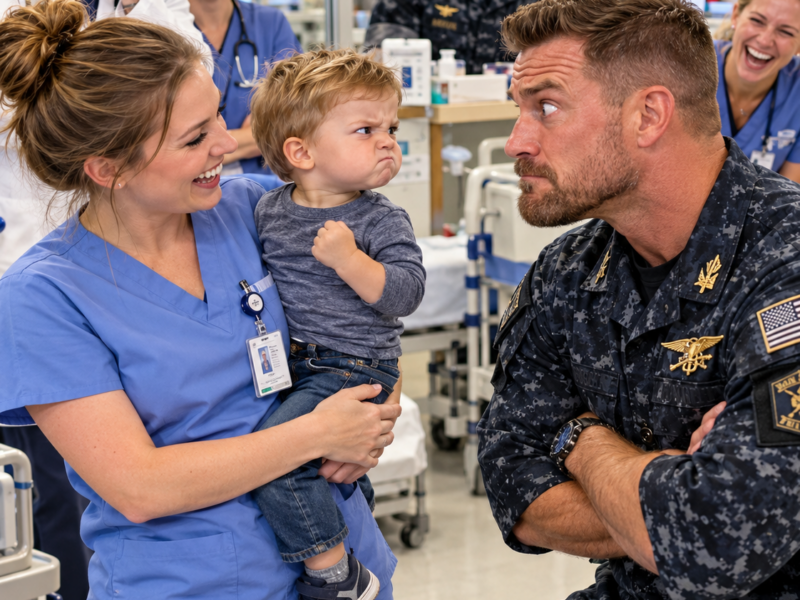
The entire hospital ward went silent when the Navy SEAL slammed his fist against the counter and demanded to know why nobody had helped his brother
“Emily, I need you to think carefully,” Marcus said. “The man who spoke to your son tonight—did he tell you his name?”
I shifted Noah higher on my hip. My little boy was already half asleep, his cheek resting against my shoulder, one hand curled around the silver anchor Marcus had given him.
“I didn’t get his full name,” I admitted. “He said he knew my family. He knew my name, too, which I thought was strange, but I was rushing to get back to work.”
“What did he look like?”
I described the man as best I could. Mid-forties, neatly trimmed beard, gray jacket, a small scar near his left eyebrow. He had been standing near the hospital entrance when I arrived that evening. He had offered Noah a sticker shaped like a blue star and told him he looked like a little soldier.
Marcus’s face hardened.
“Did he touch Noah?”
“No. He gave him the sticker, and Noah showed it to me. I told him not to accept things from strangers.”
“Do you still have it?”
I frowned.
“I think so. It’s probably in his pocket.”
Marcus looked toward the officer holding the folder.
“Get security to preserve the entrance footage immediately. I want every camera covering the lobby and parking area from the last six hours.”
The officer nodded and hurried away.
I stared at Marcus.
“What’s going on? Why are you asking about my son?”
He hesitated. For a man who seemed comfortable issuing commands, he suddenly looked unsure how to explain something frightening to someone who had never asked to be involved.
“My brother, Daniel, was driving back from a training facility when his vehicle left the road. The initial report called it a single-vehicle accident.”
“And you think someone caused it?”
“I think someone wanted him off the road long enough to take something from him.”
He opened the folder again and showed me a photograph of a black SUV parked behind a damaged military vehicle.
“This vehicle appeared near the training facility three times in the week before the accident. It also appeared near Daniel’s apartment yesterday morning.”
My stomach tightened.
“That doesn’t prove anything.”
“No, it doesn’t. But the man you described matches the general appearance of someone our investigators have been trying to identify.”
I looked down at Noah.
He stirred and mumbled something about dinosaurs.
A wave of guilt washed over me. I had brought him to work because I had run out of options. I had thought the hospital was the safest place for us to wait until my mother arrived.
Now I was wondering whether someone had deliberately approached my child.
“Why would anyone be interested in me?” I asked.
Marcus studied me.
“That’s what I want to find out.”
Then he glanced at Noah’s sleeping face, and his expression softened.
“First, we’re going to make sure you’re both safe.”
I wanted to protest that I could take care of myself. I wanted to remind him that I was a nurse, not someone who needed a stranger to tell me how to protect my son.
But I also remembered the way the man had known my name.
And the way he had watched Noah.
So I nodded.
“Okay. Tell me what you need me to do.”
Marcus gave the officer a few quiet instructions, then turned back to me.
“Stay inside the secure staff area. Don’t leave alone until security has reviewed the footage. And if that man contacts you, don’t respond. Call me or Agent Brooks, the investigator assigned to Daniel’s case.”
He handed me a card with the investigator’s number.
“Why are you helping me?” I asked.
Marcus looked genuinely surprised.
“Because someone may be using you to get to my brother.”
“That explains why you need information from me. It doesn’t explain why you care about my safety.”
For several seconds, he said nothing.
Then he looked toward the trauma room where Daniel was being treated.
“Because I know what it feels like to watch someone you love get hurt and have no idea how to stop it.”
His voice dropped.
“And because your little boy just reminded me that not everyone in this world is trying to take something from someone else.”
I didn’t know what to say to that.
Fortunately, Noah chose that moment to lift his head and peer at Marcus.
“Are you still angry?”
Marcus blinked.
“No, buddy. Not anymore.”
Noah considered this answer, then patted the SEAL’s cheek with his tiny hand.
“Good. Angry face makes your head hurt.”
Marcus let out a quiet laugh.
“You may have a point.”
Then Noah yawned, tucked his head beneath my chin, and went back to sleep.
For a moment, the danger outside the hospital doors seemed distant.
But it wouldn’t stay that way for long.
At 11:30 p.m., Nurse Patel arranged for Noah and me to wait in a staff room near the security office. My mother had finally reached the hospital, exhausted and apologetic after managing to get her car towed.
When I told her about the stranger in the lobby, her face changed.
“Emily,” she whispered, “did he say anything about your father?”
I stared at her.
“My father died when I was twelve. Why would he mention him?”
She looked away.
My father, James Carter, had been a Navy communications technician. He had died in what our family had always been told was a training accident. I remembered very little about the details. My mother had rarely discussed it, and whenever I asked, she said the Navy had investigated and there was nothing more to know.
“What aren’t you telling me?” I asked.
She sat down slowly.
“Your father worked on a communications project that was canceled shortly before he died. He believed there was a serious flaw in the system. He said it could cause military vehicles to receive incorrect navigation instructions.”
My mouth went dry.
“Why have I never heard this?”
“Because he told me to keep quiet if anything happened to him.”
“Mom, he died fourteen years ago.”
“I know.”
She looked at Noah, sleeping with his stuffed rabbit beside him.
“I thought it was over.”
I sat opposite her.
“Did you know the man who spoke to Noah?”
“No. But if he knew your name and knew you were here, someone may have been looking into your father.”
The room suddenly felt too small.
Marcus’s brother had been involved in a military training accident. Someone had approached my son. And my father had once worked on a communications system that could potentially send military vehicles in the wrong direction.
I thought about the black SUV in the photograph.
“Mom, do you still have Dad’s things?”
She nodded.
“Some of his old papers. A few notebooks. I kept them in a box after we moved.”
“Did he ever mention a man named Daniel Mercer?”
She shook her head.
“Not that I remember.”
“What about Robert Voss? Or a company called Northstar?”
At the company name, she went very still.
I noticed immediately.
“Mom?”
She pressed her hands together.
“Your father received a letter from Northstar a few weeks before he died. He was upset after reading it. He told me they wanted him to approve a report he believed was inaccurate.”
“Do you still have that letter?”
“I don’t know. It may be in the box.”
Before I could ask anything else, someone knocked on the door.
Nurse Patel opened it.
“Emily, Marcus is asking for you. The security team has reviewed the footage.”
I looked at my mother.
She nodded, but I could see the fear in her eyes.
“Go,” she said. “I’ll stay with Noah.”
I kissed my son’s forehead and followed Nurse Patel into the corridor.
Marcus was waiting beside the security office, speaking to a woman in civilian clothes. She introduced herself as Special Agent Rebecca Brooks, NCIS.
The resemblance between her name and Marcus’s brother’s name was purely coincidental, she explained with a tired smile.
“We’ve identified the man in the lobby,” she said. “His name is Adrian Cole. He previously worked as a security contractor for Northstar Strategic Systems.”
Marcus folded his arms.
“Is he still employed there?”
“Not officially. His contract ended eighteen months ago. But we found payments to a consulting company registered under his name.”
Agent Brooks turned a monitor toward me.
The footage showed the hospital entrance. Noah and I were walking through the lobby when Adrian Cole approached us. He crouched to Noah’s level, handed him the blue star sticker, and spoke to him for nearly a minute.
Then he looked directly at the security camera.
Not casually.
Deliberately.
He knew it was there.
“He wanted us to see him,” I whispered.
“That’s our concern,” Agent Brooks replied. “He may have been trying to establish contact with you, or he may have been checking whether you were alone.”
Marcus’s jaw tightened.
“Can we locate him?”
“We’re tracking his vehicle, but we don’t want to alert him before we understand his purpose.”
I looked at the frozen image of Cole smiling at my son.
“What does this have to do with Daniel?”
Agent Brooks exchanged a glance with Marcus.
Then she opened another file.
“Your father’s name appears in a set of technical documents recovered from Daniel’s vehicle.”
I felt the floor seem to shift beneath me.
“My father has been dead for fourteen years.”
“I understand. The documents indicate that he worked on the original navigation architecture used in a military communications project. That project was later acquired by Northstar.”
Marcus leaned closer to the screen.
“Daniel was investigating the same system?”
“Yes. He believed a software update had introduced a vulnerability that could redirect military vehicles during training exercises. He was collecting evidence when his vehicle crashed.”
“And the accident?” I asked.
“We haven’t established whether it was deliberate. We are investigating the possibility that someone tampered with the vehicle or interfered with its navigation system.”
I gripped the back of a chair.
My father had died believing something was wrong with the system. Daniel had apparently discovered similar problems years later. And now someone who had worked for Northstar was approaching my child.
Agent Brooks lowered her voice.
“Emily, I need to ask you something. Did your father leave behind any original technical records?”
“My mother may have his notebooks.”
“Those could be important. If they contain original design notes, they may help establish whether the flaw was known before the system was deployed.”
Marcus looked at me.
“We need to get those notebooks safely.”
I nodded.
“Then we’ll go to my mother’s house.”
Agent Brooks shook her head.
“Not tonight. If Cole has been watching you, he may know where your mother lives. We’ll arrange a secure escort in the morning.”
I hated waiting.
I hated not knowing what my father had discovered, why Daniel had been investigating it, or what the stranger wanted with my son.
But I had spent enough nights in the emergency department to understand that panic didn’t make a situation safer.
So I waited.
And sometime after midnight, I fell asleep in a chair beside Noah’s bed, listening to the quiet hum of the hospital.
The following morning, Marcus came to see us before his brother’s next surgery.
He had changed into clean clothes, but the exhaustion remained in his eyes.
“Daniel’s stable,” he told me. “They’re going to repair the damage to his leg today. The doctors think he’ll recover, although it’ll take time.”
I smiled with relief.
“That’s good news.”
He sat beside the window while Noah ate a banana from a paper cup.
For several minutes, we talked about ordinary things. My nursing rotation. Daniel’s recovery. Noah’s obsession with dinosaurs and his belief that every large animal was either a dinosaur or a dragon.
Then Marcus looked at the little boy.
“Can I ask you something, Noah?”
Noah nodded solemnly.
“Do you remember the man who gave you the blue star?”
“Uh-huh.”
“What did he say?”
Noah thought for a moment.
“He said I was a brave boy.”
Marcus nodded.
“Anything else?”
“He asked if Mommy worked here every night.”
Marcus and I exchanged a glance.
“Did you tell him?” I asked gently.
Noah nodded.
“I said Mommy helps sick people. And sometimes she sings the dinosaur song.”
I felt a small, painful knot form in my stomach.
“Did he ask anything else?”
Noah’s face brightened.
“He asked if I knew where the shiny box was.”
Marcus leaned forward.
“What shiny box, buddy?”
Noah shrugged.
“I don’t know. I told him Mommy has a shiny box in her room.”
My heart stopped.
The box.
The small storage box where I kept my father’s old photographs and the few papers my mother had given me years ago.
I had never mentioned it to Noah, but he had seen me open it once when looking for an old family photograph.
The stranger had been asking my son about something he had no reason to know existed.
Agent Brooks, who had just entered the room, heard the last part of the conversation.
“Emily, where is that box now?”
“At my mother’s house.”
“Then we need to secure it before anyone else gets to it.”
Marcus stood.
“I’m going with you.”
Agent Brooks gave him a stern look.
“Chief Hale, your brother is about to undergo surgery. You are not an investigator assigned to this case.”
“I’m also the person whose brother was nearly killed while investigating the same system.”
“Your presence may compromise the operation.”
Marcus opened his mouth, then stopped.
I could see the struggle in his face. He was accustomed to moving toward danger, not sitting still while someone else handled it.
Then Noah reached for his hand.
“You can stay with me,” my son said. “You don’t have to be mad.”
Marcus looked down at him.
The tension left his shoulders.
“You know what, buddy? I think you’re right.”
He turned to Agent Brooks.
“I’ll stay with Daniel. But if you find anything that connects this to Northstar, I want to know immediately.”
She nodded.
“Agreed.”
Before I left with the agents, Noah tugged on my sleeve.
“Mommy?”
“Yes, sweetheart?”
“Can I keep the anchor?”
I looked at the small silver object in his hand.
“Of course.”
He smiled.
“I’m going to show Grandma.”
I kissed his forehead.
“That’s fine. But remember, we don’t go anywhere with strangers, even if they’re nice.”
“Even if they have stickers?”
“Especially if they have stickers.”
He giggled.
Marcus laughed quietly, and for a moment, the hospital room felt warm again.
Then I followed Agent Brooks out into the corridor.
We were going to my mother’s house to retrieve a box of papers my father had left behind.
I had no idea that inside it was the missing piece of a story that had been buried for fourteen years.
My mother’s house looked exactly as I remembered it: a small blue bungalow with white trim, a wind chime on the porch, and a row of flowerpots beneath the living room window.
Two agents checked the exterior before allowing us inside.
My mother waited near the front door, holding an old photograph of my father.
“I found the box,” she said.
She led us to a small room that had once been my father’s office. Most of his furniture was gone, but a wooden desk remained against the wall. Beneath it sat a metal storage box with a faded label.
JAMES CARTER — TECHNICAL RECORDS
Agent Brooks photographed the box before opening it.
Inside were several notebooks, old military documents, photographs, and a sealed envelope bearing the Northstar logo.
My mother covered her mouth.
“I haven’t seen that letter in years.”
Agent Brooks put on gloves and carefully removed it.
The letter was dated three weeks before my father’s death. It requested his signature on a technical validation report. A handwritten note in the margin read:
The routing fault is still present. I will not certify a system I know to be unsafe.
Beneath the letter was a second document.
It was a test report describing a navigation system that had repeatedly redirected military vehicles away from their assigned routes during simulated emergency conditions.
My father had circled three lines in red ink.
FAULT IDENTIFIED. CORRECTION NOT VERIFIED. DEPLOYMENT NOT RECOMMENDED.
I stared at the page.
“He knew,” I whispered.
Agent Brooks nodded.
“This establishes that Northstar was aware of the fault before the system was approved for further testing.”
My mother sat down heavily.
“Your father wanted to report it. He told me he had copies of the original data. Then he died, and the investigation concluded that his vehicle had left the road because of poor visibility.”
“Did he ever say he was being threatened?” I asked.
She shook her head.
“He didn’t want me to worry. But the week before he died, he received several phone calls after midnight. He would go into his office and close the door.”
Agent Brooks continued reviewing the box.
Then she found a small envelope taped to the inside cover of one notebook.
It contained a memory card and a handwritten note.
If the system is ever deployed without correction, the original logs are the only reliable record. Do not trust any report that relies solely on the final software output.
Agent Brooks looked up.
“This could be exactly what we need.”
She sealed the memory card as evidence and contacted the technical team.
For the first time, I felt the mystery beginning to take shape.
My father had identified a flaw.
Northstar had wanted him to approve a report that ignored it.
Years later, Daniel had investigated the same system.
And someone had apparently tried to stop him.
But one question remained.
Why had they approached Noah?
Agent Brooks found the answer in a small notebook tucked beneath the technical documents.
The final page contained a list of names and dates. Most were unfamiliar, but one entry had been circled twice.
EMILY CARTER — FAMILY CONTACT.
Beside my name was a date from six months earlier.
Someone had been tracking me long before I met Marcus Hale.
And beneath the entry was a handwritten instruction.
Locate the original archive. Confirm whether the daughter has access.
I felt sick.
“They weren’t interested in me because of Daniel,” I said.
Agent Brooks looked grim.
“They may have been interested in you because of your father.”
The next forty-eight hours moved quickly.
The technical team recovered partial data from the memory card. Although some files were damaged, the surviving records showed that the navigation system had repeatedly misclassified friendly signals during testing. The failures were documented months before the system was used in the training program connected to Daniel’s accident.
More importantly, the files contained an internal authorization record linking the final software update to a Northstar executive who had signed off on deployment despite unresolved safety concerns.
The evidence did not prove that the executive had ordered Daniel’s vehicle to crash. But it showed that the company had concealed a known vulnerability, then attempted to minimize the significance of subsequent failures.
Agent Brooks obtained additional warrants.
Investigators traced Adrian Cole’s payments to a private consulting firm funded by Northstar. They discovered that Cole had been hired to locate former employees and retrieve documents that could expose the company’s earlier testing practices.
His assignment concerning me had been described as a routine records inquiry.
But the hospital footage and Noah’s account told a different story.
Cole had deliberately approached a child to learn whether his mother possessed the original records.
He had not threatened Noah physically, and investigators could not establish that he had intended to harm him. But his actions were calculated, intrusive, and designed to bypass me.
When investigators located Cole at a rented property outside San Diego, he initially denied any involvement.
The evidence changed his position.
He admitted that he had been instructed to determine whether my father’s original records still existed. He also acknowledged following Daniel before the accident, although he insisted that he had not tampered with the vehicle.
That claim remained under investigation.
Cole provided investigators with messages from a Northstar security manager who had directed him to locate the archive and prevent its contents from being circulated.
The messages did not contain an explicit order to hurt anyone.
They did, however, make clear that the company wanted the documents recovered before an independent review could expose the safety failures.
The security manager was suspended and later charged in connection with the unlawful collection and concealment of records. Northstar’s executives faced a separate investigation into the falsified safety reports.
For the first time in fourteen years, my father’s concerns were being examined as evidence rather than dismissed as an old dispute.
And Daniel’s accident was no longer treated as an isolated event.
Three weeks later, I visited Daniel in his hospital room.
His leg was in a brace, and he was using crutches to move short distances. He looked tired, but he was smiling when I entered.
“Emily,” he said. “I heard your little guy has become famous around here.”
I laughed.
“Apparently, the story of him copying Marcus’s angry face has traveled farther than I expected.”
Daniel grinned.
“I wish I’d seen it.”
“You would have laughed, too.”
“I know.”
Marcus sat beside the window, reading a report on his phone. He looked up when he heard us talking.
“Your son has a gift,” he said.
“Embarrassing his mother?”
“Making people remember they’re human.”
I rolled my eyes.
“That’s one way to put it.”
Daniel laughed, then winced slightly as he adjusted his position.
Marcus immediately put the phone down.
“You okay?”
“I’m fine. Stop looking at me like I’m about to fall apart.”
“I’m your brother. That’s my job.”
Daniel shook his head.
“Your job is to stop making that angry face at everyone.”
I burst out laughing.
Marcus pointed at him.
“You’re supposed to be recovering.”
“And you’re supposed to be smiling.”
Marcus tried to look stern.
Daniel copied his expression perfectly.
The two brothers stared at each other for a second before both broke into laughter.
I watched them, feeling a warmth I hadn’t expected.
For weeks, fear had dominated every conversation. We had talked about accidents, evidence, threats, and the possibility that people we had never met had been willing to risk lives to protect a company’s reputation.
Now, for a few moments, we were simply people laughing in a hospital room.
Noah arrived that afternoon with my mother.
He ran toward Marcus the instant he saw him.
“Captain Angry Face!”
Marcus stared at him.
“That’s not my name.”
Noah giggled.
“Chief Angry Face!”
Daniel laughed so hard he had to wipe his eyes.
Marcus sighed dramatically.
“I save your life by laughing at your jokes, and this is the respect I get?”
Noah climbed onto the chair beside him.
“Do happy face!”
Marcus puffed out his cheeks.
Noah copied him.
Daniel joined in.
Within seconds, the room was filled with the same ridiculous expressions that had first broken the tension in the emergency department.
A nurse passing by stopped at the doorway.
“What on earth is going on in here?”
Marcus turned toward her with his cheeks still puffed out.
“Medical training,” he said solemnly.
She stared at him.
Then she burst out laughing.
For the rest of that afternoon, the nurses kept stopping by to see whether the notorious Navy SEAL could still be persuaded to make his angry face. Marcus complained that his reputation was being destroyed, but he never refused Noah when the little boy asked him to perform.
And every time he made that ridiculous expression, the whole room laughed.
The official investigation continued for several months.
Northstar eventually admitted that its earlier safety reports had failed to accurately disclose known system vulnerabilities. The company agreed to cooperate with the government review, revise its testing procedures, and accept substantial contractual penalties.
Several employees were disciplined or charged for their roles in concealing records. Adrian Cole faced legal consequences for his unauthorized collection of information and his conduct toward my family.
The investigation into Daniel’s vehicle crash did not establish that Northstar had directly caused the accident. Investigators found evidence of troubling circumstances and potential interference, but they could not prove who, if anyone, had deliberately caused the vehicle to leave the road.
That uncertainty was difficult to accept.
I wanted a clean answer. I wanted someone to stand in a courtroom and explain exactly what had happened to Daniel, why my father had died, and why anyone had believed my family was a convenient target.
But the evidence could only take us as far as it went.
What it did establish was enough to change the official history.
My father’s original findings were added to the technical review. His refusal to certify the system was formally acknowledged. Daniel’s investigation was recognized as legitimate, and his concerns were included in the final assessment.
The report did not call my father a hero.
It didn’t need to.
It stated that he had identified a serious safety flaw and had refused to approve a system he believed was not ready.
For my mother, that sentence mattered more than any ceremony.
“He wasn’t imagining it,” she told me one evening as we sat at her kitchen table.
“No,” I said. “He wasn’t.”
She held the letter in both hands.
“I spent fourteen years wondering whether he had made a mistake. Whether he’d been so convinced he was right that he couldn’t see something everyone else understood.”
I reached across the table and held her hand.
“You trusted him.”
“I did.”
“And he was right to be careful.”
She nodded slowly.
For the first time since my childhood, we could talk about my father without the conversation ending in silence.
That was its own kind of healing.
Six months after the night Noah copied Marcus’s angry face, Daniel was discharged from inpatient rehabilitation and moved into an accessible apartment near his family.
He still needed physical therapy. He still had difficult days. But he could walk short distances with support, and he had begun planning a gradual return to work.
Marcus visited him whenever his duty schedule allowed.
He also became a familiar face at the hospital.
Whenever his unit brought sailors in for treatment, he made a point of stopping at the nurses’ station to say hello. He learned the names of the staff members who had cared for Daniel. He stopped treating every delay as a personal insult and started asking what he could do to help.
Nurse Patel noticed the change.
“You’ve made quite an impression on that man,” she told me one afternoon.
“I think Noah made the impression.”
“Possibly. But your son didn’t teach Marcus how to listen to people. Marcus had to decide to do that himself.”
I thought about her words.
She was right.
A child’s laughter could open a door, but it couldn’t force someone to walk through it.
Marcus had been frightened for his brother. His anger had come from love, helplessness, and the fear of receiving news he could never undo. Noah hadn’t solved those feelings. He had simply reminded Marcus that there was another way to respond.
And Marcus had chosen it.
One Saturday, he invited Noah and me to a small family picnic near the waterfront. Daniel came with his sister, and my mother brought enough food to feed a platoon.
Noah ran across the grass with a toy dinosaur in each hand.
Marcus sat on a bench beside me, watching him.
“You know,” he said, “I used to think being strong meant never letting anyone see you lose control.”
I glanced at him.
“And now?”
“Now I think it means knowing when to stop before your anger hurts someone who doesn’t deserve it.”
He looked toward Daniel, who was laughing as Noah tried to convince him that a plastic dinosaur could swim.
“I nearly lost my brother,” Marcus continued. “I was scared, and I didn’t know how to do anything with that fear. So I got angry at everyone around me.”
“You weren’t the first person to do that.”
“No. But I was responsible for what I did with it.”
He turned toward me.
“I owe you an apology for the way I spoke to you that night.”
I blinked.
“You were worried about Daniel.”
“That explains it. It doesn’t excuse it.”
I studied him for a moment, then smiled.
“Apology accepted.”
He nodded.
“Good. Because I’d rather not have to face Noah’s angry face again.”
As if he had heard his name, Noah ran toward us.
“Marcus! Angry face!”
Marcus groaned.
“No, buddy. Not today.”
Noah planted his hands on his hips and narrowed his eyes.
Marcus stared at him.
Then he puffed out his cheeks.
Noah squealed with laughter.
Daniel shouted from the picnic blanket, “You realize the entire Navy is going to hear about this?”
Marcus shook his head.
“My career is over.”
I laughed so hard that I had to wipe tears from my eyes.
For a few seconds, the world felt uncomplicated.
There was no classified report on the table. No investigator waiting for a phone call. No stranger watching us from a hospital lobby.
There was only a little boy, two brothers who had survived a terrible ordeal, a mother who had finally found answers about her husband, and a group of people learning how to breathe again.
On Noah’s fourth birthday, Marcus arrived at our apartment carrying a small wrapped present.
Noah tore through the paper with the enthusiasm of a child who had never met a gift he didn’t want to open immediately.
Inside was a wooden box containing a small silver plaque and a photograph of Marcus, Daniel, Noah, and me at the waterfront.
The plaque read:
FOR NOAH CARTER — HONORARY MORALE OFFICER.
Noah stared at the words.
“What’s morale?”
Marcus crouched beside him.
“It means helping people feel better when things get hard.”
Noah thought about that.
“Like happy face?”
“Exactly like happy face.”
Noah hugged him.
“Then I’m the best morale officer.”
Marcus smiled.
“You certainly are.”
After the guests had left and Noah had fallen asleep, I placed the plaque on the bookshelf beside his favorite storybooks.
I thought about the night everything began: the crowded emergency department, Marcus’s furious expression, my embarrassment when Noah copied him, and the laughter that spread across the ward.
I had believed the biggest challenge of that evening was getting through my shift while caring for my son.
I hadn’t known that a stranger was watching us, that my father’s old work would become part of a new investigation, or that a Navy SEAL who seemed incapable of smiling would become one of the people my son trusted most.
Life rarely announces the moment when everything is about to change.
Sometimes it arrives as a frightening phone call. Sometimes it arrives in a file stamped confidential.
And sometimes it arrives in dinosaur pajamas, with puffed-out cheeks and an expression so ridiculous that an entire hospital forgets to be afraid for a moment.
I learned that night that kindness is not weakness, laughter is not the absence of pain, and strength does not always look like a person standing tall in uniform.
Sometimes strength looks like admitting you’re frightened.
Sometimes it looks like apologizing.
And sometimes it looks like a tired nurse holding her little boy while a battle-hardened SEAL makes the silliest face in the world just to hear him laugh.
As I turned off the bedroom light, I heard Noah mumble in his sleep.
“Happy face, Marcus.”
I smiled in the darkness.
The investigation had given my family answers. It had helped Daniel begin rebuilding his life and allowed my mother to understand the truth about my father. It had forced powerful people to answer questions they had avoided for years.
But the most unexpected gift had been much smaller.
A frightened man had walked into a hospital demanding control over a situation he couldn’t control.
A little boy had copied his angry face.
And somehow, in the middle of a night filled with uncertainty, that tiny act of innocence had reminded everyone involved that even the strongest people sometimes needed a reason to smile.
I tucked the blanket around Noah’s shoulders and kissed his forehead.
Tomorrow, I would return to the hospital. Marcus would return to his unit. Daniel would continue his rehabilitation, and my mother would keep my father’s letter in a place where she could reach it whenever she needed to remember that he had been right to speak up.
Our lives would continue, imperfect and ordinary, with difficult days still ahead.
But we would face them differently.
Because the night my son made a Navy SEAL laugh, he did more than lighten the mood in a crowded hospital ward.
He reminded all of us that beneath every uniform, every title, and every angry expression, there was a human being who might be carrying more fear than anyone could see.
And sometimes, all that person needed was one small, unexpected reason to let the anger go.
THE END.









