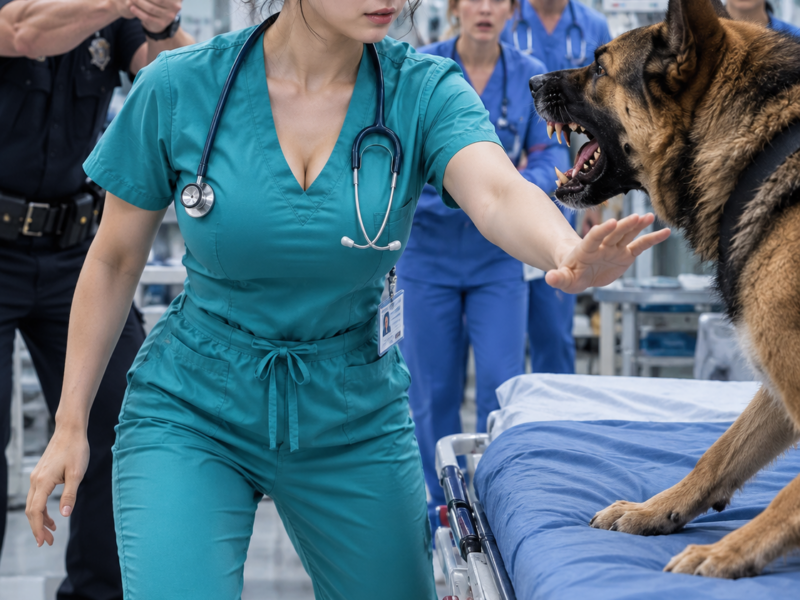
“The entire emergency room watched as a battle-tested police K9 lunged at three armed officers
The monitor screamed again, and every person in the emergency room seemed to forget how to breathe.
Ranger stood between the stretcher and the officers, his massive body rigid, his eyes fixed on the torn red canvas bag beneath the bed. His ears were forward. His tail was still. The dog who had just dropped to his knees at my whisper now looked ready to tear through anyone who tried to reach that bag.
I could still feel the warmth of his head against my palms.
“Find the boy, Buddy.”
I had said those four words without thinking. I hadn’t even known why they came out of my mouth.
But the moment I said them, the entire room changed.
“Everybody back!” Sergeant Collins shouted. “Nobody approaches the dog!”
The unconscious officer’s hand clamped around my wrist.
“Don’t let them take it,” he rasped again.
“Sir, I need you to stay still.” I leaned over him, trying to keep my voice calm while checking his pulse. “You’re at St. Vincent Medical Center. You’re injured, and I’m going to help you.”
His eyes fluttered open.
“What’s your name?” I asked.
“Ethan.” He swallowed hard. “Ethan Cole.”
“Okay, Ethan. I’m Hannah. Can you tell me where you’re hurt?”
He barely seemed to hear me. His gaze moved past my shoulder, toward Ranger.
“Buddy?”
The K9’s growl faded.
Ethan’s face crumpled. Tears slipped from the corners of his eyes into his hair.
“You came back.”
Behind us, Sergeant Collins muttered, “This is impossible.”
I looked up at him. “What is?”
Collins stared at the dog as though he were watching a ghost.
“Buddy was killed eleven years ago.”
The words struck me harder than they should have.
My grandfather had died six months earlier. In his bedroom, inside a battered wooden box, I’d found an old photograph of a German Shepherd sitting beside a young boy wearing a red jacket. The boy’s face was scratched almost beyond recognition, but the dog was clear: a notch in his left ear, a white patch on his chest, and a thin scar running across his muzzle.
On the back, in my grandfather’s handwriting, were the words: Buddy. The bravest soul I ever knew.
I had carried that photograph in my purse ever since his funeral.
And the dog standing in front of me looked exactly like him.
“Sergeant,” I said slowly, “you said this dog died eleven years ago. How do you know?”
Collins’s expression hardened.
“Because I was there.”
Before I could ask another question, Ranger barked once. It wasn’t an aggressive bark. It was sharp, urgent, and directed at the red bag.
Ethan tried to lift his head.
“The boy,” he whispered. “You have to find him.”
“Who?” I asked. “What boy?”
His fingers tightened around mine.
“Your grandfather knew.”
My stomach dropped.
The emergency room doors opened, and a tall man in a charcoal suit strode in with two security officers behind him. He wore no hospital badge, but he moved through the department like he owned it.
“I’m Director Vance,” he announced. “I’ve been informed there’s a dangerous animal loose in my emergency department. Have it restrained immediately.”
Ranger’s lips curled.
Vance stopped several feet away.
“That’s an order.”
“Sir, the dog is responding to the patient and the bag,” I said. “We need to understand what’s happening before anyone makes a sudden move.”
“I don’t need a rookie nurse explaining security to me.”
His eyes flicked to my name badge.
“Hannah Miller. You’re on probation, aren’t you?”
My cheeks burned.
“Yes, sir.”
“Then this is an excellent opportunity to learn that compassion without control is negligence.”
He turned to the officers.
“Take the dog outside. If it resists, use whatever force is necessary.”
Ethan jerked against the stretcher.
“No!”
The effort sent him into a coughing fit. His monitor began to beep faster, and I moved to stabilize him.
“Ethan, stop. You’re making it harder to breathe.”
“Don’t let them touch Buddy!”
“His name is Ranger,” Collins snapped.
Ethan looked at him with sudden, fierce clarity.
“That’s what they call him now.”
The room went quiet.
Director Vance glanced at Collins. It was a brief look, but I saw something pass between them—recognition, perhaps, or fear.
Then Vance recovered.
“Sergeant, remove the patient from this room. We’ll handle the animal and the property.”
“Sir,” Collins said carefully, “I don’t think that’s wise.”
Vance’s face tightened.
“Excuse me?”
Collins looked from Ethan to the dog, then at me.
For the first time, the sergeant who had spent the last ten minutes issuing commands appeared genuinely frightened.
“There’s a possibility,” he said, “that this incident is connected to the old Mercer case.”
Vance went pale.
I heard someone whisper, “Oh, my God.”
I had never heard of the Mercer case, but the way the officers reacted told me it wasn’t just an old police story.
It was something they had tried very hard to bury.
“Get everyone who isn’t essential out of here,” Vance ordered.
“No,” Ethan said.
His voice was weak, but it carried.
“Not this time.”
He looked directly at me.
“Hannah, open the bag.”
I glanced down at the red canvas lying beneath the stretcher. One strap had been ripped almost clean through, and dark stains marked the bottom. It looked old, weather-beaten, and unremarkable.
But Ranger wouldn’t take his eyes off it.
“Why me?” I asked.
“Because your grandfather promised he’d keep it safe.”
I felt the room tilt.
“What was my grandfather’s name?”
Ethan’s lips parted.
“Thomas Miller.”
The name landed between us like a gunshot.
I had spent my childhood listening to Grandpa Thomas tell stories about his years as a military medic. He’d talked about blood, broken bones, and the people he’d carried out of danger. But he’d never mentioned a police dog named Buddy, an officer named Ethan Cole, or a missing boy.
Never once.
I reached into my pocket and felt the edge of the photograph.
“How did you know him?”
Ethan closed his eyes for a moment.
“He saved my life. And I helped him save a little boy.”
“Which boy?”
Before he could answer, Director Vance stepped forward.
“That’s enough. This patient is confused and possibly suffering from a head injury. His statements aren’t reliable.”
“Then why are you afraid of a canvas bag?” I asked.
The question escaped before I could stop it.
Vance stared at me.
“You’re dismissed from this situation, Nurse Miller.”
“I’m treating the patient.”
“Not anymore. Security will escort you out.”
Ranger moved.
He didn’t lunge at Vance. He didn’t bare his teeth. He simply stepped closer to me and sat down at my feet, placing his broad shoulder against my leg.
A silent declaration.
If I left, he would follow.
If I stayed, he would stay.
I looked down at him.
The scar across his muzzle. The notched ear. The white patch on his chest.
Then I remembered the photograph.
The dog in the picture wasn’t just similar to Ranger.
It was Ranger.
Or someone who looked exactly like him.
My hands shook as I took out the photograph and held it where Ethan could see.
His face drained of color.
“Where did you get that?”
“It belonged to my grandfather.”
Ethan reached toward it, then stopped when pain flashed across his face.
“That’s the original Buddy.”
“But Sergeant Collins said Buddy died eleven years ago.”
“He did,” Ethan whispered. “At least, that’s what we were told.”
Collins looked away.
I stared at him.
“What does that mean?”
He rubbed a hand over his mouth.
“Eleven years ago, we responded to a fire at an abandoned community center on the east side. A boy named Noah Mercer was reported missing. His father was a police informant, and the boy had witnessed something he shouldn’t have.”
Ethan struggled to sit up.
“His father had discovered a group inside the department selling information to criminals. He planned to expose them. Before he could, someone set fire to the building where Noah was hiding.”
“Why was the boy there?” I asked.
“Because he was hiding from the men who wanted to silence his father,” Ethan said. “Thomas Miller found him first.”
My throat tightened.
“Grandpa?”
“He was working as a volunteer medic during a multi-agency search,” Ethan explained. “He went inside after hearing a child cry. Buddy found the boy trapped beneath a collapsed section of the stairwell.”
I looked at the photograph again.
The red jacket. The German Shepherd.
The scratched-out face.
“Was that Noah?”
Ethan nodded.
“Your grandfather got him out. Buddy stayed behind to help me search the second floor. The roof collapsed before we could reach him.”
He stopped to catch his breath.
“We found blood, part of his harness, and a body that couldn’t be identified. The department declared Buddy dead. The boy disappeared into protective custody. Thomas was told never to speak about what he’d seen.”
“Why would Grandpa agree to that?”
“Because the people responsible had threatened the boy’s life.”
Ethan’s eyes moved toward Vance.
“And because some of those people were wearing police badges.”
The director’s expression turned cold.
“That’s enough. Sergeant, you will secure the patient. The nurse will leave. The bag will be transferred to the authorities.”
“Which authorities?” Collins asked.
“Mine.”
Collins didn’t move.
Vance stepped toward him, lowering his voice.
“You know what happens if this gets out.”
The sergeant’s jaw clenched.
“That’s exactly why it needs to get out.”
For one long second, nobody moved.
Then Collins reached for his radio.
“Dispatch, this is Sergeant Collins. I need an independent supervisor at St. Vincent Medical Center, and I need federal contact on the Mercer investigation. Possible evidence recovered. Suspected interference by department personnel.”
Vance lunged for the radio.
Ranger rose with a thunderous bark.
The director stumbled backward.
“Control that animal!”
“I’m trying,” Collins said. “But he seems to have better judgment than most of us.”
I almost laughed. The sound came out as a shaky breath.
Then Ethan grabbed my hand again.
“Hannah, the bag.”
I knelt beside it.
“Tell me what I’m looking for.”
“There’s a false seam beneath the lining. Thomas made it. He said if anything ever happened to him, the truth would still have a way out.”
I carefully turned the bag over. The canvas was stiff with age, and the bottom seam had been ripped open, perhaps during the incident that had brought Ethan here.
I found a second row of stitching beneath the torn outer layer.
There was something inside.
“I’m going to need scissors,” I called.
A nurse hurried over with a pair of trauma shears. I slid one blade beneath the loose thread and cut slowly, careful not to damage whatever lay within.
A small plastic sleeve slipped into my hand.
Inside it were a microSD card, a folded sheet of paper, and a tiny silver tag shaped like a dog bone.
The tag was engraved with one word.
BUDDY.
Ranger whined softly and lowered his head.
I unfolded the paper.
The handwriting was unmistakably my grandfather’s.
If this reaches Hannah, then I failed to keep my promise myself. I’m sorry, sweetheart. I wanted you to have a life untouched by what happened that night. But some truths become dangerous when good people stay silent.
My eyes blurred.
Noah is alive. The evidence is on the card. Trust the boy who remembers Buddy. Trust the dog who remembers the boy. Do not trust anyone who insists this case is closed.
At the bottom was a date from eleven years earlier and a name I recognized from a thousand childhood stories.
Thomas Miller.
I pressed the paper against my chest.
My grandfather had known this day might come.
He had prepared for it.
And somehow, he had trusted that I would be the one to finish what he’d started.
“Give me that card,” Vance said.
He no longer sounded like a hospital director.
He sounded desperate.
I closed my fist around the sleeve.
“No.”
His face twisted.
“You have no idea what you’re holding.”
“I know it belongs to the patient.”
“It belongs to the department.”
“It was inside his bag.”
Vance took another step.
Collins moved between us.
“Director Vance, stay where you are.”
For the first time, Vance looked truly cornered.
“You’re making a mistake, Sergeant.”
“Maybe,” Collins said. “But I’m done making the same one.”
The automatic doors opened again.
Two plainclothes investigators entered, followed by a uniformed lieutenant. Behind them was a woman in her late fifties with silver hair, a leather jacket, and a badge clipped to her belt.
She introduced herself as Special Agent Rebecca Shaw.
“I was assigned to the original Mercer investigation,” she said. “I’ve been waiting eleven years for someone to call.”
Her eyes went straight to the red bag.
Then to Ethan.
Then to the dog.
She stopped breathing for a moment.
“Buddy?”
Ethan managed a weak smile.
“Hello, Rebecca.”
The agent approached slowly, keeping her hands visible. Ranger sniffed her fingers and allowed her to kneel beside him.
“I thought you were both gone,” she whispered.
“Almost,” Ethan said.
“Who told us the dog had died?” I asked.
Rebecca’s expression hardened.
“An officer named Daniel Vance.”
I turned toward the hospital director.
His face had gone the color of ash.
“That’s impossible,” he said. “I’m Martin Vance. I’m a hospital administrator.”
“Today you are,” Rebecca replied. “Eleven years ago, you were a detective assigned to the Mercer case. You resigned before the internal investigation was completed.”
The room erupted in whispers.
Vance shook his head.
“This is ridiculous. You can’t prove anything.”
I held up the microSD card.
“Maybe this can.”
He made one last attempt to grab it.
Collins caught his arm.
“Don’t.”
Vance struggled, shouting that he was being framed, that the evidence was fabricated, that everyone in the room would regret this. But the investigators restrained him and led him away before he could reach the doors.
As he passed me, he leaned close enough for me to hear.
“You should have stayed a nobody.”
I looked him in the eye.
“That’s what everyone kept telling me.”
Then he was gone.
For the first time since Ranger had entered the emergency room, the dog relaxed.
He lowered himself beside Ethan’s stretcher, resting his chin on the mattress.
The monitor continued to beep, but Ethan’s breathing had begun to steady.
I turned to Agent Shaw.
“What happens now?”
“First, we protect the evidence. Then we find Noah Mercer.”
“Is he still alive?”
“We have reason to believe so,” she said. “But we need confirmation.”
I thought about the note.
Trust the dog who remembers the boy.
I looked down at Ranger.
“Can he find him?”
Rebecca studied the dog.
“If he’s the same animal I remember, then there’s a chance.”
“But he’s eleven years older.”
“Dogs age. They don’t forget everything.”
She crouched in front of him and held out the silver tag.
“Buddy,” she said softly. “Do you remember Noah?”
Ranger lifted his head.
His ears pricked.
Then he stood, walked to the red bag, and nudged it with his nose.
He looked at me.
Waiting.
A strange certainty settled over me.
I knew what I had to do.
I picked up the tag and whispered the words that had come from somewhere deeper than memory.
“Find the boy, Buddy.”
Ranger barked once.
Then he turned toward the hospital exit.
Agent Shaw stared at him.
“Well,” she said, reaching for her coat, “I suppose that’s our answer.”
The next hour passed in a blur of blood tests, police statements, and secure phone calls. Ethan was stabilized and taken for emergency imaging. Before they wheeled him away, he caught my hand one more time.
“Your grandfather saved Noah twice,” he said. “Once from the fire. Once by keeping the evidence alive.”
“Why didn’t he tell me?”
“Because he knew the people involved would come after anyone who could lead them to Noah. He wanted you to grow up safe.”
I swallowed the ache in my throat.
“He could have trusted me.”
Ethan’s eyes softened.
“He did trust you. That’s why he left the bag where it could find its way to you.”
I wanted to argue, but I couldn’t.
After the stretcher disappeared down the corridor, I followed Agent Shaw to a secure room. The microSD card was handed to a digital forensics specialist, who made a protected copy before opening the files.
The first video showed a smoky corridor, flames crawling along the ceiling, and a younger Thomas Miller dragging an injured boy toward an exit.
Buddy ran ahead, barking frantically.
The camera shook. Someone shouted. A gunshot echoed.
Then the picture went black.
The second file was an audio recording.
A man’s voice spoke quietly.
“If you’re hearing this, the people who took the money are preparing to destroy the records. The names are in the ledger. Vance is one of them. So are two officers in the evidence unit. They sold confidential addresses to a criminal group, and Noah saw the transfer.”
Another voice interrupted.
“Thomas, we need to move the boy now.”
My grandfather answered, “Not until I know who I can trust.”
The recording ended with a series of names and dates.
Agent Shaw’s face grew darker with every second.
“This is enough to reopen the case,” she said. “Maybe more than enough.”
“Can it prove Noah is alive?”
“Not by itself.”
A knock sounded at the door.
A young detective stepped in holding a phone.
“Agent Shaw, we got a hit from a missing-persons database. A man matching Noah’s age and description was admitted to a rehabilitation clinic outside Cleveland three weeks ago. He used a different name, but his old medical record contains a childhood injury that matches the Mercer file.”
Shaw stood so quickly her chair scraped the floor.
“Where?”
“About forty minutes from here.”
She looked at Ranger.
The dog had been lying beside my chair. At the word Noah, he rose immediately.
“Looks like we have a lead,” she said.
I glanced at the clock.
My shift was nearly over. My hands still smelled faintly of antiseptic, and my knees ached from hours of standing. I was a rookie nurse who’d been told to stay out of the way by nearly everyone in authority.
But the dog was looking at me as if he expected me to come.
“I want to go,” I said.
Agent Shaw hesitated.
“You’re not law enforcement.”
“No. I’m the person he trusted with the bag. And my grandfather’s note says to trust the dog who remembers the boy.”
She studied me for several seconds.
“Stay behind me. Do exactly what I say. If I tell you to stop, you stop.”
“I will.”
We drove through the dark in an unmarked SUV, with Ranger secured in the rear. The entire time, he sat upright, staring through the windshield whenever the road curved east.
At the clinic, a nurse led us to a small garden enclosed by brick walls. A man sat alone on a bench, his face turned toward a patch of moonlight. He was in his early thirties, with dark hair, a thin scar above his eyebrow, and the wary posture of someone who had spent years expecting danger.
When he saw Agent Shaw, he stood.
“Rebecca?”
She stopped several feet away.
“Noah Mercer?”
The man went completely still.
Then his eyes moved to the dog.
Ranger stepped out from behind me.
For a moment, the years between them seemed to vanish.
Noah’s hand flew to his mouth.
“Buddy?”
The dog ran to him.
Noah dropped to his knees, wrapping both arms around Ranger’s neck. Ranger pressed his muzzle into the man’s shoulder and whined, a sound so raw and human that I felt tears spill down my cheeks.
“I thought you were dead,” Noah sobbed. “They told me you died saving Ethan.”
Ranger licked his face.
Noah laughed through his tears.
“You stubborn old dog.”
I stood a few feet away, unable to move.
This was the boy in the photograph.
The child my grandfather had rescued.
The person whose survival had shaped every secret he had carried.
Noah finally looked at me.
“Who are you?”
I pulled the photograph from my purse and held it out.
“My name is Hannah Miller. Thomas Miller was my grandfather.”
Noah stared at the picture.
His expression changed from confusion to grief.
“He kept it?”
“He kept everything.”
Noah touched the scratched-out face with trembling fingers.
“Your grandfather gave me a chance to live,” he said. “He helped me get a new identity and start over. He told me that one day, if it became safe, he would find a way to tell me what really happened.”
“He tried,” I whispered. “He left the evidence in the bag.”
Noah closed his eyes.
“I was afraid he’d been killed because of me.”
“He died six months ago,” I said gently. “But he wasn’t forgotten.”
For a long time, Noah said nothing.
Then he looked down at Buddy—at Ranger, as the world knew him now—and stroked the white patch on his chest.
“He came back for me.”
Agent Shaw crouched beside them.
“We need to talk about what happened eleven years ago. The evidence suggests that the men who threatened your father are connected to a larger corruption case. We can protect you, but we need your testimony.”
Noah’s jaw tightened.
“I’ve been hiding long enough.”
He stood, keeping one hand on the dog’s back.
“I’ll tell you everything.”
The case took months to unfold.
The microSD card led investigators to financial records, falsified reports, and a hidden account used to pay officers for leaking witness locations. Several former police officials were arrested. Daniel Vance was charged with obstruction, evidence tampering, and conspiracy. The investigation also uncovered the truth about the fire: Buddy had survived the collapse, but a corrupt officer had taken him from the scene and arranged for him to be transferred under a false identity to a private training program.
The dog had spent years working with different handlers, eventually becoming Ranger, a veteran K9 known for his discipline and courage. His original records had been erased. Ethan, who had survived the fire but suffered severe injuries, had never stopped searching for him.
When Ethan was strong enough to leave the hospital, he visited Noah at the clinic.
The reunion was quiet at first.
Then Noah said, “You owe me eleven years of stories.”
Ethan laughed, wincing as he did.
“I’ve got a few.”
Buddy sat between them, his head resting on Noah’s knee while Ethan scratched behind his notched ear.
They looked less like men who had survived a conspiracy and more like old friends who had finally found their way home.
A week later, Agent Shaw invited me to a small ceremony at the police training center. I almost declined. I still had shifts to cover, and I wasn’t comfortable standing in front of a room full of officers.
But I went.
Noah stood beside Ethan. Ranger sat at their feet, wearing a simple collar with his original silver tag attached.
Agent Shaw spoke about courage, loyalty, and the importance of protecting those who tell the truth. Then she invited me forward.
“Hannah Miller wasn’t part of the original investigation,” she said. “She wasn’t trained to identify evidence or question a conspiracy. She was a nurse doing her job. But she listened when others dismissed a patient, protected an animal everyone else feared, and recognized a truth she couldn’t yet explain.”
She handed me a small framed photograph.
It showed my grandfather standing beside a younger Ethan, a little boy in a red jacket, and a German Shepherd with a white chest.
For the first time, the boy’s face was clear.
Noah had found an undamaged copy among his own belongings.
I pressed the frame against my chest, fighting back tears.
“Your grandfather taught you something important,” Agent Shaw said. “He taught you that protecting someone doesn’t always mean having all the answers. Sometimes it means refusing to look away.”
After the ceremony, I found Noah and Ranger in a quiet corner of the training yard.
Noah was rubbing the dog’s ears, telling him stories about the years they’d missed.
“Can I ask you something?” I said.
He smiled.
“Anything.”
“Why did he respond to me? When I whispered those words in the emergency room, I had no idea what they meant.”
Noah glanced down at Buddy.
“Thomas used to say that dogs remember the people who made them feel safe. He taught me those words when I was little. If Buddy ever got lost, I was supposed to say them.”
“But I said them.”
“Maybe your grandfather taught you the phrase without you realizing it. Maybe you heard it as a child and forgot. Or maybe, when you saw Buddy, something about him reminded you of the photograph and the stories you grew up with.”
He paused.
“I don’t know. But I do know that Buddy heard the words and chose to trust you.”
I looked at the old dog.
He lifted his head, his dark eyes calm and bright.
For the first time, I didn’t see a terrifying K9 who could bring an emergency room to a standstill.
I saw a survivor.
A friend who had crossed eleven years of fear and confusion to find his way back to the person he had never forgotten.
Months later, I was no longer the rookie nurse people dismissed.
Not because I had uncovered a corruption scandal or stood up to a hospital director, but because I had learned what my grandfather had tried to teach me all along.
The best care begins when you pay attention.
When you listen to the person everyone else has decided is confused.
When you recognize that fear can look like anger, that silence can hide grief, and that the truth doesn’t always arrive in a form you expect.
I still work at St. Vincent Medical Center. I still make mistakes. I still have nights when the alarms seem endless and every decision feels too big for me.
But I carry Grandpa’s photograph in my locker, beside a small silver dog tag engraved with one name.
Buddy.
Sometimes, when I pass the emergency department entrance, I remember the night a battle-tested K9 lunged at three armed officers and a room full of people decided he was dangerous.
I remember how quickly they wanted to control him, remove him, and silence the questions he raised.
And I remember the moment he dropped to his knees at four words he had waited eleven years to hear.
“Find the boy, Buddy.”
He had never stopped looking.
And neither, I finally understood, had my grandfather.
The end.









