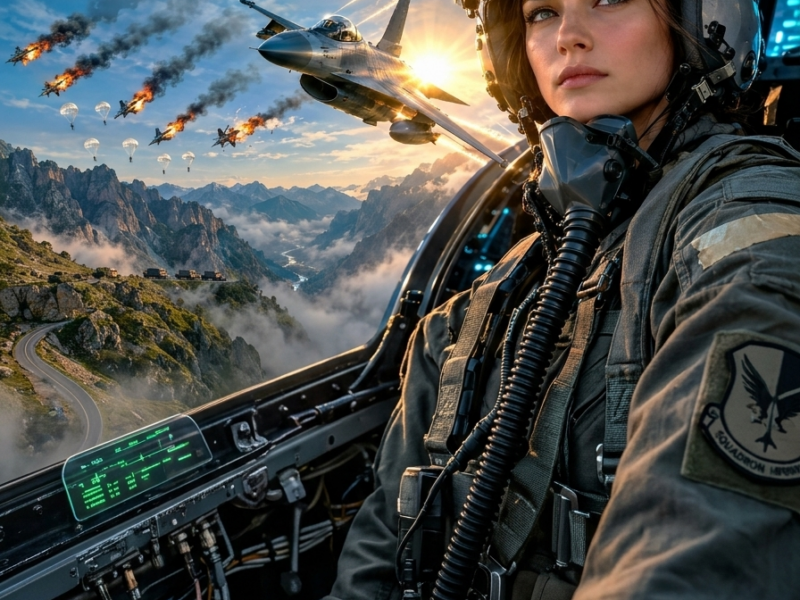
The entire briefing room burst into laughter when a senior commander called me a clueless rookie and ordered me to stay out of the fight
The air in the subterranean briefing room of Apex Base, nestled high in the mist-shrouded peaks of Northern NATO’s eastern corridor, was thick with the scent of high-grade jet fuel, machine oil, and cold arrogance. High-definition radar displays flickered on the concrete walls, casting a pale blue light across thirty combat aviators in tactical flight suits.
I stood near the door, my thumbs tucked into the harness strap of my gear bag. At twenty-six, my face still carried a youthfulness that invited condescension, but my eyes were flat, hard, and utterly drained of illusions. I was Lieutenant Claire Bennett. To the men of the 77th “Valkyrie” Fighter Squadron, I was just the new transfer—a tiny, quiet girl with zero confirmed air-to-air kills listed on her public ledger and a service record so full of blacked-out redactions it looked like a census report from a dead city.
Major Daniel Hayes sat at the head of the mahogany briefing table. He was a broad-shouldered veteran with forty combat sorties over the Gulf and a jagged scar cutting through his left eyebrow. He tossed a dry-erase marker against the whiteboard and turned his cold, grey eyes on me.
“How many hours do you have in a real combat aircraft, rookie?” Hayes asked, his lips curling into a dismissive smirk as he gestured toward the tactical diagrams of our modified F-22 EX Block IV Raptors. “And I don’t mean time spent in a air-conditioned simulator in Texas playing video games.”
“Enough to do my job, sir,” I replied, my voice calm, even, and devoid of any defense or inflection.
The entire briefing room erupted in a roaring chorus of laughter.
“Enough to do her job!” chuckled Captain Miller, a lead element pilot sitting in the second row, slapping his thigh. “Careful, Major, she might accidently turn on the windshield wipers during a supersonic run!”
Hayes leaned back in his leather chair, crossing his heavy arms over his chest, basking in the laughter of his squadron. “Stay behind the formation tomorrow, Bennett. Tail-end Charlie. Way in the back where you can’t hit anything and nothing can hit you. We can’t afford to babysit a rookie when the eastern border is burning.”
“Understood, Major,” I said softly, taking my assigned seat at the back corner of the room.
I let them laugh. I held my tongue. They saw a quiet civilian-style transfer in a crisp, brand-new suit—a girl who had somehow skipped the standard three-year tour in continental defense. They didn’t know that my real military record was stored on an air-gapped server beneath the Pentagon, locked behind a level-seven cryptographic key. They didn’t know why a three-star general had personally hand-signed my transfer orders at two in the morning, or why my flight surgeon was the only person on this base required to sign a non-disclosure agreement just to check my heart rate.
And I wasn’t about to explain it to men who measured a pilot’s worth by how loud he barked in a briefing room.
The next morning, at 0500 hours, the sky above the Northern sea was the color of bruised slate. Five F-22 EX fighters tore off the runway, their afterburners searing twin spears of orange flame into the damp ground fog. We banked hard east, climbing past forty thousand feet into the thin, freezing stratosphere.
I kept my Raptor, callsign Ghost 5, tucked three miles behind the main four-ship diamond formation, exactly where Hayes had ordered me to stay. The radio chatter was light, professional, and slightly relaxed—this was supposed to be a routine border patrol along the neutral air corridor.
Then, at 0542 hours, the tactical bus line shattered.
BEEP-BEEP-BEEP.
“Control, this is Valkyrie Lead,” Hayes’s voice snapped across the encrypted frequency. “I’m picking up multiple high-speed radar tracks painted on long-range search. Vector zero-four-five, altitude thirty-eight thousand. Speed Mach two point two.”
“Valkyrie Lead, Control,” came the urgent reply from the airborne warning and control plane high above us. “Tracks are non-responsive to IFF queries. Five unidentified contacts… wait, correction, five high-agility fighters dropping out of the clouds! They are maneuvering hard!”
On my tactical display, five crimson icons appeared out of the radar clutter, slicing through our boundary line like razor blades. They weren’t flying the standard doctrine of any known regional force. They were flying in an aggressive, interlocking wedge—a lethal formation designed for asymmetric interception.
“All pilots, defensive formation!” Hayes shouted. “Power up weapons systems! Lock them up!”
The sky turned into a chaotic nightmare of radio static, warning tones, and intersecting contrails. The enemy fighters closed the distance with terrifying velocity.
I zoomed my synthetic aperture sensor onto the lead hostile aircraft. While Hayes and Miller were frantically trying to secure missile locks, I spent six long seconds studying the movement pattern of the enemy lead. The way he banked, the precise sub-second delay before he rolled to invert his radar cross-section, the subtle pitch-up maneuver to bleed speed while drawing our attention…
My chest tightened. My pulse didn’t spike; it dropped into the cold, terrifying thirty-beats-per-minute calm that only comes from deep trauma and total familiarity.
“Flight leader, they’re setting a trap,” I warned over the squadron net, my voice cutting through the panic. “Hostile three and four are executing a wide pincer, but it’s a feint. They want you to turn left so the lead element can drive you down into the low-altitude surface-to-air missile envelope.”
“Shut up, Bennett! Stay in position!” Hayes snapped angrily. “This isn’t a training exercise! Do not clog the tactical channel!”
A fraction of a second later, the radio exploded with screeching alarms.
“MISSILE WARNING! MISSILE WARNING!” Miller yelled. “Break right! Break right! I’m painted! My radar display just went completely dead—they’re blinding our main array!”
“I can’t clear his tail!” Hayes roared, his aircraft lurching violently on my screen into an emergency defensive turn as two hostile fighters closed in on his six o’clock position. “My primary tracking bus is jammed! Break out! Break out!”
The enemy had executed their trap with textbook perfection. In less than forty seconds, our elite four-ship formation was fragmented, blind, and being systematically driven toward the sea by five superior, unidentified fighters.
I took a slow, deep breath inside my oxygen mask. I closed my eyes for a fraction of a second, remembering the cold, concrete vaults of the skunkworks testing facility in Nevada, and the words of the chief test engineer who had watched me fly three years ago: The best pilots aren’t the ones who pull twelve Gs until they pass out, Claire. They’re the ones who can see the chess game before the pieces are moved.
I slammed my throttle forward into full military power. My Raptor surged through the air like a silver arrow.
“Control, this is Ghost 5,” I said, my voice dead calm. “Requesting permission to engage.”
“Denied!” Hayes screamed into his radio, his breath raspy with high-G strain as he fought to avoid an incoming missile track. “You are not cleared to freelance, rookie! Get your ass back to base!”
On my helmet-mounted display, I saw the lead enemy fighter bank hard, aligning his nose directly with Miller’s disabled, tumbling aircraft. In three seconds, Miller would be dead.
“With respect, sir,” I whispered, flicking my primary weapons master switch from SAFE to ARM, “I’m not freelancing. I’m ending this.”
My Raptor didn’t execute a standard defensive break. Instead of turning away from the fight to build distance, I pitched the nose straight up sixty degrees, dumping air-speed rapidly while using thrust-vectoring nozzles to force the aircraft into an impossible cobra-like maneuver directly above the center of the dogfight.
The world outside my canopy became a blur of grey ocean, white clouds, and flashing orange missile trails. The force of seven Gs crushed my ribs, forcing the air out of my lungs, but my hands on the stick and throttle remained as steady as surgical scalpels.
“Ghost 5, what are you doing?!” Hayes yelled over the radio. “You’re stalling out!”
“I have the high ground,” I said softly.
I wasn’t using the automated targeting computer—the enemy was jamming the standard radar bands our squadron relied on. But I knew their jammer’s blind spot. I manually recalibrated my passive infrared search and track system to lock onto the thermal exhaust signature of their engines, bypassing their digital defenses entirely.
TONE.
A solid, high-pitched warble filled my helmet.
“Fox Two,” I said quietly, pressing the red launch button on my stick.
A short-range Sidewinder missile detached from my internal bay, its rocket motor igniting with a sharp white blinding pulse. It crossed the sky in less than two seconds, slamming directly into the engine nozzle of the hostile fighter chasing Miller. The enemy jet exploded into a cloud of burning titanium and carbon fiber, its wreckage plunging into the dark sea below.
“Target one destroyed,” I reported, sweeping my stick left and plunging my nose into a vertical dive straight through the fireball.
“What the hell…?” Miller gasped over the radio, his voice shaking. “Who took that shot?!”
“Keep moving, Miller,” I commanded, taking operational control of the squadron channel without asking for permission. “Valkyrie three and four, pull hard left to vector one-eight-zero! Drive the remaining hostiles into my firing arc!”
The sheer authority in my voice was so absolute, so commanding, that Lieutenants Vance and Davis executed the order without thinking. They banked hard left, luring the two secondary enemy fighters into a long, sweeping turn.
The hostiles took the bait. They accelerated to complete their attack run, completely unaware that I was diving out of the sun directly behind them at Mach 1.4.
“Fox Two… double launch,” I muttered.
Two more missiles leaped from my weapons bay. They tracked clean and true through the cold sky. On my optical display, twin orange fireballs bloomed across the sky as both enemy aircraft were destroyed simultaneously.
“Three down!” control screamed over the speaker, their voices frantic with disbelief. “Ghost 5, you have two targets remaining on your six! Move!”
The final two enemy fighters—the lead element—had realized what was happening. They abandoned their pursuit of Hayes, broke their formation, and executed a synchronized pincer move to sandwich my aircraft between them. They were good. Terrifyingly good. They maneuvered with a liquid fluidity that no normal operational pilot could match.
They rolled in behind me, their nose cannon rounds tracing bright red lines through the air just feet above my canopy.
“Bennett! Pull up!” Hayes shouted, his voice laced with sudden, desperate panic. “They’re on your tail! Break clear! I’m coming to help!”
“Negative, Valkyrie Lead. Stay clear,” I said, my heart rate steady at forty-five beats per minute. “They fly like Skunkworks aggressors. They expect me to pitch down.”
Instead of pitching down or pulling Gs, I inverted my aircraft completely, pulled my throttle back to idle, and deployed my dorsal airbrake for a split second. My Raptor shuddered violently as it shed three hundred knots of speed in less than two seconds.
The two hostile fighters, moving too fast to react, overshot my position. They roared right past my canopy—so close I could see the dark, unpainted stealth composite of their hulls and the blank, black visors of their pilots.
For half a second, the lead enemy pilot turned his head and looked directly at me through the glass.
My breath hitched in my throat. On the side of his dark cockpit frame was a tiny, hand-painted insignia—a silver compass rose crossed by a broken sword.
It was the emblem of the Ghost Squadron. The classified black-budget evaluation team I had belonged to three years ago.
A cold, paralyzing wave of dread washed over me.
No… it’s impossible, I thought, my hands freezing for a fraction of a second on the controls. They disbanded the program… everyone was accounted for…
The second hostile fighter began to roll hard to realign its cannon on my belly. The muscle memory from three thousand hours of classified flight testing took over before my brain could process the shock. I pulled my stick into my lap, brought my nose up, and slammed the cannon trigger.
A two-second burst from my 20mm rotary cannon tore through the second fighter’s wing root. The wing sheared off cleanly, sending the aircraft into a violent, unrecoverable flat spin.
The last remaining enemy jet—the lead pilot with the silver compass on his hull—didn’t try to re-engage. He slammed his engine into full afterburner, banked ninety degrees toward the eastern horizon, and vanished into the thick cloud deck at supersonic speed.
The sky suddenly went dead quiet.
The heavy, suffocating silence was broken only by the sound of my own slow, rhythmic breathing inside my oxygen mask.
“Control…” Hayes stammered over the radio, his voice hollow, shocked, and completely stripped of his earlier bravado. “Control… status report on hostile contacts.”
“Valkyrie Lead… all hostile tracks have cleared the board,” the AWACS operator replied, his voice trembling with disbelief. “Four hostiles confirmed destroyed. One hostile fleeing eastern sector. Ghost 5… Ghost 5 single-handedly neutralized the threat envelope.”
“Bennett…” Miller breathed, his voice choked with emotion. “You… you just saved my life.”
I looked out my canopy at the empty blue sky, my fingers trembling slightly against the throttle. I didn’t feel triumph. I felt a cold, sharp blade of terror sliding between my ribs.
“Ghost 5 to all elements,” I said, my voice cold and flat as stone. “Re-form on my wing. We’re returning to base.”
When the five F-22 EX Raptors touched down on the concrete runway at Apex Base forty minutes later, the usual celebratory noise of a successful combat return was entirely absent.
The ground crews in their high-visibility vests stood frozen beside their yellow tow tractors, staring as my aircraft taxied toward Hangar 3. My Raptor was immaculate. While Major Hayes’s aircraft had scorch marks along its ventral fuselage from an enemy missile’s near-miss, and Miller’s jet was riding low on a damaged hydraulic main gear, Ghost 5 didn’t have a single scratch on its radar-absorbent paint.
I shut down the twin Pratt & Whitney engines, listening to the low, descending whine of the turbines as the canopy slowly hissed open.
The cool, damp mountain air rushed into the cockpit, carrying the smell of pine trees and burnt kerosene. I unclipped my oxygen mask, letting it dangle from my helmet, and ran a hand over my damp forehead.
At the foot of my boarding ladder, a crowd had gathered.
Major Hayes stood in the center, his helmet tucked limply beneath his left arm. Beside him were Miller, Vance, and Davis. The arrogant, smirking squad leader who had called me a clueless rookie in front of thirty people two hours ago looked like he had seen a phantom. His face was pale, his eyes wide, and his jaw set in a tight line of raw, unvarnished embarrassment.
I lowered myself down the yellow metal ladder, my flight boots clicking sharply against the wet tarmac.
As soon as my feet touched the ground, Hayes stepped forward. The pilots behind him snapped to attention—not for Hayes, but for me.
“Claire…” Hayes started, his raspy voice failing him for a moment. He swallowed hard, staring at me as if he were looking at an alien species. “I… we saw the telemetry logs on the tactical bus. The cobra maneuver… the passive infrared offset… the low-speed gun kill… Where in God’s name did you learn to fly like that?”
I unzipped my harness straps, keeping my face impassive. “In the air, Major.”
“Don’t give me that bullshit!” Hayes snapped, though there was no anger in his voice—only a desperate, awe-struck confusion. “No standard line pilot moves like that! No human being turns an F-22 inside out at three hundred knots without pulling their own wings off! Who are you, Bennett? What branch of the service did you actually come from?!”
Before I could answer, the low, powerful rumble of a heavy engine echoed across the tarmac.
A sleek black government sedan with darkened bulletproof windows and staff flags mounted on the front fenders rolled around the corner of Hangar 3. It pulled to a smooth stop just ten feet from my aircraft.
The rear door opened immediately.
A tall, broad-shouldered man in a dark green service dress uniform stepped out into the damp morning fog. On his shoulders, three silver stars caught the dim light of the overcast sky. His face was lined with deep, permanent crevices of stress, his hair cut into a stark, military high-and-tight.
It was Lieutenant General Arthur Vance—Deputy Chief of Staff for Strategic Air Operations, and the director of the Pentagon’s most sensitive black programs.
Behind him stepped two heavily armed military police officers carrying suppressed carbines and locked briefcase tactical comms.
The entire flight line froze. Hayes immediately snapped a rigid, textbook salute. “General Vance, sir! We were not informed of your arrival—”
General Vance ignored Hayes completely. He didn’t even look at the major. He walked straight toward me, his heavy polished boots clicking against the concrete, carrying a thick, black leather folder sealed with a red classified locking clasp.
“Lieutenant Bennett,” General Vance said, his voice deep, resonant, and heavy with authority.
“General,” I replied, standing at attention and offering a clean salute.
Vance returned the salute briefly, then turned his stern, unforgiving eyes onto Major Hayes and the surrounding pilots.
“Major Hayes,” Vance said, his tone colder than the arctic ocean. “I monitored your squad’s tactical radio logs from my airborne command platform twenty minutes ago. I heard you call this officer a clueless rookie who needed a babysitter.”
Hayes’s face flushed a deep, burning crimson. He opened his mouth to speak, but no words came out.
“I also monitored the engagement data,” Vance continued, stepping closer to Hayes until he was towering over him. “While you and your senior element were being outmaneuvered by a sophisticated aggressor unit, Lieutenant Bennett single-handedly saved your squadron from total destruction.”
“Sir, I… I didn’t know—” Hayes stammered, his eyes darting nervously toward the black folder in the general’s hands.
“Of course you didn’t know, Major,” General Vance said, a dark, bitter smile touching the corner of his lips. “Because her record was sanitized on my direct order. But given what just occurred in the airspace three hundred miles north of here… I believe it’s time your squadron learned who Lieutenant Bennett really is.”
The general unlocked the red clasp on the black leather folder with a fingerprint scanner on its spine. He pulled out a large, high-resolution gloss photograph and turned it around, holding it up in front of Hayes’s face.
The photograph showed a sleek, swept-wing black aircraft sitting in an underground hangar. It had no country markings, no squadron tail codes, and no standard canopy. Its hull was made of an exotic, matte-black material that seemed to swallow the light around it.
It was the YF-42 Eclipse—the ultra-classified, neural-interface stealth prototype developed under Project Darkreach. An aircraft that, according to official Air Force public statements, had been canceled four years ago after a catastrophic test crash.
Hayes stared at the photograph, his eyes widening in horror as he recognized the cockpit configuration. “This… this is the Darkreach prototype… The one that crashed over the Pacific three years ago…”
“It didn’t crash because of mechanical failure, Major,” General Vance said coldly. “And Lieutenant Bennett wasn’t just a pilot. She was the chief evaluation officer of Project Darkreach. She has more combat testing hours in high-threat, non-conventional environments than your entire squadron combined.”
Hayes looked at me, his breath hitching, absolute shock paralyzed across his face.
“And there is one more thing you need to see, Major,” General Vance added, his voice dropping into a deadly whisper.
He flipped the photo over. Stamped on the back of the paper was a high-resolution satellite frame taken from the dogfight twenty minutes ago, showing a close-up of the lead enemy aircraft’s cockpit that had escaped into the eastern clouds.
Beneath the satellite image, written in bold, red archival ink, were six words that made the blood run cold in my veins, and sent a shudder of pure horror through every pilot standing on that tarmac.
The fifth enemy pilot was American.
A suffocating silence settled over the tarmac. The wind seemed to freeze in the pine trees surrounding the flight line.
Major Hayes stared at the red text beneath the satellite photo, his fingers trembling violently as he pointed at the paper. “An… an American? Sir, that’s impossible! Those were foreign aggressor fighters! They crossed the eastern maritime boundary!”
“They were flying captured and modified foreign airframes, Major,” General Vance said, his voice flat and hard as steel. “Equipped with stolen American flight-control avionics and black-market stealth coatings. And the man sitting in the lead cockpit—the man who almost executed your squadron today—was wearing a United States Air Force flight suit.”
My mind was reeling, spinning back three years into the dark, rain-swept nights at Groom Lake. I stepped forward, ignoring standard protocol, my eyes fixed on the general.
“General…” I whispered, my voice shaking for the first time all morning. “The silver compass rose on the hull… The pilot who escaped… Is it… is it Major Marcus Cole?”
General Vance turned his heavy, sad eyes onto me and gave a single, slow nod.
“Marcus Cole died three years ago!” I insisted, my chest heaving with sudden, suffocating emotion. “I saw his telemetry drop off the board over the Mariana Trench during the Phase Four neural-link flight test! His aircraft disintegrated at Mach 5! We recovered his flight helmet!”
“We recovered a staged helmet, Claire,” General Vance corrected softly, dropping the military rank and using my first name for the first time. “Marcus Cole didn’t die. He staged his own ejection, allowed his prototype to crash into deep water where a foreign retrieval vessel was waiting, and walked away with three terabytes of our most classified flight control algorithms.”
The world seemed to spin beneath my feet. Marcus Cole had been my wingman. He had been my instructor, my mentor, and the man who had taught me how to execute the high-angle cobra maneuver I had used just thirty minutes ago to save Miller’s life. For three years, I had carried the crushing guilt of his death, believing that I had failed to spot a structural flaw in his experimental aircraft before takeoff.
“He didn’t just walk away, Claire,” General Vance continued, turning back to the group of stunned pilots. “For the last thirty-six months, Cole has been building a rogue mercenary air wing—funded by a syndicate of foreign intelligence contractors. They’ve been hunting down our test pilots, studying our tactical vulnerabilities, and selling our flight-control weak points to the highest bidder.”
Hayes dropped his head, his face pale with a mix of shame and terror. “And… and today… he wasn’t trying to probe our defense grid. He was testing us.”
“He was testing you, Major,” Vance said ruthlessly. “And if Lieutenant Bennett hadn’t been standing on your wing, your entire flight would be at the bottom of the ocean right now, and the Pentagon would have blamed it on a routine equipment failure.”
General Vance pulled a second, smaller document from his folder and handed it directly to me.
It was an official, immediate-action operational order signed by the Joint Chiefs of Staff.
“Project Darkreach has been reactivated as of 0600 hours today, Lieutenant,” General Vance said, his eyes locking onto mine with lethal intensity. “We have traced Cole’s staging facility to a hidden, radar-blinded airfield built into a abandoned submarine base on a remote island eighty miles off the eastern coastline.”
“Sir…” Hayes interrupted, stepping forward eagerly, desperate to redeem himself. “The 77th Squadron is ready to deploy! We will assemble a full strike package immediately—”
“The 77th Squadron isn’t qualified to fly this mission, Major,” General Vance cut him off sharply, without even looking at him. “Your aircraft’s radar arrays are useless against Cole’s modified stealth coatings, and your pilots don’t know how to counter a man who helped write our tactical manual.”
Vance turned back to me. “There is only one aircraft on this continent capable of penetrating that island’s automated surface-to-air missile grid, and only one pilot alive who can match Marcus Cole in an unconstrained dogfight.”
He pointed toward Hangar 4 at the far end of the flight line. The heavy steel blast doors were slowly sliding open, revealing the dark, sleek silhouette of a jet hidden deep within the shadows.
It was the second YF-42 Eclipse prototype—the sister ship to the one Cole had stolen.
“Your aircraft has been prepped and loaded, Claire,” General Vance said softly. “You launch in twenty minutes. You are hunting down the ghost you thought you lost three years ago.”
I looked at the black aircraft sitting in the hangar shadows, then at the sky above the sea where my wingman had vanished three years ago. The fear, the confusion, and the lingering scars of the past three years burned away, leaving behind a sharp, deadly clarity.
“Major Hayes,” I said, turning to face my commanding officer.
Hayes stood straight, looking at me with absolute, reverent respect. “Yes, Lieutenant?”
“I need your ground crew to prep my primary helmet display,” I said quietly. “And tell your pilots to stay in the briefing room. I don’t want anyone in my sky who isn’t ready for what’s coming.”
“Understood, ma’am,” Hayes said, saluting me with a crispness he had never shown to another officer in his life. “Good hunting.”
Twenty minutes later, the dark, tailless silhouette of the YF-42 Eclipse sat at the edge of Runway 22. It didn’t roar like the standard Raptors; its experimental pulse-detonation engine produced a deep, low, sub-audible thrum that shook the ground like an earthquake.
I sat in the cockpit, encapsulated by a seamless, 360-degree synthetic visual display fed directly into my specialized helmet. There were no physical gauges or dials. The aircraft was an extension of my nervous system, responding to micro-gestures of my hands and the neural telemetry sensors lining my helmet liner.
“Eclipse One, Control,” General Vance’s voice came through my secure channel. “You are cleared for launch. Target coordinate is Island Sector Seven-Nine. Objective is simple: locate Marcus Cole, neutralize his airframe, and ensure the Darkreach data dies with him today. Good luck, Claire.”
“Executing launch, Control,” I said.
I slammed the throttle forward. The Eclipse launched off the runway, reaching Mach 2 before it even crossed the airfield boundary line. It climbed vertically into the overcast sky like a black phantom, vanishing into the clouds at fifty thousand feet.
Ten minutes later, I broke through the lower cloud deck over Sector Seven-Nine.
Below me, surrounded by churning grey ocean waves and jagged black rocks, sat the target: a heavily fortified island facility tucked inside a hollowed-out coastal cliff face. Automated anti-aircraft radar arrays spun furiously along the ridge lines, but my stealth hull absorbed their signals entirely.
Suddenly, a single radar contact burst out of the underground hangar bay carved into the base of the cliff.
It was Cole’s modified black fighter. He didn’t wait for his base defenses to assist him. He climbed straight toward me, his engine screaming across the open sea, trailing a long, white contrail through the cold air.
“I knew you were up there, Claire,” Marcus Cole’s voice suddenly crackled over an old, encrypted frequency—the private channel we had used as test partners three years ago. His voice sounded older, rougher, and hardened by years of living in the shadows. “I saw you pull that cobra maneuver over the water. Only one person flies with that kind of cold perfection.”
“Marcus,” I said, my voice steady as I banked my aircraft to match his climb. “It’s over. The general knows about the facility. A full carrier strike group is thirty minutes behind me.”
Cole chuckled—a dark, dry sound that echoed in my helmet. “A carrier strike group won’t get here in time to save you, kid. You shouldn’t have come alone. You were always the smartest engineer in the program, Claire… but I was always the better dogfighter.”
“You were,” I agreed, pulling my stick hard left and diving straight toward him. “Three years ago.”
Our two black stealth jets collided in the sky at Mach 3, weaving through a terrifying, high-G dance of death over the boiling ocean.
Cole was a master of energy management. He rolled, banked, and thrust-vectored his jet with incredible precision, using every trick he had ever taught me. Cannon fire zipped through the sky between us, light-speed tracer rounds missing my canopy by mere inches as we fought for position.
He executed a tight, horizontal scissors maneuver, trying to force me to overshoot his position so he could slide in behind my engine.
“You’re using my own moves, Claire!” Cole taunted over the radio, pulling nine Gs as he inverted his aircraft above mine. “I taught you everything you know!”
“No, Marcus,” I said, my eyes locking onto his thermal profile as I triggered an experimental flight-control pulse that instantly locked my forward wings into a negative-sweep configuration. “You taught me everything you knew. You haven’t seen what I’ve built since you left.”
My aircraft didn’t just stall—it stopped dead in mid-air, rotating 180 degrees on its axis like a spinning top while retaining all of its forward kinetic energy.
Cole’s eyes must have bulged behind his visor as my nose suddenly pivoted to point directly at his cockpit from less than two hundred meters away.
“What… what is that maneuver?!” Cole gasped, panic breaking through his arrogance for the first time in his life. “That’s impossible!”
“It’s called the Valkyrie Flip,” I whispered.
TONE.
My passive optical targeting array locked onto his engine core.
I didn’t launch a missile. I fired a concentrated, high-energy electromagnetic pulse burst directly from my nose cone—an experimental non-lethal system designed specifically to disable electronic flight-control buses.
The blue beam illuminated his cockpit for a fraction of a second.
Instantly, all of Cole’s digital displays went pitch black. His thrust-vectoring nozzles locked up, his engine control computers shut down, and his black stealth fighter lost all aerodynamic control, entering a steep, powerless glide toward the ocean below.
Cole’s voice came back over the emergency battery radio, heavy, breathless, and filled with a profound, awe-struck defeat.
“You… you didn’t shoot me down…” he panted. “You took my control away.”
“Eject, Marcus,” I commanded, pulling my aircraft into a hovering orbit above his falling jet. “Eject now. The strike team will pick you up out of the water in ten minutes.”
There was a long silence over the radio as his dead aircraft glided closer and closer to the white caps of the waves below.
“You really are the best pilot in the world, Claire,” Marcus said softly. “I’m sorry I made you carry the guilt.”
A second later, the canopy of his jet blew clear with a bright flash of explosive cord. Marcus Cole’s ejection seat rocketed into the sky, his orange parachute deploying cleanly against the grey clouds.
Below him, his black prototype slammed into the ocean floor, exploding into a non-toxic cloud of foam and metal, taking the last remnants of the stolen classified data into the deep dark abyss forever.
Ten minutes later, the blue sky broke through the cloud deck over the ocean.
I turned my nose west, setting my autopilot for Apex Base.
“Control, this is Ghost 5,” I reported, my voice echoing across the strategic military network, heard by General Vance, Major Hayes, and every pilot sitting in the briefing room three hundred miles away. “Target neutralized. Pilot in custody. The sky is clear.”
“Copy that, Ghost 5,” General Vance replied, his voice rich with quiet, unshakeable pride. “Welcome home, Captain Bennett.”
I looked out my canopy at the bright sunlight breaking over the horizon, feeling the weight of three years finally lift off my shoulders. I wasn’t the rookie in the back of the room anymore. I was the guardian in the dark—and the sky belonged to me.
THE end.









