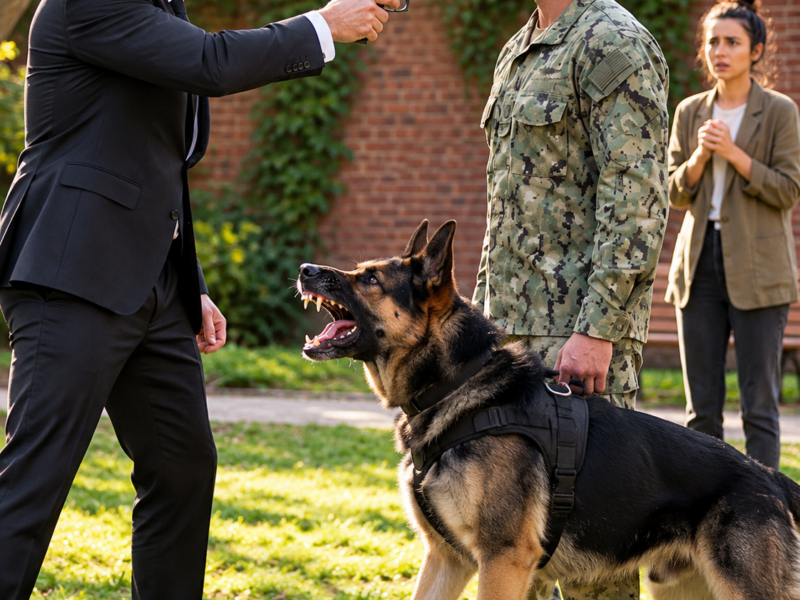
“The billionaire’s son pointed a loaded gun at my chest in the middle of downtown Charleston, then smirked when my German Shepherd stepped between us
“Michael Cross.”
The name left Ethan Whitmore’s mouth like a confession.
For one suspended second, I forgot the gun pointed in my direction, the two men beside the black SUV, and the growing crowd on King Street.
Michael Cross had been my commanding officer.
He had also been the last man I saw alive before our mission in Syria went catastrophically wrong seven years earlier.
“Put the weapon down, Ethan,” the taller man said.
Ethan jerked the gun back toward him. “You told me he was dead.”
The man’s face tightened. “You need to calm down.”
“You said there were no survivors!”
A woman near the bakery began crying. Somewhere behind me, Duke let out a low, warning growl.
I kept my eyes on Ethan.
“Who told you that?”
He swallowed, his gaze darting between me and the man in the suit.
“You need to leave, Bennett.”
“I’d love to. You’re the one holding a gun.”
For the first time since he had drawn it, Ethan seemed to realize how many people were watching him. His hand shook harder, and the muzzle drifted toward the pavement.
The man in the suit seized the opportunity.
“Ethan, give me the gun.”
“No!”
“Your father is going to be very disappointed.”
“My father?” Ethan laughed bitterly. “You people have been lying to me my entire life.”
The second man moved toward the SUV, reaching inside his coat.
I saw the movement.
So did Duke.
His growl deepened, and I tightened my grip on the leash.
“Everybody stop moving,” I said.
Something in my voice made them listen.
The taller man looked at me carefully. He was in his fifties, with silver at his temples and the controlled expression of someone accustomed to giving orders without raising his voice.
“Mr. Bennett, this is a private family matter.”
“You brought two men in suits to a public street while a young man points a gun at people. It stopped being private a while ago.”
He gave me a thin smile.
“You have no idea what you’re involved in.”
“I’m starting to get one.”
The first police cruiser turned onto King Street, followed by a second.
Ethan looked toward the flashing lights. His face had gone pale.
Then he did something I hadn’t expected.
He lowered the gun, placed it carefully on the pavement, and stepped away from it with both hands raised.
“I didn’t shoot anyone,” he shouted as the officers approached. “I didn’t hurt anybody.”
The taller man immediately stepped forward.
“Officer, thank goodness you’re here. This young man is experiencing a personal crisis. We’ll handle everything through our attorneys.”
The lead officer, a broad-shouldered woman with her hair pulled into a tight bun, ignored him.
“Everyone keep your hands where I can see them.”
She directed another officer toward Ethan and a third toward the two men from the SUV.
Then she looked at me.
“Sir, are you injured?”
“No.”
“Is that your dog?”
“His name is Duke. He’s a retired military working dog.”
Her expression softened briefly.
“Keep him close, please.”
I nodded.
As the officers secured Ethan’s weapon, the young man looked over his shoulder at me.
“Jack,” he called.
The officer guiding him toward the cruiser paused.
Ethan’s eyes were wet now.
“Don’t let them take the blue folder.”
“What blue folder?”
He opened his mouth, but the taller man spoke first.
“Officer, the boy isn’t thinking clearly. His father will explain everything.”
Ethan twisted around.
“It’s not my father you should be worried about!”
The officer guided him into the cruiser before he could say more.
I watched the door close.
The taller man adjusted his jacket and turned toward me.
“Mr. Bennett, I strongly recommend that you forget this morning.”
“That’s an interesting recommendation from a man who claims this is a family matter.”
His smile vanished.
“You served your country. You did your duty. You should be proud of that and move on.”
He stepped closer, lowering his voice.
“Some things are better left buried.”
Then he followed the other suited man toward the SUV.
I stood on the sidewalk with Duke beside me, watching the vehicle merge into traffic.
The sirens faded.
The crowd began to disperse.
And seven years of carefully buried memories came rushing back.
The mission had been called Operation Lantern.
We were supposed to retrieve a captured intelligence source from a compound outside Aleppo, extract him, and leave before dawn.
Six men went in with me.
Only three came out.
The official report blamed faulty intelligence and an unexpected enemy patrol. It described the operation as a tragic failure and praised the surviving personnel for their courage.
My commander, Michael Cross, died in the explosion that destroyed our extraction point.
At least, that was what the report said.
I remembered the radio cutting out minutes before the explosion. I remembered Cross ordering us to abandon the original route. I remembered a voice on the communications channel that shouldn’t have been there, reciting our revised coordinates.
And I remembered the final message Cross had given me.
“Bennett, if you make it home, don’t trust the report.”
I had tried to investigate.
I filed requests. I spoke with investigators. I asked questions that made people uncomfortable.
Eventually, I was told the matter had been reviewed and that no evidence of misconduct had been found.
Then my career ended after an injury sustained during a subsequent deployment.
I returned home with a damaged shoulder, a dog that had learned to sleep beside my bed, and a report that insisted my commander was dead.
I never found his body.
For years, I told myself that detail didn’t matter. In combat, bodies disappeared. Buildings collapsed. Records were lost.
But every now and then, usually in the middle of the night, I heard his voice again.
Don’t trust the report.
Now a billionaire’s son had recognized my name and claimed his father had told him I was dead.
I needed answers.
I also needed to get Duke home.
My truck was parked three blocks away.
By the time we reached it, my phone had collected eleven missed calls from an unknown number.
A text arrived while I was opening the driver’s door.
Stop asking about Operation Lantern.
I stared at the screen.
I hadn’t mentioned the operation aloud.
Not once.
I looked across the street. A delivery van sat idling beside a loading dock. Its driver appeared to be checking his phone, but when our eyes met, he quickly looked away.
I slid my phone into my pocket and got Duke into the truck.
I didn’t drive straight home.
Instead, I took a longer route through downtown, checking the mirrors and watching for anyone who might be following me.
Three turns later, the same dark sedan appeared behind us.
It stayed two cars back through a traffic light, then disappeared when I turned toward the waterfront.
I kept driving until I reached a busy parking lot outside a grocery store.
There, I called the one person I knew who might help.
“Sarah? It’s Jack.”
A pause.
“Jack Bennett?”
“Unless you know another one.”
She exhaled sharply.
“I haven’t heard from you in months. Is everything okay?”
“No. I need to ask you something about Operation Lantern.”
Silence.
Sarah Mitchell had served as an intelligence analyst attached to our unit. She had been the one who briefed us before the mission, and the last person I remembered seeing in the operations room before we deployed.
After leaving the military, she had taken a civilian position with a federal investigative office.
She had also been the only person who believed me when I said our mission briefing hadn’t matched what actually happened on the ground.
“Where are you?” she asked.
“Charleston.”
“Are you alone?”
I looked at Duke.
“Not exactly.”
“Jack, I’m serious.”
“So am I.”
I told her about Ethan Whitmore, the gun, the men in suits, and the name Michael Cross.
I didn’t tell her about the text. I wanted to hear her reaction first.
When I finished, Sarah took a long breath.
“Did Ethan say anything else?”
“He mentioned a blue folder.”
The silence that followed was longer than the first.
“Jack, listen to me. Don’t contact the Whitmores. Don’t answer any unknown calls. And don’t go looking for anything connected to that operation.”
“You know something.”
“I know enough to tell you that people spent a lot of time making sure nobody reopened it.”
“Sarah, Cross might be alive.”
“Or someone wants you to believe he is.”
I gripped the steering wheel.
“Which possibility scares you more?”
“Both.”
She told me to meet her at a coffee shop near the old market at four that afternoon. She would explain what she could, but she wouldn’t discuss details over the phone.
Before hanging up, she added one final warning.
“If anyone asks whether you still have your original mission notes, tell them you destroyed everything.”
“I don’t have the notes.”
“Good. Keep it that way.”
The call ended.
I sat in the truck for several minutes, listening to Duke breathe in the passenger seat.
Then I checked my phone again.
A new message had arrived.
This time, it included a photograph.
It showed a man sitting at a table in a dimly lit room, his face turned slightly away from the camera.
His hair was gray at the temples. A thin scar ran from his left ear toward his jaw.
I knew that scar.
I had watched Michael Cross get it during a training exercise years before our final deployment.
Beneath the photograph were four words.
He wants to talk.
At four o’clock, Sarah was already seated at the back of the coffee shop.
She wore a dark sweater and jeans, with her hair pulled into a ponytail. She looked older than I remembered, though not in the way people usually meant when they said that.
She looked tired.
Her eyes moved to Duke as we approached.
“He looks good.”
“He’s doing better than I am.”
She smiled faintly and reached down to let him sniff her hand.
Then she noticed my face.
“You saw the photograph.”
I sat opposite her.
“How did you know?”
“Because if they have your number, they have mine.”
I lowered my voice.
“Is Cross alive?”
Sarah stared at the coffee in front of her.
“I don’t know.”
“You recognized the photograph.”
“I recognized the scar.”
“That isn’t an answer.”
“No,” she said. “It isn’t.”
She pulled a folded sheet of paper from her bag and slid it across the table.
It was a photocopy of an internal incident summary, dated three days after Operation Lantern.
Most of the text had been blacked out. The remaining lines mentioned a classified transfer, an unidentified civilian contractor, and a discrepancy between the recorded extraction time and the time listed in the field report.
At the bottom was a handwritten note.
Original coordinates altered at 0217. Authorization unverified.
I read it twice.
“Our coordinates were changed at 0217,” I said.
“Yes.”
“Who changed them?”
“We couldn’t establish that.”
“Couldn’t, or weren’t allowed to?”
Sarah looked toward the window.
“Those are not always different things.”
I leaned forward.
“What does Whitmore Development have to do with any of this?”
She pressed her lips together before answering.
“Seven years ago, Whitmore Development was bidding on a series of federal infrastructure contracts overseas. Some of those projects were managed through subsidiaries. Others were handled by contractors whose names didn’t appear in the public filings.”
“Construction companies don’t plan military operations.”
“No. But companies that provide communications equipment, surveillance systems, and logistics support can have access to information they shouldn’t.”
A cold weight settled in my stomach.
“You think someone sold our coordinates.”
“I think our coordinates were accessed by someone outside the authorized chain of command. I think the access records disappeared. And I think the investigation stopped the moment it began approaching people with political connections.”
“Does Ethan know?”
“Maybe. Maybe not.”
“Then why was he carrying a gun?”
“Because he is young, privileged, and apparently accustomed to consequences happening to other people.”
Despite everything, I almost smiled.
Sarah didn’t.
“Jack, there’s something else. Michael Cross filed a confidential report two weeks before the mission. He believed someone was using our unit to protect an unauthorized transfer.”
“What transfer?”
“We never found out.”
“Was it connected to Whitmore?”
“The report mentioned a contractor whose ownership structure led to a holding company. That holding company eventually led to a Whitmore subsidiary.”
I looked down at the photocopy.
Seven years of unanswered questions had suddenly become a trail.
But it was a trail with missing documents, dead men, and people who had apparently known my name long before I had ever heard theirs.
“Why didn’t you tell me?”
“Because I didn’t have proof. And because after the operation, you were barely holding yourself together.”
She looked at Duke.
“You weren’t sleeping. You barely spoke to anyone. I thought if I gave you another reason to keep digging, you’d destroy what little life you had left.”
“I deserved to know.”
“Yes,” she said quietly. “You did.”
The admission hurt more than an excuse would have.
She folded her hands.
“I was wrong about that.”
For a moment, neither of us spoke.
Then her phone vibrated.
She glanced at the screen and went completely still.
“What is it?” I asked.
She turned the phone toward me.
A message from an unknown number read:
Tell Bennett to stay away from the blue folder.
Sarah stood so abruptly that her chair scraped across the floor.
“We need to leave.”
“Sarah—”
“Now.”
She gathered her bag, but I caught sight of another document sticking out of it.
A photograph.
I reached for it before she could tuck it away.
Three men stood in front of a transport aircraft.
I recognized myself, younger and leaner, with my arm around a smiling teammate. Cross stood on my other side.
The third man was someone I had never seen before.
On the back, in faded blue ink, were the words:
Lantern — final authorization.
Sarah took the photograph from me.
“I wasn’t supposed to have that.”
“Who is he?”
She looked toward the door.
“I don’t know his real name.”
“Then how did you get the photograph?”
“Because someone mailed it to me two days ago.”
Before I could ask anything else, the coffee shop door opened.
A man in a charcoal coat stepped inside, scanned the room, and fixed his eyes on us.
Sarah whispered, “Don’t look at him.”
Naturally, I looked.
He was the taller man from the SUV.
He walked toward our table with the calm confidence of someone who had never needed to run from anything in his life.
“Ms. Mitchell,” he said. “You’ve been difficult to reach.”
Sarah’s fingers tightened around the photograph.
“I’m not interested in speaking with you.”
“That’s unfortunate. Mr. Whitmore would prefer to settle this quietly.”
I stood.
“Then he should stop sending people to threaten us.”
The man’s expression remained composed.
“You’re making a mistake, Mr. Bennett.”
“I’ve made plenty. You’ll have to be more specific.”
He glanced at Duke, who had risen beside my chair.
“Take your dog and go home.”
I didn’t move.
“What is your name?”
He hesitated just long enough for me to notice.
“Richard Hale.”
“Are you employed by Whitmore Development?”
“I advise several private clients.”
“That’s not what I asked.”
Hale leaned closer.
“Your commander made a decision seven years ago that cost people their lives. You don’t want to discover why.”
Sarah went pale.
I felt my hands curl, then deliberately relaxed them.
“Tell me what happened.”
“I’ve already told you more than you should know.”
He straightened his coat and walked away.
Through the window, I watched him climb into a black SUV parked at the curb.
Sarah sat back down slowly.
“Richard Hale was a defense contractor liaison,” she said. “He had access to the briefing system before our mission.”
“Then he knows who changed the coordinates.”
“Possibly.”
“And he knows about Cross.”
She didn’t answer.
I looked at the photograph again.
The unidentified man beside Cross had been standing just far enough away to avoid the camera’s center, yet close enough to be included.
Someone had wanted the picture to exist.
Someone had also wanted it found.
I was beginning to understand that the evidence was not simply disappearing.
It was being placed in front of us, one piece at a time.
The question was why.
That evening, I returned home and checked every window before letting Duke inside.
My house sat on a quiet street outside downtown, a modest place with a small fenced yard and a garage that needed repainting.
It wasn’t much, but it was mine.
I had bought it after leaving the Navy, partly because I wanted somewhere permanent and partly because Duke needed a yard where he could chase a ball without hearing traffic all day.
I checked the front door lock twice.
Then I went to the garage and opened the old metal cabinet where I kept my remaining military belongings.
Most of what I had brought home was ordinary: uniforms, photographs, a few medals, and a battered notebook containing training schedules.
But at the back of the bottom drawer, beneath an old field jacket, I found a small envelope.
My own handwriting was on the front.
Operation Lantern — Personal.
I had no memory of putting it there.
Inside were three pages torn from a pocket notebook.
The writing was hurried and smudged. Most of it consisted of coordinates, times, and abbreviated observations.
One entry had been underlined twice.
0217 — Cross says route compromised. Orders came through secondary channel. Voice identified as Hale.
I sat on the garage floor, reading the line again and again.
I had written it.
I had been there.
And somehow, over the years, I had convinced myself that I had never known who gave the order.
A second entry read:
Cross says civilian asset is not extraction target. Transfer package is priority.
Below it, in different handwriting, were four words.
The package is evidence.
I recognized Cross’s handwriting immediately.
My fingers went cold.
There had been no mention of a package in our official mission briefing. We were told we were retrieving a captured intelligence source.
If Cross had known the mission involved evidence, then the operation had never been what we were told.
A sound came from the yard.
Duke lifted his head.
I folded the pages and slipped them into my pocket before moving toward the door.
The backyard gate was open.
I knew I had locked it.
A muddy footprint marked the concrete beside the garage.
Then I noticed the small metal box sitting on the patio table.
It hadn’t been there that morning.
I approached carefully and stopped a few feet away.
There was no lock on it, just a narrow strip of tape holding the lid shut.
Beneath the tape was a handwritten message.
You have something that belongs to us.
I didn’t touch the box.
Instead, I called the police and waited by the front door until an officer arrived.
They searched the yard, checked the garage, and took photographs of the footprint and the box. Inside it, they found no weapon, no explosives, and no obvious threat.
There was only a flash drive and a folded sheet of paper.
The note contained a single sentence.
If you want to know what happened to Michael Cross, play the file.
I handed everything to the officer.
He sealed the evidence in a bag and told me someone would contact me after the drive had been examined.
I should have felt relieved.
Instead, I felt as if someone had just reached into my home and reminded me that my life was no longer entirely my own.
After the officers left, I sat at the kitchen table while Duke rested his head on my knee.
I didn’t sleep that night.
At 5:12 a.m., my phone rang.
The caller ID was blocked.
I answered without speaking.
A familiar voice came through the speaker, thin with static but unmistakable.
“Jack?”
I gripped the edge of the table.
“Cross?”
A long pause followed.
Then the voice said, “You shouldn’t have come back to Charleston.”
“Where are you?”
“I can’t tell you that.”
“Are you alive?”
Another pause.
“Yes.”
For seven years, I had imagined hearing that word. I had pictured anger, relief, explanations, and apologies.
Instead, I could barely make myself breathe.
“Why did you let us believe you were dead?”
“I didn’t have a choice.”
“Three men died, Michael.”
“I know.”
“Did you know our coordinates had been changed?”
“I suspected.”
“Did you know Hale was involved?”
“I suspected that, too.”
I pushed my chair back.
“That’s all you’ve got? Suspicion?”
“No, Jack. It’s all I can safely tell you over this phone.”
I closed my eyes.
“Then tell me what the blue folder is.”
His breathing changed.
“Where did you hear about that?”
“Ethan Whitmore.”
Silence.
“Jack, listen carefully. Do not give that folder to Hale. Do not give it to the Whitmores. And don’t trust anyone who tells you they can make this disappear.”
“Who can I trust?”
“That’s what I spent seven years trying to figure out.”
A sharp noise came through the line, followed by a muffled voice.
Cross spoke quickly.
“They’re moving sooner than I expected. Find the original transfer manifest. It will tell you why we were sent there.”
“Where do I find it?”
“Ask Ethan what his father kept in the old records building.”
Then the line went dead.
I called back.
The number was unavailable.
Duke stood beside the table, his ears pointed toward the front window.
A car engine idled outside.
I moved the curtain just enough to see a dark sedan parked across the street.
Its headlights were off.
When I stepped away from the window, the engine started.
The sedan pulled away slowly, then disappeared around the corner.
I looked down at the torn notebook pages in my hand.
Cross was alive.
Hale had known about the altered coordinates.
And somewhere in Charleston, a blue folder held the truth about a mission that had never been what we were told.
For the first time in seven years, I wasn’t chasing a dead man’s memory.
I was chasing a living man’s warning.
Ethan called me the next afternoon.
His voice was quieter than I remembered.
“Mr. Bennett?”
“Jack.”
“Right. Jack.”
He sounded exhausted.
“I’ve been released on bond. My lawyer says I should keep my mouth shut, but I can’t keep doing that.”
“Then start with the blue folder.”
He exhaled.
“My father has an old records building near the port. It’s technically owned by one of his subsidiaries. Most of the company archives were moved years ago, but he still keeps certain things there.”
“Why?”
“Because he doesn’t trust digital records.”
I thought of the flash drive in police custody.
“What does the folder contain?”
“I don’t know everything. I saw it once when I was seventeen. My father was arguing with Richard Hale. They didn’t know I was in the hallway.”
“What did you hear?”
Ethan was quiet for a moment.
“My father said, ‘If Cross ever surfaces, we’re finished.’ Hale told him that Cross would never surface because the official report had taken care of everything.”
My jaw tightened.
“Why didn’t you tell anyone?”
“Because I was seventeen, and my father told me I had misunderstood. He said the conversation was about a business dispute. Then he sent me away to a boarding school in Switzerland.”
“And you believed him?”
“I wanted to.”
His voice cracked slightly.
“I grew up thinking my father was a difficult man who sometimes did bad things for good reasons. I didn’t understand that he might have built his entire life around something unforgivable.”
I let the silence sit between us.
“Why did you pull the gun on me?”
He didn’t answer immediately.
“Because I recognized your name from a file my father kept in his study. There was a photograph of you beside a list of people who were supposed to be dead. When you said your name, I panicked.”
“You could have asked me a question.”
“I know.”
“You could have walked away.”
“I know.”
“You pointed a gun at me and threatened my dog.”
His breathing became uneven.
“I know.”
I had expected excuses. The absence of them made the conversation harder, not easier.
“Why are you calling now?”
“Because I found something in my father’s office last night. A key and a note. The note said that if you ever appeared, I was to give you the key and tell you the truth.”
“What truth?”
“That my father didn’t order the mission. He paid to cover up what happened afterward.”
I stared at the wall.
“Who ordered it?”
“I don’t know. The folder might.”
“Meet me somewhere public. No bodyguards, no lawyers, no weapons.”
“Okay.”
“And Ethan?”
“Yes?”
“If you bring another gun, I’m leaving.”
“I understand.”
We agreed to meet at a small diner near the waterfront the following morning.
Before hanging up, Ethan said something I hadn’t expected.
“Jack, I really am sorry about Duke.”
I looked at my dog, who was asleep beneath the kitchen table.
“Be more sorry about what you do next.”
The records building stood behind a chain-link fence near the port, a squat brick structure wedged between a shipping warehouse and an abandoned machine shop.
Ethan arrived in a plain sedan with a lawyer’s envelope on the passenger seat.
He looked different without the expensive clothes and polished confidence. He wore jeans, a gray sweatshirt, and a baseball cap pulled low over his forehead.
He held out a small brass key.
“My father kept this on his desk. I took it before the police searched his office.”
“You stole it?”
“I borrowed it.”
“That’s what people call stealing when they’re rich?”
He gave a humorless smile.
“Fair enough.”
I took the key.
“Why help me?”
Ethan looked toward the port cranes.
“Because my father taught me that money could fix anything. He paid off a school administrator when I got expelled. He bought a car for a man I injured in a drunken accident. He made every problem disappear before I had to face what I’d done.”
He rubbed his palms together.
“When I pulled that gun on you, I realized I had become exactly the kind of person he raised me to be.”
He looked at me.
“I don’t expect you to forgive me. I just don’t want another person paying for my family’s mistakes.”
I studied him for a moment.
“Then help me find the truth.”
We walked to the side entrance.
The key fit the lock.
Inside, the building smelled of dust, damp cardboard, and old paper. Rows of metal shelving stretched toward the back wall. Several fluorescent lights flickered overhead.
Ethan led me to a narrow office at the end of the corridor.
“My father used this room when he wanted privacy.”
The desk was empty except for a lamp and a stack of shipping manifests.
I checked the walls, the cabinets, and the floor beneath the desk.
Then I noticed a small brass plate attached to the side of a filing cabinet. It had a circular indentation in the center.
I inserted the key.
A hidden drawer slid open.
Inside lay a blue folder.
For several seconds, neither of us touched it.
Then Ethan whispered, “That’s it.”
I opened the folder.
The first document was a contract between a Whitmore subsidiary and a private logistics company. The contract had been signed six weeks before Operation Lantern.
The second document listed payments to several offshore accounts.
The third contained a transfer manifest.
I read the first page, then the second.
The manifest described a shipment of encrypted communications equipment and classified intelligence records. The shipment was scheduled to move through the same region where our mission had taken place.
A handwritten notation identified the shipment as a priority transfer.
Another line listed the authorization code.
I recognized the code.
It belonged to a command channel that had been used by our unit.
But the signature beside it was not Michael Cross’s.
It belonged to a senior officer who had testified during the inquiry into our mission.
I felt the room tilt around me.
“Ethan, do you know who this is?”
He leaned over the page.
“My father used to meet him at charity events.”
“Did you know he was involved in military operations?”
“No.”
I turned to the final page.
There was a photograph of the unidentified man from Sarah’s picture, standing beside Richard Hale and Ethan’s father.
The caption beneath it read:
Transfer authorization meeting — three days before Operation Lantern.
The man had a name.
Admiral Thomas Mercer.
A retired flag officer who had publicly praised our unit after the mission and had personally assured the inquiry that no unauthorized communications had been transmitted.
I photographed every page with my phone.
Then I heard a door slam somewhere behind us.
Ethan looked toward the corridor.
“Did you lock the entrance?”
“Yes.”
Footsteps approached.
Slow. Deliberate.
A voice called from outside the office.
“Mr. Whitmore. Mr. Bennett. Step away from the documents.”
Richard Hale appeared in the doorway with two men behind him.
His expression was almost disappointed.
“You were warned.”
I slipped my phone into my pocket.
Hale noticed the movement.
“Give me the phone.”
“No.”
He glanced at Ethan.
“You have no idea what you’ve done.”
Ethan stepped between Hale and the desk.
“I’m done doing what you tell me.”
Hale’s face hardened.
“Your father is going to prison because of your stupidity.”
“Then maybe he should have thought of that before he helped cover up the deaths of three men.”
For the first time, Hale lost his composure.
“Your father didn’t kill those men!”
The words hung in the air.
I took one step forward.
“Who did?”
Hale stared at me.
Then, very quietly, he said, “You were never supposed to find out.”
The two men behind him moved into the room.
Ethan reached for the folder.
I grabbed his arm.
“Leave it.”
Hale smiled.
“Finally, someone understands.”
Then a voice came from the corridor.
“Richard, step away from them.”
Sarah stood at the entrance, accompanied by two federal agents.
Hale turned sharply.
For the first time since I had met him, he looked genuinely afraid.
The agents secured the room and separated everyone for questioning.
Hale tried to claim that the documents were stolen corporate property and that we had entered the building illegally. The agents weren’t interested in his arguments.
Sarah had spent the night contacting an investigator who had worked on the original inquiry. When I sent her the photographs from the folder, she recognized the authorization code immediately.
It was enough to reopen the case.
Not enough to prove every crime.
But enough to stop the people responsible from quietly burying the evidence again.
The next forty-eight hours were a blur of interviews, statements, and calls from attorneys.
Ethan cooperated fully. He handed over the key, gave investigators access to his father’s records, and admitted to drawing the gun on King Street.
He was charged for that act, regardless of his cooperation.
For the first time in his life, his family’s money couldn’t erase the consequences.
His father, Charles Whitmore, was questioned about the transfer contracts and the payments to offshore accounts. He denied knowing the full purpose of the operation, but the documents contradicted parts of his testimony.
Admiral Mercer, who had retired years earlier, was located at his home in Virginia.
The evidence suggested that he had authorized an intelligence transfer through a channel that was never meant to be used for the operation. The altered coordinates had exposed our team to an ambush, and the subsequent cover-up had concealed the unauthorized transfer.
Richard Hale had helped coordinate the logistics and destroy records that could have exposed the chain of command.
But the folder did not explain everything.
It didn’t tell us why Cross had survived, how he had escaped, or why he had stayed hidden for seven years.
That answer came from Michael himself.
Three days after the discovery at the records building, Sarah called me.
“They found him.”
I stood so quickly that my chair tipped backward.
“Where?”
“A small town outside Asheville. He’s been living under a different name.”
“Is he safe?”
“He’s alive. That’s what I can tell you.”
I drove north the following morning.
Duke rode beside me, his head resting near the window, occasionally lifting his ears whenever a truck passed.
The address Sarah gave me led to a small house at the end of a gravel road. The yard was overgrown, and a wind chime rattled on the porch.
A man opened the door before I knocked.
His hair was almost entirely gray now. He leaned slightly on a cane, and the scar along his jaw had faded into a pale line.
But his eyes were the same.
“Jack.”
I couldn’t speak for several seconds.
Then I stepped forward and embraced him.
He held on tightly.
Neither of us said anything until we finally separated.
“You look terrible,” he said.
I laughed once, unexpectedly.
“You look dead.”
His smile faded.
“I’m sorry.”
We sat on the porch while Duke lay at our feet.
Cross told me what had happened after the explosion.
He had survived with serious injuries and been taken to a field hospital by a local contact who had been working with the captured intelligence source. By the time he could travel, he had learned that the official report described him as dead and that the surviving team members were being told not to discuss the mission.
He had attempted to contact his superiors.
Instead, he received a warning that any further communication would endanger the remaining members of our unit.
At first, he believed the threat was temporary. He thought the investigation would uncover the truth.
Then one of the people who had helped him escape was killed.
Cross realized that someone was willing to kill to protect the transfer.
He went underground, hoping to gather enough evidence to expose the people responsible.
“But you could have contacted me,” I said.
“I tried.”
“When?”
“Three years after the mission. I sent a message through an intermediary. I was told you’d been advised to stop asking questions and that anyone who contacted you would be placing you in danger.”
“So you believed them?”
“I believed they were watching you. I had no way of knowing whether the message reached you.”
I looked out at the trees.
“You let me spend seven years thinking you were dead.”
His eyes filled with regret.
“Yes.”
“You let me think I had failed you.”
“I know.”
I rubbed my palms together, struggling to find words that didn’t sound smaller than what I felt.
“Three men died, Michael. I carried that with me every day.”
He lowered his head.
“So did I.”
For a long time, the only sound was the wind moving through the trees.
Then Cross reached into a drawer beside his chair and took out a small envelope.
Inside was a photograph of the six men who had entered the compound that night.
Three were gone.
Three had come home.
“I kept this because I was afraid I’d forget their faces,” he said.
I stared at the photograph until the edges blurred.
“You should have trusted me.”
“Yes,” he said. “I should have.”
It wasn’t a defense. It wasn’t an attempt to make his decision sound noble.
It was simply the truth.
And somehow, that made it possible for me to begin forgiving him.
Not all at once.
Not completely.
But enough to sit beside him without feeling that the years between us were an unbridgeable distance.
The investigation lasted nearly a year.
Admiral Mercer was charged with offenses related to the unauthorized transfer and the obstruction of the subsequent inquiry. Richard Hale faced federal charges for destroying records and participating in the cover-up.
Charles Whitmore was charged in connection with the financial arrangements and false statements tied to the investigation. His attorneys fought the case aggressively, and not every allegation against him could be proven.
The evidence did establish that his company had profited from the transfer and that he had helped conceal information after the operation went wrong.
The court proceedings were long and complicated.
Some records remained classified. Some questions never received complete answers.
But the official account of Operation Lantern was corrected.
The three men who died were no longer remembered as casualties of an unavoidable accident. Their families received the truth about the unauthorized operation and the decisions that had placed them in danger.
For me, that mattered more than any headline.
Ethan pleaded guilty to the weapons charge arising from his confrontation with me. He lost access to several family-controlled accounts while the financial investigation continued, and his father refused to speak to him for months.
Ethan never asked me to help him escape the consequences.
Instead, he wrote letters to the woman he had nearly hit with his car and to the people who had witnessed his behavior that morning.
I didn’t know whether the letters changed anything for them.
They didn’t have to.
An apology wasn’t a receipt that could be exchanged for forgiveness.
When Ethan and I met again, it was outside the courthouse.
He wore an ordinary suit and looked uncomfortable without the armor of expensive clothes and inherited authority.
“I know you don’t owe me anything,” he said. “But I wanted to tell you that Duke was the reason I finally understood how far I’d gone.”
I glanced down at the dog beside me.
“Duke didn’t do anything.”
“Exactly,” Ethan replied. “He didn’t need to. He stood between you and me, and I realized I was willing to hurt an innocent animal just to prove I could control a situation.”
He looked at the pavement.
“I don’t expect you to forgive me.”
“I don’t forgive what you did,” I said. “Not yet.”
He nodded.
“But I believe you can become someone who wouldn’t do it again.”
His eyes lifted toward mine.
“That means more than you think.”
“Don’t make it mean more than it does. You still have work to do.”
“I know.”
He walked away without asking for a handshake.
For the first time, I thought he might actually understand that consequences weren’t the same thing as persecution.
Sometimes they were simply the beginning of becoming accountable.
Michael Cross moved back to South Carolina the following spring.
He rented a small house near the water and started volunteering with a program that helped injured veterans navigate medical appointments and benefits.
He never returned to military service. His injuries made that impossible, and the years he’d spent hiding had left scars that no investigation could repair.
We met for coffee every Thursday.
Sometimes we talked about the mission. Sometimes we talked about the weather, old movies, or the stubbornness of German Shepherds.
And sometimes we sat in silence.
It took time for me to stop waking in the night, hearing the explosion in my dreams. It took longer to stop feeling responsible for every part of the operation that had gone wrong.
Cross never asked me to forget.
He didn’t ask me to absolve him.
He simply showed up, week after week, and let the truth occupy the space where the lies had once lived.
One afternoon, we walked along the waterfront with Duke beside us.
Cross stopped near a bench overlooking the harbor.
“I’ve been thinking about those men,” he said.
“So have I.”
“I used to believe that if I survived, I could somehow make what happened mean something.”
I watched a cargo ship move slowly through the channel.
“And now?”
“Now I think the men we lost deserved the truth whether I could make anything of it or not.”
I nodded.
“That sounds about right.”
He looked at Duke, whose muzzle had begun to gray.
“He still watches your back.”
“He’s better at it than I am.”
Cross smiled.
“Maybe that’s why you two made it home.”
We sat on the bench until the sun lowered over the water.
For the first time in seven years, I could remember the mission without hearing only the explosion.
I could remember the men laughing before we left, the terrible jokes, the way Cross had argued with our medic over a cup of coffee, and the promise we had made to come home together.
We hadn’t kept that promise.
But we had finally stopped pretending it had never been broken.
The following October, I took Duke back to King Street.
The bakery was still there. The watch boutique had changed owners, and the stretch of pavement where Ethan had pointed the gun at me looked almost exactly as it had that morning.
People walked past carrying shopping bags and coffee cups, absorbed in ordinary lives.
No one knew what had happened there.
No one needed to.
Duke stopped beside the bakery door, sniffed the air, and looked up at me.
I scratched behind his ears.
“You hungry?”
His tail moved once.
I bought a coffee and sat outside while he rested his head against my knee.
A young couple walked past, arguing quietly about directions. A delivery driver struggled with a stack of boxes. Somewhere down the block, a child laughed.
The world kept going.
I thought about Ethan, who was learning to live without the protection of his father’s money. I thought about Sarah, who had spent years carrying evidence she couldn’t safely share. I thought about Cross, sitting in his small house near the water, trying to rebuild a life he had once believed was over.
And I thought about the men who never made it home.
For seven years, I had believed the worst thing that could happen to a soldier was to die in a place where no one knew his name.
I was wrong.
Sometimes the worst thing was surviving, coming home, and being told that what you remembered had never happened.
Duke nudged my hand.
I looked down at him and felt the leash resting lightly between my fingers.
The truth hadn’t given me back the years I’d lost. It hadn’t erased the guilt, repaired every broken relationship, or made the men responsible into strangers I could easily hate.
But it had given the dead their names back.
And it had given me the chance to stop living as though I were still waiting for permission to come home.
I finished my coffee, stood, and headed down King Street with Duke walking calmly at my side.
This time, when I looked ahead, I wasn’t searching for a threat.
I was looking at the life that was still waiting for me.
THE END.









