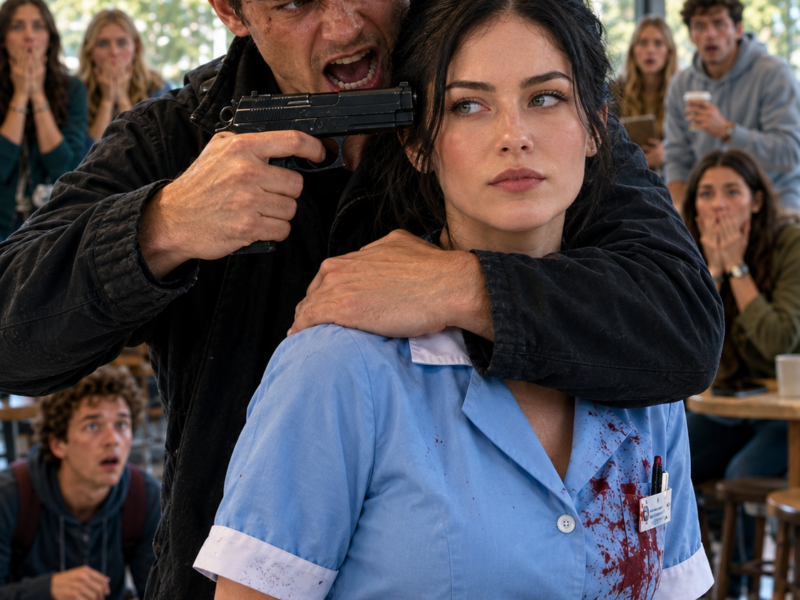
“The armed man shoved a pistol against my ribs in the middle of a crowded Virginia diner and ordered everyone to get on the floor
The name on the back of the photograph was Daniel Cross.
For three years, I’d tried to convince myself that the last time I’d heard that name was also the last time it would ever matter.
I was wrong.
The gunman watched my face as I stared at the writing.
“Do you recognize him?” he asked.
I forced myself to look away from the photograph and toward the pistol in his hand.
“Yes.”
“Then tell me what happened to him.”
Outside the office, someone shouted through a loudspeaker.
“Police! Put the weapon down and step away from the door!”
The man flinched. His injured arm trembled so badly that the muzzle dipped toward the floor.
“My name is Tyler Cross,” he whispered. “Daniel was my older brother. He died six weeks ago.”
I looked at the photograph again.
Daniel had been twenty-six when I treated him in Kandahar. He’d been a Navy corpsman attached to a special operations team, a quiet man with a crooked smile who always asked the names of the wounded before asking about himself.
I remembered his blood soaking through my gloves.
I remembered his voice over the roar of the evacuation helicopter.
And I remembered the promise I’d made him.
“You’re going to get home,” I’d told him.
He’d squeezed my wrist.
“Make sure they know what happened.”
At the time, I thought the medication was making him confused.
Now Tyler was standing in front of me, bleeding through his sweatshirt, with a gun in his hand and a photograph that had no business existing.
“Tyler,” I said carefully, “you need to put the gun down. You’re losing too much blood.”
His eyes narrowed.
“Don’t try to turn this into a medical conversation.”
“It already is one.”
I gestured toward his left arm.
“You’re pale, your breathing is shallow, and your hand is shaking. If you keep standing, you may pass out. If you fall with that weapon in your hand, somebody could get hurt.”
He stared at me for several seconds.
Then his knees buckled.
I caught his shoulder and guided him to the floor, keeping my movements slow enough that he wouldn’t mistake them for an attack.
“Don’t touch the gun,” I said. “Just let me see your arm.”
He gave a weak, bitter laugh.
“You’re really going to help me?”
“I’m going to stop you from bleeding to death. What happens after that depends on what you tell me.”
His gaze flicked toward the door.
“They’ll kill me before I get to tell anybody.”
“Who will?”
He didn’t answer.
I folded a clean dish towel from the office shelf and pressed it firmly against the wound.
He sucked in a breath through his teeth.
“That’s not a bullet graze,” I said. “Something went through the muscle.”
“Broken glass.”
“From what?”
He looked at me.
“The car they tried to run me off the road with.”
Before I could ask more, the loudspeaker sounded again.
“Tyler Cross, we know you’re inside. Release the hostage and put the weapon on the floor.”
Tyler’s face went gray.
“They know my name.”
“They probably ran your license plate.”
“No.” He shook his head. “They knew I’d be here.”
I kept pressure on the wound.
“Why?”
He looked down at the photograph between us.
“Because I was supposed to bring you to them.”
The room seemed to shrink around us.
I stopped pressing for a fraction of a second, then immediately restored the pressure.
“Bring me to whom?”
“The people who signed off on my brother’s death.”
I wanted to believe the pain was making him paranoid. It would have been easier than accepting that the name Daniel Cross had somehow followed me into the quiet life I’d built.
But there was something about Tyler’s expression that reminded me of the men I’d treated overseas after they had seen something they couldn’t fit into the world they thought they understood.
He wasn’t asking me to believe him.
He was trying to decide whether I was part of the thing he feared.
“Tell me exactly what happened to Daniel,” I said.
Tyler swallowed.
“Six weeks ago, a man came to my apartment. He said he’d worked with my brother and had information about his last deployment. He gave me a flash drive and told me Daniel hadn’t died the way the Navy said he did.”
“What did the official report say?”
“That he was killed during an operation overseas. Classified details. No further information.”
I remembered the notice I’d seen in a military newsletter months earlier. Daniel Cross, deceased. A brief tribute. A photograph of a young man in uniform.
I’d read it twice before closing the page.
Tyler continued.
“The drive contained reports, photographs, and recordings. Some were corrupted. Others were marked with codes I didn’t understand. But one recording was clear.”
His voice faltered.
“It was Daniel talking to someone. He said he’d found evidence that a medical evacuation had been deliberately delayed. He said the delay wasn’t an accident.”
My hands went cold.
Kandahar.
The evacuation.
The helicopter that had arrived later than promised.
The names on the casualty list.
I had spent three years telling myself that military operations were complicated, that bad things happened even when everyone did their jobs, and that surviving sometimes meant accepting answers that were incomplete.
“Did he mention me?” I asked.
Tyler nodded.
“He said you were the medic who treated him. He said you had the original casualty notes.”
I stared at him.
“I don’t have those notes.”
“Then why did he say you did?”
“I documented his injuries and treatment, but those records went into the military medical system. I didn’t take anything with me.”
Tyler’s jaw tightened.
“Someone else thinks you have them.”
The loudspeaker sounded again.
This time, a different voice spoke.
“Rachel Bennett, we know who you are. We know about the Kandahar incident. Put the man in custody and come out with your hands visible.”
I felt Tyler go rigid beneath my hand.
“Who is that?” I whispered.
“I don’t know.”
He looked genuinely terrified.
Then I noticed something that had been bothering me since I’d first seen him.
The blood on his sleeve was dark, but the fabric near the wound had been cut cleanly. There were tiny glass fragments embedded along the edge of the tear.
He hadn’t been shot in a struggle with police.
He’d been injured in a vehicle crash, just as he’d said.
That didn’t make him innocent. He had still pointed a gun at a room full of civilians.
But it made his story more plausible than I’d wanted it to be.
“Tyler, listen to me. I’m going to keep pressure on your arm. You are going to put the gun on the floor, away from both of us.”
He hesitated.
“If I do, they take me.”
“If you don’t, you may bleed out before anyone can ask you a question.”
For a moment, I thought he’d refuse.
Then he lowered the pistol onto the tile and pushed it away with his uninjured hand.
I kicked it beneath the desk, out of reach.
“Good,” I said.
His eyes met mine.
“Do you believe me?”
“I believe you’re hurt. I believe you lost your brother. The rest needs evidence.”
He gave a small, exhausted nod.
It was the first reasonable thing he’d done all evening.
I called out toward the door.
“I’m a former Navy SEAL combat medic. The suspect has a significant arm wound and needs medical attention. The weapon is secured away from him. I need paramedics, and I need your team to hold position while I get him stabilized.”
A brief silence followed.
Then the voice answered, “Step away from the suspect, Rachel.”
“I will when medical personnel arrive.”
“That’s not a request.”
I looked at Tyler.
He was watching the door as though he expected it to open without warning.
I had spent years following orders. I’d also spent years learning that an order could be delivered confidently by someone who had no idea what was happening on the ground.
“Then send a medic in,” I called. “He’s losing blood.”
No response.
I pressed the towel more firmly against Tyler’s arm.
“Stay awake.”
He managed a faint smile.
“You always talk like that?”
“Only to people who make my job difficult.”
“Daniel said you were stubborn.”
My throat tightened.
“He said that?”
“He said you once threatened to staple his medical paperwork to his forehead because he kept losing it.”
Despite the circumstances, a short laugh escaped me.
“That sounds like Daniel.”
For a moment, Tyler looked less like a desperate man holding a hostage and more like a younger brother trying to keep a piece of someone he loved alive.
Then he reached slowly toward the inside pocket of his sweatshirt.
I caught his wrist.
“Don’t.”
“Flash drive,” he said. “I need you to see it.”
“Tell me where it is. I’ll get it.”
He nodded toward the pocket.
I retrieved a small black drive wrapped in plastic.
“Is this what you brought here?”
“Yes.”
“Why my diner?”
“Because the man who contacted me said you worked here. He told me you’d recognize the evidence and help me understand it.”
I looked at the plastic wrapping.
“Who was the man?”
“Someone named Mercer. That’s all I know.”
The name meant nothing to me.
Tyler watched my face.
“Does it mean something to you?”
“No.”
He looked away, disappointed.
“I thought maybe you knew who he was.”
A sudden thud sounded against the back door.
Tyler jerked, and his injured arm shifted beneath my hand.
“Easy,” I said.
Another voice came from the other side.
“Rachel, this is Deputy Chief Harris. We’re coming in.”
I looked at the door, then at Tyler.
Something about the announcement bothered me. The officers had been outside for several minutes, yet nobody had mentioned the paramedics I’d requested. They hadn’t asked about the severity of the wound or whether the weapon had been secured.
They wanted the room.
They wanted Tyler.
And they seemed unusually interested in me.
I picked up the photograph and tucked it into my apron pocket.
Then I placed the flash drive inside the small inner pocket of my uniform.
“Tyler, when they enter, you keep your hands visible. Don’t make any sudden movements. Don’t say anything unless they ask you a direct question.”
“Are you going to tell them about the drive?”
“I don’t know yet.”
His eyes widened.
“Rachel—”
“I said I don’t know. I’m not risking innocent people because you want me to believe a recording.”
He fell silent.
The lock rattled.
I moved away from Tyler and raised both hands.
The door swung open.
Two uniformed officers entered with weapons drawn. Behind them stood a tall man in his fifties wearing a dark coat over a suit. His hair was silver at the temples, and his face held the calm, practiced expression of someone accustomed to having rooms fall silent when he walked into them.
He didn’t look at Tyler first.
He looked at me.
“Rachel Bennett,” he said. “I’m Deputy Chief Harris. I’m glad you’re safe.”
“Then send in the paramedics.”
“Of course.”
He nodded to one officer, who immediately stepped into the corridor to call for medical assistance.
Harris glanced at Tyler.
“Mr. Cross, put your hands behind your head.”
Tyler complied slowly.
Two officers moved in to restrain him, and I stepped aside so they could reach his injured arm.
Harris waited until Tyler was being escorted toward the door before speaking to me again.
“You’ve had a difficult evening.”
“I’d say so.”
“We’ll need a statement. But first, I’d like you to come somewhere quiet with me.”
“I can give a statement here.”
His expression didn’t change.
“Your military background makes you a valuable witness in a matter involving classified information.”
“I don’t know anything about classified information.”
“Perhaps not consciously.”
The words were delivered so smoothly that I almost missed the implication.
He knew more about my service than he should have learned from a quick background check.
I glanced toward the hallway.
“Where are you taking Tyler?”
“To the station.”
“He’s injured.”
“Medical personnel are on the way.”
I watched the officers lead him out.
Just before he disappeared through the doorway, Tyler turned his head toward me.
He didn’t plead.
He didn’t shout.
He simply mouthed two words.
Check Daniel.
Harris touched my elbow.
“Let’s go, Ms. Bennett.”
I stepped away from him.
“I’d prefer to stay here until the paramedics have treated the suspect.”
For the first time, his expression hardened.
“You’re not in the military anymore, Rachel. You don’t get to decide how this operation proceeds.”
There it was.
Not concern for the civilians. Not relief that nobody had been killed.
An operation.
I had heard that word used to excuse decisions that ordinary people would have found indefensible.
I looked him in the eye.
“Then I guess you’ll have to explain why a robbery suspect knew my name before he walked through the door.”
Harris studied me for a long moment.
Then he smiled without warmth.
“Be careful what you imagine, Ms. Bennett. Trauma has a way of making unrelated events seem connected.”
He turned and walked out.
I remained in the office until the paramedics arrived. After they took Tyler away, I gave a brief statement to an officer whose questions were ordinary enough to be believable.
I did not mention the flash drive.
I did not mention the photograph.
And I did not tell him that Deputy Chief Harris had referred to the situation as an operation.
By the time I reached my apartment, it was nearly midnight.
I locked the door, checked the windows, and placed the flash drive on my kitchen table.
For several minutes, I simply stared at it.
I had no computer with a secure connection, no clearance to examine classified records, and no idea whether the files contained anything real.
I did know one thing.
Daniel Cross had been a good man.
He’d been young, sometimes reckless, and occasionally too stubborn for his own safety, but he hadn’t been careless with the lives of others.
If he had believed an evacuation was deliberately delayed, he would have documented what he saw.
I opened my old laptop and disconnected it from the internet before inserting the drive.
Several folders appeared.
Most were encrypted. One contained photographs and scanned documents. Another held audio files, some of them damaged.
I opened the first photograph.
It showed a military staging area at night, with a helicopter parked near a row of temporary structures. The timestamp placed it on the night of the evacuation.
I recognized the location immediately.
My stomach tightened.
The second photograph showed Daniel standing beside a man in uniform.
The man’s face was partially obscured by shadow, but I recognized the insignia on his sleeve and the distinctive ring on his right hand.
I had seen that ring in the diner.
Deputy Chief Harris had worn it.
I enlarged the image until the pixels broke apart.
The date was three days before Daniel’s final mission.
Why had a local law enforcement official been photographed with a Navy corpsman in Afghanistan?
I opened the next file.
It was a scanned copy of a casualty report. Several sections were blacked out, but the time of the initial request for evacuation was visible.
The request had been made at 21:14.
The helicopter’s arrival was recorded at 22:03.
Forty-nine minutes.
I remembered those minutes with a clarity that made my hands ache.
I remembered asking for an updated arrival time.
I remembered being told the aircraft had been diverted.
I remembered Daniel’s blood on my gloves and his voice telling me to make sure someone knew what happened.
I’d assumed the delay was a terrible consequence of circumstances beyond anyone’s control.
But the next page contained a handwritten notation.
Hold evacuation until secondary objective is secured.
Beneath it were two initials.
D.H.
I sat back from the screen.
It could have been a coincidence. Initials weren’t proof of anything.
But the photograph, the casualty report, and Harris’s presence at the diner had begun to form a pattern I couldn’t dismiss.
I opened the audio file.
Static filled the speakers.
Then a voice emerged, thin and distorted.
“…confirming the evacuation delay. The medical team is requesting immediate clearance.”
A second voice answered.
“Negative. Hold position.”
I leaned closer.
The first voice was Daniel’s.
“Sir, we have casualties. We cannot hold them here.”
The second voice was lower, calm, and unmistakably familiar.
“Corpsman Cross, you will follow the order.”
The recording crackled.
Then Daniel said something that made me grip the edge of the table.
“If they die here, sir, their blood is on your hands.”
The file ended.
I sat motionless, listening to the silence that followed.
For three years, I’d wondered whether I had missed something that could have saved the men in my care.
Now I was staring at evidence suggesting someone had deliberately delayed their evacuation.
I didn’t know whether Harris had ordered it, whether the initials belonged to him, or whether the recording had been edited.
I knew only that I couldn’t investigate this alone.
At 1:17 a.m., I called the one person I still trusted from my old unit.
His name was Marcus Hill. He’d served beside me during the evacuation and had left active duty two years later. We hadn’t spoken often since then, but when I told him Daniel’s name, his voice changed immediately.
“Rachel, where did you get that recording?”
“From Daniel’s brother.”
“Tyler Cross?”
“You know him?”
“No. But I know the name of the man who signed the after-action review.”
I looked at the casualty report.
“Who?”
Marcus was quiet for several seconds.
“Daniel filed a complaint before the mission. He said someone was changing the medical logs. After the evacuation, we were told the discrepancies were clerical errors.”
“Who told you that?”
“Our commanding officer. He said the review had been completed and there was no evidence of misconduct.”
“Did you believe him?”
“I wanted to.”
His honesty hurt more than a denial would have.
“Marcus, I need you to look at something. But I need to know whether I can trust you.”
“You can trust me to tell you what I find. I won’t promise the evidence says what you think it says.”
It was the right answer.
I sent him copies of the documents through a secure channel he’d arranged.
Before we ended the call, he said, “Rachel, if these files are authentic, don’t contact Harris again. And don’t go anywhere alone.”
“I already met him.”
“Then assume he knows you have something.”
I glanced toward the window.
A dark sedan sat at the curb beneath the streetlight.
Its engine was running.
I moved away from the glass.
“Marcus?”
“I’m here.”
“There’s a car outside my apartment.”
“Do not approach it. Lock your door and call local police. I’m contacting a lawyer I know who handles military whistleblower cases.”
I did as he said.
By the time the first patrol car arrived, the sedan had disappeared.
The officers searched the block and took my statement, but they found no reason to detain anyone.
I spent the rest of the night sitting at my kitchen table with the lights on.
At dawn, Marcus called.
“I checked the dates against the records I still have access to,” he said. “The evacuation request was entered at 21:14. The dispatch log was altered afterward.”
My fingers tightened around the phone.
“Can you prove who changed it?”
“Not yet. But there’s a second discrepancy. Daniel’s original report mentions a civilian witness at the staging area. That witness isn’t in the final review.”
“Who was it?”
“A contractor. Name’s Ethan Vale. He worked communications support for the operation.”
“Where is he now?”
“That’s the problem. He left the company shortly after the investigation closed. No forwarding address, no public employment record.”
I looked at the photograph of Harris and Daniel.
“Can you find him?”
“I’m trying.”
Before he hung up, Marcus added, “There’s one more thing. The order to delay the evacuation came from outside the unit’s normal chain of command.”
“How is that possible?”
“That’s what Daniel was trying to find out.”
For the first time, I understood why Tyler had risked everything to reach me.
He hadn’t simply wanted revenge for his brother.
He wanted someone who had been there to confirm that Daniel hadn’t imagined what he saw.
And now the same people who had buried his report might be trying to bury the evidence.
Over the next four days, I barely slept.
I kept working at the diner because quitting would have made it harder to explain why I was suddenly available to disappear. I smiled at customers, poured coffee, and pretended not to notice the same gray sedan passing the front windows twice.
Marcus worked through former contacts. A lawyer named Rebecca Shaw agreed to help us preserve the evidence and determine how to submit it without compromising any legitimate classified information.
She was blunt about our chances.
“An audio file and a partial report aren’t enough to establish criminal misconduct,” she told me. “We need provenance, corroboration, and a witness who can explain the chain of custody.”
“Tyler has the original drive.”
“Then we need to know where he is and whether he can speak with counsel.”
I called the detention facility where the officers had taken him.
They confirmed he was being held on robbery and hostage-taking charges, but the clerk couldn’t tell me anything about his medical status.
When I asked to leave a message for his attorney, I was told he hadn’t been assigned one yet.
That didn’t prove Harris was interfering with the case.
But it meant Tyler was alone, and the one person who might know what had happened to Daniel was locked behind a door I couldn’t open.
On the fifth morning, Marcus called with a lead.
“Ethan Vale has a sister in Richmond. He sent her a letter two weeks ago.”
“What’s in it?”
“I don’t know. But she agreed to meet us.”
Rebecca insisted on coming with us, and we arranged to meet Ethan’s sister, Claire, in a public library near downtown Richmond.
She was in her early forties, with tired eyes and a canvas bag clutched against her chest.
“I don’t know anything about your military operation,” she said as soon as we sat down. “My brother never talked about the details.”
“We’re not asking you to reveal classified information,” Rebecca replied. “We need to know whether Ethan kept records related to a medical evacuation in 2021.”
Claire stared at the table.
“He said he saw something that frightened him. He thought someone had altered the communications log.”
My pulse quickened.
“Did he say who?”
She shook her head.
“He didn’t want to put names in writing. He said the people involved had friends in places ordinary people couldn’t reach.”
“Is he alive?” Marcus asked.
Claire looked up sharply.
“Yes. At least, I believe so. He contacted me two weeks ago and asked me to keep a package safe.”
She opened her bag and took out a plain envelope.
“I haven’t opened it.”
Rebecca examined the envelope without removing its contents.
“Did your brother tell you what to do with this?”
“He said if anyone came asking about the evacuation, I should give it to a lawyer. Not the police. Not his former employer.”
She passed the envelope to Rebecca.
Inside was a small memory card and a handwritten note.
The note contained a phone number and a single sentence.
If Daniel Cross’s medic is still alive, she deserves to hear the unedited recording.
I stared at the words.
For three years, I’d lived with the sound of Daniel’s final plea.
Now someone was telling me that I’d never heard the whole story.
Rebecca took the memory card to a digital forensics specialist she trusted. We waited two days for the results.
When she finally called, she asked us to come to her office immediately.
The original audio was longer than the file Tyler had given me. It contained several minutes of conversation before the evacuation order and nearly a minute afterward.
The voices were clearer.
One belonged to Daniel.
Another belonged to the officer issuing the order.
And a third voice appeared at the end, speaking so quietly that the forensic specialist had to enhance the recording.
I recognized it before the sentence was finished.
Deputy Chief Harris.
He had not been a random man who happened to appear in the photograph.
He had been involved in the operation.
The enhanced recording revealed that he was working as a liaison for a defense contractor at the time, coordinating a secondary objective that had been given priority over the evacuation.
The recording did not establish that he intended anyone to die. It did establish that he knew medical personnel were requesting immediate evacuation and had supported the decision to delay it.
Then came the final exchange.
Daniel’s voice sounded exhausted.
“Sir, the casualty count is increasing. We need clearance now.”
Harris answered, “The objective takes priority. Keep your team in position.”
Daniel said, “I’m documenting this order.”
There was a pause.
Then Harris replied, “You do that, Corpsman. Just understand that records can be corrected.”
The recording ended.
Nobody in Rebecca’s office spoke for a long time.
I thought about the men I’d treated that night. I thought about the hours I’d spent wondering whether a faster evacuation would have saved them.
The evidence couldn’t tell us how many lives might have been saved.
But it could prove that someone had chosen to delay help despite knowing the consequences.
“Can this be authenticated?” I asked.
“The recording can be examined by independent experts,” Rebecca said. “The logs can be compared against archived copies. We still need testimony from people who were present.”
“Marcus and I were there.”
“Then we’ll prepare sworn statements. But once this goes forward, you should expect resistance.”
I looked at the photograph of Daniel.
“I’ve spent three years thinking I failed him.”
Rebecca’s expression softened.
“This evidence doesn’t erase what happened. But it may finally answer the question you’ve been carrying.”
That afternoon, we submitted the evidence to an independent military inspector general’s office through Rebecca’s legal team.
We also provided copies to the appropriate civilian oversight authorities, who could determine whether any laws had been broken.
We did not post the files online.
We did not send them to reporters.
We let the evidence enter a process designed to verify it.
For the first time since Tyler had walked into Miller’s Diner, I felt that we were doing something more useful than running from the people who might want us silent.
But the consequences came quickly.
Harris was placed on administrative leave pending an investigation into his role as a contractor liaison and his later conduct during Tyler’s detention.
The police department opened an internal review of the diner incident, including why Harris had personally intervened and why Tyler’s request for medical attention had not been handled promptly.
Tyler was transferred to a medical facility and then granted access to counsel.
His robbery and hostage-taking charges did not disappear.
He had frightened innocent people and endangered their lives. Whatever had happened to Daniel, Tyler would still have to answer for what he’d done.
When Rebecca arranged a meeting, I visited him in a secure interview room.
His injured arm was wrapped in a clean bandage. Without the gun and the blood-soaked sweatshirt, he looked younger than I’d expected.
“I owe you an apology,” he said before I sat down.
“Yes, you do.”
He nodded.
“I thought if I made you listen, you’d help me expose them. I didn’t think about what I was doing to the people in that diner.”
“The little boy was terrified.”
Tyler lowered his eyes.
“I know. I’ve thought about him every night.”
We sat quietly for a moment.
Then I placed a copy of Daniel’s photograph on the table.
“We found the original recording.”
Tyler stared at it.
“And?”
“Daniel was telling the truth about the delay. The evidence is under independent review.”
He pressed his lips together, and tears gathered in his eyes.
“I knew he wasn’t lying.”
“I know.”
“I should have done this differently.”
“Yes.”
He looked up, waiting for me to soften the answer.
I didn’t.
Finally, he nodded.
“I’m sorry, Rachel.”
I believed he meant it.
That didn’t make what he’d done acceptable, but it gave us somewhere honest to begin.
He told me about Daniel as a brother rather than a name in a report. He described their childhood, the arguments they never resolved, and the way Daniel used to call him every Sunday even when he was deployed.
“I missed his last call,” Tyler said. “I was working late. I saw it the next morning and figured I’d call him back.”
He stared at his hands.
“Then the notification came.”
I let him sit with that for a while.
“I can’t change what happened to him,” I said. “But you can still decide what you do with what he left behind.”
Tyler nodded.
For the first time, he seemed to understand that accountability and grief could exist in the same room.
The investigation lasted months.
Experts authenticated the recording and compared it with archived communications logs. Former personnel provided statements, and the review confirmed that the evacuation had been delayed while a secondary objective was completed.
The final findings did not claim that every death could have been prevented. They did establish that the decision had violated medical evacuation procedures and that the subsequent report had omitted information material to the review.
Harris denied intentionally endangering anyone, but investigators found that he had participated in the delay and later made misleading statements about his role.
He was removed from his contractor position and referred for further legal review. The evidence did not instantly settle every question, and the case moved slowly through the appropriate channels.
But Daniel’s name was no longer attached to a report that implied the delay had been unavoidable.
The official record was corrected.
His family received a formal acknowledgment that his concerns had been legitimate and that the original review had failed to capture the full circumstances.
Marcus and I attended the small memorial held in Daniel’s honor.
Tyler stood near the front, holding the photograph of his brother in both hands.
When it was my turn to speak, I didn’t describe the blood or the helicopter or the minutes that had stretched into an eternity.
I told them about the young corpsman who had asked for the names of the wounded before asking about himself.
I told them that Daniel had insisted his medical notes be accurate, even when it would have been easier to let an error pass.
And I told them that in the worst moments of that night, he had still been thinking about the people he might be able to save.
Afterward, Tyler approached me.
“I used to think getting the truth would make me feel better,” he said.
“Does it?”
“Sometimes. Other times, it just makes me angry all over again.”
I nodded.
“That sounds about right.”
He looked at the photograph.
“I don’t know what to do with all this anger.”
“You don’t have to turn it into something today.”
For a long time, he said nothing.
Then he asked whether I would have coffee with him sometime, somewhere that didn’t involve guns, police, or a hospital.
I agreed.
We met at Miller’s Diner three weeks later.
Frank had repaired the broken glass and replaced the chair that had been knocked over during the hostage situation. The little boy who’d been there that night returned with his mother, and Frank gave him a slice of pie on the house.
When Tyler walked through the door, every conversation near the counter seemed to falter.
He noticed.
He didn’t ask anyone to understand him.
He simply approached Frank, placed a folded apology letter on the counter, and said, “I know this doesn’t make up for what I did. But I wanted you to know I’m sorry.”
Frank studied him for a moment.
“You scared the hell out of my customers.”
“I know.”
“You scared my waitress.”
Tyler glanced at me.
“I know that, too.”
Frank sighed and tucked the letter into his apron.
“Sit down. Coffee’s not free.”
It wasn’t forgiveness, exactly.
But it was a beginning.
Tyler and I spoke for nearly two hours. We talked about Daniel, the investigation, and the strange emptiness that remained after a long search finally ended.
I told him why I’d left the Navy.
It wasn’t because I’d been unable to save everyone. No medic could do that.
I’d left because after the evacuation, I had been asked to sign a report that didn’t match my own notes. I refused to certify a version of events I couldn’t support, and the dispute followed me through months of reviews and reassignment.
Eventually, I was exhausted. I wanted a life where the most urgent thing I had to do was refill a coffee cup.
Tyler listened without interrupting.
“I thought you left because you couldn’t live with what happened,” he said.
“Some days, I couldn’t. But that wasn’t the whole story.”
He nodded slowly.
“I guess I made the same mistake with you that I made with everyone else. I saw one part of your life and decided I knew the rest.”
I looked toward the window.
“Grief makes people do that.”
“Doesn’t excuse it.”
“No,” I said. “It doesn’t.”
When we left the diner, the rain had stopped.
The streetlights reflected in the wet pavement, and for the first time in years, I didn’t hear the helicopter in my memory.
I still thought about Daniel.
I still wondered how many people might have survived if the evacuation had happened sooner. No report could give me that answer.
But I no longer had to wonder whether I’d imagined the delay or failed to notice something everyone else understood.
The truth was documented. His name had been cleared of the doubts that had followed his final mission, and the people responsible for the review had been forced to answer for their decisions.
Tyler faced the consequences of his own actions, too. His case proceeded through the courts, and he accepted responsibility for the hostage situation rather than pretending his brother’s death excused it.
We stayed in touch, sometimes speaking for an hour and sometimes exchanging nothing more than a short message on a difficult anniversary.
Neither of us became the other person’s cure.
We simply learned how to remember Daniel without letting the worst night of his life become the only thing that mattered about him.
I still work at Miller’s Diner.
I still pour coffee, wipe tables, and listen when strangers talk about their families.
Sometimes a customer asks about the small photograph I keep tucked behind the counter. It’s a copy of Daniel in uniform, smiling at something outside the frame.
I tell them he was a corpsman who believed the truth mattered, even when telling it was dangerous.
Then I go back to work.
I used to think courage meant keeping my hands steady while someone else’s life slipped away.
Now I understand that courage can also mean looking at an old wound without letting it dictate what happens next.
The night Tyler Cross took me hostage, he thought he needed a medic who could explain how his brother died.
What he found was someone who needed the truth just as badly.
And what we finally gave Daniel was not a miraculous rescue or a chance to return home.
It was something we should have given him from the beginning: a record that told the truth about the man he had been and the lives he had tried to save.
The end.









