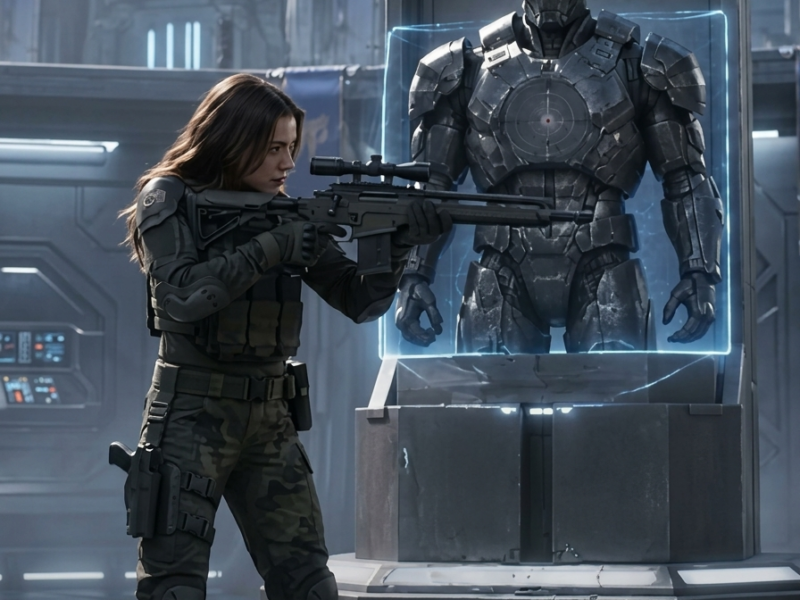
The alien weapons instructor laughed in front of 300 recruits when I raised my battered rifle
The alien weapons instructor laughed in front of 300 recruits when I raised my battered rifle and asked whether his supposedly impenetrable armor had ever been tested against human ammunition, but his smile vanished when I chambered a single round, pointed at the steel plate on his chest, and said, “You keep using the word impossible like humans have ever cared what it means.”
The training hall on Titan Station went silent.
I was Sergeant Evelyn Hayes, the only human assigned to the Galactic Defense Academy, and I had spent three weeks listening to alien officers explain why my species was too primitive to serve on the front lines. They treated Earth like a biological preserve—a quiet, heavy-gravity rock filled with stubborn bipeds who belonged in agrarian work camps or lower-tier maintenance logistics, not in combat uniforms.
Their favorite word was fragile. Their second favorite was obsolete.
Instructor Varek embodied both opinions. Standing seven feet tall inside polished combat armor made of reinforced synth-titanium and hard-light kinetic dampeners, the Vethari warrior looked like a walking fortress. His four golden eyes blinked in slow amusement as he tapped his broad chest plate with one razor-sharp claw.
“This armor survived a plasma bombardment during the Siege of Sol-3’s outer moon,” Varek announced, his booming voice amplified by the acoustic arches of the vaulted hall. “A primitive kinetic weapon firing lead and brass will barely scratch the paint.”
Several recruits—mostly scale-draped Vethari and heavy-set Korrathian shock troopers—chuckled under their breath.
I checked the ammunition in my rifle, my fingers working the cold steel by memory. “Good to know.”
Varek’s mandibles curled into a smug grin. “Surely you aren’t suggesting that little archaic tube could penetrate imperial-grade plating, Sergeant?”
I raised the rifle, bringing the stock flush against my shoulder seam. “I’m suggesting we test it.”
He laughed harder, a deep, rattling sound that echoed off the high plas-steel walls. “Standard kinetic rifles can’t pierce composite kinetic dion-plating. It is a matter of physics, human.”
I pulled the charging handle back and let it snap forward with a sharp, mechanical metallic clack. “Define can’t.”
His grin faltered.
Not because of my tone, but because the sharp, unyielding sound of that steel mechanism locking into place had triggered something buried deep within his racial memory. The slit pupils of his golden eyes contracted violently. He stepped closer, the hydraulic joints of his suit groaning under the sudden shift in posture.
“What ammunition are you using?” he asked, his voice losing its mocking edge.
“Standard issue.”
“Show me.”
I reached into my utility pouch, thumbed a round out of the spare magazine, and held up the heavy cartridge between two fingers. To him, it looked like an ordinary piece of brass, steel, and dense metal composition.
To me, it was a lesson my grandfather had taught me on our farm in Montana before I was old enough to understand why he kept a locked olive-drab ammunition box beneath his bed.
“Never trust a machine that promises you can’t be hurt, Evie,” he had told me while brushing cosmoline off an old bolt-action receiver. “Everything breaks. The only question is what it takes to break it.”
I loaded the round straight into the open breach and slapped the bolt forward.
Varek turned toward the 300 recruits sitting in the tiered amphitheater, spreading his heavy armored arms wide. “Observe carefully, cadets. This will demonstrate the clear, unyielding limits of primitive human engineering.”
I took a slow breath, let out half, and squeezed the trigger.
BOOM.
The chemical explosion thundered through the sealed training hall like a thunderclap inside a cavern. The sheer acoustic shockwave blew three rows of holoscreens off their mounts.
The heavy target plate mounted fifty yards behind Varek shattered into a thousand jagged pieces. A clean, smoking, palm-sized hole appeared directly in the center of the supposedly impenetrable armor covering his chest.
For three agonizing seconds, nobody moved. Nobody breathed.
Then alarms screamed. High-pitched emergency klaxons began pulsing overhead in a violent violet hue. Medical drones detached from the ceiling tracks, buzzing frantically down toward the instructor.
Varek stood frozen, staring down at the glowing, slagged edges of the hole in his chest plate as though the physical laws of the universe had personally insulted his ancestry. He reached down with trembling claws, touching the raw, melted metal where a bullet had just sheared through six inches of military dion-plating without even slowing down.
I lowered my rifle, letting the heat vent from the barrel. “Looks like it can.”
Before I could step back toward the armory rack, Varek lunged forward, grabbing my forearm in a tight, crushing grip. “That ammunition… that casing signature… it is restricted technology! Where did you requisition a hyper-dense kinetic core?”
I frowned, jerking my arm against his hold. “Requisition? It’s been manufactured in the scrap foundries on Earth for generations. My grandfather poured the mold for this batch thirty years ago.”
“Impossible,” Varek whispered, his voice cracking with an emotion I had never seen in a Vethari officer: terror. “The last weapon capable of penetrating this exact alloy layout destroyed an entire imperial vanguard battalion during the First Cleansing.”
The recruits in the stands were no longer laughing. Some looked terrified, backing away from the shooting lane. Others stared at my scuffed, scratched rifle with sudden, desperate interest.
I pulled myself free from his grip. “Then maybe your vanguard should have worn better armor.”
Varek ignored the insult completely. He dropped to one knee, ignoring the blue fluid leaking from his suit’s cooling lines, and picked up the spent brass cartridge casing resting on the scuffed floorboards. He held it up to his optical visor.
“Where did humanity obtain this rifling design?” he demanded, his voice shaking.
“Nobody obtained it. We developed it ourselves. It’s an old spiral-grain cut.”
His face changed. For the first time since I had transferred to Titan Station, I realized he wasn’t afraid of the rifle in my hands.
He was afraid of what the rifle meant.
Ignoring the medical drapes hovering around him, Varek hurried to the main wall console, punching his officer key into the imperial terminal and bypassing three high-level security clearance warnings.
“Classified sector archive, query code: S-99-Vanguard,” he muttered frantically into the audio pick-up.
A grainy, ancient video recording materialized in the air above the terminal. The footage was distorted by age and static, but the scene was unmistakable. It showed a desolate battlefield beneath a burning orange sky. Alien soldiers clad in armor identical to Varek’s were in full, panicked retreat, fleeing from a tight, disciplined line of human infantry.
The human soldiers were carrying rifles that possessed the exact receiver layout as the one hanging over my shoulder.
And standing at the absolute front of the human formation was a woman wearing a dark combat suit stamped with a familiar emblem—the jagged three-pointed star of my family’s old military insignia.
I stopped breathing. My stomach dropped into a cold, endless pit.
The recording zoomed in on her face as she lowered her helmet visor.
It was my face.
Older, bearing a deep, jagged scar across her left cheekbone, but possessing my eyes, my jawline, and carrying a rifle that was the direct, pristine precursor to the scuffed weapon in my hands.
Varek whispered, “This footage was recovered from the deep vaults of Veyra. It is eleven thousand years old.”
The woman in the ancient recording turned directly toward the optical sensor recording her movements. Then, her lips moved, and her voice—clear, crisp, and accented with the sharp vowels of northern Earth—cut through the crackle of static.
“If you’re watching this archive,” she said in flawless English, “it means the Empire survived long enough to start teaching our enemies how to survive us.”
The holographic screen flickered violently, her dark eyes locking directly onto mine across a gap of eleven millennia.
“Sergeant Hayes,” the voice continued, recording a targeted bio-metric response that triggered only when my DNA was scanned in the room, “if your bloodline has finally returned to this sector… do not let them activate the weapons buried beneath Earth.”
A new, deafening alarm began screaming across the entirety of Titan Station. The imperial archive screen vanished, replaced by a flashing red alert symbol that spanned five feet in the air:
ALERT: EARTH DEFENSE NETWORK – AUTOMATED ACTIVATION DETECTED
ORIGIN: SECTOR 0-EARTH SUB-BEDROCK VAULTS
STATUS: OVERRIDE INITIATED BY ANCIENT PROTOCOL
Varek slowly backed away from me, his claws raised in reflex, his golden eyes wide with horror.
Outside the massive observation windows of the training hall, the serene backdrop of distant stars began disappearing one by one as enormous, dark, angular shapes—vessels six miles long, hidden for thousands of years in the void—began emerging from hyperspace directly above Titan.
I tightened my grip on my rifle, the cold steel biting into my gloves.
Because whatever my ancestors had fought eleven thousand years ago had just discovered where we lived.
And this time, humanity had no idea it was coming.
The alarms on Titan Station didn’t just ring; they vibrated through the structural iron supports of the entire facility, shaking loose dust and condensation from the high ceilings.
The 300 recruits dissolved into pure, chaotic panic. Alien cadets trampled over one another trying to reach the emergency blast doors, while the station’s automated defense turrets deployed from their ceiling housings, tracking aimlessly as the local sensor grids crashed under an overwhelming wave of data corruption.
“All personnel to secondary lockdown!” the station speaker system blared through thick static. “Unidentified armada detected in Sector Zero! Energy signatures exceed imperial classification scales!”
I didn’t run for the exit. I stood in the center of the shooting range, staring out the reinforced observation window at the fleet materializing in the black void of space.
They weren’t alien ships.
Their hulls were built of dark, slate-gray composite metal, unadorned by gold filigree, light-ribbons, or imperial crests. They were jagged, functional, and massive—flying fortresses designed for one purpose: orbital denial. And stamped along the ventral armor of the lead six-mile dreadnought was the exact same three-pointed star emblem cut into the receiver of my rifle.
“Your bloodline…” Varek gasped, his voice trembling as he backed against the control console, holding his damaged chest plate with both hands. “You… you are not a primitive species. You are the remnant of the First Vanguard.”
I turned my head slowly to look at him. “What is the First Vanguard?”
“The nightmare our ancestors tried to bury!” Varek yelled, his composure breaking completely. “Eleven thousand years ago, the Dominion attempted to catalog Earth for assimilation. We thought your world was underdeveloped! We sent three full strike fleets to secure the planet’s resource nodes! None of them returned!”
He pulled up a shaking hand, pointing at the dark ships gathering outside the station.
“Your ancestors didn’t just defeat our fleets, Sergeant,” he continued, his mandibles quivering. “They built a containment grid around their own solar system! They erased their own historical archives, stripped their planetary infrastructure back to primitive states, and buried their war fleet beneath the Earth’s crust to trap us in a false sense of security!”
“They buried a war fleet beneath Earth?” I asked, my mind racing as I remembered the old urban legends about massive, uncharted caverns beneath the Pacific Ocean and the Siberian tundra.
“They didn’t hide from us,” Varek whispered, his eyes wide with realization. “They laid a trap. And your presence on this station… firing that weapon… was the key that unlocked the vault.”
Before I could answer, the heavy steel doors at the rear of the training hall were blown inward with a deafening concussive blast.
Smoke and blue plasma fire filled the doorway as a squad of elite Vethari Imperial Justiciars—soldiers clad in white power armor armed with heavy particle lances—surged into the room.
“Secure the human!” the lead Justiciar roared, his lance raising toward my chest. “By order of the High Council, Sergeant Hayes is classified as a Class-Zero Existential Threat! Take her alive or bring her corpse!”
“Move!” I barked at Varek.
I didn’t wait to see if he obeyed. I dove to the left just as a bolt of blue particle fire scorched the floorboards where I had been standing, melting the metal into glowing slag.
I rolled behind a heavy concrete shooting barrier, bringing my rifle up in a single fluid motion. I didn’t aim for their body armor. I aimed for the exposed hydraulic conduits behind their knee joints—the exact weak point my grandfather had drawn in his old leather-bound journals.
BOOM. BOOM.
Two shots echoed through the smoke. Two white-armored Justiciars collapsed instantly as their leg supports buckled, their heavy particle lances clattering uselessly against the floor.
“Varek!” I yelled, racking the bolt to clear a smoking casing. “Where is the station’s primary communications terminal?”
The instructor was cowering behind the main console, his proud warrior persona entirely shattered. “Sub-Level Three! But you cannot reach it! The station command has already sealed the lifts!”
“They sealed the lifts for them,” I grunted, reaching into my belt and pulling out an industrial breaching charge I had stolen from the armory two days prior during a maintenance shift. “They didn’t seal them for me.”
I slapped the charge onto the floor plating directly beneath the shooting bench, pulled the arming pin, and kicked Varek hard in the shoulder. “Get down!”
The charge detonated with a sharp, localized shockwave, blowing a six-foot hole straight down into the air ventilation and utility shaft of Sub-Level Three.
Without hesitating, I slid down the smoking hole, dropping twelve feet into the darkness of the lower maintenance corridors. I landed in a cat-like crouch, my boots absorbing the impact, my rifle leveled ahead into the dark, steam-filled hallway.
A faint, rhythmic thudding vibrated through the floorboards—a deep, mechanical pulse that wasn’t coming from Titan Station’s reactors.
It was coming from the lead dreadnought hanging in the void outside.
A soft, synthesized chime sounded directly inside my helmet receiver, bypassing the station’s jammed frequencies entirely.
“Sergeant Evelyn Hayes,” a calm, artificial voice spoke in clean, accentless English. “This is Automated Command AI ‘Vanguard-Actual’. Biometric verification confirmed. Direct bloodline lineage of Fleet Commander Sarah Hayes confirmed.”
I froze in the damp maintenance corridor, pressing my back against a rusted pipe. “Vanguard-Actual? Who authorized your activation?”
“You did, Sergeant,” the AI replied smoothly. “When you discharged a Class-5 Kinetic Core inside an Imperial Facility, your weapon’s internal resonator transmitted the activation key to the subterranean vaults beneath North America.”
A holographic tactical map projected directly onto the inside of my visor.
It showed thirty massive dreadnoughts and over a thousand automated frigates surrounding Titan Station. But it also showed something far worse: an Imperial fleet of over two hundred warships rising from the dark side of Saturn, preparing to obliterate both Titan Station and the ancient human armada before it could fully initialize its systems.
“Primary objective,” the AI continued calmly. “The Imperial fleet intends to launch a dark-matter warhead to destroy Titan Station and sever our command link. You have four minutes to reach the central spire and broadcast the Fleet Control Matrix.”
I looked down at my rifle, then up at the dark hallway ahead.
“And if I fail?” I asked.
“If you fail, Sergeant,” Vanguard-Actual answered, “the Automated Defense Network will assume humanity has been wiped out, and it will execute the ‘Clean Slate’ directive.”
My blood ran cold. “Define ‘Clean Slate’.”
“Total glassing of all worlds within twenty light-years to prevent human technology from falling into enemy hands. Starting with this station.”
I moved through the maintenance tunnels of Sub-Level Three like a ghost in a steel labyrinth.
The station was falling apart around me. The sirens were no longer rhythmic; they were stuttering, broken by the immense gravitational shear generated by the thirty ancient dreadnoughts holding Titan Station in a localized tractor lock. Pipes burst overhead, raining scalding synthetic coolant into the corridors, while distant explosions signaled that the Imperial fleet had begun firing on the outer hull.
“Vanguard-Actual,” I whispered, stepping over a severed power cable that was spitting blue arcs of electricity across the damp floor. “If my ancestors built a fleet this size eleven thousand years ago, why did they go into hiding? Why leave Earth in the dark?”
“The answer is biological preservation, Sergeant,” the AI responded instantly inside my helmet. “The First Vanguard discovered that prolonged exposure to deep-space dark matter corrupted human cellular structures. To preserve the baseline human species, the command hierarchy instituted the ‘Great Sleep’ protocol.”
“They regressed our civilization on purpose,” I said, my teeth clenching as I reached the junction leading to the central spire elevator.
“They protected your genetic purity,” the AI corrected gently. “They buried the technology, wiped the digital archives, and allowed humanity to evolve naturally under Earth’s heavy gravity and protective magnetosphere until your biology adapted to withstand deep-space radiation.”
“And my family?”
“The Hayes lineage was designated as the ‘Keyholders’. Generations of your family were engineered to retain subtle tactical instincts and sub-conscious mechanical knowledge. Your grandfather did not keep that rifle by accident, Sergeant. He kept it because his cellular memory demanded it.”
I stopped at the edge of the central lift shaft.
The primary elevator car had been destroyed, plunging down into the station’s core in a mess of twisted cables. Looking up through the three-hundred-foot vertical shaft, I could see the heavy blast doors of the Central Command Spire at the very top.
Standing on the service catwalk directly beneath those doors were six Imperial Justiciars, their heavy particle lances leveled down into the shaft.
“I have no angle,” I grunted, crouching behind a iron support pillar. “If I climb that ladder, they’ll turn me to ash before I make twenty feet.”
“Correction, Sergeant,” Vanguard-Actual chimed. “You do not need to climb.”
Suddenly, the floor beneath my feet shuddered.
A sleek, razor-thin metallic drone—no larger than a tactical shield, shaped like an inverted Delta wing—cut through the maintenance wall behind me. It hovered six inches off the floor, its dark composite surface pulsing with the same blue energy signatures as the ancient dreadnoughts outside.
“Board the Insertion Unit,” the AI instructed.
I didn’t argue. I stepped onto the flat metal surface of the drone, locking the magnetic soles of my combat boots onto its deck plating. “Take us up.”
The drone didn’t gradually accelerate. It launched straight up the vertical shaft like a bullet fired from a cannon.
G-force slammed into my chest, forcing the air out of my lungs as the dark walls of the elevator shaft blurred into a solid gray streak. The six Justiciars on the catwalk above didn’t even have time to raise their weapons.
I cleared the three-hundred-foot shaft in less than two seconds.
As the drone crested the top of the shaft, I detached my magnetic boots, flipped forward through the air, and landed hard on the catwalk, driving the butt of my rifle directly into the visor of the lead Justiciar.
The faceplate shattered with a spray of blue synthetic glass. Before the second guard could swing his particle lance, I swept my leg beneath his ankles, bringing him down onto the grating, and fired a heavy kinetic round straight through his chest-plate seal.
BOOM.
The remaining four guards backed away, their weapons trembling as they looked at the smoking holes in their comrades’ armor. They weren’t just fighting a human sergeant anymore; they were fighting a ghost from their empire’s dark past.
“Clear the door!” I barked, raising my rifle directly at the lock mechanism of the Command Spire blast doors.
“Sergeant, wait!” a voice shouted from inside the spire.
The heavy doors slid open manually, revealing not an Imperial strike team, but Instructor Varek. His damaged armor had been stripped off, leaving him in his dark undersuit, his hands covered in purple grease as he held an overridden interface pad.
“I opened the door for you,” Varek panted, his four golden eyes wide with frantic desperation. “The High Council has ordered the Imperial fleet to launch their dark-matter warhead! They are going to destroy Titan Station to prevent that fleet from taking command!”
I stepped past him into the central command deck.
The room was empty. The station’s senior officers had abandoned their posts, fleeing to the deep escape pods, leaving the vast holographic arrays floating in the center of the chamber.
On the main holoscreen, a massive, teardrop-shaped Imperial warship was descending from Saturn’s rings, its forward bay opening to reveal a pulsing, pitch-black sphere of condensed dark matter.
“They’re firing in thirty seconds!” Varek screamed, running to the side console. “We have to launch the escape pods!”
“No,” I said, stepping up to the central platform and pulling the golden control cartridge from my tactical belt. “We stop the missile.”
I jammed the cartridge straight into the main interface hub of Titan Station.
The moment the golden cartridge locked into the central console, the entire station’s lighting grid shifted from warning-red to a cold, brilliant, blinding white.
The station’s computer screens flickered violently, their alien code dissolving into clean, crisp English text. High-frequency audio feedback hummed through every speaker, followed by the deep, rhythmic hum of a thirty-ship power grid synchronizing its targeting vectors across five hundred thousand miles of empty space.
COMMAND INTERFACE: ACCEPTED
USER: HAYES, EVELYN – SERGEANT (VANGUARD FIRST CLASS)
PRIMARY FLEET STATUS: FULL CONTROL RESTORED
TARGET LOCK: IMPERIAL DREADNOUGHT ‘DION-SUPREME’
“Vanguard-Actual,” I commanded, staring at the holographic map of the space around Saturn. “Interception course on that dark-matter warhead. Do not let it detonate near Titan.”
“Acknowledged, Sergeant,” the AI responded. “Executing ‘Aegis Wall’ tactical maneuver.”
Outside the command spire’s massive panoramic windows, six of the six-mile-long ancient dreadnoughts moved simultaneously.
They didn’t use conventional impulse engines. They bent space around their hulls, vanishing from their positions around Titan in a flash of blue distortion and reappearing instantly in a tight, overlapping ring directly between Titan Station and the incoming Imperial warhead.
The Imperial warship fired.
A thick, terrifying beam of pitch-black dark matter shot through the void, aimed straight at the heart of Titan. It was a weapon designed to collapse molecular bonds—a weapon that had wiped out entire rebel colonies during the expansion wars.
It struck the forward shields of the six Vanguard dreadnoughts.
A blinding sphere of violet light expanded across space as the black beam hit the ancient energy barriers. The shockwave rattled Titan Station, sending loose tools and consoles sliding across the deck, but the energy shields held firm. The dark matter collapsed harmlessly against the barrier, dissipating into harmless background radiation.
In the command spire, Varek fell to his knees, staring out the window in absolute, paralyzed disbelief. “It… it absorbed a dark-matter strike… without taking structural damage…”
“They didn’t just build these ships to fight your empire, Varek,” I said, stepping up to the tactical console and zooming in on the Imperial fleet surrounding Saturn. “They built them to police it.”
I opened a direct, unencrypted channel to the flagship of the Imperial Fleet.
The holographic view-screen in front of me crackled, revealing the face of the Vethari High Admiral. He was a towering, heavily decorated officer clad in ornate silver armor, his four eyes wide with a mixture of rage and terror as he stood on his chaotic bridge.
“Human!” the Admiral spat, his mandibles flaring in anger. “You are committing an act of high treason against the Imperial Concordat! Stand down those automated engines immediately, or we will order the complete orbital liquidation of Earth!”
I leaned over the console, looking him dead in his four eyes.
“Admiral,” I said, my voice dangerously soft. “Eleven thousand years ago, your ancestors tried to liquidate Earth. They failed. Then my ancestors hid their weapons, gave your empire a second chance to build a peaceful galaxy, and waited to see if you’d learn your lesson.”
I pointed toward the thirty ancient dreadnoughts holding Saturn’s orbit in a vise-grip.
“You didn’t learn,” I continued. “You spent eleven thousand years building bigger armor and calling other species fragile while you forgot what a real war looks like.”
The Admiral’s face went pale under his scales. “What… what are you going to do?”
“I’m giving you ten seconds to disarm your fleet and withdraw past Jupiter,” I said. “If one of your ships charges a weapon bay after that, my AI will dismantle your entire armada piece by piece.”
“You wouldn’t dare start a galactic war!” the Admiral screamed.
“I’m not starting a war, Admiral,” I said, reaching down and tapping the receiver of my scuffed, battered rifle resting against the console. “I’m finishing the one you started eleven thousand years ago.”
I didn’t wait for his response. I cut the feed.
“Sergeant…” Varek whispered from the floor, looking up at me with an expression that held no trace of his earlier arrogance. “The Imperial High Council will never accept this. They will send the primary fleet from the capital world.”
“Let them come,” I said, walking to the panoramic window and watching as the ancient human dreadnoughts began shifting into defensive patrol orbits around Titan and Earth.
I looked down at the spent brass cartridge casing I had kept in my pocket—the one my grandfather had poured thirty years ago in a small barn in Montana.
“We’ve been waiting eleven thousand years for this fight,” I murmured. “They’re the ones who aren’t ready.”
Three hours after the confrontation above Saturn, the Imperial fleet executed a complete, panicked retreat past the Jovian system, abandoning Titan Station and leaving the local sector entirely under the control of the Vanguard Defense Network.
The news spread across the galaxy like wildfire.
From the high spire courts of Veyra to the frontier mining outposts of the outer rim, every planet received the exact same unencrypted broadcast: the ‘fragile’ species of Sector Zero possessed a fleet capable of neutralizing an Imperial armada without taking a single hull scratch.
Inside the quiet hangar bay of Titan Station, a sleek, white human transport shuttle—dispatched from the lead dreadnought Vanguard-Actual—sat with its boarding ramp lowered.
I stood at the foot of the ramp, my scuffed tactical gear packed into a simple canvas duffel bag over my shoulder. My battered rifle was clean, oiled, and slung securely across my back.
Instructor Varek stood ten feet away, his chest plate replaced with a plain industrial cover, his posture respectful, almost submissive.
“You are leaving Titan Station, Sergeant?” he asked softly, his four golden eyes watching me carefully.
“My rotation here is over,” I replied, looking around the massive, quiet hangar. “And I have a home world to wake up.”
“The Imperial Council is calling for diplomatic negotiations,” Varek said, handing me a digital data-slate containing official communication requests from six major alien worlds. “They want to know if humanity intends to conquer the sector.”
I took the slate, glancing at the long list of frantic messages from emperors, admirals, and high inquisitors.
I looked back at Varek, a faint, cold smile touching my lips.
“Tell them what I told you on the shooting range,” I said. “Tell them humanity has no interest in conquering their empire. We just want them to stop using the word ‘impossible’.”
He nodded slowly, bringing his right claw up to his chest in a crisp, traditional Vethari salute—a gesture reserved only for supreme military commanders. “Safe journey, Sergeant Hayes.”
I turned and walked up the boarding ramp of the shuttle.
The heavy steel doors closed behind me with a smooth, silent pneumatic seal. The shuttle lifted off from Titan Station, gliding out into the cold void of space toward the lead dreadnought waiting in orbit.
Through the shuttle’s side viewport, I watched Titan Station shrink into a small white dot against the massive, majestic rings of Saturn.
Sitting in the pilot seat ahead of me was the holographic projection of Vanguard-Actual, its glowing blue form turning to face me as we docked with the primary flagship.
“Course set for Sector Zero-Earth, Sergeant,” the AI announced smoothly. “Subterranean unsealing protocols are ready for your final authorization. Three hundred remaining planetary vaults are waiting to be integrated into the network.”
I unslung my rifle, holding it across my knees, feeling the cool, familiar weight of the steel and wood.
“Take us home, Vanguard,” I said softly, looking out at the bright, beautiful blue marble of Earth rising in the distance. “It’s time to teach my people who we really are.”
The ancient dreadnought armada aligned their hyper-drives in unison, their dark hulls shining under the light of the Sol sun, before engaging their engines and plunging into hyperspace—returning to the world that had forgotten them, ready to lead humanity into its true, undeniable future among the stars.
THE end.









