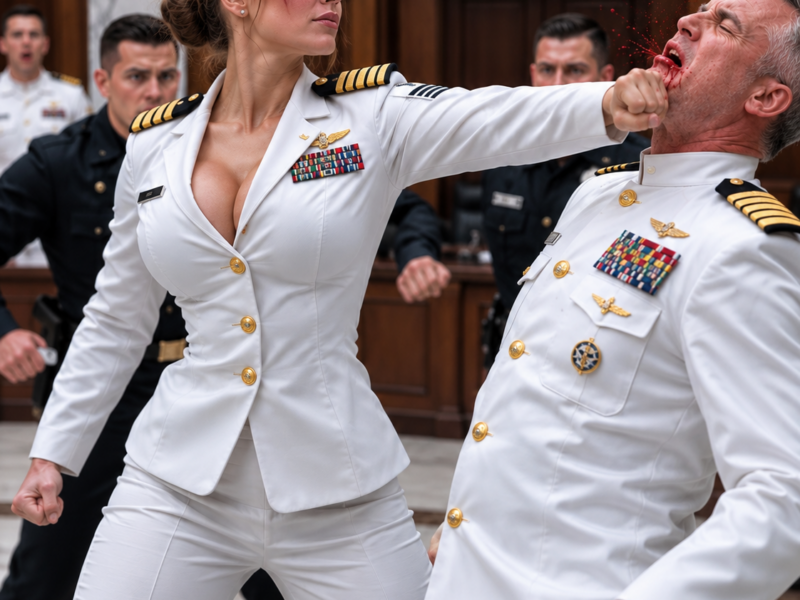
“The admiral’s hand struck my face so hard that my head snapped sideways, and thirty officers watched in stunned silence
The name on the screen was Lieutenant Nathan Brooks.
I knew him.
Not personally, but I knew his file.
He had been listed as transferred to another command eight months earlier.
According to the Navy personnel database, he was serving aboard a destroyer in the Pacific.
But the photograph showed something else.
It was a scanned page from the original evacuation roster.
Nathan Brooks’s name appeared beneath the eleven sailors whose whereabouts had never been verified.
I stared at the screen.
“Where did you get this?”
The investigator, Special Agent Daniel Mercer, lowered his phone.
“An anonymous source sent it to the inspector general’s office this morning.”
“This morning?”
“About forty minutes before the incident in this room.”
I looked at the clock.
It was almost ten.
“Then someone knew I was going to be confronted.”
Mercer didn’t answer.
He studied my face.
“Commander, I need you to tell me exactly what you know about Lieutenant Brooks.”
I took a slow breath.
“Eight months ago, I reviewed his personnel transfer. His assignment was changed suddenly, and the supporting orders were incomplete.”
“Did you question it?”
“Yes.”
“What happened?”
“My request for clarification was rejected.”
“By whom?”
I hesitated.
Then I said the name.
“Admiral Vance.”
Mercer looked down at the photograph again.
“There’s something you need to see.”
He opened a secure message on his tablet.
It contained a second photograph.
This one showed a man standing outside a warehouse near the naval station.
He wore civilian clothes.
His hair was longer than it had been in his personnel photograph.
But there was no mistaking him.
Nathan Brooks.
And behind him stood a second man.
A man I recognized immediately.
Captain Robert Harlan, Admiral Vance’s chief of staff.
My mouth went dry.
“That’s not a personnel transfer.”
“No,” Mercer said.
“It isn’t.”
“Where was this taken?”
“Outside a private logistics facility in Chesapeake. Three days ago.”
I looked at the photograph again.
“Why would Harlan be meeting him?”
“That’s what we’re trying to establish.”
I leaned back.
The original exercise had taken place six months earlier at a restricted coastal training facility.
The scenario involved a simulated evacuation after a security breach.
Eleven sailors were assigned to the final evacuation phase.
The official report claimed all eleven had been transported safely.
But the original records showed that the final transport never arrived.
I had spent weeks trying to determine whether it was an administrative error or something more serious.
Now Brooks’s name had appeared in the original roster.
And Vance’s chief of staff had been photographed with him.
“Agent Mercer, I think you need to look at the exercise’s transportation records.”
He nodded.
“We already have.”
“Then you know the last transport vehicle was never logged back into the facility.”
He looked up.
“How do you know that?”
“Because I found the original vehicle assignment sheet. It was removed from the official file, but a technician kept a copy.”
Mercer studied me.
“Where is it?”
“In a secure archive. I gave the location to the inspector general last week.”
He stood.
“Then we need to get it before someone else does.”
I stood too.
“Agent, if Harlan is involved, the archive may already be compromised.”
Mercer nodded.
“Which is why you’re not going anywhere alone.”
By noon, I was in a secure investigation room with two federal investigators, a Navy legal officer, and a medical evaluation report documenting the injury to my face.
The video from the briefing room had been recovered.
It showed the entire confrontation.
It showed Vance striking me.
It showed him reaching for my uniform.
It showed me moving away from his grip and using a controlled defensive maneuver.
And it showed me stepping back immediately after he fell.
There was no confusion about who had initiated the physical contact.
But the footage also revealed something unexpected.
During the confrontation, Captain Harlan had been standing beside the door.
He hadn’t tried to stop Vance.
He hadn’t called for medical assistance.
Instead, he had walked to the conference room control panel and disconnected the external recording feed.
The internal security camera had continued recording, but the meeting’s audio stream had been interrupted.
Mercer paused the video.
“Look at his left hand.”
I leaned closer.
Harlan had pressed a small device against the control panel.
“What is that?”
“A signal blocker.”
I looked at him.
“Why would he carry that?”
“That’s what we’re investigating.”
He restarted the footage.
Harlan disconnected the recording feed.
Then he turned toward the conference table.
He picked up my black folder.
I sat forward.
“Stop.”
Mercer froze the image.
“That’s my folder.”
“Yes.”
“He took it?”
“Watch.”
Harlan opened the folder, removed several pages, and placed them inside his jacket.
Then he returned the folder to the table.
I felt my stomach tighten.
“Those were the original discrepancy reports.”
Mercer nodded.
“Do you have copies?”
“Some.”
“Which ones?”
“The exercise roster, the transportation sheet, and the original communications log.”
“What’s missing?”
I looked at the frozen image.
“The names of the people who authorized the final evacuation.”
Mercer wrote something down.
“That may be important.”
“It is.”
“Why?”
I pointed toward the screen.
“Because the official report says the evacuation was authorized by the exercise director. But the original communications log identifies someone else.”
“Who?”
I looked at him.
“Captain Harlan.”
Mercer exchanged a glance with the other investigator.
Then he closed the file.
“Commander, I think we’ve found the beginning of this.”
I shook my head.
“No. We’ve found the beginning of the part someone failed to erase.”
At 1430, we arrived at the secure archive.
The facility was located in a restricted administrative building away from the main flight line.
A civilian records specialist met us at the entrance.
She looked nervous.
“Agent Mercer?”
“That’s right.”
She glanced at me.
“Commander Collins?”
“Yes.”
She swallowed.
“I was told you might come.”
“Who told you?”
She looked toward the hallway.
“Someone called from the admiral’s office.”
Mercer immediately stepped closer.
“What did they ask?”
“Whether the archive had been accessed recently.”
“Did you tell them?”
“No. I said I couldn’t release that information without authorization.”
Mercer nodded.
“Good.”
We entered the records room.
The original files were stored in sealed containers, each with an access log.
The specialist retrieved the container assigned to the evacuation exercise.
The seal was intact.
But when she opened it, we discovered that several pages had been removed.
I stared at the empty divider.
“That’s the transportation section.”
Mercer looked at the specialist.
“Who accessed this container?”
She checked the log.
“Three people.”
“Names?”
She read them aloud.
Mine.
Chief Petty Officer Marcus Hill.
And Captain Robert Harlan.
I frowned.
“Chief Hill wasn’t assigned to that exercise.”
“According to the log, he accessed the file two months ago.”
I looked at Mercer.
“That’s impossible. He was on medical leave.”
The records specialist turned the tablet toward us.
The access entry included Hill’s credentials.
But the signature was electronic.
Mercer frowned.
“Someone used his account.”
I stepped closer.
“Can we identify the terminal?”
She nodded.
“Yes. The access came from the operations building.”
Mercer turned to his team.
“Secure that terminal.”
Then he looked at me.
“Do you know Chief Hill?”
“Not well. He was the maintenance supervisor assigned to the training facility.”
“Was he involved in the evacuation?”
“He reported a vehicle discrepancy the day after the exercise.”
“What kind?”
I remembered the report.
“A transport vehicle returned with damage that wasn’t listed on its inspection sheet.”
“Did he say anything else?”
I thought for a moment.
“He wrote that the rear compartment had been cleaned before the vehicle was inspected.”
Mercer’s expression changed.
“Cleaned?”
“Yes.”
“Did he explain why?”
“No. His report was closed before I could interview him.”
Mercer picked up his phone.
“Find Chief Hill. Now.”
We found Chief Hill at a small medical clinic on the edge of the base.
He was recovering from surgery on his shoulder.
When he saw us enter, he looked immediately at Mercer.
Then at me.
“Commander Collins.”
“Chief.”
He tried to sit up.
“Is this about the exercise?”
Mercer pulled a chair beside the bed.
“Yes, Chief. We need to ask you about the transport vehicle that returned with unexplained damage.”
Hill looked down.
For several seconds, he said nothing.
Then he asked a question.
“Did they find Brooks?”
I felt my heart beat faster.
“Why would you ask that?”
Hill looked at me.
“Because he was on that vehicle.”
The room went silent.
Mercer leaned forward.
“You’re saying Lieutenant Brooks was inside the vehicle?”
Hill nodded slowly.
“Yes.”
“What happened?”
The chief closed his eyes.
“That exercise wasn’t supposed to be an exercise by the time the final transport arrived.”
I glanced at Mercer.
“Explain.”
Hill opened his eyes.
“During the final evacuation phase, someone changed the route. The transport was directed to a secondary facility instead of the designated extraction point.”
“Who gave that order?”
“Captain Harlan.”
Mercer wrote something down.
“Did the crew comply?”
“They had no reason to think anything was wrong. The order came through an authorized channel.”
“What happened when they arrived?”
Hill hesitated.
“Two vehicles were waiting. No official security markings. No exercise personnel.”
“Who was in charge?”
“I couldn’t see clearly. But I recognized one man.”
“Who?”
“Admiral Vance.”
I felt cold.
“You’re certain?”
Hill nodded.
“I saw him standing beside the loading area.”
Mercer leaned forward.
“What happened to the eleven sailors?”
“They were taken inside.”
“Where?”
“An old logistics warehouse near the waterfront.”
I remembered the photograph.
The same facility where Brooks had been seen three days earlier.
“Did you see them again?”
Hill looked at me.
“Only one.”
“Brooks?”
He nodded.
“About two weeks later, I received a message from him.”
“What did it say?”
Hill reached into the drawer beside his bed.
He pulled out a folded piece of paper.
“I kept it because I knew someone would eventually come looking.”
Mercer took the paper carefully.
It contained a handwritten message.
They told us the exercise was over. Then they took our phones, our identification, and our uniforms. We are being held until the investigation is closed. Don’t let them erase us.
At the bottom was a signature.
Nathan Brooks.
I stared at the words.
“Where is he now?”
Hill shook his head.
“I don’t know.”
“How did you receive this?”
“A driver left it at my house.”
“Did you report it?”
“I tried.”
“To whom?”
Hill looked at me.
“Captain Harlan.”
I understood immediately.
“You reported the message to the person who had ordered the transport.”
Hill nodded.
“After that, I was told to stay quiet.”
Mercer folded the paper.
“Chief, you’re going to need to provide a formal statement.”
“I will.”
He looked toward me.
“Commander, there’s something else.”
“What?”
Hill’s voice dropped.
“The eleven sailors weren’t the only ones on that transport.”
I felt my throat tighten.
“Who else?”
He looked at the door.
“Two civilian contractors.”
The investigators moved quickly after that.
They obtained warrants for the logistics warehouse, secured the transportation records, and requested emergency access to the private facility where Brooks had been photographed.
I remained at the clinic until Chief Hill finished his statement.
He was exhausted.
Before we left, he caught my hand.
“Commander.”
“Yes, Chief?”
“I should have done more.”
I looked at him.
“You tried to report it.”
“Not hard enough.”
“You’re still here. You’re still talking. That matters.”
He shook his head.
“Eleven families have been told their people are missing because of paperwork.”
I had no answer.
I thought about the original roster.
The names circled in red.
The official report declaring them safe.
The way Vance had looked at me when I questioned him.
He hadn’t been angry because I had embarrassed him.
He had been afraid I was getting close.
At 1900, Mercer called.
“We found the warehouse.”
I stood immediately.
“Brooks?”
“Not yet.”
“What did you find?”
“Signs of recent occupation. Food containers, medical supplies, temporary bedding.”
“Any people?”
“Negative.”
I closed my eyes.
“Then where did they go?”
“We found a vehicle log.”
“Whose vehicle?”
“Two private transport trucks registered to a company called Meridian Strategic Logistics.”
I recognized the name.
It had appeared in several supporting documents from the original exercise.
“Who owns it?”
“That’s where things get interesting.”
He paused.
“The company is owned by a holding group with a board member who has been donating to a private foundation associated with Admiral Vance.”
I felt my stomach drop.
“How much?”
“Several million dollars over three years.”
I sat down.
“Is there evidence the money went to him?”
“Not directly. But we’re following the transactions.”
“What’s the next step?”
“We’re searching the company’s transport records.”
I looked at the clock.
“Then don’t wait until morning.”
“We aren’t.”
The call ended.
I stared at the wall for a long moment.
A private contractor.
A missing transport.
Eleven sailors.
And an admiral who had just assaulted an officer in front of thirty witnesses.
It was no longer a question of a falsified report.
It was a question of what had happened to eleven people after the Navy officially declared them safe.
The breakthrough came just after midnight.
Mercer called again.
“We found Brooks.”
I stood so quickly that the chair fell backward.
“Where?”
“At a residential property outside Portsmouth.”
“Is he alive?”
“Yes.”
I closed my eyes.
“Are the others with him?”
“No. But he has information about where they were taken.”
“Is he safe?”
“He’s in protective custody.”
I pressed a hand against my forehead.
“Can I speak with him?”
“Not yet. He’s being medically evaluated.”
“Tell him I’m the officer who found the original roster.”
“I will.”
There was a pause.
Then Mercer added, “He asked about Chief Hill.”
I felt a knot form in my chest.
“Tell him Hill is alive. He’s at the medical clinic.”
“I’ll pass it on.”
I ended the call.
For the first time in weeks, I allowed myself to breathe.
But the relief lasted only a few seconds.
My phone rang again.
This time, it was an unfamiliar number.
I answered.
“Collins.”
A man’s voice came through.
“You should have left the report alone.”
I stood still.
“Who is this?”
“You know exactly who this is.”
I recognized the voice.
Captain Harlan.
“Where are you?”
“That doesn’t matter.”
“It matters to investigators.”
He gave a quiet laugh.
“You think Mercer can protect you?”
“I don’t need protection.”
“Everyone needs protection, Commander.”
I glanced toward the office door.
Two investigators were standing in the hallway.
“What do you want?”
“I want you to understand something. This investigation is going to destroy more than one career.”
“Then perhaps those careers should have been built on something better.”
His voice hardened.
“You have no idea how many people are involved.”
“Then tell me.”
Silence.
Then he said something that made my blood run cold.
“Vance didn’t start this.”
The call ended.
I immediately handed the phone to Mercer.
“Captain Harlan.”
Mercer took it.
“Did he threaten you?”
“Yes.”
“What did he say?”
I repeated the conversation.
When I finished, Mercer looked at his team.
“Locate him.”
One investigator checked the building access system.
Another started tracing the call.
But Harlan was already gone.
His office was empty.
His vehicle was missing.
And his personal security badge had been used to exit the base less than ten minutes earlier.
The man who had helped orchestrate the disappearance of eleven sailors had vanished.
The following morning, I was summoned to a formal hearing.
Admiral Vance was present.
He sat at the far end of the room, his cheek bruised and his expression carefully neutral.
A Navy legal officer sat beside him.
Two investigators occupied the opposite side.
I entered wearing my service uniform.
The bruise on my face was still visible.
Vance looked at it.
Then he looked away.
The hearing officer began.
“Lieutenant Commander Collins, this proceeding will examine the physical confrontation that occurred during the readiness briefing, as well as the underlying safety allegations.”
I nodded.
“Understood.”
“Do you maintain that you acted in self-defense?”
“Yes.”
“Did you intend to injure Admiral Vance?”
“No.”
“Did you have any opportunity to disengage?”
“I attempted to step away when he grabbed my uniform. I used a defensive maneuver to stop the immediate threat and moved away as soon as he fell.”
The hearing officer turned toward Vance.
“Admiral, do you wish to respond?”
Vance straightened.
“She attacked me.”
The room remained silent.
The hearing officer pressed a button.
The security footage appeared on the screen.
It showed the slap.
The attempted grab.
My movement.
His fall.
Then my immediate retreat.
The hearing officer paused the video.
“Admiral, is this recording authentic?”
Vance stared at the screen.
“Yes.”
“Did you strike Lieutenant Commander Collins?”
He hesitated.
Then answered.
“I did.”
“Did you attempt to physically restrain her afterward?”
“I was attempting to remove her from the meeting.”
“By grabbing her uniform?”
Vance didn’t answer.
The hearing officer looked toward me.
“Commander, do you have anything further to add?”
I placed a document on the table.
“Yes, sir.”
It was the original evacuation roster.
Behind it were the transportation logs, Chief Hill’s statement, and the handwritten message from Brooks.
“I did not report Admiral Vance because I disliked him or because I wanted to challenge his rank. I reported him because eleven sailors were listed as safely evacuated when the original records showed they were not accounted for.”
I looked around the room.
“Those eleven sailors had families who believed the official report. Some had spent months waiting for information. Others had been told that their loved ones were simply missing.”
I paused.
“An officer’s rank does not make a false report true. And a commander’s authority does not give anyone permission to erase people from an official record.”
Vance stared at me.
For the first time, he looked smaller than the title on his uniform.
The hearing officer closed the folder.
“That will be all for now.”
The investigation continued for another month.
The eleven sailors were located at two separate facilities.
They had been detained under the pretext of a classified security assessment that had never been properly authorized.
Their phones and personal identification had been confiscated.
They had been prevented from contacting their families.
The two civilian contractors had been held for questioning after refusing to sign statements supporting the false evacuation report.
Lieutenant Brooks had been the first to attempt to expose what happened.
He had been transferred under false orders, then held at the warehouse after he refused to withdraw his statement.
The investigation found that Meridian Strategic Logistics had received millions of dollars through contracts connected to the exercise.
Some of the money had been diverted through shell companies.
Captain Harlan was arrested while attempting to leave the state.
He eventually agreed to cooperate.
His testimony revealed that Vance had approved the unauthorized detention operation and ordered the official evacuation report altered.
Vance was relieved of command pending further proceedings.
The Navy’s independent review also found serious failures in oversight.
Several officers who had signed the original report were disciplined.
Others were cleared after investigators established that they had been given falsified information.
And the eleven sailors?
They were finally allowed to go home.
I visited the medical center two weeks after the investigation began.
Lieutenant Brooks was sitting beside a window when I entered.
He looked thinner than in his personnel photograph.
His left arm was in a sling.
But he was alive.
When he saw me, he stood.
“Commander Collins?”
I returned his salute.
“At ease, Lieutenant.”
He smiled weakly.
“You’re the one who found the roster.”
“Yes.”
He shook his head.
“I thought nobody would ever look at it.”
I pulled a chair beside him.
“Chief Hill kept your message.”
Brooks looked down.
“Is he all right?”
“Recovering. He asked about you.”
Brooks closed his eyes.
For a moment, he couldn’t speak.
Then he said, “I should have gotten everyone out.”
“You were a lieutenant in a situation you had no authority to control.”
“I could have done more.”
“Maybe. But the responsibility belongs to the people who put you there.”
He looked toward the window.
“Do you know what the worst part was?”
“What?”
“Every morning, I heard the base announcements. Flight schedules. Training updates. Normal things.”
He swallowed.
“People were going about their lives while our families were being told we were missing.”
I didn’t interrupt.
“One of the guys had a daughter who was supposed to start kindergarten. He kept asking whether he would make it home in time.”
Brooks’s voice broke.
“She started school without him.”
I looked down.
There was no official language that could make that easier.
“I’m sorry.”
He nodded.
“Are the others home?”
“Yes. All eleven.”
He let out a long breath.
“Then that’s enough.”
It wasn’t.
Not really.
But I understood what he meant.
Three months later, I received the final administrative decision concerning the incident in the briefing room.
The review found that Admiral Vance had used unlawful physical force against me.
My defensive response was determined to be justified under the circumstances.
No disciplinary action was taken against me for the physical confrontation.
Vance was formally removed from his command position.
The separate investigation into his involvement in the unauthorized detention and falsification of official records continued through the appropriate military and federal processes.
I was offered a new assignment.
This time, it wasn’t a routine readiness review.
I was asked to lead a small team responsible for examining discrepancies in classified operational reporting.
The work would be difficult.
There would be more powerful people who disliked questions.
More reports that didn’t match the original records.
More people who would insist that protecting an institution meant protecting the people at the top.
I accepted.
On my last day at Norfolk, I returned to the briefing room.
The table had been cleared.
The chairs were neatly arranged.
The security camera had been replaced.
I stood where Vance had struck me.
I could still remember the sound.
The stunned silence.
The feeling of thirty people watching and wondering whether anyone would intervene.
I looked at the camera.
Then I turned toward the door.
Chief Hill was waiting outside.
He had recovered enough to return to limited duty.
“Ready, Commander?”
“Almost.”
He glanced into the room.
“Hard to believe all of that started with one report.”
I shook my head.
“It started before the report. The report just made it visible.”
He nodded.
Then he handed me a small envelope.
“What is this?”
“Something from the eleven sailors.”
I opened it.
Inside was a photograph.
All eleven stood together in front of a military medical facility.
They looked tired, but they were smiling.
On the back, someone had written:
Thank you for refusing to let the paperwork become the truth.
I read it twice.
Then I folded the photograph carefully.
Chief Hill watched me.
“Funny thing, Commander.”
“What?”
“When you first arrived, some people said you were too young to challenge an admiral.”
I smiled faintly.
“And now?”
He looked toward the empty briefing room.
“Now they know age has nothing to do with courage.”
I shook my head.
“Neither does rank.”
He smiled.
“Fair enough.”
We walked toward the exit together.
Outside, the base was busy again.
Aircraft moved across the flight line.
Sailors hurried between buildings.
A routine announcement sounded over the loudspeaker.
Life had continued.
But something had changed.
The eleven sailors were home.
The false reports had been exposed.
And the people who believed their rank made them untouchable had finally been forced to answer for what they had done.
I touched the faint scar inside my lower lip.
It had healed.
The bruise had disappeared weeks earlier.
But I would never forget those eighteen seconds.
Not because I had knocked an admiral to the floor.
Because, for eighteen seconds, everyone in that room had seen what happened when someone with power believed nobody would challenge him.
And then they saw someone challenge him.
I had never wanted to be remembered for a fight.
I wanted to be remembered for the eleven people whose names someone had tried to erase.
That was the part worth standing up for.
THE END.









