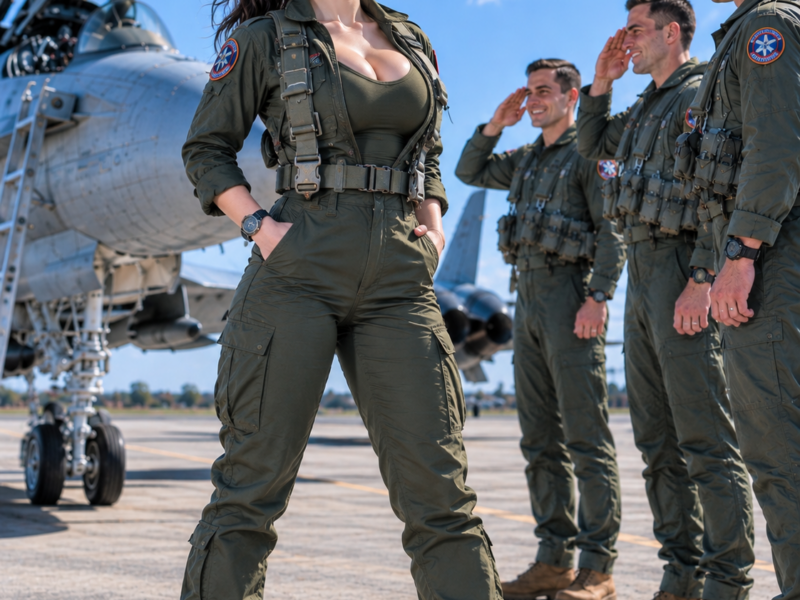
“She looked barely old enough to rent a car, standing beneath the shadow of an F-18 while a squadron of seasoned pilots laughed at her uniform
The flight line went silent.
Every pilot looked toward aircraft 217.
Lieutenant Commander Reeves stood beside the ladder, his face suddenly drained of color.
Captain Lawson took one step toward the senior officer.
“Admiral, I can explain this.”
The officer didn’t look at him.
“Not yet, Captain.”
He turned to me.
“Commander Bennett, the authorization was submitted using your squadron’s maintenance credentials. The access log identifies the terminal.”
“Which terminal?”
“Operations control.”
I glanced at Lawson.
He looked furious now, but beneath the anger was something else.
Fear.
“Who was logged in?” I asked.
The officer checked his tablet.
“Lieutenant Commander Daniel Reeves.”
A murmur spread through the pilots.
Reeves shook his head.
“That’s impossible. I wasn’t even in operations control when that entry was made.”
“Your credentials were used,” the officer replied.
“Someone must have stolen them.”
I studied him.
“Then we’ll establish that through the access records.”
Reeves turned toward me.
“You think I forged a maintenance record?”
“I think an aircraft was cleared without the required repair, and your credentials were used to authorize it.”
“That’s not an answer.”
“It’s the only answer the evidence supports right now.”
Captain Lawson stepped between us.
“This has gone far enough. The aircraft will remain grounded until we sort this out. Everyone else can return to their duties.”
“No, sir,” I said.
He looked at me sharply.
“What did you say?”
“The aircraft is already grounded. But the investigation cannot stop here.”
“You’re not running an investigation.”
The senior officer finally turned toward him.
“Actually, Captain, she is.”
Lawson’s expression froze.
The officer introduced himself as Rear Admiral Thomas Whitaker, commander of the regional aviation maintenance authority.
He had arrived that morning for what was supposed to be a routine readiness review.
Apparently, the routine part was over.
“Commander Bennett,” he said, “I want the original maintenance reports, the digital access logs, and every authorization associated with aircraft 217.”
“Yes, Admiral.”
“And I want the aircraft secured.”
Chief Hill was already moving.
“Understood, sir.”
Two security personnel approached the aircraft.
Reeves watched them place a temporary security seal on the maintenance access panel.
Then he looked at me.
“You have no idea what you’ve just done.”
I met his eyes.
“Neither do you.”
For the first time, he had nothing to say.
But I knew the aircraft was only the beginning.
The forged clearance had been submitted less than a minute after I discovered the original discrepancy.
That meant whoever altered it knew exactly what we were looking at.
And they had been watching.
We moved the investigation into a conference room beside the maintenance hangar.
Chief Hill brought the physical maintenance records.
An aviation safety officer retrieved the digital audit trail.
The security team secured the operations terminal.
I stood at the end of the table, reviewing the documents one by one.
Reeves sat opposite me.
Lawson remained standing near the window.
Neither man looked comfortable.
“Let’s start with aircraft 217,” I said.
Chief Hill opened the maintenance folder.
“The aircraft reported intermittent hydraulic pressure fluctuations during its previous flight. The pilot noted a brief warning before landing.”
“Who was the pilot?”
“Lieutenant Commander Reeves.”
Reeves leaned forward.
“The warning cleared before I landed.”
“That doesn’t make the discrepancy disappear,” I said.
“I know that.”
“Then why did you fly it again?”
“Because I was told the issue had been inspected.”
“By whom?”
He looked toward Lawson.
Lawson answered first.
“The maintenance department had reviewed it.”
Chief Hill shook his head.
“We reviewed the report. We did not clear the aircraft.”
Lawson’s expression hardened.
“Chief, be careful.”
Hill didn’t look away.
“I’ve been careful for thirty years, sir. That’s why I’m still here.”
I continued reading.
The maintenance record showed that a hydraulic component had been ordered, inspected, installed, and tested.
All within a period of eleven minutes.
I looked at the timestamps.
“That’s impossible.”
The safety officer nodded.
“The component’s serial number doesn’t match the inventory records.”
“Where is the replacement part?”
“Still in transit.”
I turned toward Reeves.
“Did you see the replacement?”
“No.”
“Did you personally inspect the repair?”
“No.”
“Did you sign the flight authorization?”
He hesitated.
“Yes.”
“Why?”
He looked down.
“Because the operations office told me the aircraft was cleared.”
“Who in the operations office?”
He glanced at Lawson again.
This time, the captain didn’t answer.
“Captain Lawson?” I asked.
Lawson folded his arms.
“Operational decisions are rarely as simple as a line on a form, Commander.”
“Aircraft safety is.”
He gave a short, humorless laugh.
“That’s easy to say when you don’t have pilots waiting for you to make decisions.”
I placed the report on the table.
“Pilots are supposed to wait when an aircraft isn’t safe.”
The rear admiral watched us without interrupting.
I pointed to the next entry.
“There’s another problem. The same component number appears in the records for aircraft 204 and 211.”
Chief Hill leaned closer.
“That can’t be right.”
“Why?”
“Because those aircraft were never issued that component.”
The safety officer checked his tablet.
“All three records were entered using the same maintenance authorization account.”
I looked at the rear admiral.
“Then we need to know who has access.”
He nodded.
“Get me the account history.”
A few minutes later, the safety officer returned with a list of user credentials.
Five people had access to the account.
Three were maintenance supervisors.
One was an administrative specialist.
The fifth was Captain Robert Lawson.
Nobody spoke.
Lawson slowly straightened.
“That proves nothing.”
“No,” I agreed. “It doesn’t.”
I turned to the safety officer.
“Can you identify which device submitted the false entries?”
“Yes, ma’am. The entries came from a terminal assigned to the operations office.”
“And who was using that terminal?”
“The camera footage will tell us.”
Lawson moved toward the door.
“That’s enough. I’m calling legal.”
The rear admiral’s voice stopped him.
“You’re welcome to call legal, Captain. But you’re not leaving this room until we’ve secured your access credentials.”
Lawson turned.
“Admiral, with respect, I have responsibilities.”
“So do I.”
The room fell quiet.
Then the safety officer returned.
He looked uncomfortable.
“Sir, we have the footage.”
The rear admiral nodded.
“Show us.”
The video appeared on the conference room screen.
It showed the operations office at 8:42 that morning.
An officer entered.
He sat at the terminal.
He opened the maintenance authorization system.
Then he typed for nearly three minutes.
The camera angle wasn’t perfect, but the face was clear.
It was Reeves.
He stared at the screen.
“That’s not possible.”
The safety officer paused the footage.
“Would you like us to continue?”
Reeves swallowed.
“Yes.”
The next image showed him printing a document.
Then he walked toward the hangar.
The timestamp matched the forged clearance.
Reeves slowly lowered his head.
Lawson looked at him.
“Daniel…”
Reeves raised his eyes.
“Don’t.”
It was the first time I had heard him address his superior without using his rank.
I turned toward him.
“Did you enter the clearance?”
He didn’t answer.
“Lieutenant Commander Reeves, did you enter the clearance?”
His jaw tightened.
“Yes.”
Chief Hill closed his eyes.
I felt something heavy settle in my chest.
“Why?”
Reeves looked at the table.
“Because I was told to.”
“By whom?”
He glanced toward Lawson.
The captain’s expression was unreadable.
“Daniel, think carefully before you answer.”
Reeves looked up.
“That’s what I’ve been doing for three months.”
The rear admiral ordered a recess.
Reeves was escorted to a separate office while security personnel secured the terminal and copied its records.
Lawson was placed on temporary administrative restriction pending the initial review.
I remained with Chief Hill.
For several minutes, neither of us spoke.
Finally, he set his tablet on the table.
“Commander, there’s something I should have told you earlier.”
I looked at him.
“What is it?”
“The maintenance discrepancies didn’t start with aircraft 217.”
“I know.”
“No. I mean I reported this exact pattern six months ago.”
He opened an archived report.
It described repeated pressure warnings, incomplete component replacements, and maintenance entries that had been closed without proper verification.
The report was signed by Hill.
At the bottom was an acknowledgment from the operations office.
Captain Lawson’s name.
“Why wasn’t this escalated?” I asked.
“It was.”
“Where did it go?”
“Back to the same office.”
I read the final line.
The complaint had been classified as an administrative misunderstanding.
“Did you challenge that decision?”
“Twice.”
“And what happened?”
Hill gave a tired smile.
“I was told I was making the squadron look bad.”
I looked at the old report.
“Did anyone else support you?”
He hesitated.
“One technician. Petty Officer Lucas Bennett.”
I recognized the name.
Lucas had helped me inspect the records earlier that morning.
“Where is he?”
“On the hangar floor.”
“Bring him in.”
A few minutes later, Lucas entered.
He was young, maybe twenty-five, with nervous eyes and grease still visible beneath his fingernails.
“Commander?”
“Sit down, Petty Officer.”
He looked at Chief Hill.
The older man nodded.
Lucas took the chair.
I placed the archived report in front of him.
“Chief Hill says you helped document these discrepancies.”
Lucas stared at the paper.
“Yes, ma’am.”
“Why didn’t you bring the evidence forward yourself?”
He swallowed.
“Because I did.”
“When?”
“Three months ago.”
“Who did you report it to?”
“Captain Lawson.”
I waited.
Lucas rubbed his palms against his uniform.
“He called me into his office. He said I was inexperienced and didn’t understand how readiness reporting worked.”
“Did he threaten you?”
“Not directly.”
“What did he say?”
Lucas took a breath.
“He said that if I couldn’t work within the squadron’s priorities, he could find someone who could.”
Chief Hill looked down.
I continued.
“Did you keep copies of your reports?”
Lucas nodded.
“Yes, ma’am.”
“Where?”
“In my personal work archive. I saved the original inspection notes before the records were changed.”
I leaned forward.
“Why?”
“Because I knew someone would eventually ask.”
For the first time that day, I smiled.
“Good decision.”
He opened his tablet and brought up a folder.
Inside were photographs, handwritten measurements, component serial numbers, and maintenance notes.
The evidence was extensive.
More importantly, it showed that the false records were not random mistakes.
They followed a pattern.
Whenever an aircraft developed a discrepancy that might affect the squadron’s flight schedule, the issue was temporarily closed.
The aircraft would then be listed as ready.
The actual repair would be delayed until a later date.
Sometimes the aircraft flew several missions before the work was completed.
Sometimes the repair never happened.
I felt my stomach tighten.
“How many aircraft?”
Lucas looked at Chief Hill.
The chief answered.
“At least four.”
I looked at the rear admiral.
He had been standing quietly behind us.
“Admiral, we need to expand the review.”
He nodded.
“Already done.”
“To the entire squadron?”
“Every aircraft assigned to this maintenance unit.”
I glanced at Lucas’s photographs again.
There was one image I hadn’t noticed before.
It showed a maintenance panel with a handwritten warning taped beside it.
The words were clear.
DO NOT RELEASE UNTIL REPLACEMENT VERIFIED.
I pointed to it.
“Who wrote this?”
Lucas leaned closer.
“Chief Hill.”
The chief looked uncomfortable.
“I put that there after the second report.”
“Who removed it?”
“I don’t know.”
I turned to the rear admiral.
“Then we need to find out.”
Reeves eventually agreed to speak with the investigation team.
He looked different when he returned.
The confidence was gone.
He sat with both hands clasped in front of him.
“Captain Lawson told me the aircraft were safe,” he began.
“Did you believe him?” I asked.
“At first.”
“And later?”
He looked at me.
“Later, I wasn’t sure.”
“Then why did you continue signing flight authorizations?”
His face tightened.
“Because I had pilots depending on me.”
“Pilots depend on you to tell them the truth.”
“I know.”
“Do you?”
He looked away.
The rear admiral remained silent.
Reeves took a breath.
“Six months ago, our squadron was behind schedule. We had training requirements, deployment preparations, and a readiness inspection coming up. Lawson said the maintenance department was exaggerating minor problems.”
“Did you verify that?”
“Not every time.”
“Why not?”
“Because he was the operations officer. I trusted him.”
I looked at him.
“Trust doesn’t replace verification.”
He nodded slowly.
“After a while, I started signing what he told me was already approved.”
“And today?”
He closed his eyes.
“Today he called me into his office.”
I leaned forward.
“What did he tell you?”
“He said aircraft 217 had to fly. The regional readiness team was arriving, and he didn’t want the inspection delayed.”
“Did he know the aircraft had an unresolved hydraulic discrepancy?”
“Yes.”
The answer came quietly.
“How do you know?”
“Because I told him.”
The room became still.
Reeves continued.
“He said the component had been replaced and the maintenance system simply hadn’t updated. He told me to enter the clearance manually.”
“Did you see the replacement component?”
“No.”
“Did you ask Chief Hill?”
“No.”
“Why?”
His voice cracked slightly.
“Because I knew what he would say.”
I let the silence sit.
“Then you knew it wasn’t safe.”
He nodded.
“Yes.”
“Why did you still do it?”
He looked at his hands.
“Because I didn’t want to lose my command position.”
It was an honest answer.
And an ugly one.
I had seen people make terrible decisions because they were afraid.
But fear didn’t make the consequences disappear.
“Did Captain Lawson tell you to falsify the repair record?”
“Yes.”
“Did he know you were using Chief Hill’s credentials?”
“He told me to use the shared maintenance account.”
“Did he know the signature would appear under Chief Hill’s name?”
Reeves hesitated.
Then he nodded.
I looked at the investigator.
“Record that.”
Reeves suddenly looked up.
“Commander, I need you to understand something.”
“I’m listening.”
“I never wanted anyone to get hurt.”
“I believe you.”
His eyes filled with relief.
Then I continued.
“But that doesn’t excuse what you did.”
His expression fell.
“You’re right.”
The rear admiral finally spoke.
“Lieutenant Commander Reeves, you will remain available for further questioning. Your flight privileges are suspended pending investigation.”
Reeves nodded.
He didn’t argue.
As security escorted him out, he stopped beside Chief Hill.
“Chief…”
Hill looked at him.
“I’m sorry.”
The older man didn’t answer immediately.
Then he said, “You should have been sorry before you signed the paper.”
Reeves lowered his head and walked away.
By late afternoon, the investigation had expanded beyond the original aircraft.
The team identified six questionable maintenance clearances across four aircraft.
Three involved components that had never been installed.
Two involved inspections that had been recorded as completed before the technicians had even started them.
The sixth was especially troubling.
It concerned a flight-control system that had produced an intermittent warning during a training sortie.
The warning had been dismissed as a sensor issue.
But the technician’s original notes suggested a deeper mechanical problem.
That aircraft had been scheduled for another flight the following morning.
I immediately ordered it grounded.
The squadron’s training schedule collapsed.
Pilots gathered outside the operations building, confused and angry.
Some blamed the maintenance department.
Others blamed Reeves.
A few blamed me.
I didn’t take it personally.
They had been told for months that everything was fine.
Now someone had to explain why it wasn’t.
I stepped outside and addressed them.
“Listen up.”
The conversations stopped.
“Effective immediately, every aircraft assigned to this unit is subject to an independent maintenance review. No aircraft will be released based on a verbal assurance, an incomplete entry, or a commander’s preference.”
A pilot near the front raised his hand.
“Commander, does that mean we’re grounded indefinitely?”
“It means you’ll fly when your aircraft are safe.”
“How long will that take?”
“I don’t know.”
He frowned.
“That’s not very reassuring.”
I nodded.
“I understand.”
Another pilot stepped forward.
“With respect, we’ve been flying these aircraft for years. We’ve never had a serious accident.”
I looked at him.
“That’s not proof that the decisions made here were safe.”
He fell silent.
I continued.
“Every one of you deserves to know that the aircraft carrying you has been properly inspected. Every technician deserves to know that their signature means something. And every person in this command has a responsibility to protect that standard.”
A voice came from the back.
“Even if it means missing deployment?”
I looked toward the speaker.
“Especially then.”
Nobody laughed.
For the first time since my arrival, I felt the squadron was actually listening.
Not because they respected my age.
Not because they agreed with every decision.
But because they had finally realized that the situation was bigger than a disagreement between a young commander and an experienced pilot.
It was about whether they could trust the aircraft beneath them.
The formal investigation lasted three weeks.
During that time, aircraft 217 remained grounded.
The hydraulic component was eventually replaced, and the system underwent a complete inspection.
The other aircraft were reviewed one by one.
Two required additional repairs.
One had a maintenance entry that had been altered without authorization.
The investigators also discovered that Captain Lawson had been pressuring supervisors to keep the squadron’s readiness numbers high before scheduled evaluations.
He had not personally performed every alteration.
But he had encouraged the practice, ignored repeated warnings, and directed Reeves to submit a false clearance.
His command authority was suspended.
He was removed from his position and referred for further administrative and legal review.
Reeves faced a separate investigation.
His cooperation mattered, but it did not erase his responsibility.
He lost his flight privileges while the proceedings continued.
The squadron had to rebuild its procedures from the ground up.
Chief Hill was appointed interim maintenance supervisor.
Lucas was assigned to the independent verification team.
And I was asked to remain until the new safety process was fully implemented.
One afternoon, I found Chief Hill standing beside aircraft 217.
The replacement component had been installed.
The inspection team had completed its work.
But the aircraft remained parked.
“How’s it looking, Chief?”
He smiled faintly.
“Better than it did three weeks ago.”
“Is it ready?”
“Mechanically, yes. But the final verification isn’t complete.”
I nodded.
“Then it stays here.”
He looked at me.
“You know, Commander, when you first walked onto this flight line, half the squadron thought you were too young to be here.”
“I noticed.”
“Some of them still do.”
I smiled.
“That’s their privilege.”
He chuckled.
“You’re not bothered?”
“Not anymore.”
He looked toward the aircraft.
“I’ve been doing this for thirty years. I’ve seen good officers, bad officers, and a lot of people who couldn’t tell the difference between rank and leadership.”
I waited.
“You’re not the first young commander I’ve worked with. But you’re the first one I’ve seen stop an entire squadron’s flight schedule before lunch.”
“Was that a compliment?”
“Don’t push it.”
We both laughed.
Then he became serious.
“Thank you for listening.”
I looked at him.
“You were telling the truth. Someone needed to hear it.”
He nodded.
“That’s all most of us want.”
On the morning aircraft 217 was finally released, I arrived at the hangar before sunrise.
The inspection team had completed every required check.
The maintenance records had been independently verified.
The replacement component matched the inventory.
The hydraulic system had passed its operational test.
And every technician involved had signed the final report.
Chief Hill handed me the release documentation.
“All checks complete, Commander.”
I reviewed the signatures.
“Any outstanding discrepancies?”
“None.”
“Any unresolved warnings?”
“None.”
“Are you satisfied with the inspection?”
He gave a firm nod.
“Yes, ma’am.”
I signed the authorization.
For the first time in weeks, aircraft 217 was officially cleared for flight.
The pilots gathered near the hangar.
Reeves wasn’t among them.
His case was still pending, and he remained off flight status.
Instead, another squadron pilot, Lieutenant Sarah Collins, had been assigned to conduct the first post-inspection flight.
She approached me in her flight suit.
“Commander Bennett?”
“Lieutenant.”
“I’ve reviewed the maintenance package.”
“Any questions?”
She looked toward the aircraft.
“Just one.”
“Go ahead.”
“Can I trust it?”
I glanced at Chief Hill.
Then at the technicians standing nearby.
“Every required inspection has been completed and independently verified. If you see anything unusual, you bring it back and report it. No pressure, no shortcuts.”
She nodded.
“Understood.”
Before climbing into the cockpit, she turned back.
“Thank you for not letting them rush this.”
I watched her climb the ladder.
The canopy closed.
The engines started.
The aircraft taxied slowly toward the runway.
A few minutes later, the F-18 lifted into the morning sky.
I didn’t cheer.
I didn’t celebrate.
I simply watched until it disappeared beyond the clouds.
Then I let out a breath I hadn’t realized I was holding.
The final surprise came two days later.
I was preparing to leave the base when a message arrived from the rear admiral.
He wanted me in the command briefing room.
When I arrived, several senior officers were already seated.
The rear admiral stood near the window.
“Commander Bennett, take a seat.”
I did.
He slid a folder across the table.
“Your assignment here was originally scheduled to last only one week.”
“Yes, sir.”
“That has changed.”
I opened the folder.
It contained a new set of orders.
I was being assigned to lead a regional aviation safety review team.
The position would involve examining maintenance and operational practices across multiple naval aviation units.
I looked up.
“Sir, there are more experienced officers who could do this.”
“There are.”
He paused.
“But experience is only useful when someone is willing to act on what it reveals.”
I closed the folder.
“Thank you, Admiral.”
He nodded.
“There’s one more thing.”
He handed me a second document.
It was a letter from Chief Hill and the maintenance team.
The first paragraph was brief.
It thanked me for giving their concerns the attention they deserved.
The last line was handwritten.
You reminded us that a signature is a promise, not a formality.
I read it twice.
Then I folded the letter carefully and placed it inside my folder.
On my last morning at Oceana, I walked past the same group of pilots who had laughed at me on my first day.
They were standing beside the hangar, preparing for a briefing.
Lieutenant Collins noticed me first.
“Commander Bennett!”
The others turned.
Reeves wasn’t there, but several of the pilots who had mocked me that morning were.
One of them stepped forward.
“Commander, are you leaving today?”
“Yes.”
He shifted awkwardly.
“Well… I wanted to apologize for how we treated you when you arrived.”
I studied him.
“What changed your mind?”
He looked toward the aircraft.
“Watching what happened.”
I nodded.
“Then remember it.”
He smiled faintly.
“We will.”
Another pilot straightened.
“Good luck with your next assignment, Commander.”
“Thank you.”
Then Collins approached.
She gave me a crisp salute.
“Commander.”
I returned it.
And then something happened that I hadn’t expected.
One by one, the pilots turned toward me.
Their hands rose in salute.
No laughter.
No jokes.
No comments about my age.
Just a row of experienced naval aviators standing at attention.
“Commander,” they said.
I returned each salute.
As I walked away, I heard Chief Hill calling from the hangar.
“Don’t let them work you too hard, ma’am!”
I turned.
“Keep those aircraft honest, Chief.”
He raised his tablet.
“Always.”
I smiled and continued toward the parking lot.
I knew the next assignment would be harder.
There would be more aircraft, more pressure, and more people convinced that questioning an old procedure was the same as disrespecting experience.
But I also knew something I hadn’t fully understood when I first stepped onto that flight line.
A commander doesn’t earn respect by being the oldest person in the room.
And leadership isn’t measured by how many people follow your orders.
Sometimes it’s measured by whether you’re willing to stand alone when everyone else wants you to look away.
That morning, they had called me too young to fly.
Three weeks later, they stood at attention and called me Commander.
And for once, the title meant exactly what it was supposed to mean.
THE end.









