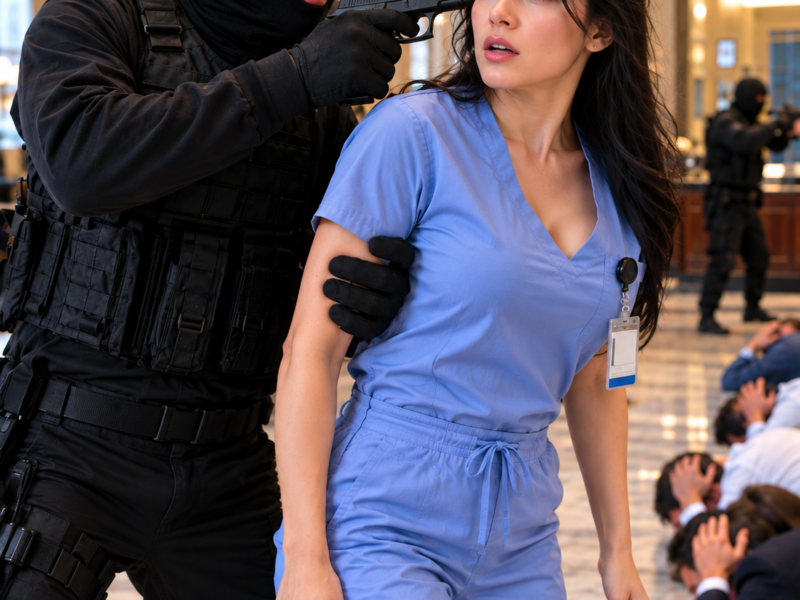
“Put the gun against her head,” the robber ordered, laughing as the entire bank dropped to its knees. “Let’s see if the brave little nurse still wants to play hero.
The gun was still pressed against my temple when the first police cruiser stopped outside the bank. I could hear the officers shouting through the glass, ordering everyone inside to remain calm, but the man holding me only tightened his grip.
“Tell them to back off,” he whispered. “Tell them if they come through that door, I’ll start killing people.”
I forced myself to breathe slowly.
My name was Hannah Mitchell. To the people waiting for treatment at St. Mary’s Medical Center, I was an emergency nurse who worked too many night shifts and drank too much coffee. To the three men holding Atlantic Federal hostage, I was just another frightened civilian.
They had no idea what I had done before I ever put on hospital scrubs.
They didn’t know about the nights overseas when the difference between life and death came down to a steady hand, a clear head, and the ability to recognize fear before it turned into violence.
And I intended to keep it that way for as long as possible.
“Please,” I said softly to the man with the scar above his eyebrow. “There are injured people here. Let me help them.”
He gave a short, humorless laugh.
“You think you’re in charge?”
“No,” I answered. “I think if that woman loses too much blood, you’re going to have another problem you don’t need.”
His eyes flicked toward Patricia, the woman he’d shot in the arm.
She sat on the polished floor near a row of waiting chairs, her face pale and wet with tears. One hand clutched her wounded arm while the other pressed against the shoulder of a terrified young man who looked barely old enough to shave.
The bullet had torn through the soft tissue of her upper arm. It was bleeding heavily, but she was conscious, breathing, and able to follow instructions.
For now.
“She’s not dying,” the leader snapped.
“You don’t know that.”
His jaw tightened.
For one brief second, I saw something behind his anger. Not remorse. Not yet. Something closer to panic.
That mattered.
A man who believed he had complete control was dangerous. A man who knew things were slipping away could be even more dangerous, but he might still be reached.
I lowered my voice.
“Let me stop the bleeding. I won’t try anything.”
He studied me as if he were searching for a hidden weapon beneath my clothes.
Then he shoved me toward Patricia.
“Fine. But you move wrong, and I’ll put a hole in you.”
I stumbled, caught myself against a chair, and dropped beside her.
“Look at me,” I told Patricia. “I’m Hannah. I’m a nurse. I need you to keep your eyes open for me.”
She nodded frantically.
“Am I going to die?”
“Not if I can help it.”
I pressed a clean cloth against the wound and applied firm pressure. She cried out, her fingers gripping my wrist, but I kept my voice calm and steady.
“I’m sorry. I know it hurts. Keep breathing with me. In through your nose, out through your mouth.”
As I worked, I listened.
The robber at the vault was muttering to himself. The one at the entrance kept glancing through the glass, shifting his weight from foot to foot. The leader paced in short, sharp movements, his pistol never far from his hand.
Three men. Three different kinds of fear.
The man at the vault was focused on the task. The guard was watching the police. The leader was watching everyone.
And he was beginning to lose patience.
“What’s taking so long?” he shouted toward the counter.
The man behind it slammed something against the metal door.
“The second authorization isn’t working! The manager said it needs another code!”
“Then make him give it to you!”
“He says he can’t!”
The leader turned toward the bank manager, who stood near the teller stations with his hands raised.
“You told me you could open it.”
“I said I could help,” the manager stammered. “I can’t override the system by myself. The vault has a time delay.”
The leader crossed the floor in three long strides and grabbed him by the collar.
“Are you telling me you lied?”
“No! Please! I’m telling you the truth!”
The manager’s shoes slipped on the polished floor as the robber dragged him closer.
I looked down at Patricia and pressed the cloth more firmly against her wound.
“Stay with me,” I whispered.
Then the gunshot came.
It wasn’t a bullet striking anyone. The leader had fired into the ceiling.
The sound tore through the bank like an explosion. Several people screamed. A child began sobbing. The young man beside Patricia threw his hands over his head and curled into a ball.
“EVERYBODY SHUT UP!”
The leader’s voice cracked against the marble walls.
For a moment, even the air seemed to stop moving.
He released the manager and turned toward the entrance, where blue and red lights flashed through the windows.
“They’re surrounding us,” the guard said.
“Then tell them to move!”
“They’re not going to move just because I ask!”
The leader pointed his gun at him.
“Do you want to be the next one who finds out what happens?”
The guard fell silent.
I had seen that expression before. The moment when a frightened person realizes the man beside him might be more dangerous than the people outside.
The robbers were no longer a team. They were three desperate men sharing a room, each waiting for the others to make a mistake.
That was a dangerous situation, but it was also an opening.
I finished securing the pressure dressing around Patricia’s arm. Her bleeding had slowed, although she needed emergency medical care as soon as it was safe to move her.
I checked her fingers for warmth and movement.
“Can you wiggle them?”
She did, trembling.
“Good. Keep your arm still.”
Then I looked toward the leader.
“She’s stable for the moment,” I said.
He stared at me.
“Did I ask you for a report?”
“No.”
“Then stop talking.”
I lowered my eyes.
But as I did, I noticed a small detail that changed the way I understood him.
His right hand was shaking.
Not much. Just enough to make the barrel of his pistol tremble when he held it away from his body.
He was trying to hide it by clenching his jaw, but his breathing had become shallow. Sweat shone along his hairline.
He wasn’t simply angry.
He was coming apart.
A voice crackled from the loudspeaker outside.
“This is the Norfolk Police Department. We know there are people inside who need help. We want everyone to leave safely. We are prepared to talk.”
The leader barked a laugh.
“Talk? They want me to walk out with my hands up so they can put me on the ground.”
I remained quiet.
He looked at me again.
“You think that’s what happens?”
I met his eyes carefully.
“I think they want this to end without anyone else getting hurt.”
“You don’t know anything about what they want.”
“You’re right. I don’t know what they want.” I paused. “But I know what happens when people stop listening to each other.”
His expression hardened.
“You some kind of therapist now?”
“No. Just a nurse.”
“Then stick to nursing.”
He turned away, but he didn’t tell me to move.
I took that as permission to remain where I was.
Minutes passed. The sirens continued outside. The police negotiator spoke occasionally through the loudspeaker, never shouting, never threatening, never letting the silence last long enough for the situation to feel abandoned.
The man at the vault finally backed away from the door.
“It’s locked down. We can’t get in.”
The leader stared at him as if he hadn’t understood.
“What did you say?”
“The system’s locked. The delay won’t clear. We need to go.”
“We didn’t come here to leave empty-handed!”
“We’re already surrounded!”
The leader grabbed the front of his shirt.
“You told me this would work!”
“And you said there’d be no shooting!”
That accusation landed harder than a punch.
The leader shoved him away.
“Shut your mouth.”
The guard moved closer to the entrance, his pistol lowered but still in his hand.
“Listen,” he said. “We can still get out if we make them give us a vehicle. We take the manager and—”
“No one leaves until I say so!”
The guard looked at him, then at the injured woman, then at the children huddled beneath the chairs.
For the first time, I saw something other than fear in his face.
Shame.
It was brief, but it was there.
The leader noticed it too.
“What’s that look for?”
“Nothing.”
“You think you’re better than me?”
“I didn’t say that.”
“You don’t have to!”
He raised his gun again, and the guard backed away.
I felt my pulse beating against my throat.
I had treated gunshot wounds in places where the nearest hospital was hours away. I had watched brave people freeze and frightened people perform acts of extraordinary courage. I had learned that training did not eliminate fear.
It gave fear somewhere to go.
But I had no weapon, no body armor, no team beside me, and no clear view of what the police were doing outside.
I was a nurse in a bank, surrounded by civilians, with one man close to the edge of a decision that could not be undone.
I needed to keep him talking.
“What’s your name?” I asked.
His head snapped toward me.
“What?”
“Your name.”
He stared at me, apparently unable to decide whether I was mocking him.
“Why?”
“Because if I’m going to talk to you, I’d rather not call you ‘the man with the gun.’”
For a moment, I thought he might shoot me just for asking.
Then he gave a bitter smile.
“Derek.”
“All right, Derek.”
“Don’t act like we’re friends.”
“I won’t.”
He studied me, suspicious of the fact that I hadn’t argued.
“What do you think happens to people like me?” he asked suddenly.
I chose my words carefully.
“I don’t know your life, Derek. I don’t know what brought you here.”
“You think I woke up one morning and decided to do this for fun?”
“I didn’t say that.”
“My brother’s dead. My mother can’t pay her bills. The bank took everything we had, and the people responsible are sitting in offices somewhere, drinking coffee like nothing happened.”
His voice was rising, but the anger had changed. It was no longer directed entirely at the people in front of him.
“Maybe I got tired of watching everyone else get away with everything.”
I could hear the pain beneath the words. I could also see the pistol in his hand.
“I’m sorry about your brother,” I said.
“Don’t.”
“I mean it.”
“Don’t you dare feel sorry for me.”
He stepped closer, his face inches from mine.
“You don’t know what it’s like to lose everything.”
I looked at the people on the floor behind him.
“No,” I said quietly. “But I know what it’s like to lose someone and still have to decide what kind of person you’re going to be afterward.”
His expression changed.
It wasn’t recognition. Not exactly.
It was the sudden awareness that I wasn’t frightened in the way he expected.
“Who are you?” he asked.
“Someone who wants everyone to get out alive.”
He held my gaze for another second before turning away.
Outside, the negotiator spoke again.
“Derek, we need to know the condition of the hostages. If anyone is injured, we can arrange medical assistance.”
Derek laughed sharply.
“Tell them everyone’s fine!”
I looked at Patricia.
Her face had gone pale again. She was fighting to stay alert.
“She’s injured,” I said before I could stop myself. “She needs an ambulance.”
Derek swung around.
“I told you to shut up!”
He seized my arm and pulled me upright. Pain shot through my shoulder as his fingers tightened.
The gun came up between us.
“Maybe I should make an example out of you.”
Every instinct in my body sharpened.
I noticed the angle of his wrist, the tension in his shoulder, the distance between his feet. I noticed the guard taking one small step toward us before stopping when Derek glanced his way.
I also noticed the young man beside Patricia lifting his head.
He was staring at Derek with wide, terrified eyes.
I shook my head almost imperceptibly.
Not yet.
Derek pressed the muzzle against my forehead.
“You think you’re brave?”
“No.”
“You think I’m a coward?”
“No.”
“Then why aren’t you begging?”
I swallowed, keeping my hands visible.
“Because I don’t think you want to shoot me.”
His eyes flashed.
“You don’t know what I want!”
“You’re right. I don’t.” I kept my voice low. “But if you shoot me, you’ll have one more person hurt and nothing closer to getting out of here.”
His hand trembled harder.
For one awful second, I thought the argument was over.
Then the guard spoke.
“Derek. Put the gun down.”
Derek turned slowly.
“What did you say?”
The guard raised his empty hand.
“We’re done. The vault’s not opening. The cops aren’t leaving. Nobody else needs to get hurt.”
Derek pointed the gun at him.
“You’re giving me orders now?”
“No. I’m telling you it’s over.”
“Get on the floor!”
The guard hesitated.
“NOW!”
He dropped to his knees, placing his hands on top of his head.
Derek’s breathing became ragged. His eyes darted from the guard to the bank manager, then to me.
He was surrounded by evidence that he had lost control, and he couldn’t bear to look at any of it.
Then a child’s voice broke through the silence.
“Mommy?”
A little girl had crawled out from behind a chair. She couldn’t have been older than six. Her mother reached for her from the floor, whispering desperately for her to come back.
The girl was crying too hard to understand.
Derek looked at her.
His face tightened.
“Get her out of here,” he snarled.
Her mother pulled the child against her chest.
“Please don’t hurt us,” she whispered.
Something in Derek’s expression cracked.
For an instant, I saw a man who understood exactly what he had become and couldn’t find a way to turn back.
Then the front doors rattled as someone outside moved into position.
Derek jerked toward the sound and raised his weapon.
“No!”
The word came from me before I could think.
He spun around, aiming at my chest.
“YOU DON’T TELL ME WHAT TO DO!”
I froze.
His finger tightened around the trigger.
Then Patricia cried out behind him.
Not from pain.
From fear.
“Please,” she whispered. “My daughter is outside. I was only trying to get home to her.”
Derek’s eyes flicked toward her.
It lasted less than a second.
But in that second, his gun moved away from my chest.
I took a slow breath.
“Derek, look at me.”
He did.
“You can still choose what happens next.”
His face twisted.
“You think I can just put this down and everything goes back to normal?”
“No. It won’t.”
“Then what’s the point?”
“Because those people on the floor didn’t cause what happened to you. And whatever happens when you walk out of this building, you don’t have to make it worse right now.”
He shook his head, almost violently.
“You don’t understand.”
“Maybe not.”
I took one careful step toward him.
“But I understand that you’re scared.”
His eyes went cold.
“I’m not scared.”
“Then you don’t have to prove anything to me.”
The silence that followed seemed to stretch forever.
The gun was still in his hand.
The police were still outside.
And the civilians were still trapped between us.
Then Derek made a decision.
He grabbed me by the arm, pulled me against him, and backed toward the entrance.
“We’re leaving,” he shouted. “You’re coming with me.”
The guard stared at him.
“Derek, don’t.”
“Move!”
He dragged me toward the glass doors. I stumbled, forcing myself not to resist. A sudden movement could make him fire. A struggle could turn the entrance into a killing ground.
Through the glass, I could see officers crouched behind vehicles, weapons trained toward the bank.
Derek shoved the barrel against my ribs.
“Tell them to move back!”
I raised my voice.
“Please stay where you are! There are civilians behind us!”
The negotiator’s voice came through a loudspeaker.
“Derek, stop where you are. We can work this out.”
“Move your people!”
“We want everyone to leave safely.”
“Then back up!”
Derek’s grip tightened around my arm. I could feel the sweat on his palm.
He was no longer thinking about the vault. He wasn’t thinking about money or escape routes. His entire world had narrowed to the doors, the police, and the fear that they were about to take away the last thing he believed he controlled.
Me.
I looked at the officers outside and then back at Derek.
“Don’t make them choose between you and the people behind us,” I said.
He shoved me forward.
“SHUT UP!”
The entrance was only a few feet away.
Then I heard a different sound behind us.
A chair scraping across the floor.
The young man who had been sitting beside Patricia stood up.
“Hey!”
Derek whipped around.
The young man immediately regretted it. His face drained of color, and his hands flew upward.
“I’m sorry,” he stammered. “I didn’t—”
Derek raised the gun.
“Get down!”
The young man froze.
I saw the barrel turn toward him.
There was no time for another argument.
“Derek!”
He glanced at me.
I moved.
Not toward the gun, but sideways, breaking the line between Derek and the young man as I pulled the nearest chair into the space between them.
The gun fired.
The blast was deafening.
The bullet struck the chair, splintering the wood. I dropped to the floor, dragging the young man down with me as people screamed and scattered.
For one instant, everything became noise and motion.
Then I heard Derek shouting.
“Get up! GET UP!”
He was standing over me, his weapon still raised.
I looked at the shattered chair, the frightened young man, and the people huddled against the walls.
The gun had nearly killed someone who had done nothing except stand up.
I felt the old, cold clarity settle over me.
Not anger.
Not panic.
A decision.
“Derek,” I said, slowly rising to my knees. “It’s enough.”
He pointed the gun at me.
“You don’t get to decide that!”
“No,” I answered. “But you do.”
His eyes were wild.
“You think I’m going to prison?”
“I think another shot won’t change anything.”
He shook his head, breathing hard.
“They’ll kill me.”
“I don’t know what they’ll do. But if you keep pointing that gun at people, you’re making it harder for anyone to help you.”
He stared at me.
I could see the battle happening behind his eyes. The man who had entered the bank that morning with a plan was gone. In his place stood someone who had run out of plans and couldn’t accept that the world had not stopped to accommodate his desperation.
The negotiator’s voice came again.
“Derek, we heard the gunshot. Is anyone hurt? We need you to tell us.”
Derek looked at the door.
Then at me.
Then at the people on the floor.
For the first time since he had entered the bank, he seemed to notice how many of us there were.
How many lives he had placed in his hands.
His gun dipped an inch.
I didn’t move.
“That’s it,” I said softly. “Just breathe.”
He gave a broken laugh.
“Don’t tell me to breathe.”
“Then just listen.”
The room was silent except for the distant sirens and the small, frightened sobs of the child near the chairs.
I could feel every person watching us.
Derek’s arm trembled.
“I didn’t want to shoot anybody,” he whispered.
“I believe you wanted this to go differently.”
His eyes filled with tears, though he seemed furious with himself for allowing them to appear.
“I just wanted them to listen.”
“Then let them hear you now.”
He looked toward the doors.
The negotiator spoke again, calm and patient.
“Derek, we are listening.”
Derek’s lips parted, but no words came.
His gun lowered another inch.
Then the man at the vault moved.
It was a tiny movement, a shift of his knee as he began to rise. Perhaps he wanted to surrender. Perhaps he thought Derek was distracted enough to escape.
Derek saw him.
“DON’T MOVE!”
The gun snapped back up.
The guard flinched.
The young man beside me ducked.
And I knew the fragile moment was about to shatter.
“Derek,” I said, keeping my voice level, “look at me. Not him. Me.”
He turned his head.
I held his gaze.
“You’re the one holding the gun. You’re the one who can stop this.”
His face crumpled.
For a moment, he looked so exhausted that he seemed unable to keep standing.
Then his arm dropped.
The gun hit the floor with a sharp metallic clatter.
Nobody moved.
Derek stared at the weapon as though he couldn’t understand how it had left his hand.
I slid away from him, keeping my hands visible.
“Step back from it,” I said quietly.
He obeyed.
“One more step.”
He took another.
I didn’t approach him. I didn’t try to seize him or pretend the danger had disappeared. I moved behind a concrete pillar near the entrance and raised my hands toward the officers outside.
The negotiator shouted instructions.
“Everyone inside, move away from the suspect! Derek, get on your knees and place your hands on your head!”
Derek sank to his knees.
His hands rose slowly.
The front doors opened, and officers entered with weapons trained on him. They moved with controlled urgency, shouting commands and securing the area. One officer took custody of the pistol while others restrained Derek and the two remaining robbers.
The man at the vault surrendered without resistance.
The guard lay flat on the floor, his hands locked behind his head, repeating that he hadn’t fired a shot.
Within seconds, the bank was full of uniforms, radios, and urgent voices.
Someone guided me toward a wall.
Someone else began checking the hostages.
A paramedic hurried to Patricia, and I immediately stepped aside so the medical team could take over.
“She’s been shot in the upper arm,” I told him. “I applied direct pressure and secured a dressing. Her fingers were moving and warm when I last checked.”
The paramedic nodded, already examining her.
“Good work. We’ll take it from here.”
Only then did I notice my own hands shaking.
I looked down at them, surprised.
For years, I had believed that if I could remain calm during the worst moments of someone else’s life, I had learned how to remain calm during my own.
I was wrong.
My hands shook harder.
I pressed them together until the tremor eased.
A police officer approached me.
“Ma’am, are you injured?”
“No.”
“Are you sure?”
“My shoulder hurts where he grabbed me, but I don’t think anything is broken.”
He glanced toward the shattered chair.
“Were you the one who moved the other civilian?”
“Yes.”
He studied me for a moment.
“Have you had tactical training?”
I hesitated.
It had been a long time since I had spoken about that part of my life with anyone outside a very small circle.
“Some,” I said.
He looked as if he wanted to ask more, but a paramedic called him away.
I sat down beside the wall.
The little girl who had cried for her mother was now wrapped in a blanket. Her mother held her tightly, whispering into her hair. The young man whose life had nearly ended beside me sat nearby, staring at his hands.
Patricia was being moved onto a stretcher.
As the paramedics wheeled her toward the entrance, she reached for my hand.
“Hannah?”
I leaned closer.
“I’m here.”
“Thank you.”
Her voice was weak, but her eyes were clear.
I squeezed her fingers gently.
“Save your strength. Go see your daughter.”
She smiled through her tears.
Then she was gone, carried into the sunlight and the waiting ambulance.
I watched the doors close behind her.
For a moment, I was back somewhere else.
A different country. A different set of doors. A different stretcher moving away while someone shouted for supplies I didn’t have.
I could almost smell the dust and hot metal.
I closed my eyes.
Not here, I told myself.
Not now.
A woman in a police uniform knelt beside me.
“I’m Sergeant Ellis. I need to ask you a few questions, but first I want to make sure you’re all right.”
“I’m all right.”
She glanced at my face.
“You don’t look all right.”
I gave a tired laugh.
“That’s fair.”
She introduced herself again, then asked what had happened. I explained the sequence as carefully as I could, sticking to what I had seen and heard.
When I described the moment Derek had dropped his weapon, she listened without interrupting.
“You kept him talking,” she said.
“I tried.”
“And you stopped him from firing at that young man.”
“I moved a chair.”
“You made a decision under pressure. That’s not nothing.”
I looked down at my hands.
“I didn’t want anyone else to die.”
Sergeant Ellis was quiet for a moment.
“Were you in the military?”
I looked up.
“Yes.”
“What did you do?”
I hadn’t expected the question to hurt.
For years, I had learned how to answer it without saying too much. I had learned how to describe my old life in broad terms, leaving out the nights that returned in my dreams and the names I still couldn’t say without feeling something tighten inside my chest.
“I served as a combat medic attached to a Navy SEAL team,” I said. “I spent time overseas.”
Her expression changed, but she didn’t look at me like I was a hero.
I was grateful for that.
“How long ago?”
“Long enough.”
She nodded, accepting the boundary.
“Thank you for your service. And thank you for what you did today.”
I looked across the bank at the people being escorted outside.
“Please don’t call it heroism.”
“What would you call it?”
I thought about Patricia’s blood on my hands, the child’s frightened voice, and Derek’s shaking fingers.
“Trying to keep people alive.”
Sergeant Ellis didn’t argue.
Outside, the bright Virginia sunlight seemed almost offensive after the dim, frightened hours inside the bank. The police had secured the building. Officers were guiding the last hostages toward waiting family members, ambulances, and counselors.
I walked out slowly, accompanied by a paramedic who insisted on checking my shoulder.
The air smelled of rain on hot pavement, although the sky was clear.
Across the street, a small crowd had gathered behind the police barricades. People held phones above their heads. A news van had arrived. Someone was already telling a reporter that a nurse had saved everyone inside.
I kept my head down.
I didn’t want to be a headline.
I wanted to go home, take off my clothes, wash my hands, and sit in a quiet room until my heart remembered that the danger was over.
Then I saw Derek being led from the bank.
His hands were cuffed behind him. His head hung low, and the scar above his eyebrow looked darker in the sunlight.
As officers guided him toward a waiting vehicle, he stopped.
He turned toward me.
For a moment, I thought he might shout or blame me for what had happened.
Instead, he spoke quietly enough that only those nearest him could hear.
“I’m sorry.”
I stared at him.
There were a thousand things I could have said. That an apology would not erase the bullet in Patricia’s arm. That it would not undo the terror he’d inflicted on a room full of strangers. That whatever pain had brought him there, it did not give him the right to make other people suffer.
But I also knew that if I tried to make one sentence carry every truth, I would say nothing useful at all.
So I answered with the only thing I could honestly offer.
“Then don’t let this be the worst thing you ever do.”
His eyes filled again.
The officers guided him into the vehicle, and the door shut.
I watched it pull away.
I didn’t forgive him. Not then.
But I hoped he would remember the moment when he had a choice and finally made a different one.
That night, I didn’t sleep.
Every time I closed my eyes, I heard the gunshot striking the chair. I saw Patricia’s pale face. I felt the cold pressure of the pistol against my skin.
At three in the morning, I gave up trying to rest and drove to the hospital.
My colleagues had already heard what happened. News reports were circulating online, and someone had recognized me in a photograph taken outside the bank.
When I entered the emergency department, my charge nurse, Denise, came straight toward me.
“You are supposed to be home,” she said.
“I know.”
“You were held at gunpoint today.”
“I noticed.”
She pulled me into a hug before I could say anything else.
For a few seconds, I let myself lean against her.
Then she stepped back and looked me in the eyes.
“You don’t have to work tonight.”
“I know.”
“You don’t have to prove you’re fine.”
That was the sentence that finally broke through.
I sat down in the staff room and cried.
Not because I was weak. Not because I regretted what I had done.
I cried because I had spent years convincing myself that the part of me that had lived through war could be locked away neatly, like a uniform in the back of a closet.
But it had never been gone.
It had simply been waiting for a moment when someone needed me to act.
And now, after the danger had passed, my body was finally allowing me to feel the fear I’d kept at a distance.
Denise sat beside me until the tears stopped.
She didn’t ask me to explain. She didn’t tell me to be grateful that I was alive.
She just stayed.
Over the following days, the details of the robbery became public.
Derek Lawson, the leader, had lost his job months earlier and was facing serious financial problems. His brother had died in an accident the previous year, and Derek had become increasingly isolated. The other two men had known him through an acquaintance and had agreed to help him rob the bank.
Those details explained some things.
They excused nothing.
The guard at the entrance had not fired a shot, but he had knowingly participated in an armed robbery. The man at the vault had helped plan the crime. All three were arrested and charged.
Patricia survived surgery. The bullet had damaged muscle and soft tissue but had missed the major vessels in her arm. A week later, I received a message from her through the hospital’s patient liaison office.
She wanted to thank me in person.
We met in the hospital cafeteria two weeks after the robbery. Her arm was in a sling, and she looked tired, but she was smiling.
She brought a photograph of a little girl with two missing front teeth.
“My daughter,” she said. “I was on my way to pick her up when I stopped at the bank.”
I studied the photograph.
“She must have been terrified when she heard what happened.”
“She was.” Patricia swallowed. “I keep thinking about how close I came to not seeing her again.”
I didn’t know what to say.
She reached across the table and touched my hand.
“You kept talking to me. You made me believe I could get through it.”
“You did that yourself.”
“Maybe.” She smiled faintly. “But you helped me remember.”
We sat together for a while, talking about ordinary things. Her daughter’s school. My long shifts. The weather. The small, familiar details that had seemed insignificant before the robbery but now felt precious.
When we finally stood to leave, Patricia hugged me carefully so she wouldn’t hurt her arm.
“I hope you know you saved more than my life,” she whispered.
I held her for a moment longer than I intended.
After she left, I sat alone and watched sunlight move across the cafeteria floor.
I thought about the people who had been inside the bank. The child in her mother’s arms. The young man who had stood up at the wrong moment. The manager who had been dragged across the floor. The guard who had finally challenged Derek. The wounded woman who had fought to stay conscious.
I thought about how close we had all come to becoming names in a news report.
And I thought about Derek.
A month later, I was asked to give a statement during the preliminary proceedings. I answered the questions honestly. I described the gun, the threats, the shot fired into the ceiling, and the moment the chair was struck.
Derek sat at the defense table, thinner than he had been at the bank. He didn’t look toward me until the questioning was over.
When our eyes met, he gave a small, uncertain nod.
I returned it.
That was all.
I wasn’t responsible for saving him from the consequences of what he had done. I wasn’t responsible for making his life easier or turning his regret into redemption.
I had done what I could to keep him from killing someone.
The rest was his responsibility.
In the months that followed, I returned to my regular shifts. At first, the sound of a dropped metal tray made my heart race. I found myself watching people’s hands when they entered the emergency department. I chose seats with clear views of the exits without even thinking about it.
I spoke with a counselor who understood the effects of trauma, and I allowed my colleagues to help when I needed it.
Slowly, the bank became a memory rather than a place I visited every night in my dreams.
One evening, a young nurse named Olivia joined me during a quiet stretch in the emergency department.
She had started working at St. Mary’s only a few weeks earlier, and I had noticed how carefully she watched me when she thought I wasn’t looking.
“Can I ask you something?” she said.
“Of course.”
“Is it true you were a Navy SEAL medic?”
I smiled a little.
“I was a combat medic attached to a Navy SEAL team.”
“And you really stopped three armed robbers?”
“No,” I said. “I helped keep people alive while the police handled the situation.”
She considered that.
“But you weren’t afraid?”
I leaned back against the counter.
“I was terrified.”
She looked surprised.
“Then how did you do it?”
I thought about the bank’s polished floor, the gun at my temple, and Patricia’s fingers wrapped around my wrist.
“Being afraid doesn’t mean you can’t do something useful,” I told her. “It means you have to decide what matters more than your fear.”
Olivia was quiet for a moment.
“I’m not sure I’d be able to do that.”
“Neither was I, once.”
She smiled, and the conversation moved on to the next patient waiting for treatment.
But her question stayed with me.
For a long time, I had believed courage was something people carried inside them, like a fixed quality. Some people had it, and others didn’t.
Now I understood it differently.
Courage was a series of small decisions made while fear stood right beside you.
Keep pressure on the wound.
Keep your voice steady.
Don’t make a sudden movement.
Give the frightened person a chance to choose differently.
And when the moment came, remember that every person in the room was more than the worst thing they had ever done.
The day of the robbery, Derek had held a gun to my head because he believed fear was the only thing that could give him control.
He had mistaken silence for obedience and terror for power.
But the moment that changed everything wasn’t when the police arrived or when his weapon hit the floor.
It was the moment he looked at the people he had endangered and realized they were human beings, not pieces on a board.
That realization hadn’t erased his crime.
It had simply given him one last chance to stop making it worse.
I never learned what Derek thought about during the long years that followed. I didn’t need to.
I knew what I had learned.
I had survived war, carried grief into a hospital, and tried to build a quiet life around the memories I couldn’t leave behind.
I had thought the past was something I needed to outrun.
But when a gun was pressed against my head in that bank, I discovered that the past had also left me with something worth keeping: the ability to stay present when someone else was losing control.
I wasn’t invincible.
I wasn’t fearless.
I was a nurse who had learned, through painful experience, that sometimes the smallest act of courage was simply refusing to let panic make the next decision.
And every morning after that, when I walked through the emergency department doors at St. Mary’s Medical Center, I carried that lesson with me.
Not as a story about a hero.
Not as proof that I could face anything.
But as a quiet promise to the people who would come through those doors on the worst day of their lives.
Whatever happened, I would do everything I could to help them make it home.
THe enD.









