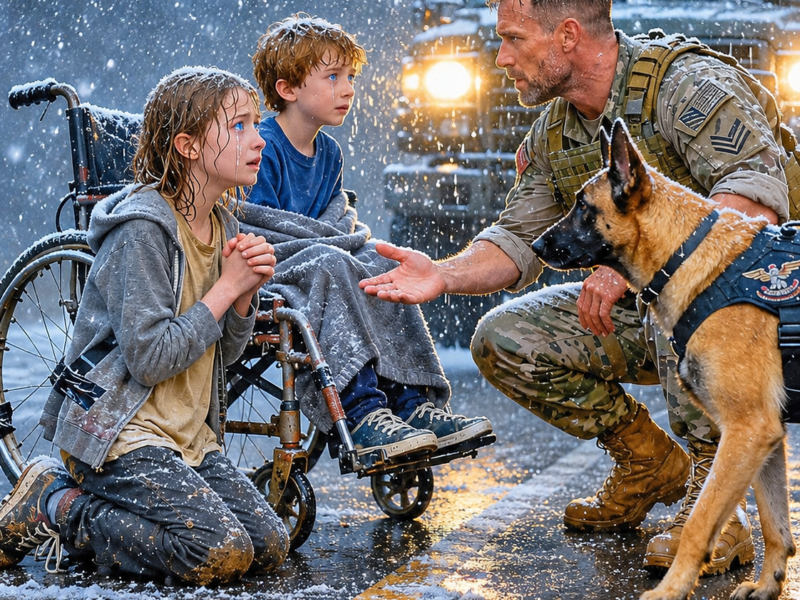
“Please help my brother,” the little girl begged, stepping into the middle of a deserted highway as my Navy SEAL instincts screamed for me to stop
I didn’t answer the man outside.
I watched the shadow beneath the shed door and listened to the rain striking the corrugated roof.
Thirty seconds was a long time when someone wanted you frightened.
It was also enough time to make a mistake.
I had made too many mistakes in my life by reacting to what other people wanted me to believe.
This time, I would decide what happened next.
“Noah,” I whispered, “can you stand?”
He tried to push himself up, but pain folded him back onto the concrete.
“Not by myself.”
I cut the plastic restraints around his wrists and checked the wound beneath his shirt.
The bleeding wasn’t as heavy as it looked, but his breathing was shallow, and his skin felt cold.
“We need a medic,” I told him.
“They won’t let you call one.”
“That’s not your decision to make.”
I pulled a compact medical kit from my truck bag and pressed gauze against the wound.
Rex stood beside the door, ears forward, waiting for my command.
Outside, the man tapped twice against the wood.
“Twenty seconds, Chief.”
I leaned close to Noah.
“Is there another way out?”
He nodded toward the back wall.
“There’s a service hatch behind those shelves. It leads into a drainage channel.”
“Does it connect to the road?”
“Not directly. It runs down the hill.”
I glanced at the shelves.
They were stacked with rusted tools, broken buckets, and old electrical equipment.
“Can you crawl?”
“If I have to.”
“You won’t be doing it alone.”
I slid Noah’s arm over my shoulder and helped him stand.
He nearly collapsed, but I caught him before he hit the floor.
Rex moved to the back wall and sniffed beneath the lowest shelf.
Then he scratched at the metal frame.
“Good boy.”
I shifted the shelf aside, revealing a square hatch almost hidden beneath a layer of dirt.
The lock had already been broken.
Someone had prepared this escape route before we arrived.
That bothered me.
A lot.
I helped Noah lower himself through the opening, then followed with Rex close behind.
The passage was barely wide enough for my shoulders.
Cold water flowed over the concrete beneath our boots.
Behind us, the shed door slammed open.
“Check the building!”
A flashlight beam swept across the floor above our heads.
I pulled the hatch closed as quietly as I could.
For several seconds, I heard only boots and the scrape of metal.
Then a voice came from the shed.
“He’s gone.”
Another man answered.
“Then find the girl. The boy is no longer our priority.”
Noah stiffened against me.
“They know Emily’s here.”
“Then we’ll make sure they don’t get near her.”
I kept moving.
The drainage channel curved beneath the hillside, carrying us toward a stand of trees below the road.
When we emerged, the storm had weakened, but the night remained black.
I checked my phone.
No signal.
The highway lay somewhere above us.
I could hear the faint hum of an engine moving along it.
Noah leaned against a tree and closed his eyes.
“Don’t fall asleep yet,” I told him.
“I’m trying.”
“I know. Keep talking to me.”
“About what?”
“Your father.”
His eyes opened.
For the first time, the fear in his expression gave way to something else.
Love.
“He used to say that if you couldn’t tell whether a person was lying, you should watch what they did when nobody was looking.”
I thought about the man recording us from the SUV.
“Sounds like good advice.”
“He taught me how to read maps. How to tie knots. How to tell if somebody had followed us.”
“How old were you when he disappeared?”
“Seven.”
“And Emily?”
“She’s my cousin. Her mom died two years ago. My dad promised he’d look after her if anything happened.”
Noah swallowed.
“He kept that promise, even when he couldn’t come home.”
I looked toward the ridge.
“Tell me what happened tonight.”
Noah took a slow breath.
“My father contacted me three days ago. He said he’d found proof that the ambush that killed his team had been arranged. He told me to meet him near an old relay station.”
“Did you see him?”
“For a few minutes.”
“And then?”
“A vehicle came up the access road. He pushed me into a storage room and told me to take the tag to a woman named Emily if I got the chance.”
“Why Emily?”
“Because she was supposed to be leaving the area with a family friend. He thought she’d be safer than me.”
Noah looked down at the metal tag in my hand.
“He said if I saw you, I should give you the tag and ask you one question.”
“What question?”
“Why did you stop transmitting eleven minutes before the ambush?”
The night seemed to grow colder.
I stared at him.
Four years earlier, our team had been sent to recover an intelligence source from a remote compound.
The briefing had described the route as secure.
The source had been identified as a man who possessed information about illegal weapons transfers.
We were told the area had been cleared.
But when our convoy entered the valley, armed men appeared on both ridgelines.
The first explosion overturned the lead vehicle.
Gunfire erupted from positions we had been assured were empty.
James Carter pulled two wounded men from the wreckage before a second blast threw him into the dust.
I remembered shouting into my radio.
I remembered the static.
And I remembered the transmission failure that had left us without command support during the most critical minutes.
Afterward, investigators told us the communications blackout had been caused by damaged equipment.
I had believed them.
I had also spent months replaying the last moments before the ambush, trying to understand why I hadn’t recognized the warning signs.
“Your father told you that?” I asked.
Noah nodded.
“He said the official report blamed you for the communication failure.”
My jaw tightened.
“They never charged me with anything.”
“They didn’t have to. They made sure you blamed yourself.”
For a moment, I couldn’t speak.
I’d carried that guilt through my retirement.
It had influenced every decision I’d made since leaving the Navy.
I had convinced myself that if I stayed isolated, if I never took another command, if I never allowed anyone to depend on me, I couldn’t make the same mistake again.
Now a wounded young man was telling me that the failure I had blamed myself for might not have been mine.
I forced myself to focus.
“First, we get you medical care. Then we find your father.”
Noah nodded.
“And Emily?”
“We find her too.”
I helped him toward the road.
Rex stayed close, checking the darkness every few steps.
We reached an abandoned service lane about ten minutes later.
I recognized the turnoff.
My truck was parked less than a mile away, but going back would mean approaching the men who had entered the shed.
I needed another way to get help.
At the edge of the lane, I spotted an old maintenance box mounted beside a utility pole.
A faded emergency number was printed on its side.
I used the remaining signal on my phone to send a short text to the one person I trusted to understand it.
MARA. NEED MEDICAL RESPONSE AND FEDERAL CONTACT. LOCATION ATTACHED. POSSIBLE ARMED PURSUIT. DO NOT USE LOCAL DISPATCH.
Mara Ellis had been my communications specialist during my final years in service.
After leaving the Navy, she’d joined a federal investigative unit that handled security breaches involving military contractors.
We hadn’t spoken in months, but I still had her secure contact.
The message showed as sent.
That was something.
I helped Noah sit beneath the utility shelter and wrapped a thermal blanket around his shoulders.
Rex settled beside him, keeping his body between Noah and the road.
“Is he always like this?” Noah asked.
“Like what?”
“Like he knows when somebody’s coming.”
I looked at the dog.
“He’s usually right about people. Less reliable around squirrels.”
Noah gave a weak laugh.
It was the first normal sound I’d heard from him.
Then headlights appeared around the bend.
I stepped into the lane and raised my flashlight.
The vehicle slowed.
A white pickup rolled to a stop about twenty feet away.
The driver’s window lowered.
A woman in her forties leaned across the passenger seat.
“Daniel Mercer?”
My hand moved toward my waistband.
“Who are you?”
“Mara Ellis.”
I stared at her.
She looked older than the last time I’d seen her, with short hair and a deep line between her eyebrows.
But it was her.
She held up both hands.
“I got your message.”
I didn’t lower my guard.
“How did you find us so quickly?”
“Your location pinged through the emergency network. I was already in the area investigating a Northstar subcontractor.”
Northstar.
The same private security company that had appeared in other investigations I had followed after leaving the Navy.
“You’re working that case?”
“I’m assisting the federal team. Get the boy into the truck.”
I hesitated.
“Mara, there are people trying to take him. They know my name, my service history, and what happened four years ago.”
“I know.”
She glanced toward the road behind us.
“Which is why we need to leave before they reach this lane.”
I helped Noah into the rear seat.
Rex jumped in beside him, then turned to watch the road through the window.
Mara pulled away without turning on the overhead cabin light.
She drove several miles before stopping at a small medical clinic near a state highway.
Two federal agents were waiting inside.
They checked Noah’s wound and began treating him immediately.
A physician confirmed that the injury was serious but not life-threatening.
While the medical team worked, Mara took me into a consultation room.
“Tell me exactly what happened,” she said.
I described Emily on the highway, the SUV, the dog tag, the shed, and the men who had tried to seize Noah.
Mara listened without interrupting.
When I finished, she placed a thin folder on the table.
“James Carter has been the subject of an unofficial search for nearly two years.”
I opened the folder.
Inside were photographs of a man leaving a gas station, entering a warehouse, and standing beside a vehicle with an obscured license plate.
The pictures were grainy, but the face was unmistakable.
James.
Alive.
“Why wasn’t I told?”
“Because the search was classified, and the people handling it couldn’t establish whether your old command had been compromised.”
“You could have contacted me privately.”
“We considered it. But your name appeared in a communications log associated with the original ambush.”
My stomach tightened.
“What communications log?”
Mara turned the page.
A printout showed a sequence of radio transmissions from the night our team was attacked.
One line had been highlighted.
COMMUNICATIONS TERMINATED: MERCER AUTHORIZATION.
I stared at the words.
“That isn’t my authorization.”
“That’s what we suspected.”
She placed a second page beside it.
The digital signature associated with the shutdown command had been created using my identification credentials.
But the timestamp was wrong.
The order appeared to have been issued eleven minutes before the time recorded in my original mission log.
Someone had inserted the shutdown into the record after the fact.
“Who had access to my credentials?” I asked.
“Your command center, the mission’s communications administrator, and two contractors who maintained the network.”
“Names.”
Mara turned to the final page.
One name stood out.
Commander Victor Hale.
He had supervised the mission’s operational planning.
He had also testified at the inquiry that the communication failure was an equipment malfunction.
I remembered his face at the memorial.
His hand on my shoulder.
His words about how no one could have predicted what happened.
I had believed him because I needed someone to tell me it wasn’t my fault.
Now I wondered whether he had been the person who made it happen.
“Where is Hale now?” I asked.
“Retired from active service. He works as a consultant for Northstar Strategic.”
I closed the folder.
“Of course he does.”
Mara’s expression remained serious.
“Daniel, we have reason to believe the ambush was designed to eliminate James and recover information he was carrying. Your team was sent into the valley using compromised intelligence.”
“And when James survived?”
“They needed the official story to hold. The report had to blame a communication failure, not a planned operation.”
I stood and walked to the window.
Outside, the rain was beginning to clear.
A family crossed the parking lot carrying takeout containers.
Ordinary people going home.
I wondered how many ordinary lives had been affected by decisions made in rooms they would never see.
“Where’s Emily?” I asked.
“We found her at the clinic entrance. She’d walked there after losing sight of you in the woods.”
“Is she safe?”
“She is now. One of our agents is with her.”
I let out a breath.
“Then we find James.”
Mara shook her head.
“Not yet.”
I turned.
“Excuse me?”
“We have an active investigation. If we rush in, we could push him into a situation he can’t survive.”
“His son was bleeding in a shed while armed men hunted him.”
“And if we move without knowing who controls the surveillance, James could disappear again.”
Her voice softened.
“I understand what you want to do. But this time, we need to use evidence instead of instinct.”
I wanted to argue.
Part of me still believed that if I moved quickly enough, I could prevent another loss.
But I had spent four years blaming myself for an ambush I hadn’t understood.
I wasn’t going to let anger make the next decision for me.
“What do you need?” I asked.
Mara opened the folder again.
“James left a dead-drop location in his last verified message. We believe the tag contains a key to the data he recovered. If we can decode it, we may learn where he’s hiding and what Northstar is trying to retrieve.”
I looked at the tag.
Its scratched surface caught the fluorescent light.
“How do we decode it?”
“We don’t know yet. That’s why I need you to tell me everything you remember about James.”
I sat down.
For the next hour, I described the man I had served beside.
James was quiet, methodical, and difficult to intimidate.
He had a habit of scratching small marks into the edges of metal objects whenever he was thinking.
He once spent an entire night reconstructing a damaged communications log because he didn’t trust the summary we had received.
And he had a particular way of organizing information.
Three groups of four.
Always.
Mara looked at the dog tag.
“Three groups of four?”
“It’s how he indexed notes. Twelve digits, three sets. He said it was easier to remember than a password.”
She turned the tag over.
Along the edge, almost hidden beneath the scratches, were twelve tiny marks.
Three groups of four.
Mara photographed them and passed the images to a digital forensics specialist.
Less than twenty minutes later, the specialist called back.
The marks corresponded to a sequence of numbers that matched a location grid used in an old military mapping system.
It pointed to an abandoned relay station about thirty miles north of where we had found Noah.
James had left us a destination.
And he had trusted that I would know how to read it.
We assembled a team under federal authorization.
Mara insisted that I remain with the agents rather than lead the entry.
I accepted the restriction, though it wasn’t easy.
Noah was stable enough to speak, but the doctor wouldn’t release him.
Emily stayed with him, sitting beside the bed and holding the dog tag’s empty chain.
Before we left, I spoke to both of them.
“Your father may be at the relay station. We’re going to find him.”
Noah looked at me.
“Don’t let them take him.”
“I won’t abandon him.”
I paused.
“But I can’t promise exactly how this will go.”
Noah nodded slowly.
It was an honest answer, and I owed him one.
The relay station stood on a wooded ridge overlooking an old service road.
The building had once carried emergency radio traffic between remote facilities.
Its windows were boarded, and the antenna tower had been cut off near the base.
A rusted sign warned trespassers to keep out.
Mara’s team approached from two directions.
I remained behind the lead agents until the perimeter was secured.
There were no guards.
No running vehicles.
No sign of a recent struggle.
Inside, the station smelled of wet concrete and old wiring.
A folding table stood in the center of the main room.
On it lay a paper map, a portable radio, and a small envelope bearing my name.
I recognized the handwriting immediately.
James.
I opened the envelope.
Inside was a single page.
Daniel,
If you’re reading this, then Noah reached you.
I am sorry I brought him into this.
I tried to keep him out of the fight, but the people who buried the truth have started moving again.
The tag is the key. The records are the proof.
Do not trust anyone who tells you the mission failed because of a technical problem.
The failure was ordered.
If you want to know why, look at the original extraction schedule.
Then ask who changed it.
James.
I read the letter twice.
Mara stood beside me.
“The original extraction schedule should be in the mission archive.”
“Unless somebody changed that too.”
“We can compare the archived version with the copy your team received.”
I looked around the room.
“James knew we would come here. Why isn’t he waiting?”
Mara pointed toward a second door.
It opened onto a narrow stairwell leading down to a lower storage level.
At the bottom, we found a small room containing a cot, bottled water, a medical bag, and several empty food containers.
James had been there recently.
A radio receiver sat on the table.
Beside it lay a notebook.
The last page contained a list of dates, vehicle registrations, and the names of several Northstar employees.
One name appeared repeatedly.
Victor Hale.
The same commander who had signed off on our mission.
Mara photographed every page.
Then an agent called from the main room.
He had found a small recorder hidden inside the portable radio.
The device contained a single audio file.
Mara played it through a secure headset.
A man’s voice emerged from the speaker.
I recognized Hale.
“Extraction has been moved to the eastern route. The team will receive the revised coordinates at zero-two-hundred.”
Another voice answered.
“That route hasn’t been cleared.”
“It will be by the time they arrive.”
“What about Carter?”
A pause.
“Carter is carrying material that cannot be allowed to leave the valley.”
The recording ended.
Nobody spoke for several seconds.
Mara removed the headset.
“That establishes intent, but we need to authenticate the recording and identify the second speaker.”
I stared at the device.
The second voice sounded familiar.
I couldn’t place it.
Then the radio on the table crackled.
A burst of static.
Three short clicks.
A pause.
Two more.
The same emergency recognition pattern Noah had described.
Mara raised her hand to stop everyone from moving.
She switched on the receiver.
“Identify yourself,” she said.
A man’s voice came through.
“Tell Daniel I’m sorry it took so long.”
I stepped toward the radio.
“James?”
A long silence followed.
Then the voice returned.
“Danny.”
Nobody had called me that in years.
My throat tightened.
“Where are you?”
“Not far.”
“Are you safe?”
“Safe enough.”
“You have a son who nearly died tonight.”
The silence on the other end changed.
It became heavier.
“I know.”
“Then why didn’t you come for him?”
James exhaled slowly.
“Because they were watching him. Every time I got close, they moved him. I thought if I stayed hidden, they wouldn’t know where he was.”
“They found him anyway.”
“I know.”
His voice cracked.
“I’ve made a lot of mistakes.”
I closed my eyes for a moment.
“So have I.”
Mara signaled to an agent to trace the radio transmission.
I kept James talking.
“Where are you?”
“An old forestry shelter south of the ridge. I can’t stay long.”
“James, listen to me. Federal agents are here. We have the recording and the tag. You don’t have to keep running.”
“Who is there with you?”
“Mara Ellis.”
A pause.
“Can I trust her?”
I looked at Mara.
“She brought medical help for Noah. She protected Emily. She’s following the evidence.”
“That isn’t the same as being trustworthy.”
“No,” I agreed. “But it’s a place to start.”
The radio crackled.
Then James said something I hadn’t expected.
“Daniel, did you ever wonder why you were the only survivor who was questioned twice?”
I remembered the inquiry.
The investigators had interviewed me, then called me back a week later to repeat questions about the communications failure.
They had asked me whether I had manually shut down the system.
I had said no.
They had asked whether I had disobeyed a direct order.
I had said no again.
At the time, I thought they were being thorough.
Now I understood they might have been trying to make me contradict myself.
“Why?” I asked.
“Because someone needed a believable explanation. You had the technical access, and you were the one who reported the system going dark.”
“I didn’t shut it down.”
“I know.”
“Then why didn’t you tell them?”
“Because I was already being hunted. The first person I contacted after the ambush was found dead two days later. I knew the investigation was compromised.”
His voice lowered.
“I thought if I disappeared, I could find enough evidence to clear you and expose Hale.”
“Four years, James.”
“I know.”
“Your family believed you were dead.”
“I know.”
The anger rose inside me, sharp and hot.
I wanted to tell him that his absence had hurt people who had done nothing wrong.
I wanted to demand why he had allowed his son to grow up without him.
But I also heard the exhaustion in his voice.
I understood that surviving and living were not the same thing.
“You’re coming in,” I said. “No more disappearing.”
“I’ll come in if you can get Noah somewhere safe.”
“He’s with Emily and a medical team. They’re protected.”
James breathed out.
“Then I’ll meet you at the shelter.”
The transmission ended.
Mara looked at the tracing equipment.
“We have a general area. Not an exact position.”
“Then we search it carefully.”
She nodded.
We moved toward the forestry shelter with a small team.
The path wound between wet pines and steep ground.
The rain had stopped, leaving droplets hanging from every branch.
Rex wasn’t with us; he had remained at the clinic with Noah and Emily under the supervision of a federal agent.
I missed his presence more than I expected.
Without him, the woods seemed quieter, but not safer.
We reached the shelter just before sunrise.
A man stood in the doorway, his hands visible.
He was thinner than the man in my memories.
His hair had gone gray at the temples, and his beard was uneven.
But the way he held himself was unmistakable.
James Carter.
For a moment, I couldn’t move.
Four years earlier, I had watched his name appear on a casualty list.
I had sat through a memorial and tried to imagine what I would say to his family.
I had blamed myself for failing to keep him alive.
Now he was standing in front of me, breathing the same cold air.
“Danny,” he said.
I crossed the distance between us.
I grabbed his shoulders, pulled him into an embrace, and held him hard enough that he winced.
“I’m going to hit you,” I said.
“I figured.”
“Maybe twice.”
“I deserve it.”
I stepped back and looked at him.
“Not today.”
His eyes filled with tears.
“I am sorry.”
I believed him.
That didn’t erase what had happened.
It didn’t bring back the years he had missed with Noah.
But it was the first honest thing between us in a long time.
Mara approached and identified herself.
James cooperated with the agents, handed over the remaining records he had collected, and agreed to provide a formal statement.
He told us that after the ambush, he had survived with injuries and escaped capture during a transfer.
He spent months moving between temporary shelters while trying to identify who had ordered the route change.
Every time he contacted someone from the original operation, another person was questioned or threatened.
Eventually, he learned that Hale had been working with Northstar executives to divert intelligence and conceal unauthorized operations.
The ambush had been designed to seize a source and recover a data package.
Our team was sent into the valley under false information.
The communications shutdown was deliberate.
The revised extraction route had placed us inside the kill zone.
James had survived because he had been thrown clear of the vehicle and buried beneath debris.
He had been badly injured and unable to contact anyone he trusted.
When he finally recovered enough to move, the official report already listed him as dead.
He had tried to reach his family but learned that their communications were being monitored.
He decided to remain hidden while collecting evidence.
“I thought I could fix it before they knew I was alive,” he told us. “I thought I could get the truth out without putting Noah in danger.”
“You couldn’t do it alone,” I said.
“No. I couldn’t.”
He looked toward the ridge.
“I kept telling myself that disappearing was protection. Sometimes it was just fear wearing a better uniform.”
That sentence stayed with me.
We returned to the clinic later that morning.
Noah was sitting upright in bed when his father entered.
For a second, the boy stared as if he couldn’t understand what he was seeing.
James stopped just inside the doorway.
He didn’t rush toward him.
He didn’t assume that being alive meant he was automatically forgiven.
“Hey, buddy,” he said softly.
Noah’s lips trembled.
“Dad?”
James nodded.
“I’m here.”
Noah looked at his father’s hands, his face, the scar near his eyebrow.
Then he began to cry.
James crossed the room and knelt beside the bed.
Noah reached for him.
They held each other while Emily stood beside them, wiping tears from her cheeks.
“I thought you were dead,” Noah whispered.
“I know.”
“I was mad at you.”
“You have every right to be.”
“You left me.”
James closed his eyes.
“I did. I thought I was keeping you safe, but I should have found a way to tell you the truth. I’m sorry.”
Noah pulled back.
“Are you going to leave again?”
James looked at him directly.
“No. If I have to go somewhere for a reason you don’t understand, I’ll tell you what I can. I’ll make sure you know where I am and who is helping us. I’m not going to ask you to live on a promise you can’t verify.”
Noah studied him.
Then he leaned forward and hugged his father again.
It wasn’t a perfect reunion.
It was a real one.
Emily stood beside the bed, holding the silver dog tag.
James reached for her hand.
“You did a brave thing tonight.”
“I was scared.”
“So was I.”
She looked surprised.
“Grown-ups get scared?”
“More often than we admit.”
He smiled sadly.
“Bravery isn’t pretending you’re not afraid. It’s asking for help even when you’re afraid.”
Emily glanced at me.
“Daniel stopped.”
James looked at me.
“I’m glad.”
“So am I,” I said.
Mara’s investigation moved quickly once James’s testimony could be compared with the recovered files.
The original extraction schedule was found in an archived system backup.
It showed that the route had been changed after the mission briefing was approved.
The authorization came from an account assigned to Commander Victor Hale.
The communications shutdown command had been generated from a separate terminal, using credentials copied from my profile.
A forensic examination showed that the command had been inserted into the log after the ambush.
The recording from the relay station was authenticated against other known communications.
The financial records connected Northstar executives to payments made through shell companies.
The evidence did not prove every suspicion immediately, but it established a clear pattern of deliberate interference.
Hale was detained for questioning.
At first, he denied knowing James had survived.
He claimed the route change was a necessary response to a last-minute intelligence update.
Then investigators showed him the original schedule, the revised coordinates, and the communications record.
His story changed.
He said he had followed orders from senior officials.
When asked to identify them, he refused.
But the financial trail and the recovered messages continued beyond his office.
Several Northstar executives were arrested.
A former communications administrator agreed to cooperate and confirmed that the shutdown command had been entered manually.
The administrator also identified the second voice on James’s recording.
It belonged to a Northstar operations director who had coordinated the ambush’s aftermath.
He had known that James might have survived and had approved efforts to locate him.
He had also authorized surveillance of Noah.
The man who had stood outside the shed was one of the contractors assigned to recover the dog tag and identify anyone who had made contact with James.
They had watched Emily because they knew she had access to Noah.
They had watched me because my name appeared in the original mission records.
And they had waited on that highway because they believed I would stop for a frightened child.
They were right about that.
What they hadn’t understood was that stopping would give me a chance to see them.
The case took months to build.
I gave testimony about the original operation and the inquiry that followed.
James provided the missing pieces.
Mara and her team documented the altered records, the surveillance, the false reports, and the financial transfers.
The government reopened the investigation into the ambush and corrected the official account of the communications failure.
My service record was amended to reflect that I had not authorized the shutdown.
I received a formal letter acknowledging the error.
I read it once, then placed it in a drawer.
It mattered that the truth had been recorded.
But no document could return the years I had spent believing I had failed my team.
The legal process was not clean or simple.
Some defendants pleaded guilty.
Others contested the charges.
The courts separated what could be proven from what investigators suspected.
There were no miraculous confessions that solved everything in one afternoon.
There was evidence, testimony, and the slow work of holding people accountable.
Hale was ultimately convicted on charges related to falsifying records and obstructing the investigation.
Several Northstar officials were convicted for their roles in the conspiracy and the intimidation campaign.
The broader review led to renewed inquiries into other operations that had relied on the same compromised channels.
Not every question was answered.
Not every person involved was identified.
But the ambush could no longer be dismissed as an unfortunate technical failure.
And James Carter was no longer officially dead.
The first time I visited him and Noah after the immediate danger had passed, they were living in a protected residence outside the city.
Emily stayed with them while arrangements were made with her surviving relatives.
James was still recovering from years of stress and untreated injuries.
Noah had physical therapy appointments of his own after the wound in his side began healing.
Neither of them pretended that everything was suddenly normal.
Some nights, Noah woke from dreams about the shed.
Some days, James became quiet when a car slowed outside the house.
Emily still checked windows whenever someone knocked.
They worked with counselors who understood trauma and with investigators who explained each change in their protection arrangements.
The children were told what could safely be shared, without being burdened with every detail of the case.
Most importantly, they were allowed to ask questions.
One afternoon, I arrived with Rex.
Noah was sitting on the porch, holding the silver dog tag in his palm.
Rex approached him slowly and lowered his head.
Noah scratched behind his ears.
“Dad says I have to stop carrying this everywhere.”
“He might be right,” I said.
Noah frowned.
“It reminds me that he came back.”
I sat beside him.
“Then maybe you don’t need to carry it every minute to remember that.”
He considered this.
“Do you ever stop remembering your team?”
“No.”
“Does it hurt?”
“Sometimes.”
“What do you do?”
I looked at Rex, who had settled at Noah’s feet.
“I remember the people they were, not just the way I lost them. And I try not to let the worst thing that happened become the only thing I remember about them.”
Noah turned the tag over in his hand.
“My dad says you saved his life.”
“I helped find him. He did the hard part by staying alive.”
“He says you stopped when you saw Emily.”
“I did.”
“Why?”
I thought about the highway, the rain, and the black SUV waiting between the trees.
“Because she asked for help.”
Noah looked at me as if the answer were too simple.
Maybe it was.
But after years of complicated lies, simple truths deserved a place too.
James came out onto the porch.
He moved more easily now, though he still favored one leg.
He sat beside his son and looked at the dog tag.
“You ready to put it somewhere safe?” he asked.
Noah nodded.
They went inside together.
I stayed on the porch with Rex, listening to the ordinary sounds of a family learning how to live in the same house again.
A few months later, I received an invitation to a small gathering honoring the members of our old team.
It wasn’t a formal military ceremony.
There were no speeches about glorious sacrifice.
Just families, a few surviving teammates, and people who had spent years carrying unanswered questions.
James attended with Noah and Emily.
He stood beside the memorial plaque and read the names slowly.
When he reached his own, he stopped.
For four years, the plaque had listed him among the dead.
The correction had been made, but the original lettering remained visible beneath the new inscription.
James touched the metal with his fingertips.
“I used to imagine what I’d say if I ever stood here again,” he told me.
“What did you come up with?”
“Nothing that made sense.”
“That sounds about right.”
He smiled faintly.
Then he looked at the other names.
“I can’t give those families their people back.”
“No.”
“But we can tell them what happened.”
“And we can make sure the record doesn’t lie to them anymore.”
He nodded.
That was what we did.
We spoke with the families who wanted answers.
We explained what had been verified and what remained uncertain.
We didn’t ask anyone to forgive the people responsible.
We didn’t tell them that knowing the truth would make their grief disappear.
We simply gave them the truth we had fought to recover.
Afterward, James and I walked outside.
The sky was clear, and the air smelled of cut grass.
He stopped beside my truck.
“I owe you an apology.”
“You’ve given me several.”
“This one’s different.”
He looked down at his hands.
“I let you believe you had failed us. I knew the official report was wrong, but I couldn’t prove it, and I was afraid that contacting you would make you another target.”
“You were trying to survive.”
“I was trying to control something I couldn’t control.”
I leaned against the truck.
“So was I.”
He looked at me.
“I thought if I found enough evidence, I could undo what happened.”
“Did you?”
He considered the question.
“No. But I stopped them from deciding what happened next.”
That was the closest thing to peace either of us could offer.
We shook hands.
Then he pulled me into a brief embrace.
When I drove away, Rex rested his head against the window, watching the memorial disappear behind us.
I had spent years believing that the moment a mission went wrong, a person had to identify the mistake and carry it forever.
I had mistaken guilt for responsibility.
I had mistaken silence for strength.
And I had mistaken an official report for the truth because it was easier to accept a finished explanation than live with uncertainty.
That night on the highway, a frightened child had asked me to help her brother.
I could have driven past.
I could have told myself that someone else would stop.
I could have treated the black SUV as a reason to keep my distance.
Instead, I stopped.
Rex saw the danger before I did.
Emily trusted us with a secret she barely understood.
Noah gave me the question that forced me to confront my past.
And James, after years of hiding, finally had a chance to come home.
None of us solved the whole mystery alone.
That was the part I carried forward.
Sometimes the person who needs help can’t explain the danger.
Sometimes the truth arrives in pieces, carried by people who are scared and exhausted.
And sometimes the first step toward uncovering a conspiracy is simply refusing to leave a child standing alone in the rain.
Rex shifted in the passenger seat and nudged my hand.
I scratched his neck.
“Yeah, buddy,” I murmured. “I know.”
The road stretched ahead through the Virginia mountains, quiet beneath the fading light.
For the first time in four years, I wasn’t driving away from the past.
I was finally able to leave it behind.
The end.









