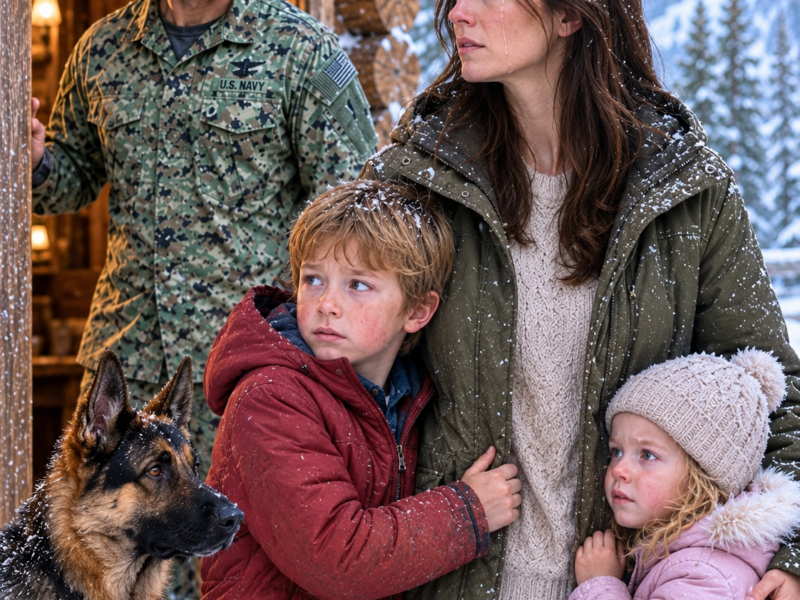
“Please don’t make me leave my children out here tonight,” the woman whispered in front of my locked cabin door
For one suspended second, nobody moved.
The man upstairs had spoken with the calm certainty of someone who believed the house already belonged to him.
Titan stood at the foot of the stairs, teeth bared, his growl deep enough to vibrate through the floorboards.
Claire’s fingers dug into my arm.
“He was supposed to be dead,” she whispered again.
I gently pulled free and moved her behind me.
“Get the children into the bathroom at the end of the hall,” I said. “Lock the door. Keep them low and stay away from the windows.”
She stared at me as if she wanted to argue.
“Now, Claire.”
Something in my voice finally reached her.
She ran upstairs, gathered the children, and disappeared down the hallway.
I listened to the bathroom door lock.
Then I turned toward the staircase.
I had spent years learning that fear could be useful if you kept it from making your decisions for you.
My heart was hammering, but my thoughts had become clear.
One unknown man upstairs.
A black SUV outside.
Three children hiding in my house.
And a photograph showing a dead teammate who apparently wasn’t dead at all.
I drew my old service pistol from the lockbox beside the kitchen and checked it.
Titan looked back at me.
“Stay close,” I whispered.
He moved ahead, placing his paws carefully on each step.
I followed, keeping to the wall.
At the top of the staircase, the hallway stretched into darkness.
The bedroom door stood open.
A man’s silhouette occupied the far end, near the window.
He was tall and broad-shouldered, wearing a dark jacket beaded with rain.
He held something small in one hand.
“Daniel Mercer,” he said.
His voice carried no surprise.
“You’ve gotten harder to find.”
“Funny. I live on a road with one entrance.”
He gave a faint laugh.
“Still making jokes when things get uncomfortable.”
I recognized the voice before he stepped into the light.
My former teammate, Aaron Cole, had spoken that way during training exercises, long deployments, and the quiet hours after operations went bad.
For six years, I had believed Aaron died in an explosion outside Kandahar.
I had attended a memorial service.
I had watched his mother receive a folded flag.
I had spent months waking from dreams in which I reached for him and found only dust.
Now he stood ten feet away, alive and breathing.
His face was thinner than I remembered.
A pale scar crossed his left cheek, and his eyes had lost the easy warmth I remembered from the man who once pulled me out of a burning vehicle.
But he was unmistakably Aaron.
I raised the pistol.
“Put your hands where I can see them.”
He obeyed slowly.
“You should put that away, Danny.”
“Give me one reason.”
“Because if I wanted you dead, I wouldn’t have knocked.”
I glanced at his empty hands.
“What do you want?”
“The dog tags.”
“What dog tags?”
His expression hardened.
“Don’t insult me. Claire brought them here.”
I had no idea what he meant, but I wasn’t about to tell him that.
“Who sent you?”
“Nobody sent me.”
“Then why are you here?”
“Because Claire has something that could destroy people who have spent years making sure nobody knows what really happened.”
“Who?”
He looked past me toward the staircase.
“People you used to trust.”
The words landed with more force than I wanted to admit.
I shifted my stance.
“You were declared dead.”
“I’m aware.”
“Your family buried an empty coffin.”
His jaw tightened.
“I know.”
“Your death was reported to the entire command.”
“I know, Daniel.”
“Then explain it.”
For the first time, anger broke through his composure.
“Not here. Not while somebody is listening.”
He glanced toward the ceiling.
I followed his gaze.
A faint electronic chirp came from the bedroom behind him.
Aaron moved his eyes toward the sound, and I saw genuine alarm.
“Did you bring a phone?”
“No.”
“Neither did I.”
He looked toward the bedroom.
“Then we need to leave this hallway.”
Before I could respond, a voice came through a small speaker near the ceiling.
“Agent Cole, your time is up.”
The voice was distorted, almost mechanical.
Aaron went completely still.
A red light blinked beside the speaker.
Then every light in the house went out.
Titan barked once, sharply.
I grabbed the railing with my free hand as the darkness swallowed the hallway.
A crash sounded downstairs.
The front door slammed against the wall.
Someone had entered the cabin.
Aaron lunged toward me.
“Get the children out through the back!”
I struck him across the chest with my forearm and forced him away.
“You’re not giving orders in my house.”
“Then stop wasting time!”
A gunshot cracked through the lower floor.
The sound punched the air from my lungs.
Titan launched down the stairs before I could stop him.
I followed, Aaron close behind.
At the bottom, a figure moved across the living room.
I caught the outline of a rifle and shouted for him to drop it.
He turned toward me.
I fired once into the wooden frame above him.
The man ducked and disappeared behind the couch.
Another shot shattered a lamp.
I moved behind the kitchen island while Aaron crouched near the wall.
“Two of them,” he said.
“How do you know?”
“Because the one upstairs isn’t working alone.”
A heavy thump came from the rear hallway.
My blood went cold.
The children.
I moved toward the hall, but Aaron caught my sleeve.
“Daniel, listen to me. They don’t care about you. They want the evidence.”
“What evidence?”
“The tags.”
“Start explaining, or I’ll decide you’re part of this.”
He stared at me through the darkness.
“Your teammate didn’t die in Kandahar because of an explosion. He disappeared because he found out our mission was being used to move people and equipment under false authorization.”
I felt the floor tilt beneath me.
“What are you talking about?”
“Someone inside the command structure was selling operational access to a private security contractor. Routes, identities, extraction schedules. Everything. Our team stumbled onto it.”
“Who?”
Aaron shook his head.
“I don’t know everyone involved. I know the man who signed the first false report.”
“Mercer?”
“No. Captain William Mercer was trying to investigate it.”
That made even less sense.
“Then why did Claire say he sent her here?”
“Because he did.”
Another gunshot echoed from the living room.
The attacker behind the couch was moving toward the staircase.
I didn’t have time to untangle six years of lies.
I broke from cover and ran for the rear hallway.
Titan was there, braced in front of the bathroom door.
The dog was snarling at a man in black tactical clothing who stood several feet away, one hand reaching toward the knob.
The man turned when he heard me.
His other hand held a pistol.
Titan lunged.
The attacker stumbled backward, striking the wall, and I closed the distance before he could bring his weapon around.
We crashed into the hallway table.
The pistol skittered across the floor.
I drove the man against the wall and pinned his arm behind him.
He fought hard, but the narrow hallway gave him no room to maneuver.
“Who sent you?” I demanded.
He spat blood onto the floor.
“You don’t understand what you’re protecting.”
“Try me.”
His eyes flicked toward the bathroom.
“Those kids are already marked.”
My grip tightened.
“What does that mean?”
He smiled despite the pain.
“It means you should’ve stayed retired.”
A sharp whistle cut through the hallway.
Titan released the man’s sleeve and turned.
Aaron stood at the corner, holding a small device with a blinking green light.
“Daniel! Move!”
I threw myself sideways.
A burst of electricity cracked through the air where I had been standing.
The attacker had managed to retrieve a second device from his belt.
Aaron kicked it away.
I dragged the man to the floor and secured his wrists with a plastic restraint from the emergency kit beside the stairs.
Then I turned toward the bathroom.
“Claire! It’s me. Open the door.”
Nothing.
I knocked twice.
“Claire!”
The lock clicked.
The door opened just enough for her to look out.
Her face was white.
Ethan stood behind her, holding a heavy flashlight in both hands.
Sophie had her arms around Noah.
“Are you hurt?” I asked.
Claire shook her head.
“Who was that man?”
“Someone who won’t be coming near you again.”
It was a promise I intended to keep, though I knew better than to guarantee what I couldn’t control.
I ushered them into the kitchen and checked the windows.
The black SUV was gone.
So was the attacker who had been behind the couch.
A back window stood open, rain blowing across the floor.
I swore under my breath.
Aaron entered the room with his hands visible.
Claire recoiled as if he had raised a weapon.
“Stay away from us.”
He stopped immediately.
“Claire, I’m not here to hurt you.”
“You’re the reason my husband is gone.”
Aaron lowered his eyes.
“I know.”
The room went silent.
I looked between them.
“Your husband?”
Claire swallowed.
“Marcus Bennett.”
I stared at Aaron.
He nodded once.
“Marcus was our intelligence specialist. He discovered the falsified records before the operation in Kandahar.”
I remembered Marcus as a quiet man who carried a notebook everywhere and could reconstruct an entire mission from a handful of radio transmissions.
I remembered the official account of his death.
His vehicle had been destroyed in an ambush, and no remains had been recovered.
We had been told the explosion left nothing identifiable.
“You said Marcus was dead,” I whispered.
“I was told the same thing,” Aaron replied.
Claire shook her head.
“You were all told whatever they needed you to believe.”
She walked to the battered duffel bag and knelt beside it.
Her fingers shook as she unzipped the main compartment.
Inside were children’s clothes, a plastic folder, a small medical kit, and a padded envelope wrapped in a grocery bag.
She removed the envelope and held it against her chest.
“Marcus found out they were using military records to make people disappear. Witnesses, contractors, even members of our own teams. They created false identities, moved people between properties, and made the paperwork show that they had died or left the country.”
“Why?” I asked.
“Because people who didn’t exist couldn’t testify.”
Her eyes filled with tears.
“Marcus copied the records. He planned to turn them over to investigators, but somebody learned what he had. He was taken before he could reach anyone.”
Aaron’s expression tightened.
“I spent years trying to find him.”
“And you never found him,” Claire said bitterly.
“No.”
“Because you were looking where they told you to look.”
Aaron didn’t argue.
Claire opened the envelope.
Inside was a set of dog tags, a tiny memory card sealed inside a plastic sleeve, and a handwritten note.
I recognized the tags.
They belonged to Marcus.
The same man whose death I had mourned.
The same man whose wife had arrived at my door with three children and nowhere safe to go.
“Why bring this here?” I asked.
Claire unfolded the note.
“Because Captain Mercer gave me a name. He said if I ever had the evidence in my hands, I should find Daniel Mercer and his dog.”
She looked at Titan.
“He said the dog would know if I was telling the truth.”
I stared at her.
“Captain Mercer said that?”
“He told me you wouldn’t trust a stranger. He also said your dog had saved you when you didn’t trust your own instincts.”
I looked at Titan.
He had settled beside Sophie, allowing her to rest one hand against his shoulder.
For the first time all night, his ears were relaxed.
I didn’t know what that meant about Claire.
But I knew it meant he wasn’t sensing an immediate threat from her.
A faint vibration came from the kitchen counter.
My phone had regained a signal.
I called the county sheriff, reported the intruders and the shots fired, and requested medical assistance.
Then I called the emergency contact number Captain Mercer had given me years earlier.
It rang once.
A man answered.
“Daniel?”
“Captain, I have Claire Bennett in my cabin. Aaron Cole is here. People are trying to take the evidence.”
There was a long silence.
Then Mercer said, “Do not let anyone remove that memory card.”
“Who is behind this?”
“Daniel, listen carefully. You have to get those children out of there.”
“Not until you tell me what happened.”
“I will tell you everything. But first, you need to understand that the people responsible have access to systems that can make an official rescue look like an arrest, and an arrest look like an accident.”
“Names, Captain.”
“Colonel Richard Voss. He was a senior operations officer when your team deployed. He now works with a private security company called Northstar Strategic.”
Aaron closed his eyes.
“I know the name,” he said quietly.
Mercer continued.
“Northstar was awarded contracts that depended on access to military intelligence. Voss used that access to hide illegal transfers and silence witnesses. Marcus discovered the pattern. Aaron helped him copy the records.”
I looked at Aaron.
“You helped Marcus?”
“I helped him get the files out,” Aaron said. “I didn’t know who else was compromised.”
Mercer’s voice sharpened.
“The operation was exposed before they could deliver the evidence. Aaron was captured, not killed. He escaped from a transport facility six years later, but he was watched constantly. He couldn’t safely contact you.”
“Why not?”
“Because your mission report was altered, and your communications were monitored. They wanted you to believe Aaron had betrayed the team. If you’d started asking questions, they would have used you to locate Marcus.”
My mouth went dry.
All those years, I had carried anger toward a man who had been fighting to survive.
I had replayed his last radio transmission in my mind hundreds of times.
I had convinced myself that the hesitation in his voice meant he had abandoned us.
Now I understood how carefully someone had planted that interpretation.
“Where is Marcus?” I asked.
“I don’t know,” Mercer replied. “But the evidence in Claire’s possession may tell us.”
A new sound came through the phone.
Three short electronic beeps.
Mercer cursed.
“Daniel, they may have traced this call. Do not use the memory card in a connected computer. Keep it offline. I have an investigator I trust, Special Agent Elena Brooks. I’ll send you her direct contact details through a secure channel.”
The call ended.
I stared at the screen.
The room smelled of wet wool, spilled soup, and smoke from the shattered lamp.
Three children stood near the fireplace, watching the adults who had turned their evening into something they couldn’t understand.
I put the phone down.
“Claire, I need you to tell me everything from the beginning.”
She sat slowly.
Then she began.
Marcus had worked as an intelligence specialist supporting special operations units.
His job was to verify movement orders, check the origin of mission updates, and ensure that sensitive information went only to authorized personnel.
About seven years earlier, he noticed that certain vehicles appeared in official records as empty transports while independent logs showed that they carried personnel.
The discrepancy seemed minor at first.
Then he found duplicate authorization codes.
A shipment recorded as medical equipment had been diverted to a private facility.
A list of names appeared in two different databases, with different birth dates and different outcomes.
Some of the people were listed as discharged.
Others were marked dead.
A few simply vanished from the system.
Marcus traced the records to Northstar Strategic.
He believed the company was using legitimate military contracts to conceal unauthorized movements and payments.
He copied what he could and contacted Aaron.
Aaron had served with Marcus and knew enough about operational security to recognize that the records were not innocent mistakes.
They made plans to deliver the files to an independent investigator.
But the night before the handoff, their secure meeting location was compromised.
Marcus was taken.
Aaron tried to reach him and was captured during the search.
A false report stated that both men had died in the same operation.
The remaining team was given a sanitized account and ordered to stop discussing the incident.
Daniel Mercer, my namesake but no relation, had been the officer who challenged that account.
Captain Mercer told me he had spent years pursuing inconsistencies through channels that repeatedly closed before he could reach the next level.
He finally located Claire after a former Northstar employee contacted him.
By then, Marcus had been missing for years.
Claire had been told that he was dead.
Then, three months earlier, she received an anonymous package containing a recent photograph of Marcus.
He was older, thinner, and standing behind a chain-link fence.
On the back was a handwritten message.
KEEP THE CHILDREN SAFE. THE RECORDS ARE STILL OUT THERE.
She contacted Captain Mercer.
He arranged for her to leave Ohio with the children and told her where to find me.
“He said he’d meet us at a safe location,” Claire explained. “But the meeting never happened. Somebody called from his number and told me to turn around.”
“Did you?”
“No.”
She looked down at her hands.
“I heard a voice in the background. A man asked whether the children had been identified. Then the call ended.”
She had kept driving until her car broke down on the road near my cabin.
“I didn’t know whether Captain Mercer was alive,” she said. “I didn’t know if the person who gave me your address was trying to save us or deliver us.”
“Why didn’t you tell me all this when you arrived?”
“Because I couldn’t risk being wrong.”
Her gaze moved toward the hallway.
“And because my children have already been used to make me cooperate once.”
I waited.
She took a shaky breath.
“Last year, someone sent me photographs of the children leaving school. They said Marcus was alive, and if I wanted him back, I had to stop asking questions.”
Sophie moved closer to her mother.
Claire wrapped an arm around the girl.
“I did what they told me for months. I stopped contacting people. I changed our routine. I kept the children home whenever I thought we were being watched.”
Her voice broke.
“Then they demanded the evidence.”
She touched the envelope.
“I refused. Two days later, someone broke into our apartment. We left that night.”
I looked at the three children.
Ethan was trying not to cry.
Noah had fallen asleep against Sophie’s shoulder.
I knew what it meant to be frightened by something you couldn’t identify, to distrust every ordinary sound because danger had once arrived without warning.
But these children shouldn’t have had to learn any of it.
“Claire,” I said, “you and the kids are staying here until we have a safe plan. Nobody is taking you anywhere.”
She looked at me for a long moment.
“Why are you helping us?”
I glanced at the photograph still lying on the table.
“Because somebody once told me the wrong story about a man I trusted. I spent six years believing it.”
I picked up the memory card.
“And I’m done letting other people decide what the truth is.”
We moved the children into the room farthest from the road.
I checked the exterior doors, secured the broken window temporarily, and placed the captured intruder in a separate room while we waited for law enforcement.
Aaron sat on the opposite side of the kitchen table.
He had not asked for forgiveness.
That, more than anything, made me willing to listen.
When I finally sat down across from him, he looked older than he had upstairs.
“I should have found a way to reach you,” he said.
“You were being hunted.”
“I still should have tried.”
“Maybe. But I don’t know what I would have done if you had shown up six years ago claiming you were alive and everybody else was lying.”
He gave a tired smile.
“You would’ve punched me first.”
“Probably.”
For a moment, we were almost the men we had been before Kandahar.
Then I looked at his scar.
“Who did that to you?”
He touched his cheek.
“A transport guard. I was trying to get a key off him.”
“Did you escape?”
“Eventually.”
“Where have you been?”
“Moving between places where I couldn’t stay long. I found pieces of the operation, but never enough to prove who controlled it. Every time I got close, someone moved the records or the people.”
“And now?”
“Now they know Claire has the original files.”
He looked at the memory card.
“If Voss believes those records are still intact, he won’t stop.”
I didn’t doubt him.
At 11:46 p.m., headlights appeared on the road.
This time, I recognized the vehicle.
A county sheriff’s cruiser pulled into the driveway, followed by an unmarked sedan.
I went outside with my hands visible and explained the situation to the first deputy.
He was a middle-aged man with a rain-soaked uniform and a tired expression.
When I mentioned the armed intruders and the captured man, he called for additional units.
Then he asked me to hand over the memory card.
I didn’t move.
“Who authorized that request?”
He frowned.
“I’m securing evidence.”
“Then you’ll understand why I need to verify your identity and chain of custody.”
His eyes hardened.
“Are you refusing a lawful order?”
“I’m asking you to identify the investigator responsible for this case.”
The second deputy stepped out of the cruiser.
His hand rested near his holster.
Inside the cabin, Titan began barking.
I looked at the first deputy.
He was watching the window rather than me.
That was all the confirmation I needed.
I stepped backward toward the doorway.
“I’m calling the state police.”
The second deputy drew his weapon.
“Don’t move.”
Before he could say anything else, a woman’s voice rang out from behind the unmarked sedan.
“Deputy, put the weapon away.”
A woman in a dark rain jacket walked toward us, holding a badge in one hand.
“Special Agent Elena Brooks, Federal Bureau of Investigation. Both of you, step away from the door.”
The second deputy hesitated.
Brooks repeated the command.
The first deputy’s shoulders slumped.
He lowered his eyes.
“Agent, we were responding to a call.”
“Then you can explain why your dispatch record says you were sent to a different address.”
The two deputies exchanged a look.
Brooks turned toward me.
“Mr. Mercer, Captain Mercer contacted me. Is Claire Bennett inside?”
“Yes.”
“Are the children safe?”
“For now.”
She nodded.
“Good. Nobody leaves with the evidence until we verify the chain of custody. My team is two minutes behind me.”
The second deputy slowly holstered his weapon.
I kept my hands visible until Brooks entered the cabin and confirmed her credentials through an independent channel.
Only then did I allow myself to breathe.
She examined the captured intruder, spoke briefly with Claire, and photographed the damaged windows and the bullet holes.
When she reached the kitchen table, she looked at the memory card.
“Is this the original?”
Claire nodded.
“It contains copies of the records Marcus collected. He hid them inside the casing of his dog tags.”
Brooks didn’t touch it.
“Then we won’t connect it to any networked device. We’ll create a verified forensic copy in a controlled environment.”
She looked at Aaron.
“Mr. Cole, I’ve been looking for you.”
He gave a weary nod.
“I’m sure you have.”
“Your reported death has been under review for years. Your testimony may help establish how the records were altered.”
Aaron looked toward the children.
“I’ll cooperate. But I want them protected first.”
“They will be,” Brooks said. “I’ll arrange independent protection, with no connection to Northstar or the command offices involved in the original investigation.”
“Who can we trust?” Claire asked.
Brooks didn’t pretend the question was easy.
“Right now, trust the process only after you can verify it. You won’t be asked to take anyone’s word for anything.”
I liked her answer.
By dawn, the cabin had become a temporary command post.
Federal agents secured the perimeter, documented the evidence, and took statements.
The captured intruder was identified as a contractor working for a subsidiary of Northstar Strategic.
The second attacker, who had escaped through the back window, was identified from a partial vehicle registration and a discarded communications device.
The two deputies were separated and investigated for evidence tampering and unauthorized coordination with the contractor.
Neither had been assigned to the original call.
They had received a private message directing them to my address.
The message was traced to a phone registered under a false identity.
It wasn’t enough to establish who had sent it, but it confirmed that someone had access to information about the response.
Brooks told us the case would take time.
The memory card contained encrypted files, incomplete logs, and fragments of conversations that had been recorded without the knowledge of several participants.
The information pointed toward a coordinated effort to conceal unauthorized movements, falsify casualty reports, and intimidate witnesses.
Some of the records were years old.
Others were recent.
One file contained a list of individuals who had been relocated under false names.
Another contained payment records connecting Northstar executives to shell companies.
And a third contained a set of messages signed with the initials R.V.
Richard Voss.
I sat beside Aaron while Brooks explained what the investigators had found.
He stared at the table, his hands clasped tightly together.
“I knew he was involved,” he said. “I just didn’t know how far it went.”
“Neither did Marcus,” Brooks replied. “That’s why we need him alive.”
Claire’s head snapped up.
“You mean you believe he’s alive?”
Brooks chose her words carefully.
“The recent photograph is credible. We also found a transport record that may indicate Marcus was moved within the last month. We haven’t confirmed his location yet.”
Claire pressed her fingers against her mouth.
Sophie climbed into her lap.
“Mom, is Daddy coming home?”
Claire closed her eyes.
“I don’t know, sweetheart.”
For the first time since she had arrived, she didn’t try to make uncertainty sound like a promise.
She kissed Sophie’s hair.
“But people are looking for him now. People who know the truth.”
I watched them and felt a familiar ache.
I had once believed that hope was dangerous because it made you careless.
Now I wondered whether refusing hope could be its own kind of surrender.
Brooks left before noon to coordinate the next phase of the investigation.
Before she went, she handed me a card with her direct number and a case reference.
“Don’t investigate this yourself,” she said. “If someone contacts you, call me. If you notice anything unusual, tell my team. I know you’re trained, but this isn’t a mission you need to carry alone.”
I nodded.
She studied me for a moment.
“Captain Mercer says you have a habit of taking responsibility for things that aren’t yours to fix.”
“He exaggerates.”
“He said you’d say that.”
Then she left.
For two days, Claire and the children remained in my cabin under federal protection.
Ethan gradually began talking.
He asked about the old photographs on my bookshelf and whether I had ever been afraid during deployment.
I told him fear was normal, and that courage wasn’t the absence of fear.
It was deciding what mattered more.
He considered that.
“Are you scared now?”
I glanced at the window.
“Yes.”
He seemed surprised.
“Then how do you know what to do?”
“I don’t always. That’s why I check my assumptions and ask for help when I need it.”
He nodded as if I had given him something useful.
Sophie became attached to Titan.
She brushed him with a plastic comb and read him stories from a book she had brought in the duffel bag.
Titan endured every page with solemn patience.
Noah remained quiet, but his coughing eased, and he began eating full meals.
Claire slept in short stretches, waking at the smallest sound.
I recognized that too.
One night, I found her sitting by the fireplace after the children were asleep.
She was holding Marcus’s dog tags.
“Do you think he’s still the same person?” she asked.
I sat across from her.
“I don’t know.”
“He used to leave notes everywhere. On the refrigerator, in my coat pocket, inside books. He’d write down little things he wanted to remember because he said life moved too quickly to trust memory.”
She smiled sadly.
“When he was taken, I kept finding notes for months. Some were about groceries. Some were about the children. One was just a reminder to tell me I was right about a movie.”
She rubbed the edge of the metal tag.
“I kept those notes like proof that he had existed.”
“He existed whether you kept the notes or not.”
“I know that now. But for a long time, I thought if I stopped looking, I would be helping them erase him.”
I understood.
“Looking for someone isn’t the same as keeping them alive,” I said. “And accepting help doesn’t mean you’re giving up.”
She looked at me.
“Is that what you had to learn?”
I thought about the memorial service, the folded flag, and the anger I had carried toward Aaron.
“Yes.”
She lowered her eyes.
“I’m afraid that when we find Marcus, he’ll look at the children and see how much they’ve changed.”
“Then he’ll have to learn who they are now.”
“And what if he can’t?”
I didn’t offer a guarantee.
“Then you’ll take it one day at a time. But he’ll have the chance to try.”
For the first time, Claire let herself cry without hiding her face.
I didn’t try to fix it.
I simply stayed until she was ready to go upstairs.
On the third morning, Brooks called.
“We found a location,” she said. “A private medical property in western Maryland. The records indicate that a man matching Marcus’s description was transferred there under a false name.”
“Is he alive?”
“We have a recent image from an external camera. He’s walking with assistance.”
Claire stood beside me, one hand over her mouth.
“Can we go?” she whispered.
Brooks heard her.
“We’re assembling a team now. Claire and the children will be moved to a protected staging location. They won’t enter the property until it’s secured.”
“I’m coming,” Claire said.
Brooks paused.
“I understand why you want to.”
“No. You don’t understand. I’ve spent years being told to wait, to stay quiet, to accept what people said because they claimed it was for my safety. I’m not asking to go through the door first. I’m asking not to be left behind again.”
The line remained quiet for a moment.
Then Brooks said, “You can accompany us to the staging area. If the site is secure, we’ll discuss the next step.”
Claire nodded.
It wasn’t everything she wanted, but it was an honest answer.
Before we left, I checked the cabin one final time.
The broken window had been covered, the shell casings collected, and the bullet holes marked for documentation.
The house looked smaller in daylight.
I had thought of it as a refuge when I bought it, a place far from orders, briefings, and the constant calculations of military life.
Now I understood that safety wasn’t something a building could promise.
It was something people created for one another, sometimes in the middle of a storm.
We drove in a protected convoy toward Maryland.
Claire sat with the children in the rear vehicle, while I traveled with Aaron and two federal agents.
Aaron said little.
As we approached the property, he turned toward me.
“If Marcus is there, I don’t know what I’ll say.”
“Start with hello.”
He gave a faint smile.
“You always were good at making complicated things sound simple.”
“Only the things I can’t solve for you.”
The facility stood behind a high fence on a wooded parcel of land.
From the road, it looked like a private rehabilitation center.
The sign carried a legitimate business name, but the address matched one of the shell companies listed on the memory card.
Agents moved in from several directions.
Brooks stayed in contact with the team leader as they secured the entrance, checked the buildings, and detained two guards.
There was no exchange of gunfire.
No dramatic chase.
Just doors opening, identification checks, and people who had believed their paperwork would protect them discovering that it wouldn’t.
Then Brooks came out of the main building.
She looked at Claire.
“We found him.”
Claire made a sound I had never heard from another human being.
It was part sob, part breath, and part the release of a fear that had lived inside her for too long.
“Is he alive?”
“Yes.”
“Can I see him?”
Brooks nodded.
“Come with me.”
Claire took Ethan’s hand.
Sophie grabbed Noah’s, and the children followed their mother toward the building.
I remained outside with Aaron, giving them room.
Through the open doorway, I could see a narrow hallway and a small treatment room.
A man sat on the edge of a bed, one hand resting on a walking frame.
His hair had gone mostly gray at the temples.
His face was thinner than in the photograph.
But when Claire entered, he lifted his head.
For a moment, neither of them moved.
Then Marcus whispered her name.
Claire crossed the room so quickly that Brooks stepped aside.
She dropped to her knees in front of him and wrapped her arms around his waist.
Marcus held her with both arms, pressing his face into her hair.
“I thought I’d never see you again,” he said.
Claire shook with sobs.
“I looked for you.”
“I know.”
“I looked everywhere.”
“I know.”
“I kept telling the children you might come home, and I hated myself every time I said it because I didn’t know if it was true.”
Marcus pulled back enough to see her face.
“You gave them hope when I couldn’t.”
Then Ethan stepped forward.
He had spent the entire drive rehearsing what he would say.
Now he stood frozen at the foot of the bed.
Marcus looked at him as if he were seeing a ghost.
“Ethan?”
The boy’s mouth trembled.
“Hi, Dad.”
Marcus reached out, but he stopped before touching him.
Ethan closed the distance himself.
He wrapped his arms around his father, and Marcus held him as tightly as his weakened body allowed.
Sophie came next, crying openly.
Noah hesitated until Marcus extended one hand.
“Come here, little man.”
Noah climbed onto the bed and pressed his face into Marcus’s shoulder.
“I got bigger,” he whispered.
Marcus laughed through his tears.
“You did. I missed a lot, didn’t I?”
Noah nodded.
Marcus closed his eyes.
“I am so sorry.”
Claire touched his cheek.
“You’re here now.”
It wasn’t a declaration that everything had been repaired.
It was a beginning.
I stood outside the doorway with Aaron and felt the weight of six years shift inside me.
For the first time since Kandahar, the man I had mourned was alive in front of me.
Not a name on a report.
Not a face in a photograph.
A husband holding his wife.
A father learning the voices of his children again.
And a teammate who had survived the lie that nearly destroyed all of us.
When Marcus was ready, Brooks brought Aaron and me into the room.
He looked at Aaron first.
Neither man spoke.
Then Aaron walked forward and stopped beside the bed.
“I should’ve gotten you out,” he said.
Marcus shook his head.
“You got the records out. That’s why they couldn’t make the whole thing disappear.”
“I left you there.”
“You survived. That mattered too.”
Aaron lowered his head.
Marcus reached for his hand.
“We don’t have to settle six years of guilt today.”
Aaron nodded, unable to speak.
Then Marcus turned toward me.
“Daniel Mercer.”
I tried to smile.
“You look terrible.”
He laughed, and the sound brought back a hundred memories at once.
“You still know how to welcome a man home.”
I gripped his hand.
“I thought you were dead.”
“I know.”
“I believed the report.”
“I know that too.”
His expression softened.
“You were supposed to believe it. That’s why they wrote it that way.”
I looked away for a moment.
“I should have questioned it.”
“Maybe. But they knew how to make the story fit what you had already seen. The explosion was real. The mission was real. The loss was real. They just gave you a false explanation for it.”
That was the part I had never understood.
A lie didn’t always require inventing an entire world.
Sometimes it only required arranging the truth so that people drew the wrong conclusion.
Marcus looked toward Titan, who had been waiting in the corridor with one of the agents.
“Is that your dog?”
“Titan.”
Marcus held out his hand.
Titan approached slowly, sniffed his fingers, and rested his head against the bed.
Marcus stroked his ears.
“Good dog.”
I looked at Claire.
“He knew something was wrong with the bag before I did.”
She smiled faintly.
“Captain Mercer said he might.”
Marcus’s smile faded.
“William got you here?”
“He tried,” Claire said. “I don’t know where he is now.”
Brooks answered from the doorway.
“Captain Mercer is safe. He gave a formal statement this morning. He’s also provided documents showing that he repeatedly challenged the original casualty reports.”
Marcus closed his eyes in relief.
“Good.”
Brooks explained that the investigation was now moving forward on multiple fronts.
Northstar’s offices had been searched under federal warrants.
Several executives were in custody.
Colonel Voss had been detained while investigators reviewed evidence of obstruction, conspiracy, unlawful surveillance, and falsification of official records.
The evidence would need to be authenticated, and the case would take months, perhaps longer.
But the people involved could no longer quietly move the witnesses or erase the records.
Marcus would provide testimony when doctors cleared him.
Aaron would do the same.
Claire’s statements and the recovered messages would help establish the timeline.
And my own records, including the original mission communications I had kept after leaving the service, might help prove how the false account had been constructed.
For the first time, the truth had more than one person willing to defend it.
Marcus spent several weeks in medical care.
The doctors found that he had suffered prolonged malnutrition, untreated injuries, and repeated periods of confinement.
He needed physical therapy before he could walk without assistance.
He also needed time to adjust to the fact that he was free.
Freedom, I learned, didn’t arrive like a switch being flipped.
It came in small decisions.
Choosing when to close a door.
Deciding who could enter a room.
Sleeping through a night without listening for footsteps.
Eating a meal without being told how long he had.
Claire stayed close, but she didn’t try to make every decision for him.
The children learned to ask before hugging him when he was tired.
Marcus learned their favorite foods, their school routines, and the small stories that had accumulated while he was gone.
Ethan showed him a collection of drawings.
Sophie read him the book she had shared with Titan.
Noah insisted that his father learn the rules of a game that seemed to change every time they played it.
There were difficult days.
Marcus sometimes woke in the night convinced he was still inside the facility.
Claire sometimes became angry over something as small as a missed phone call, because waiting had once meant that someone might never return.
The children asked questions no parent could answer perfectly.
Why had nobody found him sooner?
Why had people lied?
Why had their family been forced to live in fear?
Marcus didn’t give them a simple villain’s story.
He told them that some people had chosen to do terrible things, and others had failed to stop them.
He told them the truth was still being investigated.
And he told them none of it had been their fault.
That mattered.
Because the greatest damage wasn’t only what had happened to Marcus.
It was what the lies had taught the people who loved him to believe about themselves.
Claire had believed she was weak for being afraid.
Ethan had believed it was his job to protect his siblings from every adult.
Sophie had learned to hide her sadness so her mother wouldn’t have another problem to solve.
Noah had grown accustomed to asking whether they would have to leave every place they stayed.
Healing meant helping them unlearn those lessons.
Months later, I testified before a federal grand jury.
The evidence recovered from the memory card had been matched against original records, financial documents, and communications obtained through the investigation.
The false casualty report had been authorized by officials who knew Aaron and Marcus had survived.
The report was used to close inquiries, redirect resources, and conceal the movement of witnesses.
Northstar’s leadership had paid intermediaries to obtain sensitive information and intimidate people who might expose the scheme.
Voss had used his position to protect the operation and had pressured others to preserve the false account.
Several people cooperated with investigators.
Others were charged and went to trial.
The case didn’t end with one dramatic confession.
It unfolded through records, testimony, cross-examination, and the patient work of proving what had been hidden.
That was how justice actually looked.
Slow.
Complicated.
Often frustrating.
But difficult to erase once enough people were willing to speak.
Aaron’s official record was corrected.
Marcus’s death declaration was withdrawn.
The families who had been misled were notified, and the government began reviewing other casualty reports linked to the same operation.
Not every missing person was found.
Not every question received an answer.
But the machinery that had kept Marcus hidden was exposed, and the people who had operated it could no longer claim that the system had never existed.
When Marcus was finally strong enough to leave medical care, Claire brought him to my cabin for a weekend.
The children had been asking to see Titan.
They ran from the car the moment the doors opened.
Titan met them on the porch, tail wagging, while Sophie wrapped her arms around his neck.
Noah showed him a new stuffed animal.
Ethan carried a small box of photographs he wanted to share with his father.
Marcus stepped out of the car slowly.
He stood in the driveway for a moment, looking at the cabin.
“This is where it happened?”
“This is where they tried to take the evidence.”
He studied the repaired window and the new doorframe.
“And you let us stay.”
I shrugged.
“You were cold.”
He smiled.
“That’s all?”
I looked toward Claire and the children.
“No. But it was enough to open the door.”
Marcus nodded as if he understood exactly what I meant.
Inside, Claire made coffee.
Ethan helped me prepare lunch.
Sophie read to Titan again, and Noah fell asleep on the rug with one hand resting on the dog’s paw.
Marcus sat by the fireplace and watched his family move around the room.
For a long time, he said nothing.
Then he looked at me.
“Do you ever think about the people we couldn’t save?”
I knew what he was asking.
I thought about the teammates who had died, the families who had been left with false answers, and the witnesses who might still be missing.
“Every day,” I said.
“Does it get easier?”
“Not exactly.”
He looked down at his hands.
“Then what changes?”
I considered the question.
“You stop treating grief like a debt you can repay by suffering forever. You remember the people you lost. You do what you can for the people still here.”
Marcus nodded slowly.
Outside, the rain had finally stopped.
Sunlight broke through the clouds and stretched across the porch.
For years, I had imagined that bringing Aaron and Marcus home would make everything that happened in Kandahar feel resolved.
It didn’t.
The dead were still dead.
The lost years remained lost.
The families who had been hurt still had to rebuild their lives, one ordinary day at a time.
But the truth was no longer buried beneath a false report.
Aaron no longer had to live as a ghost.
Marcus could sit beside his wife and hear his children argue about what to watch on television.
And Claire no longer had to choose between protecting her children and searching for the man she loved.
When the weekend ended, they left with a plan for the next visit.
Marcus stood beside the car and shook my hand.
“Thank you for opening the door.”
I glanced at Titan.
“He’s the one who decided you belonged here.”
Marcus scratched the dog’s head.
“Then I owe him more than I owe you.”
“Good. He accepts payment in treats.”
Marcus laughed.
The sound followed them down the driveway.
I stood on the porch until the car disappeared around the bend.
Titan sat beside me, watching the road.
I rested my hand on his neck.
For six years, I had believed that one of the worst moments of my life was the moment I learned Aaron had died.
For six years, I had believed the worst thing I could do was question the men who had delivered that news.
And on a stormy night, when a frightened mother begged for shelter, I nearly made the same mistake again.
I could have looked at Claire’s fear and decided it was someone else’s problem.
I could have sent her and the children into the rain.
I could have trusted the first official explanation and ignored the dog who knew something was wrong.
Instead, I opened the door.
That choice didn’t solve everything.
It gave the truth somewhere to begin.
Titan leaned against my leg, warm and steady.
I looked out at the road where Claire’s car had vanished and listened to the quiet settle over the trees.
For the first time in years, the silence didn’t feel like something waiting to hurt me.
It felt like peace.
And when the next knock came, I knew I would open the door.
The end.









