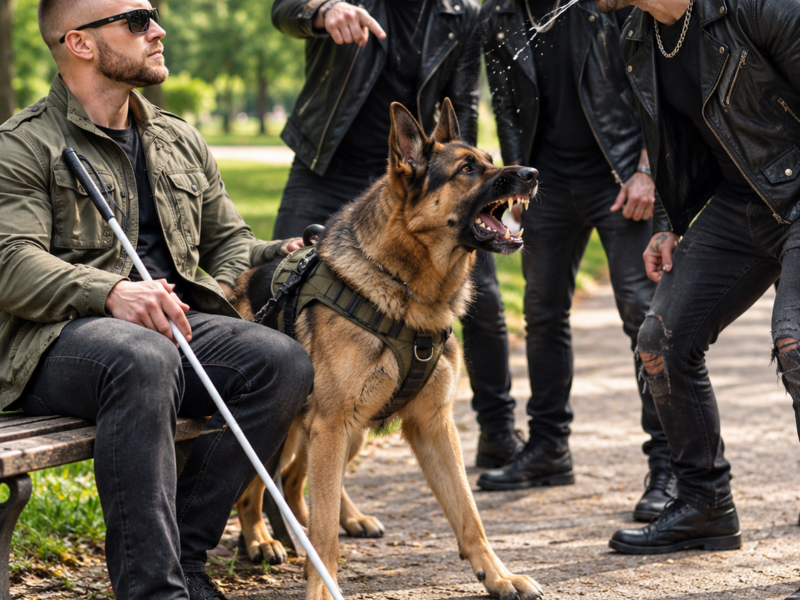
“‘Nobody’s coming to save you, old man!’ the gang leader laughed as he shoved a blind veteran against the brick wall and sent his German Shepherd sprawling across the pavement
For several seconds after the woman spoke, nobody moved.
I was still on one knee against the brick wall, my palm resting on Ranger’s head. His breathing was shallow, and every time he shifted, a quiet whine escaped his throat.
I wanted to focus on him, but the woman’s words had changed the atmosphere around us.
The gang leader had stopped laughing.
I heard him take a small step backward.
“That’s impossible,” he muttered.
The woman ignored him. She crouched beside me and spoke gently.
“Daniel, my name is Captain Rebecca Shaw. I’m with the county sheriff’s office. Don’t try to stand yet. Let me check your shoulder.”
I recognized her name before I recognized her voice.
Four years earlier, after the explosion that destroyed my eyesight, Captain Shaw had been one of the officers assigned to help investigate the attack on our convoy. She had interviewed me twice in the military hospital and had promised to return when new evidence became available.
She never did.
I had assumed she transferred to another case.
Now she was kneeling beside my injured dog on a sidewalk in Millbrook.
“Rebecca?” I whispered.
“Yes.”
“What are you doing here?”
“Making sure the people responsible for what happened to your unit don’t get another chance to hurt you.”
The gang leader let out a nervous laugh.
“Lady, I don’t know what kind of game you’re playing, but this is a local matter.”
Rebecca stood.
“No, Evan. Assaulting a disabled veteran, injuring his service dog, and threatening witnesses are not local matters you get to define.”
The name landed like a stone.
Evan.
I had heard the others call him that, but Rebecca said it with a certainty that made him sound less like a bully and more like a suspect whose file she had studied for years.
He tried to recover his swagger.
“You’ve got the wrong guy.”
“I don’t think so.”
She reached into her jacket and produced a small recording device.
“I’ve been listening to you for the last eleven minutes.”
The men fell silent.
Across the street, Mrs. Collins gasped. I heard a door open behind her, then another. People were coming out of the bakery, the hardware store next door, and the houses along Maple Street.
The town was watching.
For months, these men had counted on people staying inside, looking away, and pretending they hadn’t heard anything.
Now there were dozens of witnesses.
Evan noticed them.
His voice sharpened.
“Everybody go home! This doesn’t concern you!”
Nobody moved.
Rebecca spoke into her radio.
“Units, I’m at the old hardware store on Maple Street. Three suspects detained for assault and threats. One injured veteran, one injured service dog. Request medical assistance and additional officers.”
Evan turned toward the sound of her voice.
“Detained? You can’t detain me.”
“I can, and I just did.”
He swore and rushed toward her.
I heard his boots scrape the pavement. Rebecca moved aside, caught his arm, and used his momentum to force him against the wall. The impact knocked the air out of him.
The other two men started backing away.
“Don’t even think about it,” Rebecca warned.
One of them ignored her and ran.
A second voice shouted from across the street.
“Stop right there!”
Footsteps thundered along the sidewalk. A man in work boots intercepted the runner near a parked truck, while another resident stepped into the road to block his escape.
The man struggled for a few seconds before two people held him in place until the arriving deputies could take over.
The third gang member raised his hands immediately.
Evan, however, continued fighting.
“You have no idea who you’re messing with!” he shouted.
Rebecca secured his wrists.
“Actually, Evan, I know exactly who you are.”
I heard handcuffs click shut.
Then she turned back to me.
“Daniel, can you tell me where Ranger is hurt?”
I ran my fingers carefully along his neck and chest, avoiding the place where he’d been kicked.
“His left side. I think they struck him more than once.”
“Help is coming.”
Ranger pressed his nose into my palm.
I bent close to his ear.
“You did good, buddy. You’re safe now.”
But I could feel him trembling.
And I knew that until a veterinarian told me he would recover, I wasn’t going to feel safe at all.
A few minutes later, an ambulance pulled up. The paramedics examined my shoulder and knee while a veterinary emergency technician arrived in a separate vehicle to assess Ranger.
The technician introduced herself as Melissa Grant. She spoke to Ranger in a soothing voice, checked his breathing, and gently examined his ribs.
“He’s in pain, but he’s conscious and responsive,” she said. “I want to get him to the clinic for imaging as soon as possible.”
“Can I go with him?”
“Of course.”
I reached for Ranger’s harness.
Melissa helped me guide him onto a padded stretcher. He tried to stand, but his front legs buckled, and I felt panic rise into my throat.
“Easy, boy. Let them help you.”
He gave a faint whine.
I leaned down and pressed my forehead against his.
“I’m coming with you. I’m not going anywhere.”
When the ambulance doors closed, I heard Rebecca speaking to one of the deputies outside.
“Keep the three suspects separated. Nobody interviews them together. Preserve every recording and photograph from this scene.”
Then she climbed into the ambulance.
“You don’t have to come with me,” I said.
“I know.”
“Then why are you?”
She was quiet for a moment.
“Because I owe you the truth.”
I turned toward her voice.
“What truth?”
She took a slow breath.
“Four years ago, your convoy was sent along a route that had been marked safe. It wasn’t safe. Someone changed the intelligence report before it reached your commanding officer.”
My fingers tightened around Ranger’s leash.
“We already knew the intelligence was wrong.”
“We knew it was wrong after the explosion. We never knew why.”
“Then tell me why.”
“Because somebody wanted a particular vehicle destroyed.”
I felt cold despite the warmth inside the ambulance.
“What vehicle?”
“The transport vehicle carrying the evidence from an investigation into a private security company. Your convoy was assigned to escort it, but your team wasn’t told what it was carrying.”
I remembered the road, the dust, the sudden radio confusion, and the explosion that had swallowed the world in white light.
I remembered waking in a hospital unable to see the faces of the people speaking to me.
“Are you saying my team was used as cover?”
“I’m saying that is what the evidence suggests.”
“Who did it?”
“Evan Cole’s older brother, Marcus, worked for the security company involved. Marcus died overseas shortly after the attack. Evan came back to Millbrook and began building a network of people who would do whatever he asked.”
I sat very still.
“And you’ve been investigating him?”
“For nearly a year. We had reports of intimidation, extortion, and assaults. But witnesses kept withdrawing their statements. Business owners denied what they’d told us privately. People were frightened.”
“Why didn’t you tell me?”
“Because we didn’t know you were connected to Evan until a few weeks ago.”
I frowned.
“Connected how?”
“Someone recognized you at the veterans’ center and reported that you’d moved to Millbrook. Your name appeared in the original investigation file. Evan began asking questions about you soon after.”
I thought about the motorcycles outside the hardware store, the men who seemed to know exactly where I walked, and the way they had approached Ranger as if hurting him was part of a plan.
“They knew who I was.”
“Yes.”
“Was today planned?”
Rebecca didn’t answer immediately.
That silence told me enough.
“Daniel, we have reason to believe Evan wanted to provoke you into a public confrontation. If you had seriously injured him, he could have used the incident to portray you as unstable and dangerous. He was also hoping to intimidate anyone who might speak to investigators.”
I stared down at my hands.
“They kicked my dog to make me lose control.”
“Yes.”
I wanted to shout. I wanted to hit something. I wanted to return to the sidewalk and make Evan understand what it felt like to be helpless in front of someone who enjoyed your fear.
But Ranger was lying beside me, hurt and trusting me to stay calm.
So I breathed.
Once.
Twice.
Then I asked, “What happens now?”
“Now we prove what they did.”
The veterinary clinic smelled of antiseptic and wet pavement. A receptionist led us through the entrance, and Melissa guided Ranger into an examination room.
I waited outside while the veterinarian took X-rays.
Those minutes were worse than anything I remembered from the convoy.
In the military, fear had a shape. It was the sound of incoming fire, the weight of a wounded teammate, the urgency of a radio call. You had a job to do, and you did it.
Here, I had nothing to do but wait.
I paced until Rebecca gently placed a hand on my arm.
“Sit down, Daniel.”
“I can’t.”
“You can. And you need to.”
I lowered myself into a chair.
She sat beside me.
“I should have come back to the hospital,” she said.
I turned toward her.
“What?”
“After the initial investigation, I found discrepancies in the route approval. I suspected someone had altered the intelligence, but my superiors told me the matter had been reviewed and closed. I was transferred to another assignment before I could pursue it.”
“And you believed them?”
“No. But I didn’t have enough evidence to challenge them.”
“So you left me with nothing.”
“Yes.”
There was no excuse in her voice, no attempt to make herself sound better.
I respected that.
“Why come back now?”
“Because an anonymous source delivered a set of financial records and a copy of the original route report. The records linked Marcus Cole’s company to payments made just before the convoy was attacked. A separate trail led to Evan’s organization here in Millbrook.”
“Who sent the records?”
“We don’t know yet.”
I rubbed my hands together.
“And the name you said earlier? The security company?”
“Redstone Tactical. It provided security services overseas and later received several municipal contracts in this region. We believe Marcus helped move restricted equipment and documents through the company.”
“Does Evan know you have the records?”
“He may suspect it. We think he was trying to find out whether you remembered anything about the convoy or whether you had seen documents that weren’t included in the official report.”
I thought about the years after my injury. The endless medical appointments. The rehabilitation sessions. The nights when I woke up convinced I could still see the explosion burning across the road.
I hadn’t remembered any secret documents.
I had remembered my team.
“I’m sorry,” Rebecca said.
I shook my head.
“Save your apologies for when you can tell me who ordered it.”
The examination room door opened.
The veterinarian approached us.
“Mr. Mercer? Ranger has two fractured ribs and significant bruising. Fortunately, there is no puncture to the lungs, and we haven’t found evidence of internal bleeding. He’ll need pain management and several weeks of restricted activity, but I expect him to recover.”
I stood so fast that the chair scraped backward.
“He’s going to be okay?”
“Yes. He’s a tough dog.”
My knees almost gave out.
I gripped the back of the chair and bowed my head.
“Thank you.”
When I was allowed to see Ranger, he lay on a thick blanket with a light bandage around his side. He lifted his head when he heard my footsteps.
I found his paw and held it between my hands.
“Hey, soldier.”
His tail tapped the blanket.
I laughed, and the sound came out broken.
“You gave me a terrible scare.”
He nudged my wrist.
I stayed with him until the clinic staff insisted he needed rest.
By the next morning, the story had spread across Millbrook.
People had seen the arrest. Someone had recorded Evan threatening me. Another resident had captured the moment Ranger was kicked. The footage spread through local community pages, and by noon, reporters were parked near the courthouse.
But what happened next mattered more than the videos.
Mrs. Collins, the woman who had shouted from across the street, came to my house with a casserole and a stack of handwritten notes.
“I know you probably don’t want to talk about it,” she said, “but people have been asking how they can help.”
I invited her inside.
She placed the notes on my kitchen table.
“Shop owners. Residents. Two young men who used to work for Evan. They want to give statements.”
I touched the edges of the papers.
“How many?”
“Twenty-three so far.”
I couldn’t speak.
For months, I had heard the town fall silent whenever those motorcycles appeared. People who had once greeted me warmly began crossing the street to avoid passing the gang’s hangout. Shop owners shut their doors early. Parents warned their children not to speak about what they saw.
Now, twenty-three people had decided they were done being afraid.
“Why now?” I asked.
Mrs. Collins sighed.
“Because they saw what happened to you and Ranger. And they realized that if they kept quiet, it could happen to somebody else.”
She reached across the table and squeezed my hand.
“I should have called the police the first time I heard them threaten someone. I didn’t. I’m sorry.”
I shook my head.
“You were scared.”
“So were you.”
I had no answer to that.
She left the notes on the table, then asked whether she could visit Ranger after he came home.
“He’d like that,” I told her.
For the first time in a long while, the house felt less empty.
Ranger came home two days later.
The veterinarian gave me strict instructions: short walks, no stairs if possible, no running, no jumping, and no work until his injuries had fully healed.
Ranger appeared deeply offended by every part of the plan.
When I guided him toward his bed, he turned around and tried to follow me into the kitchen.
“Don’t start,” I told him.
He sat.
I took one step away.
He stood.
I stopped.
He sat again, staring at me with an expression that said the rules were poorly designed and should be reconsidered.
I laughed.
“You’re supposed to be resting, not negotiating.”
His tail thumped once.
For several days, our routine became a careful dance. I helped him get up, kept his walks short, and listened for any change in his breathing. At night, I slept on the couch beside his bed because I couldn’t bear the thought of him needing me and finding me in another room.
He recovered steadily.
But the investigation continued.
Rebecca called regularly with updates. The three men arrested at the hardware store were charged with assault and related offenses. Additional investigators were assigned after the financial records revealed possible connections between Redstone Tactical and several local officials.
The evidence also suggested that Evan had been using threats to control witnesses who knew about his brother’s business dealings.
Then, a week after Ranger came home, Rebecca arrived at my front door.
She didn’t come alone.
A second investigator stood behind her, carrying a thick folder.
“Daniel,” she said, “we need your help identifying something.”
I invited them inside.
Rebecca sat at the kitchen table and opened the folder.
She described a photograph before placing it in front of me, explaining each detail so I could understand what it showed. It was an image of a military transport vehicle taken shortly before the convoy attack.
I listened as she explained that a metal equipment case was visible near the rear door.
“Does that case look familiar?” she asked.
I closed my eyes.
The memory came slowly, in fragments.
A hard case with two silver latches.
A red strip of tape near the handle.
A warning label someone had tried to cover.
“I remember seeing a case like that,” I said. “It wasn’t standard medical equipment.”
Rebecca leaned forward.
“Do you remember who loaded it?”
“No. But I remember asking about it.”
“What happened?”
“My team leader told me it was classified communications equipment. He said it wasn’t part of our mission.”
“Do you remember who gave that instruction?”
I thought harder.
There had been a man at the staging area. Not one of our soldiers. He wore civilian clothes, spoke with an officer near the transport vehicle, and carried a clipboard.
“I remember a civilian contractor,” I said. “He was standing near the loading area. I didn’t see his face clearly, but he had a distinctive voice. Low, rough, almost like he was speaking through gravel.”
Rebecca went quiet.
“What?” I asked.
“The anonymous source who sent us the records included a recording of a meeting. We believe the voice belongs to someone who worked for Redstone Tactical.”
“Do you know his name?”
“Not yet. But if you can describe anything else, it may help.”
I remembered a silver ring tapping against a clipboard. A brief exchange about a route change. A voice saying, “The convoy will follow the revised corridor. The authorization has already been approved.”
My stomach tightened.
“That was him.”
Rebecca stopped writing.
“You’re certain?”
“I’m certain I heard those words. I can’t tell you who spoke them, but I remember them.”
The second investigator exchanged a look with her.
Rebecca closed the folder.
“That may be enough to connect the original route change to the contractor.”
“Enough for what?”
“To reopen the case formally and compel the release of additional records.”
She stood.
“Daniel, I know this has cost you a great deal. You don’t have to keep participating if it becomes too much.”
I turned toward her voice.
“I lost my sight on that road. I lost friends. I spent four years thinking the worst thing that happened to me was an accident.”
I placed my hands flat on the table.
“If somebody deliberately sent us there, I want it proved. Not because I need revenge. Because the families deserve to know what happened.”
Rebecca nodded.
“Then we’ll keep going.”
The next breakthrough came from someone nobody expected.
A former bookkeeper named Helen Price had worked for Redstone Tactical for six years. She had left the company after Marcus Cole died and had spent years avoiding any discussion of her former employer.
After the Millbrook arrests, she contacted the investigators.
She brought bank statements, internal emails, and a list of payments that had been disguised as equipment purchases. One payment had been approved two days before our convoy left the staging area. Another had been made to a consulting firm owned by a man who had served as an intermediary between Redstone and a senior military official.
The records did not prove every part of the conspiracy on their own, but they gave investigators a trail they could follow.
When they interviewed Evan, he denied knowing anything about the convoy attack.
Then they showed him the records linking his brother’s company to the operation.
He stopped talking.
A few days later, he asked for a lawyer and agreed to provide information in exchange for consideration in his case.
He admitted that he had targeted me because he believed I remembered the contractor who had delivered the equipment case. He had been told that if I identified the man, the old investigation could expose people who had spent years protecting themselves.
He had not been ordered to hurt Ranger, he claimed. He said he wanted to frighten me into silence.
That explanation made me angrier than any confession could have.
He had treated a living creature’s pain as a tool.
He had assumed my blindness made me easy to control.
And he had believed the whole town would keep looking away.
The case moved into federal hands after the investigators uncovered evidence of interstate financial transactions and possible obstruction involving military records. The original route report was recovered from an archived system, along with messages showing that a safety warning had been removed before the convoy was dispatched.
The contractor’s identity was confirmed.
His name was Victor Hale, a former Redstone Tactical operations director who had coordinated the transport of the equipment case. Investigators traced the order to a senior officer who had approved the revised route despite receiving warnings that the corridor was unsafe.
The evidence did not establish that every person involved had intended the deaths that followed. Some had concealed mistakes. Others had ignored warnings. A smaller group appeared to have deliberately arranged the operation to protect the company and its clients.
But the central fact was clear: the convoy had not been sent down that road because of a simple clerical error.
Someone had made a decision, and then people had worked to hide it.
When Rebecca told me, I sat silently for a long time.
“Does this mean my team gets its names cleared?” I finally asked.
“It means the inquiry can establish what happened and correct the official record. That process will take time, but the evidence is strong.”
I nodded.
“That’s all I’ve wanted.”
“Daniel,” she said softly, “you deserve more than that.”
“Maybe. But I can’t get those men back.”
“No.”
I turned my head toward the sound of Ranger’s breathing. He was lying beside my chair, his side healing, his tail resting across my foot.
“I can still make sure their families don’t spend the rest of their lives believing they were forgotten.”
The town changed after Evan’s arrest.
Not overnight, and not because one brave person suddenly made everyone else fearless. Change came in small, awkward steps.
The hardware store owner installed new lights outside his building. Shopkeepers began sharing security footage when they witnessed threats. Residents organized a neighborhood meeting and invited the sheriff’s office to explain how to report intimidation without exposing witnesses unnecessarily.
Several teenagers who had once been pressured into running errands for the gang came forward. One described being ordered to damage a business owner’s truck. Another reported that Evan had threatened his family after he refused to participate in a confrontation.
The town council reviewed the contracts connected to Redstone Tactical and suspended the agreements pending an independent audit.
For the first time in years, people discussed the Black Creek Riders without lowering their voices.
But the moment that truly changed Millbrook came on a Saturday morning, nearly three months after the attack.
The town held a public meeting at the old community hall. I hadn’t planned to attend. I disliked crowds, and the idea of standing in front of a room full of people while strangers discussed my blindness and my dog made me uncomfortable.
Then Mrs. Collins called.
“People want to hear from you,” she said.
“They’ve heard enough about me already.”
“Not from you, Daniel. They want to know what comes next.”
I considered refusing.
Then Ranger nudged my hand.
He was nearly recovered. His walk was steady again, and the veterinarian had cleared him for longer outings, though not for military work.
“All right,” I told Mrs. Collins. “I’ll come.”
The hall was full when we arrived. I heard chairs scraping, people whispering, and the occasional bark from a dog outside the building. Rebecca stood near the front with several deputies. The sheriff himself sat at the table beside the town council.
When I entered, the conversations faded.
I didn’t know whether the silence meant respect, guilt, or curiosity.
I only knew that it was the same silence I had heard on Maple Street before the gang attacked us.
This time, I refused to let it frighten me.
The sheriff introduced me and explained that the investigation was continuing. He confirmed that the arrests had exposed a wider pattern of intimidation and that additional charges were being considered. He also announced that the town would establish a formal process for reporting threats and protecting witnesses.
Then he asked whether I wanted to say anything.
I stood, one hand resting on Ranger’s harness.
“I didn’t come here because I’m brave,” I began. “I came because I’m tired.”
A few people shifted in their seats.
“I’m tired of being told that a person who needs help is somehow less capable. I’m tired of people believing that fear is the same thing as respect. And I’m tired of hearing that a dog is just an animal when that dog is the reason somebody can walk through the world with dignity.”
The room grew quiet.
“On the day I was attacked, I couldn’t see who was surrounding me. I couldn’t tell how many people were watching. I couldn’t tell whether anyone was going to help. But I could hear the laughter, and I could hear people stepping away.”
I took a breath.
“I don’t blame every person who was afraid. I’ve been afraid, too. I know what it feels like to wonder whether speaking up will make things worse. But I want you to remember something: when people like Evan believe nobody will stand against them, their power grows. It grows every time a witness stays silent because it’s easier. It grows every time a shop owner pays money because the alternative feels dangerous. It grows every time we tell ourselves that somebody else’s suffering isn’t our business.”
I paused and felt Ranger lean against my leg.
“I’m not asking you to fight gang members in the street. I’m asking you to call for help. To tell the truth when you’re interviewed. To check on your neighbors. To refuse to treat cruelty as entertainment.”
I looked toward the front row, where Mrs. Collins was sitting.
“One woman shouted when she saw what was happening to us. She didn’t know whether she could stop it. She shouted anyway. That gave the rest of the town a chance to act.”
My throat tightened.
“Courage isn’t always a person standing in front of danger with a weapon. Sometimes it’s a person opening a door, picking up a phone, or saying, ‘No. This is wrong, and I’m not going to pretend I didn’t see it.’”
When I finished, nobody spoke for several seconds.
Then someone began to clap.
Another person joined.
Soon the whole room was standing.
The sound washed over me so suddenly that I had to grip Ranger’s harness to steady myself.
I hadn’t expected applause. I hadn’t expected anyone to treat my words as something worth hearing.
But as the clapping continued, I realized they weren’t applauding me alone.
They were applauding the decision they had finally made to stop being afraid.
Then the sheriff asked everyone to remain seated for one final announcement.
He explained that the town council had voted to establish a community assistance fund for veterans and residents with disabilities who needed help with transportation, home repairs, and service-animal care. Local businesses had contributed money, and the fund would be overseen by an independent committee.
The first grant, he announced, would cover Ranger’s remaining veterinary expenses and establish a small emergency fund for working dogs serving veterans in Millbrook.
I couldn’t speak.
Mrs. Collins stood and said, “It’s the least we can do.”
Others began offering help. A local contractor volunteered to repair the uneven steps at my house. The bakery owner offered to deliver groceries whenever I needed them. A retired teacher proposed a monthly gathering where veterans could share resources and talk without feeling pressured to explain themselves.
The town that had once looked away was beginning to look after one another.
And then something happened that nobody in that hall had expected.
A teenage boy stood near the back.
I recognized his voice from the day of the attack. He had been one of the young men standing across the street when Evan threatened me.
“Mr. Mercer?”
I turned toward him.
“My name is Tyler. I was there that day.”
His voice shook.
“I heard them laughing. I saw them kick your dog. I was scared, and I didn’t do anything.”
The hall went silent again.
Tyler swallowed.
“I’ve been thinking about it every day. I keep telling myself I was just a kid, but I could have called the police sooner. I could have shouted. I could have done something.”
He struggled to continue.
“I’m sorry.”
I listened to him breathe, fighting back tears.
Then I stepped away from the table and found his shoulder.
“Tyler, you can’t change what you did that day. Neither can I. But you can decide what you do the next time someone needs help.”
He nodded.
“Will you?”
“Yes.”
“Then start there.”
He began to cry.
I pulled him into a brief hug, and the room remained silent—not the silence of fear this time, but the silence of people watching someone decide to become better.
Later that afternoon, Tyler visited my house with his father. He asked whether he could help with Ranger’s walks once the dog was fully cleared for normal activity.
I told him we would start with something simple: helping me organize the equipment at the veterans’ center.
He showed up the following Tuesday.
He came back the next week.
Over time, he became one of the most dependable volunteers at the center. He helped older veterans carry supplies, fixed broken chairs, and learned how to approach service dogs respectfully. He never asked me to tell him that what he had done on Maple Street was all right.
He simply tried to do better.
The legal case took much longer.
Evan and his associates faced state charges for the assault and intimidation in Millbrook. Investigators continued tracing the financial records tied to Redstone Tactical, and federal prosecutors brought separate charges against individuals accused of conspiracy and obstruction connected to the original convoy investigation.
Not everyone implicated was convicted of every allegation. Some charges were contested, and the court process required careful examination of the evidence. But the records, the witness statements, and the recovered communications changed the official account of the operation.
The military inquiry eventually corrected the findings about our convoy. It acknowledged that warnings had been disregarded and that the route change had not been handled according to required procedures.
My teammates’ families were notified of the new findings.
I attended the memorial service when the families gathered to hear the results.
This time, I didn’t stand before them as the man who had survived and spent years wondering why.
I stood as someone who could tell them that their loved ones had not been forgotten, that their questions had mattered, and that the truth had finally been investigated.
After the ceremony, one of the widows approached me.
Her husband, Sergeant Paul Bennett, had been the youngest medic on our team. He had a habit of making terrible jokes and keeping chocolate bars in his medical bag for anyone who looked exhausted.
She took my hand.
“For years, I wondered whether Paul had made a mistake,” she said. “Whether he’d missed something that could have saved him.”
I shook my head.
“He did everything he was asked to do. He helped people. He stayed with his team. He was a good soldier and a better man.”
She started to cry.
“Thank you for telling me.”
I wanted to give her more than words. I wanted to return the years she had spent grieving without answers. But all I could do was hold her hand and tell her what I remembered about her husband.
I told her about the chocolate bars.
I told her about the terrible jokes.
I told her that when the convoy came under attack, Paul had stayed behind to help a wounded teammate reach cover.
She cried harder, but she was smiling by the time I finished.
“He always did that,” she whispered.
“Yes,” I said. “He did.”
When I returned to Millbrook, Ranger was waiting by the door.
He greeted me with a soft bark and pressed his head against my waist.
I knelt and wrapped my arms around him.
“We did it, buddy.”
His tail swept the floor.
“No, not all of it. There’s still work to do.”
He nudged my hand.
I laughed.
“All right. You can stop supervising me now.”
He did not stop supervising me.
In the months that followed, Ranger and I returned to our morning walks. We passed the old hardware store, where new lights illuminated the sidewalk. We stopped outside the bakery, where the owner had placed a small water bowl near the entrance.
People greeted us without pity or awkwardness.
Some asked how Ranger was healing. Others asked about the veterans’ center. A few simply said good morning and continued on their way.
It felt ordinary.
And ordinary had become a gift.
One evening, I sat on my porch with Ranger resting beside me. The sky was darkening, and the first crickets had begun to sing.
I heard footsteps on the walkway.
It was Mrs. Collins, carrying two cups of tea.
“Thought you might like some company,” she said.
“I always do.”
She sat beside me and rested her cup on the table.
For a while, we listened to the neighborhood.
Then she asked, “Do you ever think about what would have happened if I hadn’t shouted that day?”
I considered the question.
“Sometimes.”
“Does it frighten you?”
“Yes.”
She was quiet for a moment.
“Me too.”
I reached down and scratched Ranger behind the ears.
“But I don’t think the ending belongs to just one person,” I said. “You shouted. Rebecca acted. The people across the street stepped in. The deputies arrived. Witnesses came forward. And the town decided it wasn’t going to keep looking away.”
Mrs. Collins sighed.
“People are calling it the Millbrook turning point.”
I smiled faintly.
“Sounds like a name somebody would put on a plaque.”
“Would that bother you?”
“A little.”
She laughed.
“I thought it might.”
The next morning, I took Ranger to the veterans’ center. A group of children from the elementary school was visiting to learn about service animals and the different ways people adapt after losing their sight.
Their teacher asked whether I would speak to them.
I told the children about Ranger’s work, about how he guided me around obstacles, and about the importance of asking before touching a working dog.
One little boy raised his hand.
“Is Ranger a hero?”
I looked down at the dog beside me.
“He’s done heroic things,” I said. “But I don’t think being a hero means you’re never afraid. I think it means you do what you can to help, even when you’re afraid.”
The boy thought about that.
“Then can regular people be heroes?”
“Absolutely.”
He smiled.
“Even kids?”
“Especially kids. You don’t have to be big or strong to tell someone when something is wrong. You don’t have to win a fight to help another person. Sometimes you just have to make sure someone isn’t alone.”
The teacher thanked me after the children left.
As Ranger and I walked home, I thought about how much had changed since the day three men cornered us against the brick wall.
They had believed my blindness made me powerless. They had mistaken my restraint for weakness and Ranger’s loyalty for something they could exploit.
They had believed fear would keep the town silent forever.
They were wrong.
The town didn’t become perfect after the arrests. People still disagreed. Some residents struggled to trust the authorities, and others had to learn how to speak up after years of keeping quiet. Healing was not a single moment, no matter how satisfying a courtroom verdict or a standing ovation might feel.
But Millbrook had changed direction.
People had learned that looking away was a choice, and that choices could be changed.
As for me, I was still blind. I still had difficult nights. I still sometimes woke from dreams of the convoy and reached for a world I could no longer see.
But I was no longer trying to prove that I could manage everything alone.
I accepted help when I needed it. I let friends visit. I began volunteering more regularly at the veterans’ center, helping newly injured service members navigate the first frightening months of life after a life-changing injury.
And every morning, Ranger walked beside me.
His ribs healed. His strength returned. The veterinarian eventually cleared him for normal activity, though he would never return to military work.
I was glad.
He had earned the right to be a dog again.
Sometimes, when we passed the old hardware store, I would remember the sound of his yelp and feel the anger rise all over again.
Then I would feel his shoulder press against my leg.
I would hear his steady breathing.
And I would keep walking.
One afternoon, nearly a year after the attack, the town unveiled a small memorial garden beside the veterans’ center. It was dedicated to veterans, service animals, and the families who supported them through difficult transitions.
The plaque did not carry my name.
It did not carry Ranger’s name.
It simply read: “Courage begins when we refuse to look away.”
I stood beside the plaque with Ranger’s leash in my hand and listened as the sheriff spoke about the importance of protecting people who could not always protect themselves.
Rebecca was there, too. After the original case had been referred to federal investigators, she had continued working with the county on witness protection and public safety. She greeted me after the ceremony.
“You’ve made quite a difference here,” she said.
“So have you.”
She smiled.
“Do you think the town will remember what happened?”
I listened to the children playing nearby, the quiet conversation of neighbors, and the familiar sound of Ranger shifting his paws beside me.
“I think they’ll remember what they did afterward,” I said.
Rebecca nodded.
“That may be more important.”
She left to speak with the sheriff, and I remained in the garden.
A little girl approached with her father.
“Can I pet your dog?” she asked.
I smiled.
“Let’s ask him first.”
I guided her hand toward Ranger’s nose. He sniffed her fingers, then leaned gently into her palm.
The girl giggled.
“He’s so soft.”
“He is.”
“Is he brave?”
I ran my hand along his back.
“Yes,” I said. “But his best quality isn’t that he’s brave.”
“What is it?”
I thought about the hospital rooms, the quiet mornings, the long walks, and the day when I had believed the entire world had abandoned us.
“His loyalty,” I said. “He stayed beside me when I couldn’t find my way. And when he needed me, I stayed beside him.”
The little girl considered this seriously, then wrapped her arms around her father’s leg.
“I think that’s what family does.”
Her father laughed softly.
“I think you’re right.”
After they walked away, I knelt beside Ranger and pressed my forehead to his.
“You hear that, boy? We’re family.”
He gave a contented sigh.
The sun warmed my face, and the breeze carried the smell of grass and flowers across the garden.
I couldn’t see the memorial, the children, or the town that had gathered around us. I couldn’t see the people who had once been afraid to speak and were now standing beside one another.
But I could hear them.
I could hear life returning to a place that had spent too long holding its breath.
And I could feel Ranger leaning against me, steady as ever.
For years, I had believed that losing my sight meant losing control over my own life. The attack in Millbrook reminded me that vulnerability was not the same as helplessness, and that the people who tried to exploit it were not as powerful as they wanted everyone to believe.
The gang had cornered a blind veteran and his dog because they thought nobody would intervene.
They were wrong about the veteran.
They were wrong about the dog.
And they were wrong about the town.
The ending that left Millbrook speechless wasn’t the sound of handcuffs closing, or the announcement that the investigation had uncovered a larger crime.
It was the sound of ordinary people finally standing together.
It was a frightened teenager choosing to become someone better.
It was a widow receiving the truth about the husband she had lost.
It was a community deciding that cruelty would no longer be treated as somebody else’s problem.
And it was a loyal dog, resting his head against the leg of a man who could no longer see him, reminding everyone that love does not need sight to recognize what matters.
I rose, took Ranger’s harness in my hand, and turned toward home.
He guided me down the familiar path.
One step at a time.
And for the first time in a very long time, I didn’t feel as though I was walking through darkness alone.
The end.









