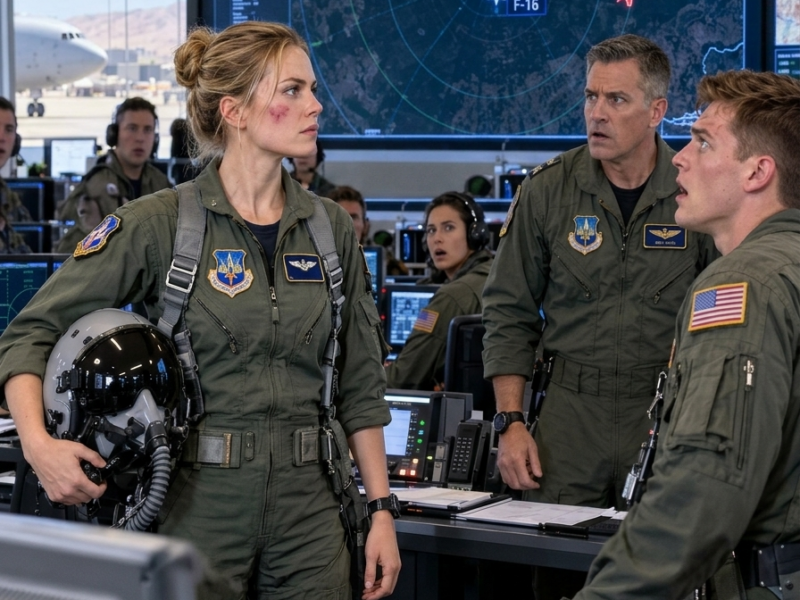
My wingman abandoned me over enemy territory, laughing over the radio as my damaged fighter dropped toward a wall of mountains
“You’re on your own, sweetheart,” Captain Blake Morrison said over the radio, his voice dripping with venomous contempt that cut sharper than the freezing wind outside my canopy. “Try not to make the rest of us look bad.”
Then, with a casual flick of his stick, his F-22 Raptor banked sharply north, leaving his afterburners blazing like mocking stars against the twilight sky. Within three seconds, his radar blip flickered once and vanished entirely from my tactical display. He had ghosted his own flight leader’s flank in the middle of a hot combat zone.
I stared at the empty green sweep of my radar screen, my hands trembling inside my fire-resistant flight gloves as a harsh, synthetic voice chimed inside my helmet: WARNING. SYSTEM FAILURE. HYDRAULIC PRESSURE DROPPING. Brilliant crimson warning lights flashed across my cockpit, casting a bloody glare over the shattered glass of my primary display panel.
My name is Lieutenant Emily Carter, callsign Valkyrie, and I was the only woman assigned to our elite squadron’s combat flight rotation in this sector. For six long, agonizing months, Blake had treated me like a dangerous liability. He questioned my tactical decisions in front of junior officers, mocked my landing routines, and spread whispers throughout the officer’s mess that I had earned my wings through political favoritism and diversity quotas rather than raw, blood-sweat skill.
Now, thirty thousand feet above the jagged, snow-capped teeth of the Hindu Kush mountains—deep within hostile, unmapped airspace—with my fuel reserves bleeding out and my primary communications matrix failing, he had finally engineered the ultimate setup to prove his point. He had left me to die, confident that the crash would hide his treason behind the tragic narrative of an under-qualified female pilot panicking under fire.
Except Blake had made one fatal calculation error. He thought I was afraid of being left alone in the dark.
“Control, this is Carter,” I said, keying my throat mic and forcing every shred of panic out of my voice. I kept my breathing slow, steady, and rhythmic, just as my late father had taught me before he was shot down over the desert a decade ago. “My wingman, Flight Lead Two, has broken formation and abandoned sector. I am currently experiencing partial engine failure and secondary sensor degraded modes. Requesting updated threat assessment for Grid Zulu-Nine.”
The response from Forward Operating Base Apex took four agonizing seconds to puncture the thick storm of electronic jamming static filling my headset.
“Carter, this is Apex Control,” a strained voice crackled back. It was Technical Sergeant Miller, his usual calm demeanor totally shattered. “We… we lost Morrison’s transponder. Be advised, we have multiple high-speed hostile radar contacts rising fast from the southern valley. Bearing two-seven-zero, speed Mach 1.4. Altitude fifteen thousand and climbing fast. Emily, you are blind out there and your airframe is heavily compromised. We recommend immediate vectoring to the west. Immediate withdrawal, Lieutenant!”
I looked down at the red, triangular symbols blooming like a malignant disease across my secondary display screen. My stomach tightened into a hard, cold knot.
There was no safe withdrawal route. If I banked west, I would fly straight into the teeth of an active surface-to-air missile envelope covering the border. But worse than that was what lay directly behind my tail section.
Eighteen miles to the east, hugging the floor of the valley, flew a lumbering, unarmored C-130 Hercules transport aircraft. It was carrying a critically wounded American army reconnaissance team, including four men who required emergency surgical intervention within the hour. They were flying low and slow, completely unaware that the air cover promised to them by Blake Morrison had just evaporated into thin air.
If I turned away to save my own skin, those hostiles would sweep through the mountain pass and shred that helpless transport within ninety seconds.
“Negative, Control,” I replied, my voice dropping an octave into a ice-cold register that shocked even myself. “I am not turning back. I’m staying in the fight.”
The controller fell completely silent on the other end of the crackling line. In the background, I could hear the chaotic hum of the Tactical Air Command room—shouted coordinates, screaming alarms, and frantic boots shuffling across steel floors.
“Lieutenant Carter, read back your status!” the controller shouted, his voice cracking with desperation. “You have a degraded engine, zero wingman support, and at least three MiG-35s on intercept vectors! You cannot engage those contacts alone! That’s suicide!”
I almost let out a dark, bitter laugh into my oxygen mask. They still thought like textbook strategists. They still thought I was crazy enough to engage three superior air-superiority fighters in a dogfight with a crippled jet.
They didn’t understand. I wasn’t trying to win a dogfight. I was buying seconds with my life.
I slammed the throttle forward, wincing as the port engine shuddered violence against its mounts, spitting black smoke into the pristine mountain air. Instead of fleeing, I shoved the stick forward and dived my damaged F-35 straight down into the abyssal shadows of the mountain trenches, using the massive granite cliffs to break the enemy’s radar lock while simultaneously broadcasting a high-gain tactical data stream that my degraded sensors could still barely generate.
In the command center hundreds of miles away, the master radar display must have looked like a nightmare unfolding in real-time. The room erupted into a chaos of overlapping, terrified voices.
“What in God’s name is she doing?!” someone yelled through the open mic.
“She’s heading straight back into the primary threat envelope!” another operator screamed. “She’s suicidal!”
Then, the low-frequency ping representing the C-130 transport flickered, distorted, and abruptly vanished from the tracking display as local enemy jammer trucks activated along the ridge.
For three unbearable, suffocating seconds, nobody in the entire military chain of command spoke a single word. The silence across the radio frequency was as heavy as a gravestone.
“Transport, respond! C-130 King-Zero-Four, respond immediately!” the controller shouted, his voice rising into a terrified panic.
Nothing. Just the hollow hiss of white noise.
My knuckles turned paper-white as I gripped the flight controls with everything I had, pulling six Gs through a narrow granite canyon that missed my wingtips by less than thirty feet. In that dark, terrifying moment, the blinding white glare of the snow-covered peaks reflected off my visor, and I remembered a promise I had made five years ago to Captain David Vance—the man who had mentored me, the pilot who had stayed behind in an burning F-16 over Mosul to draw anti-aircraft fire away from my damaged canopy during my first operational tour. David had died in a ball of flame over enemy sand so that I could live to wear these wings.
I had buried him in Arlington, and over his cold marble tombstone, I had sworn a solemn oath: I will never leave another soul behind in the dark just because saving them is dangerous.
“Control, Valkyrie One,” I gasped, blood rushing away from my eyes as the gravitational forces pressed my chest flat against my seat. “I am stepping down into the canyon floor. I have visual contact on the terrain shadow. I will find that transport and drag them out, or I will fill this pass with every piece of lead I’ve got.”
“Emily, listen to me!” A new voice cut through the static—hard, authoritative, but edged with genuine, uncharacteristic panic. It was Colonel Jonathan Vance, my commanding officer—and David Vance’s father. He was abandoning all military protocol, discarding callsigns, and using my real name. “You need to disengage right now and vector three-zero-zero! That is a direct, lawful command from your CO! Turn around, Emily!”
I closed my eyes for half a second, feeling the steady beat of my heart hammering against my ribs. I’m sorry, Colonel, I thought. Not today.
Through the blizzard of static and fog covering the valley floor, my eyes caught a microscopic, flickering infrared signature tucked beneath a razor-sharp mountain ridge.
“Found them,” I whispered.
The transport was in a dead glide. Its left inboard engine was spewing a trail of thick, oily black flame that stained the pristine white snow of the gorge below, and its tail assembly was riddled with heavy cannon fire. They were blind, deaf, and heading directly into a massive granite wall obscured by the thick lower cloud deck.
“King-Zero-Four, this is Valkyrie One!” I barked into the secure tactical channel, overriding their jammed receiver by slave-linking my short-range laser transmitter directly to their cockpit sensor dome. “Hard right stick! Hard right NOW! You are five seconds away from impact with the ridge!”
For a second, nothing happened. Then, the giant, four-engine transport banked violently to the starboard side, its massive wings clearing the jagged rock face by a distance so small I could see the snow spraying off the cliffside from their propeller wash.
“Valkyrie One, King-Zero-Four!” a rasping voice burst through my headset, heavy with coughing and the screaming sound of cabin depressurization. “God almighty, Lieutenant! We thought we were ghosted! Our instruments are fried, we’ve got three casualties bleeding out in the cargo bay, and we have zero visibility!”
“Stick to my tail, King,” I ordered, sweeping my damaged jet up over their nose and painting a bright infrared landing path onto their heads-up display using my targeting pod. “I am your eyes. Keep your nose locked on my thermal trail. We are going to ride the spine of this valley until we clear the missile engagement zone.”
Suddenly, my threat receiver screamed a high-pitched, terrifying warning tone. MISSILE LAUNCH. MISSILE LAUNCH. LOCK-ON BEARING ZERO-NINE-ZERO.
Two enemy MiG-35s had dropped out of the cloud cover above us, their sleek, dark airframes sweeping through the valley like hunting hawks. They had launched a pair of radar-guided heat-seeking missiles, and the twin streaks of brilliant white smoke were tracking rapidly toward the slow, defenseless transport aircraft.
“Chaff and flares!” I yelled, but I already knew the transport was out of countermeasures—their dispenser boxes were hanging open and burned out.
I had less than two seconds to make a choice.
I didn’t hesitate. I pulled my stick back with every ounce of physical strength I possessed, slammed my left rudder pedal down, and forced my shuddering F-35 into a brutal, high-alpha cobra maneuver. My jet stood almost vertically on its tail, airbrakes deploying with a deafening roar as air flared across the composite frame.
I didn’t shoot the missiles down. I placed my own aircraft directly between the incoming weapons and the transport.
“Emily, NO!” Colonel Vance’s voice shattered across the open radio from the command center, filled with raw horror as the controllers watched my radar track merge directly with the incoming missile threat vectors.
I popped my remaining magnesium flare banks. A blinding cascade of white-hot sunfire erupted from the belly of my fighter. The first missile bit on the decoy, detonating sixty yards off my left wing in a violent ball of orange fire that sent heavy shrapnel tearing through my tail wing. The force of the explosion slammed my head against the canopy glass, momentarily blacking out my vision as warm blood trickled down into my eyes beneath my night-vision visor.
The second missile swept through the smoke, clipped my lower ventral fin, and exploded forty feet behind my exhaust.
My aircraft spun out of control, tumbling like a leaf in a autumn storm through the dark canyon. The cockpit was a symphony of alarms. Master caution lights blared, the primary hydraulic loop was dead, and my left engine flamed out completely, spewing sparks and raw aviation fuel.
“System collapse… recovering…” I gritted out through clenched teeth, pulling the manual flight-control override cables with hands that felt like lead. The g-forces compressed my throat, denying me oxygen as the dark mountain walls rushed up to swallow me whole. Not today. You don’t die today, Emily.
Five hundred feet above the snow, the control surfaces caught the air. With a sickening metal groan, the jet leveled out, scraping through the treetops at the bottom of the gorge, kicking up a massive cloud of powder that blinded the enemy fighters above.
“King-Zero-Four,” I wheezed into the mic, wiping blood from my eyes with the back of my flight glove. “Status…”
“We… we cleared the ridge, Valkyrie!” the transport pilot gasped, his voice trembling with unfeigned awe. “The pass is open! We’ve got clear air to the border! Emily… you just took a missile hit for us…”
“Get those men to a field hospital, King,” I grunted, wrestling the crippled stick as my single remaining engine sputtered and coughed. “Control… track King-Zero-Four… confirm they are clear.”
In the distant Tactical Air Command room, an eerie, reverent silence had descended upon the hundreds of personnel standing around the main battle map.
“King-Zero-Four transponder re-established,” Technical Sergeant Miller reported, his voice shaking visibly over the open comms line. “They are in friendly airspace. Medical teams are rolling on the tarmac. All four reconnaissance operators are alive.”
A massive cheer broke out in the command center, echoing faintly down the open radio line before Colonel Vance’s stern voice cut through the celebration.
“Valkyrie One,” Vance said, his voice thick with suppressed emotion. “The transport is safe. Now bring yourself home, Lieutenant. That is an absolute command.”
I looked at my fuel gauge. The digital digits were rolling down rapidly: 0.2… 0.1… 0.0.
My remaining engine gave one final, violent metallic cough, sputtered, and died completely. The sudden silence inside the cockpit was terrifying, broken only by the rushing hiss of the mountain wind against the canopy glass. I was gliding blindly through the night, a twenty-ton metallic rock with dead flight controls, ten miles inside hostile territory.
“Control,” I whispered softly, watching the faint lights of the forward operating base appearing over the crest of the final hill line. “I’m out of gas. Going dead stick. Pray for me.”
A dead-stick landing in a modern stealth fighter is widely considered by military aviation experts to be a mathematical impossibility. Without engine thrust to generate lift over the shortened, swept-back wing surfaces, an F-35 descends at a rate closer to a falling brick than an airplane.
I relied entirely on muscle memory, kinetic energy conservation, and pure, stubborn refusal to drop from the sky.
As the shadowy outline of the FOB Apex runway appeared through the ground fog, I lowered my landing gear using the mechanical emergency gravity-drop lever. The nose of the aircraft pitched down violently. The ground rushed up at terrifying speed—two hundred miles per hour, then one hundred and eighty. I had one shot. No second chances. No go-arounds.
Crash.
The heavy rubber tires slammed onto the concrete threshold with a violent, bone-jarring impact that blew out the starboard main tire instantly. Sparks showered into the night sky like fireworks as metal scraped against asphalt. The aircraft violently veered toward the dirt embankment, but I stomped on the left brake pedal with all my weight, wrestling the dead controls until the jet skidded to a shrieking halt less than fifty feet from a line of hardened concrete fuel bunkers.
The cockpit canopy popped open with a hiss of pressurized gas. Cold, crisp night air rushed in, clearing the acrid smell of burnt plastic and smoke from my lungs. I sat there in the dark cockpit for a long moment, my chest heaving, my heart hammering like a trapped bird inside my ribs, blood dried on my chin.
Footsteps rushed across the tarmac. Fire trucks and emergency ambulances flooded the runway with blinding red and blue strobe lights. Armed perimeter guards moved into defensive positions around the aircraft.
And standing just thirty feet away, near the shadow of the main maintenance hangar, was Captain Blake Morrison.
He was leaning against a support beam, his hands shoved deep into his flight jacket pockets. But he wasn’t smiling. The smug, arrogant expression that he had worn for six straight months had been violently wiped from his features. His face was drained of every drop of color, pale as a sheet under the harsh halogen floodlights. He stared at me as I dragged myself out of the cockpit, his eyes wide with a mixture of disbelief, terror, and deep, simmering rage.
He had expected me to die in that pass. He had planned on my fiery death being buried under a mountain of snow and officially written off as a tragic pilot error caused by an inexperienced female officer who couldn’t handle the pressure of combat.
I lowered myself down the side boarding ladder, my legs shaking so violently under my weight that I nearly collapsed onto the cold concrete floor. I straightened my flight suit, unclipped my helmet, and held it firmly under my arm.
Blake stepped out from the shadows, stepping into my path as I walked toward the debriefing facility. He opened his mouth to speak, his lips trembling slightly as he searched for words—perhaps to offer a fabricated story, perhaps to threaten me into silence, or perhaps to ask how in God’s name I was still breathing.
“Emily… I—” Blake began, his voice raspy and devoid of its usual booming swagger.
Before he could finish his sentence, the heavy steel side door of the command annex slammed open.
Colonel Jonathan Vance stepped out onto the tarmac. Behind him walked two armed Master-at-Arms naval MPs carrying full combat gear and sidearms. The Colonel’s face was carved out of hard granite, his eyes cold and dark as midnight. He didn’t look at Blake. He walked directly up to me, stopping two feet away and executing a sharp, perfectly crisp salute.
I returned the salute, my hand stiff and bloody.
“Lieutenant Carter,” Colonel Vance said, his deep voice carrying through the cold night air, echoing against the metallic walls of the hangar. “The medical team from the C-130 just reached the trauma unit. All four reconnaissance team members will make a full recovery. Captain Miller and his crew owe their lives to your flying tonight.”
“I was doing my duty, sir,” I replied quietly, my throat raw. “Just following standard operational protocols for asset defense.”
“No,” Vance said softly, lowering his salute and looking down at me with a rare warmth in his eyes. “You went far beyond the call of duty, Lieutenant. You saved lives while operating a compromised platform without tactical support.”
Then, Vance’s gaze shifted slowly, locking onto Blake Morrison. The air between the three of us turned instantly to ice. Blake visibly flinched, taking a half-step backward toward the shadow of the hangar door.
“Lieutenant Carter,” Vance continued, lowering his voice into a quiet, dangerous whisper that chilled me to the bone. “Your wingman’s actions tonight have already been officially flagged at the Pentagon level. A formal court-martial panel is being assembled as we speak.”
I nodded slowly. I wasn’t surprised. Abandoning a flight lead during active engagement was the ultimate sin in military aviation—an act of cowardice that carried a sentence of decades in a military penitentiary.
“Thank you, sir,” I said quietly. “I’ll prepare my formal flight-log deposition immediately.”
“Wait,” Colonel Vance stopped me, raising a gloved hand. He reached into his leather jacket pocket and pulled out a thick, sealed Manila folder marked with red top-secret security tape. “There is something else, Emily. Something you need to know about why Captain Morrison turned his back on you over those mountains.”
My brow furrowed. I looked from the file to Blake, whose face had gone from pale to an absolute, ghastly white. He looked as if he were about to throw up on the tarmac floor.
“Sir?” I asked, a fresh wave of cold dread washing over my spine.
Colonel Vance broke the red security seal on the Manila folder and pulled out a single, high-resolution surveillance photograph, along with a folded piece of paper written in black ink.
“This photograph was taken inside the main maintenance bay six hours before your flight was scheduled to launch,” Vance said, turning the image so I could see it under the floodlights.
I looked at the picture. It showed my F-35 parked in the darkness of Hangar 4. Standing beside the port engine intake was a figure in a flight suit, holding a specialized electronic diagnostic tool hooked directly to my primary radar junction box.
The face of the figure was clearly visible in the sharp infrared camera footage.
It wasn’t just Blake Morrison. Standing right beside him, handing him a satellite data-link flash drive, was Major General Arthur Sterling—the regional commander of our entire air task force.
I stared at the photograph, my brain struggling to process the sheer, terrifying scale of what I was looking at. Major General Sterling was a war hero, a four-star flag officer who sat at the highest tables of international military intelligence. He was the man who oversaw every strategic air campaign across three continents.
“I don’t understand…” I whispered, my fingers clutching the edge of the folder so hard the paper crumpled under my thumb. “What were they doing to my avionics?”
Colonel Vance drew a deep breath and unfolded the handwritten note attached beneath the photograph. The handwriting was sharp, jagged, and cold.
‘If Carter survives the pass, the truth comes out. Ensure the transport down-link fails. No survivors.’
The room around me seemed to spin. The cold wind blowing across the desert airfield suddenly felt like needle pricks against my skin. The puzzle pieces that had felt so fragmented and senseless over the past six months suddenly slammed together with terrible, terrifying clarity.
This wasn’t about sexism. It wasn’t about a bitter male pilot hating a female colleague or questioning her flight capabilities. Blake’s public harassment of me, his constant belittling comments in the mess hall, his deliberate attempts to make me look incompetent in front of the squadron—it was all a carefully constructed smoke screen. They were laying the foundation for my death, ensuring that when my plane mysteriously failed over enemy territory, everyone in the Wing would casually nod and accept the official cover story: She panicked. She made a rookie mistake. She couldn’t handle the jet.
“The C-130 transport team,” I gasped, looking up into Vance’s eyes as the realization struck me like a physical blow. “They weren’t just carrying wounded soldiers. What were they carrying, Colonel?”
Vance looked around the empty tarmac, ensuring the armed MPs were maintaining a strict thirty-foot perimeter before he answered in a hushed tone.
“They were carrying hard physical evidence recovered from an illegal black-market weapons facility in the valley,” Vance explained grimly. “Evidence proving that high-ranking officials inside our own command structure—specifically General Sterling and his inner circle—have been secretly selling advanced military sensor tech to foreign adversary cartels for the past four years. The reconnaissance team found the paper trail. Sterling knew he was about to be exposed.”
My heart hammered against my ribs. “So Sterling ordered Blake to sabotage my jet’s communications and radar link to ensure I couldn’t protect that transport. They wanted the transport shot down by hostile MiGs so the evidence would be destroyed in the crash!”
“And they needed a scapegoat,” Vance added, his jaw tight. “You were supposed to die alongside that transport, Emily. Your destroyed plane would be found five miles away, and Sterling’s press team would report that your tactical incompetence led to the loss of both aircraft.”
I turned my head slowly to look at Blake Morrison.
He was trembling uncontrollably now, his hands shaking as the two armed MPs stepped up behind him, placing their gloved hands on the holstered grips of their sidearms.
“You…” I said, my voice barely more than a whisper, but laced with a lethal, concentrated fury that made Blake flinch backward. “You sabotaged my aircraft. You tampered with my engine hydraulics. You risked the lives of four critically injured soldiers and tried to send me into a mountain wall… for money?”
“Emily, you don’t understand!” Blake stammered, his voice cracking into a high-pitched, pathetic whine as he held up his hands in a defensive posture. “They… they had files on me! Sterling threatened to end my career! He said he’d throw me in Leavenworth if I didn’t help him sweep that transport under the rug! I didn’t have a choice! I had to break off formation!”
“You ALWAYS have a choice!” I screamed, stepping directly into his face, my chest breathing heavy against my flight suit. “You wore the same uniform I wear! You took the same oath! You left me out there in the dark, Blake! You left four wounded men to die!”
“I didn’t think you’d survive!” Blake wept, tears finally cutting tracks through the grime on his pale face. “I thought… I thought you’d turn back! I thought you’d eject as soon as the warning lights came on!”
“Because you’re a coward,” I said quietly, leaning in until I was inches from his face. “You assumed everyone else is as spineless as you are.”
“Captain Blake Morrison,” Colonel Vance barked, his voice sounding like a gavel slamming down in a courtroom. “Under Article 99 and Article 104 of the Uniform Code of Military Justice, you are under immediate arrest for treason, sabotage, and attempted murder of United States military personnel.”
The two MPs moved in instantly, grabbing Blake’s arms, twisting them behind his back, and snapping heavy steel handcuffs around his wrists.
“Wait! Please!” Blake shrieked, kicking his legs as the guards violently dragged him backward across the concrete toward a waiting armored transport vehicle. “Vance, listen to me! Sterling knows! He knows the transport survived! He knows Carter landed! He’s not going to let her leave this base alive! You don’t know what he’s capable of! HE’S ALREADY ON HIS WAY HERE!”
The heavy rear doors of the armored van slammed shut, drowning out Blake’s frantic screams.
Silence returned to the cold tarmac. I stood there, wiping a bead of cold sweat from my forehead, feeling the crushing weight of physical and mental exhaustion washing over my body.
“Lieutenant,” Colonel Vance said softly, placing a firm, fatherly hand on my shoulder. “You’ve done enough tonight. Go to the infirmary, get that head wound patched up, and get some rest. I will handle General Sterling.”
I looked into Vance’s eyes. I saw the deep worry etched in the lines around his forehead, and I realized something that made my blood run cold.
“You can’t handle him alone, Colonel,” I said, looking over at the darkened command annex building. “Sterling commands the base security force. He controls the perimeter guards, the satellite feeds, and the local communications array. If he realizes we have the evidence from the transport and Blake’s confession, he won’t just try to cover it up.”
Before Vance could answer, the air base’s primary emergency siren suddenly roared to life.
WAAAAAIL. WAAAAAIL. WAAAAAIL.
The towering floodlights illuminating the tarmac violently turned off, plunging the entire airfield into pitch-black, suffocating darkness. Red emergency backup lights flickered on inside the hangars, casting long, monstrous shadows across the concrete.
Over the base loudspeaker system, a mechanical, synthesized voice began to repeat a terrifying message:
“SECURITY BREACH. BASE LOCKDOWN IN EFFECT. ALL PERSONNEL ARE ORDERED TO REMAIN IN BARRACKS. LETHAL FORCE IS AUTHORIZED FOR PERIMETER COMPLIANCE.”
I looked at Colonel Vance. His hand was already on his sidearm holster.
“He’s here,” Vance whispered.
The darkness swallowed the airfield whole. The distant hum of emergency generators echoed off the metal hangars, punctuated by the sharp metallic clicks of assault rifles being chambered in the shadows around us.
General Sterling wasn’t coming to surrender. He was initiating a scorched-earth protocol to clean up every loose end on FOB Apex.
“With me, Emily! Move!” Colonel Vance barked, drawing his Beretta M9 sidearm and pulling me toward the shadowy overhang of the maintenance hangar.
We crouched behind a heavy steel equipment crate just as a tactical security vehicle pulled onto the tarmac, its high-intensity LED searchlights sweeping over my damaged, bullet-riddled F-35. Four heavily armed men wearing unmarked, dark tactical gear dismounted from the vehicle, holding suppressed rifles. These weren’t standard military police. These were Sterling’s private, black-ops security contractors.
“Target aircraft is empty!” one of the contractors called out, his voice radioed through an open helmet comms loop. “Find Carter and Vance! Primary objective is the retrieval of the hard drive from the transport files! No witnesses!”
My heart thundered in my chest. I looked down at my flight suit. I had no weapon—only my survival knife tucked into my flight boot and my tactical pilot helmet hanging from my belt.
“Emily, listen to me closely,” Vance whispered, leaning in close as the contractor’s flashlight beams swept closer to our position. “The main communications tower is on the far side of Hangar 3. It operates on a hardwired emergency landline connected directly to the Pentagon’s Joint Chiefs of Staff. If we can upload the flight-data logs, Blake’s taped confession, and the evidence files from that transport to that hardwire, Sterling is finished.”
“How do we get across two hundred yards of open tarmac with four armed mercenaries hunting us?” I whispered back, my hand gripping the hilt of my boot knife.
Vance looked at me, a proud, tight smile appearing on his weathered face. “You’re a fighter pilot, Lieutenant. What do you do when you’re outgunned?”
I looked back at my shattered, dead-stick F-35 sitting twenty yards away under the emergency red lights. A crazy, reckless, nearly insane idea suddenly burst into my mind.
“We create a distraction,” I said, my eyes flashing with renewed fire.
“How?” Vance asked.
“My jet’s right wing fuel cell still has fifty gallons of volatile jet fuel trapped in the secondary feed line,” I gritted out. “And the emergency flare dispenser battery is still active.”
Without waiting for his response, I dropped to my stomach and low-crawled through the dark shadows, sliding beneath the belly of a parked refueling trailer. I moved like a ghost, ignoring the sharp agony in my bruised ribs and the dripping blood on my cheek.
I reached the port landing gear of my crippled F-35. Rising silently, I reached up into the open maintenance panel, pulled the emergency manual fuel dump release, and let raw, highly flammable JP-8 aviation fuel pour out onto the tarmac floor, creating a massive, expanding pool that flowed directly toward the mercenary’s tactical vehicle.
Then, I unhooked my pilot helmet, activated the emergency manual flare ignition switch on the visor frame, and rolled the helmet straight into the pool of fuel.
WHOOOOOOSH!
A towering wall of blinding, bright orange flame erupted into the night sky with a deafening roar. The shockwave blew out the windows of the nearby maintenance shed and instantly set the mercenary vehicle ablaze. The contractors screamed, scattering in terror as the sudden inferno illuminated the entire flight line in brilliant, burning light.
“GO! VANCE, GO!” I screamed, sprinting out of the shadows toward Hangar 3.
Colonel Vance burst from cover, firing three precise shots from his sidearm that pinned down the remaining contractor, covering my flank as we sprinted up the external metal stairs of the communications tower.
We burst through the heavy steel security door of the control booth. Inside, a terrified technician dropped his headset and threw his hands into the air.
“Get out!” Vance ordered, pointing his sidearm toward the door. The technician didn’t hesitate—he sprinted out into the hallway, leaving the main console wide open.
I slammed the transport team’s encrypted satellite drive into the primary hardwire terminal.
“System initializing…” the digital screen read. “Uploading data to Pentagon Defense Network: 10%… 20%…”
BANG!
The steel door behind us was kicked open with brutal force.
Major General Arthur Sterling stepped into the room, holding a heavy tactical pistol. His uniform was immaculately pressed, but his eyes were bloodshot, wild, and filled with the unhinged rage of a desperate man whose empire was crumbling around him.
“Step away from the console, Lieutenant,” Sterling hissed, leveling his weapon directly at my chest. “You’ve been a thorn in my side since the day you were assigned to this wing. You should have died in those mountains, Carter.”
“General Sterling,” Colonel Vance said, stepping slowly between Sterling’s gun and my position, keeping his own weapon raised. “It’s over. The transport survived. The men are alive. The files are uploading right now.”
Sterling chuckled—a dark, cold, lifeless sound. “It’s not over until I say it’s over, Jonathan. A tragic accident in the comms tower… a stray bullet setting off an explosion… the press will buy whatever story I write tomorrow morning.”
“Upload complete: 90%…” the digital terminal chimed behind me.
Sterling’s eyes flickered to the computer screen. His finger tightened on the trigger.
“Goodbye, Lieutenant,” Sterling barked.
BANG!
A gun roared inside the small room.
But it wasn’t Sterling’s gun.
Through the shattered glass window behind Sterling, a high-velocity sniper round smashed through the frame, striking Sterling’s wrist with brutal force. His pistol flew from his shattered grip, clattering across the linoleum floor.
Sterling screamed, collapsing to his knees, clutching his arm as blood spilled over his brass medals.
Down on the tarmac below, four heavily armed figures clad in torn, blood-stained army uniforms emerged from an incoming medical transport helicopter that had just landed on the pad. It was the reconnaissance team from the C-130—the very men I had saved from the mountain canyon. The team leader was leaning out of the helicopter door, holding a silenced sniper rifle, his eyes locked onto the tower window.
He raised two fingers to his helmet in a crisp, reverent salute to me.
I looked back at the terminal screen.
“UPLOAD COMPLETE. DATA TRANSMITTED TO JOINT CHIEFS OF STAFF. ACTION VERIFIED.”
I let out a long, shuddering breath, the adrenaline that had sustained me for three terrifying hours finally draining from my body. I walked over to the floor, picked up Sterling’s dropped weapon, cleared the chamber, and tossed it onto the desk.
Ten minutes later, heavily armed federal marshals and loyal base security personnel swarmed the communications tower. General Sterling was dragged out in heavy chains, his career, reputation, and freedom permanently destroyed. Blake Morrison was placed into a high-security transport cell, awaiting a court-martial that would ensure he spent the rest of his natural life behind military bars.
The morning sun began to rise over the jagged peaks of the Hindu Kush, casting a warm, golden glow across the snow-capped mountains that had almost become my grave.
I stood alone on the edge of the flight line, wrapped in a heavy military jacket, holding a steaming mug of black coffee. In front of me, maintenance crews were carefully towing my charred, battered F-35 into the main hangar for investigation and repair. The airframe was ruined, scarred by missile shrapnel and mountain branches, but it had carried me home.
Footsteps crunched against the light frost behind me. Colonel Vance walked up, stopping beside me and staring out at the golden sunrise.
“The Secretary of Defense called twenty minutes ago,” Vance said quietly, his voice filled with deep respect. “The entire syndicate has been dismantled. Sterling, his contacts, and everyone involved in the sabotage are being processed as we speak.”
He paused, reaching into his pocket and pulling out a gleaming set of silver wings—the official combat leader’s insignia.
“You proved everyone wrong, Emily,” Vance said, turning to face me. “You didn’t just survive an impossible tactical scenario. You saved four brothers-in-arms, exposed a network of treason, and proved that true courage isn’t the absence of fear—it’s standing your ground when everyone else runs away.”
He pinned the silver wings onto the lapel of my jacket.
I looked out at the vast, open sky above the mountains. The dark night was finally over, the shadows had cleared, and for the first time in my life, as I felt the cold wind against my face, I knew that no matter what storms lay ahead, I would never be afraid of flying alone again.
THE End.









