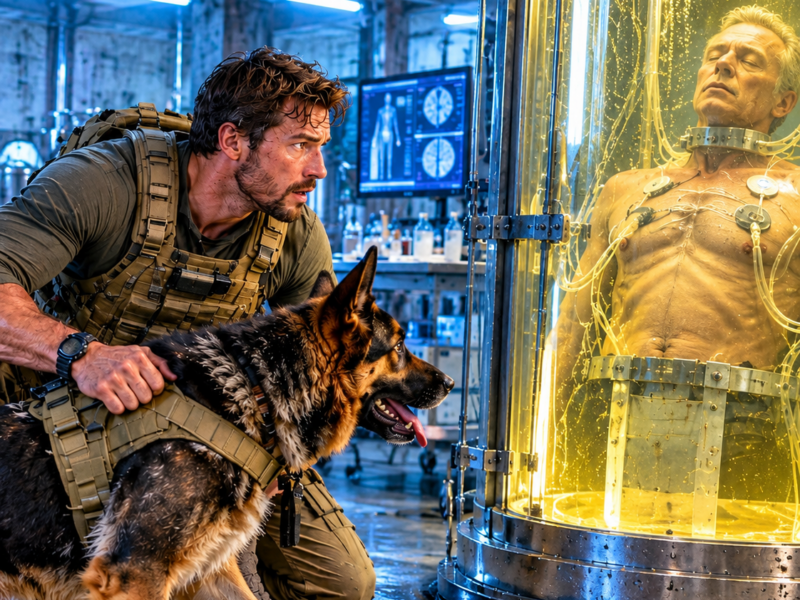
“My Navy SEAL dog tore through my sleeve and dragged me toward a locked basement door in an abandoned Virginia farmhouse
The engine outside roared louder, then gravel crunched beneath tires.
Marcus grabbed my wrist.
“Don’t let them take her.”
“Who? Marcus, who has Lily?”
He tried to answer, but a violent coughing fit folded him forward. Ranger pressed against his side, whining, while Deputy Bennett raised her flashlight toward the stairs.
“Everyone stay where you are!” she shouted.
Her partner, Deputy Collins, drew his weapon and moved toward the basement entrance.
I heard the rear door slam above us.
Then came footsteps on the porch.
Bennett keyed her radio. “Possible suspect on scene. One vehicle departing the property. Need units on the road immediately.”
Marcus clutched my sleeve.
“Not the police,” he rasped. “Not all of them.”
Bennett looked down at him.
“Sir, you’re going to need to explain that statement.”
He shook his head, struggling to catch his breath.
“They have the radios. The access codes. They know where the calls go.”
I felt the muscles in my back tighten.
Fourteen years in the Navy had taught me that panic and suspicion were not the same thing. A frightened man could say almost anything, especially after six years in captivity.
But the look on Marcus’s face wasn’t the wild confusion of someone who’d lost his grip on reality.
It was recognition.
He knew something about the people outside, and he was terrified they would reach us before he could tell me what it was.
“Laura,” I said, turning to Deputy Bennett, “we need to get him out of here.”
She studied Marcus for a moment.
“Agreed. But we do this by the book.”
Marcus gave a weak, bitter laugh.
“That’s how they got me in here.”
Bennett didn’t argue.
She called for an ambulance and requested that dispatch send a supervisor directly to the property. Then she told Collins to secure the entrance and watch the surrounding road.
I knelt beside Marcus.
His face was so thin that his cheekbones stood out sharply beneath the beard. A dirty blanket covered his legs, and his wrists bore pale marks where something had rubbed against them repeatedly.
There were old bruises along his forearms.
The man I’d remembered as broad-shouldered and nearly impossible to tire had become someone who looked as though a strong wind might break him.
“Marcus,” I said quietly. “Look at me.”
His eyes found mine.
“I’m here.”
He swallowed.
“You came back.”
“I never stopped wishing I could.”
For a moment, neither of us spoke.
Then his gaze shifted toward Ranger.
“Good boy.”
Ranger pressed his nose into Marcus’s palm.
Marcus began to cry.
Not loudly. He simply lowered his head and let the tears fall into the dirty blanket while the dog stayed beside him.
I turned away long enough to wipe my own eyes.
I’d spent six years imagining the last moments of my friend’s life. I’d replayed the operation, the explosion, and the frantic evacuation until I could remember details I’d never actually witnessed.
I’d carried the belief that Marcus had died because I hadn’t reached him in time.
Now he was alive, and I didn’t know whether to embrace him or demand an explanation for every night I’d spent mourning him.
The sirens arrived before I could decide.
Two paramedics came down the stairs with a stretcher. One began checking Marcus’s pulse and oxygen level while the other examined his injuries.
“Sir, can you tell me your name?”
Marcus looked at me.
I answered for him.
“Marcus Reed. Former Navy SEAL. Reported killed six years ago.”
The paramedic paused.
“Reported killed?”
“Long story,” I said.
Marcus reached for my hand again.
“Danny, the girl.”
“I know.”
“No, you don’t.” He pulled weakly at my sleeve. “The red shoe. Look at the size.”
I glanced toward the sneaker beside the folding chair.
“What about it?”
“Lily never wore red shoes.”
I stared at him.
“But I remember—”
“You remember the picture they showed you.”
His breathing became shallow.
“They told me she was wearing those shoes when they found her. They said she’d been taken to a safe house. They said her mother had agreed to let them move her.”
The paramedic adjusted his oxygen mask.
Marcus pushed it aside.
“They lied.”
Bennett crouched beside us.
“Who lied to you?”
Marcus looked at her, then at me.
“Everyone who told me the operation was over.”
The paramedics insisted on moving him.
As they lifted him onto the stretcher, his fingers closed around mine.
“Find the school records,” he whispered.
“What school records?”
“The ones from the day I died.”
Then the stretcher rose, and the paramedics carried him toward the stairs.
I followed them into the fading afternoon light.
The farmhouse looked different now. Its broken windows reflected the flashing red and blue lights, and the cellar entrance stood open like a wound in the foundation.
A deputy approached Bennett with a report.
“The vehicle went east. We have a description, but the plate came back registered to a rental company.”
“Get the rental company on the phone,” she said. “And nobody leaves without documenting this scene.”
She turned toward me.
“Mr. Mercer, I need you to tell me everything you know about Marcus Reed.”
I looked toward the ambulance.
“That’ll take a while.”
“Then we’d better start.”
I told her about our deployments, the operation six years earlier, and the official notification of Marcus’s death.
I explained how the Navy had informed his family that his remains had been identified and that the circumstances surrounding the operation prevented them from releasing certain details.
I told her about Lily’s red sneakers and the last photograph I’d seen of her.
Bennett listened without interrupting.
When I finished, she asked, “Did you ever see his body?”
“No.”
“Did you see the remains?”
“No. I attended the funeral.”
She looked at me carefully.
“Then what made you certain he was dead?”
I thought of the flag folded into a triangle, the sealed coffin, the officer who had stood beside Marcus’s widow and described him as a hero.
“The Navy told me.”
Bennett nodded slowly.
“Sometimes that’s enough. Sometimes it isn’t.”
She handed me her card.
“I want you to come to the sheriff’s office tomorrow morning. Bring anything you still have from that operation.”
I glanced toward the ambulance again.
“What if Marcus doesn’t make it through the night?”
“Then we’ll need to learn everything he can tell us while he’s still able.”
She paused.
“And Mr. Mercer? Don’t go looking for Lily on your own.”
I didn’t promise.
That evening, I sat beside Marcus’s hospital bed while machines measured the rhythm of his breathing.
The doctors had treated severe dehydration, malnutrition, and an untreated infection. They believed he’d been confined for a long time, though they couldn’t determine how much of his condition came from deliberate abuse and how much from neglect.
His wrists had healed over old injuries, but fresh bruises marked his ribs.
He’d lost nearly forty pounds.
The hospital assigned a guard to his door after Bennett explained the circumstances of his discovery.
I remained in the chair beside the bed, listening to the steady beep of the heart monitor.
Ranger lay across my boots.
Every few minutes, he lifted his head to check on Marcus before settling again.
At around nine, Marcus opened his eyes.
“Danny?”
“I’m here.”
He looked toward the door.
“Are we alone?”
“There’s a deputy outside. The hospital staff knows you’re a possible victim of a crime.”
He closed his eyes.
“Good.”
I leaned forward.
“Tell me about Lily.”
His jaw tightened.
“She’s my daughter. You know that.”
“I know who she is. I don’t know why you think she’s in danger.”
He stared at the ceiling.
“Because I found out she was in danger before the operation went bad.”
I waited.
Marcus took a slow breath.
“Six years ago, our unit was assigned to support an intelligence recovery operation overseas. The briefing said a civilian contractor had been selling military communications equipment and restricted information to unauthorized buyers. We were supposed to secure a location, recover digital records, and bring the evidence home.”
“That was the operation where the convoy was hit?”
“Yes.”
He shifted against the pillow, wincing.
“The problem was that somebody had changed the target coordinates after our briefing. We arrived at the wrong building, and the people we were supposed to meet had already been moved.”
“Who changed the coordinates?”
“We didn’t know then. We found a second set of records in a locked office. They showed that the contractor wasn’t working alone. Somebody inside our own command was feeding them information.”
I remembered the confusion of that night, the radio traffic, the sudden blast, and the order to evacuate before we’d recovered everyone.
Marcus had been assigned to the other side of the compound.
I’d last seen him running toward a doorway with his rifle raised.
Then the explosion hit.
The world became smoke, debris, and men shouting names into radios.
“I thought you were still inside,” I said.
“I was.”
He looked at me.
“But I wasn’t alone.”
“Who was with you?”
“A man named Peter Vaughn. He worked in intelligence analysis. He’d been tracking the contractor’s communications, and he had evidence that someone had deliberately compromised our operation.”
“Was he killed?”
Marcus looked away.
“I don’t know.”
The answer unsettled me more than a simple yes would have.
Marcus continued.
“Vaughn helped me get out of the building after the blast. I was badly injured. He said he could take me somewhere safe, but he wouldn’t explain who was coming after us.”
“And you trusted him?”
“I didn’t have much choice.”
He rubbed his thumb against the edge of the blanket.
“He took me to a temporary medical facility. There was a doctor there who treated my injuries without asking questions. I was unconscious for days. When I woke up, Vaughn told me the Navy had listed me as dead.”
“Why?”
“He said it was the only way to keep the people behind the operation from finding me.”
I shook my head.
“That doesn’t make sense. If they believed you were dead, why keep you locked in a basement?”
“Because I had seen something they needed to know whether I’d shared.”
He reached for the water cup. I helped him drink.
“When I recovered enough to move, Vaughn took me to Virginia. He said the people involved had contacts in the military, law enforcement, and private security. He told me to stay hidden until he could get the evidence to someone he trusted.”
“Did he ever get it?”
Marcus’s expression darkened.
“That’s what I was trying to find out when they moved me to that farmhouse.”
“Who moved you?”
“A man who called himself Daniel Price. He claimed to work for a private security firm contracted to protect witnesses.”
“Was that his real name?”
“I don’t know.”
I leaned back.
“Marcus, why didn’t you escape?”
He gave me a tired look.
“I tried.”
He described the first attempt, when he’d slipped through a service door and made it to the road before a vehicle intercepted him. The second time, he’d managed to hide in a maintenance shed until a search dog found him.
After that, his captors kept him inside.
“They told me Lily was safe,” he said. “They said she’d been moved to a protected location because somebody had threatened her mother.”
“Did you believe them?”
“I wanted to.”
His voice cracked.
“They showed me photographs. A house. A school bus. A woman they said was watching over her. Every time I asked to speak to Lily, they said it would compromise her location.”
He looked at me.
“Eventually, I realized the photographs were old.”
“How old?”
“At least two years.”
I thought of the red sneaker in the basement.
“Then why did you say someone was about to move her?”
“Because I heard them talking about a transfer. One of them said the girl was being relocated before the next audit.”
“An audit of what?”
“I don’t know.”
He swallowed.
“That’s why I needed you.”
I stared at him.
“Why me?”
“Because you were the only person I knew who would still be looking for the truth, even after everyone told you to stop.”
I wanted to tell him he was wrong. That I’d spent years trying to accept his death, that I’d moved away from the Navy, found a quiet job, and learned to sleep without hearing explosions in my dreams.
But I couldn’t say it.
Some part of me had never stopped questioning the official story.
I’d simply learned to keep those questions to myself.
Marcus reached toward the bedside table.
“My dog tag. Did they recover it?”
I nodded.
“It’s with the sheriff.”
He seemed relieved.
“There was something inside it.”
I frowned.
“What do you mean?”
“The back plate isn’t original. Vaughn modified it before we separated. There’s a small memory chip inside.”
I stared at him.
“You’re telling me you’ve been carrying classified evidence around your neck?”
“I was told the chip contained a backup copy of the communications records. I never had a way to read it.”
“Why didn’t you tell the police?”
“I didn’t trust them. And I didn’t know whether the chip was still there.”
I stood.
“I’ll call Bennett.”
“Wait.”
Marcus caught my hand.
“If the chip is intact, don’t let anyone access it without an independent forensic examiner.”
“Why?”
“Because whoever altered the operation records might have the credentials to access the same systems.”
He released me.
“Danny, I need you to understand something. I don’t know how many people were involved. I don’t know whether Price was working for the contractor or for someone inside the military. But I know they were afraid of what was on that chip.”
I looked at Ranger.
The dog had lifted his head, watching us.
“Then we’ll find out what’s on it.”
Marcus closed his eyes.
For the first time since I’d found him, his breathing seemed to settle.
Before I left the room, he spoke again.
“Danny?”
“Yeah?”
“If Lily is alive, don’t tell her what happened to me until you know she’s safe.”
I stared at him.
“She’s your daughter.”
“I know.”
His voice was barely audible.
“That’s why I can’t risk being wrong again.”
The next morning, Deputy Bennett met me at the sheriff’s office.
She had obtained the dog tag from the evidence locker and arranged for a digital forensics specialist from the state police to examine it.
The memory chip was still inside.
It was damaged, but not beyond recovery.
While the specialist worked, Bennett pulled up a missing-person report on her computer.
Lily Reed had been reported missing from her mother’s home in Columbus, Ohio, eleven months earlier.
The report described her as thirteen years old, approximately five feet tall, with brown hair and hazel eyes.
The last confirmed sighting placed her at a bus stop outside her middle school.
Her mother, Emily Reed, had reported her missing after she failed to come home.
Three days later, an anonymous caller claimed Lily had been seen boarding a bus with a woman who identified herself as a family friend.
No such family friend had been identified.
The case had remained open, but investigators had received no reliable leads.
I stared at the screen.
“Why didn’t Marcus know she’d been reported missing?”
Bennett folded her arms.
“Someone may have told him she was safe to keep him compliant. If he was being held by people who had access to the information, they could have made him believe she was protected.”
“Did Emily know he was alive?”
“We’re trying to reach her now.”
I looked at the photograph attached to the missing-person report.
Lily’s face was narrower than I remembered, her hair longer, but I recognized the small crease between her eyebrows.
Marcus had the same crease when he concentrated.
“Call her,” I said.
Bennett did.
Emily answered from Ohio, and her voice was thin with exhaustion.
When Bennett told her that Marcus had been found alive, there was a long silence.
Then Emily began to cry.
I turned away to give her privacy, but I heard her ask the same question three times.
“Is he really alive?”
Bennett assured her that the identification had been confirmed.
Emily’s next question was quieter.
“Does he know about Lily?”
When Bennett said yes, Emily began crying harder.
The call lasted almost twenty minutes.
By the end, we knew that Lily had disappeared eleven months earlier, that Emily had received several calls from blocked numbers warning her not to contact military authorities, and that a man had visited her home two weeks before Lily vanished.
He’d claimed to be investigating a threat against the family.
He’d shown her identification from a private security company and asked questions about Marcus’s old service records.
Emily had refused to cooperate.
Three days later, Lily was gone.
The company listed on the man’s identification had dissolved the previous year.
Bennett arranged for Emily to travel to Virginia under protective supervision.
Then the forensics specialist entered the room carrying a laptop.
“We recovered a portion of the data.”
He placed the computer on the table.
The files included encrypted communications, financial transfers, and an audio recording made during the operation six years earlier.
The recording began with static.
Then Marcus’s voice came through.
“If you’re hearing this, the operation has been compromised. The target location was changed after the briefing. Someone with access to the command system is feeding our movements to the contractor.”
A second voice responded.
“Do you have proof?”
“Enough to start an investigation. Not enough to identify everyone involved.”
The second voice belonged to Peter Vaughn.
“Then we get the records out. We don’t trust the internal channels.”
There was a pause.
Then another voice entered the recording.
A voice I recognized immediately.
Commander Robert Harlan.
He had been the senior officer who delivered the official notification of Marcus’s death to his family.
He’d stood beside the coffin and described Marcus as a man who had given everything for his country.
On the recording, Harlan sounded calm.
“Reed, you have no idea how far this goes. If you release those files, you won’t just destroy the contractor. You’ll expose people who have been keeping this operation running for years.”
Marcus answered, “That’s the point.”
The recording ended abruptly.
I sat staring at the screen.
Harlan had retired two years earlier. His public record showed a distinguished career, several commendations, and no disciplinary action.
He’d also been the person who had assured us that Marcus’s death had been independently verified.
Bennett called the state police investigator assigned to the case.
Within an hour, the recording had been copied and sealed for examination.
But the most important discovery came from a separate file.
It contained a list of payments made by the private security company to a series of shell businesses. One payment, dated three weeks before Lily disappeared, had been routed to a residential property in Maryland.
The address belonged to a house that had been registered to Daniel Price.
The same name Marcus had given us.
Bennett sent a team to the property.
By the time they arrived, the house was empty.
They found discarded medical supplies, food containers, and a room with a reinforced interior door.
In a closet, they recovered several children’s clothing items.
One of them was a red sneaker.
The matching shoe was nowhere to be found.
I stared at the evidence photograph on Bennett’s screen.
The sneaker looked almost identical to the one we’d found in the basement.
But there was no blood, no DNA evidence, and no reliable way to establish when it had been left there.
It was a clue, not an answer.
Still, it confirmed that the farmhouse hadn’t been an isolated incident.
Someone had been moving people between locations, using false identities and private security contracts to keep them out of sight.
And Lily might have been one of those people.
We spent the next two days following the financial trail.
A former employee of the security company agreed to speak with investigators after learning that Marcus had survived.
He told them the company had been paid to provide transportation and temporary housing for witnesses who were considered security risks.
But some of the people listed as witnesses had never appeared in any official investigation.
Their identities had been created using false records.
The employee had seen Lily at the Maryland property.
He described her as quiet, frightened, and unusually protective of a younger child who had been staying there.
He didn’t know the child’s name.
He said Lily had been moved shortly before he left the company.
He’d been told she was being taken to a long-term placement.
“Where?” Bennett asked.
The employee shook his head.
“I never saw the destination. I just prepared the paperwork.”
“Who signed it?”
He looked at the table.
“Daniel Price.”
“Who gave him the orders?”
“I don’t know.”
Bennett leaned forward.
“You’re going to need to do better than that.”
The man rubbed his hands together.
“There was someone above Price. We called him the Director. He never used his real name. He communicated through encrypted messages and paid bonuses when we didn’t ask questions.”
“Did you ever meet him?”
“Once.”
“Describe him.”
The employee hesitated.
“Older. Gray hair. Military posture. He had a scar across his left hand.”
Bennett wrote it down.
“Anything else?”
The man looked at me.
“He asked about a Navy SEAL named Daniel Mercer.”
My blood ran cold.
“Why?”
“He said Mercer was a loose end. He wanted to know whether you were still in contact with Reed.”
I stood so quickly that my chair scraped across the floor.
“Why didn’t you tell the investigators that earlier?”
“I was afraid.”
“Of what?”
He looked at me with miserable eyes.
“They told me people who talked had accidents.”
Bennett motioned for me to sit.
I forced myself back into the chair.
“Did the Director know where Lily was?”
The employee nodded.
“He approved every transfer.”
“Do you know where she is now?”
“No.”
He swallowed.
“But I remember something Price said before I quit. He said the girl was being moved somewhere no one would think to look.”
Bennett continued questioning him, but the man had no further details.
That night, I sat in my car outside the hospital and called Emily Reed.
She answered immediately.
“Have they found her?”
“Not yet.”
I heard her draw a shaky breath.
“Marcus always said Lily was stubborn. If she thinks someone is trying to protect her, she’ll fight them every step of the way.”
“Did she ever mention a place she wanted to go if she felt unsafe?”
Emily was quiet.
“Her grandmother’s cabin. It’s in the mountains in West Virginia. We haven’t used it in years.”
“Does anyone else know about it?”
“Marcus knew. My parents knew. That’s about it.”
I wrote down the location.
“Why are you asking?”
“Because the people who took her may have been moving her between properties. We’re trying to identify places connected to the family.”
Emily began to cry again.
“Please bring her home.”
“I will do everything I can.”
After we hung up, I gave Bennett the cabin’s address.
She arranged for a team to check it at first light.
I couldn’t sleep that night.
I kept seeing the red sneaker beside the folding chair, the chain around Marcus’s neck, and the fear in his eyes when he said someone wanted me at the farmhouse.
At dawn, Bennett called.
The cabin was empty, but the team had found fresh tire tracks near the rear entrance and a child’s drawing tucked beneath a kitchen drawer.
The drawing showed three figures holding hands beneath a yellow sun.
One was a tall man with dark hair.
One was a woman.
The third was a girl with red shoes.
On the back, in a child’s handwriting, were the words:
If I get lost, I want to go home.
Bennett sent me a photograph.
I sat on the edge of my bed and stared at it until the room brightened around me.
Then my phone rang again.
It was Emily.
“I remember that drawing,” she said through tears. “Lily made it the week before she disappeared.”
“Why didn’t you mention it?”
“Because I thought she’d left it at school.”
She paused.
“There’s something else. The woman who visited our house before Lily disappeared had a silver bracelet with a little blue stone. Lily said she’d seen the same bracelet at the bus stop.”
I looked at the drawing.
“Did Lily know the woman?”
“No. But she told me the woman had smiled at her and said her father was waiting.”
The words settled heavily between us.
Marcus had been told Lily was safe.
Lily had been told her father was waiting.
Someone had used the same lie to control both of them.
I called Bennett and told her about the bracelet.
She immediately asked the state police to review surveillance footage from the bus stop and nearby businesses.
By that afternoon, they found a woman matching Emily’s description entering a convenience store less than half a mile from Lily’s school.
The image was grainy, but the silver bracelet was visible.
So was the man’s face behind her.
Daniel Price.
The footage showed Price leaving the store with the woman and walking toward a dark SUV.
A second camera captured the vehicle turning onto a highway.
The license plate was false.
The investigation was no longer just about a missing girl.
It was about a coordinated operation that had used military credentials, false records, and private security contracts to conceal people and manipulate their families.
Bennett obtained a warrant for Price’s remaining accounts and properties.
The state police traced a payment to a rural storage facility near the West Virginia border.
Inside one unit, they found boxes of records, outdated identification cards, and a collection of encrypted drives.
They also found a handwritten list of names.
Marcus Reed was crossed out.
Lily Reed was marked with a date.
And beside my name were two words.
Contact confirmed.
I stared at the page.
“They expected me to find him.”
Bennett nodded.
“That’s one possibility.”
“Then the farmhouse wasn’t just a place to hide Marcus.”
“It may have been a place where they expected someone to come looking.”
I thought about Ranger dragging me toward the door, the fresh scratches on the lock, and the text from the property owner telling me not to open the basement.
Had someone deliberately left Marcus where I’d find him?
Had Ranger’s instincts uncovered a trap?
Or had someone inside the operation lost control of the situation and made a desperate mistake?
We didn’t know.
But the list suggested that whoever had organized the disappearances was tracking our movements.
Bennett arranged for me to stay at a secure location while the investigation continued.
I refused at first.
Then I remembered Marcus’s warning about Lily, and I agreed.
The next morning, a state police investigator arrived with a report from the storage facility.
One of the drives had contained an encrypted file labeled with a date from six years earlier.
The date of the operation in which Marcus had supposedly died.
A forensic analyst had recovered a short video.
It showed a warehouse with several people standing near a loading bay. The image was dim, but the audio was clear enough to hear a man speaking.
“We’ve secured Reed. His family is the leverage.”
Another voice asked, “And Mercer?”
“Keep him out of the file. If he learns Reed survived, he’ll keep digging.”
The video ended.
I sat very still.
They hadn’t simply hidden Marcus.
They had used his family to control him and kept me away because they knew I would never stop asking questions if I learned he was alive.
The investigator paused the video.
“We’re working to identify the speakers.”
“How long?”
“I can’t give you a timeline.”
I looked at the frozen image on the screen.
“Then what do we do now?”
“We follow the money. We identify the people who authorized the transfers, and we locate Lily.”
It wasn’t the answer I wanted.
But it was the only answer that would hold up in court.
Three days later, Marcus was strong enough to sit through a formal interview.
Bennett arranged for him to speak with investigators in a secure room at the hospital. Emily joined by video call, her face pale and drawn.
When Marcus saw her, he began to cry.
“I’m sorry,” he said.
Emily pressed both hands over her mouth.
“Marcus, don’t.”
“I should have found a way home.”
“You were alive. That’s all I needed to know.”
He shook his head.
“I believed them when they said Lily was safe.”
Emily leaned toward the screen.
“They told me she was gone. They told me you were dead. I spent eleven months wondering whether I had missed something that could have saved her.”
Marcus closed his eyes.
“We were both lied to.”
For a moment, the room was silent.
Then Emily asked the question none of us had been able to answer.
“Where is our daughter?”
Marcus looked at the investigators.
“We need to find Peter Vaughn.”
The name brought the room to attention.
Marcus explained that Vaughn had been the last person he knew who had direct access to the original evidence and the network’s communications.
If Vaughn was alive, he might know where Lily had been taken.
The investigators traced Vaughn to a small town in Pennsylvania, where he’d been living under his own name and working as a consultant.
He agreed to meet them.
At first, he denied knowing anything about Lily.
Then the investigators showed him the recovered audio and the financial records.
His face went gray.
“I didn’t know they were going to take the child,” he said.
Marcus leaned forward.
“You knew they were using my family.”
“I knew they were threatening them. I didn’t know they’d actually—”
“Don’t finish that sentence.”
Marcus’s voice was quiet, but the anger in it silenced everyone.
Vaughn lowered his head.
He admitted that he’d helped Marcus escape after the operation, but he’d later been contacted by Harlan and told that the evidence needed to be secured through a private security contractor.
He believed he was helping protect witnesses.
When he realized the contractor was holding people against their will, he tried to withdraw.
They threatened to expose his own involvement in the unauthorized transfer of classified material.
He went silent.
He’d told himself that staying away would keep him alive long enough to find another way to help.
Instead, he’d spent six years pretending not to know what had happened to his friend.
“Do you know where Lily is?” Bennett asked.
Vaughn stared at the table.
“I know where they were taking her.”
“Where?”
“A residential property in western Maryland. It was being used as a temporary holding location before witnesses were moved to new identities.”
“Is that where she is now?”
“I don’t know.”
Marcus gripped the armrests.
“Then why bring us here?”
Vaughn looked up.
“Because I kept a copy of the transfer schedule. I thought it might be useful if things ever went wrong.”
He gave the investigators a password and the location of a separate encrypted drive.
The schedule contained several entries, each associated with a false identity and a destination.
Lily’s name appeared under an alias.
The destination was a property near the West Virginia border.
The transfer date was the following morning.
We were out of time.
Bennett and the state police coordinated with federal investigators to secure the property. Marcus was ordered to remain at the hospital, and Emily was placed under protection.
I wanted to go with the team.
Bennett refused.
“You are not a law enforcement officer, Mr. Mercer.”
“I know how to operate in dangerous environments.”
“And that is exactly why you are not going in. You have a personal connection to the victim, and the people we’re dealing with may be watching you.”
I hated that she was right.
For years, I’d believed my job was to move toward danger when other people moved away.
Now the most difficult thing I could do was stay behind and trust someone else to bring Lily home.
I waited in the hospital conference room with Marcus, Emily, and Ranger.
Nobody spoke much.
At 10:42 a.m., Bennett sent a message.
Team on site. No visual contact with suspect.
At 11:03:
One adult detained. Searching residence.
At 11:17:
Child located. Conscious. Medical assessment underway.
Emily made a sound that seemed to come from somewhere deep inside her.
Marcus covered his face with both hands.
I reached across the table and held his shoulder.
He leaned forward, shaking.
For six years, he’d survived by believing his daughter was somewhere safe.
For eleven months, Emily had survived by believing she might still come home.
And for the first time, neither of them had to imagine what it would feel like to see Lily again.
The next message arrived at 11:29.
Lily Reed confirmed alive. Transporting to secure medical facility.
Emily began sobbing.
Marcus stood, then had to grip the table as his weakened legs gave way.
Ranger rose and pressed his head against Marcus’s knee.
I looked at the dog and rubbed his ears.
“You found him, buddy.”
Ranger’s tail moved once.
As if that were all the acknowledgment he needed.
Lily arrived at the hospital that afternoon.
She was taller than I’d remembered, with her mother’s hazel eyes and Marcus’s dark hair. She wore a borrowed sweatshirt and carried a small canvas bag.
When she saw her mother, she ran.
Emily caught her in both arms and held her so tightly that neither seemed able to breathe.
Marcus stood a few feet away, afraid to move.
Lily turned.
For several seconds, she simply stared at him.
Then she whispered, “Dad?”
Marcus nodded.
His face crumpled.
“I’m here, sweetheart.”
She crossed the room and wrapped her arms around him.
He sank to his knees, holding her as though the world might take her away again if he loosened his grip.
“I’m sorry,” he whispered into her hair. “I’m so sorry.”
Lily clung to his shoulders.
“They told me you were dead.”
“I know.”
“They said you didn’t want to see me.”
Marcus drew back, his eyes wet.
“That was never true. Not for one second.”
She studied his face, searching for something familiar.
Then she touched the scar on his cheek.
“You’re real.”
He covered her hand with his.
“Yes, baby. I’m real.”
I stepped out into the hallway to give them privacy.
Ranger followed and sat beside me.
For the first time since the farmhouse, the dog looked relaxed.
The investigation continued for another year.
Harlan was charged after investigators established that he’d helped conceal the original operation’s failure, authorized falsified records, and coordinated with the private contractor to keep Marcus from exposing the network.
Price was arrested while attempting to leave the country.
Several employees of the security company were charged with unlawful confinement, fraud, and related offenses.
Peter Vaughn cooperated with investigators and faced separate consequences for his role in the unauthorized transfer of evidence.
Not everyone involved was identified, and some financial trails ended in shell companies with no recoverable records.
But the central case held.
Marcus’s death had been falsified. Lily had been abducted under the cover of a supposed witness-protection arrangement. And people who had once sworn to serve the country had used their positions to make a family disappear.
Marcus spent months in physical rehabilitation.
He had to learn how to walk long distances without pain, rebuild his strength, and sleep without waking at every unfamiliar sound.
Lily received counseling and gradually returned to school.
Emily stayed beside them both, though there were difficult days when the years of uncertainty came rushing back.
They didn’t become a perfect family overnight.
Sometimes Marcus struggled to answer Lily’s questions. Sometimes Emily became angry when he apologized for things he hadn’t been able to control. Sometimes Lily refused to leave her parents’ sight, even when she was only going to the kitchen.
Healing was slower than the investigation.
But it was real.
One spring afternoon, I visited them at their new home in Ohio.
Marcus was sitting on the back porch with Ranger, watching Lily teach the dog to retrieve a tennis ball.
She threw it too far, and Ranger raced across the grass with the joyful determination of a dog who had finally been given permission to enjoy an ordinary day.
Marcus smiled.
“He used to do that with her when she was little.”
I sat beside him.
“She remembered how.”
“She remembers more than I thought she would.”
He watched Lily laugh as Ranger returned with the ball.
Then his expression grew serious.
“I owe you more than I can say, Danny.”
I shook my head.
“You don’t owe me anything.”
“I do. You spent years believing I was dead. You carried that guilt because you thought you hadn’t reached me in time.”
I looked down at my hands.
He was right.
“I should have checked the records again,” I said. “I should have asked why they never showed us the body.”
“You were grieving. You trusted the people who were supposed to know.”
“That doesn’t make it easier.”
“No,” he said. “It doesn’t.”
We sat quietly.
After a while, Marcus spoke again.
“I don’t want the rest of my life to belong to what they did to us.”
I looked toward Lily.
“Neither do I.”
He nodded.
“Then let’s make sure it doesn’t.”
When I left that evening, Lily ran to the driveway and hugged me.
“Uncle Danny?”
I smiled at the name.
“Yeah, kiddo?”
“Dad says you found him because Ranger knew he was there.”
I glanced at the dog, who was sitting beside Marcus with his ears alert.
“That’s right.”
Lily rubbed Ranger’s head.
“I think he knew Dad was waiting for us.”
I didn’t have an answer for that.
Maybe Ranger had smelled a familiar person behind a locked door. Maybe he’d recognized something no human could detect. Maybe he’d simply refused to ignore a sound that everyone else had missed.
Whatever the reason, his stubbornness had led me to a man I had mourned for six years and a girl who had spent eleven months believing her father was gone.
I drove home as the sun dipped behind the trees.
For a long time, I’d believed the worst thing that could happen to a soldier was losing someone in the line of duty.
I knew better now.
Sometimes the worst thing was being told to stop looking, being handed a folded flag, and learning to live with a story that had been written by people who needed you to stop asking questions.
Marcus had survived the basement.
Lily had survived the lies.
And Ranger, who had never understood why anyone would walk away from someone who needed help, had done what he’d always done.
He had found the person everyone else had decided was lost.
That night, I placed Marcus’s old photograph on the shelf beside my service medals.
I no longer looked at it and wondered whether I could have saved him.
I looked at it and remembered that, when the door finally opened, he was still there.
And this time, when he called my name, I was close enough to answer.
THe End.









