“My in-laws threw me out in the middle of a blizzard with nothing but a suitcase and the wedding ring I no longer wanted
Richard knocked again.
“Rebecca, open the door. You’re making this far more complicated than it needs to be.”
I stood frozen beside the steel hatch, the envelope trembling in my hands.
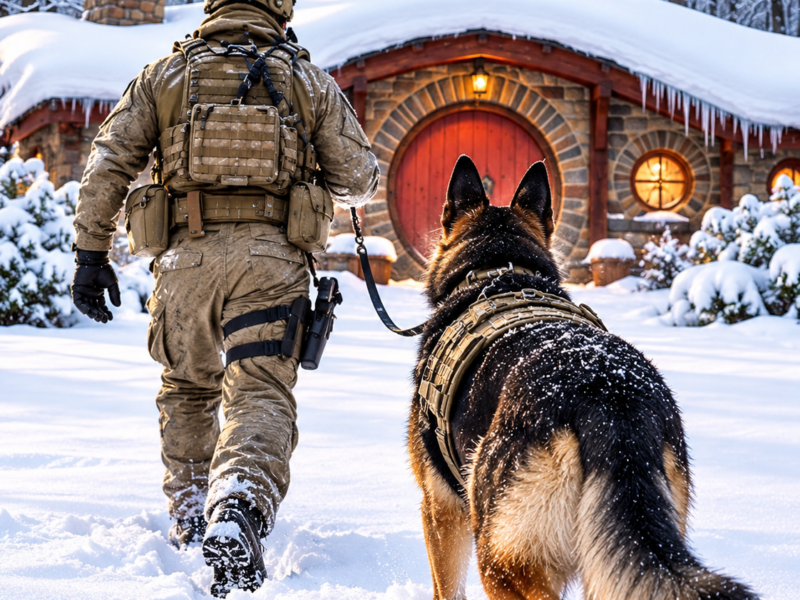
Daniel positioned himself between me and the entrance. Duke stood at his left side, his ears forward and his body perfectly still.
“Do you know how many people have died on this road tonight?” Daniel called through the door. “If you have a legitimate reason to be here, state it from outside.”
Richard laughed, but there was no humor in it.
“This is a family matter. You wouldn’t understand.”
“Then you won’t mind explaining it to the sheriff.”
The laughter stopped.
I had never heard anyone speak to Richard like that. In the eleven months since Andrew’s death, he had treated every disagreement as something he could crush through volume, intimidation, or a carefully chosen insult.
Daniel didn’t raise his voice.
He didn’t need to.
“Rebecca,” Richard said, suddenly sounding almost reasonable, “you have no idea what you’re dealing with. That property is dangerous. Andrew’s grandfather was an old man who spent his last years imagining things. Give me the documents, and I’ll get you somewhere warm.”
I looked at the letter again.
*Do not let them learn what lies beneath the floor.*
“Why did you follow me?” I asked.
“Because you’re family.”
“You threw me into a blizzard.”
“That was a misunderstanding.”
“You told me to go live on the property.”
Silence.
Then Richard said, “You should have signed the papers.”
Something inside me became very still.
There it was.
Not concern.
Not family.
The truth.
Daniel glanced toward the small window, where another shadow had appeared beside Richard’s vehicle.
“We’re calling the authorities,” he said.
Richard’s voice sharpened.
“You have no idea how much trouble you’re inviting.”
A few seconds later, the footsteps retreated from the porch.
I waited until the vehicle’s headlights disappeared through the trees before allowing myself to breathe.
My knees weakened, and I sat on the edge of the wooden bench.
Daniel crouched several feet away, giving me room.
“You all right?”
“No.”
The answer came out before I could hide it.
“I don’t know what that number means. I don’t know why my husband’s family is here. And I don’t know why someone who died before I ever met him left a warning with my name on it.”
Daniel nodded.
“Then we don’t guess. We document what we find, get somewhere safe, and bring in people who can establish what’s real.”
He took photographs of the hatch, the letter, the scratches around the door, and the tracks in the dust. I photographed the handwriting and the brass plaque.
Before leaving, I looked back at the floor.
Whatever was underneath had already changed my life.
But I wasn’t going to let Richard decide what happened next.
We drove to a ranger station several miles down the mountain. Daniel knew the night supervisor, a woman named Elena Brooks, who helped us contact the county sheriff despite the storm.
When I explained what had happened, Elena gave me a blanket and a cup of hot tea.
She didn’t ask why I hadn’t simply gone home.
She didn’t tell me to forgive anyone.
She listened.
The sheriff’s deputy took a statement and said he would document the confrontation. Since the cabin was on private property and the ownership records needed to be verified, he advised us not to open the hatch until the property could be secured and the appropriate authorities could be present.
It was sensible advice.
It was also the longest night of my life.
I barely slept.
Every time I closed my eyes, I saw Richard standing on the porch, his face illuminated by the headlights.
At dawn, Daniel brought me a fresh cup of coffee.
“You should call someone you trust,” he said.
I stared into the cup.
“I don’t know who that is anymore.”
“You trusted Andrew.”
The mention of my husband hurt.
“Yes.”
“Then start with what he taught you. Not what his family told you to believe.”
I thought about Andrew’s quiet patience, his habit of checking every lock before bed, and the way he always said that people showed their true character when they thought nobody could challenge them.
He had once told me something about his grandfather that I had forgotten.
“My grandfather built things that were supposed to outlast him,” Andrew had said while showing me an old photograph. “He didn’t trust banks with everything. He said institutions change, people change, but a properly built vault can survive both.”
At the time, I had assumed it was just another story about an eccentric old man.
Now I wondered whether it had been a warning.
By midmorning, the storm had eased enough for a county team to reach the property. The deputy arranged for a locksmith and an investigator to accompany us back to the cabin.
Richard’s vehicle was gone.
The fresh tracks outside, however, had not disappeared.
The investigator photographed them and marked the location.
Then we entered the cabin.
Under the team’s supervision, the steel hatch was examined and opened.
Beneath it lay a narrow stone stairway leading to a room carved into the hillside.
The air smelled of damp earth and cold metal.
A battery-powered work light revealed steel cabinets, shelves of archival boxes, and a heavy safe bolted into the rock.
On the far wall hung a framed photograph of an elderly man standing beside a much younger Andrew.
I recognized Andrew immediately.
The old man had one hand resting on his grandson’s shoulder.
Beneath the photograph was a brass plate engraved with a name.
THOMAS HALE.
Andrew’s grandfather.
The investigator checked the room before allowing us to proceed farther. Nothing appeared to be unstable, and there were no signs of anyone hiding inside.
Then I saw the ledgers.
Dozens of them, carefully numbered and arranged by year.
There were property maps, mining surveys, legal documents, and photographs of land stretching across the surrounding mountains.
Daniel stood beside me as I opened the first box.
“Rebecca,” he said quietly, “I think your grandfather-in-law was planning for someone to find this.”
Inside the box was a sealed envelope with Andrew’s name on it.
The paper had yellowed with age.
I carefully opened it.
*Andrew,*
*If you’re reading this, then you have come back to the place where our family began. I hope you have brought someone who understands that wealth is not the same thing as worth.*
*The records below this cabin concern the land, the mineral rights, and the trust I established to protect them. I have spent years watching people confuse ownership with entitlement. Do not make the same mistake.*
*If I have passed before I can explain everything, consult the independent trustee listed in the blue ledger. Do not rely on anyone who insists that a signature must be obtained immediately.*
I read the final paragraph twice.
Then I looked at the investigator.
“Can we find out what this property is worth?”
“We can begin by identifying what the documents actually represent,” she said. “But nobody should promise you a number until the ownership and valuations are independently verified.”
That caution was the first thing anyone had said that made me feel safe.
We spent the next several hours documenting the contents of the underground room.
The blue ledger contained references to mineral exploration permits, timber rights, and several parcels of land acquired by Thomas over more than four decades.
Some documents referred to a company that had since become a major supplier of materials used in advanced battery production. Others concerned water rights, conservation easements, and mineral deposits that had been mapped but never fully developed.
The property was far more complicated than an old cabin and a few acres of wilderness.
A sealed folder contained correspondence with a financial institution and a trust administrator.
Another held an appraisal from several years earlier, marked preliminary and subject to further geological analysis.
The figure on the first page made my hands go cold.
Estimated combined asset value: $195,000,000.
I sat down.
One hundred ninety-five million dollars.
The number on the plaque had not been a random marking.
It had been a warning about the scale of what lay beneath our feet.
But the appraisal also contained several qualifications. The valuation depended on the validity of mineral rights, environmental restrictions, market conditions, and the trust’s legal structure.
It was not a check for $195 million.
It was a collection of potentially extraordinary assets whose ownership and value had to be established.
I was still trying to understand the documents when the investigator called us out of the room.
A second team had arrived.
They had found evidence that someone had recently entered the cabin and attempted to force the hatch. A small tool mark matched damage around the entrance, although the investigators had not yet identified who made it.
Then a deputy approached me with a question.
“Does your brother-in-law have access to your late husband’s estate documents?”
“Yes,” I answered. “He handled most of the paperwork after Andrew died. He told me the mountain property was practically worthless.”
The deputy exchanged a glance with the investigator.
“Did he ever ask you to sign a transfer?”
“Several times.”
“Do you still have those papers?”
I remembered the stack of documents Richard had left on the dining table two days earlier.
“I think so.”
The investigator explained that the documents could be important. She asked me not to contact Richard or accuse him of anything while the facts were being established.
I agreed.
For the first time, I understood that anger could be useful only if I didn’t let it make decisions for me.
That afternoon, Daniel drove me back to town.
We stopped at a small motel where I could shower, change, and call an attorney independent of Andrew’s family.
Before he left, Daniel handed me his card.
“Call if you need help getting to appointments or if someone makes you feel unsafe.”
I looked at him.
“Why are you doing all this?”
He considered the question.
“Years ago, a man stopped to help my younger brother after a roadside accident. He stayed with him until the ambulance arrived. My brother survived. I never learned the man’s name, so I never got to thank him.”
Daniel glanced at Duke, who was lying beside the truck.
“I can’t repay a person I never found. But I can make sure I don’t drive past someone who needs help.”
I swallowed the lump in my throat.
“Thank you.”
He nodded once.
“Get some sleep, Rebecca. Tomorrow is going to be complicated.”
He was right.
The following morning, my attorney, a woman named Helen Ward, reviewed the documents with me.
She explained that Thomas Hale had established a private trust years before his death. The mountain property, associated mineral rights, and certain investment interests had been placed under its administration.
The trust named Andrew as a beneficiary, but a later amendment addressed what would happen if he died before the trust’s assets were distributed.
I held my breath as Helen read the relevant section.
The amendment named me as the successor beneficiary, provided that the marriage remained legally valid at the time of Andrew’s death and that I had not signed away my interest.
I had not.
But there was another complication.
The trust was administered by an independent fiduciary, and any transfer of the underlying assets required a formal review. No family member could simply claim the property or sell the mineral rights on my behalf.
Helen looked up from the papers.
“Your in-laws may have known the trust existed. They may even have known about the potential value. But we’ll need evidence before we can say what they intended.”
I thought of Patricia’s expression when she told me the land was worthless.
I thought of Richard’s repeated demands for my signature.
And I thought of the warning in Thomas’s letter.
*Do not rely on anyone who insists that a signature must be obtained immediately.*
Helen asked me to bring every document I had.
That evening, I returned to the house where Patricia and Richard lived.
Not alone.
Helen had arranged for a neutral third party to accompany me while I collected my personal belongings, and the deputy knew where I was going.
Patricia opened the door.
Her expression changed when she saw the attorney beside me.
“What is this?”
“I’ve come for my belongings and the estate papers,” I said.
Richard appeared behind her.
His eyes moved from Helen to the deputy waiting near the driveway.
For the first time since Andrew’s funeral, he looked uncertain.
“You’ve been talking to people who don’t understand our family,” he said.
“No,” I replied. “I’ve been talking to people who understand documents.”
I went upstairs and collected my clothes, photographs, and the small wooden box containing Andrew’s wedding ring.
When I returned downstairs, Richard stood beside the dining table.
A familiar folder lay open in front of him.
“You don’t know what you’re doing,” he said.
Helen stepped forward.
“Then you should have no objection to allowing an independent attorney to review these papers.”
Richard shut the folder.
Patricia’s face had gone pale.
“Rebecca, darling,” she began, her voice suddenly soft. “We’ve all been under tremendous stress. Your husband was our son. We were only trying to protect what he left behind.”
“Then why did you throw me out into a blizzard?”
She opened her mouth.
No answer came.
I took the folder from the table.
Inside were copies of a proposed assignment of interest in the Hale family trust. My name appeared on the signature line.
The document would have transferred my beneficiary rights to a company I had never heard of.
The signature line was blank.
A handwritten note in the margin read: *Get Rebecca to sign before the trustee contacts her.*
Helen photographed the document and placed it in a protective folder.
Richard stepped toward us.
“You can’t take that.”
The deputy moved between us.
“Sir, step back.”
For one long moment, nobody spoke.
Then Patricia sat down heavily in a chair.
“You don’t understand,” she whispered.
“Then explain it,” I said.
She stared at the table.
Richard had told her the trust was tied up in legal complications. He had said that if I signed the assignment, the family could settle everything quickly and avoid years of litigation. He had promised her that the money would protect their home and pay off debts she hadn’t known existed.
She insisted she had never seen the underground vault.
I didn’t know whether she was telling the truth.
And for the first time, I realized I didn’t need to decide that night.
The documents, the attempted entry, and the proposed transfer would be examined by people whose job was to establish the facts.
I left with my belongings.
As I reached the porch, Patricia called after me.
“Rebecca, Andrew would never have wanted us to become enemies.”
I turned around.
“Then you should have treated me like family when I was grieving.”
I walked away before she could answer.
The investigation took months.
The trustees confirmed that the documents in the cabin were authentic, although several mineral rights still required additional title work and environmental review. Independent experts assessed the property, and the trust’s financial advisers updated the valuation.
The combined assets were ultimately valued at approximately $195 million, subject to the trust’s obligations, taxes, legal costs, and the conditions attached to the land.
The figure was real.
So was the responsibility that came with it.
The investigation also uncovered evidence that Richard had been working with a business associate who hoped to acquire the rights through a shell company. Communications and financial records suggested that they had deliberately understated the property’s potential value when discussing it with me.
Authorities pursued the matter based on the evidence they collected. Richard faced legal consequences for his role in the attempted fraudulent transfer, though the exact outcome was determined through the legal process rather than by anything I demanded.
Patricia was questioned as well. The evidence against her was less clear, and I refused to invent certainty where none existed.
I wasn’t interested in revenge.
I wanted the truth, my independence, and a life in which no one could threaten me into signing away my future.
When the trust finally confirmed my beneficiary status, I returned to Black Pine Ridge.
The cabin had been secured, and the entrance to the underground vault was protected. The trustees began the long work of managing the property responsibly, including environmental assessments and negotiations with qualified partners.
I could have sold everything immediately.
Instead, I took time to learn what Thomas had spent his life protecting.
Some of the land contained valuable resources. Other sections were essential to local watersheds and wildlife corridors. The trust’s terms required careful management, and I came to believe that preserving the land mattered as much as its financial value.
I established a foundation to support surviving spouses facing financial coercion, particularly those navigating complicated estates after losing a partner.
I didn’t call it the Thomas Hale Foundation.
I named it Andrew’s Promise.
Because my husband had never wanted wealth to become a weapon.
He had wanted the people he loved to be safe.
Months after the blizzard, Daniel and Duke visited the cabin with me.
The snow had melted from the roof, revealing the little round windows and the weathered cedar door. Sunlight fell across the hillside where the entrance had once been nearly invisible.
Duke bounded through the clearing, delighted to be free of his winter harness.
Daniel stood beside me, hands in his jacket pockets.
“Do you ever think about what would have happened if I hadn’t stopped that night?” I asked.
He looked toward the road.
“You would’ve found another way.”
“You can’t know that.”
“No,” he admitted. “I can’t.”
I appreciated that answer more than a comforting lie.
For months, I had replayed the night Patricia shut the door, wondering how my life could have changed so completely in a few minutes.
But the cabin hadn’t made me brave.
The money hadn’t made me worthy.
And Daniel hadn’t rescued me by solving every problem I had.
He had stopped long enough to see that I was in trouble, then helped me find the people and the strength I needed to take the next step.
That was the difference.
I had spent years believing that being loved meant being protected from every hardship.
Now I understood that real kindness gave you room to stand on your own feet.
Before we left, I entered the cabin one final time.
The brass plaque bearing the number $195,000,000 had been removed for safekeeping. The old photograph of Thomas and Andrew remained on the wall, preserved behind protective glass.
I touched the frame.
“I’m trying to do right by him,” I whispered.
For a moment, I imagined Andrew beside me, smiling that small, crooked smile he always wore when he knew I had finally figured something out.
Then I stepped outside.
Daniel was waiting by the truck, and Duke came trotting toward me with a fallen branch in his mouth.
I laughed.
It was the first completely unguarded laugh I could remember since Andrew died.
A year earlier, I had been thrown out of a house because I refused to sign away something I didn’t understand. I had stood in a storm believing I had lost everything.
Instead, that night had led me to the truth about my husband’s family, a fortune hidden beneath a forgotten cabin, and the realization that my future did not belong to the people who had hurt me.
The $195 million changed what I could do.
But it wasn’t the greatest thing I found under that frozen mountain.
The greatest thing was the part of myself I had nearly abandoned while trying to earn a place in a family that never intended to give me one.
I no longer needed their permission to belong.
And when I drove away from Black Pine Ridge that afternoon, I left the cabin standing exactly where it had stood for generations—not as a hiding place for a fortune, but as a reminder that sometimes the truth survives beneath the deepest snow, waiting for someone to stop, look carefully, and refuse to walk away.
The end









