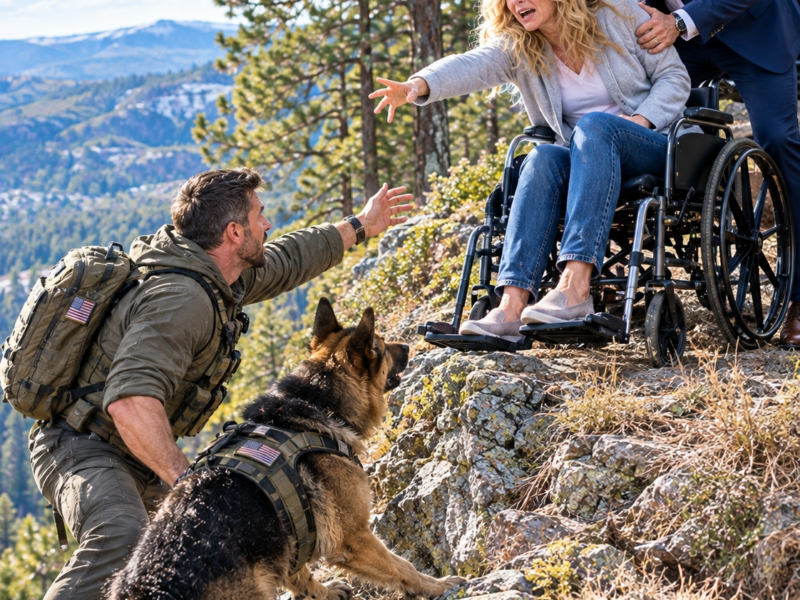
“My husband shoved my wheelchair-bound body over a rocky ridge in the Blue Ridge Mountains, then stood above me whispering, ‘Finally
Jack Sullivan didn’t move toward the shadow.
He raised one hand, signaling me to stay still, then reached for the radio clipped to his shoulder strap.
His German Shepherd stood between us and the narrow path, every muscle tense beneath his dark coat.
“Stay with me,” Jack whispered. “Whatever happens, don’t try to sit up.”
I couldn’t have moved if I’d wanted to.
Pain spread through my back and shoulders, and every breath felt like drawing air through a narrow tube. My wheelchair lay several yards away, twisted against a cluster of rocks.
Above us, loose gravel crunched beneath someone’s boots.
Christopher appeared between two trees.
He wasn’t looking at the ground where he’d pushed me.
He was looking at Jack.
For one brief moment, the two men stared at each other.
Then Christopher smiled.
“Thank God,” he said, breathing hard. “I thought I heard someone down here.”
Jack remained on his knees beside me.
“She needs an ambulance.”
Christopher glanced at me, then at the dog.
“That’s my wife. She fell when her wheelchair slipped. I’ve been trying to get help.”
The lie came so easily that I felt something inside me go cold.
I opened my mouth.
“That’s not—”
“Rebecca’s confused,” Christopher interrupted. “She’s on several medications. She gets disoriented when she’s in pain.”
Jack looked at him without blinking.
“I heard what you said before you walked away.”
Christopher’s smile disappeared.
“What?”
“I heard you tell her nobody would believe her.”
The mountain seemed to go silent around us.
Christopher looked toward the ridge, then back at Jack.
“You have no idea what you’re talking about.”
“Maybe not. But I saw you push her.”
For the first time, Christopher seemed to understand that this wasn’t a conversation he could control.
He took one step toward us.
The German Shepherd barked sharply.
Christopher stopped.
“Call your dog off.”
Jack didn’t raise his voice.
“Don’t come any closer.”
Christopher’s eyes narrowed.
I recognized that expression. I’d seen it whenever I questioned him about the insurance documents, whenever I refused to let him answer a doctor’s question for me, whenever I dared to suggest that I still had a say in my own life.
He was calculating.
He was deciding what to do about a witness.
“Look,” he said, changing his tone. “I don’t know what you think you saw, but this is a family matter. My wife needs medical attention. Let me help her.”
Jack glanced down at me.
“Rebecca, do you want him near you?”
I struggled to draw a breath.
“No.”
It was barely a whisper, but Jack heard it.
“So you’ve got your answer,” he said.
Christopher’s face tightened.
Then he backed away.
For one terrible second, I thought he was going to leave us there again.
Instead, he turned and ran up the trail.
Jack immediately keyed his radio.
“Dispatch, this is Jack Sullivan. I’m at the lower slope beneath the eastern overlook on the Blue Ridge Parkway. I have an adult female with traumatic injuries after a fall. I witnessed what appears to be an intentional push. The suspect is fleeing uphill, male, approximately six feet tall, dark jacket, blue jeans.”
He gave our location and requested emergency medical services and law enforcement.
Then he put the radio down and returned his attention to me.
“Rebecca, I need you to stay awake. Can you tell me your full name?”
I did.
“Good. Do you know where you are?”
“The mountains.”
“That’s right. You’re doing well.”
His voice was calm, but his hands moved with the efficient precision of someone who had spent years responding to emergencies.
He checked for major bleeding without moving my spine, then placed his jacket beneath my head only after carefully assessing my position.
The dog lowered himself beside my shoulder.
“What’s his name?” I whispered.
“Bear.”
Bear’s warm breath brushed my cheek.
“He’s beautiful.”
Jack gave me a faint smile.
“He knows it, too.”
I wanted to laugh, but the movement hurt too much.
Instead, I closed my eyes.
“Hey, Rebecca. Keep looking at me.”
I forced them open.
“Is he coming back?”
Jack looked toward the trail.
“I don’t know. But if he does, he won’t find you alone.”
For the first time since Christopher had pushed me, I believed someone.
Not because Jack promised everything would be fine.
Because he didn’t.
He simply stayed.
The sirens reached us several minutes later, sounding faint and distant through the trees.
Jack guided the first responders toward our position, then stepped aside as they stabilized my neck and assessed my injuries.
Before they loaded me onto a stretcher, I caught his sleeve.
“Please don’t let him tell them I fell.”
Jack looked down at me.
“He won’t get to write your story for you.”
Then the paramedics carried me up the slope.
I never saw Christopher that day.
By the time police reached the overlook, he had disappeared.
But Jack had heard every word.
And Bear had watched him run.
That was enough to begin.
It wasn’t enough to make me feel safe.
Not yet.
The first thing I remember after the ambulance doors closed was a paramedic asking whether I could feel my toes.
I couldn’t.
I knew that answer before she finished the question, but hearing it spoken aloud dragged me back to the hospital room where doctors had first explained my paralysis.
I began to shake.
“You’re going to be okay,” the paramedic said gently.
I stared at the ceiling.
“I can’t do this again.”
She took my hand.
“You don’t have to do anything right now except breathe.”
At the hospital, doctors found several fractured ribs, a broken collarbone, and a serious spinal injury that required further evaluation.
I was lucky that the fall hadn’t caused a catastrophic injury to my head or neck.
Lucky.
The word followed me into every room.
By late afternoon, a detective named Laura Bennett arrived with a notepad and a quiet manner.
She explained that Jack had given a formal statement and that his account was being treated as a serious allegation of attempted homicide.
“We’ll need to hear your version when you’re medically stable,” she said. “But you don’t have to tell us everything today.”
I swallowed.
“Did you find my husband?”
“Not yet.”
My hands tightened around the hospital blanket.
“He knows Jack saw him.”
“We’ve notified officers in the area and contacted the county authorities. We’re also looking into the vehicle you arrived in.”
She paused.
“Rebecca, is there anything about your husband’s behavior before today that you think we should know?”
I looked toward the window.
For six months, I had been explaining away his cruelty.
He was exhausted.
He was overwhelmed.
He was grieving the future we’d lost.
I had built excuses around him until I could no longer see the shape of the man underneath.
Then I remembered the forged signature.
The phone calls.
The way he had insisted that I stop attending appointments.
“There are insurance documents,” I said. “He forged my signature on at least one of them.”
Detective Bennett stopped writing.
“Can you explain?”
I told her about the folder on his desk and the life insurance policy I had discovered.
I explained that Christopher had been pressuring me to sign additional paperwork and that I had overheard him discussing what would happen once the documents were complete.
I also told her about the trip.
When I finished, she asked me to describe the policy and identify the company.
“I can do that,” I said. “But I need to know something.”
“What’s that?”
“Do you believe me?”
She didn’t rush to answer.
“I believe you deserve to be heard, Rebecca. And we have an independent witness who says he saw your husband push you. We’ll investigate the evidence, not your husband’s opinion of you.”
I looked down at my hands.
It was the first time anyone had said something like that to me in months.
After she left, I cried until the medication made me sleepy.
When I woke, a nurse was adjusting my IV.
“There’s someone here asking about you,” she said.
My stomach clenched.
“Christopher?”
“No. A man named Jack Sullivan.”
I let out a breath I hadn’t realized I was holding.
“Can I see him?”
A few minutes later, Jack entered the room.
He had changed into clean clothes, but a scrape marked one forearm and dried mud remained on his boots.
Bear wasn’t with him.
“How are you feeling?” he asked.
“Like I lost a fight with the entire mountain.”
He smiled, though his eyes remained serious.
“That’s a pretty accurate description of what happened.”
I studied him.
“Why were you there?”
“Bear and I were hiking a lower trail. I heard a crash, then a man shouting. We were close enough to see the ridge.”
“Would you have helped me if you hadn’t seen him push me?”
Jack seemed surprised by the question.
“Of course.”
I looked away.
“Sorry.”
“Don’t apologize for asking.”
He pulled a chair closer to the bed.
“Listen, Rebecca. I’ve seen people in dangerous situations convince themselves they don’t deserve help. Sometimes they do it because they’ve been told that for so long they’ve started believing it.”
My eyes stung.
“That’s not what I think.”
“Maybe not consciously.”
I wanted to argue.
Instead, I thought about how many times I’d said sorry to Christopher for needing to be carried into the shower.
How many times I’d pretended not to hear his sigh when I asked for help.
How many times I’d accepted his version of events because contradicting him took more energy than I had.
Jack leaned forward.
“You don’t owe me a perfect explanation. You don’t have to convince me you’re a good person. I saw what I saw.”
I wiped my eyes.
“Thank you.”
He nodded, then reached into his pocket and placed a small card on the bedside table.
“It’s my number. Detective Bennett has it, too. If you remember anything, or if someone contacts you, let her know. You can call me as well.”
I picked up the card.
“Will you tell me what happens?”
“As much as I can without interfering with the investigation.”
I hesitated.
“Can I ask you something else?”
“Sure.”
“Does Bear always know when something bad is happening?”
Jack smiled faintly.
“Bear doesn’t know everything. He’s trained to notice things, and he’s good at his job. But he makes mistakes, just like the rest of us.”
“Still,” I whispered, “he came to me.”
Jack’s expression softened.
“He did.”
For several seconds, neither of us spoke.
Then he stood.
“Get some rest, Rebecca. You’ve got a difficult few days ahead.”
After he left, I kept his card beside my phone.
It was a small thing.
But it was the first object I’d held in months that reminded me help could arrive without a price attached.
The next morning, Detective Bennett returned with an update.
Christopher’s SUV had been found near a bus station roughly twenty miles from the overlook.
He had abandoned it and purchased a ticket under his own name before changing his mind and leaving the terminal.
Security footage showed him walking into a nearby convenience store, where he had bought a prepaid phone.
“He knows we’re looking for him,” Bennett said.
“Does he know I survived?”
“We don’t know what he knows. But we’re taking steps to protect you.”
She asked whether there was somewhere safe I could stay after discharge.
I thought of my sister, who lived outside Raleigh.
“With my sister, if she’ll take me.”
“We can arrange transport when your medical team clears you.”
I hesitated.
“There’s something else.”
Bennett waited.
“I don’t think he planned this yesterday.”
I told her about the forged signature, the insurance policy, and the changes in Christopher’s behavior.
Then I remembered a conversation from two months earlier.
He had asked me whether I had updated the beneficiaries on my retirement account.
When I said no, he’d grown strangely irritated.
He had also insisted that I sign a document giving him broad authority to manage my finances while I recovered.
I’d refused because my physical therapist had warned me to be cautious about signing anything I didn’t fully understand.
At the time, Christopher had accused me of treating him like a stranger.
Now I wondered whether he had been testing how much control he could obtain before resorting to something worse.
Detective Bennett wrote everything down.
“Do you have copies of the insurance paperwork?”
“Not yet.”
“Do you know where the originals are?”
“His desk at home. At least, that’s where I found them.”
“We’ll seek the appropriate authorization to collect the documents.”
She closed her notebook.
“Rebecca, I want you to understand that financial motives are one possibility we’re investigating. We won’t assume they’re the whole explanation until we have evidence.”
I appreciated her honesty.
For months, Christopher had controlled the conversation by telling me what I should believe.
I didn’t want the police to make the same mistake in the opposite direction.
That afternoon, my sister, Megan, arrived at the hospital.
The moment she saw me, she burst into tears.
“Oh, Becky.”
She wrapped her arms around me carefully, avoiding my injuries.
“I’m so sorry.”
I stared at her.
“For what?”
“For not listening.”
She stepped back, wiping her cheeks.
“You told me he was different at home. You told me you were scared of him. And I kept saying he was probably under pressure.”
I didn’t know what to say.
Megan had always been the practical one. When Christopher first started helping me through rehabilitation, she’d praised him for doing what a husband should do.
When I later told her about his anger, she suggested counseling.
She hadn’t meant to abandon me.
But she had mistaken the absence of bruises for the absence of danger.
I reached for her hand.
“You didn’t know what was happening.”
“I should have asked more questions.”
“Maybe.”
She nodded, accepting the answer without defending herself.
Then she pulled a chair close to my bed.
“You don’t have to protect anyone from the truth anymore.”
I turned toward the window and let the tears come.
The following week, I was discharged to Megan’s home.
The transition was difficult.
My injuries made transfers painful, and the fall had left me exhausted. I needed more assistance than I had before, and I hated how quickly frustration could turn into despair.
Some mornings, I woke convinced I would never feel like myself again.
Other mornings, I woke angry enough to fight the entire world.
Megan let me have both kinds of mornings.
She helped arrange home nursing, physical therapy, and a legal consultation.
She didn’t insist that I be cheerful.
She didn’t tell me how lucky I was.
And when I apologized for asking her to help me get dressed, she looked at me with raised eyebrows.
“Becky, if you apologize one more time for having a body, I’m going to start charging you rent for every unnecessary sorry.”
I laughed.
It hurt my ribs.
We both laughed harder.
For the first time in months, I didn’t feel as though my needs were inconveniences that had to be disguised.
But Christopher remained out there.
I checked the locks before bed.
I jumped when unfamiliar cars slowed outside.
Every unknown number made my hands tremble.
Detective Bennett called regularly, but she couldn’t tell me everything.
The investigation was moving, though not quickly enough to quiet the fear.
Then, nine days after the fall, I received an email from Christopher.
It arrived at an account he knew I still used.
The subject line read: Please let me explain.
I stared at it for several minutes before calling Bennett.
She told me not to respond and asked me to forward the message without opening any attachments.
The email contained only a few paragraphs.
Christopher claimed he had panicked when my wheelchair moved toward the edge.
He said he had tried to stop it, but the ground was unstable.
He insisted that the words Jack heard were taken out of context.
Then came the sentence that made my hands go numb.
“You know how difficult things have been since your accident, Rebecca. You know I would never deliberately hurt you.”
I read it twice.
Not because I believed him.
Because I recognized the strategy.
He was trying to make me responsible for understanding him.
He was reminding me of every night I’d watched him struggle and every morning I’d convinced myself that his anger was just another symptom of grief.
He was asking me to return to the version of our marriage in which I doubted myself before I doubted him.
I closed the email.
Then I called Megan.
“I think I need to tell the police everything,” I said.
She sat beside me.
“You already told them a lot.”
“Not everything.”
I took a breath.
“There were other things he said. Things I was embarrassed to admit.”
I told her about the way Christopher had begun controlling my medication schedule, sometimes delaying doses because he claimed I was becoming dependent on pain relief.
I told her about the times he had refused to let friends visit because he said I needed rest.
I told her about one evening when he had moved my phone to another room and said I was becoming paranoid about people checking on me.
Megan listened without interrupting.
When I finished, she took my hand.
“None of that was your fault.”
I looked down.
“I know.”
For the first time, I almost believed it.
The next morning, I met Detective Bennett by secure video.
I gave a fuller statement about the months leading up to the fall.
She asked careful questions about the insurance documents, the conversations I’d overheard, and Christopher’s access to my medical records.
She didn’t promise that every detail would lead to a charge.
She promised it would be documented.
That distinction mattered.
Two days later, the police obtained the records they needed from the insurance company.
The policy had been increased shortly before my accident, and Christopher had submitted an application to become the sole beneficiary.
The application included a signature that appeared to be mine.
A handwriting examiner later concluded that it was likely forged.
Investigators also found messages between Christopher and a friend discussing the cost of my long-term care.
In one exchange, Christopher complained that the expenses were draining his savings.
His friend suggested selling the house.
Christopher replied that the house wasn’t the problem.
“Once the claim clears, everything changes,” he wrote.
The message didn’t prove what he had intended at the overlook.
But it gave investigators a motive worth examining.
The final piece came from a source none of us expected.
A park maintenance worker contacted police after seeing news coverage about the incident.
He had been working near the upper trail that morning and remembered a man pacing beside a dark SUV before the overlook opened fully to visitors.
The worker had noticed the man because he kept looking at his phone and checking the trail.
He had also heard him say, “It has to happen today.”
The worker had no idea what the words meant at the time.
Now he provided a statement and identified Christopher from a photograph.
Investigators matched the timing with parking records and surveillance footage.
Christopher had arrived earlier than he had told me.
He had not simply taken me to the mountains for an impulsive confrontation.
He had prepared for the trip.
When Detective Bennett called to explain the discovery, I felt the room tilt around me.
I had spent months trying to decide whether my husband had changed because he couldn’t handle my disability.
The evidence suggested something much more deliberate.
He had not merely reached a breaking point.
He had made plans.
I asked Bennett whether that meant he had intended to kill me from the beginning.
“We can’t say that with certainty yet,” she replied. “But the evidence supports a much more serious charge than a simple accident.”
I looked at Megan.
She had gone pale.
For several seconds, I couldn’t speak.
Then I whispered, “I slept beside him for six months.”
Megan took my hand.
“You survived him for six months.”
That was the first time anyone had framed those months as something I’d endured rather than something I’d failed to prevent.
I held on to the sentence.
Christopher was arrested twelve days after the fall.
Police located him at a motel outside Knoxville after tracking the prepaid phone he had used to contact me.
He didn’t resist.
He told officers he wanted to speak to his wife.
I learned that later from Detective Bennett.
She told him I would not be contacting him.
The investigation continued for months.
Christopher’s attorney argued that the fall had been an accident and that Jack’s account was unreliable because he had been standing at a lower elevation.
But the physical evidence, the witness statements, the insurance records, and the messages contradicted Christopher’s story.
Jack’s testimony was clear.
He described seeing Christopher release the wheelchair brakes, place both hands on the handles, and push.
He repeated the exact words he had heard afterward.
When Christopher’s attorney suggested that he had misunderstood the scene, Jack didn’t become angry.
“I saw a man push his wife over a ridge,” he said. “I heard him tell her nobody would believe her. I don’t need to guess what that means.”
Bear had been present, but the dog wasn’t asked to do anything dramatic.
He had no magical ability to solve crimes.
He was simply a trained working dog whose handler had taught him to stay calm around injured people and alert to sudden movement.
The most important witness had been Jack.
He had been watching when it mattered.
At the preliminary hearing, I sat in the front row beside Megan.
I had worried that seeing Christopher would make me doubt myself again.
Instead, when he entered the courtroom, I felt a strange distance between us.
He looked tired and thinner than I remembered.
For a moment, I could almost see the man who had held my hand in the hospital and promised that nothing would change.
Then he looked at me.
There was no apology in his expression.
Only irritation that I was still there to contradict him.
His attorney approached the bench, and the proceedings began.
I listened as the prosecutor outlined the evidence.
I listened as Jack described what he had witnessed.
I listened as the insurance investigator explained the forged documents.
When the hearing ended, the judge found sufficient evidence for the case to proceed.
Christopher was held pending trial.
Outside the courthouse, reporters waited near the steps.
I wasn’t ready to speak to them.
I didn’t want to become a headline about a paralyzed woman whose husband tried to kill her.
I wanted to go home.
Megan wheeled me toward the car.
Halfway across the pavement, I stopped.
“Can we wait a minute?”
She looked at me.
“Of course.”
I turned toward the courthouse doors.
For months, Christopher had made me feel as though my life had become something that happened to other people.
My accident.
My rehabilitation.
My marriage falling apart.
My future decided by forms I hadn’t signed and conversations I hadn’t been allowed to hear.
Now, for the first time, the next step belonged to me.
I didn’t know whether the trial would be easy.
I didn’t know how long recovery would take.
I didn’t know what my life would look like in a year.
But I knew I would no longer let Christopher answer those questions for me.
The trial began the following spring.
By then, I had completed months of rehabilitation and learned new ways to transfer safely, manage my pain, and conserve my strength.
Some days were good.
Some were not.
I still needed a wheelchair, and my injuries continued to affect my independence.
But I had started making decisions without asking whether Christopher would approve.
I hired my own attorney.
I took control of my finances.
I changed my passwords and made sure every important document was stored somewhere he couldn’t access.
I also began working with a therapist who specialized in trauma.
For the first time, I was able to talk about the ways emotional abuse had crept into our marriage long before the day at the overlook.
The hardest part wasn’t remembering Christopher’s cruelty.
It was remembering how often I had defended him.
I had told myself that he was tired.
I had told Megan that he was adjusting.
I had told my doctors that everything was fine because I was afraid of what might happen if I admitted otherwise.
My therapist helped me understand that fear and dependence had narrowed my choices.
Recognizing that didn’t mean I had been foolish.
It meant I had been trying to survive with the resources I had.
On the first day of trial, I wore a navy-blue dress and the small silver necklace my mother had given me years earlier.
Megan wheeled me into the courtroom and sat beside me.
Jack was there, too.
Bear waited outside with a member of the courthouse security team who had agreed to keep him comfortable during the proceedings.
Before testimony began, Jack approached me.
“How are you holding up?”
I looked at the closed courtroom doors.
“Ask me again afterward.”
He nodded.
“Fair enough.”
I hesitated.
“Jack, why did you stop on the trail that day? Why didn’t you just keep walking when you heard the crash?”
He looked genuinely puzzled.
“Because someone was hurt.”
“But you didn’t know me.”
“Didn’t need to.”
He said it simply, without any hint that he expected gratitude.
Then he returned to his seat.
The trial lasted several days.
The prosecution presented the insurance documents, the forensic evidence, the messages recovered from Christopher’s devices, and testimony from the park worker.
The defense argued that Christopher had been overwhelmed by the demands of caregiving and had acted in panic.
I listened to that argument with a strange sense of recognition.
It was the same explanation I had offered myself for months.
But the evidence showed that he had researched the insurance payout, forged my signature, and arranged the trip before pushing me.
His attorney asked the jury to see a desperate husband who had made a terrible mistake.
The prosecutor asked them to look at what he had actually done.
When it was my turn to testify, I wheeled myself to the witness stand with help from a court officer.
I was nervous, but I had rehearsed the facts with the prosecutor.
I described the trip, the ridge, and Christopher’s words before he pushed me.
I explained that I had tried to negotiate, that I had offered to discuss divorce, and that he had responded by telling me there was no point if I wasn’t there to sign anything.
Then I told the jury about the months before the fall.
I described the forged signature, the pressure to sign financial documents, and the way Christopher had gradually isolated me from people who might have helped.
The defense attorney questioned me for nearly two hours.
He asked whether pain medication affected my memory.
He asked whether I had been angry with Christopher about our marriage.
He asked whether I had misunderstood his words because I was frightened.
I answered each question as carefully as I could.
At one point, he asked, “Isn’t it true that you depended on your husband for nearly every aspect of your daily life?”
“Yes,” I said.
“And that dependence caused tension between you?”
“It caused tension for him. I was trying to recover.”
“Your husband was under enormous pressure, wasn’t he?”
I looked directly at him.
“I don’t know how much pressure he felt. I know what he chose to do with it.”
The courtroom fell quiet.
The attorney moved to another question.
When I was finally excused, my hands were shaking so badly that Megan had to help me settle them in my lap.
Jack caught my eye from across the room.
He didn’t smile or give me a reassuring nod.
He simply met my gaze.
I felt seen.
Not as a victim, not as a diagnosis, and not as a woman who had failed to save her marriage.
As a person who had told the truth.
The jury deliberated for less than a day.
When they returned, I gripped Megan’s hand.
The foreperson stood.
The verdict was guilty.
Christopher was convicted of attempted murder and related fraud offenses.
He stared straight ahead while the judge scheduled sentencing.
I waited for relief to arrive.
Instead, I felt tired.
Deeply, completely tired.
I had wanted justice, and the verdict mattered.
But no jury could restore the months I had spent believing I was difficult to love because I needed help.
No sentence could erase the moment I had watched my husband step away from the ridge.
Outside the courtroom, reporters asked how I felt.
I gave them one answer.
“I’m grateful the truth was heard. Now I need to get on with my life.”
Then Megan wheeled me toward the car.
Halfway down the courthouse steps, I began to cry.
Not because I missed Christopher.
Not because I regretted telling the truth.
Because I had finally reached the end of a long stretch of fear, and I no longer needed to hold myself together for him.
Megan crouched beside my chair.
“You did it, Becky.”
I wiped my cheeks.
“We did it.”
She hugged me carefully, and we stayed there until I was ready to leave.
Christopher was sentenced to a lengthy prison term.
The judge cited the deliberate nature of the attack, the attempt to profit from my death, and the vulnerability he had exploited.
The insurance company voided the fraudulent application, and the court ordered restitution for certain financial losses.
I didn’t attend every later hearing.
There came a point when I no longer needed to know what Christopher was doing every day.
I had spent enough of my life arranging my thoughts around him.
I wanted something else to occupy the space.
A year after the attack, I moved into a small, accessible apartment near Megan’s home.
The windows faced a stand of oak trees, and the kitchen was large enough for me to move around comfortably.
I chose the furniture myself.
I chose the paint color.
I chose where to put the photographs.
The first time I unlocked the front door and entered alone, I sat in the middle of the living room and cried.
It was the smallest apartment I’d ever lived in.
It was also the first place in years where I felt completely safe being myself.
I started volunteering with a local organization that helped people with disabilities navigate housing, benefits, and rehabilitation services.
At first, I only answered phones for a few hours a week.
Eventually, I began helping newly injured patients prepare questions for their medical teams and understand the resources available to them.
I never told them that I knew exactly how they felt.
I didn’t.
Every person’s experience was different.
But I could tell them that needing help didn’t make them a burden.
I could tell them that accepting assistance didn’t mean surrendering control of their lives.
And if someone described a partner who monitored their calls, controlled their money, or made them afraid to disagree, I knew how to listen without explaining it away.
Jack visited occasionally.
He and Bear lived a few towns away, and he sometimes brought the dog to the rehabilitation center when staff arranged visits for patients.
Bear became a favorite.
He was gentle with people who moved slowly and patient with children who wanted to touch his ears.
Whenever he saw me, he walked straight to my wheelchair and rested his head on my knee.
“Still checking on you,” Jack would say.
I would scratch behind Bear’s ears.
“He’s a better judge of character than most people.”
Jack would laugh.
“Don’t tell him that. He’ll become impossible.”
Our friendship grew slowly.
There was no grand declaration, no sudden romance, and no promise that he would rescue me from the life I was rebuilding.
He never treated me as though I were fragile.
If I wanted help, he offered it.
If I said no, he respected that.
When I needed time alone, he gave it to me without making me feel guilty.
I didn’t realize how much those ordinary gestures mattered until I found myself looking forward to his visits.
One afternoon, several months after the trial, Jack brought Bear to the rehabilitation center for a scheduled visit.
A young woman in the next room had recently suffered a spinal injury and was struggling with the idea that her life would never be the same.
She had refused visitors all morning.
Bear approached her doorway and sat down.
The woman looked at him for a long moment.
“Can I pet him?”
Jack glanced at the staff member, who nodded.
“Of course.”
The woman reached out and rubbed Bear’s head.
Her shoulders relaxed.
“I used to have a dog,” she whispered.
Jack pulled up a chair.
“Tell me about him.”
I watched from the hallway as she began talking.
It was the first time I’d heard her speak more than a few words.
I looked at Jack, and he caught my eye.
Neither of us said anything.
We didn’t need to.
A year and a half after the day on the ridge, I returned to the Blue Ridge Mountains.
I had thought about that place many times.
For a while, I couldn’t bear to look at photographs of mountain trails or even see autumn leaves without remembering the fall.
But the memory gradually changed.
The ridge was still the place where Christopher had tried to kill me.
It was also the place where a stranger had refused to look away.
I wanted to see it again on my own terms.
Jack drove us there on a clear October morning.
Bear rode in the back seat, watching the passing trees through the window.
When we reached the overlook, Jack checked the accessible path and helped me make my way to a level viewing area.
The wind carried the smell of damp leaves and pine.
Far below, the mountains faded into blue layers.
For a long time, I said nothing.
Then I took a slow breath.
“I thought coming back would make me feel brave.”
Jack stood beside me.
“And does it?”
I considered the question.
“No. It makes me feel like someone who came back.”
He smiled.
“That’s probably better.”
Bear sat beside my chair.
I rested my hand on his head and looked out across the mountains.
“I used to think surviving meant getting back to the person I was before.”
“And now?”
“Now I think it means learning who I am after.”
I had lost my marriage, my former independence, and the future I’d imagined.
Some of those losses would never be repaired.
I still had difficult days.
I still needed help with things that had once been effortless.
But I had also gained something I hadn’t expected.
I trusted my own judgment again.
I could hear a warning in someone’s voice without immediately inventing an excuse for it.
I could accept kindness without feeling indebted.
And I could say no without believing I had to earn the right.
Jack crouched beside Bear and scratched the dog behind the ears.
“He still remembers this place,” he said.
I glanced at him.
“How can you tell?”
“He’s been watching the trail since we arrived.”
Bear looked up at us, then settled his chin on my knee.
I smiled.
“Maybe he’s making sure nobody gets pushed off a mountain today.”
Jack laughed.
“That’s a full-time job around here.”
We stayed until the light began to soften.
On the drive home, I watched the trees pass and thought about the woman I had been before the accident.
I didn’t hate her for trusting Christopher.
She had loved someone and believed the promises he made.
Those were not crimes.
The mistake was not that I had trusted him.
The mistake was allowing his cruelty to convince me that my worth depended on how little I needed.
I could no longer change the past.
But I could choose what happened next.
That evening, I returned to my apartment and placed a photograph from the trip on the shelf beside my window.
It showed me in my wheelchair, Bear sitting proudly at my side, and Jack standing behind us with one hand resting lightly on the chair’s handle.
The mountains stretched across the background.
I looked at the photograph for a long time.
Then I turned off the living room light and rolled toward the window, where the last of the autumn sun fell across the floor.
For months, I had believed Christopher’s greatest power over me was his ability to hurt my body.
I finally understood that it had been something else.
He had convinced me that because I needed help, I had lost the right to decide what happened to me.
He was wrong.
My life was not the one I’d planned.
It was not always easy, and it was not free from pain.
But it was mine.
And the day a stranger and his dog found me beneath that ridge, they hadn’t given me back the life I’d lost.
They had helped me believe I was still allowed to build another one.
THE END.









