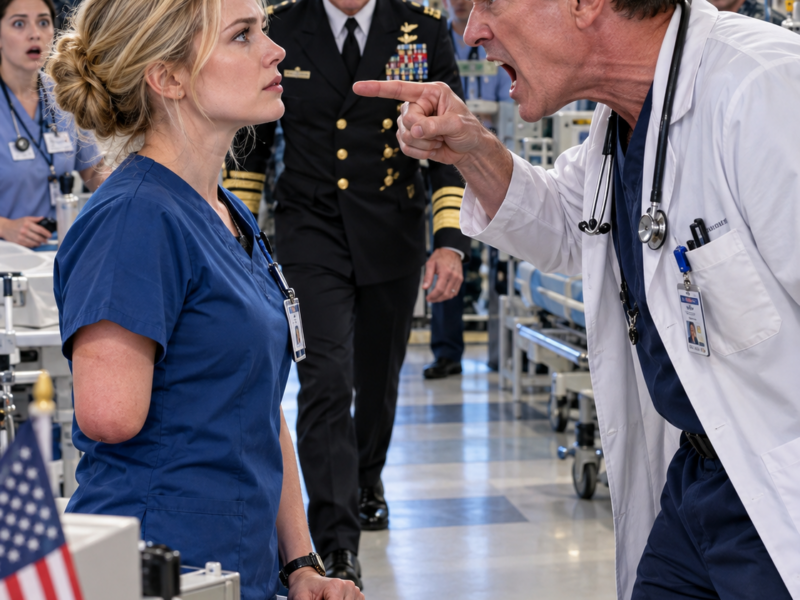
““Maybe the Navy should stop handing out uniforms to broken people,” the lieutenant said loudly in the naval emergency room
My fingers tightened around Daniel’s letter until the paper bent beneath my thumb.
“Before I answer that,” I said, “tell me where my brother is.”
Admiral Thomas Whitaker glanced toward the emergency department doors.
“He’s alive.”
The two words loosened something inside my chest that I hadn’t realized I’d been holding since 2:17 that morning.
I gripped the back of the chair to steady myself.
“Is he hurt?”
“He’s being evaluated by a medical team. He was brought in under restricted access about an hour ago.”
“Why wasn’t I told?”
Whitaker’s eyes shifted briefly toward the lieutenant.
“Because someone requested that all family inquiries be held until the initial investigation was complete.”
“Someone with a name?”
“Yes.”
“Then say it.”
The admiral drew a breath, but the lieutenant interrupted.
“Sir, with respect, this woman has not established that she has any authority to access information concerning the incident.”
Whitaker turned slowly.
“Lieutenant, do you know who you’re speaking to?”
“Senior Chief Bennett, apparently.”
“Apparently?”
The admiral’s voice never rose, yet the lieutenant’s shoulders straightened as if he’d heard a gunshot.
“Senior Chief Claire Bennett was awarded the Navy Cross for extraordinary heroism during Operation Mercer. She was presumed dead after entering a flooded compartment to evacuate trapped sailors. Her actions saved seven lives.”
Nobody moved.
Whitaker continued.
“She lost her left arm during that evacuation, sustained multiple injuries, and refused medical evacuation until every survivor had been accounted for.”
He paused.
“She was twenty-eight years old.”
The sailor who had laughed earlier lowered his eyes.
I wished the admiral would stop.
Not because any of it was untrue, but because the people in the room were staring at me as though my missing arm had suddenly become a monument.
I hadn’t come to be admired.
I had come to find my brother.
“Sir,” I said quietly, “I appreciate the explanation, but I don’t want a ceremony. I want Daniel.”
Whitaker nodded.
“Of course.”
He turned to a nurse and asked her to take us to the secure treatment wing.
As we started down the corridor, the lieutenant hurried after us.
“Admiral, may I speak with you privately?”
“No.”
“Sir, the restrictions were issued through proper channels.”
Whitaker stopped.
“Then you should have no difficulty explaining them to investigators.”
The lieutenant’s face lost what little color it had left.
I looked at him, wondering why a routine question about my brother had turned into a situation that made a commissioned officer look afraid.
The admiral resumed walking.
I followed him through two security doors and into a quieter hallway where the smell of antiseptic was stronger and the fluorescent lights hummed overhead.
“Now,” I said, “tell me what happened aboard the Harlan.”
Whitaker didn’t answer immediately.
Instead, he studied my face.
“You haven’t changed as much as I expected.”
“Six years can change a person without changing her face.”
“Yes,” he said. “I suppose it can.”
He looked down at the letter in my hand.
“Did Daniel give you that?”
“He mailed it two weeks ago.”
“Did he tell you what Mercer meant?”
“No. He just wrote that I should ask about it if anything happened.”
The admiral’s expression hardened.
“Then he found something.”
“What?”
“We don’t know yet.”
“You’re an admiral. Don’t tell me you don’t know what’s happening aboard your own ship.”
“The Harlan reported a medical emergency involving several crew members. During the response, your brother discovered a discrepancy in a restricted maintenance record. Before he could report it through the normal chain of command, someone confiscated his device and ordered him to remain in his quarters.”
“Who gave the order?”
“We’re trying to establish that.”
I stopped walking.
“You’re trying to establish who ordered my brother to stay in his quarters?”
“Claire—”
“No. I spent six years learning to live with the fact that the Navy closed the Mercer investigation without answering my questions. I will not stand here while you tell me that nobody knows who’s giving orders.”
Whitaker looked older than he had a few minutes earlier.
“I know how that sounds.”
“Then explain it.”
He glanced toward the ceiling camera.
“Not here.”
I followed him into a small consultation room, where he closed the door and asked the nurse to give us a few minutes.
For a moment, neither of us spoke.
Then Whitaker took off his cap and placed it on the table.
“I was the operations commander during Mercer,” he said. “I approved the mission plan, and I signed the report that classified the final radio transmission as inconclusive.”
I stared at him.
“You signed the report that said the evacuation order came from the ship’s command team.”
“Yes.”
“I heard the order myself.”
“I know.”
“No, Admiral. You don’t understand. I was in the compartment when the order came through. We were told to abandon the lower passage because the flooding had become uncontrollable. But the men were still alive down there.”
My voice had begun to shake, and I hated it.
“I asked for four more minutes. Four minutes to get them out. The response was that the compartment was being sealed.”
Whitaker looked down at his hands.
“That order did not originate with me.”
“Whose voice was on the radio?”
He hesitated.
“Captain Robert Voss.”
I knew the name.
Voss had been the senior officer overseeing the operation. He had testified at the inquiry, describing the evacuation as an unavoidable tragedy and praising my actions as exemplary.
He had shaken my hand at the hospital afterward.
He’d told me I had done everything humanly possible.
I’d believed him.
“Why would he order us to leave men behind?” I whispered.
Whitaker didn’t offer an easy answer.
“That is what I have been trying to establish.”
“For six years?”
“For six years.”
I laughed once, without humor.
“And what have you established?”
He opened a thin folder he’d brought with him.
Inside was a copy of the original incident report, a communications log, and a photograph of a damaged electronic component.
“The Mercer was officially a rescue operation following an explosion aboard a vessel conducting classified trials,” he said. “The inquiry concluded that a secondary structural failure made the lower compartment inaccessible.”
“I was there. The structure didn’t fail until after the order to seal it.”
Whitaker nodded.
“Your account was included in the preliminary findings. It was removed from the final version.”
“Removed by whom?”
“The final report was amended before it reached the review board. The amendment was authorized under a classified operational directive.”
“Authorized by whom?”
He slid a document across the table.
A signature appeared near the bottom.
Robert Voss.
Beneath it was a second authorization.
The name was partially obscured by a black classification mark, but the final letters were visible.
“…MERCER.”
I looked up.
“Mercer was the operation’s name. Why would someone sign it?”
Whitaker leaned forward.
“Because Mercer wasn’t only an operation. It was also the internal designation of a weapons-testing program.”
I read the line again.
The Navy had told the families of the dead that the explosion resulted from an equipment malfunction during routine testing. The report I had seen described a fire in a support compartment, followed by a chain reaction that compromised the ship’s structure.
But the document in front of me referred to a system that had never appeared in the official report.
“An experimental guidance system,” Whitaker said. “A contractor was testing a new component designed to improve targeting accuracy. There were irregularities in the test data, and some of the readings were being manually altered.”
“Altered how?”
“To make the system appear safer and more reliable than it was.”
I stared at the photograph.
“That doesn’t explain the evacuation order.”
“No,” Whitaker said. “But it gives us a reason someone might have wanted the original records destroyed.”
I thought of the men trapped below deck, the emergency lights turning red, and the water rising around my knees.
I thought of the radio going silent.
“How does Daniel fit into this?”
“Your brother was assigned to a medical unit that treated one of the contractors after the incident. That contractor later died in an unrelated accident. Recently, Daniel was asked to assist with an audit of archived medical records. He noticed that the contractor’s recorded injuries didn’t match the timeline in the official incident report.”
“So he found the discrepancy.”
“We believe so.”
“And someone on the Harlan found out.”
“That’s our concern.”
I pushed the folder away.
“Then let me see him.”
Whitaker stood.
“Of course.”
He led me into the secure treatment wing.
Daniel was sitting upright in a hospital bed with a blanket around his waist and a bandage wrapped around his right hand. His hair was damp, and there were dark circles beneath his eyes.
When he saw me, his face crumpled.
“Claire.”
I crossed the room and pulled him into a careful hug, avoiding his injured hand.
He clung to me like he had when we were children and a thunderstorm had knocked out the power in our house.
For several seconds, neither of us said anything.
Then he pulled back.
“I’m sorry.”
“Don’t you dare apologize for being alive.”
“I didn’t know who else to call.”
“You called the right person.”
He looked at my arm, then at the letter still in my hand.
“I was hoping you wouldn’t have to come back to this.”
“Neither was I.”
He swallowed.
“Did he tell you about the record?”
“Some of it.”
Daniel glanced toward the closed door.
“Not everything.”
Whitaker remained near the wall, giving us space but making no attempt to leave.
I sat beside the bed.
“Start at the beginning.”
Daniel rubbed his uninjured hand over his face.
“Three weeks ago, I was assigned to help review old medical logs connected to the Harlan’s maintenance systems. The records were supposed to be routine. Personnel injuries, equipment exposure, evacuation drills.”
“And?”
“I found a patient entry dated the morning of Mercer. The patient was listed as a civilian contractor with chemical exposure, but the time stamp placed him aboard the ship several hours before the explosion was reported.”
“That could have been a clerical error.”
“That’s what I thought. Then I found a second entry.”
He reached toward the bedside cabinet and winced.
I handed him the folder lying there.
He removed a small plastic evidence sleeve containing a printed page.
The page had three entries, each marked with a different timestamp.
The first showed the contractor admitted for treatment before the explosion.
The second showed his medical status updated after the evacuation order.
The third indicated that he had been transferred off the vessel.
Except the transfer record was dated seventeen minutes before the evacuation order had supposedly been issued.
“Someone changed the timeline,” I said.
Daniel nodded.
“Or created a second timeline that was never meant to be compared with the first.”
I looked at the final entry.
The contractor’s name was Martin Mercer.
For several seconds, I couldn’t make the words fit together.
“Mercer was a person?”
Daniel nodded again.
“The program was named after him. He was the civilian engineer who developed the original component. The man who died in that accident had the same name, but the official report listed him as a different contractor.”
“Why would they do that?”
“Because Martin Mercer was never supposed to be on the ship.”
Whitaker stepped closer.
“We believe he had evidence that the system had failed during an earlier test. He may have been trying to get it off the vessel.”
Daniel looked at me.
“And I think he was still alive when the evacuation order came through.”
The room seemed to shrink around us.
I remembered a voice over the radio that night, faint beneath the alarms.
Not a sailor’s voice.
A man’s voice asking for help from a compartment that wasn’t listed on our evacuation map.
I had reported it afterward.
The inquiry had dismissed it as radio interference.
“Daniel,” I whispered, “did you find anything else?”
He reached under his pillow and produced a folded sheet of paper.
“I copied the maintenance reference before they took my device.”
The page contained a list of access logs.
One entry was marked with the same internal designation I’d seen on the admiral’s document.
MERCER.
Next to it was a timestamp.
Two hours after the evacuation order.
And beneath that was a personnel authorization.
Robert Voss.
I stared at the name.
“He went back aboard after the ship was cleared?”
“Someone used his credentials to access the compartment,” Daniel said. “The system doesn’t tell me who physically entered, only whose authorization was used.”
Whitaker took the page and examined it.
“This is the first time I’ve seen that entry.”
“Then someone has been hiding it from you, too,” Daniel said.
The admiral didn’t argue.
I looked at my brother.
“How did you end up here?”
“I confronted my supervisor. I told him I was going to preserve the record and request an independent review. He said I was misunderstanding a classified system.”
“And then?”
“That night, two men came to my quarters. They said there was a concern about my fitness for duty and that I needed to surrender my phone.”
Daniel’s fingers tightened around the blanket.
“I refused. One of them grabbed my arm. I fell against the desk, and my hand went through the edge of a broken glass.”
“Did they threaten you?”
“They told me that if I kept digging, I’d ruin my career and yours.”
I felt a cold line run down my back.
“Mine?”
Daniel nodded.
“They knew who you were. They knew about Mercer.”
For the first time since arriving at the hospital, I felt the full weight of the six years I’d spent trying to put the past behind me.
Someone had not forgotten what happened that night.
Someone had been counting on me to remain silent.
I looked at Whitaker.
“Who has access to Daniel’s records?”
“His command, the medical staff, and the investigators assigned to the incident.”
“Names.”
“I can give you the official roster.”
“Give me the names of everyone who knew he was investigating Mercer.”
Whitaker studied me for a moment.
Then he nodded.
“I’ll get it.”
“No,” I said. “We’ll get it.”
He opened his mouth to object, then closed it again.
Perhaps he finally understood that I wasn’t asking for permission.
I was asking him to decide whether he was going to stand beside me or in my way.
Before he could answer, the nurse returned with a sealed envelope.
“Admiral, this was delivered to the front desk for Senior Chief Bennett. The courier said it had to be handed directly to her.”
I took it.
There was no return address.
My name was printed across the front in neat block letters.
Inside was a single photograph.
It showed the lower passage aboard the Mercer, taken from a security camera angle I recognized immediately.
I was visible near the far end, dragging an injured sailor toward the ladder.
Behind me, a second figure stood beside the access panel.
The image was grainy, but the uniform was unmistakable.
Robert Voss.
He wasn’t trying to reach the evacuation point.
He was holding the panel controls.
And in the corner of the photograph, a digital timestamp showed the image had been captured seventeen minutes after the official evacuation order.
On the back, someone had written four words.
You left one alive.
I read them twice.
Daniel stared at the photograph.
Whitaker’s hand tightened around the edge of the bed.
Then the admiral said something that made the room go silent.
“That’s impossible.”
I looked at him.
“Why?”
He turned the photograph over and pointed to a small detail I’d missed.
The access panel displayed a green indicator light.
The compartment had not yet been sealed.
For six years, I’d believed the men below deck had been lost because the flooding had made rescue impossible.
But this photograph showed someone standing at the controls after the evacuation order, with the system still active.
I heard myself ask, “Who was still inside?”
Whitaker didn’t answer.
He was staring at the photograph as though he had seen a ghost.
“Admiral.”
His eyes lifted to mine.
“Claire, there were four men officially listed as trapped in that compartment.”
“I know.”
“Three bodies were recovered.”
I waited.
“The fourth was never found.”
Martin Mercer.
The name on Daniel’s medical record.
The man who wasn’t supposed to have been aboard.
I sat down slowly.
“Then why did the Navy list him as dead?”
Whitaker’s voice was barely audible.
“Because Captain Voss testified that he had personally confirmed the compartment was empty before the seal was engaged.”
I looked again at the photograph.
Voss was still at the controls seventeen minutes later.
The evidence didn’t prove he had sealed anyone inside, but it made his testimony impossible to accept without question.
Someone had lied.
Someone had altered the records.
And someone had just sent me proof that the official story might have been built around a missing man who had never been found.
I slipped the photograph into the evidence sleeve.
“We need to preserve this,” I said. “And we need to know who sent it.”
Whitaker nodded.
“I’ll contact the investigative command.”
“No,” Daniel said suddenly.
We both turned toward him.
He looked frightened, but he didn’t look away.
“If the person who sent that photograph has access to the original security system, they’ll know the image was copied. If we start making calls through the same channels that buried the first report, we’ll give them time to destroy whatever remains.”
Whitaker regarded him carefully.
“You’re suggesting we don’t notify the investigators?”
“I’m suggesting we preserve the evidence before we tell anyone who might be compromised.”
I watched my brother.
A few hours earlier, he’d been a frightened young corpsman trying to reach his sister.
Now he was thinking like someone who had spent days tracing a dangerous truth and had learned the hard way how quickly a record could disappear.
He was right.
“We need an independent chain of custody,” I said. “Someone outside the original command structure.”
Whitaker considered it.
“I know a special agent assigned to naval criminal investigations. She wasn’t involved in Mercer.”
“Can you guarantee that?”
“No,” he said honestly. “But I can request her directly and make sure the evidence is documented in our presence.”
That was the first answer I’d heard all morning that I could trust.
“Then do it.”
He stepped into the adjoining office to make the call.
Daniel watched him leave.
“Claire?”
“Yeah?”
“Do you think you could have saved them?”
The question struck a place I had spent six years trying to keep closed.
I looked at his bandaged hand and remembered the seven sailors who had survived because I refused to leave until the last one was out.
“I don’t know,” I said.
It hurt to admit it.
“I know I tried. I know I heard someone calling for help. And I know the report said I was mistaken.”
Daniel’s eyes filled.
“I never believed that part.”
I reached across the bed and held his hand.
“Thank you.”
He looked down at our joined hands.
“I should have told you about the letter sooner.”
“You were trying to protect me.”
“I was trying to protect the only family I have left.”
“So was I.”
For a while, we sat quietly.
The hospital sounds continued beyond the door: footsteps, a rolling cart, a distant announcement over the intercom.
Ordinary life carrying on while the past rearranged itself around us.
Then Whitaker returned.
“The agent is on her way. Her name is Special Agent Elena Ruiz. She’ll meet us here, take custody of the photograph and records, and coordinate the next steps.”
“Good.”
He hesitated.
“Claire, there’s something else you should know.”
I looked at him.
“Before I came here, I reviewed the personnel files connected to the Harlan incident. Captain Voss retired from active duty three years ago. He’s currently serving as a senior adviser to a defense contractor that worked on the Mercer program.”
“Which contractor?”
“Northstar Systems.”
Daniel let out a quiet breath.
“That’s the company listed on the medical records.”
Whitaker nodded.
“The same company.”
I felt the pieces shifting, but they still didn’t form a complete picture.
“Does Voss know about Daniel’s discovery?”
“We believe someone informed him.”
“Then he’s going to know we’re looking.”
“Probably.”
I looked down at the photograph again.
“Then we’d better make sure the evidence gets somewhere he can’t reach.”
Special Agent Ruiz arrived forty minutes later.
She was in her late thirties, wearing a dark blazer over a plain shirt, with a small identification badge clipped to her belt.
She listened without interrupting while Daniel explained the records and Whitaker described the photograph.
When I finished, she asked to examine the original envelope.
“Did you touch anything else inside?”
“Only the photograph and the paper.”
“Did anyone photograph it before I arrived?”
“No.”
She placed the envelope, the letter from Daniel, and the photograph in separate evidence sleeves.
Then she asked each of us to describe exactly when we’d received them.
Her questions were careful and precise, without the faintest hint that she had already decided what the answers should be.
When she finished, she turned to me.
“Senior Chief, I need to be clear about something. This photograph is important, but it doesn’t establish who ordered the compartment sealed or what happened to the missing contractor.”
“I understand.”
“It gives us a reason to reopen questions that were never properly answered. That’s different from proving a crime.”
“I understand that, too.”
She held my gaze for a moment.
“Good. Because if this goes where I think it may go, you’re going to hear people tell you that your memory is unreliable, that the records are incomplete, and that you should be grateful the original inquiry cleared you of wrongdoing.”
“I’ve already heard all three.”
“Then you know what we’re dealing with.”
She turned to Whitaker.
“I need the original Mercer files, including every version of the final report and the authorization trail for the amendments.”
“I’ll arrange access.”
“Not through Northstar, and not through anyone who worked on the original inquiry.”
Whitaker nodded.
Ruiz looked at Daniel.
“Can you identify the person who took your device?”
“One of them. His name was Chief Petty Officer Mark Ellison.”
“Did he physically threaten you?”
“He grabbed my arm and blocked the door. The other man told me I’d lose my career if I kept investigating.”
Ruiz wrote down the names.
“That will be documented separately. I don’t want anyone treating your assault as proof of the Mercer allegations, but it may help establish why the records matter now.”
She closed her notebook.
“Until we have more information, don’t contact Voss, don’t discuss this with anyone who isn’t part of the investigation, and don’t access any restricted systems.”
I nodded.
Then I asked the question I’d been holding since the admiral first said the name Mercer.
“What happens if we discover that someone deliberately left those men behind?”
Ruiz’s expression didn’t change.
“Then we follow the evidence wherever it leads, even if the person responsible is a senior officer or a contractor with powerful friends.”
She glanced at the photograph.
“But I need you to prepare yourself for another possibility.”
“What possibility?”
“That the truth won’t be as simple as the official report or the story you’ve carried for six years.”
I thought about that for a moment.
For six years, I’d imagined finding one signature, one recording, one piece of evidence that would prove I’d been right.
I’d pictured the relief of hearing someone say I hadn’t failed those men.
I’d never considered that the truth might be more complicated than the guilt I’d learned to live with.
“Then we’ll find the complicated truth,” I said.
Ruiz gave a small nod.
“That’s the plan.”
The first break came two days later.
Ruiz located an archived access log showing that the compartment’s control panel had been activated after the evacuation order, but the original video file was missing from the central system.
A backup copy existed on an older storage device that had never been transferred to Northstar’s servers.
The device was stored in a Navy archive facility in Virginia.
Its access history showed that someone had requested its destruction six years earlier.
The request had been approved.
But the destruction certificate was never signed.
Ruiz arranged for the device to be retrieved under independent supervision.
Three days later, she called me into a secure conference room.
Whitaker was there, along with two investigators and a technical specialist who had spent the morning recovering the files.
Daniel joined us by video from the hospital, his hand still bandaged but his face less pale than it had been.
Ruiz placed a laptop on the table.
“We’ve recovered part of the recording,” she said. “The image is incomplete, and the audio has gaps. I want everyone to understand that before we watch it.”
She pressed play.
The footage showed the lower passage in dim emergency lighting.
I appeared near the ladder, helping an injured sailor toward the exit.
Then I disappeared from view.
A figure entered from the opposite end of the passage.
Robert Voss.
He stopped beside the control panel and looked toward the sealed compartment.
The audio crackled.
A voice came through the speakers.
“Sir, there are still people below.”
Voss leaned toward the panel.
“I know.”
The recording skipped.
When it resumed, Voss was speaking into a handheld radio.
“Initiate the closure.”
Another voice answered.
“Confirmation required. There are unaccounted personnel.”
Voss stared at the panel.
“Confirm the closure.”
The screen flickered.
A warning light appeared.
Then the video ended.
No one spoke for several seconds.
I could hear the air-conditioning system cycling above us.
Ruiz stopped the playback and looked at the technical specialist.
“Can we establish whether the recording is authentic?”
“We’re still examining it. The timestamp sequence is consistent with the surviving system logs, but we need additional verification.”
“Can we identify the other voice?”
“Not from this segment.”
I leaned forward.
“Play the last ten seconds again.”
Ruiz did.
This time, I watched Voss’s hands.
He didn’t appear panicked.
He didn’t appear confused.
He moved through the controls with the familiarity of someone who knew exactly what each one would do.
But something else caught my attention.
Before he issued the closure command, he looked toward a small monitor mounted beside the panel.
The screen was angled away from the camera.
I pointed at it.
“Can you enlarge that?”
The specialist adjusted the image.
The monitor remained blurred, but a line of text became partly visible.
TRANSFER AUTHORIZED.
Below it was a code.
M-17.
Daniel spoke from the laptop.
“That’s the same code in the medical log.”
Ruiz turned toward him.
“Are you certain?”
“Yes. It’s on the entry for Martin Mercer. I thought it was a patient classification, but it could be a transfer designation.”
The specialist checked the recovered files.
“There’s another segment. It was indexed under the same code.”
He opened it.
The footage showed a different camera angle, this time near a service corridor adjacent to the lower compartment.
Two men in protective gear were moving a stretcher.
A third man walked ahead of them carrying a case.
The timestamp placed the scene twenty-three minutes after the evacuation order.
The stretcher passed the camera.
For a fraction of a second, the man’s face was visible.
I didn’t recognize him.
But the technical specialist did.
He checked the personnel index.
“The individual carrying the case is identified as a Northstar Systems security contractor. He was not listed on the ship’s official crew roster.”
Ruiz looked at Whitaker.
“How did a civilian security contractor get access to a restricted passage during an evacuation?”
Whitaker’s expression had become grim.
“That’s exactly what we need to establish.”
The footage didn’t prove who was on the stretcher, whether he was alive, or where he was taken.
But it showed something the official report had denied.
People had moved through the supposedly inaccessible area after the evacuation order.
The compartment hadn’t simply become a sealed tomb.
It had remained part of an operation someone was still controlling.
Ruiz paused the footage.
“We’re going to need Northstar’s original transport records, the contractor’s employment file, and any documentation connected to the M-17 designation.”
She looked at me.
“Until we have those, we cannot say what happened to Martin Mercer.”
I nodded.
For the first time, I didn’t feel the need to insist that the answer was already obvious.
I wanted proof.
And proof, I was beginning to understand, required patience as much as courage.
The next week was a blur of interviews, document requests, and long hours waiting for answers.
Northstar’s legal department denied that its security personnel had participated in any unauthorized transfer.
Captain Voss declined an initial interview, citing his obligations to the company.
The Navy announced that it was reviewing the original inquiry.
For the first time in six years, someone was asking the questions I’d been told to stop asking.
Then Ruiz discovered a financial record connecting a Northstar subsidiary to a private medical facility in Arizona.
The payments began three months after Mercer.
They continued for nearly five years.
The recipient was a long-term care provider that specialized in treating patients whose identities required additional protection.
One name appeared in a confidential billing record.
Martin Mercer.
I read it three times before I could speak.
“He’s alive?”
Ruiz shook her head carefully.
“We haven’t confirmed his current condition. The records establish that a person using his identity received treatment at that facility. We need independent verification.”
“Then let’s go.”
“We will, but not until we have the necessary authorization and can secure the records.”
I wanted to argue.
I wanted to get in my car and drive until I found the building where someone had hidden a man for years.
But Daniel’s voice came through the phone beside me.
“Claire, if we rush in, they might move him.”
I closed my eyes.
He was right again.
So we waited.
Two days later, Ruiz obtained a court-authorized search and preservation order.
A medical investigator accompanied our team to the facility.
The building sat behind a row of cottonwood trees on the outskirts of Tucson, its low windows shaded against the desert sun.
There were no signs announcing the names of patients.
At the front desk, the administrator looked at Ruiz’s credentials and went pale.
“I need to contact our counsel,” she said.
“You may do that,” Ruiz replied. “But no records are to be altered, and no patient is to be moved without medical necessity. We have an order requiring preservation.”
The administrator disappeared into an office.
While we waited, I stared at the pale sunlight on the tile floor.
I had spent six years imagining the men I’d failed to save.
Now I was standing in a building where one of them might have been living under a false name.
The thought was almost unbearable.
A doctor eventually led us down a quiet corridor to a small room with a window overlooking the courtyard.
A man sat in a wheelchair near the window.
He was older than the photographs in the archive, his hair almost entirely white, his body thinner than it should have been.
When the doctor said his name, the man turned.
“Martin Mercer?”
His eyes moved from Ruiz to Whitaker, then settled on me.
For a long moment, he said nothing.
Then his gaze dropped to my left sleeve.
“I remember you,” he whispered.
My throat tightened.
“You were on the Mercer?”
He nodded.
“You came back for us.”
I moved closer, gripping the back of a chair.
“I tried.”
“I know.”
His voice was rough, but the words were clear.
“You kept calling for the others. You kept telling us not to let go.”
I couldn’t make myself sit down.
“Why didn’t you come forward?”
Mercer looked toward the window.
“Because they told me everyone who knew what happened was dead.”
He paused.
“Then they told me that if I ever tried to correct the record, the people who had survived would be accused of participating in the cover-up.”
I felt a chill pass through me.
“Who told you that?”
“Voss. Not directly at first. A man from Northstar delivered the message. Later, Voss came himself.”
Ruiz sat in the chair beside him.
“Mr. Mercer, do you have any documentation of those meetings?”
He nodded toward a small cabinet.
“In there. Everything I could keep.”
Inside the cabinet were medical summaries, handwritten notes, and copies of letters addressed to a lawyer whose name I’d never seen before.
The letters described the experimental system, the failed test, and a decision to remove the original records before an independent review could take place.
They also described the night of the evacuation.
Mercer had been trapped in a service compartment with two technicians when the order came through.
One technician died before the corridor was sealed.
The other was never identified in the final report.
Mercer survived because a maintenance hatch connected the compartment to a service passage.
A Northstar security team reached him after the closure sequence began.
They removed him from the ship under an emergency transfer authorization.
He was alive, but badly injured.
His identity was then used to create a medical record that concealed his actual location.
The body later identified as his had belonged to another contractor who had died in the explosion.
The records were altered so that the Navy could close the inquiry without explaining why an unauthorized civilian had been aboard.
I read the account slowly, stopping whenever a sentence became too difficult to absorb.
“Why would Voss agree to this?” I asked.
Mercer looked at me.
“Because the test had failed before the explosion, and he had approved the decision to continue it.”
He swallowed.
“He told himself the risk was acceptable. Afterward, he needed the incident to look like an unavoidable accident rather than a preventable failure.”
“And the closure order?”
“He said he believed the compartment was empty.”
“Do you believe him?”
Mercer looked down at his hands.
“No.”
The answer came without hesitation.
“He knew I was there. I had argued with him about the test results hours earlier. He knew I was trying to get the original data off the ship.”
He took a breath.
“But I can’t tell you whether he intended to kill us or whether he thought he could bury the evidence and still get everyone out.”
That distinction mattered.
It didn’t erase what Voss had done.
But it separated what Mercer knew from what he suspected.
Ruiz asked him to explain the M-17 designation.
Mercer described it as a temporary transfer code used to move a person from the ship’s medical system into a contractor-controlled facility without linking the transfer to the original incident.
The code was supposed to be deleted after the transfer was completed.
Instead, it had remained in the archived records, connecting the false medical timeline to the missing man.
Daniel’s discovery had exposed the link.
The photograph sent to me had been copied from the old security archive.
Someone had kept a record of the closure order and the subsequent transfer.
And someone had finally decided that the truth should no longer remain hidden.
But the identity of that person was still unknown.
Ruiz collected the documents and arranged for Mercer to be interviewed formally, with medical support and independent legal counsel.
Before we left, I stood beside his wheelchair.
“I need to ask you something.”
He looked up.
“Go ahead.”
“Did you hear the voice on the radio that night? The one asking for four more minutes?”
His eyes softened.
“Yes.”
“I was the one who asked.”
“I know.”
I swallowed.
“For six years, I thought I had failed you.”
Mercer reached out and placed his hand over mine.
“You didn’t seal that door, Claire.”
The words were simple.
They didn’t bring back the men who had died.
They didn’t erase the nights I’d woken up hearing the radio.
But for the first time, someone who had been there had told me that the blame I’d carried wasn’t mine alone.
I lowered my head, and the tears came before I could stop them.
I had cried in hospital rooms before.
I had cried alone in my car.
I’d never cried in front of someone who understood exactly what I had heard that night.
Mercer waited until I could speak again.
“There’s one more thing you should know,” he said.
I wiped my face.
“What?”
He glanced at Ruiz.
“The man who sent you the photograph wasn’t trying to frighten you.”
Ruiz leaned forward.
“Do you know who sent it?”
Mercer nodded.
“It was a technician who worked on the original system. He was the one who copied the security footage before the archive was altered.”
“What’s his name?”
“Peter Lawson.”
Ruiz wrote it down.
“Is he still alive?”
Mercer looked toward the courtyard.
“I don’t know. But he told me once that if the record ever surfaced, he would make sure the people who had survived Mercer weren’t left to carry the lie.”
The investigation widened.
Lawson was located through an old contractor directory, and his attorney agreed to arrange an interview.
He confirmed that he had preserved the security footage after noticing discrepancies in the archive logs.
He had kept silent because he feared prosecution for retaining classified material and feared that the company would retaliate against his family.
When he learned that Daniel had discovered the M-17 records, he sent the photograph.
He hadn’t known whether Daniel could be trusted to keep digging.
He hadn’t known whether I would believe it.
He had simply decided that someone deserved to see what had been hidden.
His testimony, Mercer’s records, Daniel’s copied logs, and the recovered footage gave investigators enough evidence to challenge the original inquiry.
The case did not resolve overnight.
There were hearings, additional interviews, and months of legal disputes over the classified records.
Voss continued to deny that he had knowingly ordered the death of anyone in the compartment.
He argued that the evacuation had been necessary, that the transfer was an emergency medical measure, and that the altered records had been intended to protect classified research rather than conceal wrongdoing.
But the recovered footage contradicted key parts of his testimony.
The medical records established that Mercer had survived.
The transport logs connected Northstar’s personnel to the unauthorized transfer.
And the financial records showed that the company had paid for Mercer’s treatment while denying that he had ever been under its care.
The investigation ultimately found that Voss had authorized the compartment closure despite being informed that personnel remained unaccounted for.
It also found that he had participated in concealing the subsequent transfer and had provided materially false information during the original inquiry.
The evidence did not establish that he had intended for anyone to die.
It did establish that he had chosen to protect the program and his own decisions rather than tell the truth.
Several Northstar executives were implicated in falsifying records and concealing the failed test.
The Navy reopened its review of the deaths and corrected the official record to acknowledge that Mercer had survived the incident and been removed from the vessel through an unauthorized transfer.
Voss was charged with offenses relating to the false statements and obstruction supported by the investigation.
His case proceeded separately from the broader contractor inquiry, and he was eventually convicted on the obstruction-related charges.
For the first time, the public record no longer described Mercer as a man who had died in the explosion.
It described him as a survivor whose existence had been concealed.
The Navy also corrected the account of my actions during the evacuation.
I had never asked for another medal.
I had never wanted my name on a wall.
All I wanted was for the record to say that I had heard the men calling for help and had tried to reach them.
When the review was complete, the Navy invited me to a formal ceremony at Naval Medical Center San Diego.
I almost declined.
The thought of standing beneath bright lights while people applauded a night I still struggled to remember made my stomach tighten.
Daniel persuaded me to attend.
“You spent years wishing someone would tell the truth,” he said. “Let them say it out loud this time.”
So I put on my dress uniform.
The sleeve on my left side was neatly pinned, and my prosthetic was polished until it reflected the light from the hallway windows.
Daniel stood beside me, his hand healed enough to rest comfortably at his side.
Admiral Whitaker waited near the entrance to the auditorium.
When he saw me, he stepped forward.
“Senior Chief.”
“Admiral.”
He offered his hand.
“I owe you an apology.”
I looked at him for a moment.
“For what?”
“For allowing the original report to stand for as long as it did. I knew there were inconsistencies. I believed I could resolve them through the proper channels, and I let the process become an excuse for inaction.”
He didn’t look away.
“I can’t give you those six years back.”
“No,” I said. “You can’t.”
He nodded.
“I won’t ask you to make that easier for me.”
I shook his hand.
It wasn’t forgiveness.
Not yet.
But it was the beginning of an honest conversation, and that was more than we’d managed before.
Inside, the ceremony was brief.
The official review was read aloud, including the findings about the altered records and the men who had been left behind.
When my name was mentioned, I heard a few people shift in their seats.
I didn’t look at them.
I looked at Daniel.
He was watching me with the same expression he’d worn when he was a child and I had come home from my first deployment.
Pride mixed with relief.
When the ceremony ended, several sailors approached me.
One apologized for the lieutenant’s behavior on the morning I’d arrived.
Another said he had been in the room and should have spoken up.
I thanked them, though I didn’t pretend that their apologies could erase what had happened.
The lieutenant himself was no longer assigned to the department.
He had been formally counseled for his conduct and for failing to follow the proper procedures for handling a family inquiry.
When I saw him in the corridor afterward, he stopped.
“Senior Chief Bennett,” he said. “I owe you an apology.”
I waited.
“I judged you before I knew anything about you. I saw your injury and made assumptions about what you could do.”
He swallowed.
“That was wrong.”
I could have reminded him that I had never needed him to know my service record to treat me with basic respect.
I could have told him that the men who had laughed in the emergency room had not hurt me nearly as much as the officers who had spent years deciding which truths were convenient.
Instead, I said, “You don’t need to know what someone has done to understand that they deserve dignity.”
He nodded, his eyes lowered.
“I understand.”
I hoped he did.
But his understanding was no longer my responsibility.
A month later, Daniel and I visited Martin Mercer.
He had been moved to a facility closer to his sister, and his doctors were cautiously optimistic about his recovery.
He looked better than he had in Tucson, though he still tired easily.
We brought coffee for ourselves and a small box of pastries he insisted he wasn’t supposed to eat.
Daniel sat beside him and described his new assignment.
He had decided to remain in the Navy, but he wanted to continue working in medical records and patient advocacy.
“I’d rather catch the discrepancy before someone has to risk everything to expose it,” he said.
Mercer smiled.
“That’s a good place to start.”
I sat by the window, watching sunlight move across the courtyard.
For years, I’d imagined that finding the truth would feel like a door swinging open.
Instead, it felt like learning to breathe in a room where the windows had finally been unlatched.
There were still things I couldn’t change.
Three men had died.
Their families had spent six years believing the official account.
Some of the people responsible would never face charges for every decision they had made.
And I would always carry the physical cost of that night.
But I no longer carried the lie that I had abandoned the men below deck.
Before we left, Mercer asked me to wait.
He reached into a drawer and brought out a small envelope.
Inside was a photograph of the Mercer crew taken several days before the explosion.
I recognized the young sailor I’d dragged toward the ladder.
He was grinning at the camera, one arm slung around a friend, his future still wide open.
On the back, Mercer had written the names of everyone he could remember from the lower compartment.
He had spent years trying to ensure that the people who died would not be reduced to a line in a report.
I traced the names with my fingertip.
“Thank you,” I said.
Mercer shook his head.
“You were the one who went back for us.”
I looked at the photograph.
“No,” I said softly. “We went back for each other. That’s what I want people to remember.”
When Daniel and I left the facility, the afternoon air was warm, and the sky over the parking lot had turned the pale blue of an approaching evening.
He walked beside me without trying to hurry.
“Do you think you’ll ever stop thinking about that night?” he asked.
I considered the question.
“I don’t know if I’ll stop remembering it.”
He nodded.
“But I don’t have to keep remembering it the way they told me to.”
We reached the car.
Before getting in, I looked down at my left sleeve, then at the photograph tucked safely inside my bag.
For six years, I had believed the worst thing that happened to me was losing my arm.
I was wrong.
The worst thing was being made to believe that my survival was proof I had failed.
That morning in the emergency room, a lieutenant had looked at my missing arm and decided he understood my limitations.
He had seen a part of my story and mistaken it for the whole.
I couldn’t blame him for not knowing what I had endured.
But I would never again allow someone else’s ignorance to become the measure of my worth.
I climbed into the driver’s seat, and Daniel settled beside me.
As we pulled out of the parking lot, the photograph rested between us, its edges softened by time.
I didn’t feel like a legend.
I felt like a sister taking her brother home.
And for the first time in six years, I could finally leave the past where it belonged—not forgotten, not excused, but no longer standing between me and the life I still had left to live.
THE END.









