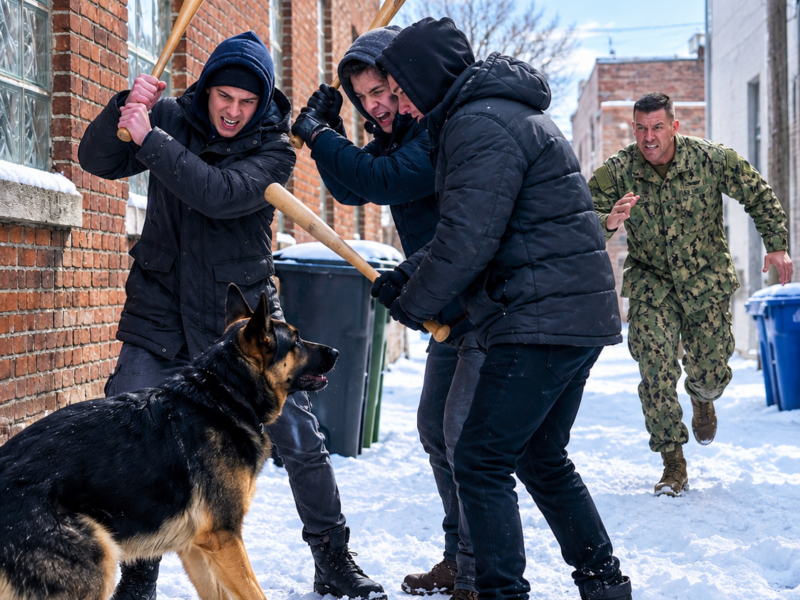
“Keep kicking the dog,” the biggest thug laughed, raising his boot as a terrified German Shepherd curled against the alley wall
The gunshot struck the metal dumpster behind us, sending a sharp clang through the alley.
I hit the ground instinctively, pulling Atlas-7 down with me as another shot punched through the service door.
“Move!” Agent Lauren Price shouted.
I didn’t need her to tell me twice.
Atlas lunged forward, dragging me through the narrow doorway into a dark corridor that smelled of rust, wet concrete, and old chemicals.
I slammed the door behind us just as another round tore through the frame.
For three seconds, all I could hear was my breathing and the distant pounding of boots.
Then Atlas pressed his injured body against my leg.
He was trembling, but he wasn’t afraid.
He was listening.
“Easy, buddy,” I whispered, running a hand over his neck.
His fur was damp with blood, and every breath came with a faint, painful rasp.
I had seen that look before.
Not in a stray dog.
Not even in an ordinary military working dog.
I had seen it in animals trained to keep going long after their handlers had ordered them to stop.
“Agent Price,” I called into the darkness, “you have about ten seconds to explain why people are shooting at us.”
Her flashlight snapped on.
“Because Atlas found something he wasn’t supposed to find.”
“That tells me nothing.”
“It will when we get out of this building alive.”
A heavy impact shook the door behind us.
I drew the pistol I’d carried since leaving the service, checked the chamber by touch, and moved between Atlas and the entrance.
Price noticed.
“You’re protecting a dog you met five minutes ago.”
“I’ve met men for five years who didn’t earn that much trust.”
Her expression changed, but only briefly.
“Then you’ll understand why we can’t leave him here.”
She pointed her flashlight down the corridor.
At the far end stood a steel door with a faded red stripe across it.
Atlas moved before either of us could speak.
He limped toward the door, nose low, tail rigid, and stopped beside a small ventilation grate.
Then he scratched the floor twice.
I crouched beside him.
“What is it?”
Atlas pushed his nose against the grate and let out a low, urgent whine.
Price went pale.
“He found it.”
“Found what?”
She knelt, pulled a small tool from her coat, and loosened the grate.
Behind it sat a black metal cylinder, no larger than a thermos, secured inside a cavity in the wall.
It had no label, no visible power source, and a narrow strip of blue paint around its center.
I recognized the paint immediately.
I had seen it on equipment used by a classified naval unit years earlier, equipment that officially had never existed.
Price reached toward the cylinder.
Atlas snapped his teeth inches from her glove.
She froze.
“Don’t,” I said.
The dog stared at the cylinder, then at me.
His ears angled forward.
He wasn’t guarding it from us.
He was warning us about it.
I took a closer look and saw a tiny red indicator blinking beneath the blue stripe.
“Is that a tracking device?”
“Worse,” Price whispered. “A remote trigger.”
I pulled my hand back.
“What exactly did this dog find?”
She swallowed.
“Proof that someone inside a military logistics program has been selling the identities and locations of covert American personnel to private buyers.”
The corridor seemed to shrink around us.
“How many?”
“We don’t know.”
“Who?”
“We know one name.”
Before she could say it, the service door behind us exploded inward.
I grabbed Price’s coat and shoved her behind a concrete support as debris scattered across the floor.
Two armed men entered the corridor.
The first wore a black tactical jacket and carried a suppressed rifle.
The second held a compact device with a glowing screen.
Neither wore insignia.
The man with the device looked directly at Atlas.
“There you are,” he said.
His voice was calm, almost affectionate.
“Good dog.”
Atlas growled so deeply that I felt it through the floor.
The gunman raised his rifle.
I fired first.
The shot struck the metal pipe above his shoulder, showering him with sparks and forcing him to duck.
Price returned fire from behind the support.
The second man dropped the device and ran toward the far exit.
I started after him, but Atlas barked sharply.
I stopped.
The black cylinder’s red light had changed to a rapid pulse.
“Price!” I shouted.
She looked at it and swore.
“Get away from the wall!”
We scrambled toward the opposite end of the corridor as the cylinder emitted a piercing electronic tone.
Then the sound stopped.
Silence followed.
No explosion came.
Instead, somewhere above us, machinery began to turn.
The building shuddered.
A hidden door slid open behind the red-striped steel panel.
Cold air rushed out, carrying the smell of seawater and diesel.
Price stared into the opening.
“This isn’t on the building plans.”
“Your people didn’t know about it?”
“Not until Atlas disappeared.”
I looked at her.
“Start talking.”
She took a breath.
“Six months ago, a military working dog named Atlas-7 was assigned to a classified search operation at a coastal storage facility. His handler reported that the dog had located a concealed compartment containing equipment that wasn’t on any inventory.”
“And then?”
“The handler was killed in what the report called an accidental vehicle fire. Atlas was listed as dead. The entire operation was buried.”
I looked down at the dog.
He leaned against my knee, his injured leg shaking.
“Who was his handler?”
“Chief Petty Officer Nathan Cole.”
The name hit me like a punch.
Nathan Cole had served with me on two deployments.
He was the kind of man who could make an exhausted team laugh at three in the morning, the kind who always carried extra food for the dogs.
His death had never made sense.
The official report said his vehicle had gone off a road during a storm.
No enemy contact.
No suspicious circumstances.
Just a terrible accident.
I had attended his memorial.
I had stood beside his mother and promised her that Nathan had been a good man.
Now I was staring at his dog.
“Atlas belonged to Nate,” I said.
Price nodded.
“He was the only animal that could identify the location of the hidden equipment. The program had trained him to detect a particular chemical residue used to protect data-storage devices from corrosion.”
I looked at the cylinder.
“So this is what he was trained to find.”
“Part of it.”
“Part?”
Price looked toward the newly opened passage.
“The rest is down there.”
Atlas moved toward the opening.
This time, I followed.
The passage descended into a concrete chamber beneath the warehouse.
At the bottom, a narrow platform overlooked a flooded service tunnel.
Metal shelving lined the walls.
Some shelves held old military cases.
Others held sealed containers bearing shipping labels from legitimate American companies.
At the center of the room stood a reinforced glass cabinet.
Inside it were dozens of small storage modules.
Each had a name, a date, and a sequence of coordinates.
I recognized some of the unit designations.
They belonged to teams that had operated overseas during my final years in uniform.
One module bore a name I knew better than any other.
MERCER, DANIEL.
My stomach tightened.
I stepped closer.
The label included coordinates from a mission in Syria, a mission that had ended with three American personnel dead and my team barely escaping.
I had spent years believing the ambush had been caused by bad intelligence.
I stared at the module until the letters blurred.
“Why is my name here?”
Price stood beside me.
“Because your team was one of the first to be betrayed.”
I turned toward her.
“You knew?”
“I suspected. I didn’t know the full scope until two weeks ago.”
“And you let me walk into an alley with a wounded dog and men shooting at us without telling me anything?”
“I didn’t know you would be there.”
“That’s not an answer.”
“No,” she said. “It isn’t.”
For the first time, she looked frightened.
Not of me.
Of what she was about to admit.
“I was assigned to investigate Nate Cole’s death. The case was closed before I received it. Every witness had been interviewed, every piece of evidence logged, every question answered in a way that made further investigation impossible.”
“Someone wanted the file buried.”
“Someone with access to the highest levels of the operation.”
She pointed to the cabinet.
“The records in there were being used to sell information about active and retired personnel. Some names were sold to foreign intelligence services. Others were sold to private security companies that wanted to eliminate competition or silence witnesses.”
“And Nate discovered it.”
“Yes.”
Atlas whined.
He had stopped in front of a steel locker at the far wall.
The locker had been forced open, its door hanging crookedly.
Inside lay a torn harness, a folded uniform, and a small photograph sealed in a plastic sleeve.
I lifted the photograph carefully.
Nathan stood beside Atlas, one arm around the dog’s neck.
Both were muddy.
Both looked exhausted.
Both were smiling.
On the back, in Nate’s familiar block handwriting, were four words.
IF HE LEADS YOU, TRUST HIM.
For a moment, the years disappeared.
I was back in a dusty compound, watching Nate argue with a quartermaster over the proper size of a dog bed.
I remembered his laugh.
I remembered the last message he’d sent before his supposed accident.
Keep your head down, Mercer. Something stinks.
I’d never answered.
I’d been preparing for a mission.
Then he was gone.
I pressed the photograph between my fingers.
“I should have listened.”
Price said nothing.
She didn’t need to.
A mechanical click echoed from the passage behind us.
I turned.
The man who had escaped stood at the top of the stairs, accompanied by two more armed men.
Behind them was an older man in a tailored charcoal coat.
His hair was silver at the temples, his face clean-shaven, his posture perfectly relaxed.
I recognized him from briefings I’d attended before my last deployment.
Admiral Thomas Vance.
He had been one of the senior officials who approved the operation that sent my team into Syria.
He had also delivered the eulogy at Nathan Cole’s memorial.
Vance looked down at the dog.
“Atlas,” he said. “You have caused an extraordinary amount of trouble.”
I raised my pistol.
“Stop right there.”
He looked at me with mild disappointment.
“Daniel Mercer. I had hoped you would remain retired.”
“You sent men to kill us.”
“I sent men to recover stolen government property.”
“You mean evidence.”
“Evidence is a word people use when they don’t understand the difference between national security and personal grievances.”
Price stepped out from behind me.
“Admiral, you’re under investigation for the deaths of at least seven American personnel, illegal surveillance, and the sale of classified operational data.”
Vance sighed.
“Agent Price, you were warned to close this matter.”
“You threatened my supervisor.”
“I gave him a choice.”
“You threatened his family.”
For the first time, Vance’s expression hardened.
“You have no idea what this information has prevented. We redirected hostile operations, manipulated regional conflicts, and protected assets that would otherwise have been lost.”
“By selling our own people?” I asked.
“By deciding who could be sacrificed to preserve the larger mission.”
The words settled over the room.
I thought about the men I’d buried.
I thought about the letters their families had received, full of careful phrases and classified explanations.
I thought about Nathan’s mother, still believing her son had died in an accident.
“How much did you make?” I asked.
Vance looked almost offended.
“This was never about money.”
“That’s what every liar says when the money isn’t the only thing they’re protecting.”
He gave a small nod to the gunmen.
They raised their rifles.
Atlas stepped in front of me.
His injured body trembled, but he held his ground.
Something inside me went very still.
“Don’t,” I warned.
Vance looked at the dog.
“He was never supposed to survive the first extraction. Cole made the mistake of choosing loyalty over orders. The dog made the same mistake.”
I stared at him.
“You killed Nate.”
“He was given an opportunity to cooperate.”
“And when he refused?”
“He became a liability.”
The words were so casual that for one terrible second, I couldn’t breathe.
Then Atlas barked.
Not once.
Three times.
A sharp, rhythmic sequence.
Price’s eyes widened.
“What is he doing?” I whispered.
“Alerting,” she said. “That’s his trained signal.”
“Alerting to what?”
She looked at the storage cabinet.
Then at the cylinder.
Then at the blinking indicator.
“The system.”
Vance’s composure cracked.
“Stop the dog!”
One gunman stepped forward.
I fired into the metal railing beside him.
He flinched and dropped behind cover.
Price shouted, “Atlas, down!”
The dog crouched immediately.
A second later, every light in the chamber turned red.
A siren began to pulse.
On the wall, a concealed monitor flickered to life.
A countdown appeared.
03:00.
Vance spun toward it.
“What did you do?”
Price stared at the screen.
“Nothing.”
I understood then.
Atlas hadn’t merely been trained to locate hidden equipment.
He’d been trained to recognize the system connected to it.
The dog had found the cylinder, triggered its signal, and activated a failsafe.
A failsafe Nate had built before he died.
“What happens at zero?” I asked.
Price scanned the screen.
“There’s a data purge.”
Vance’s face went white.
“No.”
“It’s wiping the archive,” she said.
He lunged toward the cabinet.
“Stop it!”
The gunmen hesitated.
For the first time, their employer looked less like an admiral and more like a man watching his entire life collapse.
He reached for a control panel.
Price raised her weapon.
“Don’t touch it!”
Vance ignored her.
He slammed his palm against the panel.
A sharp electrical crack snapped through the chamber.
He staggered backward, clutching his hand.
The countdown continued.
02:41.
I moved toward the cabinet.
“Can we stop the purge?”
Price shook her head.
“Not without the authorization key.”
“Where is it?”
She looked at Atlas.
The dog had moved to the bottom shelf, where a small compartment sat behind a loose metal plate.
He pawed at it twice.
I dropped to one knee and removed the plate.
Inside was a narrow black key with a silver number stamped into its side.
07.
Atlas-7.
I pulled it free.
Price’s mouth fell open.
“Nate hid it in the only place they couldn’t search without triggering the system.”
“His dog.”
“Not just his dog,” she said softly. “His partner.”
I inserted the key into the panel.
The screen changed.
A prompt appeared.
HANDLER VERIFICATION REQUIRED.
Below it was a line for a biometric code.
I looked at Price.
“Now what?”
She studied the display.
“Cole’s handler credentials were revoked after his death. But the system may still accept his emergency authentication phrase.”
“Do you know it?”
“No.”
I stared at the photograph in my hand.
Nate used to say the same thing before every dangerous operation.
A joke he’d repeated so often that our entire team had memorized it.
I leaned toward the panel and spoke.
“Bring everyone home.”
For one second, nothing happened.
Then the screen turned green.
AUTHENTICATION ACCEPTED.
The countdown stopped at 02:17.
A second window opened.
TRANSFER ARCHIVE TO SECURE OVERSIGHT?
YES OR NO.
Price looked at me.
“If we transfer it, the evidence goes to an independent federal repository. It won’t be controlled by the command that buried this case.”
“Do it.”
She pressed YES.
The system began copying the archive.
Vance stared at the screen in disbelief.
“You have no idea what you’ve just unleashed.”
“I know exactly what I’ve done.”
“No,” he said, his voice rising. “You have destroyed years of carefully managed operations. You have exposed intelligence networks. You have endangered people who have spent their lives serving this country.”
“Then you should have protected them instead of selling them.”
He turned toward the gunmen.
“Kill them. Destroy the server.”
Neither man moved.
A voice suddenly filled the chamber.
“Admiral Thomas Vance, step away from the controls.”
The sound came from hidden speakers.
Then came the unmistakable noise of boots pounding down the corridor above us.
Price’s face changed.
“Federal agents,” she whispered.
Vance stared at her.
“You brought them here?”
“I sent the location and the evidence package to an independent inspector general before I entered the alley. If I missed my check-in, the team was instructed to move.”
The first gunman dropped his rifle.
The second followed.
Vance looked around the room, searching for a way out.
His eyes settled on the flooded tunnel.
He ran.
I went after him.
The tunnel was knee-deep in dark water, its concrete walls slick with condensation.
Vance slipped once, caught himself on a rusted ladder, and kept moving.
Ahead, a maintenance hatch opened onto a drainage channel that led toward the waterfront.
He was almost there when Atlas limped past me.
“Atlas, no!”
The dog ignored me.
He moved with a determination that seemed impossible for an animal whose leg had been injured and whose body was running on exhaustion.
Vance reached the hatch and tried to pull himself through.
Atlas caught the back of his coat.
The admiral shouted and swung his arm.
Atlas released him, dodging the blow, then planted himself between Vance and the exit.
Vance drew a small knife from his sleeve.
I raised my pistol.
“Drop it!”
He looked from me to the dog.
“You’d shoot a decorated admiral?”
“I’d stop a murderer.”
For a moment, he considered his options.
Then he threw the knife into the water.
I secured his hands with the restraints from my belt.
He didn’t fight.
He simply stared at Atlas with pure hatred.
“That animal has ruined everything.”
I looked down at the dog.
“No,” I said. “He remembered what you wanted everyone else to forget.”
When we returned to the chamber, federal agents had secured the area.
The gunmen were in custody.
Price was speaking into a radio, giving the names of personnel who needed immediate protection.
The archive transfer had completed.
Every file, every payment record, every altered mission report had been preserved.
The evidence was no longer hidden beneath a warehouse.
It was in the hands of investigators who could not be ordered to make it disappear.
I sat on a metal crate while a medic examined Atlas.
The dog leaned against my leg, his head resting heavily on my knee.
The medic cleaned the wound on his side and checked the swelling around his front paw.
“He needs surgery,” she said. “But he’s going to make it.”
I closed my eyes.
For the first time since the gunshot in the alley, I let myself breathe.
Price came over carrying a clear evidence bag.
Inside was a worn military dog tag.
The name engraved on it was Nathan Cole.
“We recovered it from a locked drawer in Vance’s office,” she said. “He kept it as a trophy.”
My hands tightened.
“I want to give it to Nate’s mother.”
“We’ll make sure she gets it.”
I looked at Atlas.
“Does she know he’s alive?”
“Not yet. We wanted to make sure he was safe before contacting her.”
The medic finished wrapping his leg.
Atlas raised his head and looked toward the corridor.
I knew that look.
He was waiting for someone.
Someone who wasn’t coming.
I rested a hand against his neck.
“I’m here, buddy.”
His eyes met mine.
Then he lowered his head into my lap.
The next three weeks were a blur of interviews, statements, medical appointments, and investigators asking me to repeat details I wished I could forget.
The case spread far beyond the warehouse.
Vance had built a network that included contractors, intelligence officers, and executives who had profited from the deaths of American personnel.
Some had known exactly what they were doing.
Others had signed documents without asking why certain names kept appearing on casualty reports.
The archive revealed that the Syria ambush that killed three members of my team had not been a random intelligence failure.
Our movements had been sold two days before the operation.
A contractor had received payment for providing our route.
A senior officer had altered the threat assessment.
The report that followed had been rewritten to conceal both actions.
My friends hadn’t died because they made a mistake.
They had been sent into a trap.
I sat alone in the federal office when the investigator finally showed me the original message from Nate.
It had been recovered from a damaged storage module.
The message was dated four days before his death.
Mercer, if you’re reading this, I couldn’t get the evidence out.
They know what Atlas can find.
I tried to protect him, but I may have run out of time.
If he gets to you, don’t let them take him back.
He knows where the truth is.
Bring everyone home.
I read it twice.
Then a third time.
I didn’t cry when I first learned Nate was dead.
I didn’t cry at the memorial, or when his mother hugged me, or when I stood beside the folded flag.
But sitting in that quiet office, with his final words glowing on the screen, I finally broke.
I covered my face and let the grief come.
Not because I had failed him.
Because he had trusted me to finish something he couldn’t.
And somehow, his dog had found me.
A month after the warehouse operation, I drove to a small house outside Richmond.
Nate’s mother, Margaret, opened the front door before I reached the steps.
She had aged since the memorial.
Her hair was almost entirely silver now, and she leaned on the railing when she walked.
But when she saw Atlas standing beside me, she went completely still.
“No,” she whispered.
Atlas sat.
His ears lifted.
Margaret covered her mouth with both hands.
“Atlas?”
The dog rose slowly and stepped toward her.
She dropped to her knees, heedless of the cold porch boards, and wrapped her arms around his neck.
He pressed his face against her shoulder.
The sound she made wasn’t quite a sob.
It was the sound of someone who had been holding her breath for months and had finally remembered how to breathe again.
“Oh, my boy,” she whispered. “Where have you been?”
Atlas licked her cheek.
I stood a few feet away, unable to speak.
Margaret looked up at me, tears running down her face.
“Where is Nathan?”
I knelt beside her.
I told her everything.
I told her about the evidence, the cover-up, and the arrest.
I told her that Nate had tried to protect Atlas and had hidden the key where only the dog could find it.
I told her the truth about his death.
I didn’t soften it.
She deserved better than another carefully worded report.
When I finished, she held the dog tighter.
“He knew,” she said quietly. “My son knew he might not come home, and he still made sure this little soul had a chance.”
“Yes.”
She looked at me.
“Thank you for bringing him back.”
I shook my head.
“He brought himself back.”
For the first time in months, she smiled.
That afternoon, we sat together at her kitchen table while Atlas slept on a blanket beside the heater.
Margaret showed me photographs of Nate as a child, as a young sailor, and finally in uniform with Atlas sitting proudly at his side.
She laughed when she told me how Nate had once tried to teach the dog to bring her slippers.
“He brought me a garden hose instead,” she said.
I laughed, too.
It surprised me how good it felt.
Before I left, Margaret handed me a small envelope.
Inside was a letter Nate had written but never sent.
Mercer,
If Atlas is with you, I need you to know something.
You were always better at carrying other people’s pain than your own.
I saw it after Syria.
You blamed yourself for the men we lost, even though you did everything you could.
Don’t make that mistake again.
If you get the chance to give Atlas a home, do it.
He deserves someone who understands that loyalty isn’t a command.
It’s a choice.
And if you can, try choosing a life outside the uniform.
You earned one.
Nate
I folded the letter carefully and put it in my pocket.
Atlas watched me from the doorway.
His tail moved once against the floor.
“You heard the man,” I told him. “Looks like we’re stuck with each other.”
He gave a soft huff.
It sounded almost like a laugh.
I adopted Atlas officially two weeks later.
The paperwork took longer than the surgery.
The rehabilitation took longer than either of us expected.
Some mornings, he refused to climb the stairs.
Some nights, he woke from dreams with his teeth bared and his body trembling.
I learned to sit beside him until his breathing slowed.
He learned that no one would drag him into a vehicle in the middle of the night.
Neither of us healed in a straight line.
But we healed.
I moved out of my cramped apartment in Norfolk and rented a small house with a fenced yard.
Atlas claimed the patch of sunlight beside the back door as his own.
I started working with a veterans’ organization that helped retired service members and military working dogs adjust to civilian life.
At first, I told myself I was doing it because I understood the transition.
The truth was simpler.
I knew what it felt like to leave a team behind and wonder whether the world had any use for you anymore.
I knew what it felt like to wake up and realize that the people you trusted were gone.
And I knew how much difference it could make when someone sat beside you and refused to leave.
Six months after the warehouse operation, the first public hearings began.
Admiral Vance and several senior officials faced criminal charges.
The Navy corrected the records of the personnel whose missions had been deliberately compromised.
Families received answers they had been denied for years.
Nate’s death was formally reclassified as a homicide connected to the conspiracy.
His mother attended the hearing.
So did I.
Atlas came with us, wearing a new harness that carried no classified designation, no unit number, and no claim of government ownership.
Just his name.
When Margaret spoke, she didn’t talk about classified operations or intelligence failures.
She talked about her son.
She talked about the little boy who used to rescue injured birds and the young man who always called home after a deployment, even if he had only three minutes.
She talked about his kindness.
Then she looked directly at the officials seated behind the microphones.
“My son was not a line in a report,” she said. “He was not an acceptable loss. He was a person who trusted his country to tell the truth about him.”
The room fell silent.
I looked down at Atlas.
He sat beside my chair, calm and steady, his shoulder touching my boot.
For the first time, I felt that Nate’s name had been returned to him.
Not as a case number.
Not as a casualty.
As a man who had tried to do the right thing when doing the right thing cost him everything.
After the hearing, a young sailor approached me.
He couldn’t have been older than twenty-two.
“Sir,” he said, “I heard you were there when they found the evidence.”
“I was.”
He glanced at Atlas.
“Is he the dog who exposed the whole thing?”
I looked at the German Shepherd beside me.
The scars along his side had faded, but they hadn’t disappeared.
Neither had the stiffness in his leg when the weather changed.
“No,” I said. “He was the dog who refused to forget.”
The sailor nodded as though he understood.
Maybe he did.
Maybe he was just trying to make sense of a story too large for one afternoon.
Before he left, he crouched and offered Atlas his hand.
Atlas sniffed it, then leaned forward and accepted a gentle scratch behind the ears.
The sailor smiled.
“Good dog.”
I watched him walk away.
Then I looked at Atlas and thought about the night in the alley, when three men had believed an injured dog was helpless and a retired SEAL was just another obstacle.
They had seen weakness.
They had seen loose ends.
They had seen a problem they could solve with a gun.
They hadn’t seen a partner who had survived a murder attempt, carried a dead man’s last hope, and remembered exactly where the truth was buried.
That evening, I took Atlas to the waterfront.
The sky over Norfolk was turning orange, and the water moved gently against the pilings.
He walked slowly beside me, no longer pulling at the leash, no longer searching every shadow for a threat.
At the edge of the pier, he stopped and looked out toward the horizon.
I rested my hand on his back.
“You can stop looking now,” I whispered. “We’ve got it.”
Atlas leaned into me.
For a long time, we stood together without speaking.
I thought about Nate, about the men we had lost, and about all the years I had spent believing survival meant carrying every failure alone.
Maybe I had been wrong.
Maybe survival meant learning when to put the weight down.
A boat passed in the distance, its engine humming softly across the water.
Atlas lifted his head, ears alert.
Then he relaxed again.
No alarm.
No warning.
Just a dog watching the world move on.
I had spent years believing the most important thing a soldier could do was complete the mission.
That night, standing beside a dog who had carried his handler’s last message farther than any of us could have imagined, I finally understood something different.
The mission mattered.
The truth mattered.
But the people we brought home mattered most.
And sometimes, when every official report says the story is over, the one who knows the truth is the wounded soul standing beside you, waiting for you to follow.
THe end.









