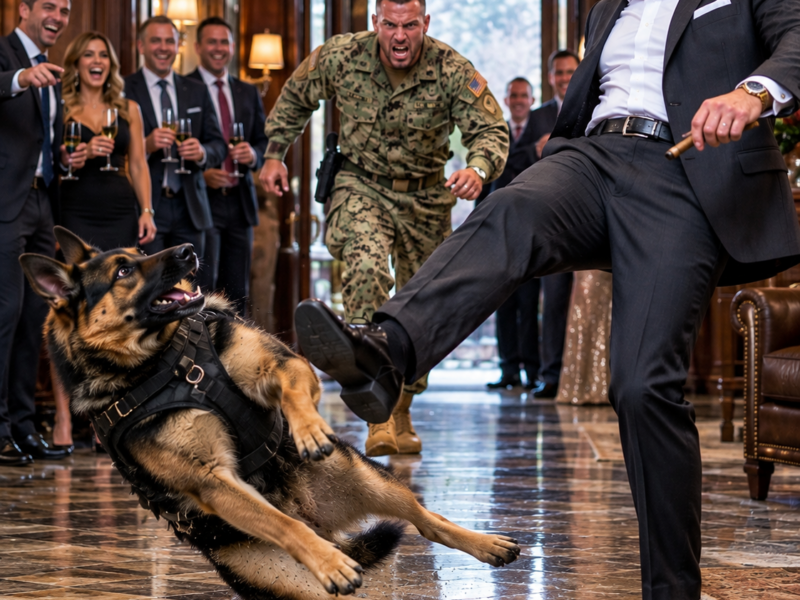
“‘It’s just a dog!’ the man shouted as his boot slammed into my K9’s ribs, and the entire deck erupted in laughter—until a woman stepped out of the shadows
The alarm kept screaming as the ferry shuddered beneath our feet.
For half a second, nobody moved. Then the lounge erupted into chaos. Passengers rushed toward the exits, children cried, and a crew member shouted for everyone to remain calm over a loudspeaker that sounded anything but calm.
I ignored all of it.
Athena was still pressed against my leg, struggling to breathe. I lowered myself beside her and ran my hands carefully along her ribs, looking for signs of a puncture or a broken bone. She flinched when I touched her left side.
“Easy, girl,” I whispered. “I’m right here.”
Her eyes found mine.
Even in pain, she tried to lift her head as if she were apologizing for not being able to stand.
That nearly broke me.
The tall man took one step toward the stairwell.
“Don’t move,” the woman in the navy jacket ordered.
He stopped, but his hand drifted toward his waistband again.
I rose slowly, keeping Athena behind me.
“Who are you?” I asked the woman.
“Commander Rebecca Shaw. Naval Criminal Investigative Service.”
She showed me her credentials for less than a second before slipping them back inside her jacket.
“NCIS?” I repeated. “What are you doing on a civilian ferry?”
“Trying to prevent what is happening right now.”
Another thud echoed from somewhere beneath the deck. The lights dimmed, then returned with a faint red glow around the emergency fixtures.
Rebecca looked at the three men.
“They were supposed to wait until we reached open water.”
The tall man gave a humorless laugh. “You should have stayed out of this, Commander.”
“Evan Rourke,” she replied, using his name as if she had been waiting years to say it. “I was wondering when you would stop hiding behind contractors.”
His smile disappeared.
That told me more than any explanation could have.
These men weren’t random troublemakers. They had arrived knowing my name, knowing Athena was with me, and apparently knowing exactly where we would be at a specific time.
“Commander,” I said, “you have about ten seconds to explain why armed men are on this ship and why one of them just kicked my dog.”
“Because you were carrying something they believe you still have.”
“I boarded with a duffel bag and a dog.”
“They don’t care about your luggage, Daniel. They care about what you remember.”
Rourke suddenly lunged toward the stairwell.
Rebecca moved to intercept him, but the shaved-head man threw himself into her path. I caught his shoulder and drove him sideways into the wall. He swung wildly, catching me across the cheek.
The impact flashed white behind my eyes.
I recovered, controlled his arm, and pinned him against the bulkhead long enough to strip away the small knife he had pulled from his sleeve.
“Bad choice,” I muttered.
Behind me, Rebecca was struggling with Rourke. The younger man bolted through the lounge doors.
Rourke struck Rebecca hard enough to send her against a table, then disappeared through the stairwell.
I could have pursued him.
But Athena made a small, painful sound behind me.
That decided it.
I shoved the knife away, dropped beside her, and checked her breathing again.
“Stay with her,” Rebecca said, regaining her footing. “I’ll get help.”
“No.” I looked at her. “You’re going to tell me what’s happening first.”
Her jaw tightened.
“Your former team leader, Lieutenant Commander Michael Vance, died six years ago during an operation outside Kandar Ridge. The operation was classified. The official report said your unit was ambushed by an insurgent force.”
I felt the lounge grow strangely quiet around me.
I hadn’t heard the name Michael Vance spoken aloud in years.
He had been my team leader, my mentor, and the man who had taught me that protecting the person beside you mattered more than protecting your own reputation.
I remembered the dust, the radio chatter, the screaming metal of a vehicle rolling down a rocky slope.
I remembered the last transmission from Vance.
Then nothing.
“What does Michael have to do with this?”
Rebecca glanced at the men, then back at me.
“His death was not what the report claimed. A classified intelligence package was removed from the operation before your team arrived. Someone altered your route, disabled your backup, and made sure the people who knew the truth would never be able to prove it.”
I stared at her.
“Are you telling me my own command sent us into a trap?”
“I’m telling you the evidence points to a deliberate compromise.”
For a moment, I couldn’t hear the alarm anymore. All I could hear was Vance’s voice from that last night, ordering us to move, telling us the extraction point had changed.
I had followed that order.
Three men never came home.
And for six years, I had blamed myself for every one of them.
“Why now?” I asked.
“Because a witness recently surfaced. He has evidence linking the operation to a private military contractor called Black Meridian. The people behind it learned that you were taking this ferry, and they decided to deal with you before you could be questioned.”
“I’m not carrying any evidence.”
“No,” Rebecca said. “But you may be the last living person who can identify the people who gave the order.”
A crew member rushed into the lounge, pale and sweating.
“Commander! We have a problem on the bridge.”
Rebecca turned sharply. “What kind of problem?”
“The captain and first officer are missing. The communications officer says the bridge doors are locked from the inside, but nobody is answering.”
My instincts snapped into place.
“How many attackers?” I asked.
The crew member looked at me as if he hadn’t expected to be addressed.
“I don’t know. At least four. Maybe more.”
Rebecca swore under her breath.
“Rourke’s team must have taken the bridge early. The alarm was supposed to be a distraction.”
“Then we stop standing here talking.”
I looked down at Athena.
She tried to rise again.
“No,” I told her gently. “You’ve done enough.”
Her ears tilted forward, and she gave me a look that said she strongly disagreed.
I almost smiled.
“That’s an order, Athena.”
She lowered herself, though she kept her eyes on me.
I turned to Rebecca. “Get the crew moving passengers into a secure area. Find the medical kit and somebody who knows how to treat a working dog. Then tell me how many people you have who can actually follow instructions under pressure.”
Her expression changed.
For the first time since she had approached us, she looked at me not as a witness but as the operator I used to be.
“Three crew members I trust,” she said. “One security officer. Possibly two more.”
“Good. Keep them together. No one approaches the bridge alone.”
I started toward the stairwell.
Rebecca caught my arm.
“Daniel, you don’t understand what Rourke is capable of.”
I looked at her hand until she released it.
“I understand exactly what a man like that does when he thinks nobody can stop him.”
Then I went after him.
The stairwell smelled of diesel, salt, and overheated electrical wiring. Emergency lights cast long shadows across the steel steps. Somewhere above, a door slammed.
I climbed quietly, pausing at each landing to listen.
Two voices came from the deck above.
“Control says the package isn’t on him.”
“Then why are we still here?”
“Because Rourke wants confirmation. Nobody leaves until the witness is secured.”
I leaned around the corner.
One man stood with his back to me, holding a radio. The other guarded a heavy service door. Neither appeared to have noticed me.
I moved before they could turn.
The first man went down under a controlled strike and a sweep of his legs. I caught him before his head hit the stairs. The second reached for his weapon, but I drove his hand against the doorframe and forced him to the floor.
The fight lasted only seconds.
I took their radios and checked the corridor.
A third man appeared at the far end, carrying a compact rifle.
He saw me.
I dropped behind a steel cart as he fired. The first round punched through a plastic container; the next shattered a wall light, filling the corridor with sparks.
I couldn’t return fire. I had no weapon, and there were crew cabins on both sides of the passage.
Instead, I waited for the pause between shots, pushed the cart down the corridor, and moved in the opposite direction.
He stepped out to follow the noise.
I came around the corner and slammed into him.
We hit the deck hard. His weapon skidded away, and he tried to reach for a sidearm. I trapped his wrist, drove my shoulder into his chest, and held him there until he stopped fighting.
“Stay down,” I told him.
He spat at me.
“Rourke will kill you.”
“Get in line.”
I zip-tied his hands with restraints taken from the other men, then grabbed the rifle and secured it before moving on.
The bridge access corridor was ahead.
A crew member crouched behind a cleaning cart near the door. She looked about twenty-five and was shaking so badly she could barely speak.
“Are you hurt?” I whispered.
She shook her head.
“Name?”
“Lena.”
“Lena, look at me. I need you to tell me what you saw.”
“Three men went into the bridge. One of them had a key card. They said the captain was going to help them, but he wouldn’t. Then they took him away.”
“Where?”
She pointed toward a narrow passage leading to the navigation office.
“Two of them dragged him there. The other one stayed on the bridge.”
I checked the radio.
“Rebecca, do you read?”
Her voice crackled through the speaker. “Go ahead.”
“I have one corridor secure and three suspects restrained. The captain may be in the navigation office. Do not send anyone toward the bridge until I give you the word.”
“Understood. Daniel, listen to me. Rourke has access to the ship’s internal communications. He’s been listening to everything.”
“Then I’ll stop using the radio.”
I turned it off.
Lena stared at me.
“Are you really a Navy SEAL?”
“Former.”
“Can you get us out of here?”
I looked toward the bridge.
“Yes,” I said. “But first we get the captain back.”
The navigation office door was partly open. I heard a man talking inside.
“Tell me where she put the card.”
A second voice answered, strained and breathless.
“I don’t know what you’re talking about.”
“Then you won’t mind if I ask again.”
I pushed the door open.
The captain sat in a chair with his hands tied behind his back. A cut marked his forehead. Standing over him was the younger attacker from the lounge, the one with the narrow face.
He turned, startled.
I closed the distance before he could raise his pistol. We collided with the desk, scattering charts and papers. He was quick, desperate, and stronger than he looked. He drove an elbow into my ribs and tried to twist free.
I trapped his weapon hand against the desk and struck his wrist until the pistol dropped. He kicked my knee, breaking my balance for half a second, then ran for the door.
I caught the back of his jacket.
He spun and slashed at me with a small blade.
The knife cut my forearm.
I barely felt it.
I drove him against the wall, disarmed him, and forced him to the floor.
“Who sent you?” I demanded.
He laughed through clenched teeth.
“You think this is about you?”
“Start talking.”
“You’re a dead man, Hayes. You and that dog.”
I tightened my grip.
“Try again.”
His eyes flicked toward the ceiling.
“Rourke’s already got what he needs.”
“What does he need?”
Before he could answer, a metallic crash sounded above us.
Then the ship’s engines slowed.
The captain lifted his head.
“Oh, no.”
“What?” I asked.
“The emergency steering system. If they shut it down while we’re moving through this channel, we could lose control before we reach the turn.”
“How long?”
“Minutes. Maybe less.”
I looked at the restrained attacker.
He was still smiling.
That was when I understood the plan. They hadn’t come aboard just to threaten me. They had taken the bridge, disabled communications, and were preparing to create a disaster that would erase the evidence along with everyone who knew anything about it.
I cut the captain’s restraints with the confiscated knife.
“Can you get the ship under control?”
“If I can reach the bridge.”
“Then we’re going.”
We moved into the corridor, with Lena following at a distance. I told her to stay behind the security door and alert Rebecca if she heard anything from the bridge.
The captain knew the ship’s layout, but the route ahead was blocked by a locked service gate. He entered an emergency override code, and the gate clicked open.
Beyond it, the corridor vibrated with the strained hum of machinery.
We were halfway to the bridge when Rourke’s voice came through a ceiling speaker.
“Daniel Hayes. You have made this much more difficult than it needed to be.”
I kept moving.
“You should have taken the deal,” he continued. “You could have left with your dog, gone home, and forgotten everything.”
“I don’t know what deal you’re talking about.”
“You will.”
A door opened at the end of the passage.
Rourke stepped out, holding a pistol in one hand and a small black device in the other. His shirt was torn, and blood marked his temple, but he looked more irritated than injured.
The captain stopped beside me.
“Mr. Rourke, stand down.”
Rourke laughed.
“Captain, you really should have stayed in your cabin.”
He pointed the pistol at me.
“Hands where I can see them.”
I raised mine slowly.
“What’s the device?”
“The reason you don’t get to be a hero tonight.”
He lifted it.
“Remote trigger. The ship’s emergency power controls. I can shut down the systems keeping this vessel stable, and I can do it before you take another step.”
The captain’s face drained of color.
“You can’t be serious.”
“Dead serious.”
Rourke glanced toward the bridge.
“Your dog is still alive, I hear. That’s unfortunate. I was hoping you’d be too distracted to interfere.”
My hands curled into fists.
“Leave her out of this.”
“Why? She’s the only thing you seem to care about.”
He took one step closer.
“Tell me where the evidence is, and maybe I let you both walk away.”
“I don’t have it.”
“Then you’re no longer useful.”
He started to raise the pistol.
The lights went out.
For one breath, the corridor was completely black.
A sharp crash sounded to my left. Someone shouted. The captain dropped to the floor.
Then a powerful bark split the darkness.
Athena.
I heard claws striking the deck, followed by Rourke’s startled curse. The emergency lights flickered back on, revealing my dog between us, her body low, her ears forward, her eyes fixed on the man who had hurt her.
She was limping.
She should have been resting.
But she had followed my scent through the ship.
“Athena, no!” I shouted.
Rourke swung his pistol toward her.
I launched myself at him.
The gun fired once, the bullet striking the ceiling. Athena lunged at his arm, forcing his aim aside. Rourke stumbled into the wall, and the black device flew from his hand.
I drove him to the floor and pinned his weapon arm.
Athena stood over him, growling, blood darkening the fur along her side.
“Back,” I ordered her.
She didn’t move.
“Athena. Back.”
Her gaze flicked to mine. Slowly, painfully, she stepped away, never taking her eyes off Rourke.
I secured his hands with restraints and retrieved the pistol, keeping it pointed away from everyone.
The captain rushed toward the bridge.
“Come on! We need to restore the controls.”
I looked at Athena.
“You’re supposed to be resting.”
She gave a low whine and leaned against my leg.
I touched her neck.
“Yeah. I know. You heard an order you didn’t like.”
Her tail moved once.
Then her legs trembled, and she lowered herself to the deck.
The fight had cost her more than she wanted me to see.
I dropped beside her.
“Stay with me, girl.”
She pressed her muzzle into my palm.
I had spent years believing that protecting the people beside me meant never allowing them to suffer. It was an impossible standard, one I had carried from deployment to deployment, from the battlefield into civilian life.
Athena had never asked me to be invincible.
She had only asked me to come back.
And now, after everything, she had come back for me.
The captain shouted from the bridge.
“We’ve got partial control! I need the second engineer down here!”
I forced myself to stand.
“Get the ship stable,” I told him. “I’m bringing her to medical.”
Rourke laughed weakly from the floor.
“You think this ends with me?”
I turned.
“No. I think it starts with you.”
For the first time that night, he looked afraid.
By the time Rebecca reached us with two security officers, the ship was turning back toward safer water. The engines had regained power, communications were partially restored, and the captain had sent a distress call through an emergency channel.
Rebecca took one look at Rourke in restraints, then at Athena.
“Oh, Daniel.”
“She needs a veterinarian. Now.”
“We have a doctor and a veterinary technician among the passengers,” she said. “They’re waiting in the infirmary.”
I lifted Athena carefully, supporting her chest and hindquarters. She was heavier than she looked, and every step sent a stab of fear through me. I kept talking to her as we moved.
“You’re all right. We’re going to get you checked out. No more running through corridors. That’s an order.”
She rested her head against my shoulder.
Rebecca walked beside us.
“You realize she may have saved everyone aboard this ship.”
“She shouldn’t have had to.”
“No,” Rebecca said quietly. “She shouldn’t.”
The infirmary was crowded with frightened passengers and crew members. A retired veterinarian named Dr. Elaine Foster had already set up a treatment area on the examination table. She examined Athena with calm, practiced hands while I stood nearby, unable to stop watching her chest rise and fall.
“Bruised ribs, possibly a fracture,” Dr. Foster said after a careful examination. “There’s no sign of a punctured lung, which is good. She has a deep soft-tissue injury, but I don’t believe it’s life-threatening. She needs imaging and proper treatment as soon as we reach port.”
“Will she be okay?”
“She has a good chance. But she needs rest, and she needs you to keep her from trying to save the world for the next few days.”
I let out a breath I hadn’t realized I was holding.
“That’s going to be difficult.”
Dr. Foster smiled faintly.
“I gathered.”
Athena received pain medication, and the veterinarian wrapped her side. Once the immediate danger had passed, she finally allowed her eyes to close.
I sat on the floor beside her table, one hand resting against her paw.
Rebecca appeared in the doorway.
“Rourke is in custody. So are the other men. The crew has secured the bridge, and the Coast Guard is on the way.”
“What about the evidence?”
She pulled a sealed envelope from her jacket.
“The witness I mentioned is already under federal protection. He has the original intelligence package and a recording from Michael Vance. He contacted investigators three days ago and gave them enough information to reopen the case.”
“Why didn’t you tell me before we boarded?”
“Because we had reason to believe your communications were being monitored. We couldn’t risk tipping off the people behind the operation. I was supposed to approach you privately after we docked.”
I looked down at Athena.
“And instead, they attacked her in front of half the passengers.”
Rebecca lowered her eyes.
“Yes.”
“Who ordered it?”
“We don’t have the full chain yet. Rourke claims he was hired through a security company called Black Meridian. We’re checking the financial records now. But there’s a senior official whose name appears in the original evidence.”
She paused.
“Admiral Thomas Kessler.”
I knew the name.
Kessler had been a flag officer when my team deployed to Kandar Ridge. He had approved the operation and signed the authorization for the route change that sent us into the ambush.
For six years, I had believed that decision was based on faulty intelligence.
Now I wondered whether it had been deliberate.
“Does the witness know what happened to Vance?”
Rebecca nodded.
“He says Vance discovered the operation had been compromised before the team arrived. He tried to warn command, but his messages never reached the people they were meant for. The witness also claims Vance survived the initial attack long enough to transmit a final recording.”
I stared at her.
“You’re telling me there’s a recording?”
“Yes. And it may prove that your team was betrayed.”
For a long time, I couldn’t answer.
The memory of that night had never left me. I could still picture Vance standing beside the transport vehicle, one hand raised as he listened to the radio. I could hear his calm voice telling us the route had changed.
I had followed the order because he was our team leader and because trust was the foundation of everything we did.
When the ambush came, I survived.
Three of my teammates didn’t.
For years, I had replayed every decision, searching for the moment when I could have done something different.
Maybe there was no such moment.
Maybe we had been betrayed before we ever reached the ridge.
Rebecca sat in the chair beside me.
“Daniel, I need you to understand something. If the evidence holds up, you were not responsible for what happened at Kandar Ridge.”
“I know what the evidence might say.”
“Do you believe it?”
I looked at Athena, sleeping under the infirmary lights.
“I don’t know how to stop believing that I should have saved them.”
Rebecca didn’t offer me an easy answer.
She simply stayed there until the silence became something I could bear.
The Coast Guard met the ferry before sunrise. Armed officers boarded, secured the remaining suspects, and escorted Rourke away in handcuffs. Investigators collected the weapons, the communication devices, and the remote trigger recovered from the corridor.
The passengers were interviewed one by one. Several had recorded the confrontation in the lounge, including the moment Rourke kicked Athena and the instant Rebecca identified herself.
By midmorning, the ferry was escorted into port.
Athena was transferred to a veterinary hospital, where imaging confirmed two fractured ribs and extensive bruising. She needed surgery to repair a damaged area of tissue, but the veterinarian assured me that her prognosis was good.
I waited outside the operating room for nearly four hours.
When the surgeon finally emerged, I stood so quickly that my chair fell backward.
“She made it through,” he said. “The repair went well. She’ll need time, but she’s a strong dog.”
I covered my face with both hands.
For the first time since the lounge, I allowed myself to cry.
No one tried to stop me.
Athena spent three nights in the hospital. When I was finally allowed to see her, she lifted her head from the blanket and gave a tired wag of her tail.
I leaned down and pressed my forehead against hers.
“You scared me, girl.”
She licked my chin.
“I know. You’re not sorry.”
Her tail moved again.
I laughed through the tears.
“That’s what I thought.”
The investigation took months.
Rourke eventually agreed to cooperate after investigators showed him financial transfers connecting his team to Black Meridian. The company had been paid through a network of shell businesses, and messages recovered from its servers revealed that the attack on the ferry had been planned weeks in advance.
The stated objective was to recover the evidence held by the protected witness and prevent me from contradicting the official account of Kandar Ridge.
The attack on Athena had not been part of the original plan. Rourke had used it to provoke me, hoping I would react violently in front of witnesses and give his employers a reason to portray me as unstable and dangerous.
Instead, the recordings captured the truth.
The footage showed three men harassing a retired servicemember, assaulting his working dog, and escalating the confrontation before the ship’s takeover. It showed me trying to protect passengers and restrain the attackers without unnecessary force.
It also showed Athena returning to my side despite her injuries.
The evidence was impossible to explain away.
Federal investigators recovered the original operation files, including Vance’s final recording. They traced the altered route order to an office that had reported directly to Admiral Kessler.
Kessler denied knowing about the ambush.
Then the recording was played for him.
Vance’s voice filled the hearing room, rough with static but unmistakable.
“Command, this is Vance. Our route was changed after the team was already in transit. The intelligence package has been compromised. Black Meridian personnel are on-site, and they knew our arrival time. Repeat, they knew our arrival time. We need immediate extraction and an investigation into who authorized the change.”
There was a pause.
Then Vance spoke again.
“If this recording reaches anyone outside our chain, understand this: my team was sent into a situation someone had already prepared. We did not walk into this blind by accident.”
The recording ended.
I sat with my hands locked together beneath the table.
For six years, I had carried the belief that I had failed my team.
Now I was hearing the man I trusted most tell the world that we had been betrayed.
The truth didn’t bring my friends back. It didn’t erase the nights I had spent wondering whether I could have saved them.
But it finally gave their deaths a name.
The investigation led to charges against several Black Meridian executives and officers accused of conspiracy, obstruction, evidence tampering, and their roles in the operation’s cover-up. Kessler was removed from duty while the case proceeded, and the military formally reopened the inquiry into Kandar Ridge.
The process was slow, complicated, and often frustrating. There were hearings, sealed documents, denials, and months when it seemed that every new answer created three more questions.
But this time, the truth had witnesses.
And it had evidence.
Most importantly, it had the voice of a man who had refused to let his team be forgotten.
About five months after the ferry incident, Rebecca called me.
“We found him,” she said.
I was sitting on the floor of my living room while Athena slept with her head across my ankle. She was healing well, though she still limped slightly after long walks.
“Found who?”
“The witness from Kandar Ridge. The man who brought us the recording.”
I sat up.
“What’s his name?”
“Sergeant First Class Marcus Bell. He served as a communications specialist attached to the operation. He was listed as missing after the ambush.”
I remembered him. Quiet, sharp, and always carrying a battered notebook in his vest pocket. He had been the youngest man in the support element, but he could repair a radio under fire faster than anyone I knew.
“Is he alive?”
“Yes.”
I closed my eyes.
“Can I speak to him?”
“Not over the phone. He’s under protection, and the investigators want to keep his location secure. But he asked to meet you in person.”
“When?”
“Tomorrow, if you’re willing.”
I looked at Athena.
She raised her head as if she knew something important had just happened.
“Tell him I’ll be there.”
The meeting took place in a plain federal office outside Washington. No flags, no ceremonial welcome, no cameras. Just a small table, two chairs, and a man standing near the window with his hands clasped behind his back.
Marcus looked older than I remembered. His hair had thinned, and a pale scar crossed his jaw. But when he turned, I recognized his eyes.
For a moment, neither of us spoke.
Then he said, “Hayes.”
I crossed the room and pulled him into a hug.
He held on like a man who had been waiting years for permission to stop running.
“You’re alive,” I whispered.
“So are you.”
I stepped back to look at him.
“We buried you in our heads, man.”
“I know.”
“Why didn’t you contact me?”
His face tightened.
“Because I thought they were watching everyone connected to the operation. After the ambush, I woke up in a field hospital under a false name. The people who got me out told me that if I contacted anyone from the team, I’d put them in danger.”
“You could have told somebody.”
“I tried.” He swallowed. “The first investigator I approached disappeared from the case. The second told me I had no proof and warned me that my career would be over if I kept pushing. By then, I didn’t know who I could trust.”
He looked down at his hands.
“I thought staying away was the only way to keep the truth alive.”
I wanted to be angry. Part of me was. I had spent years grieving a friend who had been alive somewhere in the world, carrying a secret that could have changed everything.
But I saw the fear in his face, and I understood that he had been surviving the only way he knew how.
“You should have had someone,” I said.
“So should you.”
We sat down.
For the next two hours, Marcus walked me through the events at Kandar Ridge. He explained how the intelligence package had been diverted, how our route had been changed, and how the extraction plan had been altered without our knowledge.
He had survived because he was thrown clear of a damaged vehicle and found by a local family. By the time he could safely return to the military system, the official story had already been written.
The operation was described as a tragic ambush caused by inaccurate intelligence.
The families were told their loved ones had died honorably.
The people responsible expected the case to disappear with the men who had died.
Marcus had kept copies of the communications he could recover, along with Vance’s recording. He had spent years trying to get them into the hands of someone who could act without burying them again.
When he finished, he looked at me.
“I’ve asked myself every day whether I should have done more.”
I stared at him.
“Me too.”
“I could have tried harder to reach you.”
“You were trying to stay alive.”
“So were you.”
For a long moment, we sat in silence.
Then I said, “I spent six years thinking I had led my men into a trap.”
Marcus shook his head.
“You trusted the orders you were given. We all did. That’s what a team does.”
“And they used that trust against us.”
“Yeah.”
His voice broke on the word.
I reached across the table and gripped his forearm.
“We’re not carrying their lies anymore.”
He nodded, wiping his eyes with the heel of his hand.
“No,” he said. “We’re not.”
The official record was corrected the following year. The inquiry confirmed that the route change and intelligence compromise had contributed directly to the deaths at Kandar Ridge. The families of the fallen received new findings, and several were invited to a formal briefing where investigators explained what had happened.
I attended the memorial ceremony with Athena beside me.
She had recovered enough to walk comfortably, though her veterinarian insisted that her working days were over. I didn’t argue. She had earned her retirement many times over.
The families gathered beneath a pale morning sky. There were framed photographs, folded flags, and flowers arranged at the base of a memorial wall. I recognized the faces in the photographs immediately.
Vance, smiling beneath a helmet that always seemed too large for him.
Corporal James Miller, who could make the entire team laugh during the worst nights.
Petty Officer Luis Ortega, who once gave away his last dry pair of socks to a local child.
And the others.
Men who had been more than names on a report.
When it was my turn to speak, I stood before the families and took a breath.
“For years, we were told that these men died because intelligence failed and circumstances turned against us. That explanation was incomplete. The investigation has now confirmed that decisions made before we arrived helped place them in danger.”
I looked at the photographs.
“They followed their orders. They trusted their teammates. They did their jobs with courage, and they deserved the truth.”
My voice tightened.
“I can’t give you back the people you lost. I wish I could. But I can tell you that they were not forgotten, and they did not fail. The men who survived them have spent years trying to understand what happened. We will continue to honor them by telling the truth about their service.”
When I stepped away from the microphone, Marcus was waiting near the front row.
He placed a hand on my shoulder.
“You did good.”
I looked at the wall.
“No,” I said softly. “We did.”
Athena stood beside me, her ears alert, her body close to my leg. A little girl approached with her mother and asked if she could pet the dog.
I knelt beside Athena.
“She’s friendly,” I said. “Just let her sniff your hand first.”
The girl held out her fingers, and Athena gently touched her nose to them.
The child smiled.
“She looks brave.”
“She is.”
“Was she a soldier?”
I thought about the ferry, the blood on Athena’s fur, and the way she had run toward danger even when every instinct should have told her to rest.
“She was my partner,” I said. “That’s a little different.”
The girl seemed satisfied with that answer and stroked Athena’s head.
For the first time in a long while, the memory of Kandar Ridge did not feel like a weight pressing against my chest. It was still there, and it always would be. But it no longer belonged to the people who had tried to bury it.
It belonged to the truth.
A few weeks later, I took Athena to the waterfront in Charleston. The afternoon was warm, and the breeze carried the smell of salt and distant rain. Boats moved slowly through the harbor while families wandered along the path.
Athena walked at my side, her leash loose in my hand.
We stopped near the water and watched the sun settle toward the horizon.
I thought about the men who had died, the friend I had found again, and the woman who had stepped out of the shadows when three men believed they could do whatever they wanted without consequence.
I thought about how close the ferry had come to disaster.
And I thought about a sentence I had heard too many times in my life: It’s just a dog.
People said it when they wanted to excuse cruelty. They said it when they didn’t understand the bond between a working dog and the person who trusted her with his life. They said it because they believed loyalty was something small, something disposable, something that could be kicked aside without consequence.
They were wrong.
Athena had never cared about my rank, my reputation, or the medals I kept in a drawer. She didn’t know the details of the case, the names of the men who had betrayed us, or the difference between a classified report and a public one.
She knew when I was hurting.
She knew when I was afraid.
And when I needed her, she came.
I knelt and wrapped my arms around her neck.
“You’re off duty,” I whispered.
Athena leaned against me.
For once, she didn’t look toward the horizon or scan the passing crowd. She simply stayed close, warm and steady, content to let the world move around us.
I had spent years thinking that being strong meant standing alone, carrying the weight, and never letting anyone see the cracks.
Athena had taught me something different.
Strength was knowing who stood beside you.
It was trusting someone enough to let them help you.
And it was refusing to abandon them when the world decided they were worth less than you were.
I rose, clipped her leash comfortably in my hand, and started walking toward home.
Behind us, the harbor lights flickered on one by one.
The past had finally been named. The men responsible would face the consequences of their actions. My fallen teammates had their truth restored, and the people who loved them no longer had to live beneath a lie.
None of that erased what happened.
But it meant the story no longer ended where the attackers wanted it to.
It ended with Athena alive, Marcus no longer hiding, and the truth finally spoken aloud.
And as we walked into the evening, my partner beside me, I knew one thing with absolute certainty.
She had never been just a dog.
She was family.
She was courage.
She was the reason I had made it home.
And no one would ever make me ashamed of loving her.
The end.









