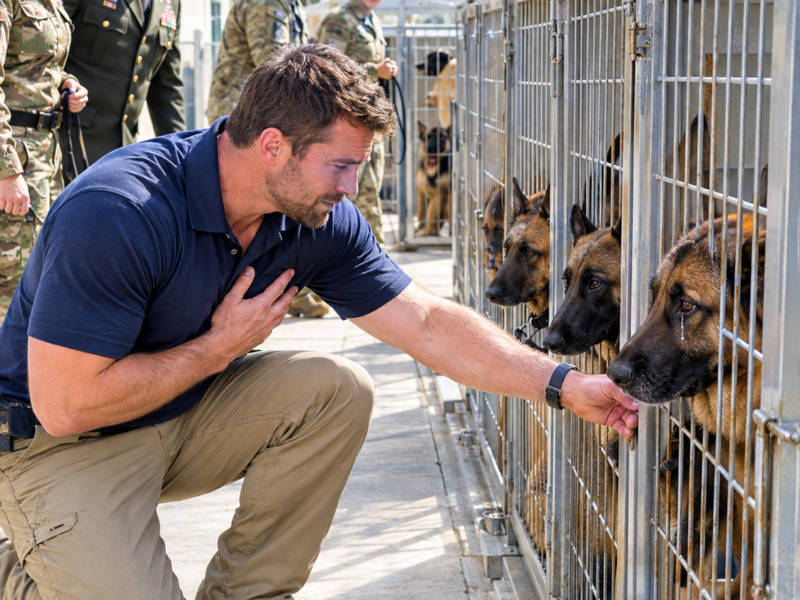
“I’ll take every one of these retired K9 dogs,” I said in front of the entire military retirement ceremony, but the commanding officer looked me straight in the eye
The photograph shook slightly in my hand as I turned it over again, hoping the words on the back would somehow change.
“Tell Cole the dog remembers everything.”
I read the sentence three times before looking toward the parking lot, where the late afternoon sun glinted off my truck.
Someone knew I had visited the kennel. Someone knew I had asked about Duke. And whoever had sent that photograph knew something about an operation the Navy had told me was closed forever.
I called the number.
It rang once, twice, then went straight to voicemail.
I tried again.
Nothing.
For several seconds, I stood beside my truck listening to the distant hum of traffic beyond the base gates. Then I noticed something else in the photograph I hadn’t seen before.
Duke was sitting beside James Walker, his ears raised and his eyes fixed on the camera.
Behind them stood a weathered concrete building with a faded number painted over its entrance.
17.
The same number as the coordinates scratched into Duke’s kennel.
I zoomed in on the photograph until the pixels blurred.
Someone had circled a small object hanging from James’s neck. It looked like a military identification tag, but the shape was wrong.
I enlarged it again.
A brass key.
I knew that key.
Three years earlier, before our team deployed to Afghanistan, my closest friend, Senior Chief Michael Hayes, had given me a small brass key and told me to keep it safe.
“If anything happens to me,” he’d said, “don’t let them convince you that the report tells the whole story.”
I’d laughed at him then.
Michael had a habit of preparing for disasters that never came, and I had been too busy worrying about our next mission to take his concern seriously.
Two weeks later, he was dead.
Or so I had been told.
I opened the glove compartment and pulled out the small leather pouch I’d carried through three deployments and two changes of command.
The key was still inside.
I held it next to the photograph.
They were identical.
My phone vibrated again.
This time, the message came from the same unknown number.
If you want the truth, come alone. Tomorrow. 0600. Old training facility. Bring the key.
I typed a reply.
Who is this?
The response arrived almost immediately.
Someone who should have spoken three years ago.
Then the number disappeared from my screen.
I didn’t sleep much that night.
By five in the morning, I was dressed, armed with nothing more than my phone, the brass key, and a thermos of coffee I never drank.
I drove to the old training facility outside the main base, a place that had been partially abandoned after a funding reorganization. The access road was cracked, weeds pushed through the pavement, and the chain-link fence rattled whenever the wind came off the water.
At 5:57, I parked near a row of empty buildings.
A man stood beneath a broken security light.
He wore civilian clothes, but his posture gave him away before I could see his face.
“Commander Cole?”
“Depends who’s asking.”
He stepped forward.
He was older than I remembered, with gray at his temples and a pale scar running from his left ear toward his jaw.
I recognized him from the photograph.
Corporal James Walker.
For a moment, neither of us spoke.
Then I reached for his arm and stopped just short of touching him.
“You were reported missing.”
“I know.”
“Your family was told you were dead.”
“I know that, too.”
“Michael Hayes died on that operation.”
His eyes lowered.
“I know.”
The three words came out so quietly that I almost wished he’d shouted them instead.
I took a step toward him.
“Then start talking.”
James glanced at the empty road behind me.
“Not here. There’s a building around the back. No cameras, no active power, and nobody’s supposed to use it anymore.”
“Why should I trust you?”
“You shouldn’t.”
His answer caught me off guard.
He looked directly at me.
“But Michael did. That’s why he sent you the key.”
I pulled the brass key from my pocket.
James stared at it, and for the first time, his composure cracked.
“He kept it, then.”
“Apparently.”
“Good.”
He turned and began walking.
I followed him past the abandoned barracks to a squat concrete building with boarded windows and a rusted steel door. The number 17 was still visible above the entrance, although most of the paint had peeled away.
James took a small flashlight from his jacket and pointed it at the lock.
“Try the key.”
I slid it into the lock.
It turned with a reluctant metallic click.
Inside, the air smelled of dust, damp concrete, and old electrical equipment. My flashlight swept across empty desks, overturned chairs, and a filing cabinet standing against the far wall.
James shut the door behind us.
“Three years ago, Michael discovered that someone had altered the operational coordinates before our team deployed,” he said.
I felt the muscles in my jaw tighten.
“Who?”
“He didn’t know at first. He only knew the coordinates on the final mission packet didn’t match the ones approved during the original briefing.”
I remembered that night.
Michael had sat across from me in a dim operations room, tapping a finger against a map.
“Something about this doesn’t add up, Cole,” he’d said.
I’d told him we’d verify it with command.
We never got the chance.
“Our extraction point changed, too,” I said.
James nodded.
“Because someone wanted your team at Grid 17.”
“Why?”
“That’s what Michael was trying to find out.”
James crossed the room and knelt beside the filing cabinet. He pulled out the bottom drawer, reached behind a loose metal panel, and removed a sealed plastic envelope.
Inside were several printed photographs, two handwritten notes, and a small digital storage device.
“Michael gave me these the night before the operation,” James said. “He told me to keep them out of the official system until he could prove what they meant.”
“Why didn’t you turn them over after he died?”
James looked at me.
“Because the people who changed the coordinates were the same people investigating his death.”
I stared at him.
“You’re telling me the investigation was compromised?”
“I’m telling you I was ordered to sign a statement saying our original route had been approved by Michael himself.”
“And you signed it?”
His silence was answer enough.
I took a slow breath.
“Why?”
“Because I was twenty-six years old, my commanding officer told me I was protecting national security, and somebody had shown me a photograph of my younger sister leaving her apartment.”
He looked down at his hands.
“They never said they’d hurt her. They didn’t need to.”
The room seemed to grow colder.
“I told myself I was buying time. I told myself I would find another way to prove what happened.”
“Three years is a long time to buy.”
“I know.”
I wanted to hate him. It would have been easier than listening to the guilt in his voice, easier than acknowledging that fear could make an honorable man do something cowardly.
But I had seen good people make terrible decisions when they believed everyone they loved was in danger.
It didn’t excuse what James had done.
It explained why he had lived with it.
I opened the envelope.
The first photograph showed a military transport vehicle parked outside a compound in Afghanistan. The second showed a group of men carrying equipment through a narrow passageway.
The third showed Michael standing beside Duke.
On the back, Michael had written a date and three words.
He found the cache.
“What’s the cache?” I asked.
James shook his head.
“Michael never told me what was inside. He only said the dog had located something that wasn’t supposed to exist.”
I picked up the digital storage device.
“What’s on this?”
“Fragments of the original mission logs. Michael copied them before the deployment.”
“Why didn’t he send them to someone?”
“He tried.”
James handed me the second note.
The handwriting was Michael’s, unmistakable even after three years.
If you’re reading this, the official record has already been altered. Don’t trust a single timeline until you compare the original coordinates with the field logs. Duke saw what happened at Grid 17. Keep him alive, and keep him away from anyone asking about the missing drive.
I read the final sentence again.
“The missing drive?”
James nodded.
“There was a second storage device. Michael believed it contained the complete communications log from the operation.”
“Who has it?”
“I don’t know.”
“Then how do you know it exists?”
“Because I saw Michael hide it.”
“Where?”
James rubbed his scar.
“Before the shooting started, Duke was ordered to search a collapsed storage room. He found a metal case buried behind a section of broken wall. Michael took something out of it and put it inside his vest.”
“And then?”
“The explosion separated us. When I came to, Michael was gone, and Duke was trying to pull me away from the debris.”
I stared at him.
“You saw him put the drive in his vest, but you never saw what happened to it afterward?”
“No.”
“Did you see Michael die?”
James looked away.
“No.”
The answer landed harder than I expected.
For three years, I’d carried the certainty that my friend had died trying to get us home. It was the one piece of the story I had never questioned.
Now a man who had been there was telling me he had never seen Michael’s body.
“Why didn’t you tell anyone that?”
“Because the report said his remains had been recovered and identified.”
“By whom?”
James swallowed.
“That’s what I was afraid to ask.”
I placed the photographs back inside the envelope.
“What does Duke remember?”
James’s face changed.
“He recognizes the voices of people who were at Grid 17. He reacts to certain phrases, certain sounds. He also reacts to the name Michael.”
“That’s not proof of anything.”
“No. But it’s why they kept moving him between handlers.”
“Who is they?”
James hesitated.
“An internal unit responsible for reviewing sensitive working-dog assignments. They claimed Duke’s behavioral issues made him unsuitable for normal adoption. Every time someone tried to place him, the paperwork was delayed.”
I thought of the commanding officer’s expression when I mentioned the coordinates.
The warning to be careful.
The restricted records.
The way Duke had stared at me as though he knew exactly who I was.
“Someone doesn’t want that dog leaving the facility,” I said.
James nodded.
“And now you’ve signed adoption papers for all seven.”
“How did you know that?”
“Because someone called me last night and asked whether I’d heard from you.”
I looked at him sharply.
“Who called?”
“I don’t know. They used a blocked number. But they knew about the photograph.”
A low mechanical hum sounded somewhere beyond the wall.
James killed his flashlight.
We stood motionless in the darkness.
Headlights swept across the narrow gap beneath the boarded window.
A vehicle rolled slowly past the building, then stopped.
I could hear a door open.
James leaned close enough for me to hear his whisper.
“They found us.”
I slipped the digital storage device into my pocket and closed my hand around the envelope.
“Is there another exit?”
“Back wall. Old maintenance corridor.”
We moved through a narrow passage behind the filing cabinet, pushed aside a warped panel, and entered a corridor barely wide enough for our shoulders.
The footsteps outside grew louder.
Someone tried the front door.
It didn’t open.
Then a voice called from the other side.
“Commander Cole, this is Captain Richard Shaw. Open the door. We need to talk.”
I knew the name.
Shaw had been the senior officer who signed the final review of our operation.
He had stood at the memorial service and told Michael’s family that their son had died serving his country.
James grabbed my sleeve.
“Don’t answer him.”
Shaw knocked again.
“Commander, you have materials that don’t belong to you. Let’s handle this professionally.”
I stared into the darkness of the corridor.
“What do you want me to do?” I whispered.
“Get Duke.”
“And you?”
“I’ll keep them occupied.”
“No.”
James gave me a tired, almost apologetic smile.
“I’ve spent three years running from what I did. I’m not doing it again.”
Before I could argue, he stepped back toward the room.
I heard the door open.
Then Shaw’s voice.
“James. I wondered when you’d decide to become useful.”
I moved down the corridor, keeping my steps quiet.
Behind me, James began speaking in a calm voice, but I couldn’t make out the words.
A moment later, something struck the floor.
I didn’t turn around.
Not because I didn’t care what happened to him, but because if I stopped, the evidence in my pocket might never reach anyone who could use it.
By the time I emerged from the far end of the building, the sky had begun to brighten.
I drove straight to the base.
I didn’t go home.
I didn’t call my command.
I went to the kennel.
The morning shift was arriving when I reached the facility. The handler who had spoken to me the day before stood near the entrance, holding a clipboard.
He looked surprised to see me.
“Commander? I wasn’t expecting you until the adoption review.”
“I need to see Duke.”
“Is there a problem?”
“Possibly.”
I kept my voice even, but he noticed the envelope under my arm.
He glanced toward the administrative office.
“Sir, there’s been a change in his status.”
“What kind of change?”
“He was scheduled to be transferred to another facility this morning.”
“Who authorized it?”
The handler checked his clipboard.
“Captain Shaw.”
For a moment, neither of us moved.
“Where is he now?”
“In the rear transport area.”
I headed toward the back of the building.
The handler hurried after me.
“Commander, I need you to understand that I can’t release a dog without authorization.”
“I understand.”
“Then you need to stop.”
I turned to face him.
“Do you know why Duke is being transferred?”
“No, sir.”
“Have you ever seen him react to a particular person?”
The handler hesitated.
“Yesterday, after you left, he became agitated when a man in civilian clothes visited the kennel.”
“What man?”
“He didn’t give his name. But Duke wouldn’t approach him. When the man reached toward the gate, Duke showed his teeth.”
“Did you report it?”
“I did.”
“And what happened?”
“My supervisor told me to leave it alone.”
I looked toward the transport area.
“Can you get Duke out of his kennel?”
The handler swallowed.
“If I do that without authorization, I could lose my position.”
I knew what I was asking him to risk. He was young, probably still trying to establish himself, and had no reason to trust a commander who’d appeared out of nowhere with a suspicious story.
I took out my phone and showed him the photograph of Duke with Michael.
“That man beside him was my teammate. He died during an operation that may have been deliberately compromised. I think Duke is being moved because someone is afraid of what he remembers.”
The handler studied the photograph.
Then he looked toward the rear doors.
“I’ll need ten minutes.”
We had five.
A transport truck sat outside the rear kennel entrance, its engine running. Two men in civilian clothes were checking a set of documents beside the driver’s door.
One of them was Captain Shaw.
The other was a stranger with a neatly trimmed beard and an expression that seemed permanently irritated.
I recognized him from the photograph James had shown me.
He had been standing near the compound at Grid 17.
Shaw saw me approaching and folded the papers in his hand.
“Commander. You’re making this more complicated than it needs to be.”
“Why are you transferring Duke?”
“Administrative decision.”
“Based on what?”
“His behavioral profile.”
“He’s been cleared for adoption review.”
“That status has changed.”
“By whose authority?”
Shaw’s jaw tightened.
“Mine.”
The handler appeared behind me with Duke on a lead.
The dog moved stiffly at first, then lifted his head.
When he saw the bearded man, he stopped.
A deep growl rose from his chest.
The stranger stepped backward.
“Get that animal under control.”
The handler shortened the lead, but Duke didn’t lunge. He simply stood between the man and me, his body rigid, his eyes locked on the stranger’s face.
Shaw’s expression darkened.
“Take him to the truck.”
“No,” I said.
Shaw turned to me.
“Excuse me?”
“I have a pending adoption request for all seven dogs. Until that request is reviewed, I expect the normal procedure to be followed.”
“Your request doesn’t override a transfer order.”
“Then show me the documentation.”
He held up the papers.
I didn’t reach for them.
“I want to read the authorization, including the receiving facility and the reason for the transfer.”
The bearded man moved closer.
“You’re a SEAL, Commander. Not an investigator. Let the people responsible for these animals do their jobs.”
Duke’s growl deepened.
I looked at the man.
“What’s your name?”
He didn’t answer.
“That’s interesting,” I said. “Most people don’t have trouble introducing themselves.”
Shaw stepped between us.
“This conversation is over.”
I reached into my pocket and pressed the record button on my phone.
“Then you won’t mind repeating your explanation for the record.”
His eyes dropped to my hand.
For the first time, I saw uncertainty in his face.
“You should think carefully about what you’re doing.”
“I have been.”
Duke suddenly pulled forward, not toward the man but toward the truck’s open rear compartment.
The handler nearly lost his grip on the lead.
“Duke, heel!”
The dog ignored him.
He reached the truck, rose onto his hind legs, and placed both front paws against the metal floor.
Then he began barking.
Not the frantic barking I’d heard from nervous dogs.
These were sharp, deliberate bursts, followed by a pause, then another series of barks.
I stepped closer.
Something inside the truck shifted.
The bearded man swore under his breath.
Shaw moved quickly toward the rear door.
“Get him away from there.”
I caught the edge of the door before he could close it.
Inside the truck, beneath a stack of folded blankets, sat a long black equipment case.
A faded inventory sticker was attached to the side.
I recognized the identification format from the mission logs.
It was military property.
And beneath the sticker, someone had scratched two characters into the metal.
17.
The handler pulled Duke back, but the dog continued to bark at the case.
I looked at Shaw.
“What’s in there?”
“Equipment.”
“What equipment?”
“Classified equipment.”
“Then you’ll have no problem explaining why it’s being transported in an unmarked truck by a man who won’t identify himself.”
The stranger stepped toward me.
“Move away from the vehicle, Commander.”
I didn’t.
His gaze flicked toward Duke, then back to me.
“That dog is unstable. You should have listened when they told you not to take him.”
The words came too quickly.
I looked at him.
“I never told you I was taking him.”
Silence settled over the transport area.
Shaw’s expression hardened, but the stranger had already revealed too much.
He knew exactly what I had asked to do.
He knew about Duke.
And he knew I had been warned.
I raised my phone slightly.
“Would you like to explain how you knew about my adoption request?”
The stranger lunged for the phone.
I stepped aside, caught his wrist, and pushed him away from me without striking him.
He stumbled against the truck.
Shaw shouted for the security team.
Two uniformed personnel came running from the main building.
“Commander Cole, step away from the vehicle,” one of them ordered.
I released the stranger and raised both hands.
“Gladly. But before you move that truck, I want the case documented and its contents verified.”
Shaw’s face had gone pale.
“You have no authority to make that demand.”
“Then call someone who does.”
For several seconds, nobody moved.
Then a voice came from behind the security personnel.
“That’s enough.”
A woman in a dark uniform approached, accompanied by two investigators carrying folders.
I recognized her rank but not her face.
She showed Shaw an identification card.
“Rear Admiral Ellen Brooks. Naval Inspector General’s office. Captain, step away from the vehicle.”
Shaw straightened.
“Admiral, this is a misunderstanding.”
“Then you’ll have no trouble explaining why an unauthorized transfer was scheduled for a retired working dog whose records are under review.”
Her eyes moved to the open truck.
“And why military equipment is being transported without a documented chain of custody.”
The bearded man took a step backward.
One of the investigators noticed.
“Sir, stay where you are.”
The man stopped.
Admiral Brooks turned toward me.
“Commander Cole, I’ve been trying to locate you since early this morning.”
I looked at the phone in my hand.
“Then you know about the message I received.”
“We know about the photograph. We also know someone attempted to access your service records overnight.”
She glanced at Duke, who had finally gone quiet.
“Is that the dog from Grid 17?”
“Yes, ma’am.”
“Then I think we’d better talk somewhere private.”
The investigation that followed lasted six weeks.
It was not the kind of investigation people imagine when they hear the word. There were no dramatic press conferences or immediate confessions. There were interviews that lasted hours, records that appeared and disappeared from secure databases, and long stretches when every person involved seemed to know something they weren’t ready to say.
I gave Admiral Brooks the photographs, Michael’s notes, and the digital storage device James had entrusted to me.
The device was damaged, but specialists recovered fragments of the original communications logs.
Those fragments revealed that the mission coordinates had been changed less than four hours before deployment.
The change had been approved using Michael’s credentials.
But the access logs showed that Michael’s account had been used from a terminal in a different state while he was already aboard the transport aircraft.
Someone had impersonated him.
The evidence also showed that the team had been diverted to Grid 17 to secure a storage facility that was not listed in the official mission objectives.
Inside that facility, investigators found evidence of an unauthorized weapons transfer operation.
The operation had been concealed behind legitimate military logistics contracts, and several senior personnel had used their positions to divert equipment and erase records.
Michael had discovered the discrepancy while reviewing a routine inventory report.
Duke had helped locate the storage cache.
And James had witnessed enough of the operation to become a liability.
But the evidence still couldn’t answer the question that mattered most to me.
What had happened to Michael?
Admiral Brooks called me into her office on a rainy Thursday afternoon.
A thick folder sat on her desk.
“We’ve confirmed that the remains attributed to Senior Chief Hayes were identified using records that don’t match the original recovery report,” she said.
I gripped the arms of the chair.
“Meaning?”
“Meaning the identification process was compromised. We have not yet established whose remains were recovered.”
I stared at her.
For three years, I had visited Michael’s memorial with his parents. I had stood beside his mother as she placed flowers beneath his name. I had listened to his father speak about the son who would never come home.
Now I was being told that even the final certainty of his death had been built on an unreliable report.
“Do you believe he’s alive?” I asked.
“I don’t know.”
It was the most honest answer anyone had given me.
“We have confirmed that the black equipment case contained original mission records and part of the missing inventory,” she continued. “The material links several individuals to the diversion operation. It also suggests Michael may have removed a separate storage device before the facility was destroyed.”
“Where is it?”
“We believe he hid it somewhere that would be difficult to search without knowing what to look for.”
I thought of Duke.
“The dog.”
Admiral Brooks nodded.
“Possibly.”
She slid a photograph across the desk.
It showed Michael standing beside Duke outside a small concrete building. On the back was a handwritten note:
If the official story survives, follow the dog home.
I stared at the words.
“Where was this taken?”
“We believe it was taken shortly before the operation.”
“Why wasn’t it in the original evidence?”
“Because it was found inside a personal effects box that had been sealed and stored under a false inventory number.”
I sat back.
Every time I thought we’d reached the bottom of the mystery, another layer appeared.
“What happens now?”
“Captain Shaw and several other personnel have been suspended pending formal proceedings. The civilian contractor is being investigated for conspiracy, theft of government property, and obstruction. Corporal Walker has agreed to provide a sworn statement.”
“And Michael?”
Admiral Brooks folded her hands.
“We continue looking.”
That evening, I returned to Virginia Beach.
The seven dogs were finally approved for placement after a full veterinary and behavioral assessment. Their adoption paperwork had taken weeks to complete, and the kennel staff had insisted on a detailed plan for their care.
I had hired two experienced handlers, arranged for a veterinary team familiar with retired military working dogs, and converted an unused section of my property into a secure, comfortable space where each dog could retreat when he needed quiet.
I had promised myself I would give them a peaceful retirement.
I hadn’t expected them to lead me back into the hardest days of my life.
Rex was the first to settle in. He chose a patch of afternoon sun near the fence and slept there for nearly two hours.
The older dogs took longer.
Some paced the perimeter. One refused to enter the kennel until I’d sat on the concrete floor beside the doorway for twenty minutes.
Duke remained watchful.
He followed me from one end of the property to the other, stopping whenever I stopped, his ears shifting toward every distant sound.
On the fourth evening, I sat on the porch with a cup of coffee and watched the dogs move through the exercise yard.
Duke approached and sat beside my chair.
I rubbed the space behind his ears.
“You’re home now, buddy.”
He leaned against my knee.
For the first time since I’d met him, he looked peaceful.
Then he stood abruptly and walked toward the old storage shed at the far end of the property.
I followed.
The shed had belonged to the previous owner, and I’d barely used it since buying the place. It contained old tools, a broken lawn mower, and a stack of wooden crates.
Duke stopped beside the lowest crate.
He sniffed the corner, circled once, then scratched at the floor.
I knelt beside him.
“What’s there?”
He scratched again.
I moved the crate aside and found a loose wooden board beneath it.
Under the board was a narrow metal compartment.
My hands began to shake before I even opened it.
Inside lay a sealed plastic pouch, protected by a layer of oilcloth.
I lifted it out carefully.
There was no name on the outside, only a date and the same grid reference that had been scratched into Duke’s kennel.
Grid 17.
I opened the pouch.
Inside was a small storage drive, a folded letter, and a photograph of Michael.
He was standing in front of a rural building I didn’t recognize, wearing civilian clothes.
He looked thinner than I remembered, but unmistakably alive.
The date on the photograph was eight months after the operation.
I sat down hard on the shed floor.
Duke pressed his head against my shoulder.
For several minutes, I couldn’t make myself move.
Then I unfolded the letter.
Cole,
If you’ve found this, Duke finally made it home.
I’m sorry I couldn’t come back when I wanted to. The people who changed our mission weren’t working alone, and I couldn’t risk leading them to my family or yours.
I know what they told you. I know what you must think of me.
I didn’t leave you because I stopped trusting you. I stayed away because I trusted you enough not to make you choose between your duty and the people you love.
The drive contains the records that prove what happened at Grid 17. I kept it hidden because I needed evidence that couldn’t be erased by the same people who controlled the investigation.
If you’re reading this, it means the cover-up may finally be breaking apart.
There is one more thing you need to know.
I never stopped trying to come home.
Michael
I read the letter again, then a third time.
The words blurred.
I had spent three years grieving a man I believed had died beside me, and now I was holding proof that he had survived at least eight months beyond the date of his reported death.
I called Admiral Brooks.
She answered on the second ring.
“Commander?”
“I found something.”
I told her about the compartment, the photograph, and the letter.
When I finished, she was quiet for several seconds.
“Do not connect that drive to any networked device,” she said. “Keep the original material secure. I’ll send an evidence team.”
“Admiral, I need to know whether Michael is alive.”
“We’ll follow the evidence.”
“I’ve followed the evidence for three years.”
“I understand.”
“No, ma’am. You understand the case. I understand what it means to have a friend disappear while everyone tells you to accept it.”
I heard her exhale.
“Then let me help you find him.”
The team arrived the next morning.
They photographed the shed, documented the compartment, and took custody of the drive under a chain-of-custody procedure that I personally watched them complete.
The recovered files included financial records, shipment logs, and communications between the contractor and military personnel involved in the operation.
They also included a series of encrypted messages sent from a rural property in West Virginia.
The most recent was dated just eleven days earlier.
It contained only four words.
The dog is home.
The sender’s identity had been obscured, but investigators traced the transmission to a location near a small town called Elkins.
Admiral Brooks called me that evening.
“We have a possible lead on Senior Chief Hayes,” she said. “I can’t promise what we’ll find.”
“I understand.”
“We’re organizing a team to verify the location.”
“I want to go.”
There was a pause.
“Commander, your connection to this case makes that complicated.”
“I won’t interfere with your investigation. But if Michael is there, he’s going to need to see a familiar face.”
She didn’t answer immediately.
Then she said, “You’ll accompany us as an observer. You will follow the team’s instructions, and you will not approach the property until it’s secured.”
“Understood.”
We left before dawn two days later.
The drive through West Virginia took us along winding roads bordered by bare trees and mist-covered hills. I watched the landscape pass through the window, trying to prepare myself for every possible outcome.
Michael could be dead.
He could be alive and unwilling to see me.
The photograph could have been old, the messages misleading, the lead nothing more than another dead end.
I had learned not to trust hope simply because I wanted it.
The property sat at the end of a narrow gravel road.
It was a modest farmhouse with a sagging porch, a detached workshop, and a field that sloped toward a stand of pine trees.
There were no obvious signs of military activity.
The team approached cautiously and secured the perimeter.
I waited beside the vehicles until Admiral Brooks gave me a signal.
“Come with me, Commander.”
We crossed the field.
The front door was unlocked.
Inside, the house smelled of coffee and wood smoke. A half-finished crossword puzzle lay on the kitchen table. A pair of work boots stood beside the back door.
Someone had been living there recently.
On the wall above the fireplace hung a framed photograph.
Michael and me, standing outside a training facility years before the operation.
I reached out and touched the frame.
A floorboard creaked upstairs.
Every member of the team turned toward the sound.
A man’s voice came from the landing.
“Who’s there?”
I knew that voice.
It was older, rougher, but I would have recognized it anywhere.
“Michael?”
Silence.
Then footsteps.
A man appeared at the top of the stairs, gripping the railing with one hand.
He had grown a beard. His hair was longer, streaked with gray. A deep scar crossed his forehead, and he leaned slightly on his right leg.
But his eyes were the same.
For several seconds, he stared at me as though I were a ghost.
Then he whispered, “Cole?”
I couldn’t speak.
He came down the stairs slowly, one hand on the wall for balance.
When he reached the bottom, we stood facing each other, separated by three years of grief, anger, and unanswered questions.
I wanted to hit him.
I wanted to grab him by the shoulders and demand to know why he’d let his parents bury an empty name, why he’d let me stand at his memorial, why he’d allowed every person who loved him to believe he was gone.
Instead, I asked the only question I could manage.
“Why didn’t you come home?”
His eyes filled with tears.
“Because the first time I tried, they followed me.”
He looked toward Admiral Brooks, then back at me.
“I sent evidence through every channel I trusted. Every time, it disappeared. I thought the only way to keep the people I loved safe was to stay gone until I could prove who was behind it.”
“You could have told me.”
“I know.”
“You could have let me help.”
“I know.”
His voice broke on the second answer.
“I was wrong, Cole. I thought I was protecting you, and I convinced myself that making you hate me was better than giving them another way to reach you.”
I looked at the scar on his forehead, the stiffness in his leg, the years that had passed while I mourned him.
“I never hated you,” I said. “I hated not knowing.”
Michael lowered his head.
“I’m sorry.”
It wasn’t enough to erase what had happened.
It wasn’t enough to give his family back the years they’d spent grieving.
But it was the first honest thing he’d been able to offer me in three years.
I stepped forward and embraced him.
He held on tightly, trembling with the effort of standing.
For a moment, neither of us tried to speak.
Then Michael pulled away and wiped his face.
“How did you find me?”
I smiled through the tears I hadn’t realized were there.
“Duke.”
Michael closed his eyes.
“My boy.”
“He remembered you.”
“Of course he did.”
His voice was almost a whisper.
“He never forgot anyone who came home for him.”
The investigation continued for months.
Michael provided a detailed statement, and the recovered evidence helped investigators establish the chain of events that had led to the altered coordinates, the concealed weapons transfers, and the false reporting surrounding the operation.
Several officers faced formal proceedings, and the civilian contractor lost its military contracts. The official record of Michael’s death was corrected, and the families of those affected by the operation were finally given answers supported by evidence rather than carefully worded assurances.
James Walker also faced consequences for the statement he had signed.
He accepted responsibility, cooperated fully with the investigation, and eventually returned to visit Duke under supervision.
I didn’t forgive him all at once.
Trust isn’t a switch that can be flipped because someone finally tells the truth.
But when I saw him kneel beside Duke and whisper an apology into the dog’s fur, I understood that he was trying to become someone who could live with what he’d done.
That mattered.
Michael returned to Virginia Beach after his medical treatment and the necessary legal reviews.
The first time he stepped into the exercise yard, all seven dogs lifted their heads.
Rex approached him first.
Then Duke broke into a run.
Michael dropped to one knee just as the dog reached him, wrapping both arms around his neck.
Duke whined, pushed his nose beneath Michael’s chin, and refused to let him stand.
Michael laughed through his tears.
I stood by the fence and let them have the moment.
There were still difficult days ahead. Michael had to learn how to live openly again, and the dogs had to adjust to a world that no longer demanded that they work until exhaustion.
Some nights, Michael woke from dreams he couldn’t explain.
Some mornings, Duke paced the fence line until Michael came outside and sat with him.
Neither of them healed on a schedule.
Neither needed to.
We built a routine around quiet things: morning walks, veterinary appointments, afternoons in the sun, and evenings when Michael sat on the porch while the dogs settled around his feet.
The seven retired K9s never became ordinary pets.
They carried too much history for that.
But they no longer had to prove their worth by walking into danger.
They had earned the right to rest.
Months later, I watched Michael throw a rubber ball across the yard for Rex while Duke lay beside my chair, his head resting on my boot.
The sun was setting beyond the trees, turning the grass gold.
Michael looked over at me.
“You know,” he said, “I never thought we’d end up here.”
“Neither did I.”
He watched the dogs for a moment.
“I spent so long thinking I had to fix everything before I could come home.”
“And now?”
He smiled faintly.
“Now I think maybe home was the one thing I should’ve stopped trying to earn.”
Duke lifted his head at the sound of Michael’s voice, then settled again when he recognized it.
I reached down and scratched behind his ears.
The military had taught those dogs how to search, protect, and survive.
It had taught Michael how to endure.
But in the end, none of them needed another mission.
They needed a place where the door stayed open, where a familiar voice would answer when they called, and where nobody would mistake a wounded heart for a broken one.
That evening, as the last light slipped behind the trees, Duke rested his head against my knee while Michael sat beside us.
For the first time in three years, none of us was waiting for someone who wasn’t coming home.
THE End.









