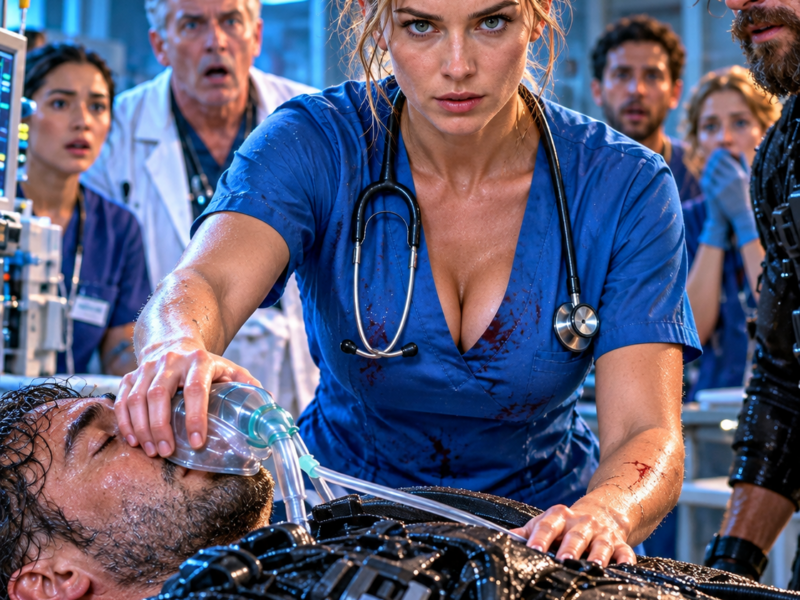
“I watched three of the best trauma doctors in Nashville fight for a Navy SEAL’s life for nearly forty minutes, but when they finally called the time of death
The words on the back of the photograph were simple.
“IF NATHAN COLE IS EVER DECLARED DEAD AGAIN, DO NOT LET THEM TAKE HIS BODY.”
Dr. Harris read them twice.
Then he looked at me.
“Emily,” he said quietly, “where did you get this?”
“I told you. I was there when the photograph was taken.”
“That doesn’t answer my question.”
“No,” I replied. “But it explains why you need to keep everyone in this room.”
Behind us, the monitor continued its flat, unbroken tone.
Nathan Cole lay beneath the trauma lights, his chest still, his skin pale beneath the blood and antiseptic.
The other nurses had stopped moving. One resident stood with a syringe in his hand, waiting for someone to tell him what to do.
Dr. Harris folded the photograph carefully.
“Everyone out except the trauma team,” he ordered.
One of the residents hesitated.
“Doctor, the patient has been pronounced—”
“I know what I pronounced.”
His voice was sharp enough to end the discussion.
The doors closed.
For the first time in eleven years, I was standing beside Nathan Cole with no one between us.
And I was terrified.
Not because I thought he was dead.
Because I knew what would happen if the wrong people discovered he wasn’t.
“Emily,” Dr. Harris said, “you have about thirty seconds to explain why I shouldn’t call security.”
I looked at Nathan’s wrist.
The black cord was still there.
Three knots.
One small metal ring.
“He isn’t supposed to be here,” I whispered.
“That’s becoming obvious.”
“Not in Nashville. Not in this hospital. Not under his real name.”
Dr. Harris glanced at the chart.
“His identification says Nathan Cole.”
“That’s the name the Navy gave him after the operation.”
“And what was his name before?”
I swallowed.
“Ethan.”
The doctor frowned.
“Ethan what?”
“Ethan Cole. He was my patient before he became a SEAL. Before the Navy reported him dead. Before I was told never to speak about him again.”
Dr. Harris looked from me to the body.
“Then why did you say he wasn’t dead?”
“Because I know the difference between a man who has no chance and a man whose body is being made to look like it has none.”
“That is not a medical explanation.”
“No,” I said. “It’s a warning.”
He studied me for a moment, then turned toward the monitor.
“Let’s start with the medical facts. He arrived in cardiac arrest. We performed prolonged resuscitation. We had no sustained response.”
“I know.”
“His pupils were unresponsive.”
“I know.”
“We had no measurable pulse.”
“I know, Michael.”
The doctor stiffened at the use of his first name.
I rarely used it.
“Then tell me what you saw.”
I leaned closer to Nathan.
“His right hand.”
“What about it?”
“When the paramedic transferred him, his thumb moved against the side of his index finger. Three times.”
“That could have been an involuntary movement.”
“It could have.”
“And the cord?”
“It’s a signal.”
I reached toward his wrist, then stopped.
“Don’t remove it.”
“Why?”
“Because the three knots aren’t decorative. They’re a message.”
Dr. Harris looked at the cord again.
“What message?”
“Wait. Watch. Remember.”
I had not said those words aloud in eleven years.
They had been part of a promise made in a small military medical facility outside Virginia Beach, during a night when the power failed and the rain came down so hard it sounded like gravel against the windows.
Nathan had tied that cord around my wrist after I told him I was afraid I would forget the people we couldn’t save.
He told me the knots were reminders.
Wait before you give up.
Watch what others overlook.
Remember who you promised to protect.
I had worn mine until the day military investigators took it from me.
Nathan had kept his.
“Emily,” Dr. Harris said, pulling me back to the present, “what exactly happened eleven years ago?”
I stared at the photograph in his hand.
“An operation went wrong.”
“That doesn’t explain why he was declared dead.”
“It was supposed to be a medical evacuation. A team had been sent to retrieve two injured men from a remote location. Nathan was one of them. The second man was a civilian interpreter named Daniel.”
“And you were there?”
“I was a military nurse assigned to the medical support unit. Nathan came in with a serious chest injury. He was conscious, but barely.”
I remembered the blood on his uniform.
The way he had tried to apologize for getting it on my hands.
The way his fingers had closed around mine when he realized he might not survive.
“He told me something before they moved him,” I continued. “He said if anyone came asking for his medical records, I should remember the three knots.”
“Who came asking?”
“Two officers. They said Nathan had died during transport. They ordered me to sign a statement confirming that he had been transferred in critical condition and had no chance of survival.”
“Did you sign it?”
“No.”
“What happened?”
“They told me I was interfering with a classified investigation. A week later, my access was revoked. A month later, I was discharged.”
Dr. Harris looked troubled.
“And you never reported this?”
“I tried. The first complaint disappeared. The second was returned without explanation. The third got me a visit from a man who knew my mother’s address.”
The room went silent.
Then Dr. Harris looked toward the door.
“Who brought him here tonight?”
“That’s what I need to find out.”
A soft electronic chirp came from the monitor.
Everyone turned.
The line was still flat, but a tiny number had appeared in the corner of the screen.
Dr. Harris moved closer.
“What is that?”
I leaned over the display.
“That’s not a heart rhythm.”
“Then what is it?”
“Respiratory impedance.”
He looked at the waveform.
The smallest movement appeared, disappeared, then appeared again.
“His chest is moving?”
“Not enough to ventilate him,” I said. “But something is changing.”
The doctor checked the airway, then looked at the ventilator.
“Disconnect the circuit for a moment.”
The respiratory therapist followed his instruction.
The waveform changed.
Dr. Harris checked the patient again, then reached for the ultrasound.
“Get me the portable machine.”
The resident moved quickly.
I watched the doctor place the probe against Nathan’s chest.
For several seconds, nobody spoke.
Then his expression changed.
“There’s activity.”
My knees almost gave way.
“What kind?”
“Not enough to call it a normal cardiac contraction. But there is movement.”
“Then he isn’t gone.”
“Don’t jump ahead.”
Dr. Harris adjusted the probe.
“Get the resuscitation cart. We’re restarting the assessment from the beginning.”
The room exploded into motion.
The doctor ordered another set of blood samples, reviewed the medication history, and asked the pharmacist to verify every drug the ambulance team had administered.
I went to the chart.
There was something wrong with it.
The medication list was almost empty.
No allergies.
No surgical history.
No previous admissions.
No emergency contact.
For a man who had served in the military for years, the absence of records was unusual.
For a man who had supposedly died eleven years earlier, it was deliberate.
I checked the ambulance paperwork.
The name of the person who had called emergency services was listed as an unknown male.
The address was a parking area near the riverfront.
But the dispatch notes contained one additional line.
“Caller requests transport to St. Vincent Medical Center only.”
I read it again.
Then I saw the time.
The call had been placed nine minutes before Nathan was found.
Someone had known exactly where he would be.
“Michael.”
Dr. Harris looked up.
“Look at this.”
He read the dispatch note.
“Why this hospital?”
I didn’t answer.
Because I knew.
Eleven years earlier, the military medical facility where I had treated Nathan had been shut down after an investigation.
The building was demolished.
The medical staff scattered.
But one person from that unit had eventually become chief of trauma surgery at St. Vincent.
Dr. Michael Harris.
He had never told me he remembered the operation.
Now I wondered how much he had known.
“Did you recognize him when he came through the doors?” I asked.
Dr. Harris didn’t respond immediately.
“I recognized the name.”
“Not the face?”
“I saw a lot of faces during my military service.”
“You served at the same facility.”
“Yes.”
“And you never told me?”
His jaw tightened.
“Because I was ordered not to.”
The room seemed to grow colder.
“By whom?”
Before he could answer, the hospital phone rang.
The charge nurse picked it up.
Her expression changed almost immediately.
“It’s security,” she said. “They have two federal agents at the entrance. They’re requesting access to the trauma bay.”
My stomach tightened.
“Tell them the patient is undergoing treatment.”
“They say they have authorization to remove him.”
Dr. Harris stepped forward.
“On what medical grounds?”
The charge nurse repeated the question.
A moment later, she covered the receiver.
“They say the patient is deceased and is part of a federal evidence transfer.”
I stared at Nathan.
They were already trying to take him.
Dr. Harris reached for the phone.
“This is Dr. Harris. No one is removing a patient from my trauma bay without proper documentation and a medical review.”
He listened.
His expression hardened.
“Then send your paperwork upstairs.”
He hung up.
“Emily, I need you to tell me everything.”
“I’ve told you what I know.”
“No. You’ve told me what happened to you. I need to know what happened to him.”
I looked at Nathan’s wrist.
“The operation wasn’t a rescue mission.”
Dr. Harris waited.
“It was supposed to be a recovery operation. The team had been sent to retrieve a man carrying information about a weapons shipment. Nathan discovered the information was false. The shipment was a cover for something else.”
“What?”
“Names. Locations. Medical identities. A list of people who had been declared dead while they were still alive.”
The doctor stared at me.
“Why would anyone do that?”
“To move people without records. To erase them from the systems that could protect them.”
“And Nathan found out?”
“He found out someone inside the operation was selling those identities.”
“Who?”
“I never knew.”
A metallic sound came from the hallway.
Then another.
The charge nurse looked toward the door.
“Security says the agents are coming up.”
Dr. Harris checked Nathan’s monitor.
“His condition is still unstable. Nobody is moving him.”
The door opened.
Two men in dark jackets entered, followed by a hospital security officer.
The first man held up a badge.
“Federal investigative service. We’re here for Nathan Cole.”
Dr. Harris stood between them and the bed.
“He is under active medical care.”
“We have an order for his transfer.”
“Then you’ll have to wait.”
The agent glanced at the monitor.
“Doctor, the patient has been pronounced dead.”
“His status is under reassessment.”
The second man looked directly at me.
I recognized his face.
Not from the hospital.
From the photograph.
He was older now, with gray at his temples, but I knew the narrow scar beneath his left ear.
He had been standing behind Nathan in the photograph, half hidden by the doorway.
He was the man who had taken my medical badge eleven years earlier.
“Emily Carter,” he said.
My mouth went dry.
“Agent Lawson.”
His eyes moved to the cord on Nathan’s wrist.
For the first time, his calm expression slipped.
“Remove that bracelet.”
“No.”
“It’s evidence.”
“It’s part of his medical belongings.”
“It’s not yours to decide.”
“Then show me the order.”
He stepped closer.
“You don’t understand what you’re involved in.”
“I understand enough to know you wanted him declared dead.”
Lawson’s partner moved toward the bed.
Dr. Harris blocked him.
“Stop right there.”
“Doctor, don’t make this difficult.”
“I’m not the one trying to remove an unstable patient from a hospital.”
Lawson looked at me again.
“You should have stayed away from this.”
I felt the old fear rise in my chest.
The memory of the officer standing outside my apartment.
The envelope on my kitchen table.
The warning about my mother.
But this time, I wasn’t alone.
And Nathan was still in front of me.
“Tell me what happened to Daniel,” I said.
Lawson went completely still.
Dr. Harris looked at me.
“Who is Daniel?”
“The interpreter from the operation. He was supposed to be evacuated with Nathan.”
Lawson’s face revealed nothing.
But his hand tightened around the folder he was carrying.
“You have no idea what you’re talking about.”
“I know Daniel’s name wasn’t on the official casualty report. I know his identity was erased. And I know Nathan refused to sign the final report.”
The second agent looked at Lawson.
“Sir?”
Lawson ignored him.
“Step away from the bed, Emily.”
“No.”
He lowered his voice.
“You have already lost eleven years of your life because of this. Don’t lose the rest.”
Before I could answer, a sound came from the monitor.
One short beep.
Then another.
Dr. Harris turned.
“Wait.”
The monitor showed a narrow, irregular electrical signal.
The resident moved closer.
“Doctor, I think—”
“Don’t touch anything.”
Another signal appeared.
Then the screen displayed a weak rhythm.
Dr. Harris checked Nathan’s pulse.
His fingers stayed at the wrist for several seconds.
Then he looked at me.
“I have a pulse.”
I couldn’t breathe.
“Are you sure?”
“It’s weak. But it’s there.”
The respiratory therapist moved immediately.
The resident called out the new readings.
Dr. Harris began directing the team, ordering continued stabilization and another assessment.
Lawson took one step forward.
“You need to stop this.”
Dr. Harris turned on him.
“Get out.”
“Doctor—”
“Now.”
For a moment, nobody moved.
Then the charge nurse called hospital security.
Two guards appeared in the doorway.
Lawson looked at Nathan one last time.
“This isn’t over.”
I met his eyes.
“It never was.”
He and his partner were escorted out.
The moment the door closed, I turned back to the bed.
Nathan’s heart was beating.
Not strongly.
Not safely.
But it was beating.
And I knew we had only won the first battle.
The next hour was a blur of procedures, blood products, imaging, and consultations.
The doctors discovered that Nathan had suffered a severe chest injury and massive blood loss. The damage was serious, but there was something else complicating the picture.
His body had been exposed to a combination of medications that made his neurological and cardiovascular responses difficult to interpret.
Dr. Harris studied the laboratory results.
“Some of these levels don’t make sense.”
“Could they have been given before the ambulance arrived?” I asked.
“Possibly. But we need to identify exactly what he received.”
The pharmacist reviewed the results with the toxicology team.
I stayed near Nathan, watching the monitor.
His pulse remained weak.
Every few minutes, I checked the cord.
Three knots.
The tiny ring.
Wait. Watch. Remember.
At 2:18 a.m., Dr. Harris came to stand beside me.
“We need to talk about that photograph.”
I looked at him.
“You said you recognized the name.”
“I did.”
“And you served at the facility.”
He nodded.
“I was a young surgeon then. I was assigned to the medical evacuation unit. I treated Nathan after the operation.”
“Then you know he wasn’t dead.”
“I know he was alive when he left the facility.”
“Where did they take him?”
Dr. Harris looked toward the closed doors.
“To a secure medical transport unit. I was told he was being moved to a military hospital.”
“But he never arrived.”
“No.”
“Why didn’t you report it?”
His eyes dropped.
“Because I was told he had died during transport. I was shown a signed report. I believed it.”
I stared at him.
“You believed a piece of paper over the patient you had treated?”
“I was young, Emily. And I was afraid.”
The honesty in his voice hurt more than an excuse would have.
“I signed the medical transfer summary,” he continued. “I didn’t sign the death certificate. But my report was used to support the claim that he had died.”
“And you never questioned it?”
“I did. The following morning, I requested the transport records. They told me the file had been classified. When I pushed, I was transferred.”
I remembered the date on the photograph.
The same week.
“Why did you come to St. Vincent?”
“Because I thought changing hospitals would let me forget.”
“Did it?”
He shook his head.
“No.”
I looked at Nathan.
“Then help me make sure he doesn’t disappear again.”
Dr. Harris nodded.
“I will.”
At 3:06 a.m., Nathan’s condition stabilized enough for the team to obtain a clearer picture of his injuries.
The damage to his chest required surgery.
The surgeon explained the risks carefully. Nathan had lost too much blood, and his body had been under extreme stress.
There were no guarantees.
I signed nothing. I wasn’t family, and I wasn’t authorized to make decisions for him.
But I stayed.
Before the surgical team moved him, I leaned close to his ear.
“You made it this far,” I whispered. “Don’t you dare stop now.”
His fingers moved.
Barely.
But I felt it.
Three small taps against the sheet.
I froze.
One.
Two.
Three.
I looked at the cord.
Then at his hand.
He was answering.
“Wait,” I whispered.
The surgical team wheeled him away.
For the first time that night, I allowed myself to cry.
I cried in the empty hallway, with my back against the wall and my hands shaking.
I cried for the man who had been declared dead.
For the years I had spent believing I had failed him.
And for the young nurse I had been, standing in a military hospital while powerful people told her that the truth was too dangerous to survive.
Dr. Harris found me there.
“He’s in surgery.”
“I know.”
“The next few hours will be difficult.”
“I know.”
He sat beside me.
After a long silence, he said, “There was something else in that old file.”
I turned toward him.
“What?”
“The name Daniel.”
My heart began to pound.
“What about him?”
“After the operation, I was told the interpreter had never been part of the evacuation. But I remembered treating another patient that night. A man with a head injury and a broken arm.”
“Daniel.”
“I think so.”
“Was he alive?”
“He was when I saw him.”
“Where did they take him?”
Dr. Harris rubbed his forehead.
“I don’t know. But I remember a nurse asking me to record his blood type and a distinctive scar on his shoulder.”
“Who was the nurse?”
He looked at me.
“You.”
I felt the hallway tilt.
I had treated so many people during that operation. Bloodied men, frightened civilians, soldiers who could barely speak.
But suddenly I remembered a young man gripping my sleeve.
His voice had been weak.
He had asked me to tell Nathan he was sorry.
I had promised.
Then the power failed, the alarms sounded, and the medical team was ordered to evacuate.
I had never delivered the message.
“Daniel was alive,” I whispered.
Dr. Harris nodded.
“And if the records were altered, he may still be alive.”
At 5:40 a.m., a hospital administrator arrived with two legal representatives.
They wanted to know why federal agents had been denied access to a patient.
Dr. Harris explained that Nathan had regained circulation and was receiving treatment.
The administrator asked for documentation.
Dr. Harris gave it to him.
Then he handed over a copy of the original dispatch notes, the medication discrepancies, and the photograph.
I watched the administrator’s face change as he read the words on the back.
“Who wrote this?”
“I did,” I said.
He looked at me.
“You wrote the warning?”
“No. Nathan did.”
I took the photograph from the table and pointed to the date.
Eleven years earlier, Nathan had given it to me before the medical transport arrived.
He had asked me to keep it.
I had hidden it in my locker, then carried it with me when I left the military.
The words on the back were not a threat.
They were instructions.
“IF NATHAN COLE IS EVER DECLARED DEAD AGAIN, DO NOT LET THEM TAKE HIS BODY.”
The administrator read it once more.
“Why would he write that?”
“Because he knew they had done it before.”
The legal representatives exchanged a look.
One of them asked Dr. Harris whether he had retained any copies of the old medical records.
He hesitated.
Then he said, “I might have.”
The administrator looked at him sharply.
“Doctor?”
“I kept a private copy of the transfer summary. I wasn’t supposed to, but something about the report bothered me.”
“Where is it?”
“At home.”
“Can you retrieve it?”
“I can.”
The administrator warned him not to leave the hospital alone.
Dr. Harris agreed.
A few minutes later, he asked me to walk with him to the staff office.
Once we were out of earshot, he spoke quietly.
“I didn’t tell them everything.”
“What did you leave out?”
“The transfer summary listed a destination hospital. It was not a military hospital.”
“Where?”
“A private medical center outside the city. It had a contract with a federal security program.”
I stared at him.
“Was it real?”
“Yes. But it closed several years ago.”
“Then the records—”
“May have been moved.”
I felt the old fear returning.
“Michael, if those records exist, Lawson will know.”
“Then we need to find them before he does.”
At 7:15 a.m., the surgeon came out.
Nathan had survived the operation.
He was still critical, but the bleeding had been controlled, and his heart was maintaining a stable rhythm with support.
I closed my eyes.
For eleven years, I had imagined what I would say if I ever saw him again.
Now I couldn’t think of a single thing.
“Can I see him?”
The surgeon nodded.
“Briefly. He’s sedated and will remain in intensive care.”
I walked into the room.
Nathan looked smaller beneath the blankets and wires.
The cord was still on his wrist.
I pulled a chair beside him.
“You always did have terrible timing,” I whispered.
I waited.
Nothing.
Then I took the photograph from my pocket and placed it on the bedside table.
“I kept it.”
My voice cracked.
“I kept every piece of it.”
I rested my hand beside his.
“You told me to remember. I did.”
His fingers twitched.
I leaned closer.
“I’m here.”
His hand moved again.
Three taps.
I covered my mouth.
Then a single tear slid down his temple.
I didn’t know whether he could hear me.
I didn’t know what he remembered.
But I knew he was still fighting.
And this time, he wasn’t fighting alone.
The investigation began before noon.
Hospital security preserved the entrance footage. The ambulance crew provided statements. The toxicology team documented the unusual medication findings.
The two agents who had arrived at the trauma bay were identified as working under a federal investigative office, but their authorization to remove Nathan was incomplete.
Their supervisor was contacted.
Lawson stopped answering his phone.
By late afternoon, Dr. Harris returned with a folder.
Inside was a copy of the transfer summary.
It listed Nathan’s condition as stable at the time of departure.
That was impossible.
Nathan had been unconscious, critically injured, and dependent on medical support.
The document also contained a signature from a physician who had never worked at the facility.
At the bottom was a second name.
Daniel Mercer.
My hands began to shake.
“That’s him.”
Dr. Harris nodded.
“His name was included as a separate patient. The official report said he died before transport.”
“But you treated him.”
“I did.”
The folder contained a final page.
A handwritten note, dated three days after the operation, read:
“Both subjects transferred under alternate identities. Original records sealed. No family notification.”
I read it twice.
“Both subjects,” I whispered.
“Nathan and Daniel.”
The room was silent.
Then I noticed something written in the margin.
A short string of numbers.
I recognized the format.
It was a storage reference from the old medical facility.
“Michael, this isn’t just a transfer number.”
“What is it?”
“It’s an archive location.”
He looked at the page.
“Can we access it?”
“Not through the hospital.”
“Then where?”
I thought about the three knots.
Wait.
Watch.
Remember.
And I finally understood why Nathan had given me the photograph.
He had not been asking me to remember only him.
He had been asking me to remember where the truth was kept.
Eleven years earlier, the medical facility had used a small off-site records building. Most of the records had been moved when the facility closed, but a storage annex had remained under private management.
The number on the page matched its archive system.
We contacted the hospital’s legal department and an independent investigator.
No one was allowed to enter the building without proper authorization.
That evening, an investigator located the current property manager and confirmed that the archive had not been destroyed.
A sealed box bearing the old reference number was found.
Inside were copies of medical transfer orders, handwritten medication records, and a list of alternate identities.
Nathan’s name appeared on the first page.
Daniel’s appeared on the second.
The third page contained the name of the man who had approved the transfer.
Colonel Richard Lawson.
The same man who had come to the trauma bay.
The documents showed that Nathan and Daniel had been moved to the private medical center after the operation. Their identities had been changed to protect them while an investigation into the stolen information was conducted.
But the protection had become a prison.
Someone had used the secret program to keep them off official records.
Nathan had discovered the truth and tried to expose it.
Daniel had disappeared.
Nathan had been reported dead.
The paperwork had been altered to make both disappearances look legitimate.
There was no evidence that the entire military operation had been designed to erase them from the beginning. But there was enough to show that Lawson had used the confusion afterward to hide what had happened.
And now, eleven years later, he had tried to finish the job.
The investigator found another detail in the archive.
A handwritten message addressed to me.
It had been placed inside the same file as Nathan’s transfer order.
“Emily Carter knows the original patient history. Do not allow her to access the archive.”
I stared at the sentence.
For eleven years, I had believed I was forgotten.
I had not been forgotten.
I had been watched.
The investigator asked whether I wanted to make a formal statement.
I said yes.
I told them everything.
About the photograph.
The cord.
The men who came to my apartment.
The report I refused to sign.
And the night Nathan had asked me to remember.
The statement took hours.
By the time I finished, the sun had gone down.
I returned to the intensive care unit.
Nathan was still there.
His condition had improved slightly. The doctors had reduced some of the support, but he remained unconscious.
I sat beside him and placed my hand near his.
“I found the records,” I said.
“Daniel’s name is there.”
I paused.
“They know what happened.”
For a long time, there was no response.
Then his fingers moved.
Three taps.
I smiled through tears.
“Wait. Watch. Remember.”
I stayed until the night nurse asked me to get some rest.
But before I left, I noticed something I hadn’t seen earlier.
A small piece of paper had been tucked beneath the edge of Nathan’s identification band.
I carefully pulled it free.
It was folded twice.
Inside was a single sentence written in uneven handwriting.
“DANIEL IS ALIVE. FIND HIS SISTER.”
I read it again.
Then I looked at Nathan.
He had known.
Even while he was being moved, even while he was barely conscious, he had found a way to leave the message.
The next morning, the investigator contacted a woman named Sarah Mercer.
She was Daniel’s younger sister.
For years, she had been told that her brother died during an overseas operation. She had never received his body. She had never received a proper explanation.
When she heard that new records had been found, she agreed to meet us.
She arrived at the hospital carrying a faded photograph of a young man with dark hair and a crooked smile.
I recognized him immediately.
Daniel.
Sarah sat across from me in a small consultation room.
“Was he alive?” she asked.
I took a breath.
“When I treated him, he was.”
Her eyes filled.
“Then why did they tell me he was dead?”
I didn’t have an answer that could make eleven years disappear.
“I’m sorry,” I said.
She pressed the photograph against her chest.
“Did he know I was looking for him?”
“I don’t know. But I believe Nathan tried to protect him.”
Sarah wiped her face.
“Can you help me find him?”
I looked at the note.
“I’m going to try.”
The investigator began following the records.
A second identity led to a medical facility in another state. The facility had closed, but one former employee remembered a patient matching Daniel’s description.
He had been transferred again under a different name.
The trail was incomplete, but it was real.
For the first time, Sarah had something more than a death certificate.
She had a chance.
Three days after the operation, Nathan woke up.
I was checking his monitor when I noticed his eyes move beneath his eyelids.
Then they opened.
At first, he looked confused.
The room.
The equipment.
The lights.
Then his gaze found me.
He stared for several seconds.
“Emily?”
His voice was barely audible.
I leaned closer.
“I’m here.”
He tried to speak again, but the words caught in his throat.
“Don’t talk yet.”
He closed his eyes, exhausted.
I pressed the call button for the physician.
When Dr. Harris arrived, Nathan was awake enough to follow simple instructions. His condition was still serious, but he was responding.
The doctor completed his assessment and told us he would need a long recovery.
After everyone left, I pulled the chair closer.
“You scared me.”
Nathan looked at the ceiling.
“I know.”
“You were declared dead.”
“I noticed.”
Despite everything, I laughed.
It was a small, broken sound.
Then I started crying.
Nathan turned his head slightly.
“Hey.”
I wiped my face.
“Don’t.”
“Don’t what?”
“Don’t act like this is normal.”
His expression softened.
“I wouldn’t know how.”
We sat quietly.
Finally, I asked the question that had haunted me for eleven years.
“Why didn’t you come back?”
Nathan closed his eyes.
“I tried.”
“What happened?”
“They told me the investigation was still active. They said if I contacted anyone, the people responsible would come after you and Daniel.”
“You could have sent a message.”
“I did.”
“Nothing ever reached me.”
“I know.”
He took a shallow breath.
“They moved me under another identity. Then they told me the operation had been compromised. I was supposed to stay hidden until the evidence was secure.”
“Was it?”
“No.”
His eyes filled with exhaustion.
“Lawson controlled the records. He controlled the transfers. Every time I got close to exposing him, someone disappeared.”
“And Daniel?”
“I thought he was dead.”
I showed him the note.
His eyes widened.
“Where did you get that?”
“Your wristband.”
He stared at the paper for a long moment.
“I thought he made it.”
“Who?”
“Daniel. Before we were separated, he told me he had a sister. He said if anything happened, I had to find a way to tell her.”
I took his hand.
“Sarah knows.”
Nathan’s face changed.
“She’s alive?”
“Yes.”
He closed his eyes.
For the first time since he had arrived at St. Vincent, his expression looked peaceful.
“Thank you.”
I shook my head.
“You don’t owe me anything.”
“I owe you eleven years.”
I looked down at our hands.
“Then start by staying alive.”
A week later, the federal investigation announced that several officials had been suspended pending review. Lawson was taken into custody after investigators obtained the archived records and additional evidence of falsified transfers and obstruction.
The case was larger than any of us had understood.
There were other names.
Other people who had been moved under alternate identities.
Some had been protected.
Others had been abandoned.
The investigation would take months, perhaps years.
But the records were no longer hidden.
And Nathan Cole was no longer a dead man on paper.
Sarah received confirmation that Daniel was alive and living under another identity. The investigator arranged a secure contact through the legal team.
I wasn’t present when she heard his voice for the first time.
But she called me afterward.
She couldn’t speak for several seconds.
Then she whispered, “He remembers me.”
I sat on the edge of my bed and cried.
Not because everything had been fixed.
It hadn’t.
There were years no investigation could return.
There were people who would never receive answers.
But one family had finally been given the truth.
And one man had come back from a death that had never been real.
Nathan spent several more weeks in the hospital.
His recovery was slow.
Some days he was strong enough to sit in a chair. Other days he could barely keep his eyes open.
He had nightmares.
Sometimes he woke convinced he was back in the transport vehicle.
Sometimes he asked whether the doors were locked.
I never told him he had nothing to fear.
He had too much reason to be afraid.
Instead, I reminded him where he was.
I told him the date.
I told him the name of the hospital.
I told him that Sarah had spoken to Daniel.
And every time he asked whether anyone was coming to take him away, I gave him the same answer.
“Not without the truth coming with you.”
On the morning he was transferred to rehabilitation, I brought the old photograph.
He looked at it for a long time.
“We were young,” he said.
“We were tired.”
“You were stubborn.”
“You were a terrible patient.”
He smiled.
Then he touched the three knots on the cord.
“You kept it.”
“I kept mine too.”
I reached into my pocket and showed him the matching cord I had recovered from my old belongings.
The black threads were faded.
The metal ring was scratched.
But the three knots were still there.
Nathan looked at it.
“Wait. Watch. Remember.”
I nodded.
“I finally understand.”
“What?”
“You weren’t asking me to wait for you to come back.”
He looked at me.
“You were asking me not to let them erase what happened.”
His expression softened.
“Both can be true.”
I sat beside him.
For eleven years, I had believed that night at the military facility was the worst moment of my life.
I had been wrong.
The worst part was everything that came afterward.
The silence.
The doubt.
The way people looked at me when I refused to accept the official story.
The years I spent wondering whether I had imagined the movement in Nathan’s hand, whether the photograph meant what I thought it meant, whether I had been wrong to keep fighting.
But now I knew.
The truth had survived.
Not because I was fearless.
Not because I had some special ability to bring a man back from the dead.
I was a nurse.
I had followed the evidence in front of me.
I had refused to ignore a detail that didn’t make sense.
And when everyone else was ready to close the file, I had asked them to look again.
Months later, Nathan returned to St. Vincent for a follow-up appointment.
He walked slowly, still carrying the effects of his injuries, but he was alive.
Dr. Harris met us in the hallway.
For a moment, the two men simply looked at each other.
Then Nathan extended his hand.
“Doctor.”
Dr. Harris shook it.
“I’m glad you’re here.”
“So am I.”
The doctor glanced at me.
“I owe both of you an apology.”
Nathan nodded.
“Then help make sure it doesn’t happen again.”
“I intend to.”
Before Nathan left, he stopped beside the nurses’ station.
He placed a small envelope on the counter.
Inside was a new black cord.
Three knots.
One metal ring.
Beneath it was a note.
“For the people who remember.”
I kept it in my locker.
Not as a reminder of a miracle.
As a reminder of the responsibility that comes with being the last person willing to ask one more question.
People sometimes ask me whether I believe Nathan was dead that night.
I tell them the truth.
His heart stopped.
His body was failing.
The doctors had exhausted the treatments they could reasonably attempt, and the declaration was made based on what they believed they were seeing.
But the story didn’t end there.
There were details no one had understood.
There were records someone had altered.
There was a man who had been hidden behind a false identity, and a nurse who recognized a small piece of cord on his wrist.
I don’t blame the doctors for trying everything they knew.
I don’t blame the nurses who followed the orders they were given.
But I will never forget how close we came to letting a piece of paperwork become the final word.
Nathan was not saved by a secret procedure.
He was saved because the team kept reassessing him, because the medical evidence changed, and because someone noticed that the story surrounding him didn’t add up.
The secret I revealed that night wasn’t a miracle cure.
It was the truth about who he was, what had happened to him, and why someone wanted him declared dead.
And sometimes, in a hospital, the most important thing a nurse can say is not another medication or another procedure.
Sometimes it is simply:
“Wait. Look again.”
THe end.









